CHAPTER SEVENTEEN
Discussion Questions
1. What are some benefits to improved sustainability of a supply chain?
2. What are some challenges that limit the effort put in by supply chains to improve
sustainability?
3. Describe the “tragedy of the commons” in the context of supply chain
sustainability. What are some “mutually coercive” mechanisms that could be
implemented to encourage supply chain sustainability?
Every company and supply chain faces the challenge of the tragedy of the
commons as it operates in a global environment. They must compete against
4. What are some problems with firms reporting their sustainability performance
based on metrics that do not consider their extended supply chain?
A major challenge relates to the scope over which a supply chain measures in
regards to the following four categories:
The Greenhouse Gas Protocol defines three scope levels which companies should
report metrics:
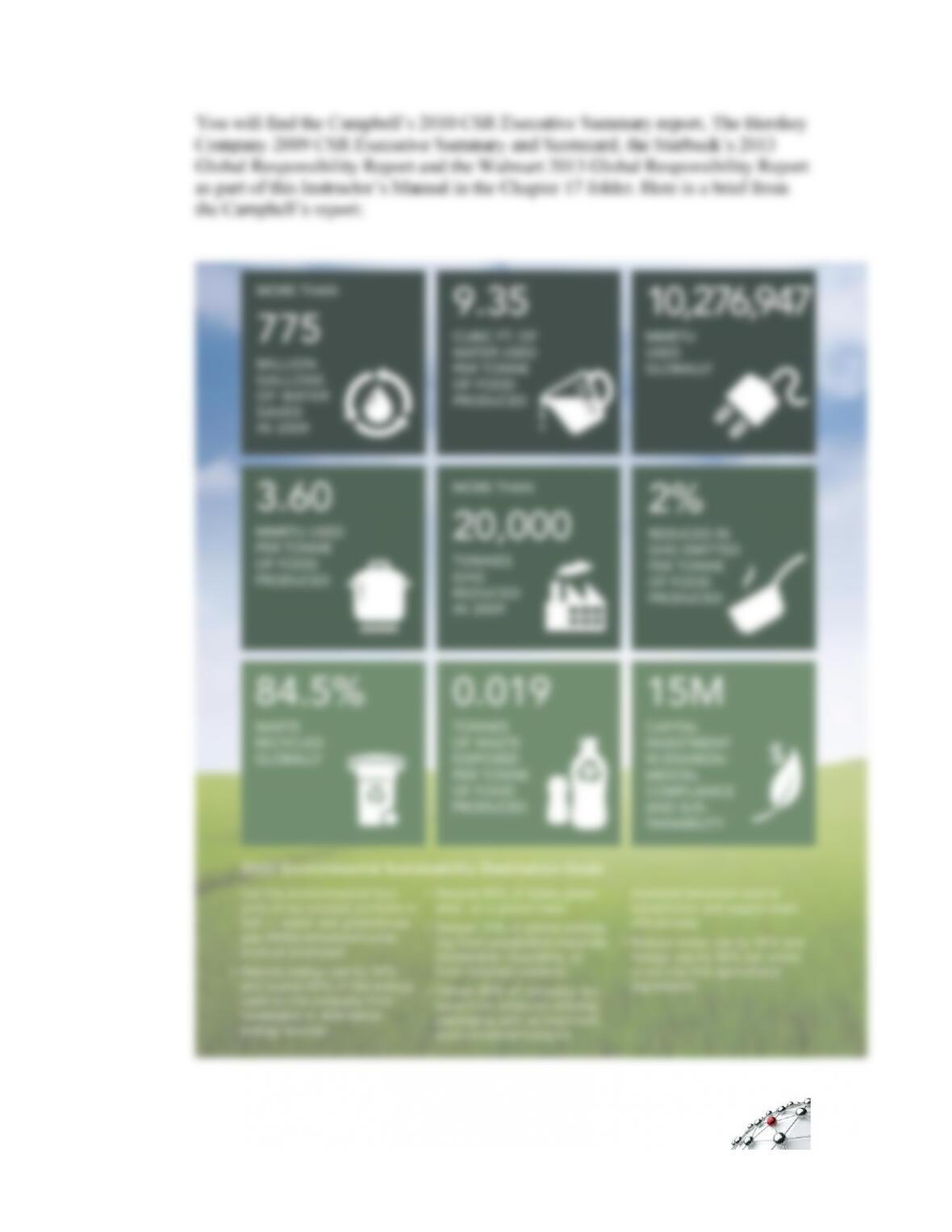
5. Study the CSR reports for a couple of firms. Identify actions across a few supply
chain drivers that have improved sustainability. Which areas has the company
found challenging to improve?
Copyright © 2019 Pearson Education, Inc.
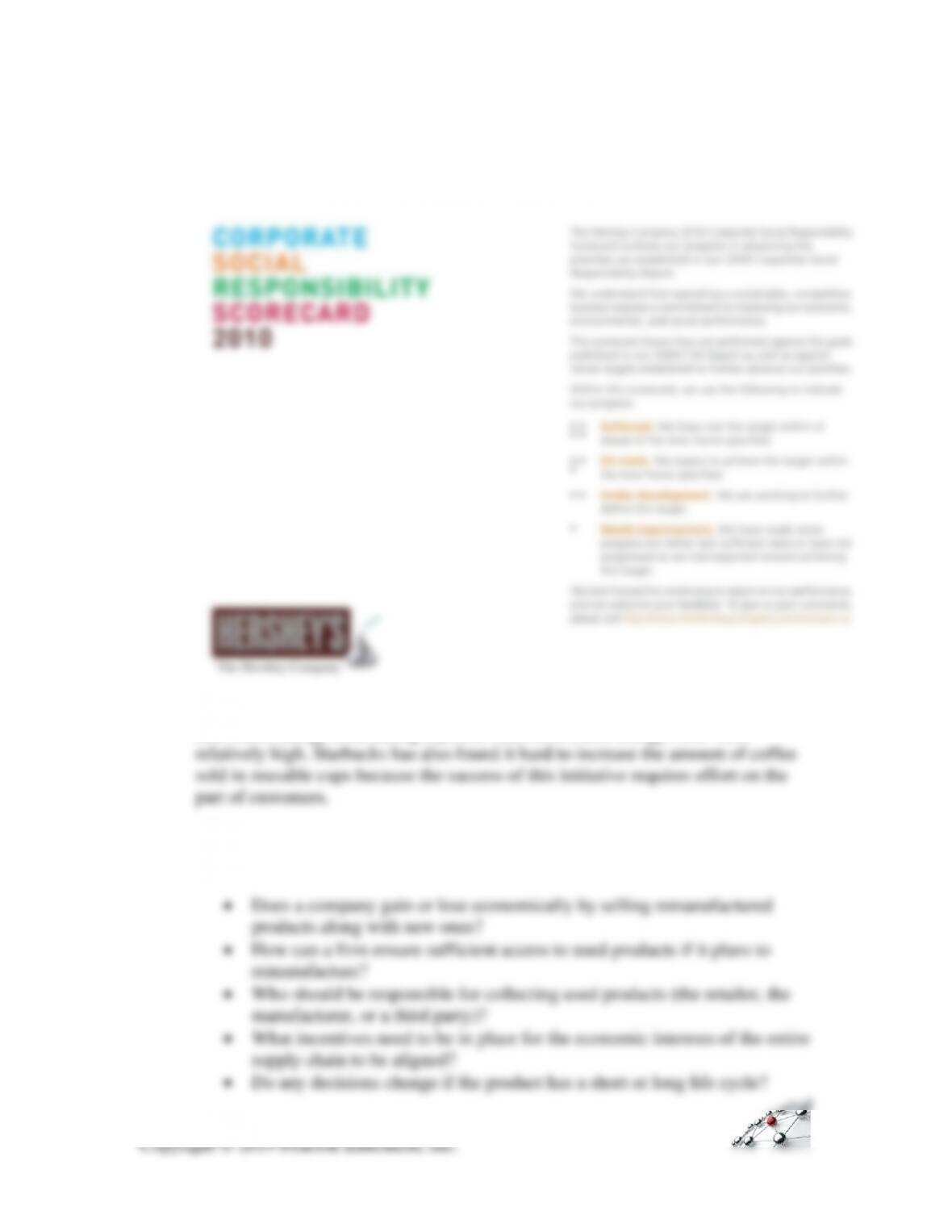
In addition, you will find the Hershey Company 2009 CSR Executive Summary
and their Scorecard results for 2010 as previewed below:
Both Starbucks and Walmart found it difficult to increase the fraction of
renewable energy used during a period when renewable energy costs were
6. Discuss some reasons why we do not see more recycling or remanufacturing of
products.
• What incentives need to be in place for suppliers to design and produce
durable products?
Some reasons that we do not see more recycling or remanufacturing:
Remanufacturing is a process where a particular product is taken apart,
cleaned, repaired, and then reassembled to be used again. Many different types
MISCONCEPTIONS ABOUT REMANUFACTURING
Often, the process of remanufacturing gets confused with other similar
activities. Rebuilt and recharged products are very close to remanufactured
In addition, a remanufactured product should not be confused with a repaired
one. Usually when a product is repaired, the whole remanufacturing process is
disregarded and only defective parts are investigated and replaced. Likewise,
restored and reconditioned products are ones that are brought back to their
original condition, but these changes are usually cosmetic and apply to things
REMANUFACTURING VS. RECYCLING
Although remanufacturing and recycling are two different things, many
environmental groups are embracing the concept of remanufacturing over
recycling because it cuts down on the use of energy and resources used for
processing. While recycled goods are consumed, then returned to their original
of the new car. Value added is embodied in the product. Recycling destroys
that value added, reducing a product to its elemental value—its recoverable
raw material constituents. Further, recycling requires added labor, energy, and
Aside from environmental benefits, there are many other reasons why
remanufactured goods exist. Like many good business decisions,
remanufacturing simply saves money by prolonging the economic life of a
product. A small business with a tight budget can save money by using
remanufactured product is not durable as a brand new one and may require
additional maintenance in the future. This is a serious issue that must be
addressed before a small business decides whether it is worth it to pursue
remanufacturing as a vocation.
time. In addition, management must work with their own employees so that
they understand the many benefits of the remanufacturing process. Many
employees may be hesitant to offer remanufactured goods to their customers
for fear of potential prejudices regarding the performance of the product.
There are many legal and regulatory issues that affect the remanufacturing
industry that businesses must be aware of. Intellectual property and anti-trust
matters; federal, state and local recycling procedures; and government
economic incentives are just a few of these issues. The Remanufacturing
7. The European Union emission trading scheme saw a lot of price volatility in
would be if no banking is allowed). As a result, prices are less volatile with
banking of allowances.
In their paper presented to the German Economic Institute for Research
entitled:

The analysis did not assess the emissions cap post 2020 and how it impacts on
expectations about future scarcity. We also did not discuss the details of the
implementation of any of the policy options, for early intervention in EU ETS.