Teaching Note – Same-Day Delivery
The Future of Same-Day Delivery: Same as the
Past?
Case Synopsis
In 2012, several retailers, including Amazon and Walmart, experimented with same-day delivery.
Home delivery of pizzas had been a very successful model in the United States and had been copied all
over the world. In contrast, home delivery attempts by companies such as Kozmo and Urbanfetch had failed
and both companies went bankrupt. The goal of this case is to build a framework that helps students identify
the factors that influence the success or failure of home delivery models.
Learning Objectives
Suggested Uses
The case is appropriate for undergraduate, graduate, and executive education students. It will be
effective in supply chain management courses and can be positioned after transportation.
Discussion Questions/Student Assignment
1. Why has same-day delivery of pizza been successful, whereas the practice has failed in other settings
(e.g., Kozmo.com)?
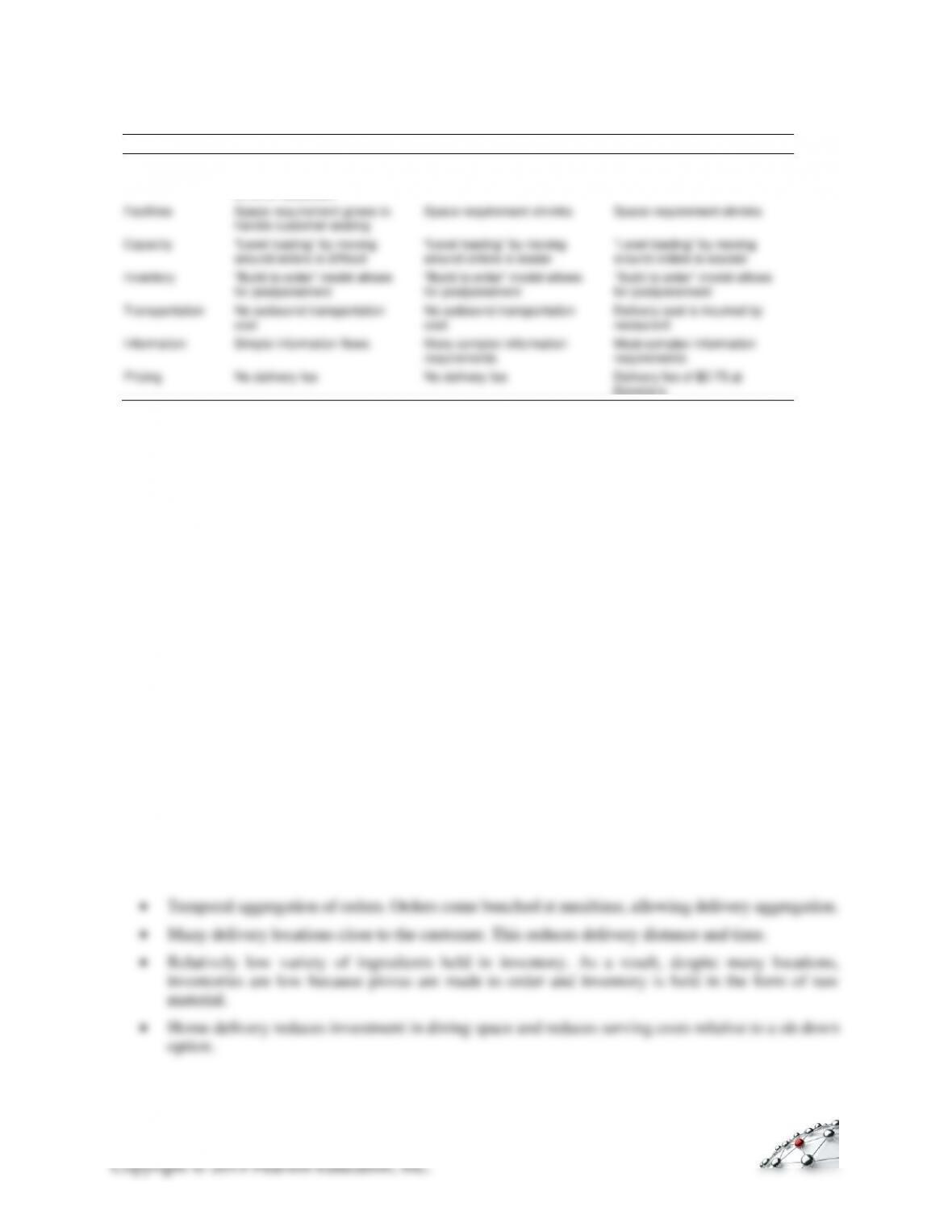
Table TN1:
Driver
Sit-Down Dining
Customer Pickup
Home Delivery
Service
Food served as soon as
cooked but customers have to
drive to restaurant
Driving similar to sit-down
dining with service delay
No driving by customer but
there is service delay
Facilities
Space requirement grows to
handle customer seating
Space requirement shrinks
Space requirement shrinks
Capacity
“Level loading” by moving
around orders is difficult
“Level loading” by moving
around orders is easier
“Level loading” by moving
around orders is easiest
Inventory
“Build to order” model allows
for postponement
“Build to order” model allows
for postponement
“Build to order” model allows
for postponement
Transportation
No outbound transportation
cost
No outbound transportation
cost
Delivery cost is incurred by
restaurant
Information
Simple information flows
More complex information
requirements
Most complex information
requirements
Pricing
No delivery fee
No delivery fee
Delivery fee of $2.75 at
Domino’s
Home delivery allows a pizza restaurant to increase its revenue per square foot because it can reduce
the space allocated to sit-down customers. Home delivery (with a queue of orders) allows the restaurant an
opportunity to batch some orders to get better throughput from its kitchen facilities. The downside, of
course, is that home delivery increases outbound transportation costs and requires more information details
than an in-store order.
Pizza orders also demonstrate “temporal aggregation” in that most customers will place pizza orders
around mealtimes. This potentially offers the restaurant an opportunity to bunch nearby deliveries together.
Pizza restaurants are located close to the customers they serve through home delivery. This reduces the
driving distance on the outbound side. Pricing seems to indicate that the tradeoff of all these factors still
results in a cost increase, and thus, a delivery fee is added.
If we look at the tradeoff for pizza delivery, the presence of many facilities reduces the outbound
delivery distance but has the potential to increase facility and inventory costs. Pizza restaurants reduce
inventory costs by storing ingredients rather than finished product (making finished product only after a
customer order) thus reducing the variety held. They reduce facility costs through home delivery by
reducing the space requirements and getting greater revenue per square foot. If orders are placed online, the
online channel allows them to potentially reduce the effort for order taking while ensuring accuracy of the
order.
2. Under what conditions can same-day delivery be offered at low cost?
Same-day delivery can be offered at low cost if the fundamental characteristics found at pizza delivery,
Jimmy John’s and others, can be replicated. These characteristics include:
Copyright © 2019 Pearson Education, Inc.
• Pizza delivery uses vehicles belonging to the employee. These vehicles would otherwise have been
idle (parked in the lot). Thus, the use of an underutilized transportation asset reduces the investment
required for same-day delivery.
The biggest challenge to offering free home delivery of pizza is the relatively low value of an order
placed at a restaurant like Domino’s.
3. What are the characteristics of businesses that can succeed with same-day delivery? Can Amazon,
Walmart, or Instacart succeed with same-day delivery? Who is likely to do better? Why?
TN2).
Table TN2:
Amazon
Walmart
Variety
Higher
Lower
Number of facilities
Lower
Higher
Potential for postponement
Low
Low
Does home delivery reduce footprint?
Not at a DC
Potentially allows better use
of back room at a store
The fewer facilities in the Amazon network increases the average delivery distance. The greater variety
will hurt inventory if Amazon increases the number of facilities. Home delivery does not reduce the pick–
pack operation at Amazon and adds a pick-pack at Walmart. If same-day delivery is based on a cutoff time
With Amazon’s recent acquisition of Whole Foods, Amazon may become more effective for home
delivery of groceries, as well as semi-cooked (in direct competition with Blue Apron and the like) and fully
cooked meals.
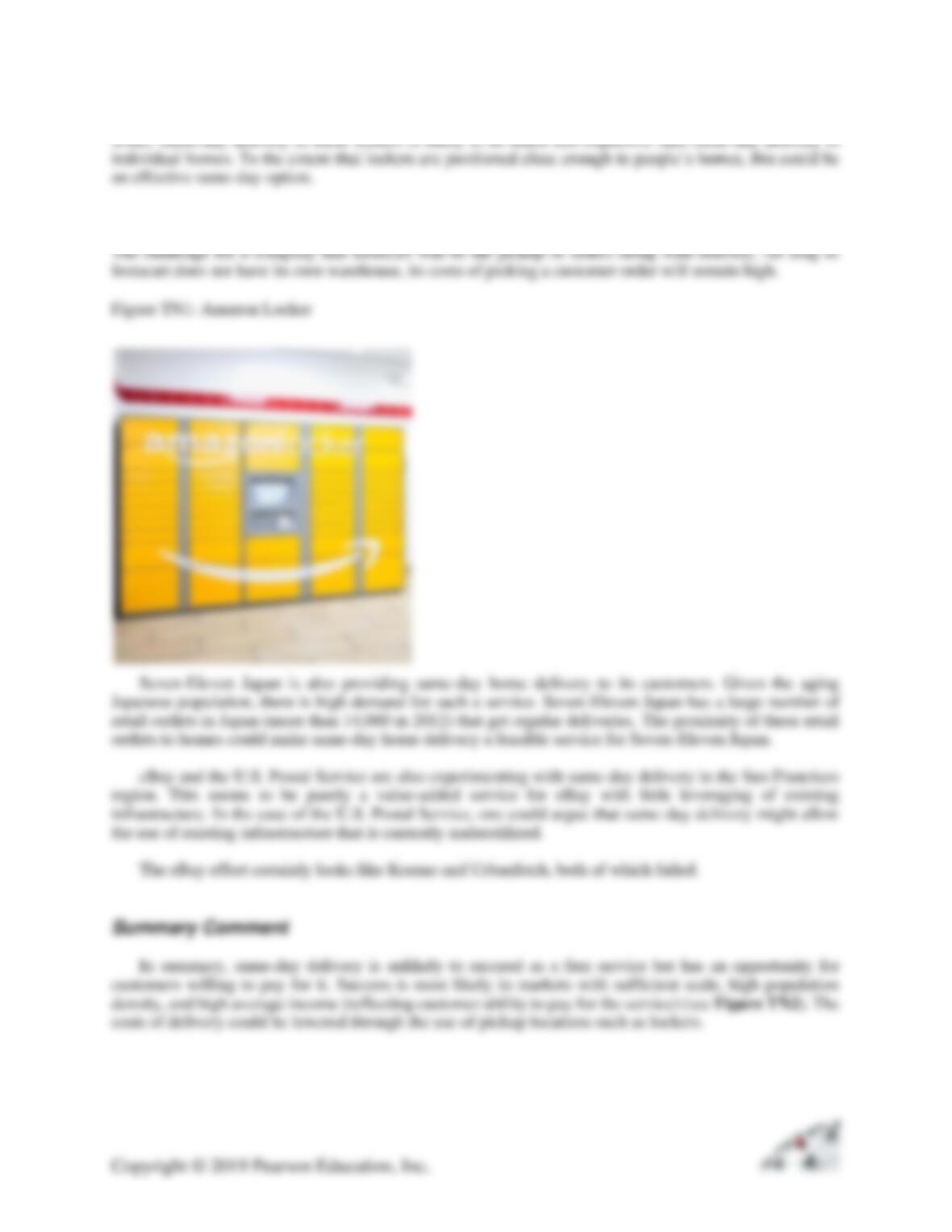
Amazon is the use of lockers positioned at physical locations such as Seven-Eleven stores (see Figure
There will always be a convenience-seeking set of customers who value responsiveness in delivery and
are willing to pay for this service. For this set of customers, a third party such as Instacart may succeed.
Copyright © 2019 Pearson Education, Inc.
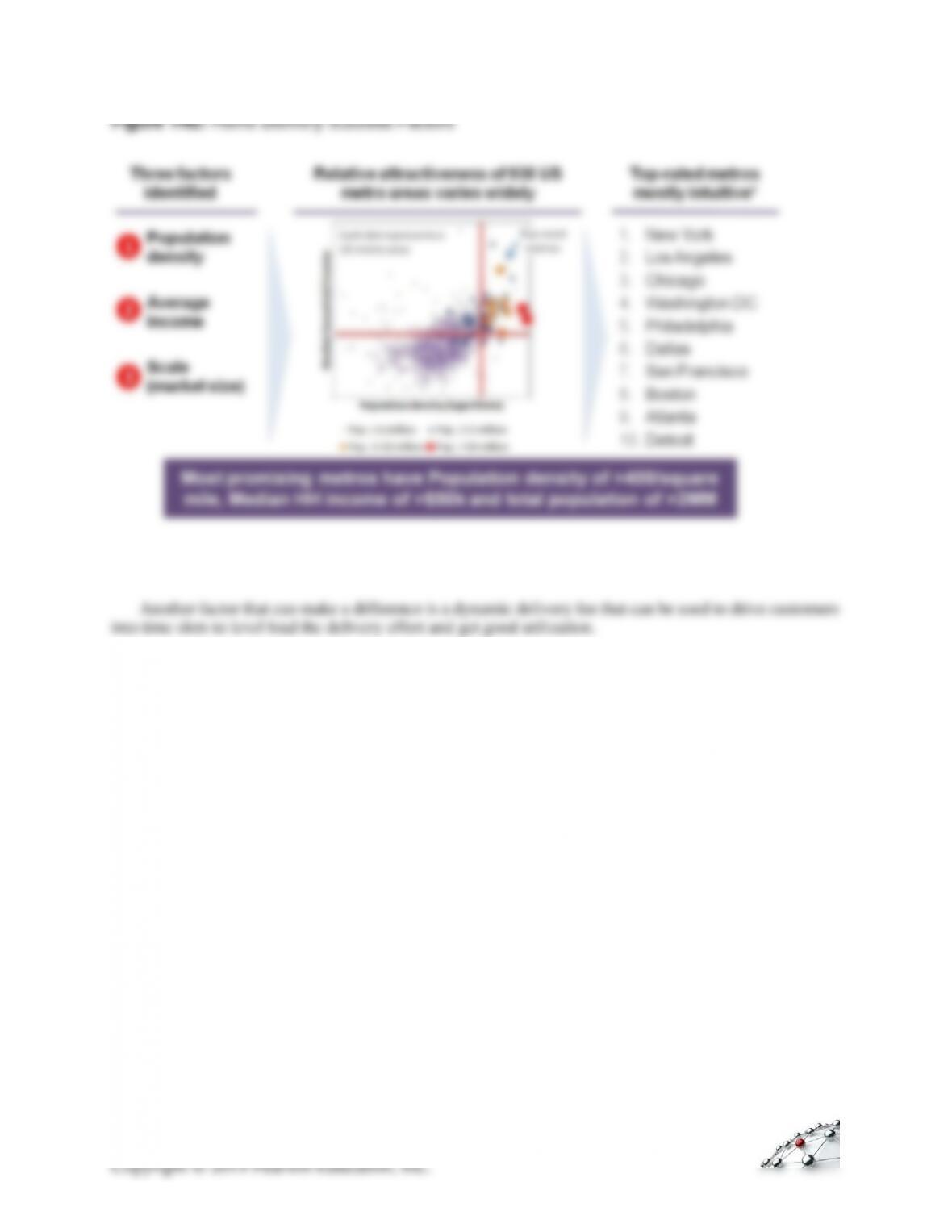
Figure TN2: Home Delivery Success Factors
Another factor that can make a difference is a dynamic delivery fee that can be used to drive customers
into time slots to level load the delivery effort and get good utilization.