Teaching Note for to Savor or to Groupon
1. Assume a variable cost of $10 per table with an average spending of $60 per table. With the
daily deal ($60 for $30 coupon), Groupon provides Mr. Chang with a revenue of $15 per table.
The analysis provided in the New York Times blog indicates that Mr. Chang makes money ($5 per
table) through the daily deal (rather than incurring advertising expense). Do you think the
analysis has included all aspects that need to be considered? Should Mr. Chang go ahead with
the daily deal?
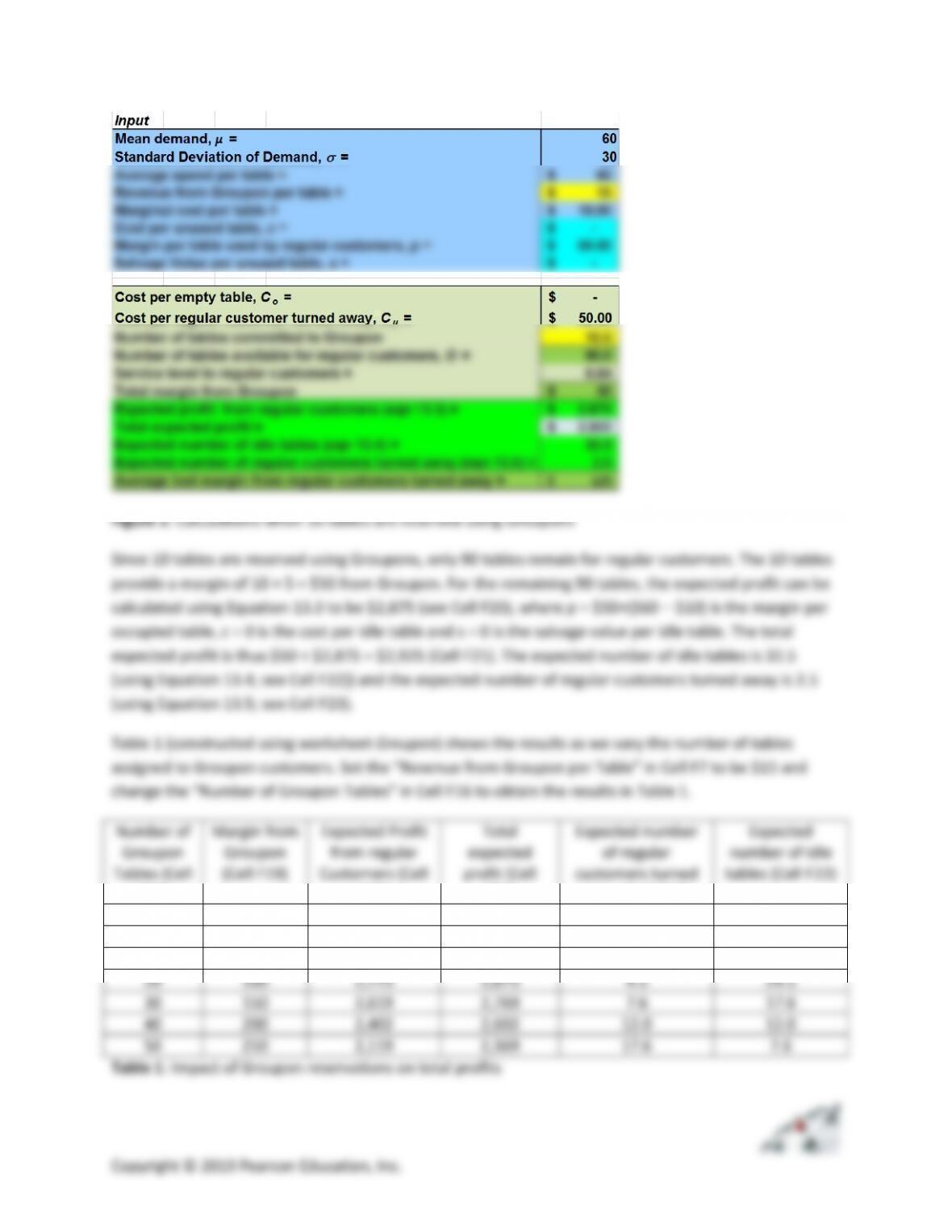
Figure 1: Calculations when 10 tables are reserved using Groupons
Since 10 tables are reserved using Groupons, only 90 tables remain for regular customers. The 10 tables
provide a margin of 10 × 5 = $50 from Groupon. For the remaining 90 tables, the expected profit can be
calculated using Equation 13.3 to be $2,875 (see Cell F20), where p = $50×($60 − $10) is the margin per
occupied table, c = 0 is the cost per idle table and s = 0 is the salvage value per idle table. The total
expected profit is thus $50 + $2,875 = $2,925 (Cell F21). The expected number of idle tables is 32.5
(using Equation 13.4; see Cell F22)) and the expected number of regular customers turned away is 2.5
(using Equation 13.5; see Cell F23).
Table 1 (constructed using worksheet Groupon) shows the results as we vary the number of tables
assigned to Groupon customers. Set the “Revenue from Groupon per Table” in Cell F7 to be $15 and
change the “Number of Groupon Tables” in Cell F16 to obtain the results in Table 1.
Number of
Groupon
Tables (Cell
F16)
Margin from
Groupon
(Cell F19)
Expected Profit
from regular
Customers (Cell
F20)
Total
expected
profit (Cell
F21)
Expected number
of regular
customers turned
away (Cell F23)
Expected
number of idle
tables (Cell F22)
0
0
2,936
2,936
1.3
41.3
2
10
2,927
2,937
1.5
39.5
10
50
2,875
2,925
2.5
32.5
20
100
2,773
2,873
4.5
24.5
30
150
2,619
2,769
7.6
17.6
40
200
2,402
2,602
12.0
12.0
50
250
2,119
2,369
17.6
7.6
Table 1: Impact of Groupon reservations on total profits
Copyright © 2019 Pearson Education, Inc.
From Table 1 observe that profits are maximized if only 2 tables could be reserved for Groupon
customers with the rest being saved for regular customers. In reality, customers with Groupons are
likely to make their reservations earlier. If more than two customers make reservations using Groupons,
the restaurant will have fewer empty tables but will also have lower profits as shown in Table 1. It is
important to recognize that the cost of using Groupon must include the loss in profits because regular
customers cannot get a table. Thus, even though Mr. Chang makes $5 from each table with a Groupon
he makes $567 (2,936 − 2,369) less if 50 tables use Groupons compared to not using Groupons. His
restaurant, however, is much more full with the Groupon sale. There are only 7.6 empty tables on
average if 50 tables use Groupons whereas there are 41.3 empty tables if Groupon is not used. The use
of Groupon fills up the tables but does not necessarily increase profits.
2. With Savored, Mr. Chang can limit the number of tables he allows for the discount price.
Assuming he makes the same revenue with Savored per discounted table as the daily deal ($15),
do you think the ability to limit the number of tables at discount has any advantages? Would
you prefer to use Savored or the daily deal?
3. Would you prefer to use Savored or the daily deal? Why?

Copyright © 2019 Pearson Education, Inc.
contrast, the daily deal can hurt profits if these customers book up tables before regular customers who
then have to be turned away. Limiting the number of tables offered at discount is the key to success in a
setting where discounts are offered. That is the approach airlines (or hotels) use when they limit the
number of seats (or rooms) sold at discount in a plane (hotel).