
SUNIL CHOPRA 5-112-003TN
Polaris Industries Inc.
Case Synopsis
In September 2010 Suresh Krishna, vice president of operations and integration at Polaris
Industries Inc., a manufacturer of all-terrain vehicles, Side-by-Sides, and snowmobiles, needed to
recommend a location for a new plant to manufacture the company’s Side–by-Side vehicles.
Learning Objectives
After analyzing and discussing the case, students should be able to:
Suggested Uses
The case is appropriate for undergraduate, graduate, and executive education students. It will
be effective in operations management or supply chain management courses that discuss
sourcing.

2 KELLOGG SCHOOL OF MANAGEMENT
1. Why does Polaris outsource the manufacture of most components but in-source final
assembly?
2. Which manufacturing location provides Polaris with the greatest cost savings?
3. Would your recommendation change if foreign exchange rates increased or decreased by 15
percent?
4. Assuming all else is constant, would your recommendation change if labor rates in Mexico
increased by 20 percent annually instead of 6 percent?
5. What other factors should Suresh Krishna and his team consider when making the
manufacturing location recommendation?
1. Why does Polaris outsource the manufacture of most components but in-source final
assembly?
The decision to outsource or in-source a particular activity depends upon a variety of factors
that include the scale and uncertainty of demand for the activity and whether the resources used
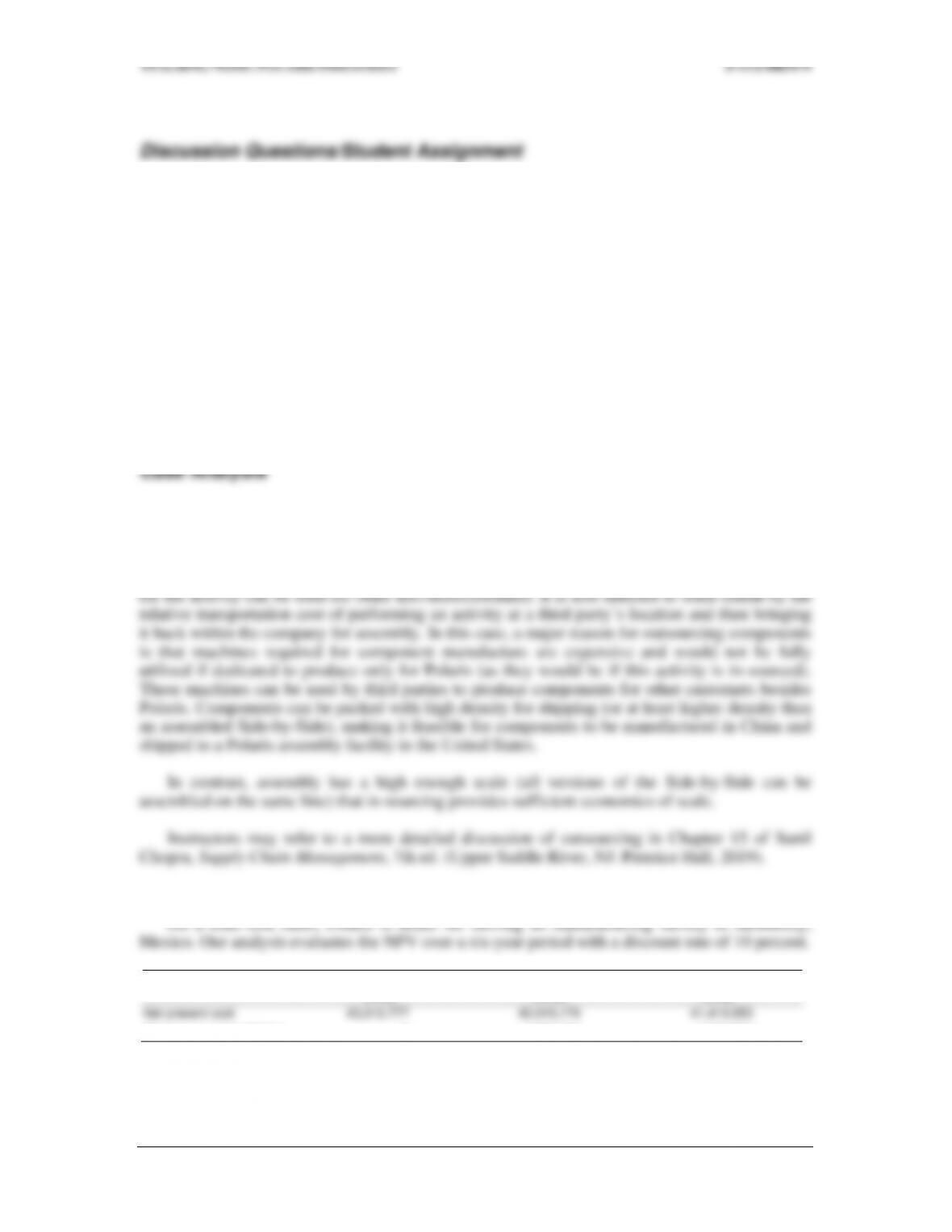
2. Which manufacturing location provides Polaris with the greatest cost savings?
United States
(US$)
Mexico
(US$)
China
(US$)
Net present cost
Savings vs. United States
0
2,997,603
1,868,824

5-112-003TN TEACHING NOTE: POLARIS INDUSTRIES
Monterrey offers the most savings compared to the base case in addition to the highest return on
investment.
To establish total cost, a model has been built in Excel. It details the different costs as
follows:
• One-time expenses, including:
• Yearly costs (for 2009 to 2013)
o Labor costs:
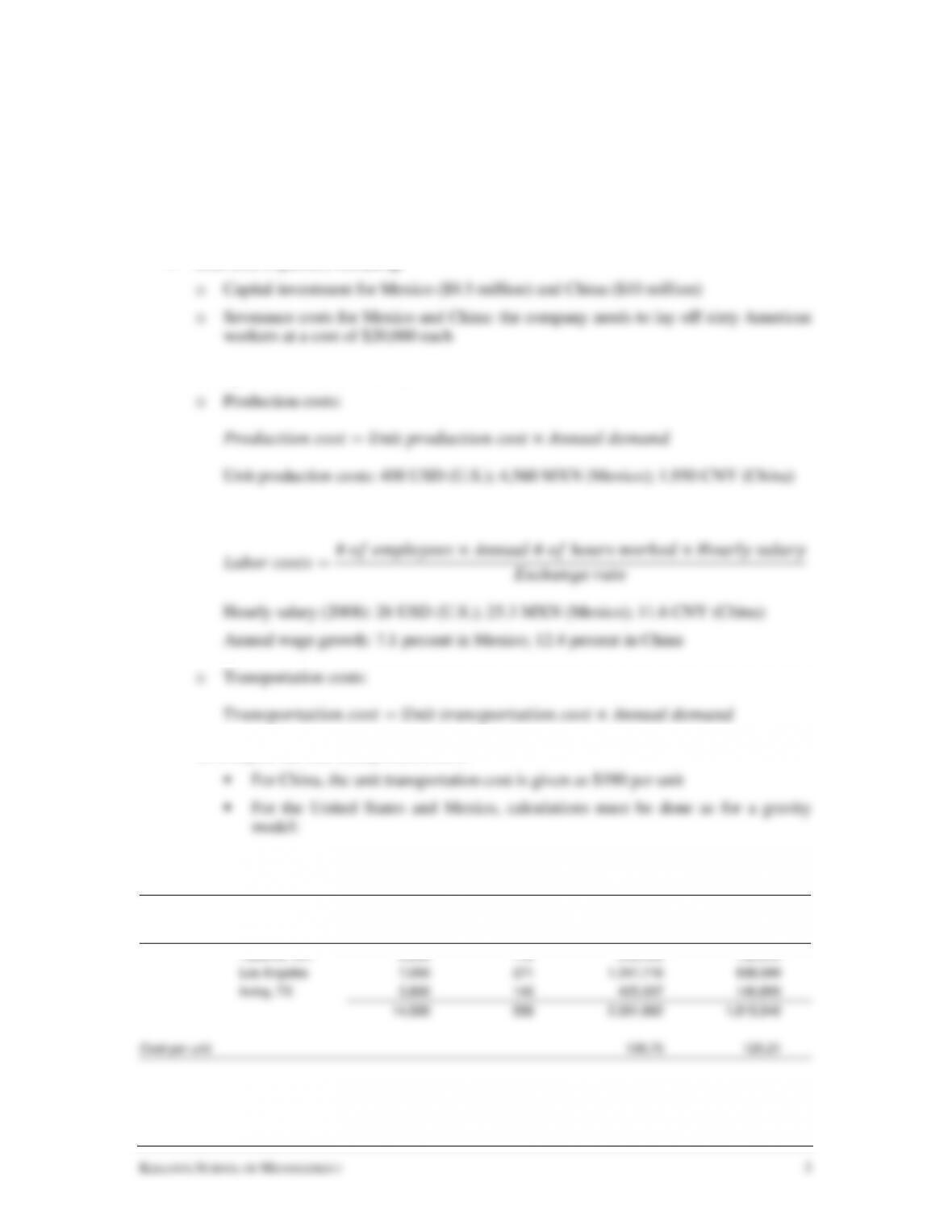
To compute the unit transportation cost:
Side–by-Sides Markets
Distribution
Center Location
Units Demanded
Trucks Needed
for Transportation
Roseau Total
Transport Cost
($)
Monterrey Total
Transport Cost
($)
Tacoma, WA
3,650
140
528,239
730,042
Irving, TX
3,800
146
425,907
146,899
558

TEACHING NOTE: POLARIS INDUSTRIES 5-112-003TN
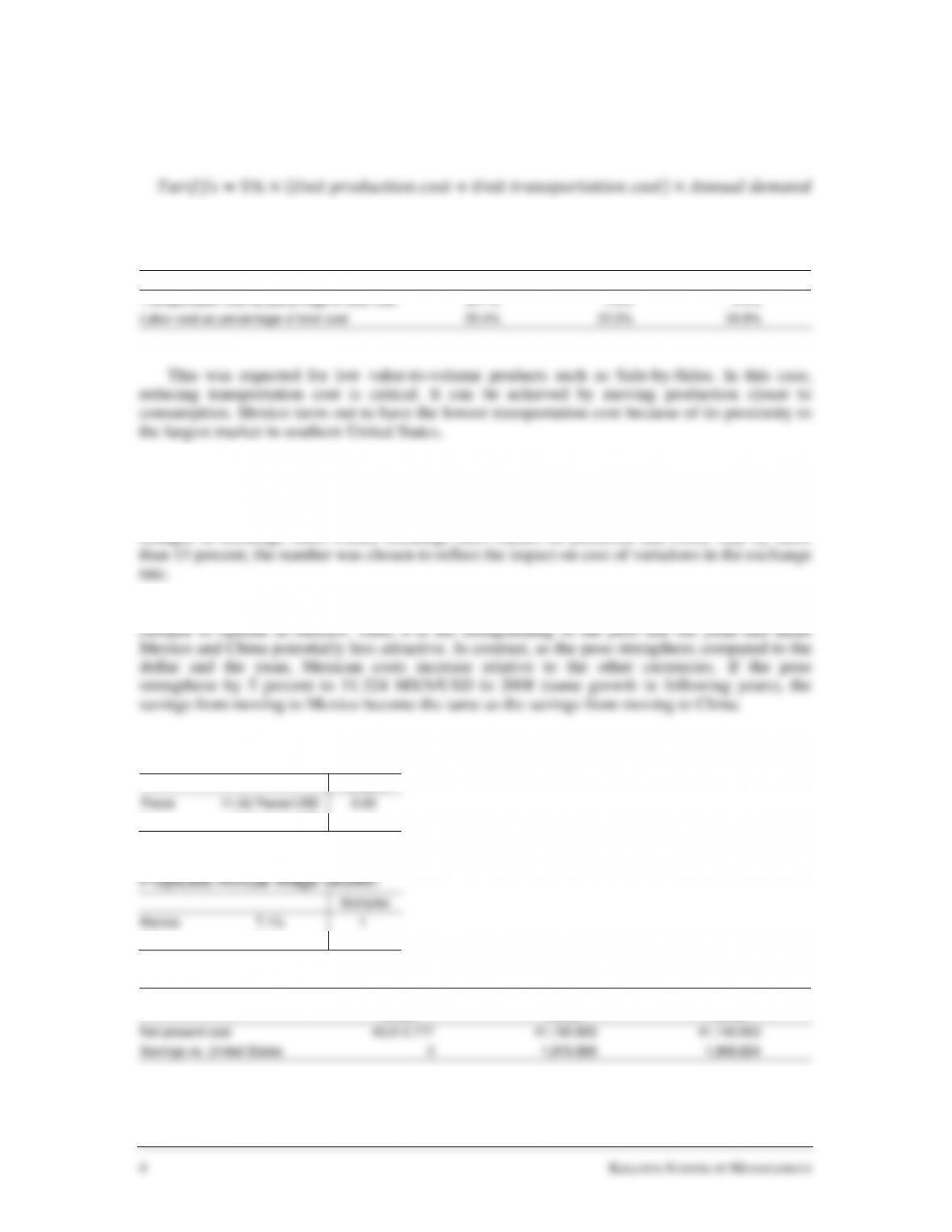
o Tariffs: if production is off-shored to China, the tariffs cost is:
In this case, transportation cost represents a high percentage of total cost (excluding capital
investment and severance) compared to labor cost (as shown in the table below).
United States
Mexico
China
Transportation cost as percentage of total cost
35.7%
4.9%
5.4%
Labor cost as percentage of total cost
25.4%
3. Would your recommendation change if foreign exchange rates increased or decreased by 15
percent?
The goal of this question is to help students understand how sensitive the total cost is to
changes in exchange rates. Future exchange rates cannot be predicted and could vary by more
When the peso is devalued from the base case of 11.92 MXN/USD in 2008, it becomes even
Expected Exchange Rates
Multiplier
Pesos
Yuan
6.47 Yuan/USD
1
Multiplier
Mexico
7.1%
1
China
13.4%
1
United States
(US$)
Mexico
(US$)
China
(US$)
Net present cost
Savings vs. United States
The peso has to strengthen by about 12 percent in 2008 (and continue all other trends) to
4. Assuming all else is constant, would your recommendation change if labor rates in Mexico
increased by 20 percent annually instead of 7.1 percent?
Mexico
20.0%
China
13.4%
1
United States
Mexico
China
Savings vs. United States
5. What other factors should Suresh Krishna and his team consider when making the
manufacturing location recommendation?