Copyright © 2019 Pearson Education, Inc.
Chapter 11 – Teaching Note for Pricing and Delivery at KAR Foods
1. What do you think of the discounting scheme that KAR had used historically? Do you think it was
justified given the circumstances?
The analysis is available on spreadsheet Chapter 11-KAR. When fixed order costs at KAR were 4,000, the
analysis is provided in worksheet KAR. We have the following data historically:
The optimal order size for a supermarket chain is thus given by (based on its fixed cost / order) (see Cell
Copyright © 2019 Pearson Education, Inc.
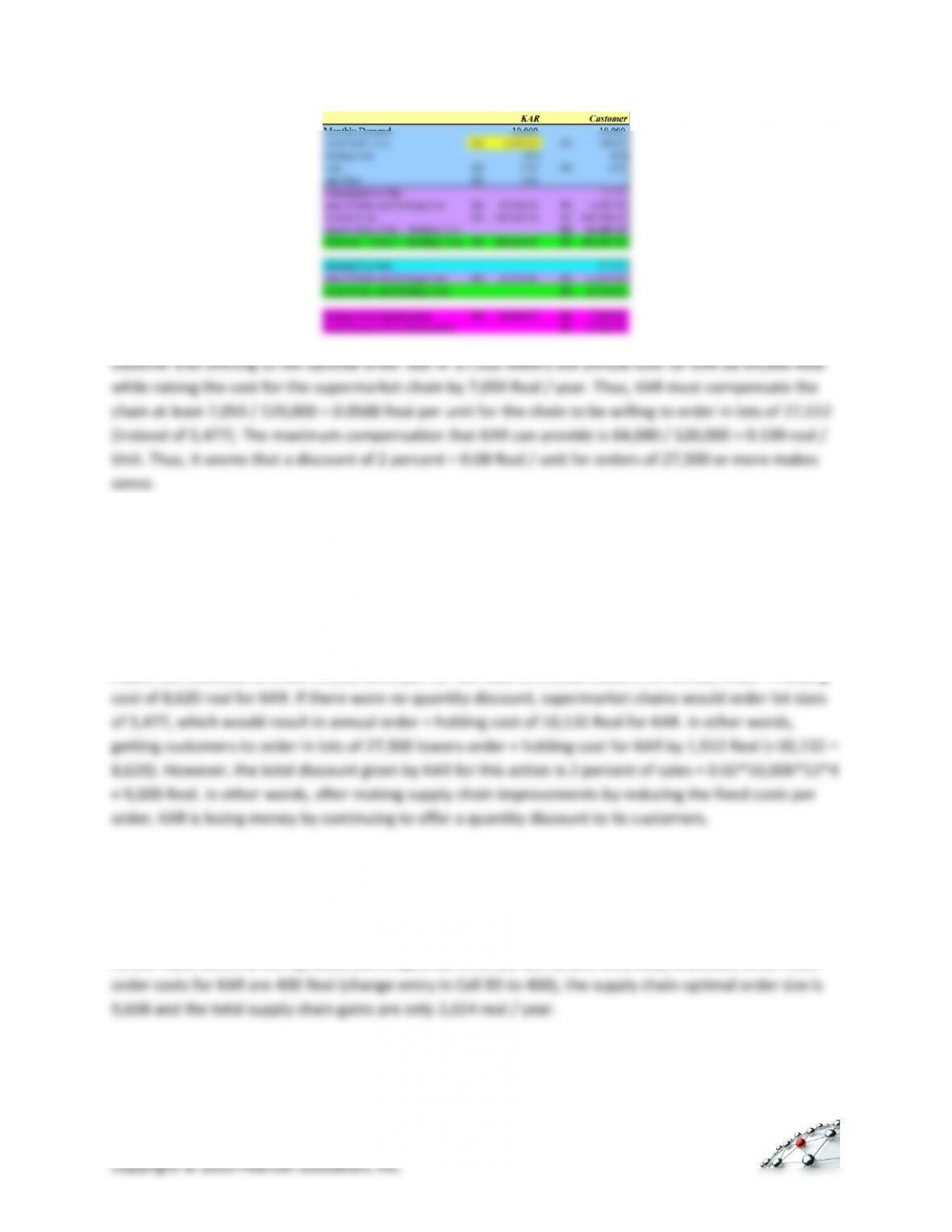
Observe that shifting to the optimal order size of 27,512 lowers the annual cost for KAR by 64,680 Real
while raising the cost for the supermarket chain by 7,059 Real / year. Thus, KAR must compensate the
chain at least 7,059 / 120,000 = 0.0588 Real per unit for the chain to be willing to order in lots of 27,512
(instead of 5,477). The maximum compensation that KAR can provide is 64,680 / 120,000 = 0.539 real /
Unit. Thus, it seems that a discount of 2 percent = 0.08 Real / unit for orders of 27,500 or more makes
sense.
2. Once KAR has reduced its fixed cost per order to 400 real, what are the downsides to leaving the
discounting scheme unchanged?
If KAR reduces its fixed cost / order to 400 Real but leaves the discounting scheme in place, supermarket
chains will continue to order 27,500 units per lot. Lot sizes of 27,500 result in an annual order + holding
3. What should Carlos suggest to Vanessa at the upcoming meeting? What are the potential gains
for KAR from this suggestion?
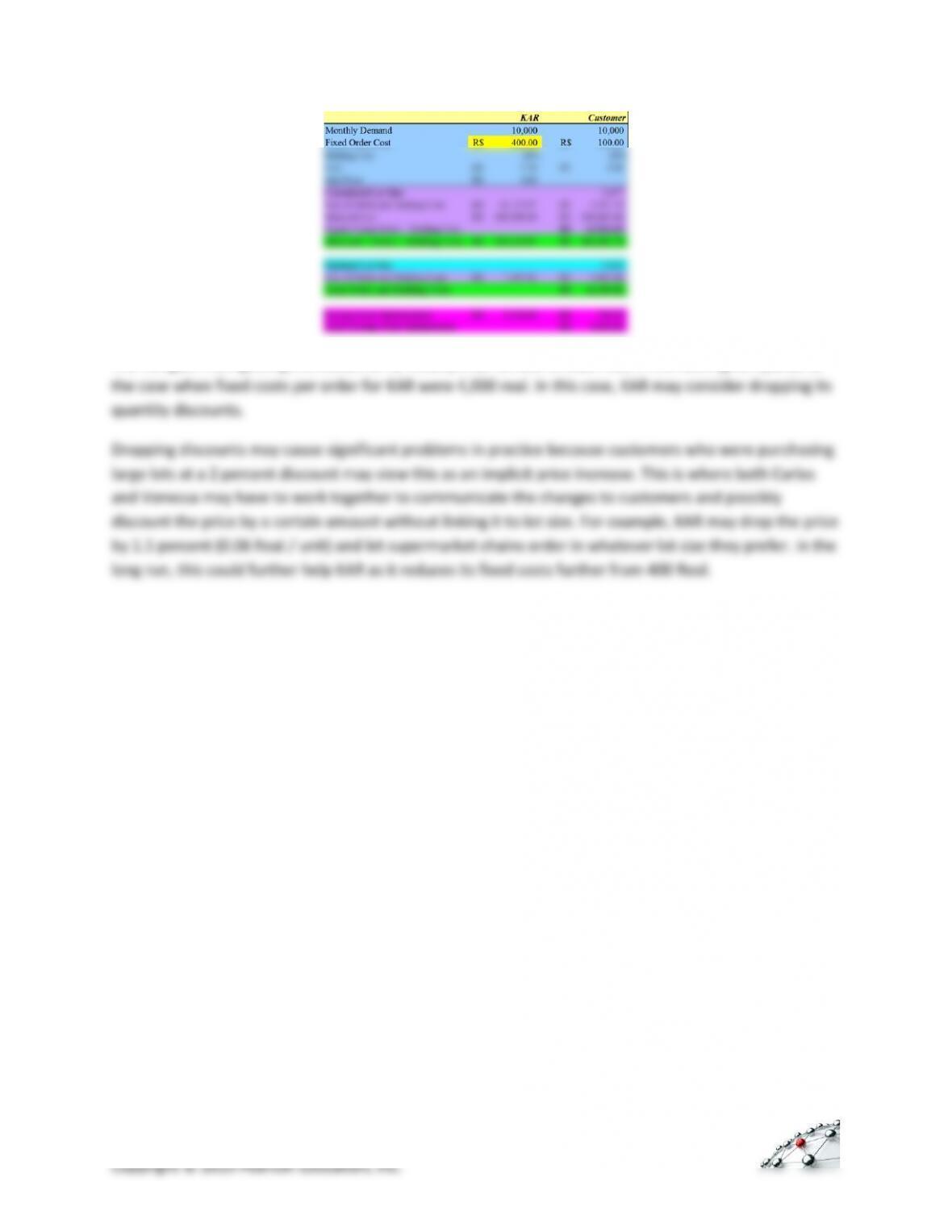
As the Table below (from spreadsheet Chapter11-KAR, see worksheet KAR(400)) indicates, when fixed
Copyright © 2019 Pearson Education, Inc.
The net gain from getting the customer to modify their lot size is much less in this setting compared to