5-310-507TN
SUNIL CHOPRA
Teaching Note:
Movie Rental Business: Blockbuster, Netflix, and Redbox
Teaching Objectives
The objective of this case is to discuss how different business models and supply chain
structures impact the financials of the firms in the DVD rental business. In particular, the goal is
to convey that the characteristics of the movie (recent/big hit or old/eclectic) affect whether it is
best rented from a centralized or decentralized model. By comparing the financials of
Blockbuster, Netflix, and Redbox, we identify the strengths and weaknesses of each model. In
addition, as streaming gains market share, the impact will be different for movie types and
business models.
Case Questions and Discussions
1. How do the different players in the movie rental value chain provide and capture value?
Movie Studios
Studios were the creators and owners of the content. Most of their costs (stars, production,
Movie Theaters
Movies were released first to movie theaters. Studios tended to enjoy a greater cut (as high as
70 to 90 percent) of the ticket sales in the opening weeks of the movie release, and the theater
TEACHING NOTE: MOVIE RENTAL BUSINESS 5-310-507TN
2 KELLOGG SCHOOL OF MANAGEMENT
In addition, a significant fraction of theater revenues had started to come from concessions
and onscreen advertising.
DVD Retail Stores
A period of three or more months after the movie was released in theaters, it was released in
Blockbuster
Blockbuster started with the business model of having physical storefronts in high-traffic
Netflix
Netflix started as a mail-order DVD rental service that later turned into a mail-based
subscription service (eventually with a greater focus on streaming) that offered customers greater
5-310-507TN TEACHING NOTE: MOVIE RENTAL BUSINESS
KELLOGG SCHOOL OF MANAGEMENT 3
more value for older movies with small and sporadic demand compared to hit movies with large
and predictable demand. Netflix therefore served the “long tail” of the customer demand
corresponding to a wide variety of movies with relatively low demand.
Redbox
Redbox’s primary value proposition was to deliver content in the form of a recently released
DVD very close to the customer (much closer than Blockbuster historically accomplished).
Redbox offered customers a cheap and easy way to rent movies through its vending machines that
were located in high-trafficked locations such as fast food restaurants and supermarkets. Because
Redbox vending machines were located at places people tended to frequent, the service offered
the easiest way to rent DVDs.
Video on Demand
Video on demand (VOD) services offered customers the most convenience in renting and
Digital on–Demand
Players such as Apple, Amazon, and Google were becoming increasingly active in the digital
pay-per-view and on-demand rental channel. Most of their offerings could be streamed directly
2. What factors led to Netflix’s growth? How should Blockbuster have responded to the challenge
posed by Netflix?
The factors that led to Netflix’s success were:
• Transition from VHS to DVD. Transition from the VHS to DVD storage of movies
coincided with the emergence of Netflix as a major player in the movie rental business.
DVDs were cheaper and easier to handle and transport. This allowed Netflix to introduce
TEACHING NOTE: MOVIE RENTAL BUSINESS 5-310-507TN
4 KELLOGG SCHOOL OF MANAGEMENT
the DVD-by-mail subscription plans. Sending VHS tapes by mail would have been much
more expensive.
• Low costs. Blockbuster incurred high operating costs due to its storefront rental model (in
the form of PP&E, inventory, and SG&A). Netflix, through its distribution center–based
delivery model, was able to reduce its costs of operation and PP&E. Netflix’s PP&E was
one-tenth that of Blockbuster, whereas its revenue was just 40 percent that of
Blockbuster.
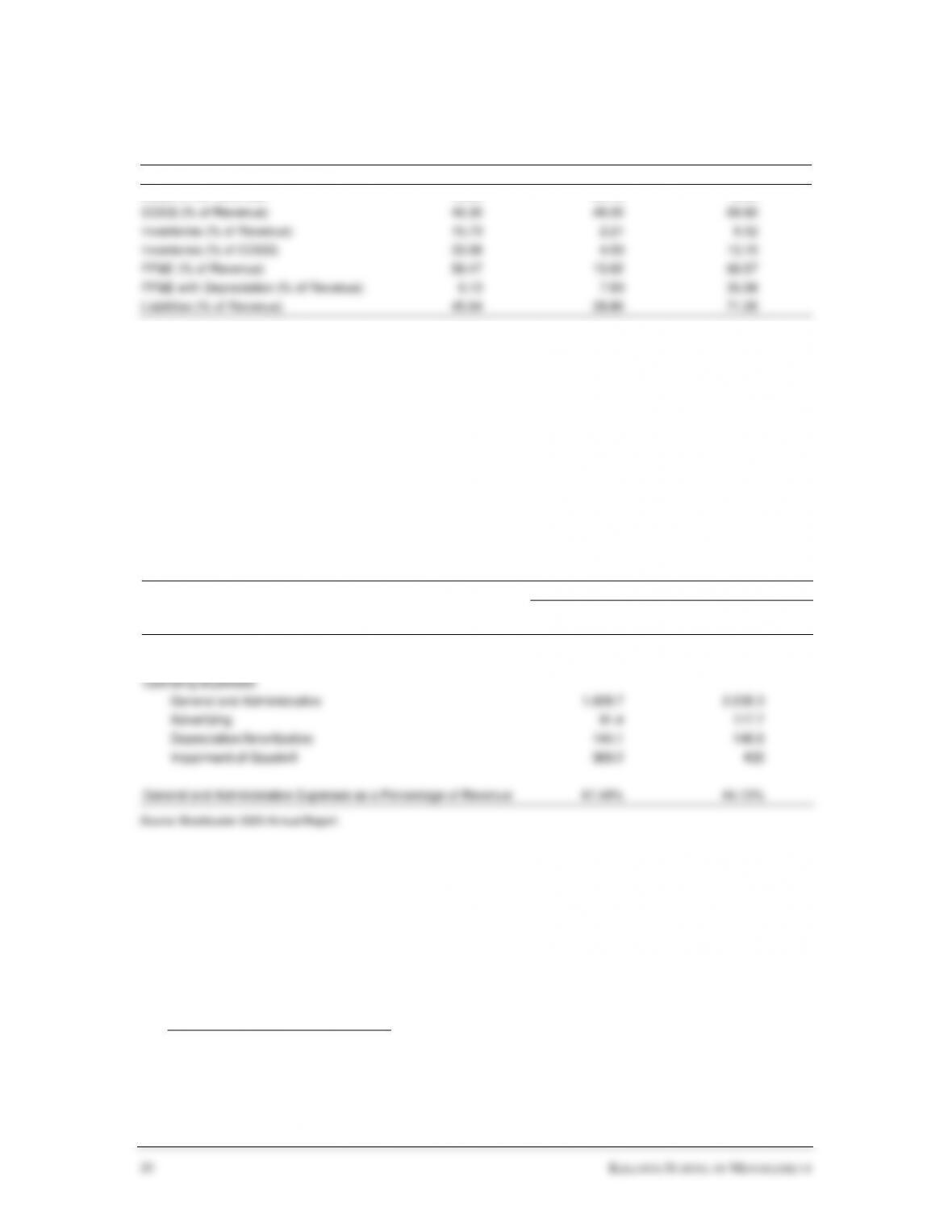
Netflix also had low inventory costs (2.21 percent of revenue or 4.5 percent of COGS)
compared to that of Blockbuster (15.73 percent of revenue or 33.98 percent of COGS), as
well as a much lower SG&A (see Exhibit 1 for details).
• Wide inventory selection. Compared to Blockbuster, Netflix carried a wider variety of
older titles sourced from studios at a cheaper rate compared to the cost of new releases.
The Blockbuster model was not well suited to carrying a wide variety of older movies
because a typical store carried only 3,000 titles (compared to more than 100,000 available
at Netflix). The centralized Netflix model, in contrast, was much better suited to carrying
large variety.
• Recommendation system. Netflix’s model of providing high variety (for both DVDs and
streaming) was bolstered by a robust recommendation system, which suggested movies to
customers based on their interests and rental history. With high variety, reducing search
costs becomes important (something that the recommendation engine helped with).
• Subscription model. Netflix’s subscription model of renting DVDs for a fixed monthly
fee was attractive to customers who wanted the privilege or comfort of watching as many
movies as they wanted for a fixed subscription price. Blockbuster’s high-cost store rental
($5 for five nights per DVD) was not attractive to those customers. In 2010, Netflix’s
monthly subscription fee of $8.99 was lower than two rentals at Blockbuster. Even when
the service was priced at $19.95 a month (in 2000), it was comparable to renting four
videos at Blockbuster.
Some Challenges for Netflix
High transportation cost was one of the biggest challenges Netflix faced for its DVD
business. Shipping a DVD (to the customer and back) can cost as much as 75 cents per disc. This
increases the SG&A costs for Netflix for its DVD business. The cost of streaming has been
estimated to be significantly lower (around 5 to 10 cents to deliver a movie online). As a result,
Netflix tried to encourage users of DVDs to transition to streaming by increasing the price of the
service (it charged $7.99 for the DVD service and a separate $7.99 for streaming instead of the
previous $8.99 for both).
5-310-507TN TEACHING NOTE: MOVIE RENTAL BUSINESS
KELLOGG SCHOOL OF MANAGEMENT 5
Blo c kb us t er ’s R e sp o ns e
In response to Netflix, Blockbuster should have pressed its advantage in multiple channels. It
should have utilized its physical storefronts and the newly introduced mail-subscription service
(in response to Netflix’s mail offering) much more effectively and as complements to each other.
In addition, Blockbuster did not move into the mail-subscription online model early enough,
as it had invested heavily in its physical storefront model. Once Blockbuster introduced its own
offering in the DVD-by-mail category, Netflix already had a firm lead. Further, Netflix’s mail
offering had many more DVD titles than Blockbuster had, and was also complemented by a
robust recommendation engine, which Blockbuster’s service lacked.
3. What factors led to Redbox’s growth? How and why was it able to capture market already
dominated by big players such as Blockbuster and Netflix?
Although Netflix already occupied a strong position in renting a wide variety of titles,
Redbox attacked Blockbuster in the new-movie segment. Its business model provided greater
convenience to customers while also reducing both price and cost. The factors that led to
Redbox’s success were:
TEACHING NOTE: MOVIE RENTAL BUSINESS 5-310-507TN
6 KELLOGG SCHOOL OF MANAGEMENT
4. What are key success factors in the movie rental business? How do Redbox, Blockbuster, and
Netflix compare along those dimensions?
The key success factors in the movie rental business were costs, which included fixed and
operational costs (facilities, transport), content (acquisition and inventories), delivery channels,
and pricing. Companies needed to adequately control all of these factors to be profitable in this
business.
Facilities
Blockbuster had a high-cost physical storefront model of movie rental. Blockbuster leased the
storefronts at high costs in high-trafficked neighborhood locations (this increased SG&A and
PP&E). Only a single wall at a Blockbuster store was dedicated to new releases, (which
constituted a significant fraction of the rentals). Redbox, in contrast, used very low cost vending
machines (with low fixed installation costs of $15,000) in high-trafficked locations such as
5-310-507TN TEACHING NOTE: MOVIE RENTAL BUSINESS
grocery stores, supermarkets, and malls to rent the same recent releases (much lower
PP&E/SG&A) compared to Blockbuster.
Inventories
Inventories at Blockbuster were high (relative to revenues) because of the decentralized
nature of its operations. In particular, carrying many low-volume rental titles (after all, there were
Transportation
Blockbuster’s physical storefront model incurred low transportation costs, whereas Netflix
bore the high shipping and handling costs of processing DVDs by mail. As per an MSNBC article
by Ethan Epstein, Netflix estimated an expenditure of $600 million on postage in 2010. Redbox
incurred low replenishment costs in restocking its vending kiosks.
Delivery Channels
Netflix offered customers the choice of renting DVD titles by mail and streaming movies
Pricing
Redbox followed a pricing model of $1 a night per DVD (the price increased to $1.20 in
TEACHING NOTE: MOVIE RENTAL BUSINESS 5-310-507TN
8 KELLOGG SCHOOL OF MANAGEMENT
After comparing the firms on the above dimensional factors it is clear that Blockbuster,
Netflix, and Redbox had their own advantages in their offerings. Redbox’s model was suitable for
5. How would you advise these companies to modify their strategies and structures going
forward?
An explosion of online on-demand rental options had recently become available. Companies
such as Apple, Amazon, and Google were providing their own on-demand stores. Many more
new devices were being introduced to the market (Apple TV, Google TV, Roku, Boxee, etc.) that
could stream on-demand content to TVs. It became increasingly likely that DVDs would be
replaced in the future as a content storage medium, and more and more content would be directly
streamed or accessed from the cloud.

5-310-507TN TEACHING NOTE: MOVIE RENTAL BUSINESS
KELLOGG SCHOOL OF MANAGEMENT 9
TEACHING NOTE: MOVIE RENTAL BUSINESS 5-310-507TN
Exhibit 1: Company Comparisons (%)
Metric
Blockbuster
Netflix
Coinstar
SG&A (% of Revenue)
49.50
24.16
13.60
COGS (% of Revenue)
46.30
49.20
69.60
Inventories (% of Revenue)
15.73
2.21
9.12
Inventories (% of COGS)
33.98
4.50
13.10
PP&E (% of Revenue)
58.47
15.92
66.57
PP&E with Depreciation (% of Revenue)
6.13
7.90
35.08
Liabilities (% of Revenue)
45.64
28.80
71.05
Exhibit 2: Blockbuster
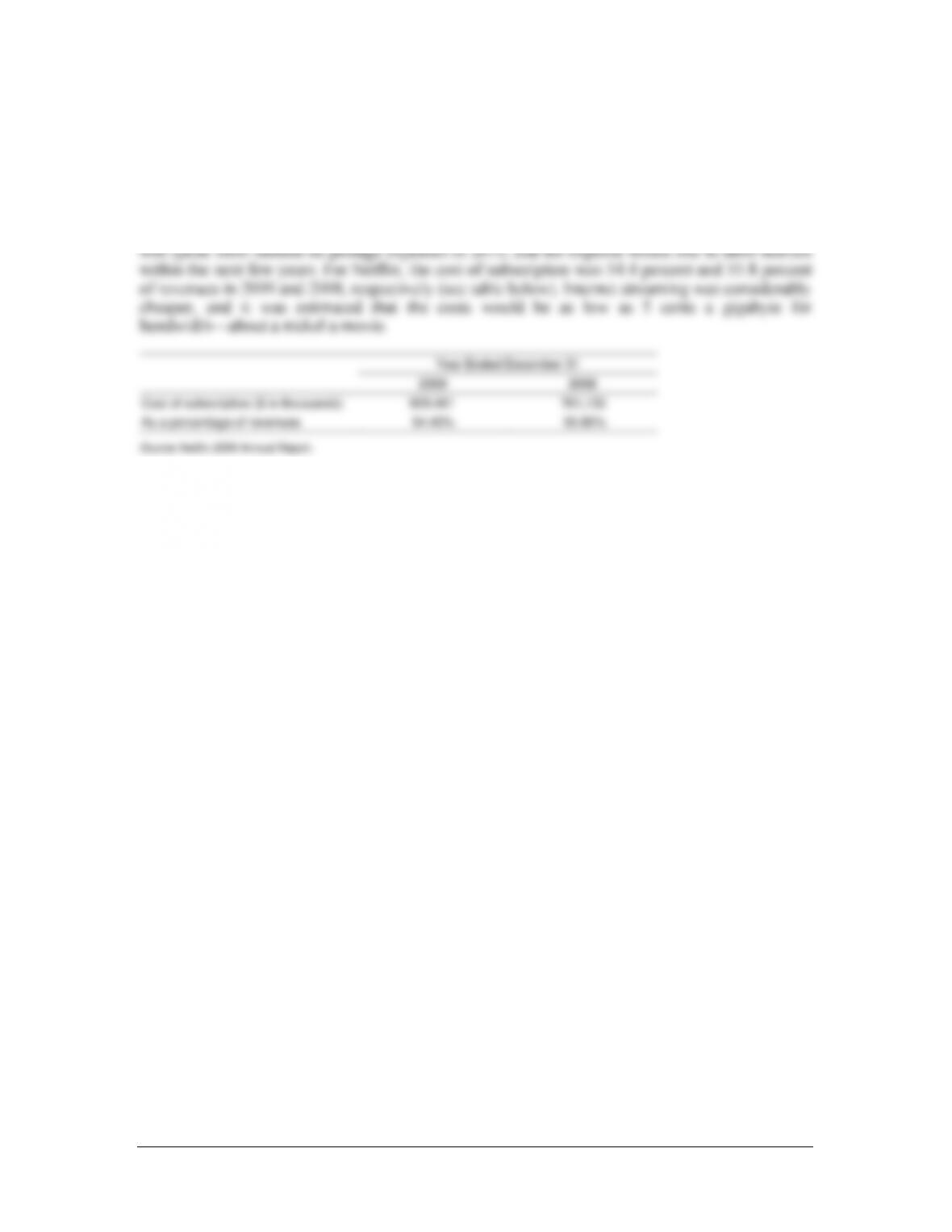
Both Netflix and Redbox operated with lower costs because they were not burdened with the
heavy fees of leasing thousands of retail locations as Blockbuster was. The table below shows
that the general and administrative expenses for Blockbuster were 47.48 percent and 44.13
percent of revenues in 2009 and 2008, respectively.
1
The figures for Netflix for the same period
were 3.1 percent and 3.6 percent, respectively.
2
Fiscal Year Ended
3-Jan-2010
($ in millions)
4-Jan-2009
($ in millions)
Total Revenues
4,062.4
5,065.4
Operating Expenses
General and Administrative
1,928.7
2,235.3
Advertising
91.4
117.7
Depreciation/Amortization
144.1
146.6
Impairment of Goodwill
369.2
435
General and Administrative Expenses as a Percentage of Revenue
47.48%
44.13%
1
Blockbuster 2009 Annual Report.
2
Netflix 2009 Annual Report.
5-310-507TN TEACHING NOTE: MOVIE RENTAL BUSINESS
KELLOGG SCHOOL OF MANAGEMENT 11
Exhibit 3: Netflix
Economic of Shift from DVDs to Digital
The shift from physical DVD mailing to digital delivery for older eclectic titles (the long tail)
would help Netflix lower its high shipping cost in mailing out DVDs. Netflix estimated that it
TEACHING NOTE: MOVIE RENTAL BUSINESS 5-310-507TN
Exhibit 4: Digital File Purchase and Rentals
Amazon
Amazon’s catalog of more than 50,000 movies and TV shows was available for rental or
purchase. These titles could be rented and watched online, through desktop software, or via
compatible devices from Panasonic, Roku, Samsung, Sony, and TiVo. Amazon streams at 720p,
like Netflix, or HD (1080p) on HD devices.
iTunes
Convergence of TV and Internet
Consumers, particularly young consumers, increasingly viewed the Internet as their primary
source of entertainment. This trend in attitude was the driving force between innovations that
sought to merge the functionality of TVs and computers. Players in this new space focused on
ways to facilitate the watching of downloaded or streaming movies on TV:

5-310-507TN TEACHING NOTE: MOVIE RENTAL BUSINESS
KELLOGG SCHOOL OF MANAGEMENT 13
• Bibliography
Chmielewski, Dawn C. “Studios, Cable Companies Band Together To Promote Video-On–
Demand.” Los Angeles Times, March 16, 2010. http://latimesblogs.latimes.com/
entertainmentnewsbuzz/2010/03/studios-cable-companies-band-together-to-promote-video-
on-demand.html.
“Crunching Numbers in the ‘Hollywood Economy.’” Fresh Air: NPR, April 1, 2010.
http://www.npr.org/templates/story/story.php?storyId=124535538.
Epstein, Edward Jay. “Hollywood’s Profits, Demystified.” Slate, August 8, 2005.
http://www.slate.com/id/2124078.
———. “Hollywood by the (Secret) Numbers: The Rise of DVDs.” 2005.
http://www.edwardjayepstein.com/table2.htm
Goldstein, Patrick. “Hollywood’s Slipped Discs.” The Guardian, May 21, 2009.
http://www.guardian.co.uk/film/2009/may/22/falling-dvd-sales.
Graser, Marc. “Blockbuster Battles Redbox.” Variety, April 27, 2010. http://www.variety.com/
article/VR1118018342.html.
Harrar, Derek. “Day-and-Date VOD Movie Release Windows . . . and 48 Hour Rentals.”
Comcast Voices, June 3, 2009. http://blog.comcast.com/2009/06/day-and-date-vod-movie-
release-windows-and-48-hour-rentals.html.
“Digital Entertainment: Streaming Video—US.” Mintel, January 2010.