CASE STUDY— Blue Nile and Diamond Retailing
and (3) develop the alignment between supply chain structure and strategic position for
a firm.
To this end, the case highlights the supply chain structures and performances of three
1. What are some key success factors in diamond retailing? How do Blue Nile, Zales,
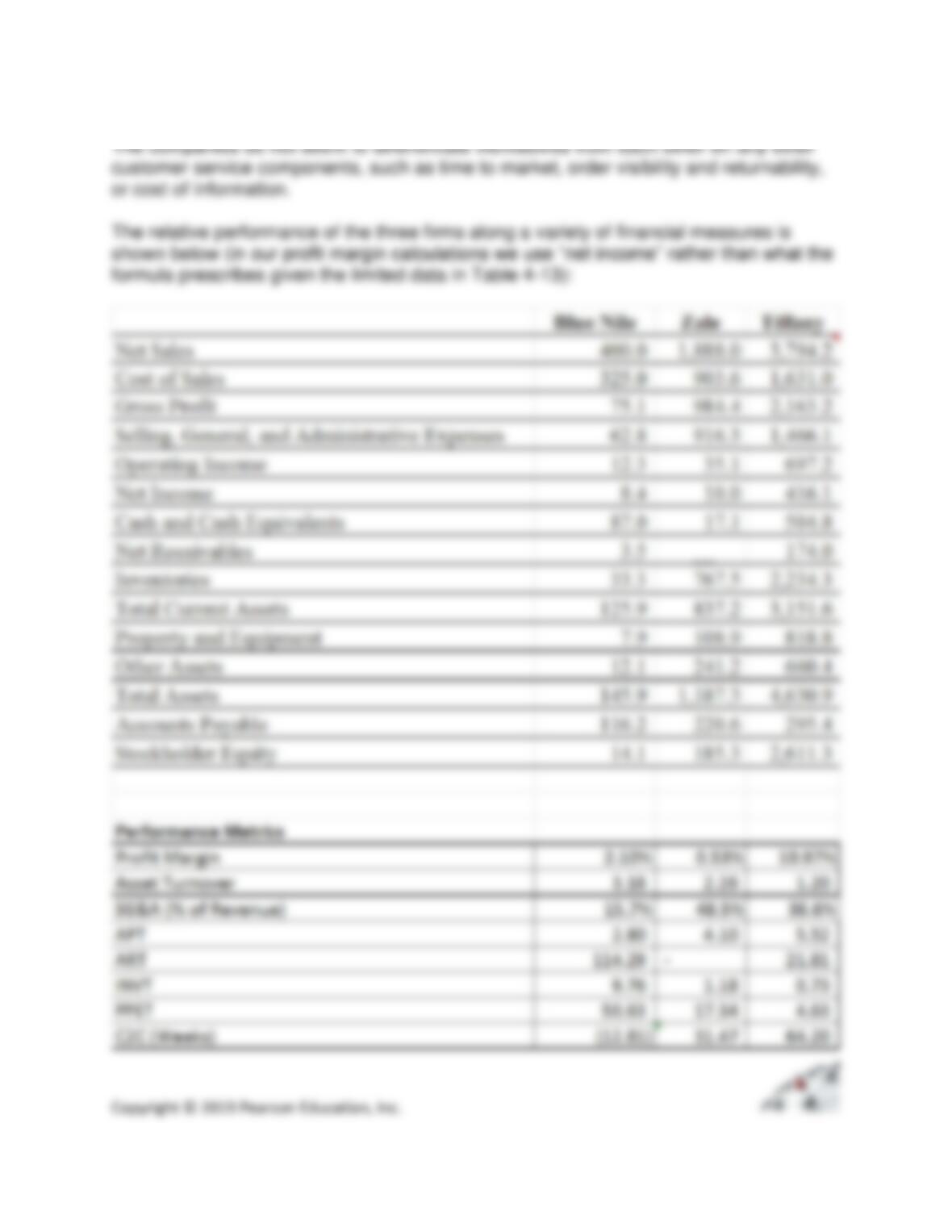
and Tiffany compare on those dimensions? How do they compare on various financial
measures discussed in Chapter 3?
As with most retailing, the key success factors in diamond retailing can be measured by
2. What do you think of the fact that Blue Nile carries many stones priced at $2,500 or
higher whereas almost 60 percent of the products sold from the Tiffany website are
priced around $200? Which of the two product categories is better suited to the online
channel?
There are different reasons why these two firms carry very different types of items on
their websites. In the case of Blue Nile, the primary reasons could be the savings in
3. What do you think of Tiffany’s decision to not sell engagement rings online? What do
you think of Blue Nile’s growth into the non-engagement category?
Given that Tiffany’s key strength is its brand (reflected in the high gross margin it
obtains through high prices), it seems appropriate that Tiffany does not sell engagement
4. Given that Tiffany stores have thrived with their focus on selling high-end jewelry,
what do you think caused the failure of Zales upscale strategy in 2006? What products
should Zales focus on?
5. Which of the three companies do you think was best structured to deal with weak
economic times?
A lean and nimble structure is an advantage in weak economic times. Blue Nile has a
distinct advantage in this regard with its very low fixed-cost structure compared to
Tiffany and Zales. Property and equipment to net sales ratios are 2.38, 13.93, and
6. What advice would you give to each of the three companies regarding their strategy
and structure? How can they best use omni-channel retail?