
Chapter 4: Developing an Effective Business Model
CHAPTER 4
DEVELOPING AN EFFECTIVE BUSINESS MODEL
LEARNING OBJECTIVES
1.
Describe business models and discuss their importance.
2.
Identify and describe the two general types of business models—standard and
disruptive.
3.
Explain the components of the Barringer/Ireland Business Model Template that
entrepreneurs can use to develop a business model for their firm.
CHAPTER OVERVIEW
This chapter introduces the concept of the business model. A business model is defined
as a firm’s plan or recipe for how it creates, delivers, and captures value. The chapter
discusses the two general categories of business models: standard business models and
disruptive business models. Examples of both standard and disruptive business models
are provided.
The middle portion of the chapter introduces the Barringer/Ireland Business Model
Template. It is slightly more comprehensive than the Business Model Canvas in that it
consists of 4 major categories and 12 individual parts.
The final section of the chapter explains each of the components of the Barringer/Ireland
Business Model Template. The first category, Core Strategy, consists of Business
Mission, Basis of Differentiation, Target Market, and Product/Market Scope. The second
category, Resources, consists of core competencies and key assets. The third category,
Financials, consists of Revenue Streams, Cost Structure, and Financing/Funding. The
final category, Operations, consists of Product (or Service) Production, Channels, and
Key Partners.
CHAPTER OUTLINE
I. Business Models and Their Importance
II General Categories of Business Models
A. Standard Business Models
B. Disruptive Business Models
III. The Barringer/Ireland Business Model Template
A. Core Strategy
1. Business Mission
2. Basis of Differentiation

Chapter 4: Developing an Effective Business Model
68
3. Target Market
4. Product/Market Scope
B. Resources
1. Core Competencies
2. Key Assets
C. Financials
1. Revenue Streams
2. Cost Structure
3. Financing/Funding
D. Operations
1. Product (or Service) Production
2. Channels
3. Key Partners
CHAPTER NOTES
I. Business Models and Their Importance
A. A firm’s business model is its plan or recipe for how it creates, delivers, and
captures value for its stakeholders.
B. Glance ahead to Figure 4.2, the Barringer/Ireland Business Model Template. As
you can see by looking at the template, a firm’s business model represents the
core aspects of its business.
C. It also describes how the core aspects fit together and support one another.
II. General Categories of Business Models
A. Standard business models depict existing plans or recipes firms can use to
determine how they will create, deliver, and capture value for their stakeholders.
1. There are a number of standard business models. An abbreviated list is shown
in Table 4.1.
a. Among the standard business models are the following:
i. Advertising Business Model
ii. Auction Business Model
iii. Bricks and Clicks Business Model
iv. Franchise Business Model
Chapter 4: Developing an Effective Business Model
ix. Razor and Blades Business Model
x. Subscription Business Model
xi. Traditional Retailer Business Model
2. It is important to understand that there is no perfect business model. Each of
the standard models has inherent strengths and weaknesses.
B. Disruptive business models, which are rare, are models that do not fit the profile
of a standard business model, and are impactful enough that they disrupt or
change the way business is conducted in an industry or an important niche within
an industry.
1. In Table 4.2, we describe actual disruptive business models that were used by
four different companies. The companies are: Dell, Google, Salesforce.com,
and Uber.
2. There are three types of disruptive business models.
a. A new market disruption addresses a market that previously wasn’t
served. An example is Google and its AdWords program.
b. The second type of disruptive business model is referred to as low-end
market disruption. Low-end disruption is possible when the firms in an
industry continue to improve products or services to the point where they
III. The Barringer/Ireland Business Model Template
The business model framework used here, the Barringer/Ireland Business Model
Template, is shown in Figure 4.2 in the chapter.
It is slightly more comprehensive than the Business Model Canvas in that it
consists of 4 major categories and 12 individual parts. The 4 categories and 12
parts make up a firm’s business model.
Chapter 4: Developing an Effective Business Model
70
The job of the entrepreneur, or team of entrepreneurs, is to configure their firm’s
business model in a manner that produces a viable and exciting business.
Appendix 4.1 (of the chapter) contains an expanded version of the
Barringer/Ireland Template shown here. Feel free to copy and use the template to
help formulate the business model for an individual firm.
A. Core Strategy (Part 1)
1. The first component of a business model is core strategy. A core strategy
describes how the firm plans to compete relative to its competitors.
2. The primary elements of core strategy are: business mission, basis of
differentiation, target market, and product/market scope.
a. Mission Statement. A business mission or mission statement describes
why it exists and what its business model is supposed to accomplish. If
carefully written and used properly, a mission statement can articulate a
business’s overarching priorities and act as its financial and moral
compass.
b. Basis of Differentiation. It’s important that a business clearly articulates
the points that differentiate its product or service from competitors. This is
akin to what some authors refer to as a company’s value proposition.
B. Resources
1. A firm is not able to implement a strategy without resources, so the resources
2. Resources are the inputs a firm uses to produce, sell, distribute, and service a
product or service.
Chapter 4: Developing an Effective Business Model
Copyright © 2019 Pearson Education, Inc.
71
3. Resources are developed and accumulated over a period of time. As a result,
when completing the Barringer/Ireland Business Model Template, the current
resources a company possesses should be the resources that are noted, but
aspirational resources should be kept in mind.
a. Core Competencies. A core competency is a specific factor or capability
that supports a firm’s business model and sets it apart from its rivals. A
core competency can take on various forms, such as technical know-how,
Model Template, a firm should list three to four key assets that it
possesses that support its business model as a whole.
C. Financials
2. For most businesses, the manner in which it makes money is one of the most
fundamental aspects around which its business model is built.
Table 4.3.
b. Cost Structure. A business’s cost structure describes the most important
costs incurred to support its business model. Initially, it is important to
amount of financing or funding to bring their business models to life.
D. Operations
1. The final quadrant in a firm’s business model focuses on operations.
2. Operations are both integral to a firm’s overall business model and represent
the day-to-day heartbeat of a firm.
Chapter 4: Developing an Effective Business Model
a. Product (or Service) Production. This section focuses on how a firm’s
products and/or services are produced. If a firm sells physical products,
the products can be manufactured or produced in-house, by a contract
manufacturer, or via an outsource provider. This decision has a major
c. Key Partners. The final element of a firm’s business model is key partners.
Start-ups, in particular, typically do not have sufficient resources to
perform all the tasks needed to make their business models work, so they
rely on partners to perform key roles.
BOXED FEATURES: QUESTIONS FOR CRITICAL THINKING
What Went Wrong?
Peer-to-Peer Business Models: Good for Some, Not So Good for Others
1.
Prior to launching their firms, how could BlackJet, Ridejoy, and
Neighborrow.com have better anticipated the issues that ultimately caused them
to fail?
Answer: They could have conducted a thorough feasibility analysis prior to
launching. Also, they could have better understood that peer-to-peer services that
are used only occasionally are less compelling than those that are used frequently.
Part of the success of Uber and Lyft, for example, is that its customers use the
service frequently. That wasn’t the case with BlackJet, Ridejoy, and
Neighborrow.com.
2.
In regard to putting together an effective business model, what can other peer-to–
peer business model start-ups learn from the failure of BlackJet, Ridejoy, and
Neighborrow.com?
Answer: That services that are used only occasionally are much less compelling
than services that are used often.
3.
Spend some time looking at Lyft, one of the successful peer-to-peer business
model companies mentioned in the feature. Why do you think Lyft has been
successful while BlackJet, Ridejoy, and Neighborrow.com failed?
Chapter 4: Developing an Effective Business Model
Answer: This is a good question for an individual or a group assignment. Lyft has
been successful in part because (1) it is a service that its customers use frequently
and (2) it provides a convenient alternative to taxi service. Most people don’t
enjoy the experience of taking a cab. It’s often a hassle to find a cab and the cars
are often unappealing. Lyft offers quick pick up and clean and comfortable cars to
ride in. Its service offering is simply more compelling than the services of the
failed start-ups.
4.
What role do you think the industry that a start-up is in plays in its success or
failure as a peer-to-peer business? Are some industries more receptive to peer-to–
peer business model start-ups than others? Explain.
Answer: Industry plays an important role. Very few people like taxis—thus the
appeal of Lyft and Uber. In large cities, particularly during conventions, it’s hard
to find a hotel room, and most convention hotels charge $150 or more per night.
Airbnb offers an attractive affordable alternative—thus the appeal of its service.
BlackJet, for example, didn’t share these advantages. As mentioned in the feature,
people can book first class tickets on airlines and fly in luxury. BlackJet’s service
was more expensive for offering a similar experience.
Savvy Entrepreneurial Firm
CoachUp: How One Company Creates, Delivers, and Captures Value for Its Stakeholders
1.
Do you think CoachUp’s business model is sound? If you could make any
changes to the firm’s business model, what would you suggest?
Answer: Most students will say that CoachUp’s business model is sound. Its
business model addresses the value creation, value delivery, and value capture
parts in a convincing way. Challenge your students to suggest changes in
CoachUp’s business model. Finding good suggestions for changes in
CoachUp’s business model is a challenge. CoachUp has a very well thought
out business model that has facilitated CoachUp’s success.
2.
To what degree does CoachUp’s business model reflect the attributes of a
sound business idea as described in Chapter 2?
Answer: A sound business opportunity is attractive, timely, durable, and is
anchored in a product, service, or business that creates or adds value for its
buyer or end user. Most students will argue that CoachUp’s business reflects
all of these attributes.
3.
Read the “What Went Wrong?” feature for this chapter. The feature focuses
on peer-to-peer business models, and makes the point that the peer-to-peer
approach works in some instances and in some instances it doesn’t. Why do
Chapter 4: Developing an Effective Business Model
you think CoachUp’s peer–to-peer business model is working while others
haven’t?
Answer: Peer-to-peer businesses act as matchmakers. In the case of CoachUp,
the match is between an athlete who has clear aspirations and a coach who
can help the athlete achieve the goals. It has succeeded because there is
potentially a large pool of aspiring athletes on the one side and coaches who
desire extra income on the other. The key is to have a critical mass on both
sides.
4.
Do some additional research on CoachUp. Complete the Barringer/Ireland
Business Model Template for the company.
Answer: This is a good question for an individual assignment because it helps
students to apply the template for a successful company. Possible sources
include: https://www.si.com/tech-media/2016/08/24/coachup-athlete-training-
stephen-curry-nerlens-noel; https://www.inc.com/kevin-j-ryan/2015-30-
under-30-coachup.html.
Partnering for Success
Upwork and Guru: Platforms That Facilitate the Forming of Partnerships with
Freelancers
1.
Imagine that you are the founder of a company and need help setting up
QuickBooks for your company. QuickBooks is an accounting and bookkeeping
platform for small businesses. Search Upwork and Guru for QuickBooks
freelancers. Select the one that you think represents the best combination of
expertise, experience, and cost. Summarize the key attributes of the person you
selected.
Answer: This is a good question for an individual or a group assignment.
2.
To what degree is it appropriate or inappropriate to hire freelancers to fulfill some
of the core competencies of a business?
Answer: It is inappropriate to hire freelancers to fulfill some of the core
competencies of a business. A core competency is a specific factor or capability
that supports a firm’s business model and sets it apart from its competitors. As a
result, it should be handled by the founders and permanent employees of a firm.
Freelancers are typically hired to fill gaps that companies have in their expertise,
rather than support a core competency.
3.
Make a bullet-point list of the advantages of hiring freelancers to do short-term
projects for a start-up?
Chapter 4: Developing an Effective Business Model
Answer: Advantages of hiring freelancers include the following:
Can fill gaps that companies have in their expertise.
They can be hired on an “as-needed basis,” so they are typically cheaper
than hiring a part-time employee.
If a project a freelancer is hired to complete doesn’t work out, a business
can simply not hire the same freelancer again. It is more difficult to
separate from part-time and full-time employees.
There are a growing number of Web-based platforms that make it easy to
identify and hire experienced freelancers.
4.
In what ways do you believe a freelancer could become a partner of a company
rather than an arms-length independent contractor?
Answer: If a company uses the same freelancer frequently, it might make sense to
frame the relationship more as a partnership rather than an arms-length
relationship. This might result in giving the freelancer more regular work and
treating him or her more as a partner rather than a contractor.
REVIEW QUESTIONS
4-1.
What is a business model?
Answer: A business model is a firm’s plan or recipe for how it creates, delivers,
and captures value for its stakeholders.
4-2.
How does a freemium business model work?
Answer: A freemium business model is a business model in which a firm
provides a basic version of its service for free, and makes money by selling a
premium version of the service.
4-3.
What is the best time for a firm to develop its business model?
Answer: After the initial validation of the business idea and prior to fleshing out
the operational details of the company.
4-4.
What is a standard business model and what is a disruptive business model?
Answer: Standard business models depict existing plans or recipes firms can use
to determine how they will create, deliver, and capture value for their
stakeholders. Disruptive business models, which are rare, are models that do not
fit the profile of a standard business model, and are impactful enough that they
disrupt or change the way business is conducted in an industry or an important
niche within an industry.
Chapter 4: Developing an Effective Business Model
Copyright © 2019 Pearson Education, Inc.
77
4-12.
How many core competencies do most start-ups have?
Answer: Two to three.
4-13.
What are a firm’s key assets?
Answer: Key assets are the assets that a firm owns that enable its business model
to work.
4-14.
What are the differences between a firm’s physical assets and its intellectual
assets?
MyLab Question.
4-15.
What is a revenue stream and why is it so important to a firm’s short– and long-
term success?
Answer: A revenue stream describes a way in which a business makes money. It
is important because revenues drive the business both in the short and in the
long-term.
4-16.
How do fixed costs differ from variable costs?
Answer: Fixed costs are costs that remain the same despite the volume of goods
or services provided. Variable costs vary proportionally with the volume of
goods or services provided.
4-17.
What are the primary elements of the Operations component of the
Barringer/Ireland Business Model Template?
Answer: Product (or Service) Production, Channels, and Key Partners.
4-18.
Who are “key partners” and why are they important to the success of an
entrepreneurial venture?
Answer: Key partners include the key relationships that start-ups strike with
other businesses. Start-ups typically do not have sufficient resources to perform
all the tasks needed to make their business models work, so they rely on partners
to perform key roles.
4-19.
What are some common advantages that accrue to a firm as a result of partnering
with other companies?
Answer: Gaining access to a particular resource, risk and cost sharing, speed to
market, and learning.
Chapter 4: Developing an Effective Business Model
Made sure the industry was sound (preferably growing).
Made sure the company’s revenue streams would support the business.
4-24.
Twitter (http://twitter.com) is a free networking and micro-blogging service that
allows its users to send and read other users’ updates, called “tweets.” This
business model continues to be criticized for not being viable in the long-term.
Spend some time studying how Twitter does business. How does the company
earn money? Does it or does it not have a business model with long-term
potential? If it does not have a viable long-term business model in your view,
what changes to its business model should Twitter make to increase its
competitiveness?
Answer: As of October 2017 (the time this response was written), Twitter’s
business model still wasn’t entirely clear. The primary concern is how Twitter
will make money. It’s not uncommon for an Internet business to focus first on
building their traffic and then on their business model (this is admittedly a risky
strategy, but it’s the way both Google and Facebook developed). Twitter has
basically three choices for making money: (1) charging access for its service—it
could offer basic service for free and enhanced tiers of service for a monthly or
yearly fee; (2) online advertising; or (3) act as a platform for third-party
application and take a piece of the profits that are earned. It has initiated a
number of online advertising programs. The jury is still out regarding whether
the programs will be successful enough to solidify Twitter’s business model and
provide the firm a long-term upward trajectory. This is a good project for
students to work on changes to Twitter’s business model.
4-25.
Debra McGahan, a close friend of yours, mentioned to you that to complete a
project in one of the courses she is taking this semester, she needs to describe a
firm that is using an effective business model. Your immediate response is to
recall that you just read this chapter and learned about CoachUp’s successful
business model while reading the Savvy Entrepreneurial Firm feature. Describe
CoachUp’s business model to Debra for the purpose of explaining to her how
this particular model allows CoachUp to create value for the firm’s stakeholders.
Answer: CoachUp is a matchmaking business that connects aspiring athletes
who need coaching to realize their goals with coaches who can provide the
training. CoachUp takes a commission from the fees paid by the athletes and also
a $9.99 per year membership fee from coaches. CoachUp creates value for its
stakeholders by getting customers (athletes) to pay for a service that they are
unable to search and fit effectively on their own.
4-26.
Resources and core competencies are both important parts of the
Barringer/Ireland Business Model Template. What are the differences between
resources and core competencies and why must an entrepreneurial firm have
both resources and core competencies in order to develop an effective business
model?
Chapter 4: Developing an Effective Business Model
Answer: Resources are the inputs a firm uses to produce, sell, distribute, and
service a product or service. A core competency is a specific factor or capability
that support’s a firm’s business model and sets it apart from rivals. Resources are
not enough to support an effective business model. Firms must also have
capabilities (i.e., core competencies) that enable them to deploy their resources
in a manner that not only supports their initiatives but is also difficult to imitate
and find a substitute for.
4-27.
What are some examples of instances in which location is an important part of a
firm’s business model?
Answer: Location is an extremely critical issue for retail stores, certain service
businesses, and professional practices (such as doctor’s offices) that deal directly
with the public. In contrast, location isn’t as important for businesses that don’t
maintain a storefront but go to their customers’ homes or businesses, such as
plumbers, painters, and electricians. A similar rationale applies to Internet and
mail-order businesses.
4-28.
Re-read the opening profile about IndieU. What are the most significant threats
to this firm’s currently successful business model? What actions should the firm
take to successfully deal with the threats you identified?
Answer: This is a good question for a group or an individual assignment. Some
of the threats to IndieU’s business model include:
Keeping its network of volunteer campus brand ambassadors together
Keeping its connections to the indie music scene intact
Finding the right people to add to the team as the company grows
Maintaining its core competency of developing compelling connections at
a low cost
Maintaining the attractiveness of IndieU’s platform to the campuses and
indie artists
Maintaining healthy business partnerships
These threats can be handled by having the right people to support Natalie Edell
and her father, Jeffrey as the firm scales up by growing.
4-29.
Basis of differentiation is part of the Barringer/Ireland Business Model
Template. This term was defined in the chapter as “what causes consumers to
pick one company’s products over another’s.” What is Apple’s basis of
differentiation?
Chapter 4: Developing an Effective Business Model
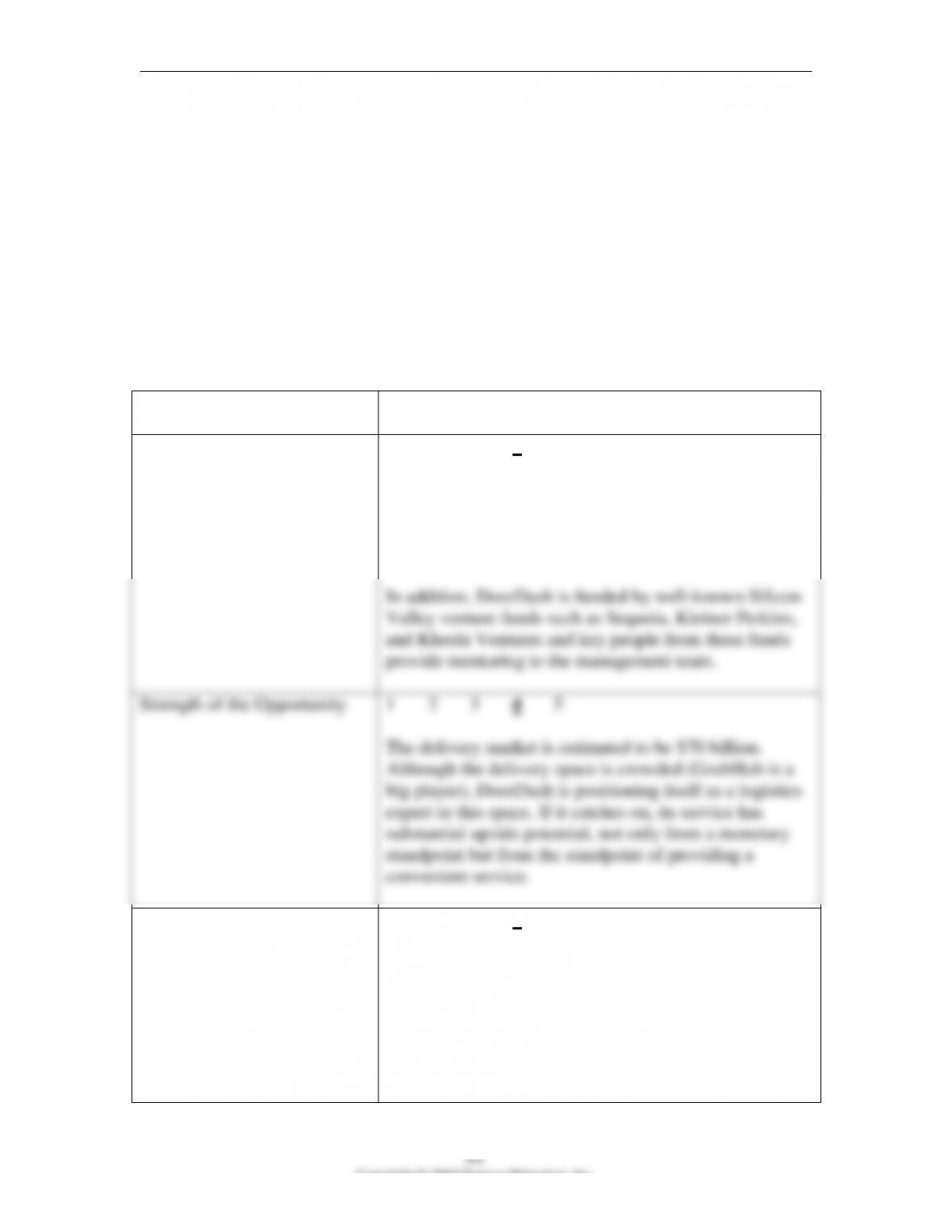
YOU BE THE VC 4.1
Company: DoorDash (www.doordash.com)
Business Idea: Launch an on-demand restaurant delivery service that empowers small
business owners to offer delivery of their food items in an affordable and convenient
manner.
You Be the VC Scorecard
DoorDash
(www.doordash.com)
Item
Score/Comments
Strength of New-Venture
Team
1 2 3 4 5
DoorDash was co-founded by four Stanford University
graduates – Tony Xu, Stanley Tang, Andy Fang, and
Evan Charles Moore. The team has both the technical
and the business experience.
In addition, DoorDash is funded by well-known Silicon
Valley venture funds such as Sequoia, Kleiner Perkins,
and Khosla Ventures and key people from these funds
provide mentoring to the management team.
Strength of the Opportunity
1 2 3 4 5
The delivery market is estimated to be $70 billion.
Although the delivery space is crowded (GrubHub is a
big player), DoorDash is positioning itself as a logistics
expert in this space. If it catches on, its service has
substantial upside potential, not only from a monetary
standpoint but from the standpoint of providing a
convenient service.
Strength of the Industry
1 2 3 4 5
While there are chain restaurants, by and large in a
typical city, the restaurant market is highly fragmented
and the typical independent restaurant does not have the
scale to offer delivery. DoorDash connects customers
with these restaurants and offers delivery service. While
entry barriers are low (it is easy to start a city-specific

Chapter 4: Developing an Effective Business Model
82
delivery service), DoorDash seems to have the
technology platform that start-ups may not have.
Strength of Business Model
1 2 3 4 5
DoorDash has three sources of revenues and regards its
drivers (called “Dashers”) as Uber-type freelancers. The
key aspect of its business model is its technology
platform.
Average Score
4.0/5.0
Decision: We would fund this firm. Although the delivery market is crowded and it’s
hard to get noticed, we believe in DoorDash’s management team and believe that their
service adds sufficient value that they will be noticed and adopted. We also believe in
their business model—that is, relying on three sources of revenues. Because of this
model, there will be very little resistance on the consumer side to using the service. The
restaurants benefit by using the relationship with DoorDash to augment their revenues via
delivery. It’s a win-win-win strategy for the customer, DoorDash, and the restaurants.
YOU BE THE VC 4.2
Company: Zagster (www.zagster.com)
Business Idea: Launch a company that designs, builds, and operates private bike sharing
programs for clients of all sizes, including universities, apartment complexes, hotels,
multi-family communities, and corporate campuses across the United States.
You Be the VC Scorecard
Zagster
(www.zagster.com)
Item
Score/Comments
Strength of New-Venture
Team
1 2 3 4 5
Zagster was founded by Drexel University graduates
Timothy Ericson and Jason Menizer. Prior to Zagster,
Ericson was with Fleming Consulting and Pennoni
Associates, and Menizer was a student. Ericson and
Menizer have built out the Zagster team which now
numbers around 12. The team consists of a nice mix of
people with business and start-up experience.
Chapter 4: Developing an Effective Business Model
Strength of the Opportunity
1 2 3 4 5
The opportunity is moderate. Both cities and private
organizations are launching bike sharing programs.
Zagster does benefit from the environment trend of
people seeking out healthier and fitter lifestyles. It also
ties into the trend of cities, communities, and private
organizations offering more health- and fitness-
enhancing services and amenities to their constituents.
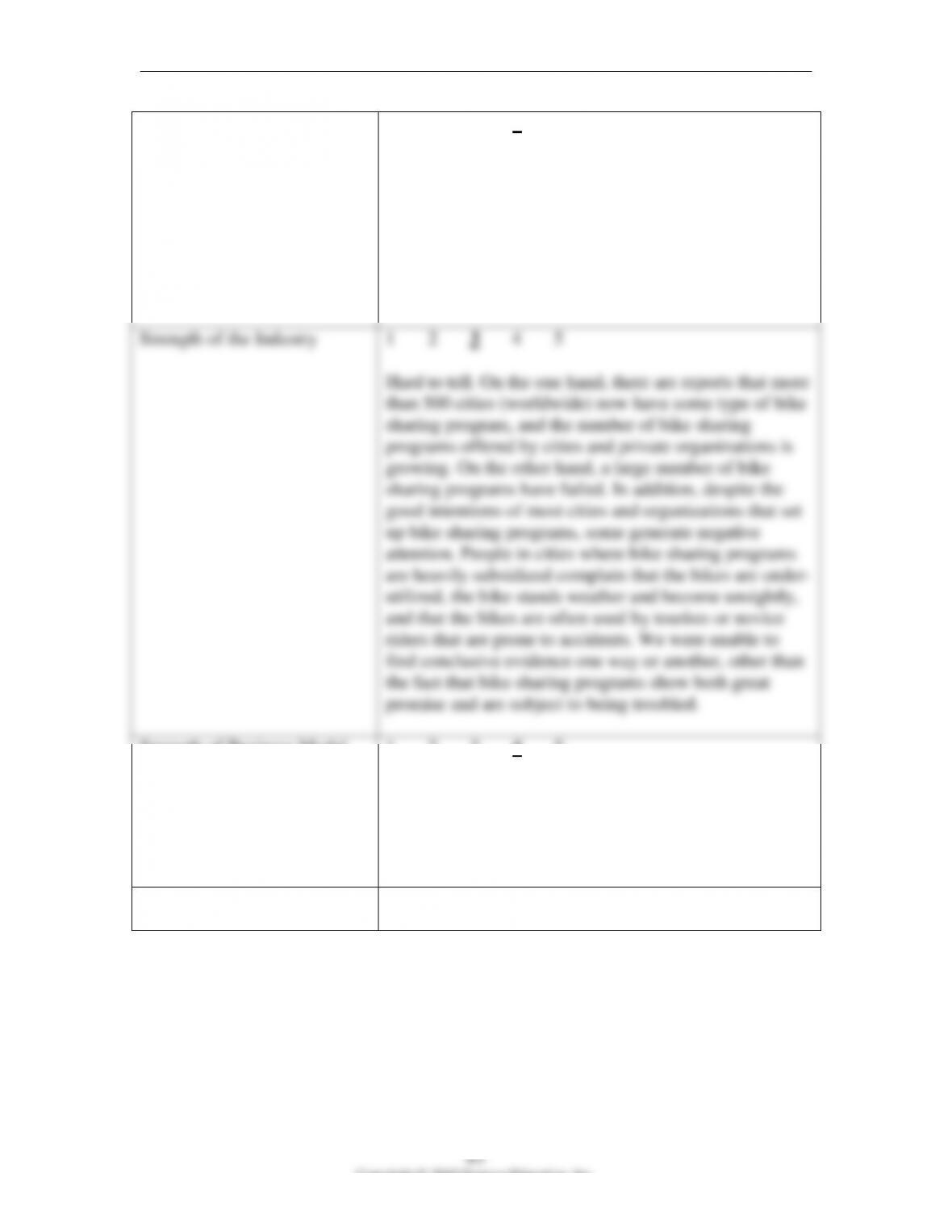
Strength of the Industry
1 2 3 4 5
Hard to tell. On the one hand, there are reports that more
than 500 cities (worldwide) now have some type of bike
sharing program, and the number of bike sharing
programs offered by cities and private organizations is
growing. On the other hand, a large number of bike
sharing programs have failed. In addition, despite the
good intentions of most cities and organizations that set
up bike sharing programs, some generate negative
attention. People in cities where bike sharing programs
are heavily subsidized complain that the bikes are under-
utilized, the bike stands weather and become unsightly,
and that the bikes are often used by tourists or novice
riders that are prone to accidents. We were unable to
find conclusive evidence one way or another, other than
the fact that bike sharing programs show both great
promise and are subject to being troubled.
Strength of Business Model
fee based on the number of bikes installed. It is up to the
client to give away the service or charge a fee.
1 2 3 4 5
Zagster’s business model is fairly straightforward. It
enlists clients to use its service and charges a monthly
Chapter 4: Developing an Effective Business Model
CASES
Case 4.1
Etsy: Breaking Down a Business Model
DISCUSSION QUESTIONS
4-34.
How does Etsy create, deliver, and capture value for its shareholders?
Answer: Etsy’s core strategy is laid out in the case. The company’s mission is to
“re–imagine commerce in ways that build a more fulfilling and lasting world.” To
do this, its basis of differentiation flows from its mission to focus on handmade
goods, the number of buyers and sellers on its site, and the sense of community it
has created. It has two target markets—its sellers and its buyers. Its sellers are the
producers of handmade goods. Its buyers are people drawn to the site because they
want something unique, something that has a story. Etsy’s product/market scope
has expanded since its inception. Although the majority of items are still
handmade, on October 1, 2013, Etsy announced it would allow factory-made
goods on its site (under certain conditions).
4-35.
Is Etsy’s business model a standard or a disruptive business model? Explain your
answer.
Answer: Most students will argue that Etsy does have a disruptive business model.
A disruptive business model is one that does not fit the profile of a standard
business model, and is impactful enough that it disrupts or changes the way
business is conducted in an industry. Most students will agree that it’s fair to say
that Etsy has changed the way people sell handmade items. As a result of Etsy,
people that sell handmade items for the first time have a robust online platform
through which they can establish an online store and make their products available
to a wide population.
4-36.
How is Etsy’s business model different from eBay’s business model for the
makers of handmade goods?
Answer: In regard to basis for differentiation from eBay, the things that
differentiate Etsy are:
Focus on handmade goods
The number of buyers and sellers on its site
The sense of community that it has developed
Chapter 4: Developing an Effective Business Model
Most students will argue that the revenue streams are sustainable. Shoes are not a
one-time purchase. If a person likes the TOMS shoes that they buy, they will
probable buy more (and encourage others to buy TOMS shoes). Coffee is a
consumable product, so if someone likes TOMS coffee they could become a
frequent purchaser. Eyewear is a more infrequent purchase, but may still have an
appeal to a large number of TOMS followers.
4-40.
What key assets does TOMS possess and how sustainable are those assets?
Answer: TOMS’ key assets include the following:
Blake Mycoskie
Corporate culture
Relationships with nonprofits that help TOMS distribute products to
children and people in need
TOMS volunteers
Interns (that work in TOMS facilities)
Campus clubs
Day Without Shoes Campaign
Most students will say that the assets are sustainable. Obviously, Blake Mycoskie
will eventually retire or exit TOMS for another reason. It’s not a stretch to believe
that he’ll be careful to select a replacement that will carry on TOMS’ mission.
4-41.
What are the major challenges TOMS faces as the firm continues implementing its
business model as a means of reaching its mission? Which of these challenges is
the most serious and why?
Answer: TOMS’ major challenges are as follows:
Meeting the criticisms of those that point out flaws in TOMS’ basic
approach. The criticisms include: (1) making people in poor countries
depend on the good will of others, rather than creating opportunities to take
care of themselves; (2) utilizing manufacturing facilities in China and
elsewhere in the world where human rights violations have been
documented; and (3) inadvertently stymieing local entrepreneurship.
Maintaining momentum given the growing number of organizations that
have a social purpose and are competing for the same socially conscious
consumer that TOMS is.
Maintaining a vibrant volunteer network of people who help make its
business model work.