
Chapter 1: Introduction to Entrepreneurship
1
CHAPTER 1
INTRODUCTION TO ENTREPRENEURSHIP
LEARNING OBJECTIVES
After studying this chapter students should be ready to:
1.
Describe entrepreneurship, corporate entrepreneurship, and the characteristics of
entrepreneurial firms.
2.
Discuss three main reasons people decide to become entrepreneurs.
3.
Identify four main characteristics of successful entrepreneurs.
4.
Explain five common myths regarding entrepreneurship.
5.
Discuss the three types of start-up firms.
6.
Discuss the changing demographics of entrepreneurs in the United States.
7.
Discuss the positive effects of entrepreneurship and entrepreneurial firms on
economies and societies.
8.
Explain the entrepreneurial process.
CHAPTER OVERVIEW
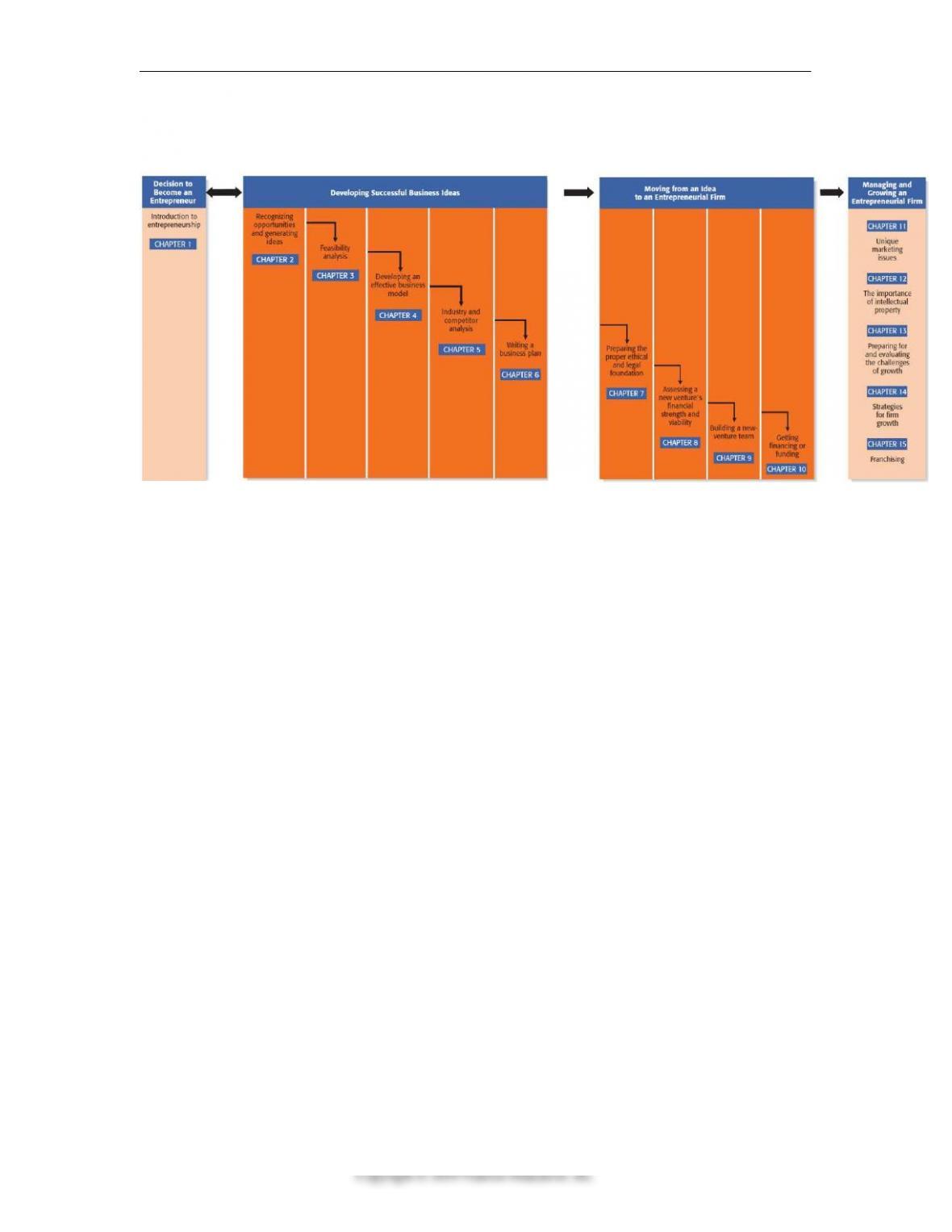
This chapter (1) introduces the book, (2) provides an overview of the entrepreneurial
process, and (3) introduces a conceptual model that shows how the entrepreneurial
process typically unfolds. The model, which is shown at the top of the next page, depicts
the entrepreneurial process as a 10-step process, beginning with the decision to become
an entrepreneur. The chapters of the book follow the model. We hope that this approach
provides your students a nice visual way of understanding how the entrepreneurial
process unfolds.
The chapter focuses on why people become entrepreneurs, the characteristics of
successful entrepreneurs, the changing demographics of entrepreneurs, and the
importance of entrepreneurship to the economy and society. The three boxed features,
which appear in every chapter, are introduced. The chapter ends with a brief discussion of
each of the major sections of the book.
The chapter, like the rest of the book, is written in an upbeat yet realistic manner.
Chapter 1: Introduction to Entrepreneurship
2
Basic Model of the Entrepreneurial Process
The Model Parallels the Chapters in the Book
CHAPTER OUTLINE
CHAPTER OUTLINE
I. Introduction to Entrepreneurship
II. What Is Entrepreneurship and Why Is It Important?
III. Why Do People Become Entrepreneurs?
A. Be Their Own Boss
B. Pursue Their Own Ideas
C. Pursue Financial Rewards
IV. Characteristics of Successful Entrepreneurs
A. Passion for the Business
B. Product/Customer Focus
C. Tenacity Despite Failure
D. Execution Intelligence
V. Common Myths About Entrepreneurs
A. Myth 1: Entrepreneurs Are Born, Not Made
B. Myth 2: Entrepreneurs Are Gamblers
C. Myth 3: Entrepreneurs Are Motivated Primarily by Money
D. Myth 4: Entrepreneurs Should be Young and Energetic
E. Myth 5: Entrepreneurs Love the Spotlight
VI. Types of Start-Up Firms
VII. Changing Demographics of Entrepreneurs
A. Women Entrepreneurs
B. Minority Entrepreneurs
C. Senior Entrepreneurs
D. Millennial Entrepreneurs
VIII. The Positive Effects of Entrepreneurship and Entrepreneurial Firms

Chapter 1: Introduction to Entrepreneurship
3
A. Economic Impact of Entrepreneurial Firms
B. Entrepreneurial Firms’ Impact on Society
C. Entrepreneurial Firms’ Impact on Larger Firms
IX. The Entrepreneurial Process
A. Decision to Become an Entrepreneur (Chapter 1)
B. Developing Successful Business Ideas (Chapters 2–6)
C. Moving from an Idea to an Entrepreneurial Firm (Chapters 7–10)
D. Managing and Growing an Entrepreneurial Firm (Chapters 11–15)
X. Developing Skills for your Career
CHAPTER NOTES
I. Introduction to Entrepreneurship
There is tremendous interest in entrepreneurship around the world.
Although the highest rates of entrepreneurial start-up activity occur in low-
income countries, where good jobs are not plentiful, the rates are also
impressive in high-income countries. According to the GEM Study, 1 out of
every 8 ½ (11.9%) of American adults is actively engaged in starting a
business or is the owner/manager of a business that is less than three-and-a-
half years old.
II. What Is Entrepreneurship and Why Is It Important?
Entrepreneurship is defined as the process by which individuals pursue
opportunities without regard to resources they currently control for the
purpose of exploiting future goods and services.
We want to note here that established firms with an orientation toward acting
III. Why Do People Become Entrepreneurs?
A. Be Their Own Boss. Many entrepreneurs want to be their own boss because
either they have had a long-term ambition to own their own business or they
have become frustrated working in traditional jobs.
B. Pursue Their Own Ideas. Some people are naturally alert, and when they
recognize ideas for new products or services, they have a desire to see those
ideas realized.

Chapter 1: Introduction to Entrepreneurship
4
IV. Characteristics of Successful Entrepreneurs
A. Passion for the Business. The number one characteristic shared by successful
entrepreneurs is passion for the business. This passion typically stems from
the entrepreneur’s belief that the business will positively influence people’s
lives.
B. Product/Customer Focus. An entrepreneur’s keen focus on products and
customers typically stems from the fact that most entrepreneurs are, at heart,
craftspeople.
C. Tenacity Despite Failure. Because entrepreneurs are typically trying
something new, the failure rate associated with their efforts is naturally high.
D. Execution Intelligence. The ability to effectively execute a business idea
means developing a business model, putting together a new-venture team,
raising money, managing finances, leading employees, and so on.
V. Common Myths About Entrepreneurs
A. Myth 1: Entrepreneurs Are Born, Not Made. This myth is based on the
mistaken belief that some people are genetically predisposed to be an
entrepreneur.
B. Myth 2: Entrepreneurs Are Gamblers. Entrepreneurs are usually moderate risk
takers, as are most people.
C. Myth 3: Entrepreneurs Are Motivated Primarily by Money. It is naïve to think
that entrepreneurs don’t seek financial rewards. As discussed previously,
public notice.

Chapter 1: Introduction to Entrepreneurship
5
VI. Types of Start-Up Firms
A. Salary-Substitute Firms. Are small firms that afford their owner or owners a
similar level of income to what they would earn in a conventional job.
1. Examples of salary-substitute firms are dry cleaners, convenience stores,
restaurants, accounting firms, and hairstyling salons.
B. Lifestyle Firms. Provide their owner or owners the opportunity to pursue a
1. Examples of entrepreneurial firms are Dropbox, Facebook, and Uber.
VII. Changing Demographics of Entrepreneurs
A. Women Entrepreneurs. Although men are still more likely to start businesses
than women, the number of women-owned businesses is increasing.
1. The average gross receipts for minority-owned firms was $58,119.
C. Senior Entrepreneurs. The number of seniors (those 50 years of age and older)
starting businesses is substantial and growing. In 2015, 5.4 percent of new
businesses were started by people 62 years and older.
D. Millennial Entrepreneurs. A desire to pursue an entrepreneurial career is high
among young people. According to a Bentley University survey, 66 percent of
millennials have a desire to start their own businesses.
VIII. The Positive Effects of Entrepreneurship and Entrepreneurial Firms
A. Economic Impact of Entrepreneurial Firms. For two reasons, entrepreneurial
behavior has a strong impact on an economy’s strength and stability.

6
1. Innovation. Innovation is the process of creating something new, which is
2. Job creation. According to the SBA, small businesses create a substantial
number of net new jobs in the United States. Firms with 500 or fewer
employees created more than 7 million out of the 11 million new jobs
created during the recent economic recovery.
B. Entrepreneurial Firms’ Impact on Society. The innovations of entrepreneurial
firms have a dramatic impact on society. Think of all the new products and
C. Entrepreneurial Firms’ Impact on Larger Firms. In addition to the impact
entrepreneurial firms have on the economy and society, entrepreneurial firms
have a positive impact on the effectiveness of larger firms.
1. For example, some entrepreneurial firms are original equipment
2. Thus, many exciting new products are not solely the result of the efforts of
3. The evidence shows that many entrepreneurial firms have built their entire
business models around producing products and services that help larger
firms be more efficient or effective.
IX. The Entrepreneurial Process
A. Decision to Become an Entrepreneur (Chapter 1). As discussed earlier, people
become entrepreneurs to be their own boss, to pursue their own ideas, and to
realize financial rewards.
B. Developing Successful Business Ideas (Chapters 2–6). Many new businesses
fail not because the entrepreneur didn’t work hard but because there was no
real opportunity to begin with.

Chapter 1: Introduction to Entrepreneurship
7
1. Developing a successful business idea includes opportunity recognition,
feasibility analysis, developing an effective business model, industry and
1. This section deals with preparing the proper ethical and legal foundation,
assessing a new venture’s financial strength and viability, building a new-
1. This section deals with unique marketing issues, the importance of
intellectual property, preparing for and evaluating the challenges of
growth, strategies for growth, and franchising.
X. Developing Skills for your Career
A. Whether you want to be an entrepreneur or not, the contents of this book
address a number of “employability” skills that are critical to have a
successful career in organizations. Key among these skills are ethics and
social responsibility, critical thinking, collaboration, and data literacy.
BOXED FEATURES: QUESTIONS FOR CRITICAL THINKING
Note: Each boxed feature in the textbook is followed by four questions. The questions
can be used for individual or group assignments or can be used to stimulate classroom
discussion. The following are suggested answers for the questions at the end of each
boxed feature.
What Went Wrong?
Prim: How a Lack of Passion and Resolve Can Kill a Business
1.
Why is passion such a critical part of entrepreneurial success? Prim’s founders
were apparently passionate about building a company but not the laundry
business specifically. In what ways is this combination problematic?
Answer: The number one characteristic shared by successful entrepreneurs is a
passion for their business. The passion typically stems from the entrepreneur’s
belief that the business will positively influence people’s lives. Prim’s founder
may have mistakenly developed a passion for starting a business rather than a

Chapter 1: Introduction to Entrepreneurship
passion for the business they started. This is problematic because once the initial
excitement of starting the business was over (and the business started
experiencing challenges), the founders were left with the day-to-day grind of
running the business and may have found that they weren’t as interested in the
(laundry) business as they originally thought they would be. One way to check
whether one’s passion is real is to work in the industry your firm will participate
in (over an extended period of time, if possible) to see if you like it. Some
franchise organizations, for example, require prospective franchisees to work in
one of the company’s franchise outlets for a period of time, just to ensure that
they like the work before they become franchisees.
As illustrated throughout the book, starting a business is a rewarding yet
challenging process. There will be many ups and downs. A person’s passion for
the business that he or she starts is what sustains one during the challenging
periods.
2.
How could Prim’s co-founders have better anticipated that laundry services
would eventually see Prim as siphoning off their own business and be reluctant
to work with them?
Answer: Students will vary in terms of their answer to this question. One thing
Prim’s co-founders could have done prior to starting the business is complete a
thorough feasibility analysis. This topic is addressed in Chapter 3. By talking to
laundry services in advance, the founders may have gained an awareness that
their business model was not viable.
3.
Rather than employ its own drivers to pick up and deliver laundry for its
customers, Prim relied on the use of third-party delivery services. In what ways
do you think this approach could have limited Prim’s growth in other markets?
Answer: Prim was not developing core competencies in the logistics of its
operations. At its heart, Prim was a pick up and delivery service. It picked up its
customers’ laundry, took the laundry to a laundry service to have washed and
folded, and then returned the laundry to the customer. If Prim had developed
unique capabilities in performing this task, it could have extended its pick up and
delivery service to other industries. Instead, Prim outsourced this service so it
developed no core competencies in this area.
a public locker; Sfwash, a delivery service where you pay by the pound; and
Sudzee (http://sudzee.com). Select the service that you think has the most

Chapter 1: Introduction to Entrepreneurship
Answer: LaundryLocker’s customers place their laundry in a locker and the
customers are notified by text when the laundry is finished and returned to the
locker (within two business days). Sfwash picks up your laundry (at your home
or business) and returns it to the same address. The pick up and delivery times
are done within agreed upon windows of time. Sudzee offers two options. It
offers home pick up and return, similar to Sfwash. It also offers a service where
customers can place their laundry in a large secure container in a Sudzee bag.
Sudzee will notify the customer when the laundry is done. The laundry can be
retrieved from the container via a secure four-digit code. Pricing seems to be
similar across the companies. Sudzee seems to be the best—capturing the
advantages of both Sfwash, which offers a pick up and delivery service, and
LaundryLocker, which offers a dropoff and retrieval service as explained. It also
beats out Prim, which offered only the pick up and delivery service.
Savvy Entrepreneurial Firm
Start-Up Incubators and Accelerators: A Smart Way of Gaining Access to Mentors,
Partners, Investors, and Other Critical Start-Up Resources
1.
If you were starting a new venture, do you think you would benefit from
participating in a business incubator or accelerator program? If so, what do you
think the primary benefits would be?
Answer: Most students will say they would benefit from participating in a
business incubator or accelerator program. The obvious benefits are gaining
access to mentors and advisors. Start-up incubators and accelerators are also
fertile places for entrepreneurs to meet potential co-founders, business partners,
and equity investors.
2.
Find an example of a start-up incubator or accelerator at the college or university
you are attending or in the town you live in or a nearby city. Describe the
program. Which one of the programs mentioned in this feature does it resemble
the most?
Answer: Answers will vary for this question. Many university entrepreneurship
programs support a start-up incubator or accelerator, as do many towns and
cities. The incubators and accelerators will vary in terms of the programs and
terms they offer, but the benefits are similar across locations.
3.
If you have a promising business idea, what can you do while you’re in college
Answer: Answers will vary to this question. Most students will say that
involvement in the following college activities will boost their chances of being
accepted into an incubator:

Chapter 1: Introduction to Entrepreneurship
Coursework in entrepreneurship.
Participation in entrepreneurship-related activities, such as pitch
competitions and business plan competitions, and winning awards in
those activities.
Participating in a college or university-sponsored incubator.
Networking (to the extent that the student could ask several high-profile
entrepreneurs or investors to write letters of support).
Make good headway on a business idea, so the student is partway down
the runway prior to applying for admittance to the incubator.
4.
Make a list of the types of mentors that a participant in a start-up incubator or
accelerator program might encounter.
Answer: There are a number of partnership opportunities that are likely to
emerge from participating in an accelerator program. They include:
Identifying a potential co-founder for a business.
Identifying potential channel partners.
Identifying potential investors.
Identifying potential advisory board members and other mentors and
advisors.
Partnering for Success
Partnering with College Students via Campus Ambassador and Campus Rep Programs
1.
As part of your college experience, do you think you would benefit from
participating in a campus ambassador or campus rep program? Why or why not?
Answer: Most students will say they would benefit from participating in a
campus ambassador or campus rep program. These are more like paid
internships and so the obvious benefits are gaining access to prospective
employers and gaining experience at the same time. In addition, such positions
also help to defray living costs.
2.
In what ways would participating in a campus ambassador or campus rep
program help you prepare to own your own business someday?
Answer: The main way is that a campus ambassador or a campus rep becomes an
evangelist for the product. This helps when marketing the product of one’s own
business. It also helps in creating a network which would be useful in helping a
start-up succeed.
3.
Why do you think companies such as Apple, Flex Watches, and Her Campus

Chapter 1: Introduction to Entrepreneurship
Answer: The companies benefit because they get low cost grassroots marketing.
Also, when a company’s target market is young people, this allows for peer–to–
peer selling. Finally, it helps these companies in their recruitment process.
4.
What types of start-ups would benefit the most from starting campus ambassador
programs?
Answer: It is likely that such programs help companies that sell a product or a
service to consumers and not businesses. In addition, if the target demographic
is young people, these programs help in grassroots marketing.
REVIEW QUESTIONS
1-1.
Do you anticipate that entrepreneurship will continue spreading throughout the
world, or do you think its appeal will subside over time?
Answer: All indicators point to entrepreneurship continuing to spread throughout
the world. The primary reasons are: (1) the downsizing of large firms, which
have placed a large number of people off the job market that would rather start
their own firm than work for another large firm; (2) the push for improved
efficiency and effectiveness on the part of firms and individuals, which has
provided entrepreneurs the opportunity to meet needs; (3) the rapid pace of
change that is taking place worldwide, which provides entrepreneurs additional
opportunities to meet needs; and (4) the increasing recognition that
entrepreneurship is the engine that fuels economic growth and prosperity
worldwide. Most students will argue that there is no reason to think the appeal of
entrepreneurship will subside over time. The need to solve problems and meet
unmet needs is universal worldwide.
1-2.
What key insights does the GEM study provide us about entrepreneurship?
Answer: The key insight provided by the GEM study is that entrepreneurial
activity is taking place across the world. In addition, although the highest rates of
entrepreneurial start-up activities occur in low-income countries, where good
jobs are not as plentiful, the rates are also impressive in high-income countries
such as France, United Kingdom, and the United States. The GEM study also
identifies whether its respondents are starting a new business to take advantage
of an attractive opportunity or because of necessity to earn an income. The
majority of people in high-income countries are drawn to entrepreneurship to
take advantage of attractive opportunities. The reverse is true of people in low-