
Learning Catalytics is a “bring your own device” student engagement, assessment,
and classroom intelligence system. It allows instructors to engage students in class
with realtime diagnostics. Students can use any modern, web–enabled device
(smartphone, tablet, or laptop) to access it. For more information on using Learning
Catalytics in your course, contact your Pearson Representative.
IN-CLASS ACTIVITIES
In-Class Activity 1: Ice-Breaker: Do You Use Accounting?
Activity Overview:
This activity asks students to think about the ways in which they use accounting in their personal
lives.
Time Limit: 20 minutes
What to Do:
1. Ask students to make a list of ways in which they use accounting in their personal lives. They
might want to consider the following questions when making up their lists: (15 minutes)
a. How do you keep track of what money is coming in?
b. How do you keep track of what money is going out?
c. How do you budget your money?
d. How do you plan for unexpected expenditures?
e. What types of “tools” do you use to keep track of your financial information?
f. At later points in your life, do you think you will account for your money differently? If
so, how?
2. Ask students to share any relevant information that might benefit other students in the class.
(5 minutes)
Don’t Forget:
In-Class Activity 2: Class Discussion: Interpreting Financial Statements
Activity Overview:
This activity asks students to determine in which financial statement specific pieces of
information are included.
Time Limit: 20 minutes
What to Do:
2. Ask students to account for each item on a balance sheet or income statement as you reveal
the item; for each item, ask, “Where would this go?” (20 minutes)
In-Class Activity 3: Small-Group Discussion: Annual Reports
Activity Overview:
This activity gives students a chance to review actual financial information from annual reports of
real companies.
Time Limit: 45 minutes
What to Do:
1. In advance, ask students to bring a copy of a recent annual report to class. Make it clear that
2. Divide students into groups of two and ask each group to review one of the annual reports. In
3. Reassemble the class as a whole and ask each group to reveal the financial status of their
selected company. (15 minutes)
In-Class Activity 4: Class Discussion: Choose an Investment
Activity Overview:
This activity asks students to calculate financial ratios and interpret the results.
Time Limit: 30 minutes
What to Do:
1. Ahead of time, ask students to bring an annual report of a corporation of their choice to class.
2. Divide the class into groups of two, asking each group to calculate the following
ratios/information based on information they find in the annual report: (15 minutes)
3. Ask each group to discuss the following questions: (15 minutes)
a. What is the company’s ability to meet currency obligations out of current assets?
b. Is the company likely to be able to repay debts in future years?
c. What might be the size of the dividend that the firm can pay shareholders?
ANSWERS FOR END OF CHAPTER ACTIVITIES
QUESTIONS FOR REVIEW
15-1. Who are the users of accounting information and for what purposes do they use it?
Business managers use accounting information to develop goals and plans, set budgets, and
evaluate future prospects. Employees and unions use it to plan for and receive compensation
15-2. Identify the three types of services performed by CPAs.
15-3. Explain the ways in which financial accounting differs from managerial accounting.
Financial accounting is concerned with external information users—the firm’s external
15-4. Discuss the activities and services performed by forensic accountants.
Forensic accountants may be called on—by law enforcement agencies, insurance companies,
15-5. What are the three basic financial statements, and what major information does each
contain?
The balance sheet reflects a firm’s financial condition at one point in time by supplying
QUESTIONS FOR ANALYSIS
15-6. If you were planning to invest in a company, which of the three types of financial
statements would you most want to see? Why?
Balance sheets and statements of cash flow both provide a piece of the picture. Balance sheets
15-7. Use the accounting equation to determine your net worth. Identify your assets and
liabilities. With this information, how would you increase your net worth in the future?
You should encourage students to carefully examine their current assets and liabilities, fixed
15-8. Consider possible reasons it is taking so long for IASB’s accounting standards to become
fully adopted for use in the United States. Using the Internet as your source for information,
identify three or more barriers that have deterred implementation of the standards, and explain
how (or why) each has (or is) causing implementation delays.
APPLICATION EXERCISES
15-9. Interview an accountant at a local business, nonprofit organization, or government entity.
How does the firm use budgets? How does budgeting help managers plan business activities?
How does budgeting help them control activities? Give examples.
Answers will vary, but students will probably recognize that firms sometimes develop budgets
15-10. Interview the manager of a local retailer, wholesale business, or manufacturing firm about
the role of ethics in that company’s accounting practices. Is ethics in accounting an important
issue to the manager? If the firm has its own private accountants, what measures are taken for
ensuring ethical practices internally? What steps, if any, does the company take to maintain
ethical relationships in its dealings with CPA firms?
Copyright © 2019 Pearson Education, Inc.
15–22
Answers will vary, though most managers will attest that ethics are an extremely important
consideration in their company’s accounting practices. Likely all those managers interviewed
will mention their recipes for ensuring internal ethical practices. (Learning Objective 6 –
AACSB – application of knowledge, reflective thinking)
BUILDING A BUSINESS: CONTINUING TEAM EXERCISE 15-11 TO 15-15
(Learning Objectives 1, 2, and 3 – AACSB – interpersonal relations and teamwork,
analytical and reflective thinking, application of knowledge)
In this assignment, the team will have the opportunity to see how they will use the three main
financial statements, how choices impact their cash flow statement, understand the role
financial data plays in creating a successful business, the role financial documents play in
obtaining credit, and who on the team will be responsible for creating and maintaining the
necessary data.
TEAM EXERCISE: AN AMERICAN LEGEND 15-16 TO 15-19
(Learning Objectives 1, 3, and 5 – AACSB – interpersonal relations and teamwork,
application of knowledge)
Answers will vary somewhat depending on what three-year-period is used. Students must use the
equations provided to determine ratios, and perform other calculations, and recognize trends.
15-16. Looking at Macy’s income statement, what has been the trend in sales (total revenue) as
well as net income over the past three years?
15-17. As you have learned, gross profit is the difference between sales (or total revenues) and
cost of sales (or cost of revenues). Gross profit percentage is calculated by dividing gross
profit by sales (or total revenues). What is Macy’s gross profit percentage for the last three
years? What does this data tell you about Macy’s pricing strategy and costs?
15-18. Looking at the balance sheet, what is Macy’s current ratio for the three most recent years?
What is the significance of these numbers? Have they been improving or getting worse?
15-19. What is the relationship between the price of Macy’s stock and earnings? What are the
earnings per share for each of the past three years, and what does that number mean to
investors?
EXERCISING YOUR ETHICS: GIVE AND TAKE WITH ACCOUNTING CLIENTS
(Learning Objective 6 – AACSB – ethical understanding and reasoning, reflective thinking)
15-20. What are the ethical issues in this situation?
15-21. What are the basic arguments for and against Aaron Ault’s position in this situation? For
and against Katrina Belinski’s position?
Aaron’s argument is that he is trying to reduce his tax bill and since the work was done
towards the end of the year and the payment was possibly received in the current year, he does
15-22. What do you think that Ault and Belinski should do in this situation?
Answers will vary, but most students will agree that Katrina completed the work correctly and
CASES:
CSI: WALL STREET
(Learning Objective 1 – AACSB – ethical understanding and reasoning, reflective thinking)
15-23. What factors do you think are most important in choosing among various methods to
protect against fraud in a firm?
15-24. Suppose you are hoping for a career as a CFE. How do recent trends in fraud provide new
opportunities for such a career?
15-25. An external auditor, such as a CPA firm’s accountant, may suspect some irregularities in a
client firm’s accounting practices. In what ways might a CFE be of assistance?
A CFE would have more expertise in pursuing and finding the fraud. The examiner has
15-26. Consider the anti–fraud training for a company’s employees and create an agenda that
Copyright © 2019 Pearson Education, Inc.
15–24
The training should include asset theft, review of financial statements, checking
documentation, inventory review, cash accounts, revenue recognition, and activity timing, etc.
15-27. What ethical issues, if any, are involved in a decision to investigate a suspected case of
fraud in a firm’s accounting activities?
The broad scope of fraud—its costs, who commits it and how, and how it is detected—might
affect the decision to investigate a fraud case. The purpose of ethics in accounting is to
FUTURE DIRECTIONS FOR THE MODERN ACCOUNTANT
(Learning Objectives 1, 6, and 7 – AACSB – ethical understanding and reasoning, reflective
thinking)
15-28. In what ways, if any, does the discussion in this case apply to managerial accountants
rather than to CPAs? Explain your response.
15-29. In what ways, if any, does the discussion in this case apply to forensic accountants rather
than to CPAs? Explain your response.
15-30. Consider the restrictions on CPA services by provisions of the Sarbanes-Oxley Act
(Sarbox). In what ways, if any, does this case’s description of the modern accountant’s
activities conflict with Sarbox? Explain your response.
15-31. Ethics has a long-standing role in the accounting profession. Will the emerging role of the
modern accountant bring with it a greater emphasis on ethics (as compared with traditional
accounting)? Explain.
CRAFTING A BUSINESS PLAN
PART 5: MANAGING INFORMATION
Assignment Overview:
The fifth part of the business plan project asks students to think about their business in terms of
their business needs and costs. Specifically, students are asked to determine their IT needs and
resources and are asked to complete a balance sheet and an income statement for their business.
Many students find this part of the plan especially challenging, and will have trouble estimating
their costs. Remind them that the values they calculate in this part of the plan are estimates, and
there is no surefire method for accurately measuring how a business may perform. You may want
to spend some class time going over each question in this part of the plan and create a list of
sources that students can use when calculating their costs.
Files to Provide Students:
If you would like students to complete a balance sheet and an income statement for their
Part 5 Estimated At-Home Completion Time:
If done well, this section will require a minimum of 3 to 5 hours. Instructor feedback is critical in
Homework Deliverable from Students:
The length of this section should be somewhat consistent, although some variance can be
STUDENT BUSINESS PLAN PROJECT TEMPLATE
PART 5: MANAGING INFORMATION
IT RESOURCES
What kind of IT resources will your business require?
Hint: Think about the employees in your business and what they will need in order to do their
jobs. What computer hardware and software will they need? Will your business need a network
CUSTOMER SERVICE
How will you use information technology to keep track of your customers and potential
customers?
Hint: Many businesses—even small businesses—use databases to keep track of their customers.
Will your business require a database? What about other information systems? Refer to Chapter
COSTS OF DOING BUSINESS
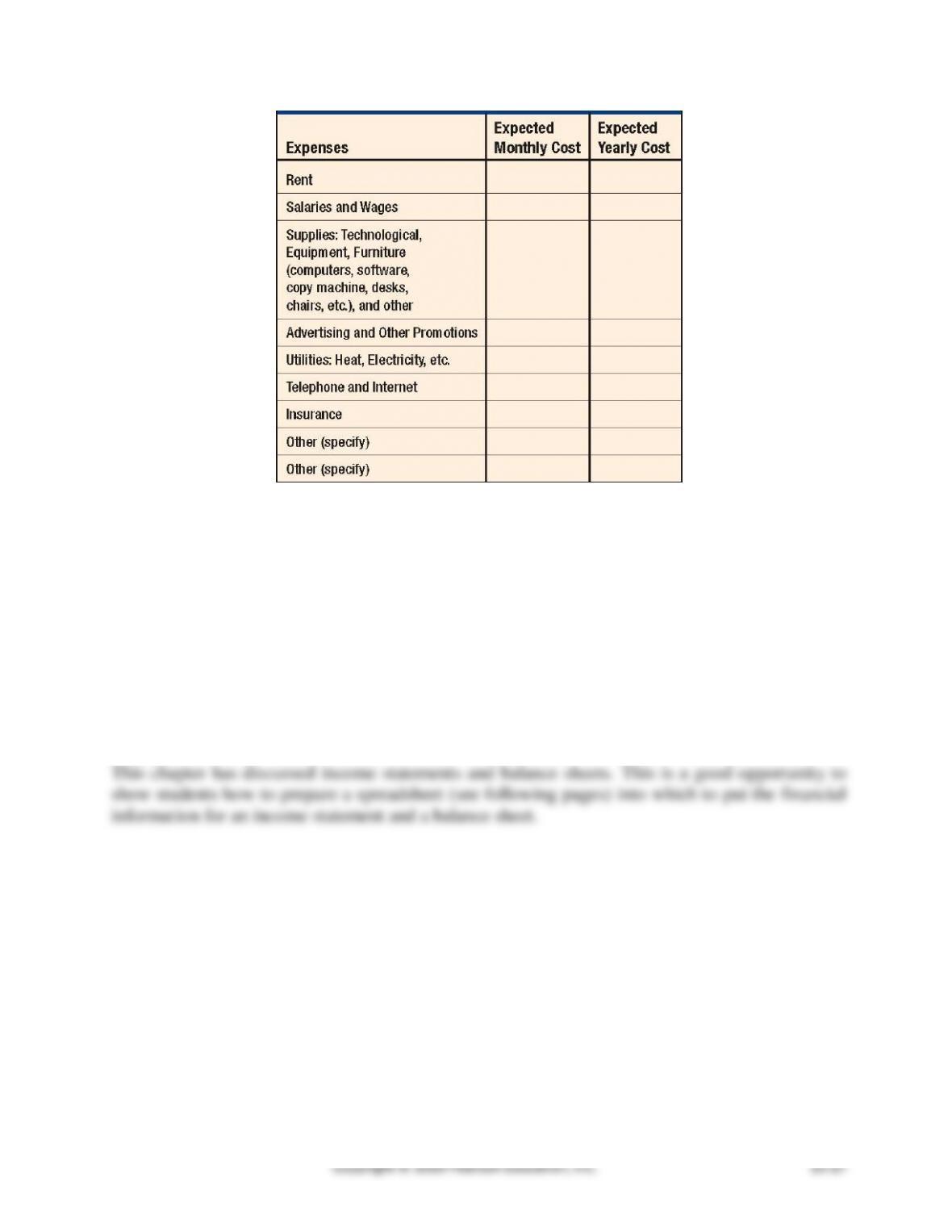
What are the costs of doing business? Equipment, supplies, salaries, rent, utilities, and
insurance are just some of these expenses. Estimate what it will cost to do business for one
year.
Hint: Insert the costs associated with doing business in the table below. The list below provides
some hints as to where you can get this information. Note that these are just estimates—just try
your best to include accurate costs for the expenses you think will be a part of doing business.
HINTS FOR EACH EXPENSE IN THE TABLE:
Rent: Refer to the floor plan. How many square feet is your place of business? What is the “going
rate” per square foot for office space in your community? A real estate agent or a local SBA
representative (www.sba.gov) can also be helpful in answering this question.
Salaries: Refer to the organizational chart. How much will each employee earn? How many
Supplies: Refer to the floor plan. How much will all the computers, equipment, and furniture
cost? What kinds of general office supplies will you need? Most prices for this information can be
found on an office supply Website, such as www.staples.com.
Advertising and Other Promotions: Refer to your marketing section. You have described how
you wish to reach your customer—now you need to decide how much it will cost. If you are using
Utilities: These amounts will vary, depending on your business and what utilities you will pay. If
EXPECTED REVENUE
How much will you charge for your product? How many products do you believe you can
sell in one year (or how many customers do you think your business can attract)? Multiply
the price you will charge by the number of products you hope to sell or the amount you
hope each customer will spend. This will give you an estimate of your revenues for one
year.
Hint: You will use the amounts you calculate in the costs and revenues questions in this part of
the plan in the accounting statements in the next part, so be as realistic as you can.
INCOME STATEMENT AND BALANCE SHEET
Create a balance sheet and an income statement (profit-and-loss statement) for your
business.
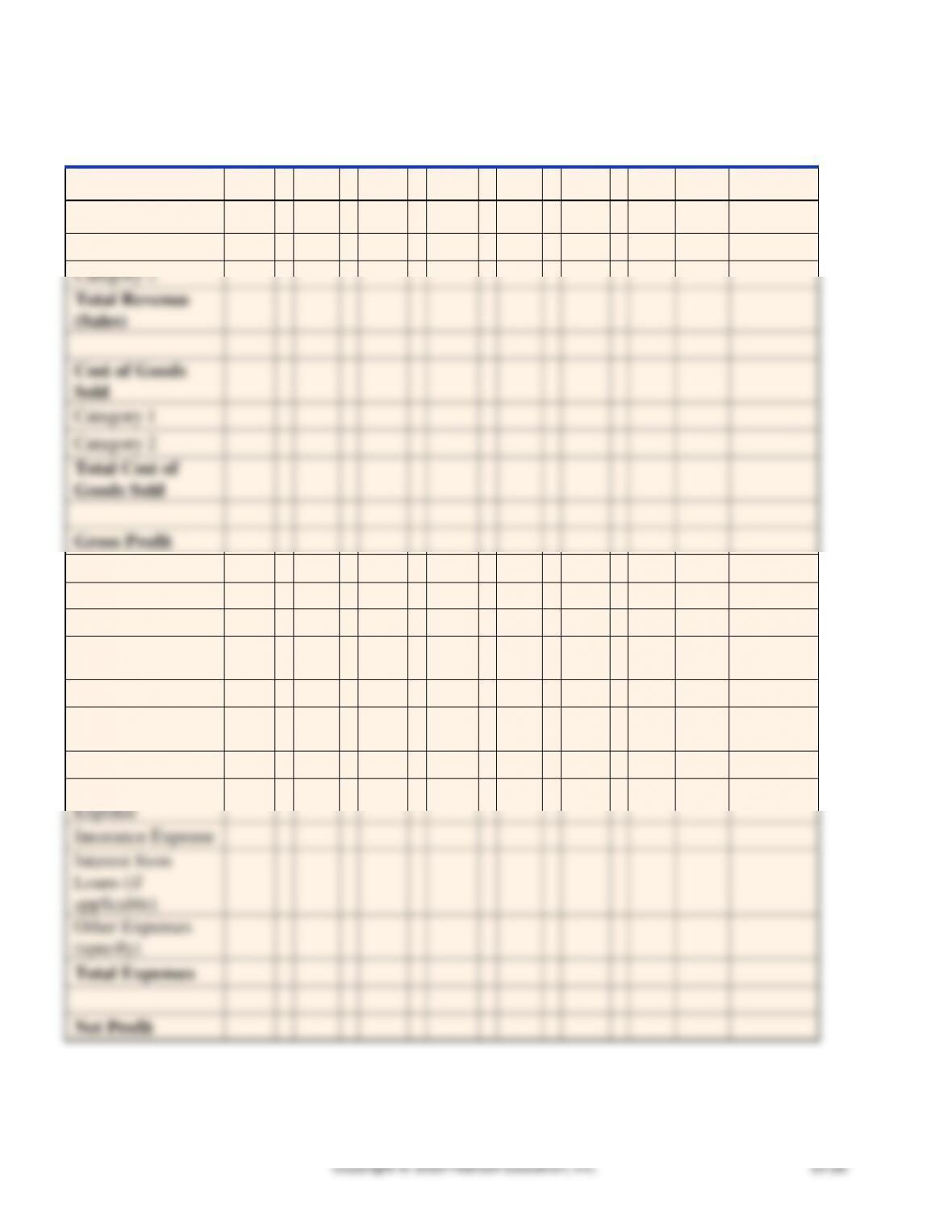
Income Statement (Profit-and-Loss Statement)
June
July
Aug.
Sept.
Oct.
Nov.
Dec.
……
YEARLY
Revenue (Sales)
Category 1
Category 2
Total Revenue
(Sales)
Cost of Goods
Sold
Category 1
Category 2
Total Cost of
Goods Sold
Gross Profit
Expenses
Rent Expense
Salary/Wage
Expenses
Supplies Expense
Advertising
Expense
Utilities Expense
Telephone/Internet
Expense
Insurance Expense
Interest from
Loans (if
applicable)
Other Expenses
(specify)
Total Expenses
Net Profit
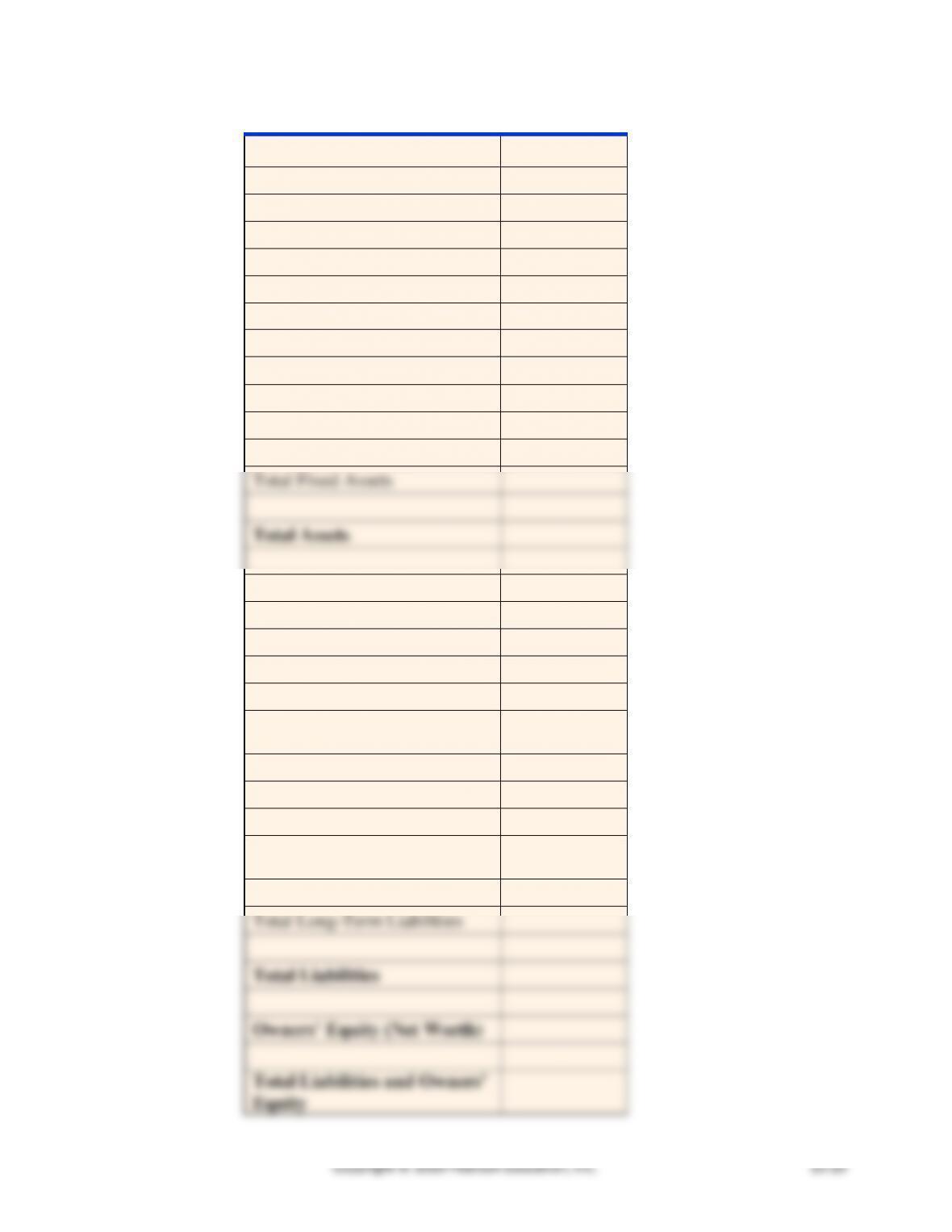
Balance Sheet
Assets
Current Assets
Cash
Cash Value of Inventory
Prepaid Expenses (insurance)
Total Current Assets
Fixed Assets
Machinery and Equipment
Furniture and Fixtures
Real Estate/Buildings
Total Fixed Assets
Total Assets
Liabilities and Net Worth
Current Liabilities
Accounts Payable
Taxes Payable
Notes Payable (due within 12
months)
Total Current Liabilities
Long-Term Liabilities
Bank Loans Payable (greater
than 12 months)
Less: Short-Term Portion
Total Long-Term Liabilities
Total Liabilities
Owners’ Equity (Net Worth)
Total Liabilities and Owners’
Equity
ACTIVITIES ON MYBIZLAB – INSTRUCTOR TIPS
BizSkills: OBM & Financial Statements
Instructor Tips Available at: mybizlab.com