333
Ans.
a=0.153 L
334
7–15. Solve Prob. 7–14 using the conjugate-beam method.
Ans.
a=0.153 L
SOLUTION
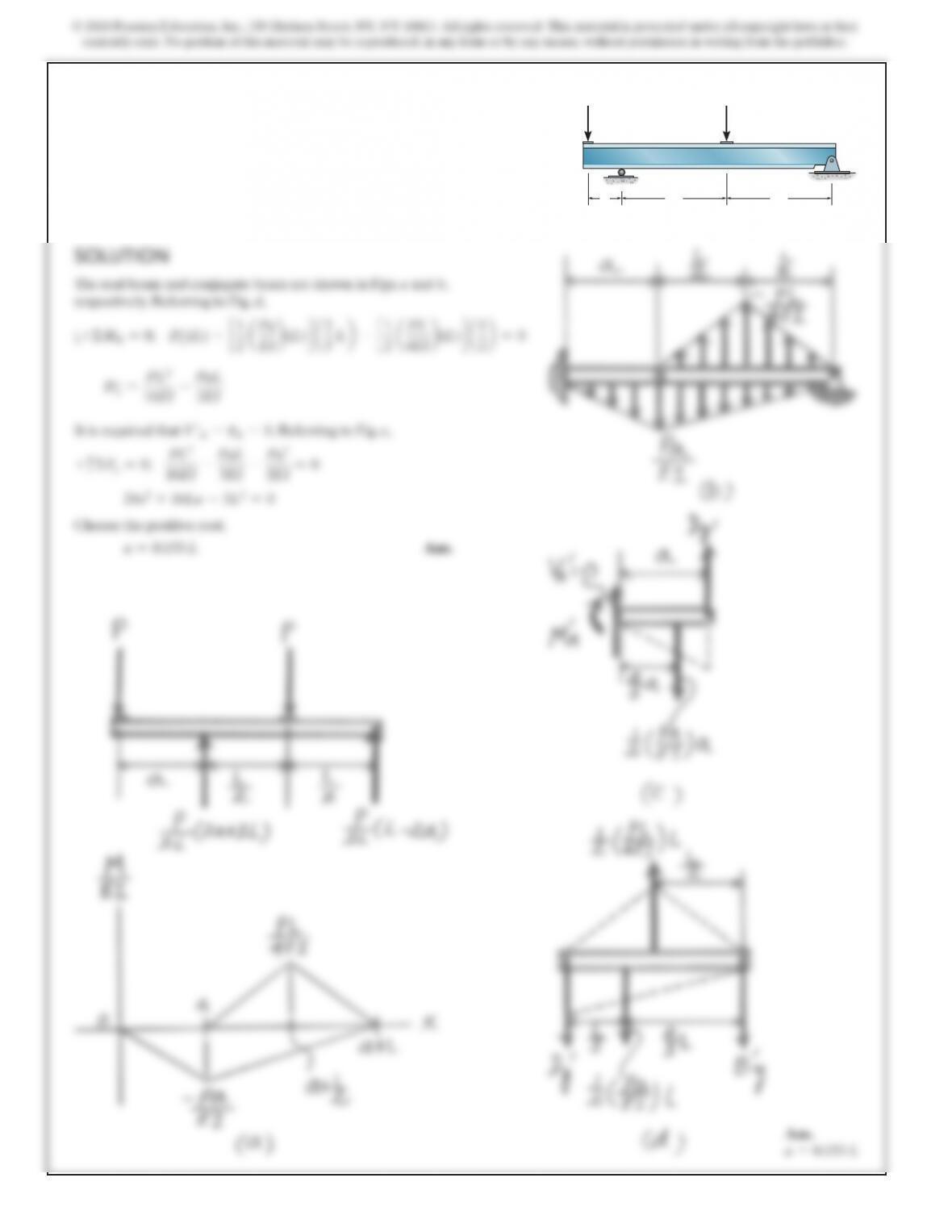
The real beam and conjugate beam are shown in Figs. a and b,
respectively. Referring to Fig. d,
a
+ΣMB=0;
D′
y(L)+
c1
2
aPa
EI b
(L)
da2
3
L
b
–
c1
2
aPL
4EI b
(L)
da1
2b
=
0
D′
y=
PL2
16EI
–
PaL
3EI
It is required that
V′A=uA=0
. Referring to Fig. c,
+
c
ΣFy=0;
PL2
16EI
–
PaL
3EI
–
Pa2
2EI
=
0
24a2+16La –3L2=0
Choose the positive root.
a=0.153 L
Ans.
A
D
P
B
C
P
aL
__
2
L
__
2
335
Ans.
a
=
L
3
3
336
Ans.
a=
L
3
3
337
EI
339
Ans.
∆C=
84
EI
T
uA=
8
EI
B
uB=
16
EI
A
uC=
40
EI
A
SOLUTION
t
B
>
A=
1
2
a–8
EI b
(6)(2) =
–48
EI
t
C
>
A=
1
2
a–8
EI b
(6)(3 +2) +
a–8
EI b
(3)(1.5) =
–156
EI
∆C=
0
tC
>
A
0
–
9
6
0
tB
>
A
0
=
156
EI
–
9(48)
6(EI)
=
84
EI
T Ans.
u
A=
0
tB
>
A
0
6
=
8
EI
B
Ans.
u
B
>
A=
1
2
a–8
EI b
(6) =
–24
EI
=
24
EI
A
uB=uB>A+uA
u
B=
24
EI
–
8
EI
=
16
EI
A
Ans.
u
C
>
A=
1
2
a–8
EI b
(6) +
a–8
EI b
(3) =
–48
EI
=
48
EI
A
uC=uC>A+uA
u
C=
48
EI
–
8
EI
=
40
EI
A
Ans.
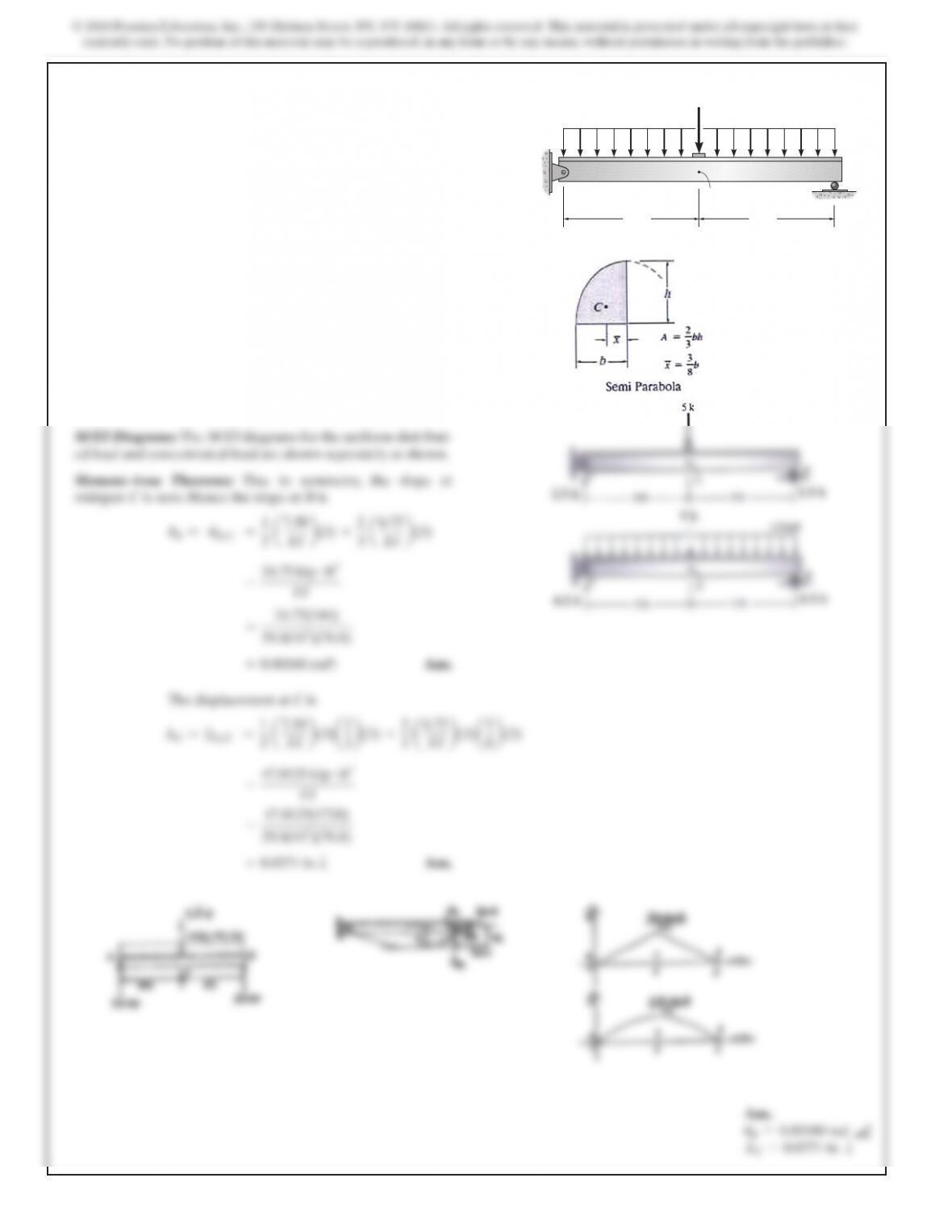
*7–20. Use the moment-area theorems and determine the
displacement at C and the slope of the beam at A, B, and C. EI
is constant.
8 kN
?
m
A
C
B
6 m 3 m
341
EI
342
Ans.
u
C=
840 k #ft2
EI
∆C=
5130 k #ft3
EI
T
EI
EI
300 k #ft2
EI
u
345
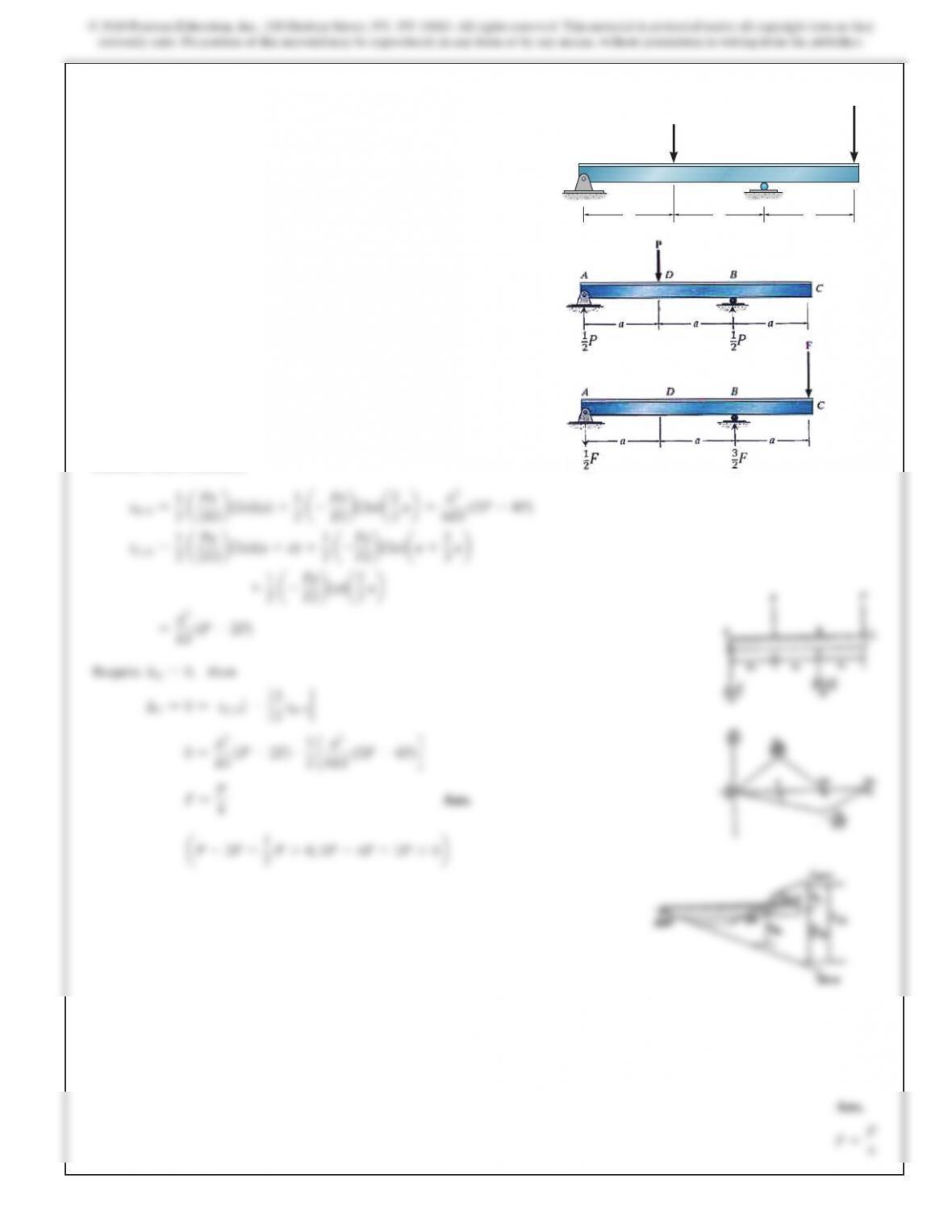
7–26. The beam is subjected to the load P as shown. Use the
moment-area theorems and determine the magnitude of force
F that must be applied at the end of the overhang C so that the
displacement at C is zero. EI is constant.
SOLUTION
Support Reactions and Elastic Curve: As shown.
M/EI Diagram: As shown.
Moment-Area Theorems:
t
B
>
A=
1
2
aPa
2EI b
(2a)(a)+
1
2
a
–
Fa
EI b
(2a)
a2
3
a
b
=
a3
6EI
(3P–4F
)
t
C
>
A=
1
2
aPa
2EI b
(2a)(a+a)+
1
2
a
–
Fa
EI b
(2a)
a
a+
2
3
a
b
+
1
2
a
–
Fa
EI b
(a)
a2
3
a
b
=
a3
EI
(P–2F
)
Require
∆C=0
, then
∆C=0=
0
tC
>
A
0
–
`3
2
tB
>
A
`
0
=
a3
EI
(P–2F)–
3
2
ca3
6EI
(3P–4F)
d
F
=
P
4
Ans.
a
P–2F=
1
2
P70, 3P–4F=2P70
b
Ans.
F
=
P
4
a a a
BDA
C
P
F