208
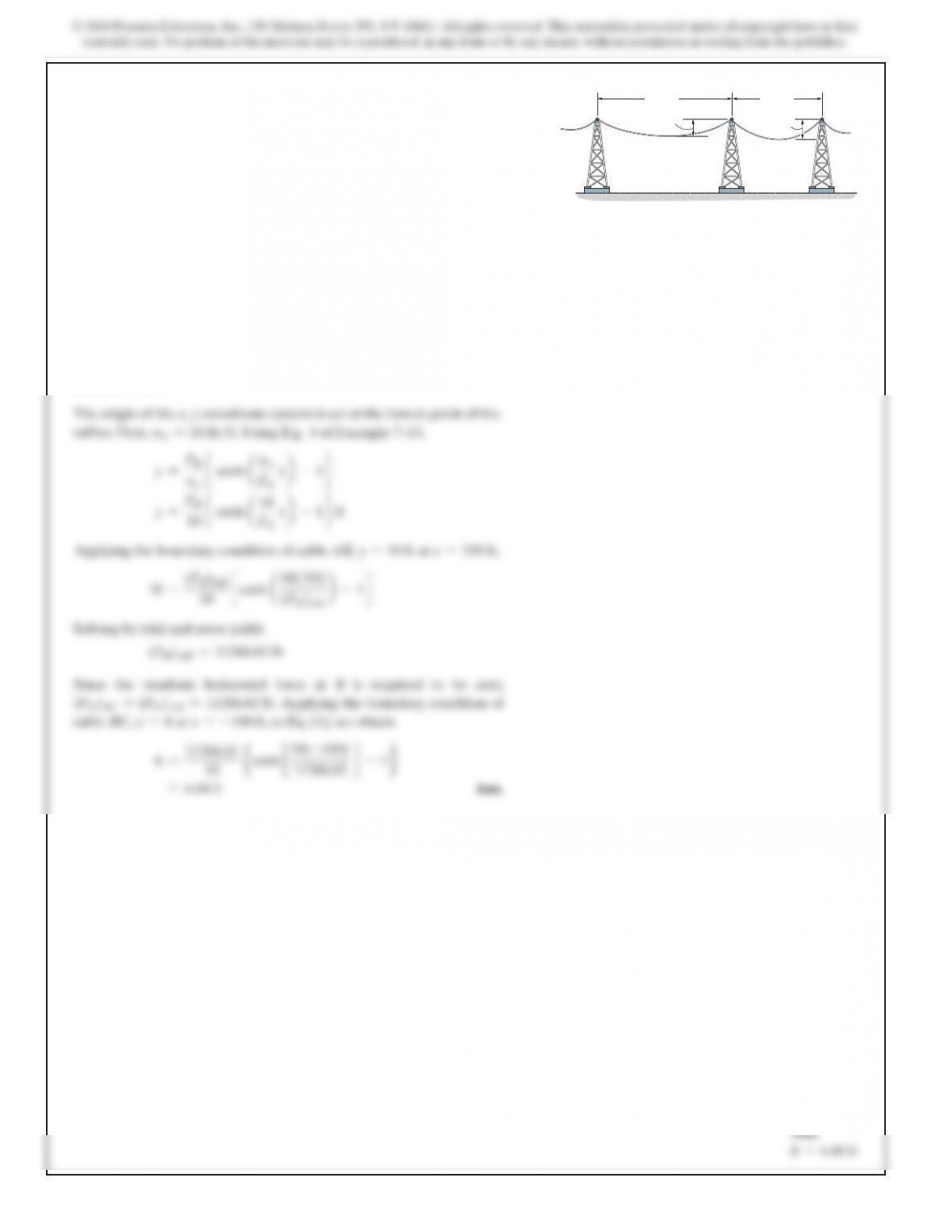
5–21. The power transmission cable weighs
10
lb>ft
. If the
resultant horizontal force on tower BD is required to be zero,
determine the sag h of cable BC.
AB
hC
D
300 ft
10 ft
200 ft
SOLUTION
Ans.
h=4.44 ft
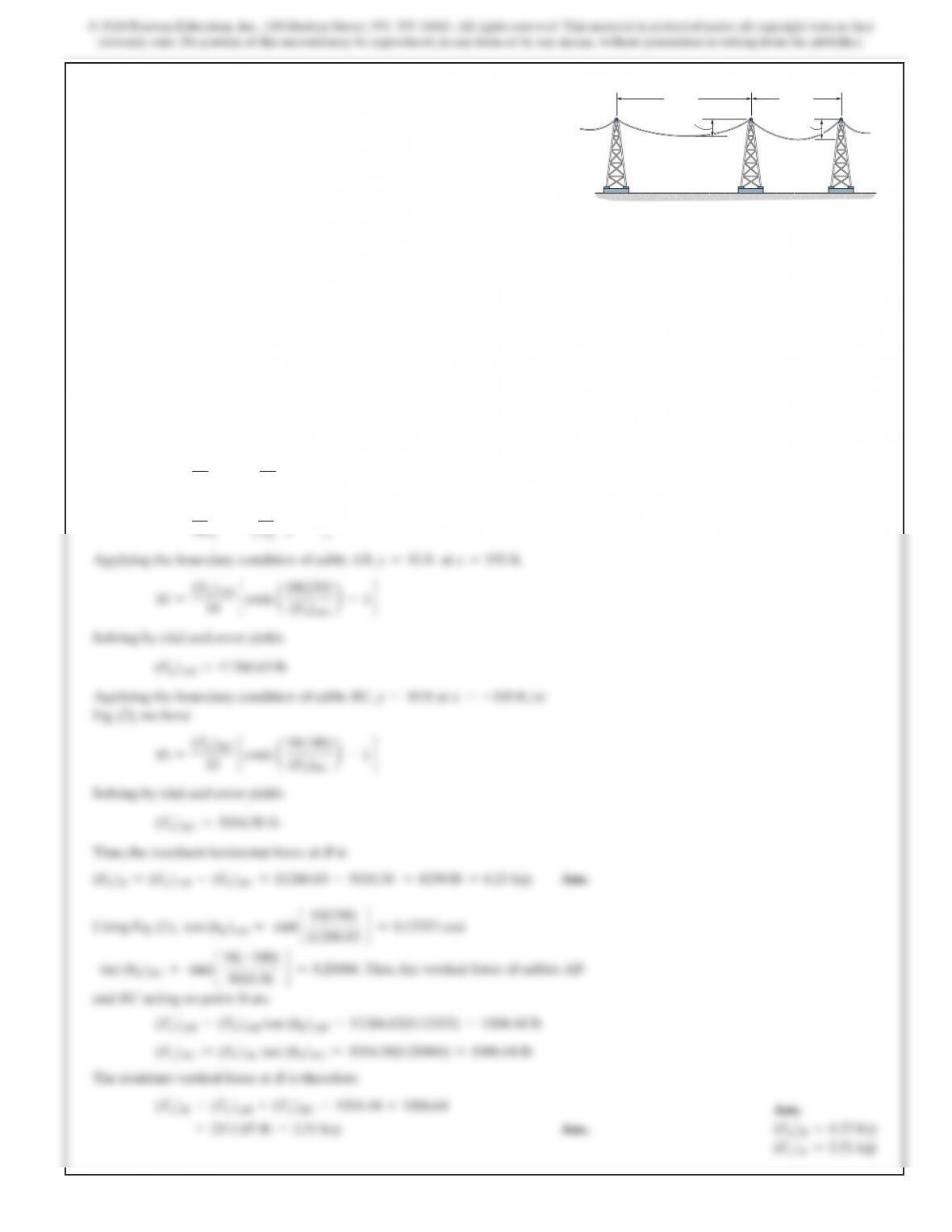
5–22. The power transmission cable weighs
10
lb>ft
. If
h=10
ft
, determine the resultant horizontal and vertical
forces the cables exert on tower BD.
AB
hC
D
300 ft
10 ft
200 ft
SOLUTION
The origin of the x, y coordinate system is set at the lowest point of the cables.
Here,
w0=10 lb>ft.
Using Eq. 4 of Example 7–13,
y=
F
h
w0
c
cosh
aw
0
Fh
x
b
–1
d
y=
F
h
10
c
cosh
a10
Fh
x
b
–1
d
f
t
210
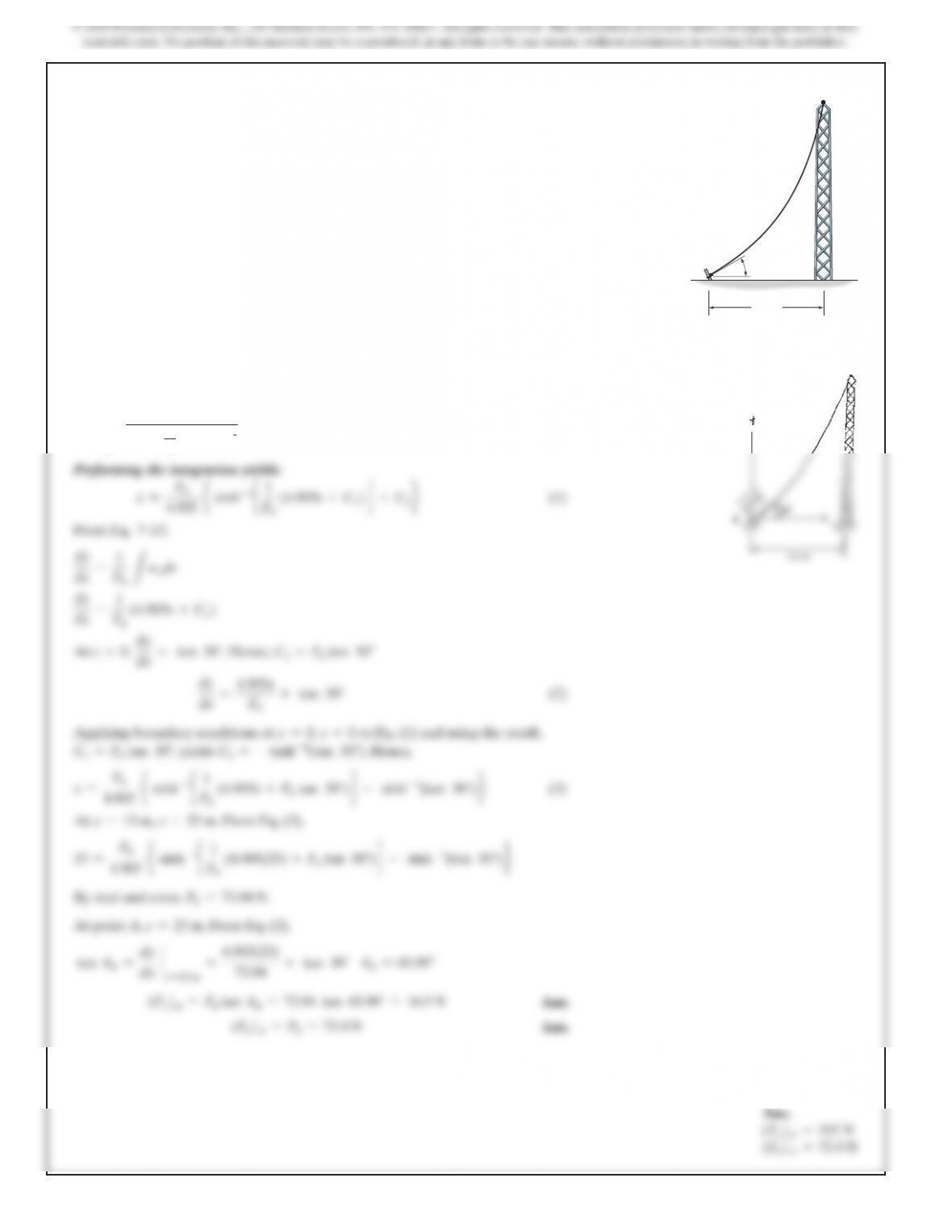
5–23. The cable has a mass of
0.5
kg>m
and is 25 m long.
Determine the vertical and horizontal components of force it
exerts on the top of the tower.
308
B
A
15 m
SOLUTION
x=
L
ds
5
1+1
F
2
h
(wods)2
6
1
2
(Fh2A=Fh=73.9 N
Ans.
(Fy2A=165 N
(Fh2A=73.9 N
Ans.
211
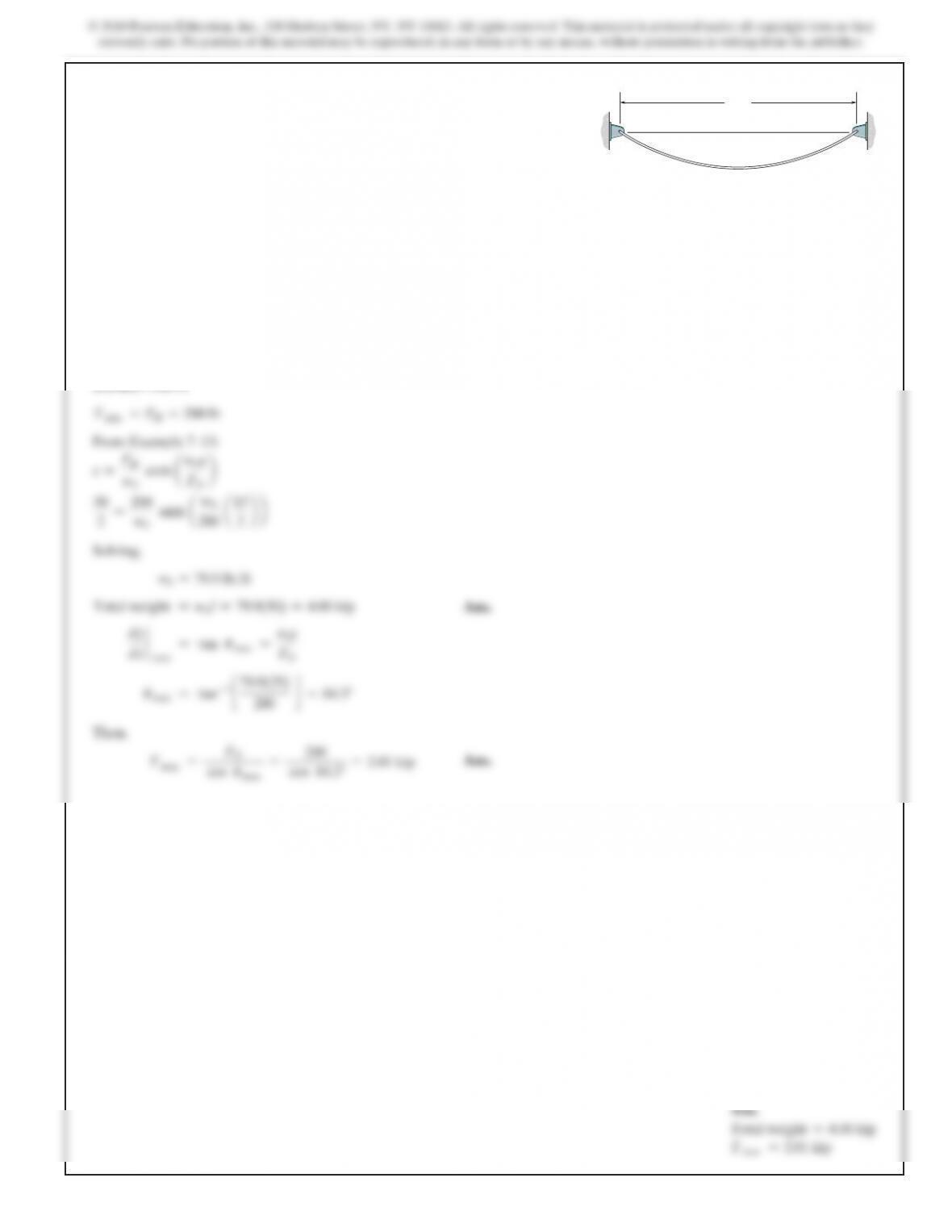
*5–24. The cable of length
ℒ=50
ft
is suspended between
two points A and B a distance of 15 ft apart. If the minimum
tension in the cable is 200 lb, determine the total weight of the
cable and the maximum tension developed in the cable. AB
15 ft
SOLUTION
T min =FH=200 lb
From Example 7–13:
s
=
F
H
w0
sinh
aw
0
x
FHb
50
2
=
200
w0
sinh
aw
0
200
a15
2bb
Solving,
w0=79.9 lb>ft
Total weight =w0l=79.9(50) =4.00 kip
dy
dx ` max
= tan u max =
w
0
s
FH
u max = tan–1
c79.9(25)
200
d
=84.3°
Then,
T max =
F
H
cos u max
=
200
cos 84.3°
=2.01 ki
p
Ans.
Total weight =4.00 kip
T max =2.01 kip
Ans.
Ans.
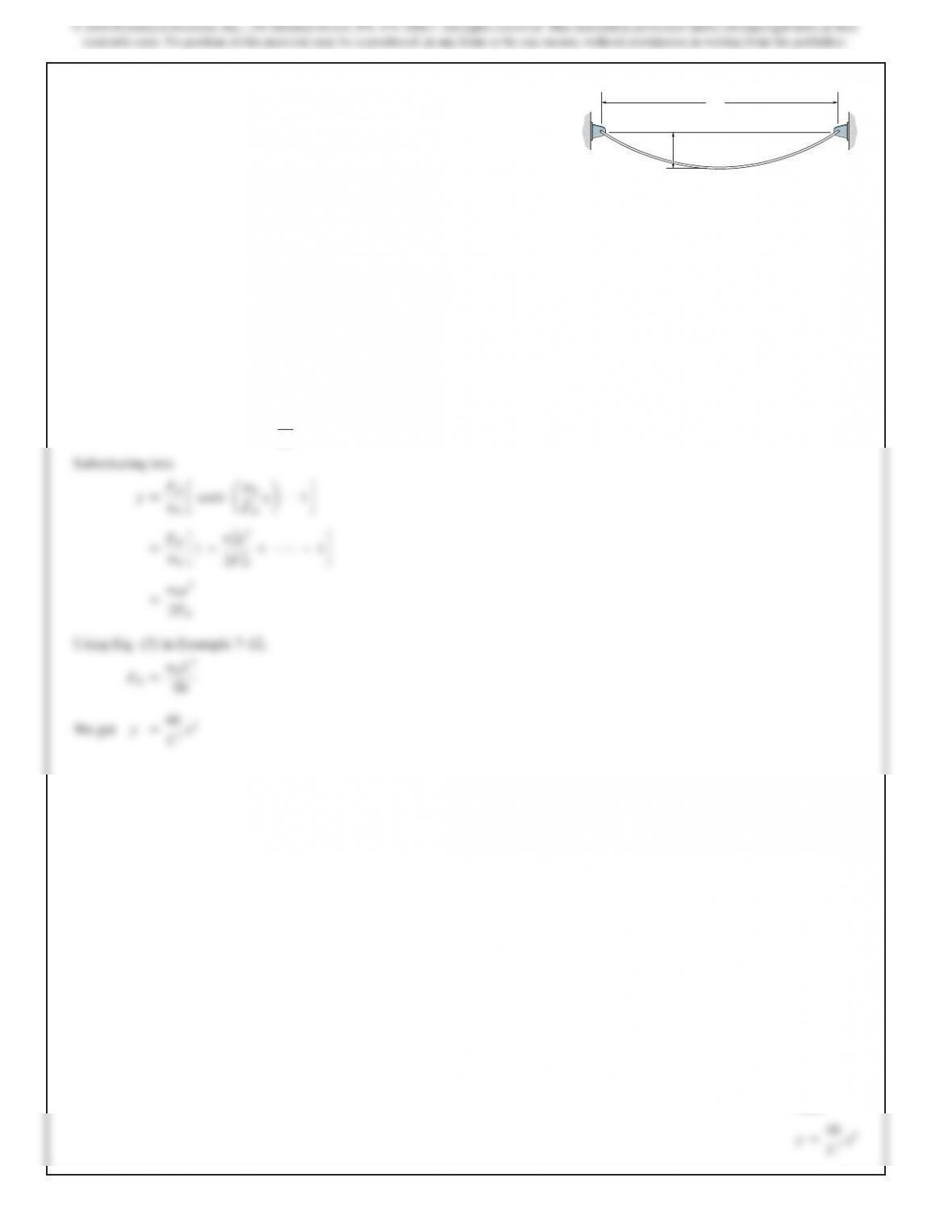
5–25. Show that the deflection curve of the cable discussed in
Example 5.4 reduces to Eq. 5–9 when the hyperbolic cosine
function is expanded in terms of a series and only the first two
terms are retained. (The answer indicates that the catenary
may be replaced by a parabola in the analysis of problems in
which the sag is small. In this case, the cable weight is assumed
to be uniformly distributed along the horizontal.)
SOLUTION
cosh x=1+
x2
21
+
g
AB
L
h
213
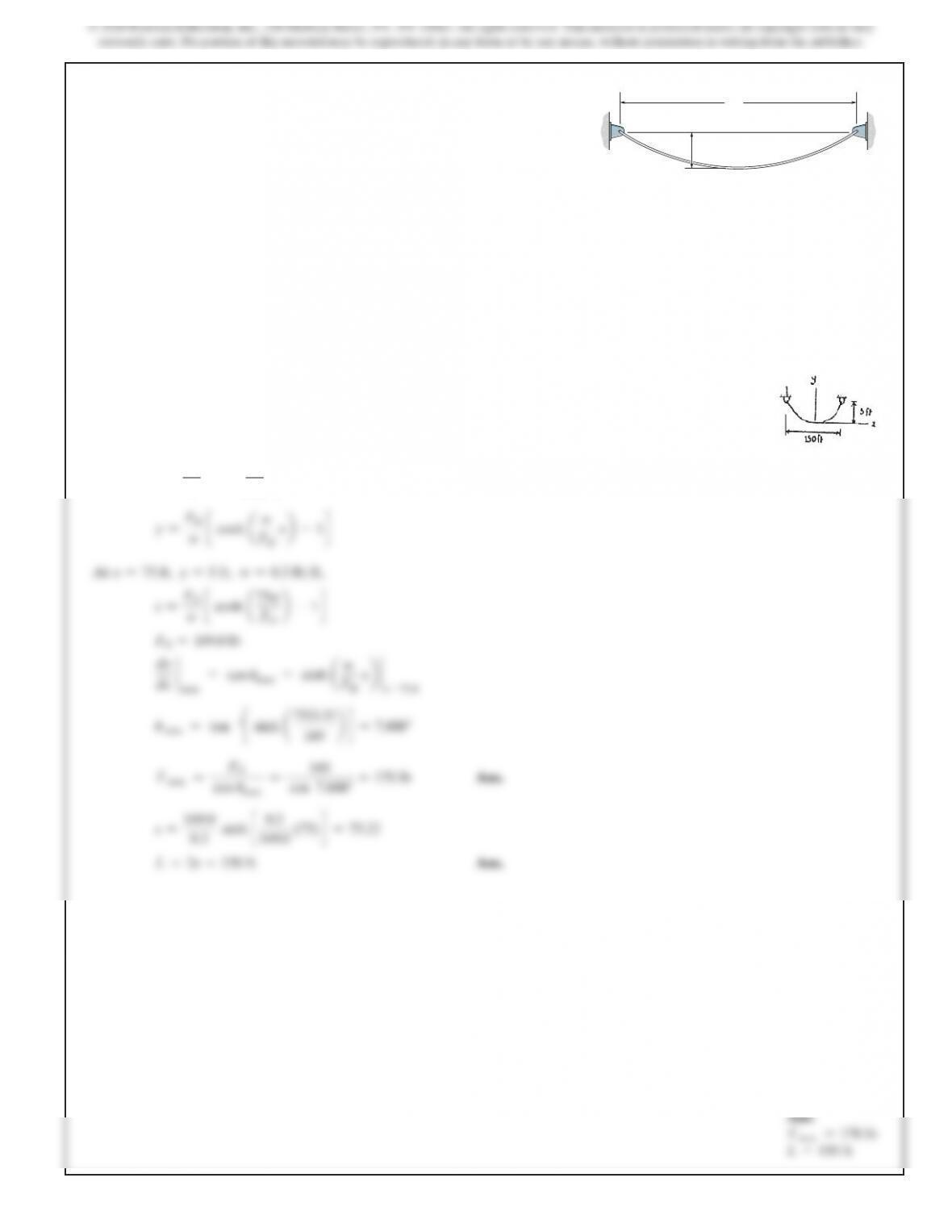
5–26. The cable stretches between two points A and B which
are
L=150
ft
apart and at the same elevation. The line sags
h=5
ft
and the cable has a weight of
0.3
lb>ft.
Determine the
length of the cable and the maximum tension in the cable. AB
L
h
SOLUTION
w=0.3 lb>ft
From Example 7–13,
s=
F
H
w
sinh
aw
FH
x
b
w=0.3 lb>ft
F
H
F
w
0.3
169.0
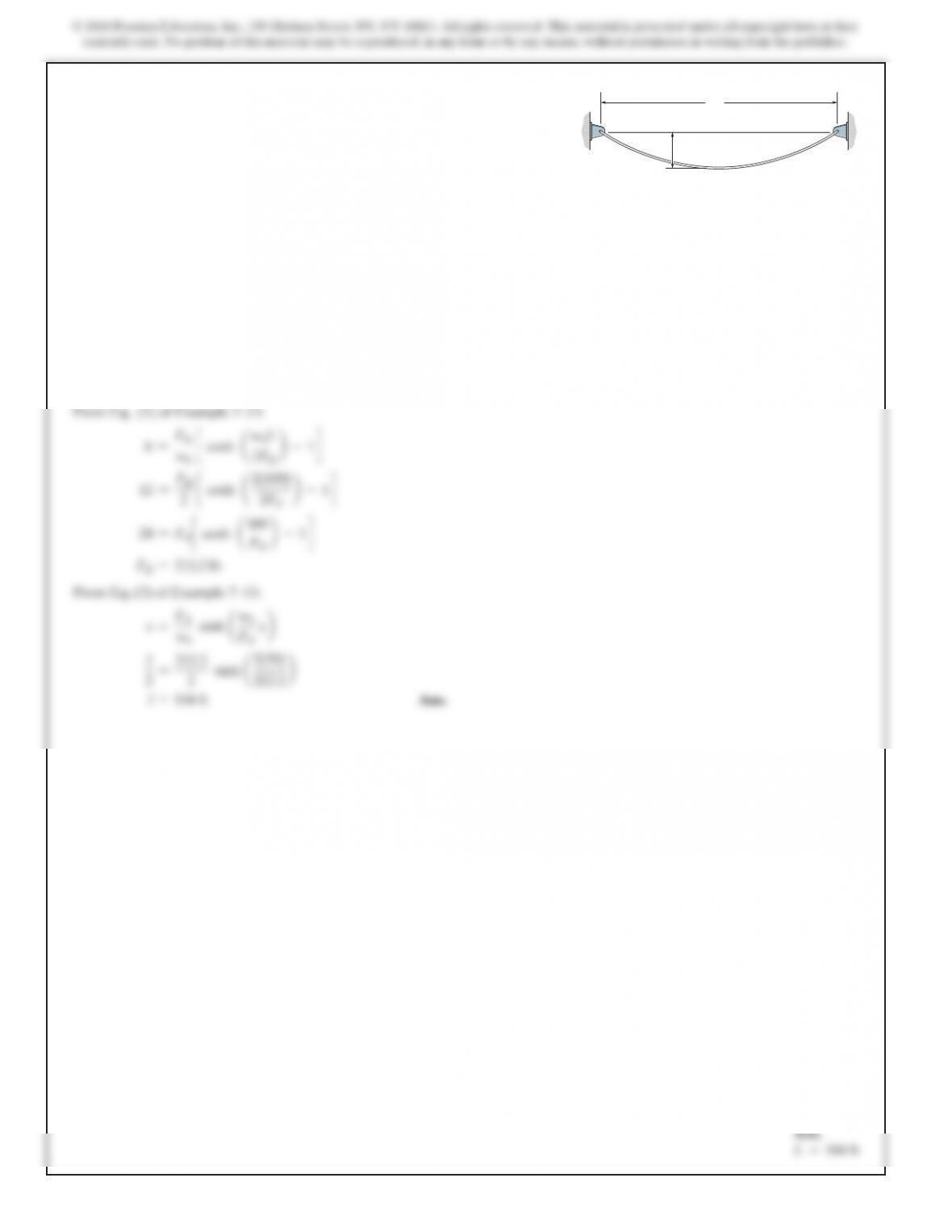
L=2s=150 ft
Ans.
T max =170 lb
L=150 ft
Ans.
214
5–27. The cable has a weight of
2
lb>ft.
If it can span
L=100
ft
and has a sag of
h=12
ft,
determine the length of
the cable. The ends of the cable are supported from the same
elevation. AB
L
h
SOLUTION
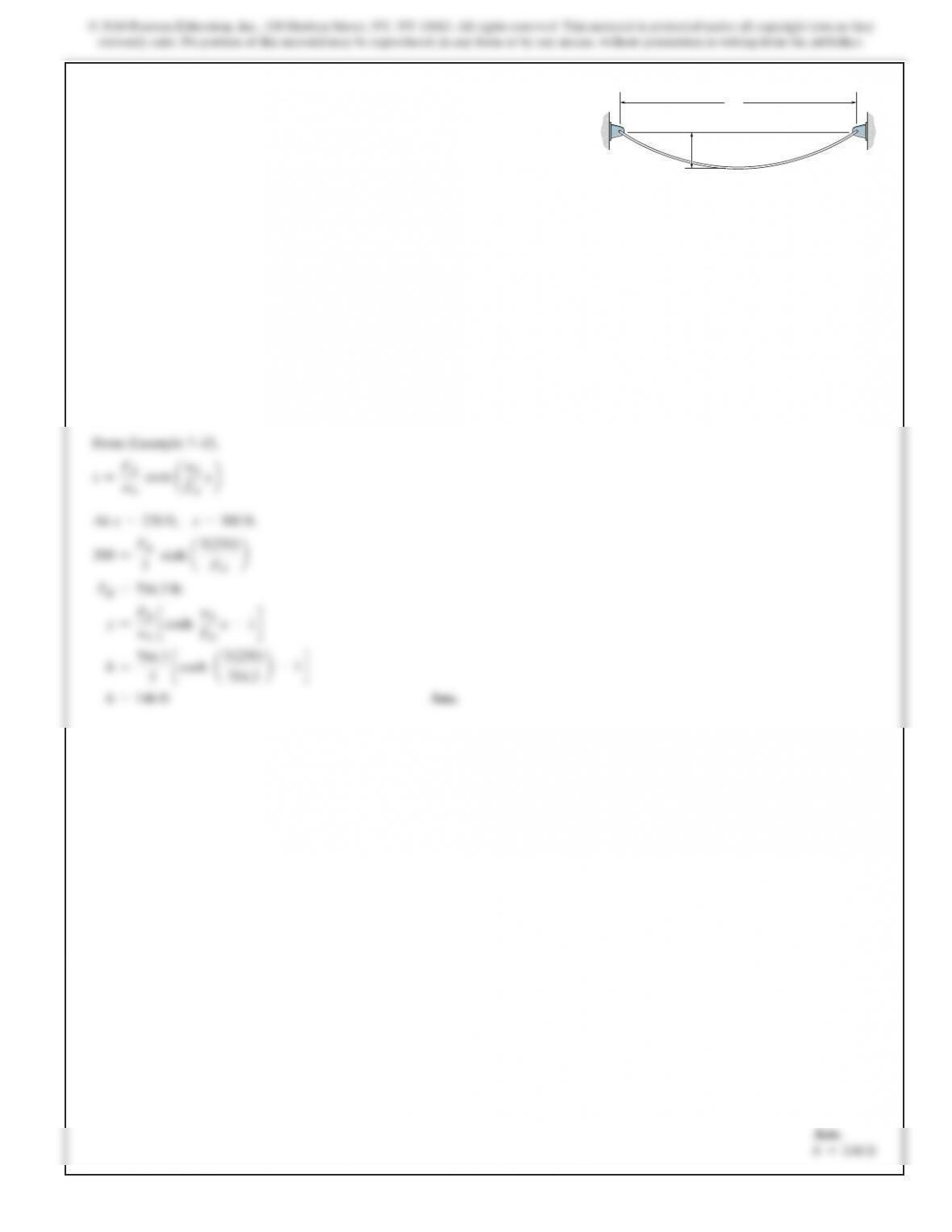
Ans.
L=104 ft
215
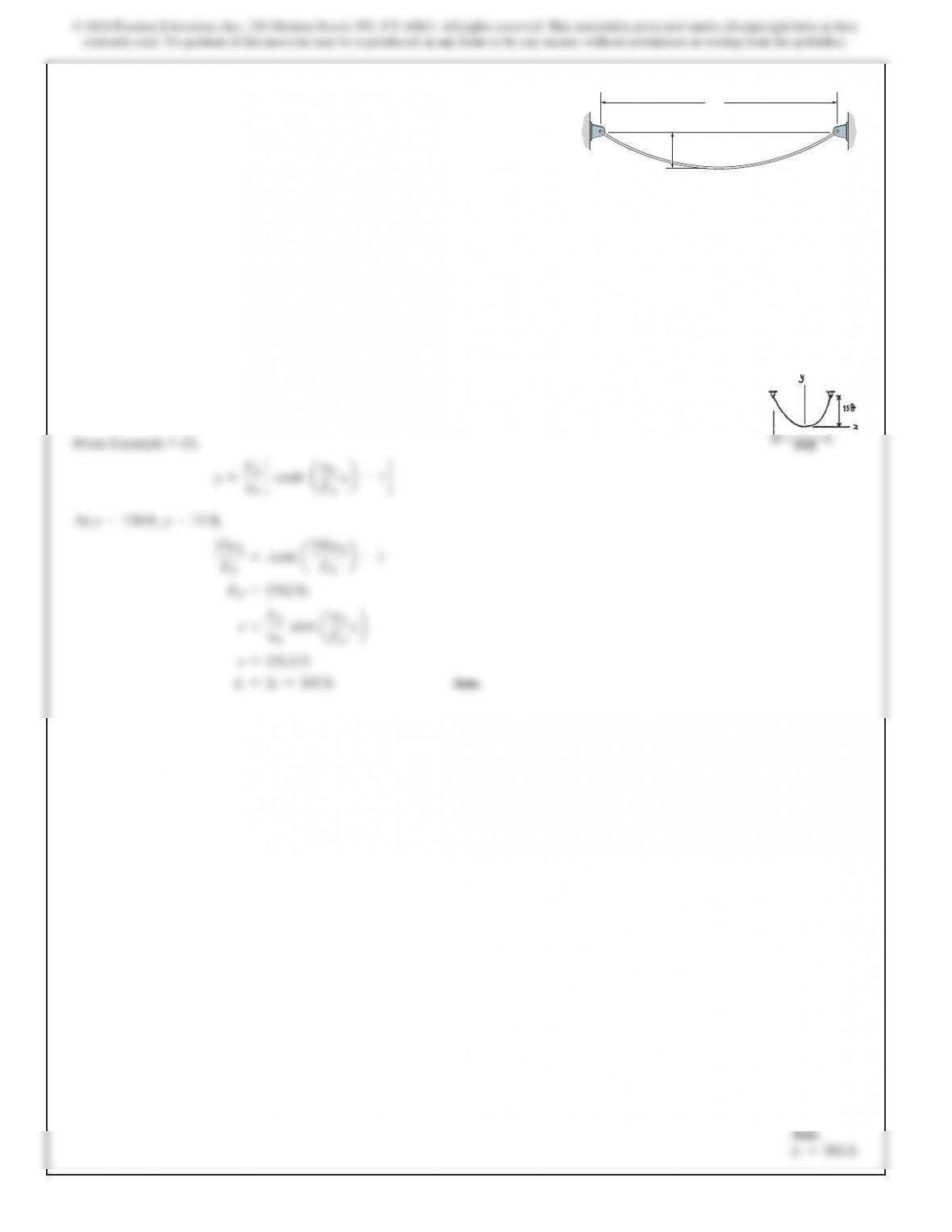
*5–28. The cable has a weight of
3
lb>ft
and is supported at
points A and B that are 500 ft apart and at the same elevation.
If it has a length of 600 ft, determine the sag h.AB
L
h
SOLUTION
w0=3 lb>ft
Ans.
h=146 ft
216
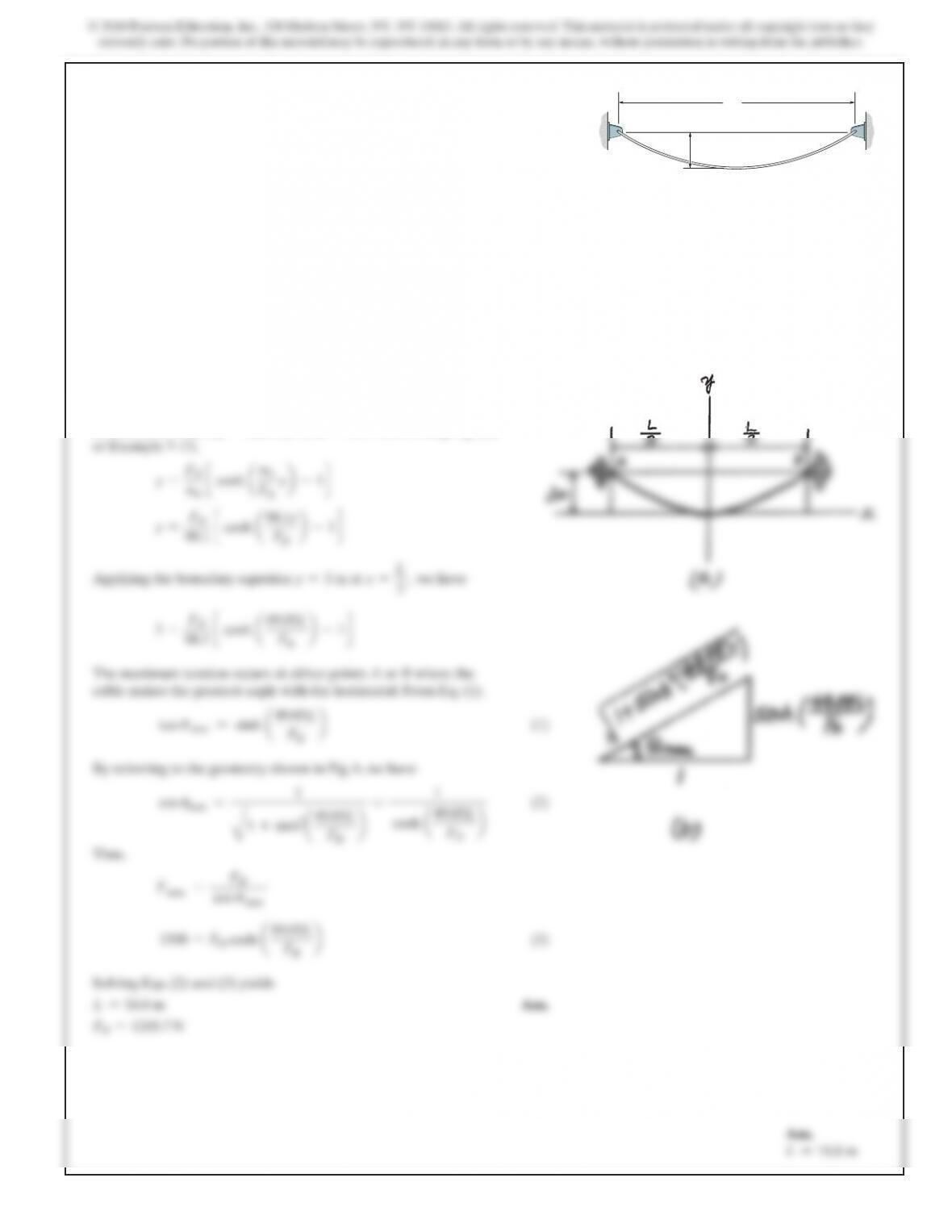
5–29. The cable has a weight of
5
lb>ft.
If it can span
L=300
ft
and has a sag of
h=15
ft,
determine the length of
the cable. The ends A and B of the cable are supported at the
same elevation. AB
L
h
SOLUTION
w0=5 lb>ft
Ans.
L=302 ft
217
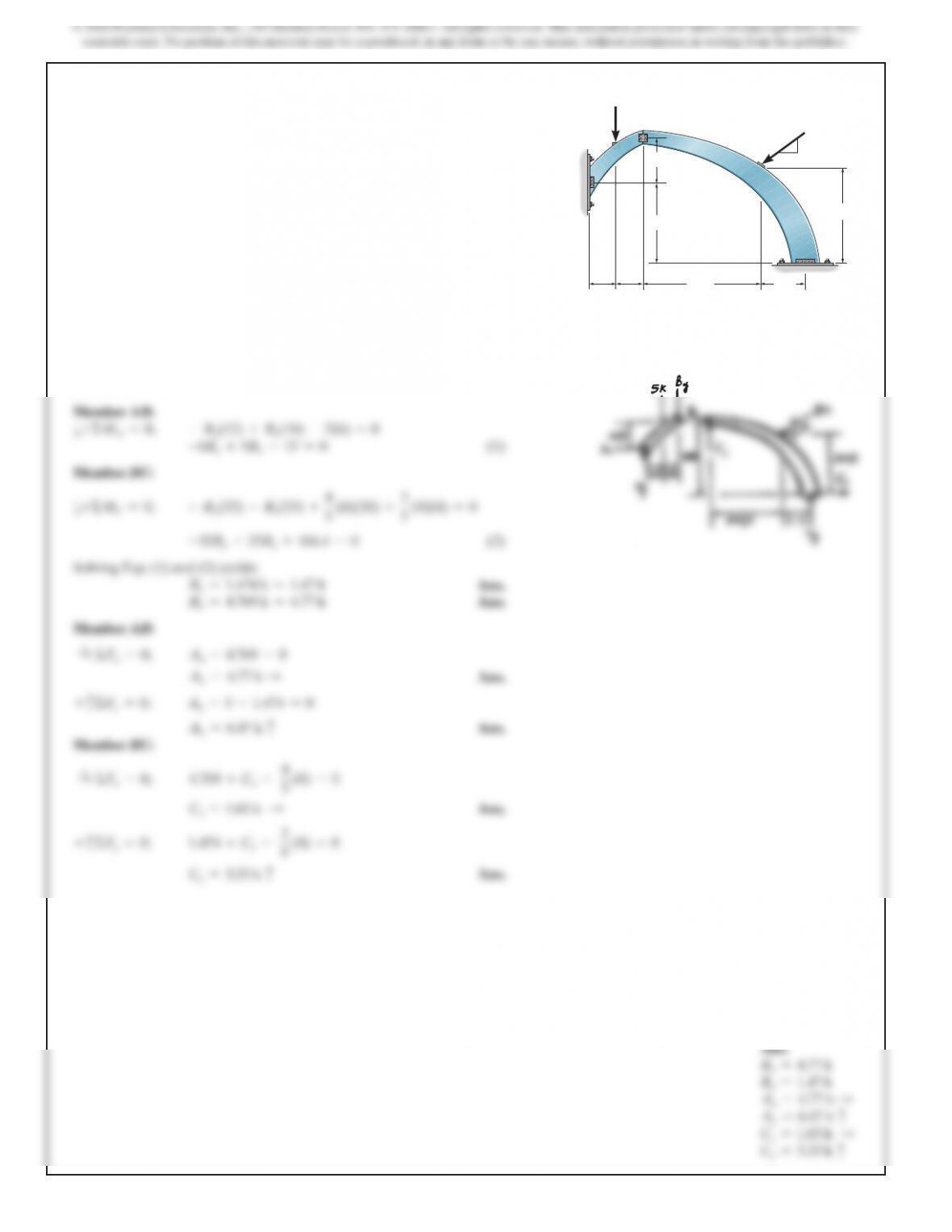
5–30. The
10
kg>m
cable is suspended between the supports
A and B. If the cable can sustain a maximum tension of 1.5 kN
and the maximum sag is 3 m, determine the maximum distance
L between the supports. AB
L
3 m
SOLUTION
The origin of the x, y coordinate system is set at the lowest point
of the cable. Here,
w0=10(9.81) N>m=98.1 N>m.
Using Eq. (4)
FH=1205.7 N
Ans.
L=16.8 m
218
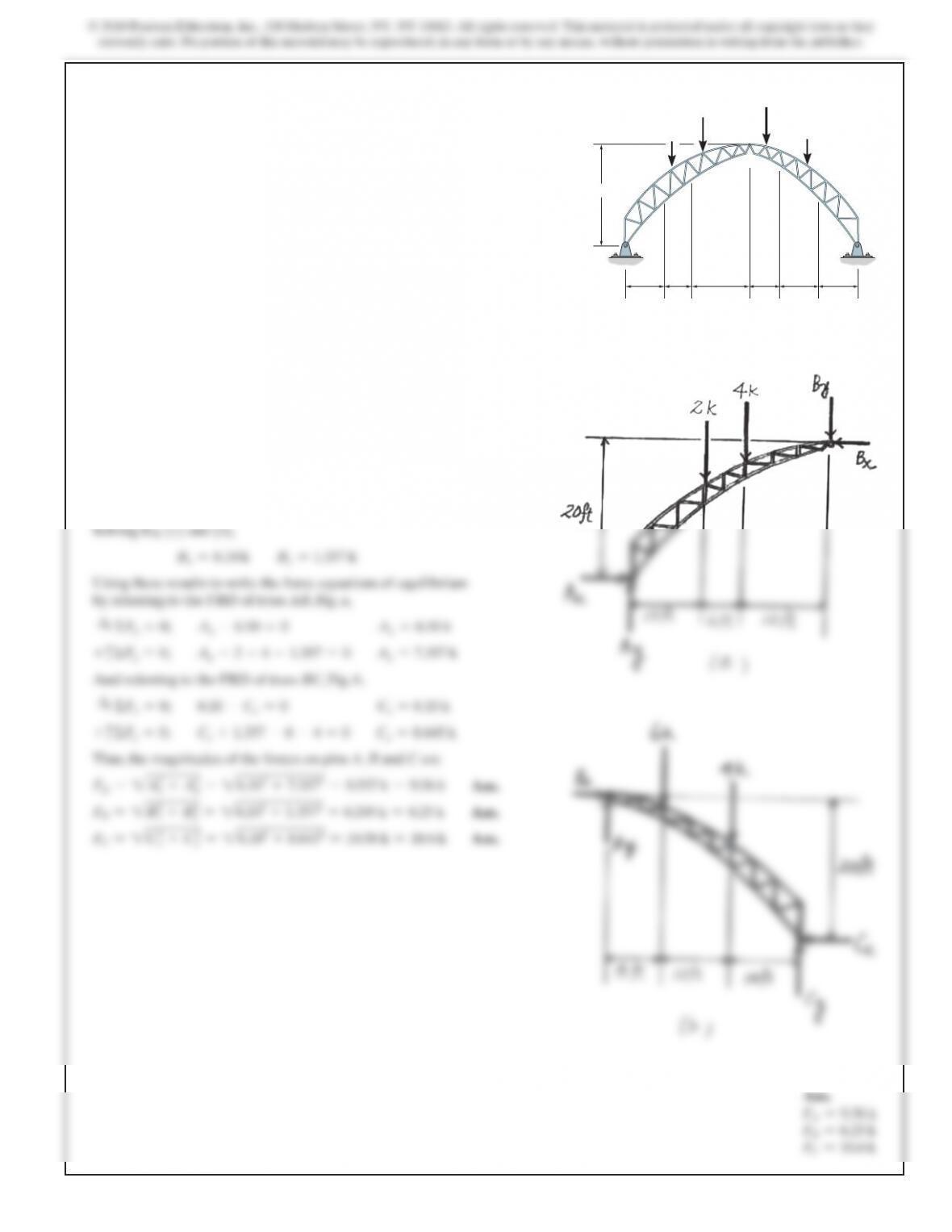
5–31. Determine the horizontal and vertical components of
reaction at A, B, and C of the three-hinged arch. Assume A, B,
and C are pin connected.
6 ft 6 ft
8 ft24 ft
C
B
A
15 ft
20 ft
8 k
5 k
10 ft 4
53
SOLUTION
Ans.
Bx=4.77 k
By=1.47 k
Ax=4.77 k S
Ay=6.47 k
c
Cx=1.63 k S
Cy=3.33 k
c
219
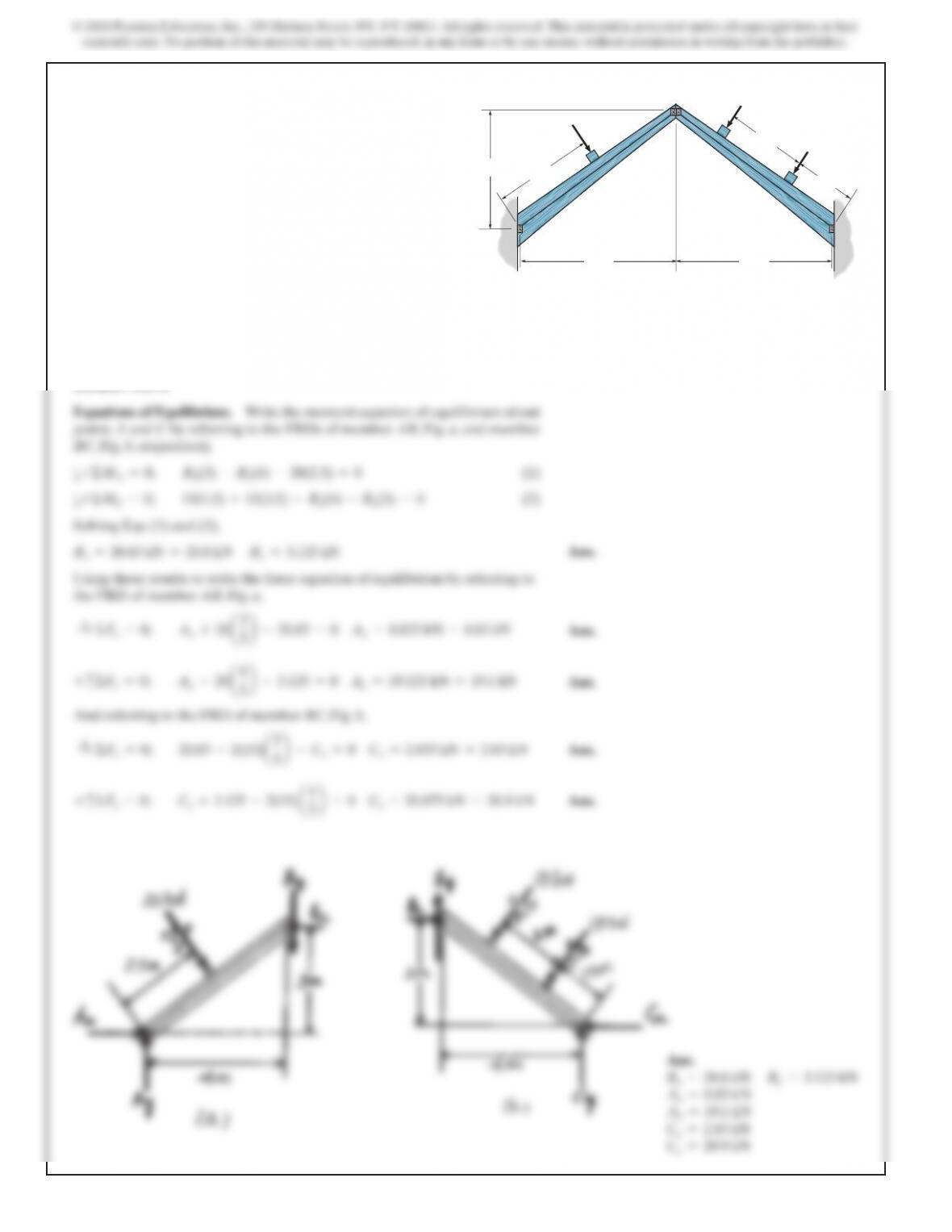
*5–32. Determine the magnitudes of the resultant forces at
the pins A, B, and C of the three-hinged arched roof truss.
10 ft 10 ft
20 ft
12 ft 10 ft8 ft6 ft
B
C
A
2 k
4 k
6 k
3 k
SOLUTION
Equations of Equilibrium. Write the moment equation of equilib-
rium about points A and C by referring to the FBDs of truss AB,
Fig. a, and truss BC, Fig. b, respectively.
a+ΣMA=0;
Bx(20) –By(28) –4(16) –2(10) =0
(1)
a+ΣMC=0;
4(10) +6(20) –Bx(20) –By(28) =0
(2)
Ans.
FA=9.56 k
FB=6.25 k
FC=10.6 k
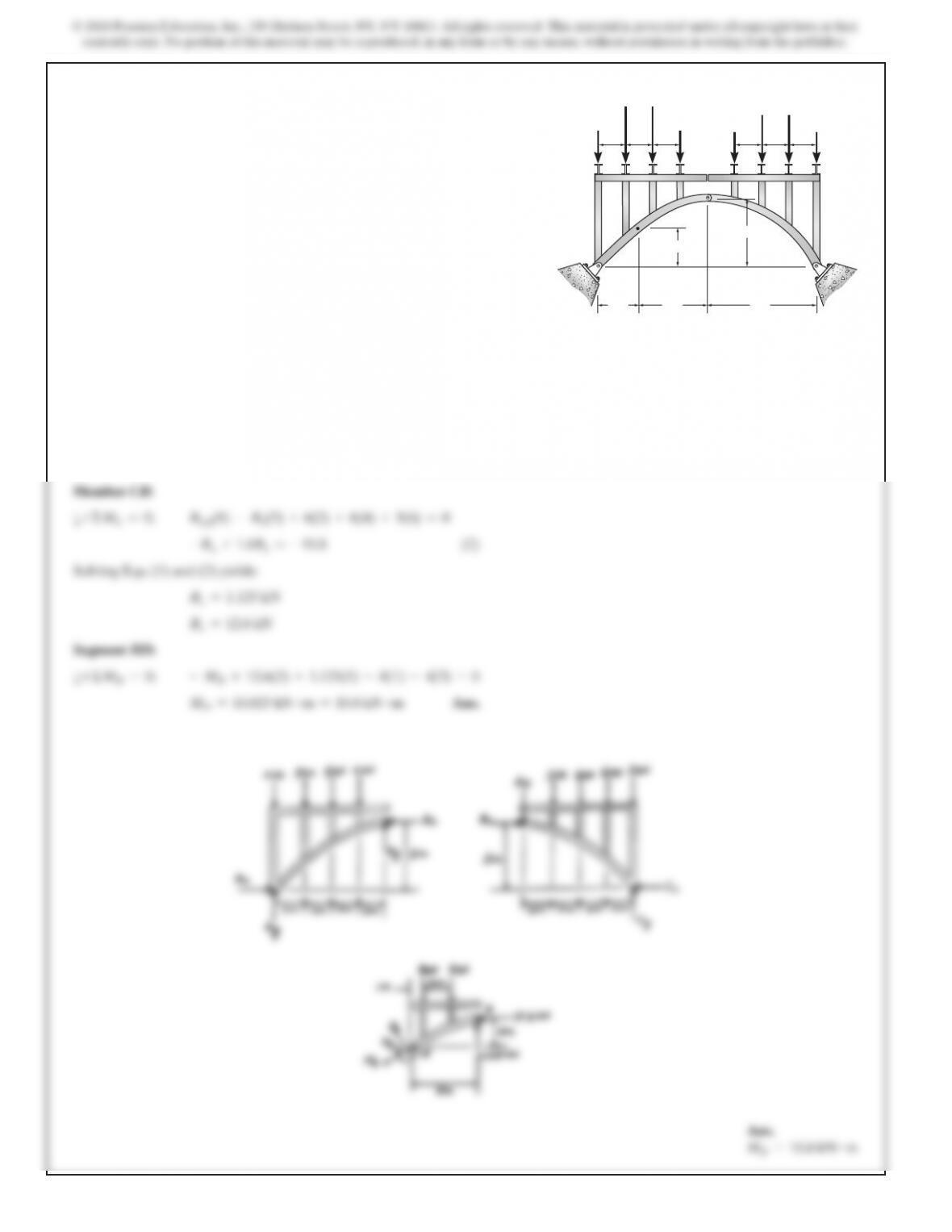
5–33. The three-hinged spandrel arch is subjected to the
loading shown. Determine the internal moment in the arch at
point D.
A
B
C
3 m
4 kN
8 kN 8 kN
4 kN 3 kN
6 kN 6 kN
3 kN
5 m
2 m 2 m 2 m 2 m 2 m 2 m
3 m 5 m 8 m
D
SOLUTION
Member AB:
a+ΣMA=0;
Bx(5) +By(8) –8(2) –8(4) –4(6) =0
Bx+1.6By=14.4
(1)
221
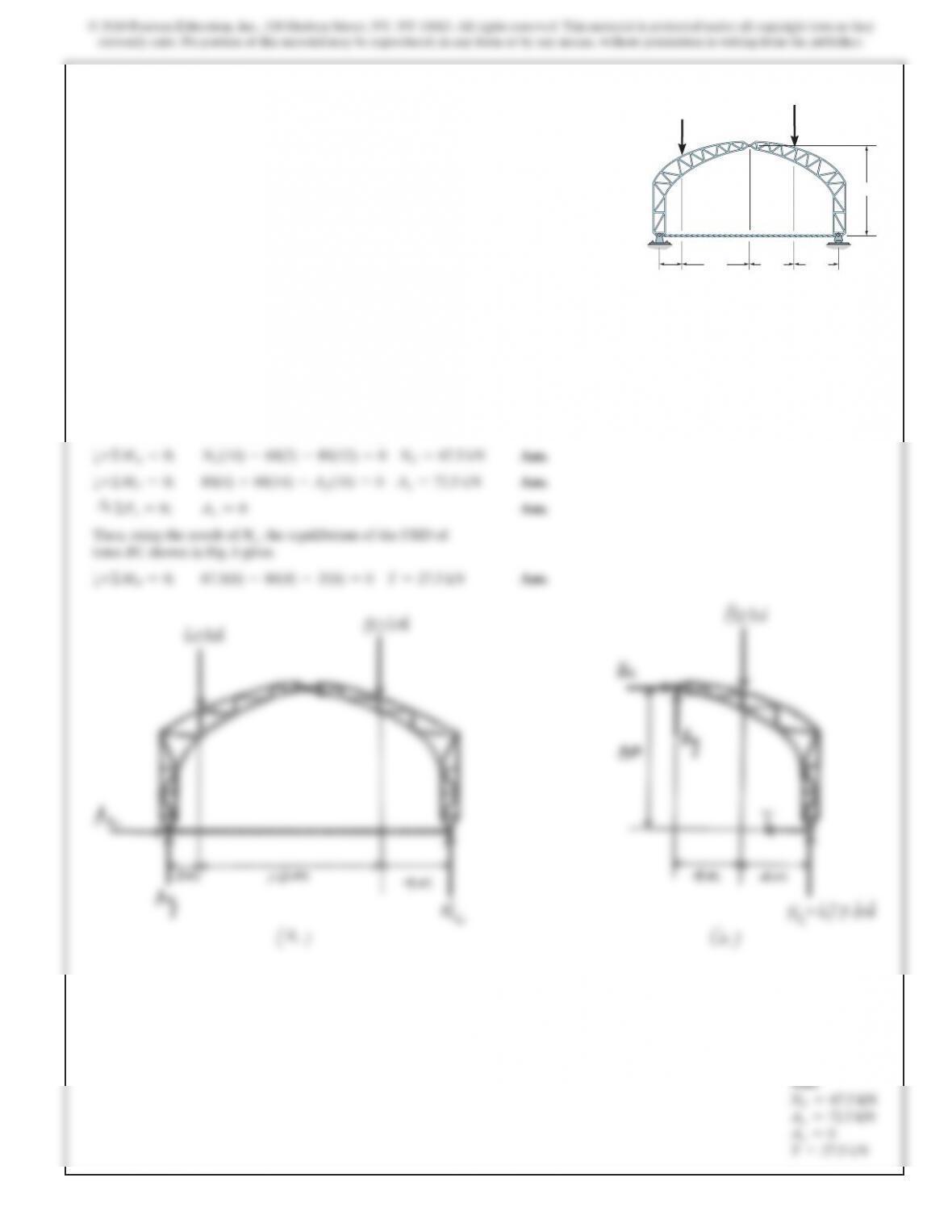
5–34. The tied three-hinged truss arch is subjected to the
loading shown. Determine the components of reaction at A
and C, and the tension in the tie rod.
8 m
2 m
6 m 4 m 4 m
A
C
B
60 kN
80 kN
SOLUTION
Equations of Equilibrium. First, we will consider the equilib-
rium of the FBD of the entire truss shown in Fig. a,
a+ΣMA=0;
NC(16) –60(2) –80(12) =0
NC=67.5 kN
a+ΣMC=0;
80(4) +60(14) –Ay(16) =0
Ay=72.5 kN
S
+ΣFx=0;
Ax=0
Then, using the result of NC, the equilibrium of the FBD of
truss BC shown in Fig. b gives
a+ΣMB=0;
67.5(8) –80(4) –T(8) =0
T=27.5 kN
Ans.
NC=67.5 kN
Ay=72.5 kN
Ax=0
T=27.5 kN
Ans.
Ans.
Ans.
Ans.
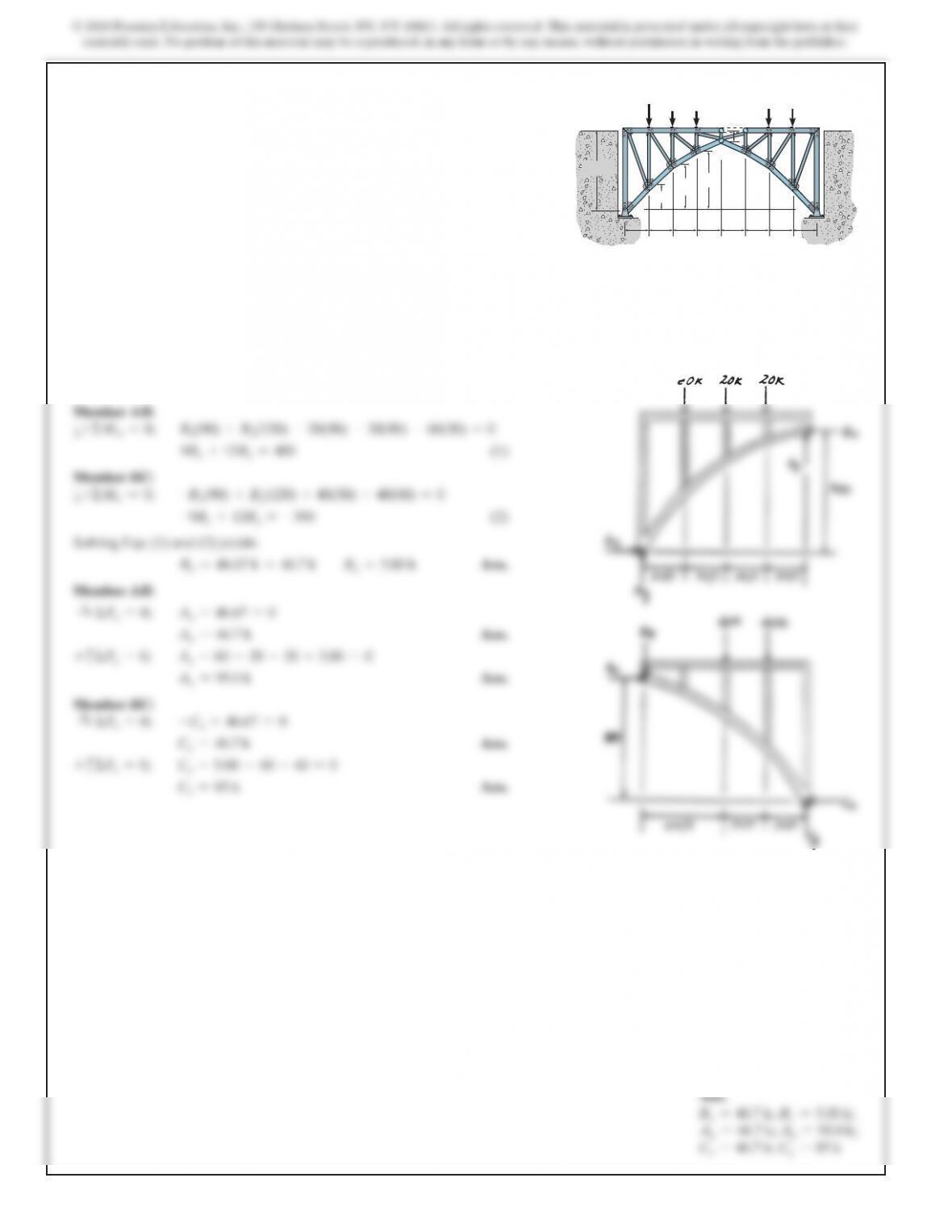
5–35. The bridge is constructed as a three-hinged trussed arch.
Determine the horizontal and vertical components of reaction
at the hinges (pins) at A, B, and C. The dashed member DE is
intended to carry no force.
30 ft 30 ft30 ft 30 ft 30 ft
10 ft
DE
20 k
20 k
60 k
40 k40 k
B
AC
100 ft
30 ft
h1
h2
h3
30 ft 30 ft
SOLUTION
223
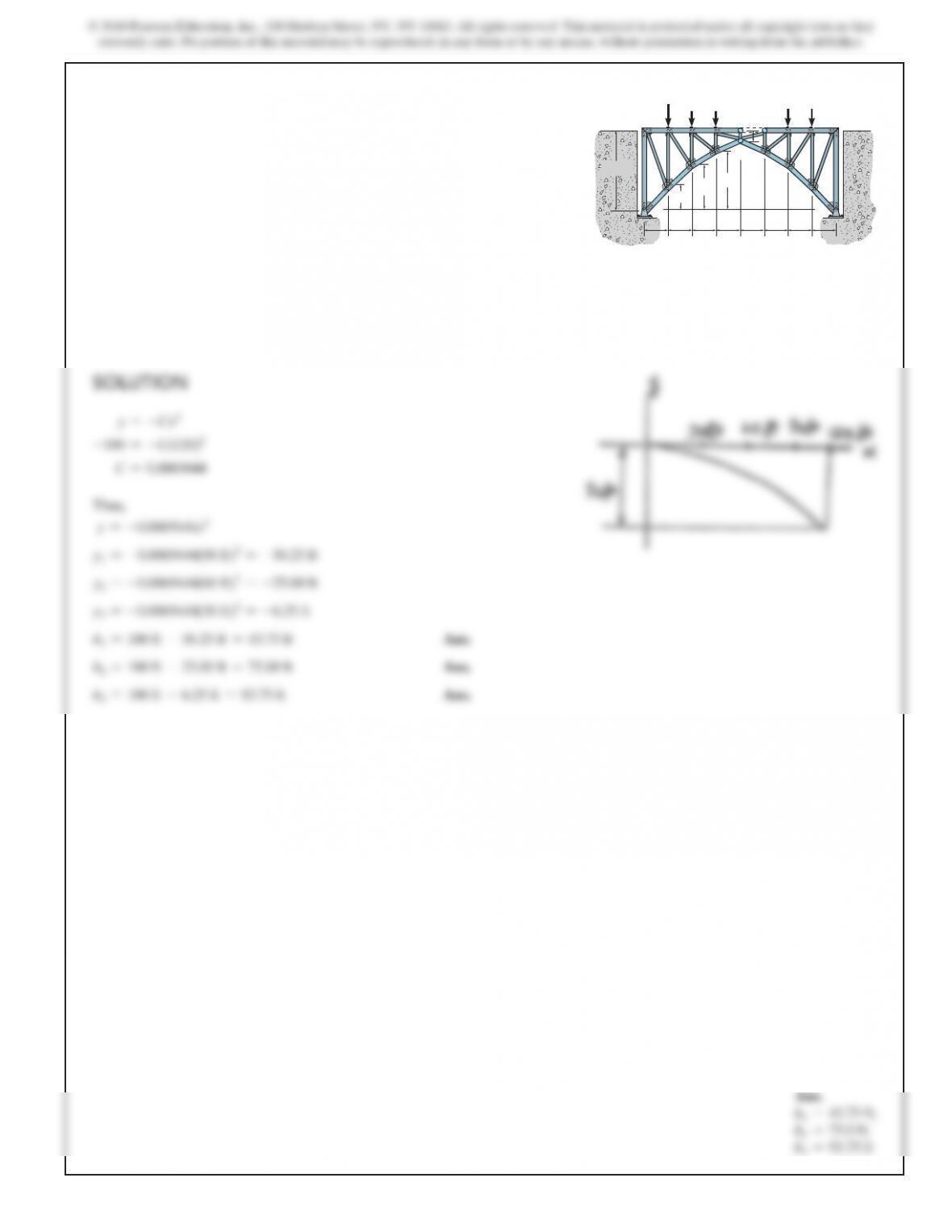
*5–36. Determine the design heights
h1,
h2,
and
h3
of the
bottom cord of the truss so the three-hinged trussed arch
responds as a funicular arch.
30 ft 30 ft30 ft 30 ft 30 ft
10 ft
DE
20 k
20 k
60 k
40 k40 k
B
AC
100 ft
30 ft
h1
h2
h3
30 ft 30 ft
h1=43.75 ft;
h2=75.0 ft;
h3=93.75 ft
224
5–37. The laminated-wood three-hinged arch is subjected to
the loading shown. Determine the horizontal and vertical
components of reaction at the pins A, B, and C.
3 m 2.5 m
1.5 m
2 m
4
m4
m
B
AC
20 kN
15 kN
15 kN
SOLUTION
5b
Ans.
Bx=20.8 kN
By=3.125 kN
Ax=8.83 kN
Ay=19.1 kN
Cx=2.83 kN
Cy=20.9 kN
225
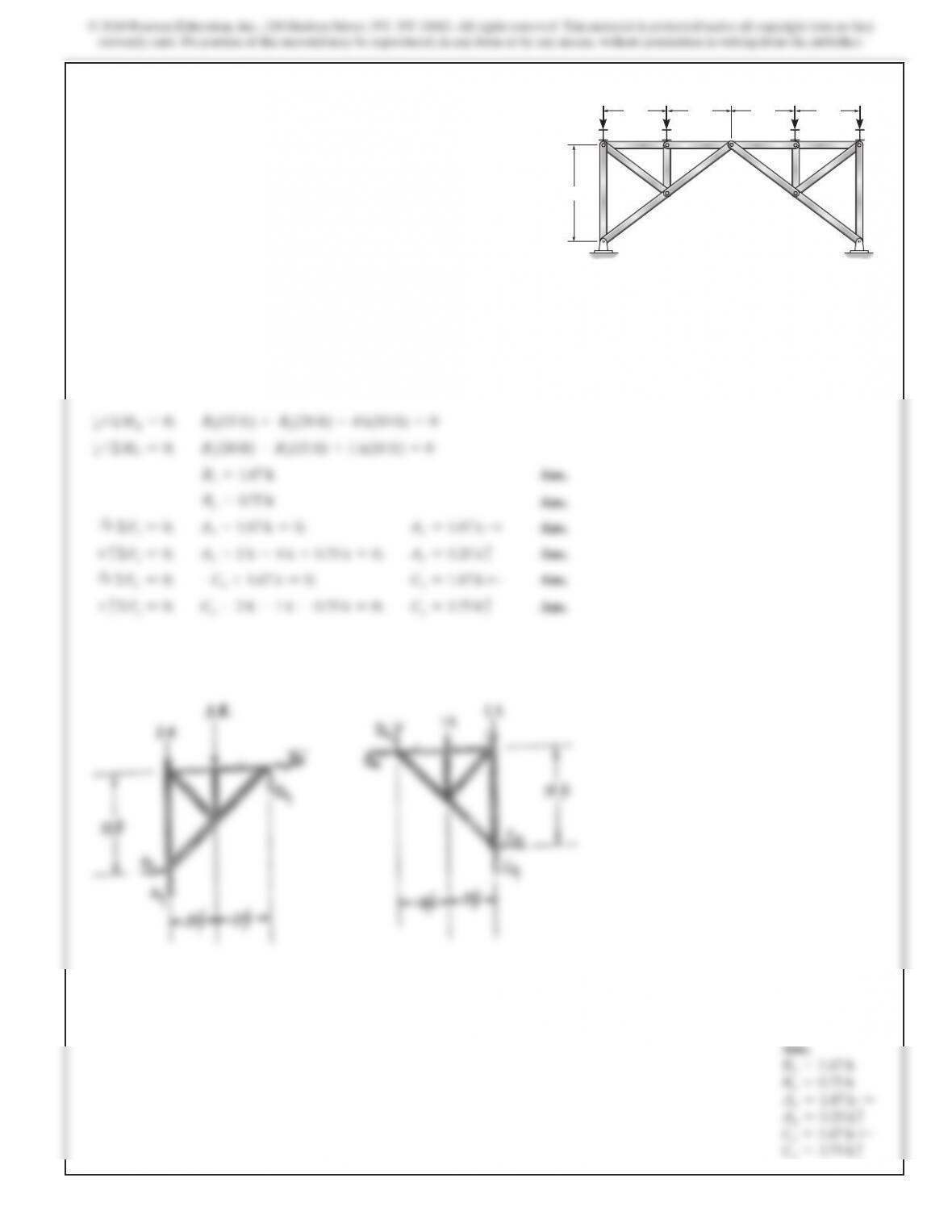
5–38. The three-hinged truss arch is subjected to the loading
shown. Determine the horizontal and vertical components of
reaction at the pins A, B, and C.
C
A
B
15 ft
10 ft 10 ft10 ft10 ft
2 k 4 k 1 k 2 k
SOLUTION
a+ΣMA=0;
Bx(15 ft) + By(20 ft) –4 k(10 ft) =0
a+ΣMC=0;
By(20 ft) –Bx(15 ft) +1 k(10 ft) =0
Bx=1.67 k
By=0.75 k
S
+ΣFx=0;
Ax–1.67 k =0;
Ax=1.67 k S
+
c
ΣFy=0;
Ay–2 k –4 k +0.75 k =0;
Ay=5.25 k
c
S
+ΣFx =0;
–Cx+1.67 k =0;
Cx=1.67 k d
+
c
ΣFy=0;
Cy–2 k –1 k –0.75 k =0;
Cy=3.75 k
c
Ans.
Bx=1.67 k
By=0.75 k
Ax=1.67 k S
Ay=5.25 k
c
Cx=1.67 k d
Cy=3.75 k
c
Ans.
Ans.
Ans.
Ans.
Ans.
Ans.
226
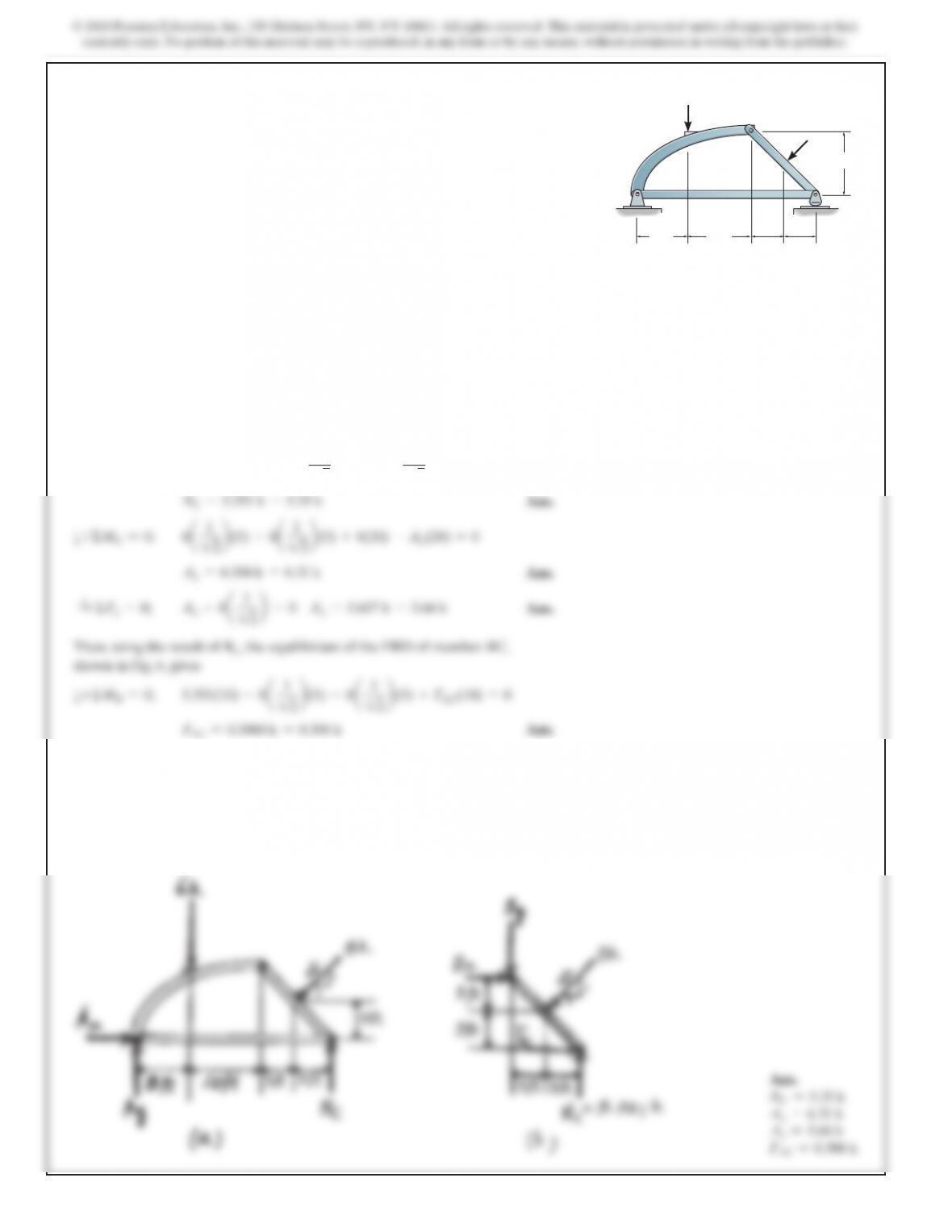
5–39. The arch structure is subjected to the loading shown.
Determine the horizontal and vertical components of reaction
at A and C, and the force in member AC.
A
B
C
8 ft
5 ft 5 ft
10 ft
10 ft
6 k
8 k
SOLUTION
Equations of Equilibrium. First, we will consider the equilibrium of
the FBD of the entire structure shown in Fig. a.
a
+ΣMA=0;
NC(28) –6(8) –8
a1
12b
(23) +8
a1
12b
(5) =
0
NC=5.351 k =5.35 k
a
a
Ans.
NC=5.35 k
Ay=6.31 k
Ax=5.66 k
FAC =0.306 k
Ans.