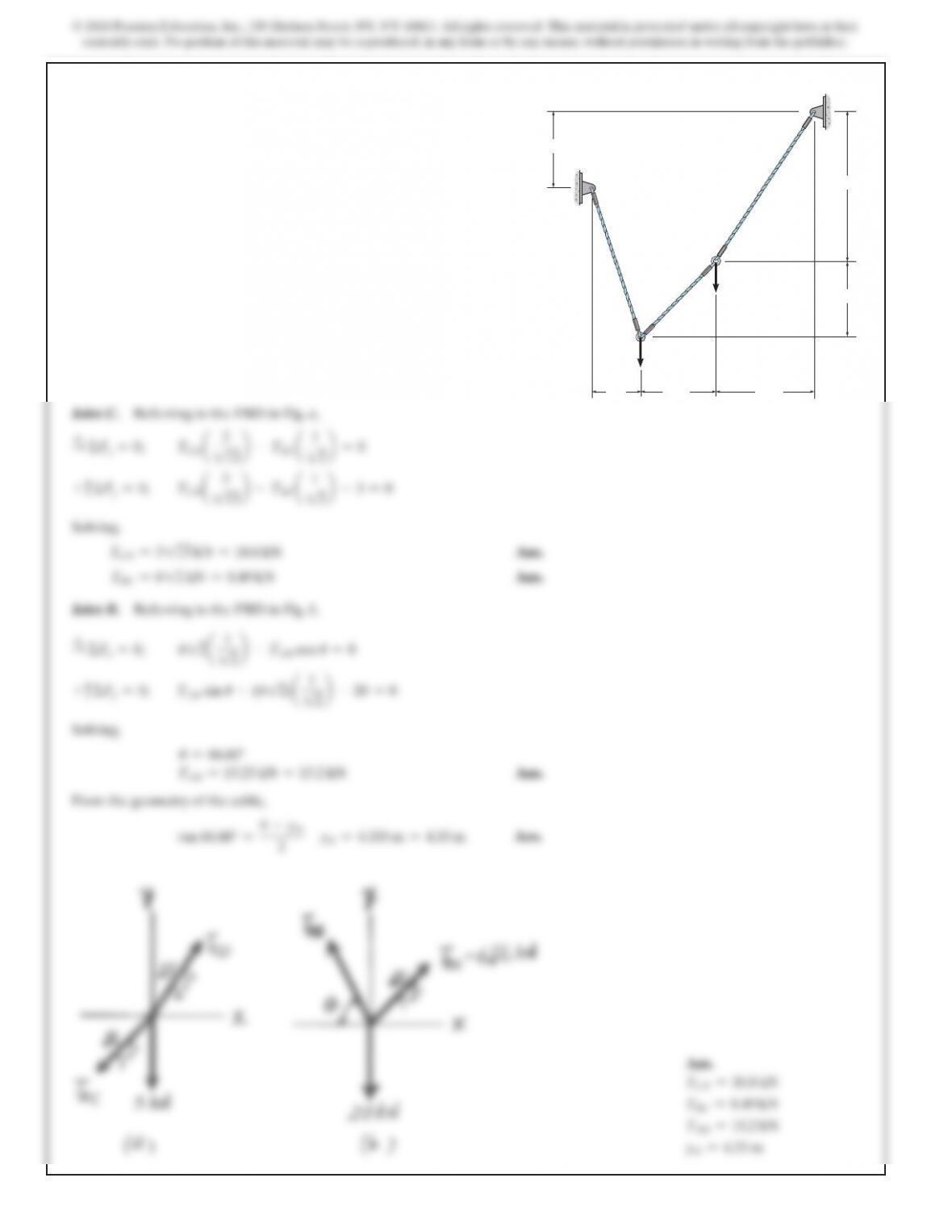
5–1. Determine the tension in each segment of the cable and
the distance yD.
20 kN
3 kN
6
m
3
m
4 m3 m2 m
yD
D
C
B
A
SOLUTION
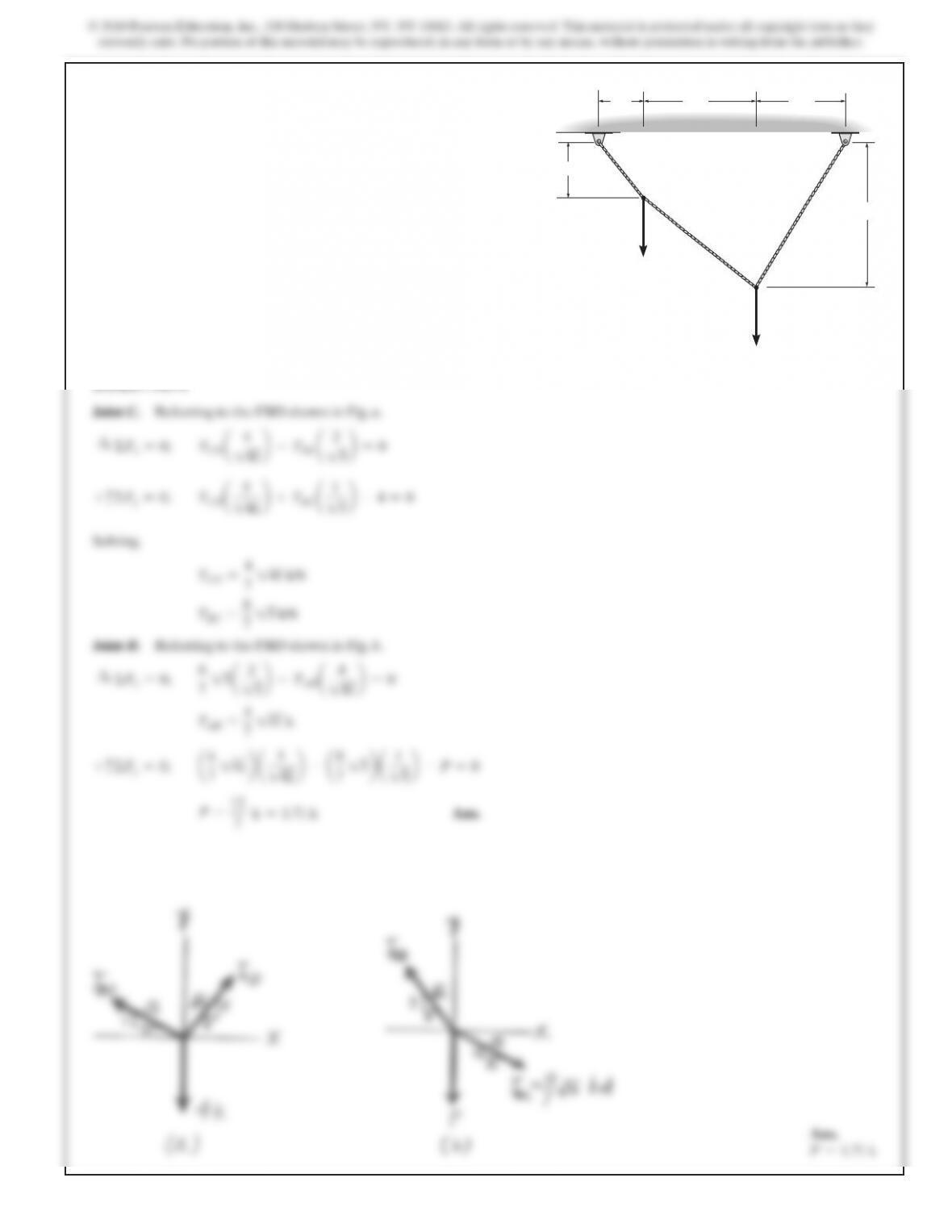
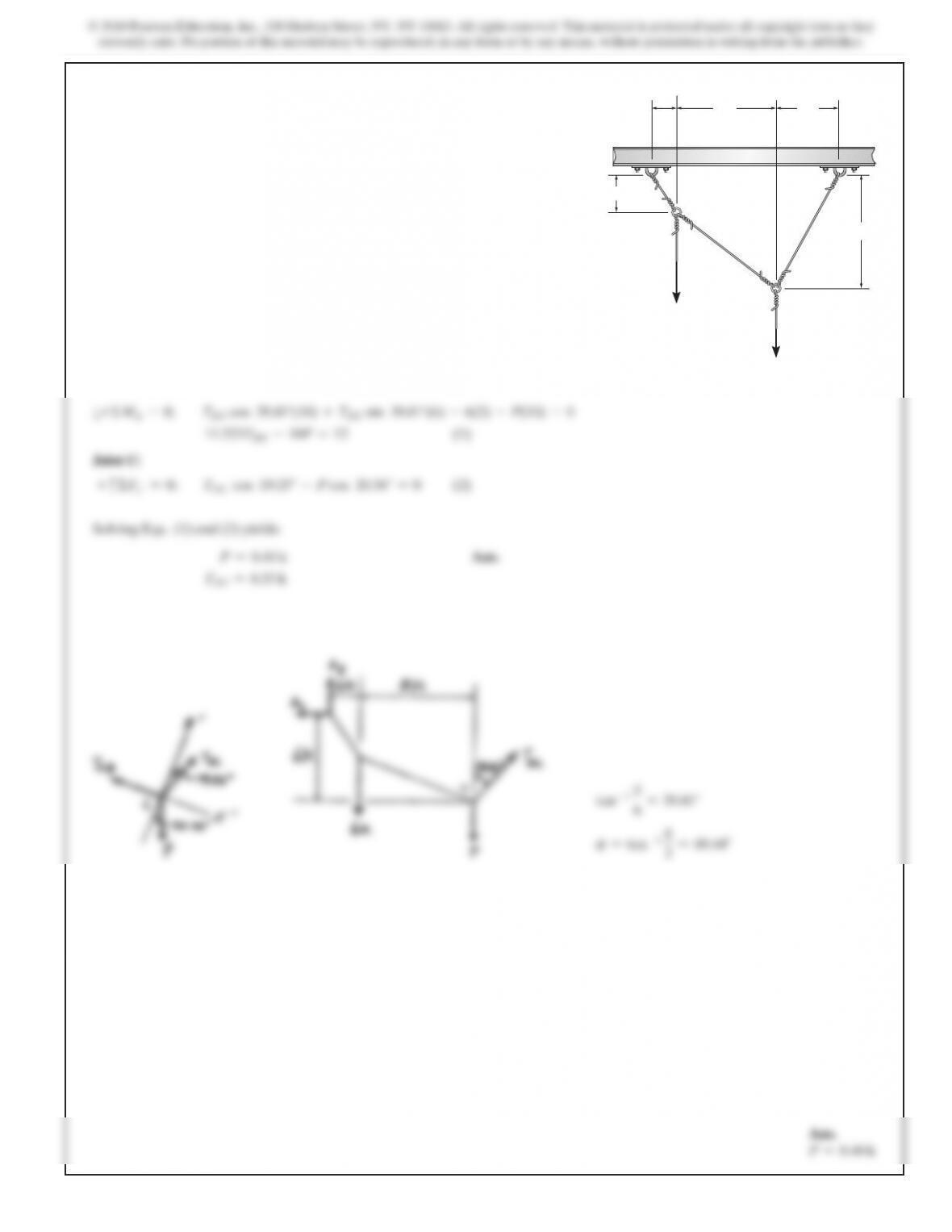
5–2. The cable supports the loading shown. Determine the
magnitude of the vertical force P so that
yC=10
ft.
SOLUTION
4 ft
5 ft
10 ft 8 ft
4 k
D
C
B
A
yC
P
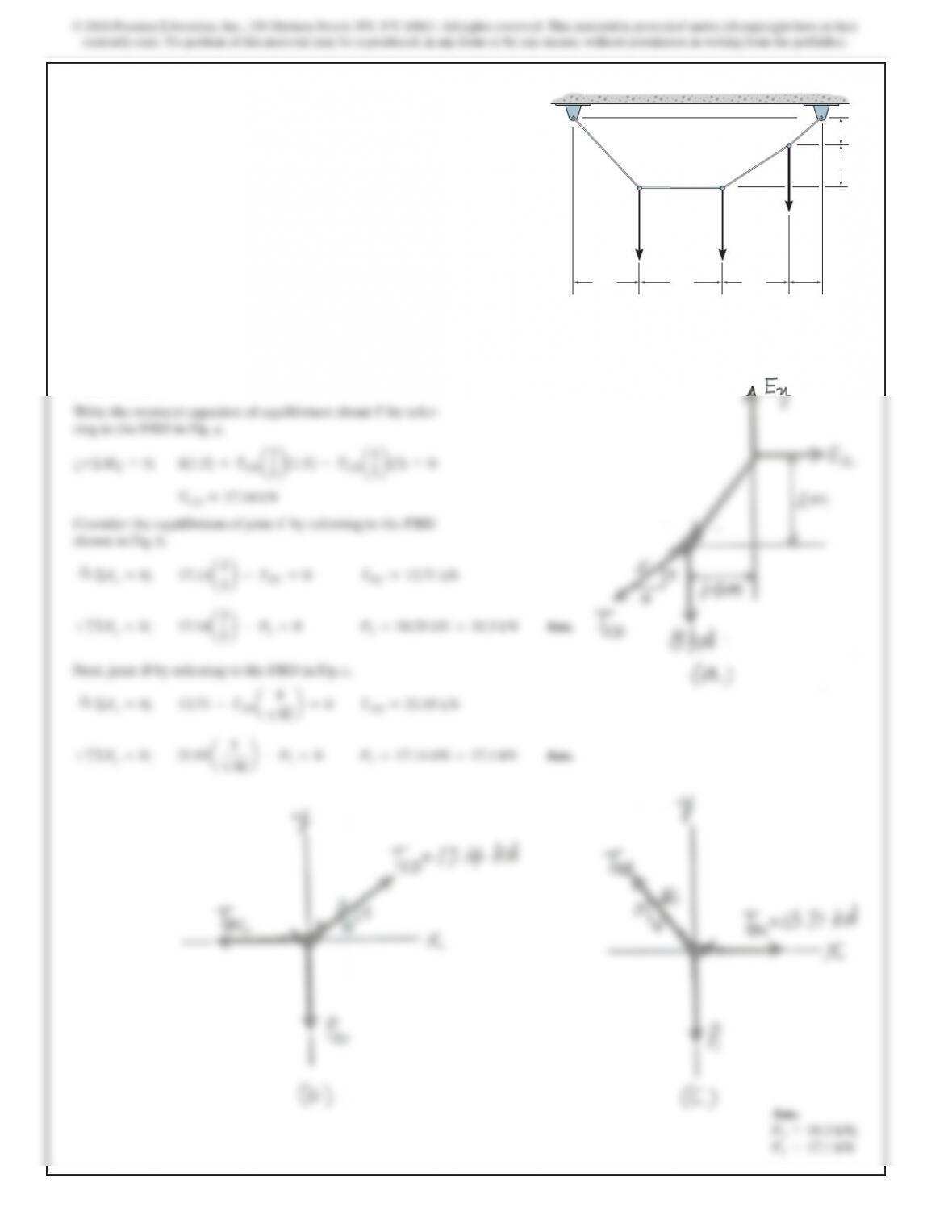
5–3. Determine the forces
P1
and
P2
needed to hold the cable
in the position shown, i.e., so segment BC remains horizontal.
SOLUTION
141 b
A
P1P2
8 kN
2
m
3 m
BC
D
E
4 m
4 m 5 m
1.5 m
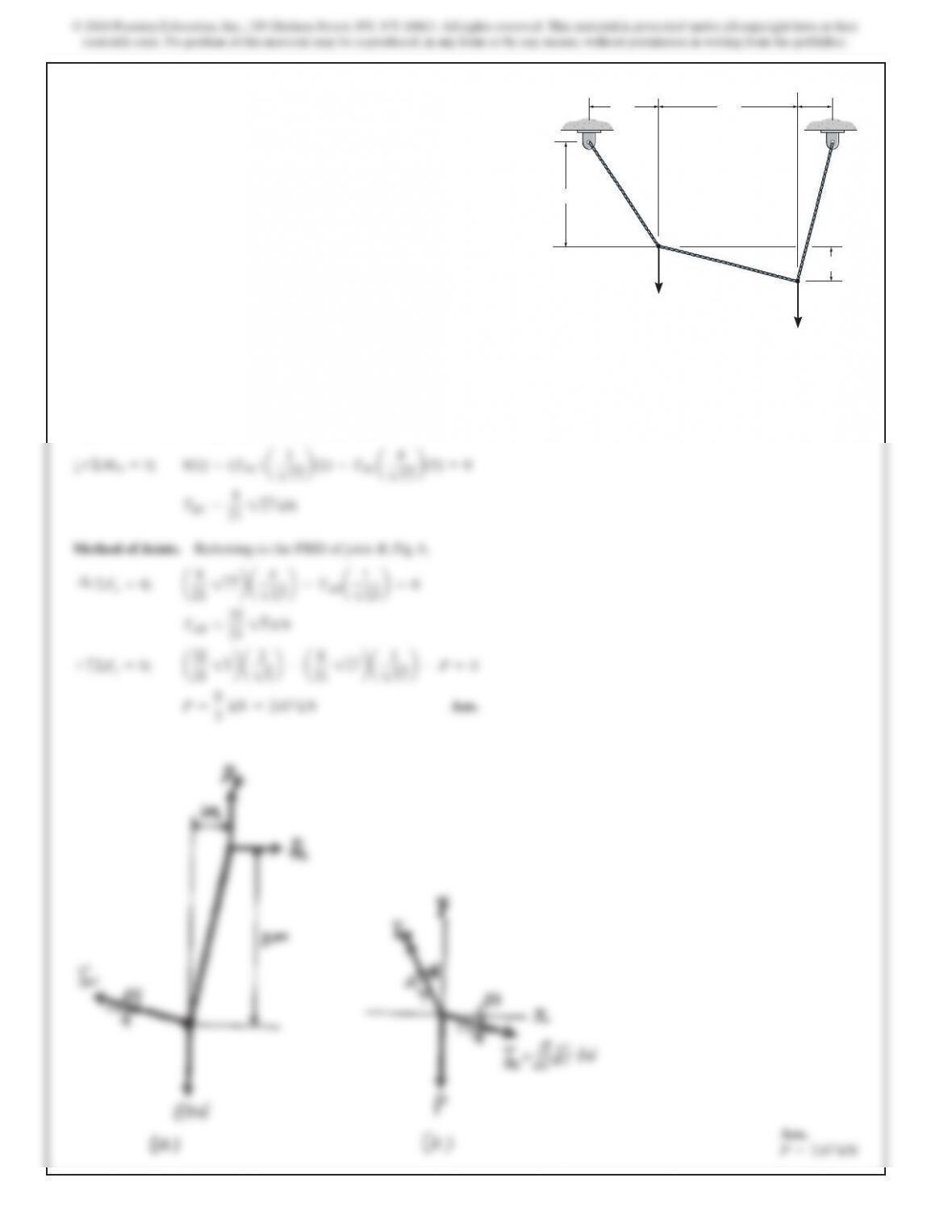
5–5. The cable supports the loading shown. Determine the
magnitude of the vertical force P so that
y=4
m.
SOLUTION
Method of Sections. Referring to the FBD of the right segment of the cable
system sectioned through cable BC, Fig. a,
a
+ΣMD=0;
8(1) –(TBC
2a 1
117 b
(1) –TBC
a4
117 b
(5) =
0
T
BC =
8
21
1
17 k
N
Method of Joints. Referring to the FBD of joint B, Fig. b,
S
+ΣFx=0;
a8
21
1
17
ba 4
117 b
–TAB
a1
115 b
=
0
T
AB =
32
21
1
5 k
N
+
c
ΣFy=0;
a32
21
1
5
ba 2
15b
–
a8
21
1
17
ba 1
117 b
–P=
0
P
=
8
3
kN =2.67 k
N
Ans.
1 m
C
B
AD
y
2 m
1 m
4 m
P
8 kN
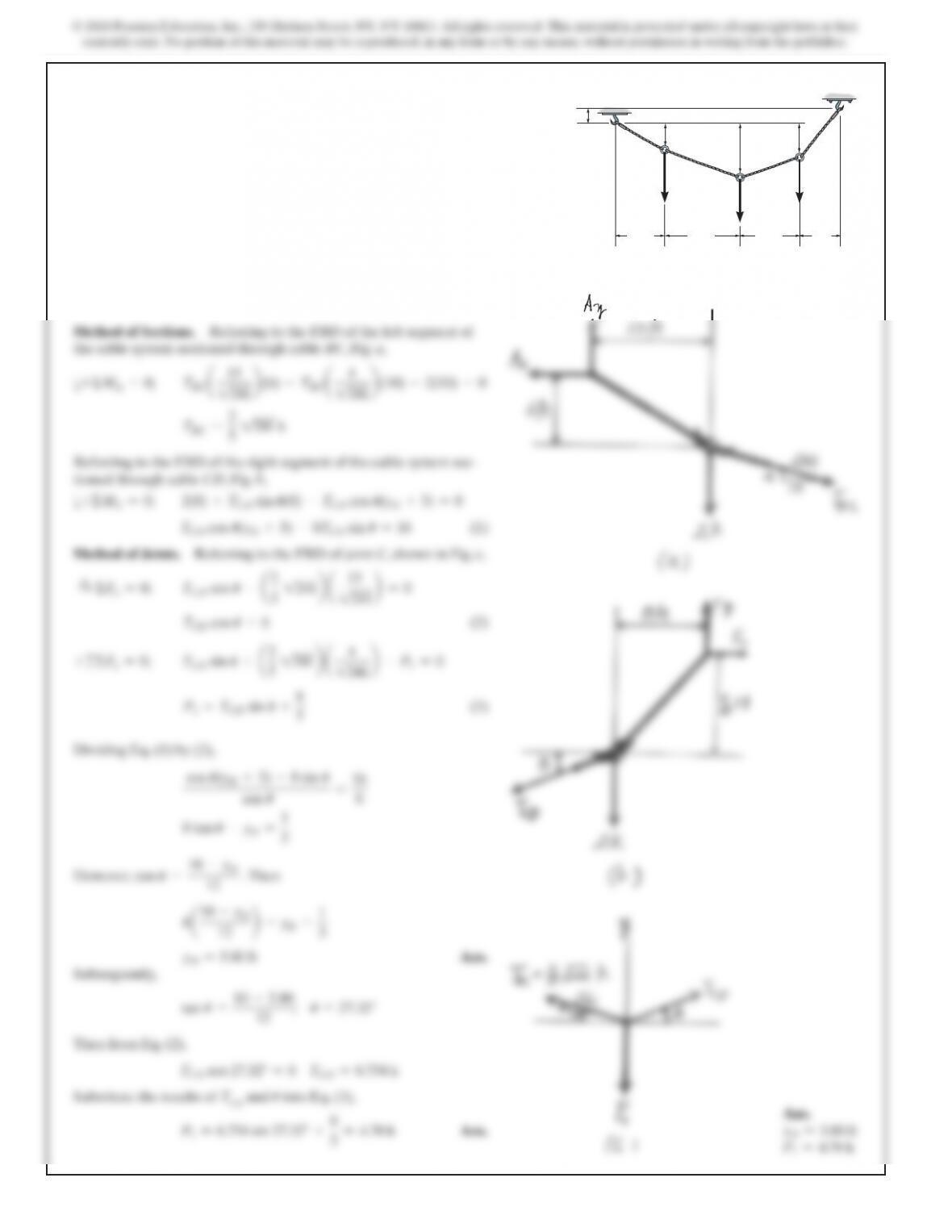
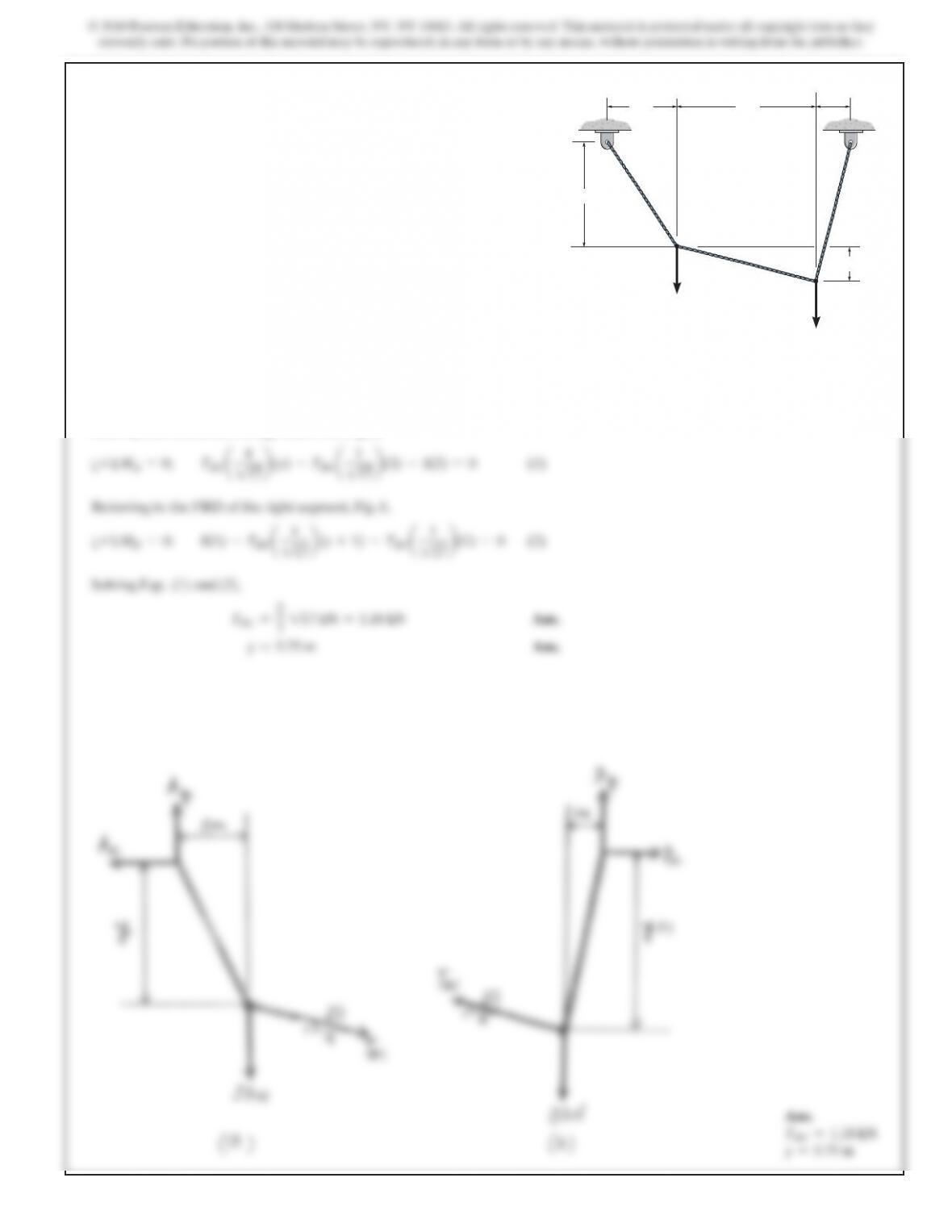
5–7. The cable supports the three loads shown. Determine the
magnitude of P1 if
P2=2
k
,
yB=6
ft
, and
yC=10 ft
. Also find
the sag yD.
SOLUTION
yD=3.80 ft
E
B
A
C
D
P2P2
P1
10 ft 15 ft 12 ft
3 ft
8 ft
yB
yC
yD
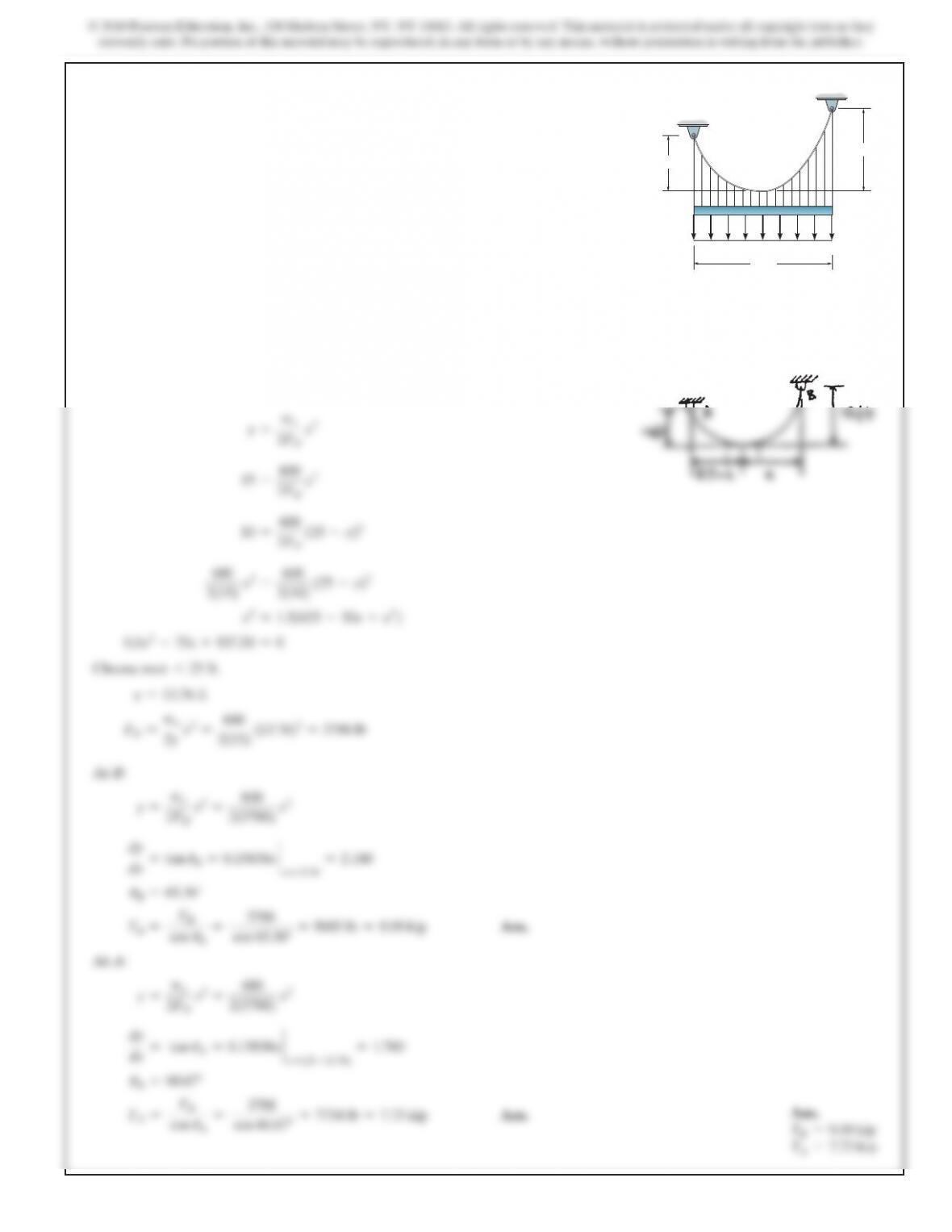
*5–8. The cable supports the uniform load of
w0=600
lb>ft.
Determine the tension in the cable at each support A and B.
SOLUTION
w
o
15 ft
A
B
10 ft
25 ft
w0
5–9. Determine the maximum and minimum tension in the
cable.
60 ft
12 ft
y
x
AB
60 ft
2 k>ft
SOLUTION
197
5–10. The cable is subjected to a uniform loading of
w=500
lb>ft.
Determine the maximum and minimum tension
in the cable.
100 ft
20 ft
w
SOLUTION
2h
2(20 ft)
And
T
max =woL
B
1+
a
L
2hb2
=(0.5 k
>
ft)(50 ft)
B
1+
c
50 ft
2(20 ft)
d2
=40.02 k =40.0 k
Ans.
Tmin =31.25 k
Tmax =40.0 k
Ans.
198
5–11. The cable is subject to the uniform loading. Determine
the equation
y=f(x)
which defines the cable shape AB and
the maximum tension in the cable. 50 ft
20 ft
y
x
AB
50 ft
150 lb
>
ft
SOLUTION
y=0.008x2
A
2(20)
Ans.
y=0.008x2
Tmax =12.0 k
199
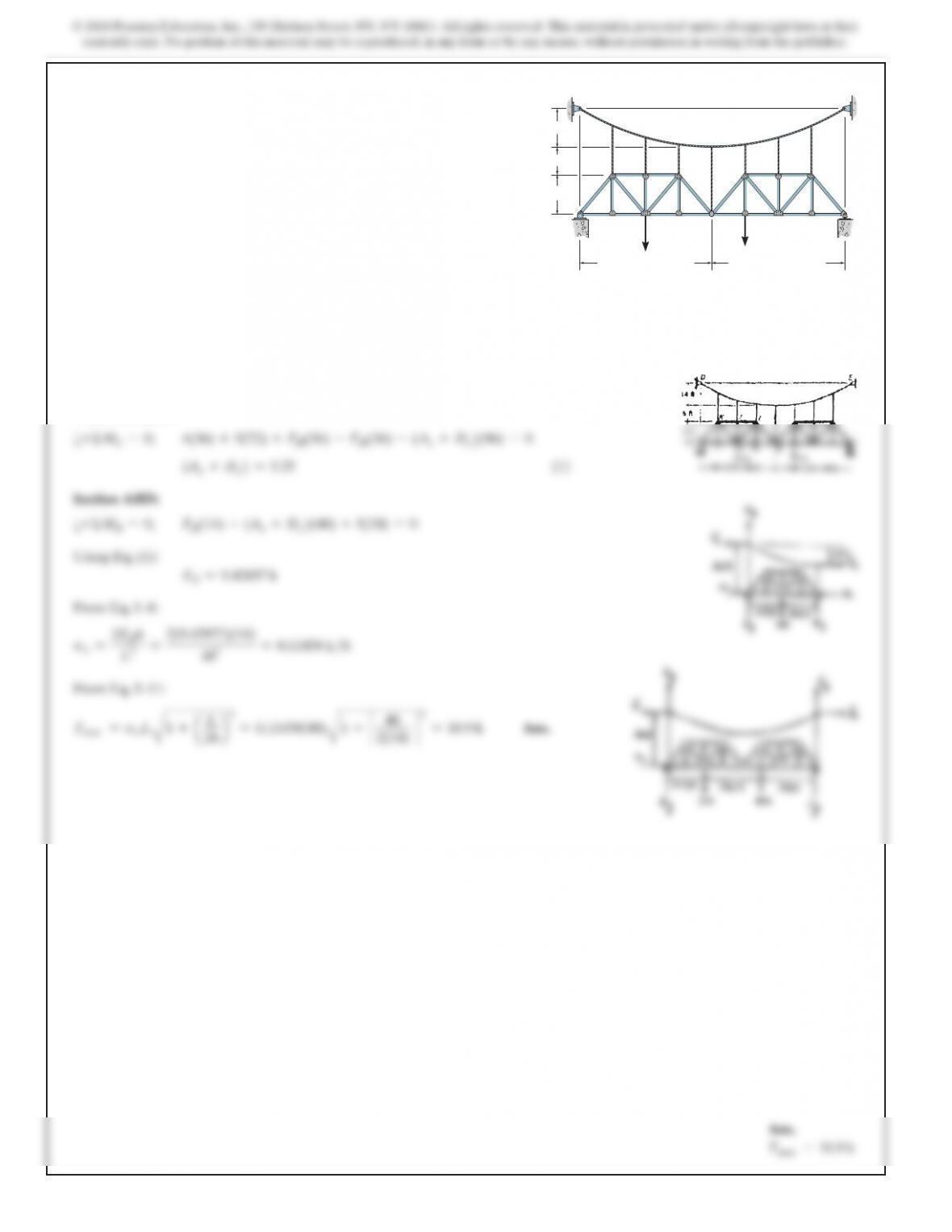
*5–12. The cable will break when the maximum tension
reaches 50 k. Determine the maximum uniform distributed
load w that can be supported by the cable.
120 ft
15 ft
w
SOLUTION
Eqs. 5–7:
y
=
w
2FH
x
2
At
x=7.5 m, y=6m
,
FH=4.688 w
T=
F
H
cos u
for 0 …u…p
2
T max
will occur when
u
is maximum.
dy
dx `max
= tan (umax
2
=
w
FH
x
`x=7.5 m
u max = tan–1
a7.5
4.688 b
=57.99°
T max =
F
H
cos (u max 2
=
4.688 w
cos 57.99°
=1
2
w=1.36 kN>m
Ans.
w=1.36 kN>m
Ans.
200
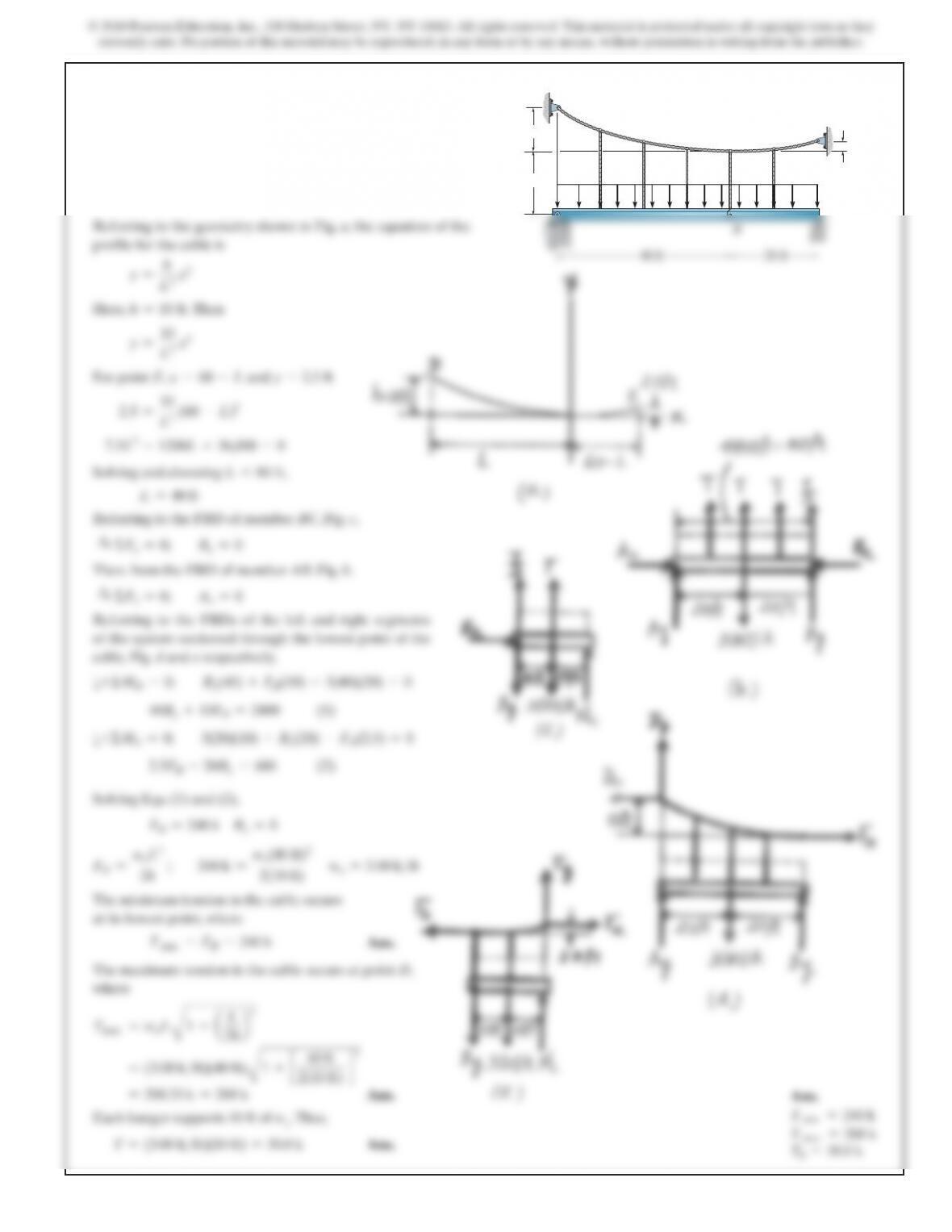
5–13. The trusses are pin connected and suspended from the
parabolic cable. Determine the maximum force in the cable
when the structure is subjected to the loading shown. The
support at A is a pin and C is a rocker.
4 k
5 k
A
FGHB
C
IJK
16 ft
4 @ 12 ft 5 48 ft 4 @ 12 ft 5 48 ft
DE
6 ft
14 ft
SOLUTION
Entire Structure:
a+ΣMC=0;
4(36) +5(72) +FH(36) –FH(36) –(Ay+Dy2(96) =0
(Ay+Dy2=5.25
(1)
Section ABD:
a+ΣMB=0;
FH(14) –(Ay+Dy2(48) +5(24) =0
Using Eq. (1):
FH=9.42857 k
From Eq. 5–8:
w
o=
2F
H
h
L
2=
2(9.42857)(14)
48
2=0.11458 k
>
f
t
From Eq. 5–11:
T
max =woL
A
1+
a
L
2hb2
=0.11458(48)
A
1+
c
48
2(14)
d2
=10.9 k
Ans.
Tmax =10.9 k
Ans.
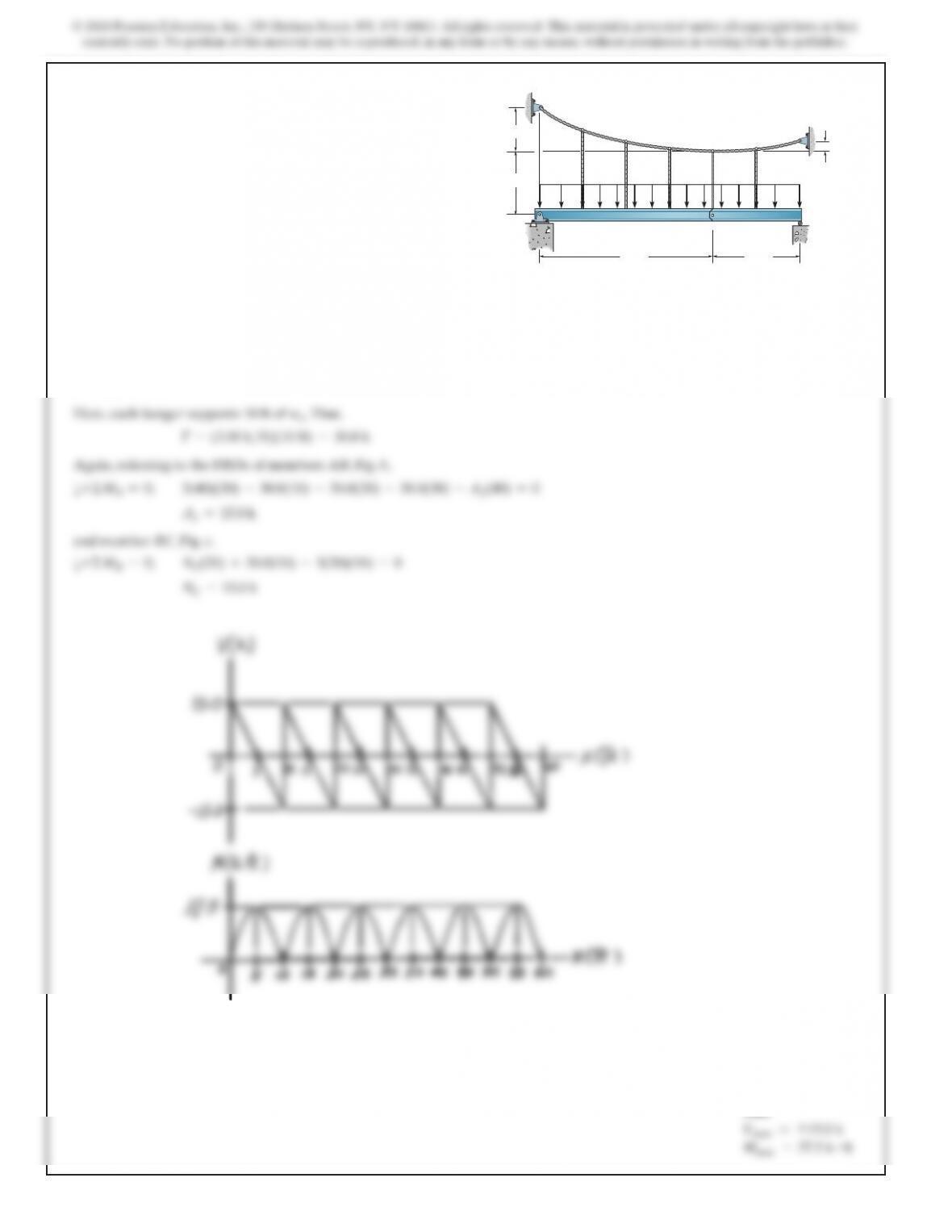
5–14. Determine the maximum and minimum tension in the
parabolic cable and the force in each of the hangers. The girder
is subjected to the uniform load and is pin connected at B.
A
D
C
E
10 ft
2.5 ft
15 ft
3 k>ft
SOLUTION
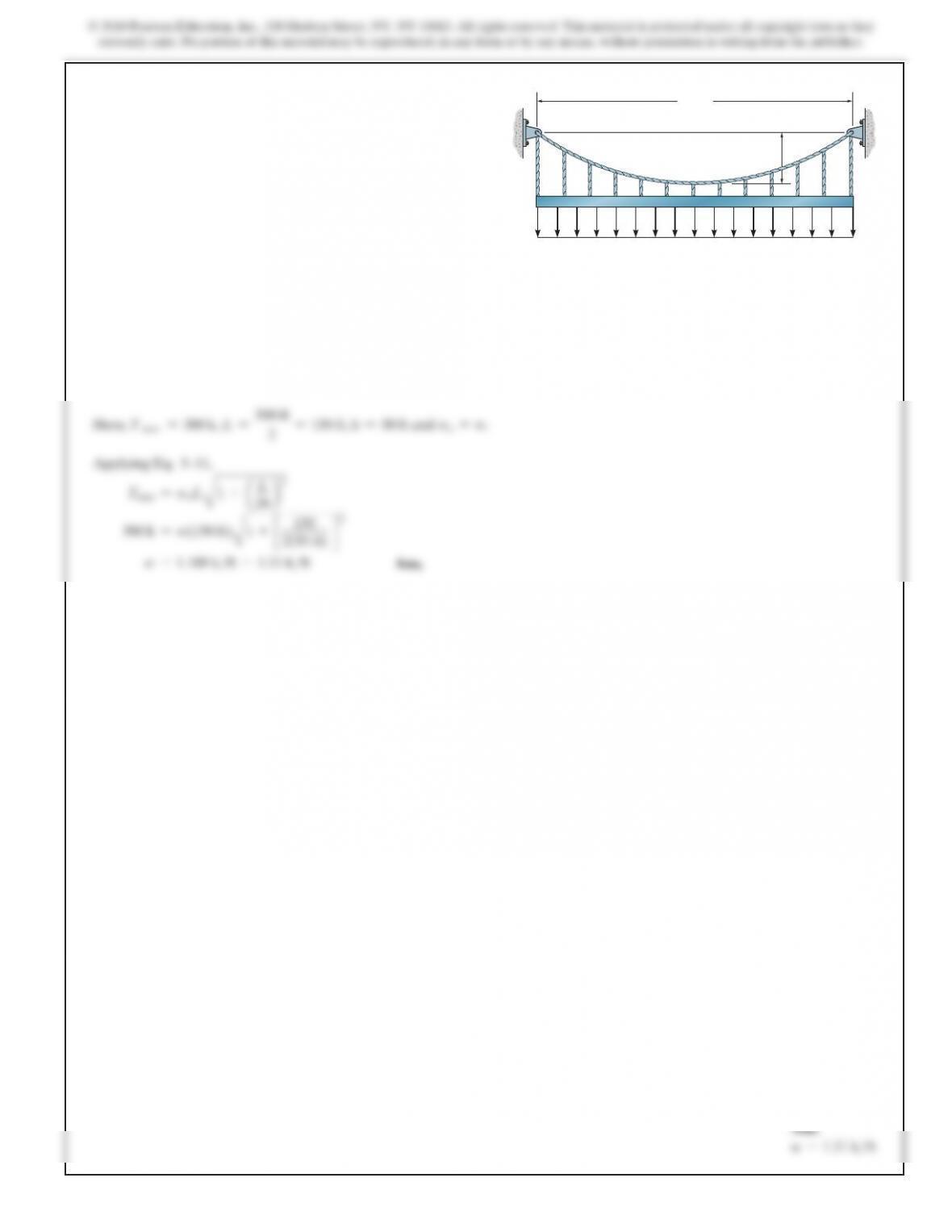
5–15. Draw the shear and moment diagrams for the pin
connected girders AB and BC. The cable has a parabolic shape.
A
D
B
C
E
10 ft
2.5 ft
15 ft
40 ft 20 ft
3 k>ft
SOLUTION
203
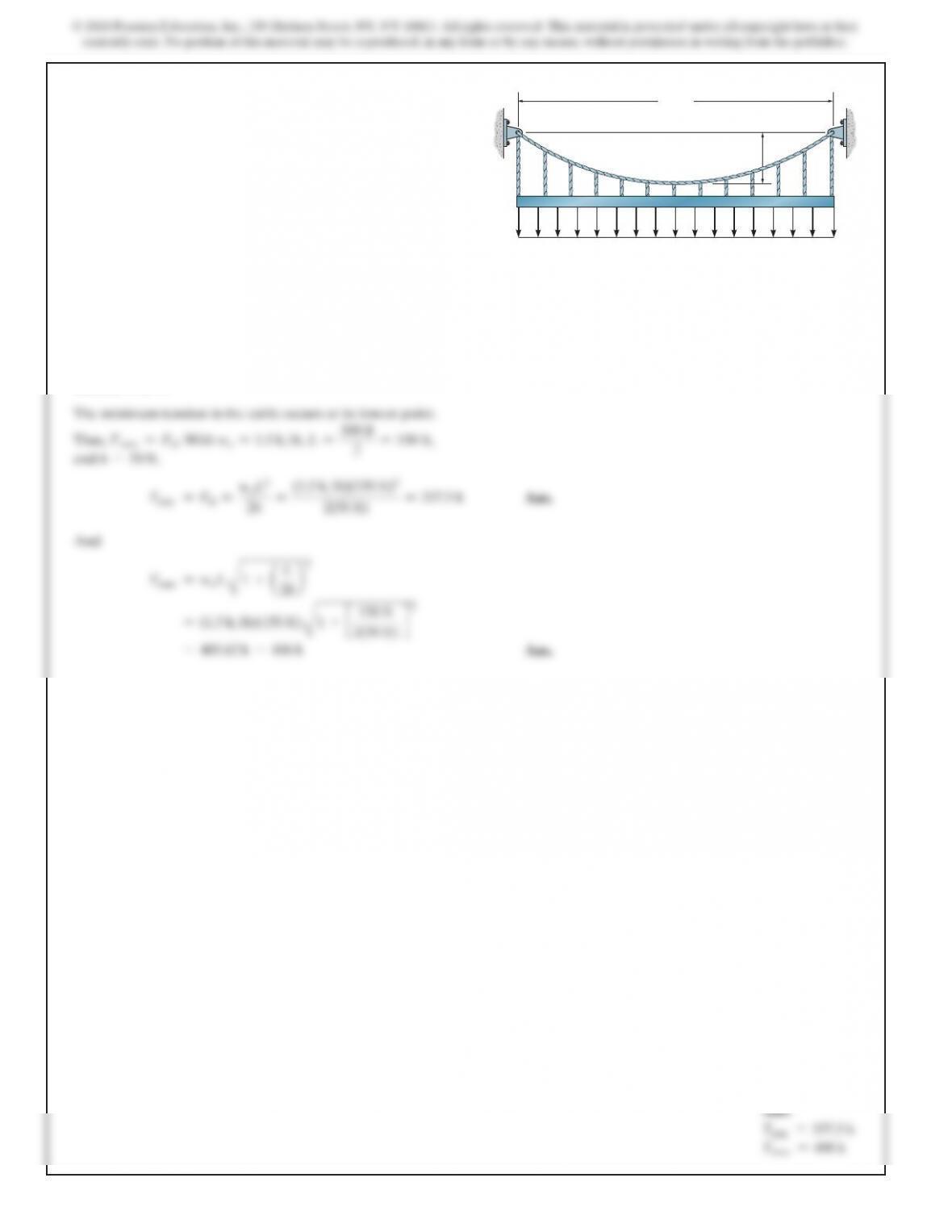
*5–16. The cable will fail when the maximum tension reaches
Tmax =300
k
. Determine the maximum uniform distributed
load w that can be supported by the cable.
w
300 ft
50 ft
SOLUTION
T max =300 k
300 ft
Ans.
w=1.11 k>ft
204
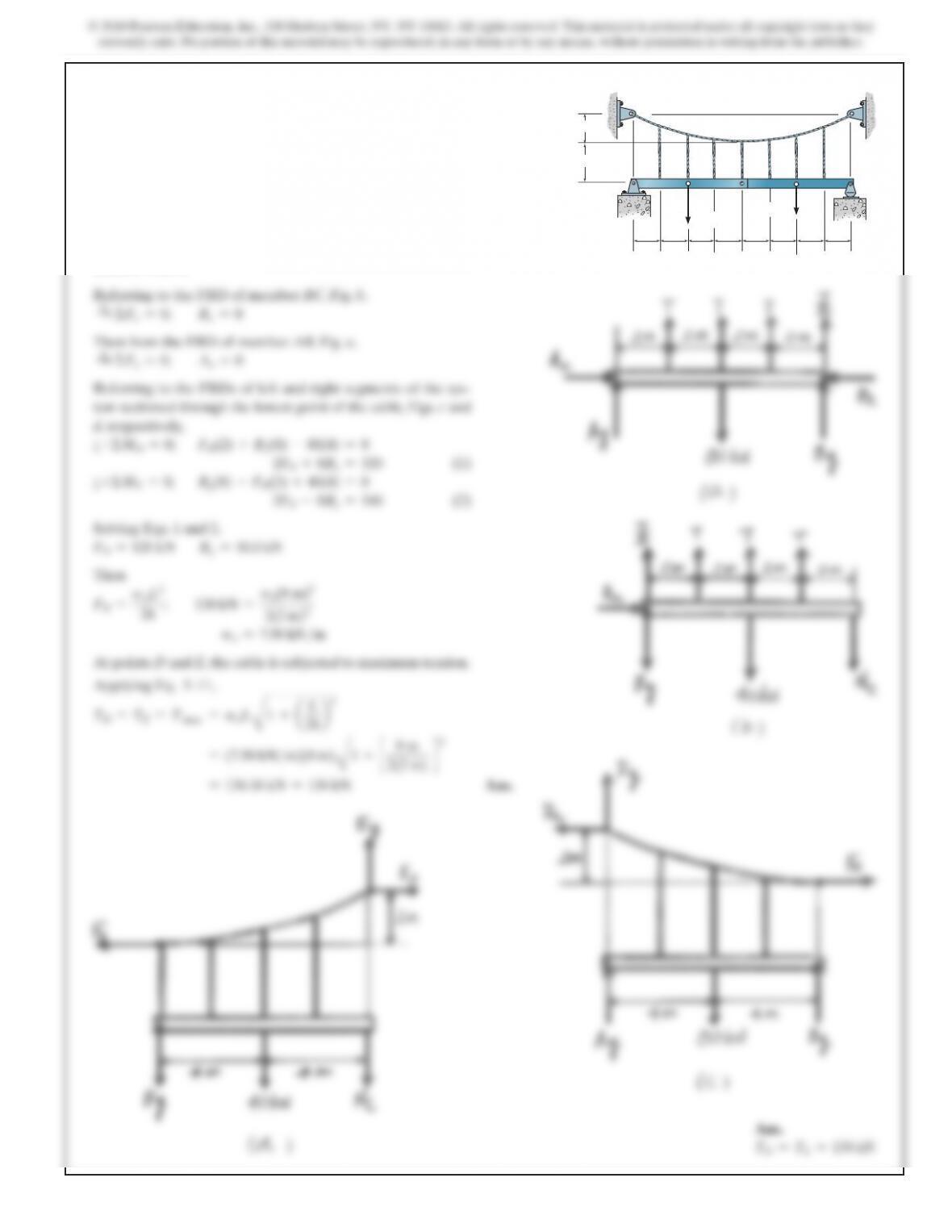
5–17. The cable is subjected to a uniform loading of
w=1.5
k>ft
. Determine the maximum and minimum tension
in the cable.
w
300 ft
50 ft
SOLUTION
Ans.
Tmin =337.5 k
Tmax =406 k
205
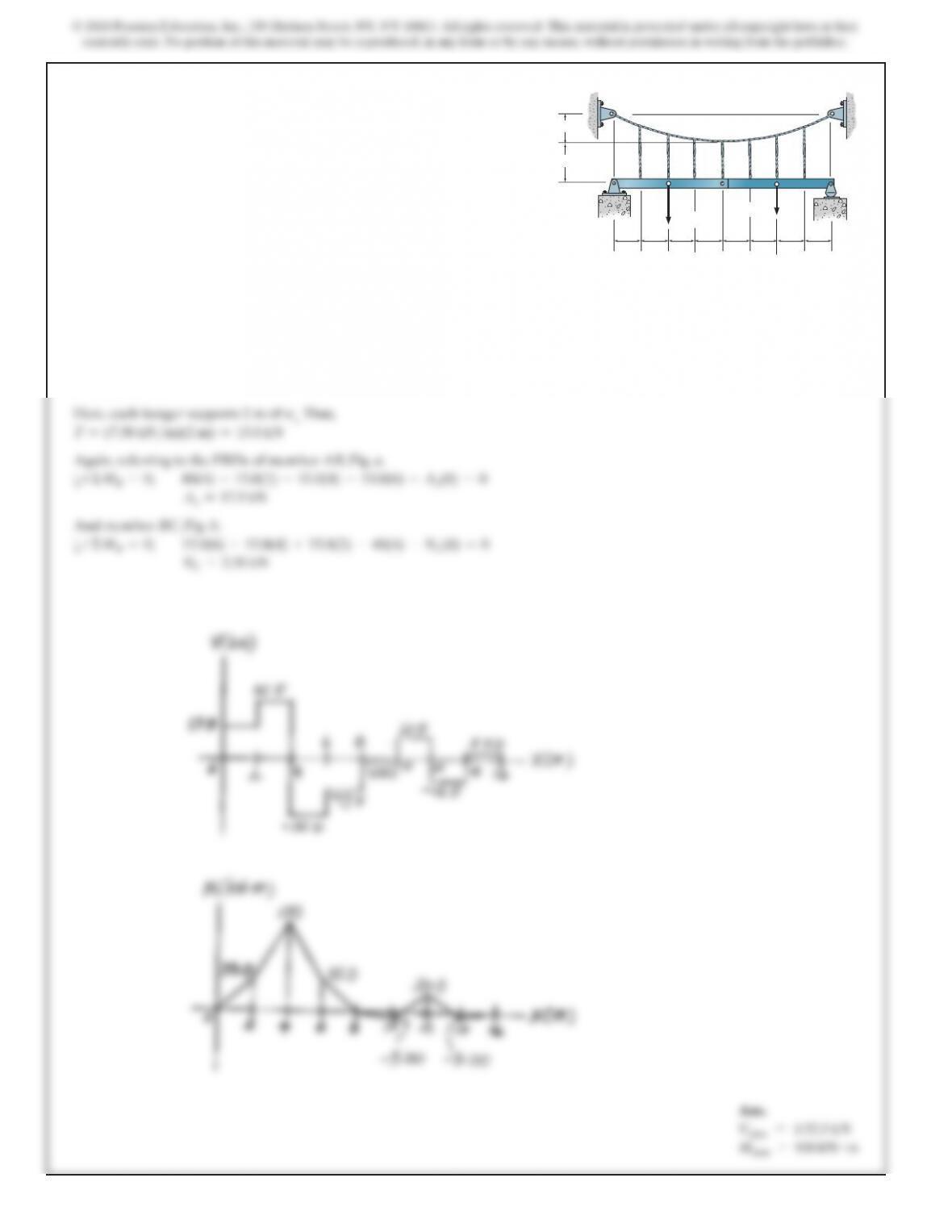
5–18. The beams AB and BC are supported by the cable that
has a parabolic shape. Determine the tension in the cable at
points D and E.
A
B
2 m2 m2 m2 m2 m2 m2 m2 m
80 kN
C
DE
3
m
2
m
40 kN
SOLUTION
Ans.
TD=TE=134 kN
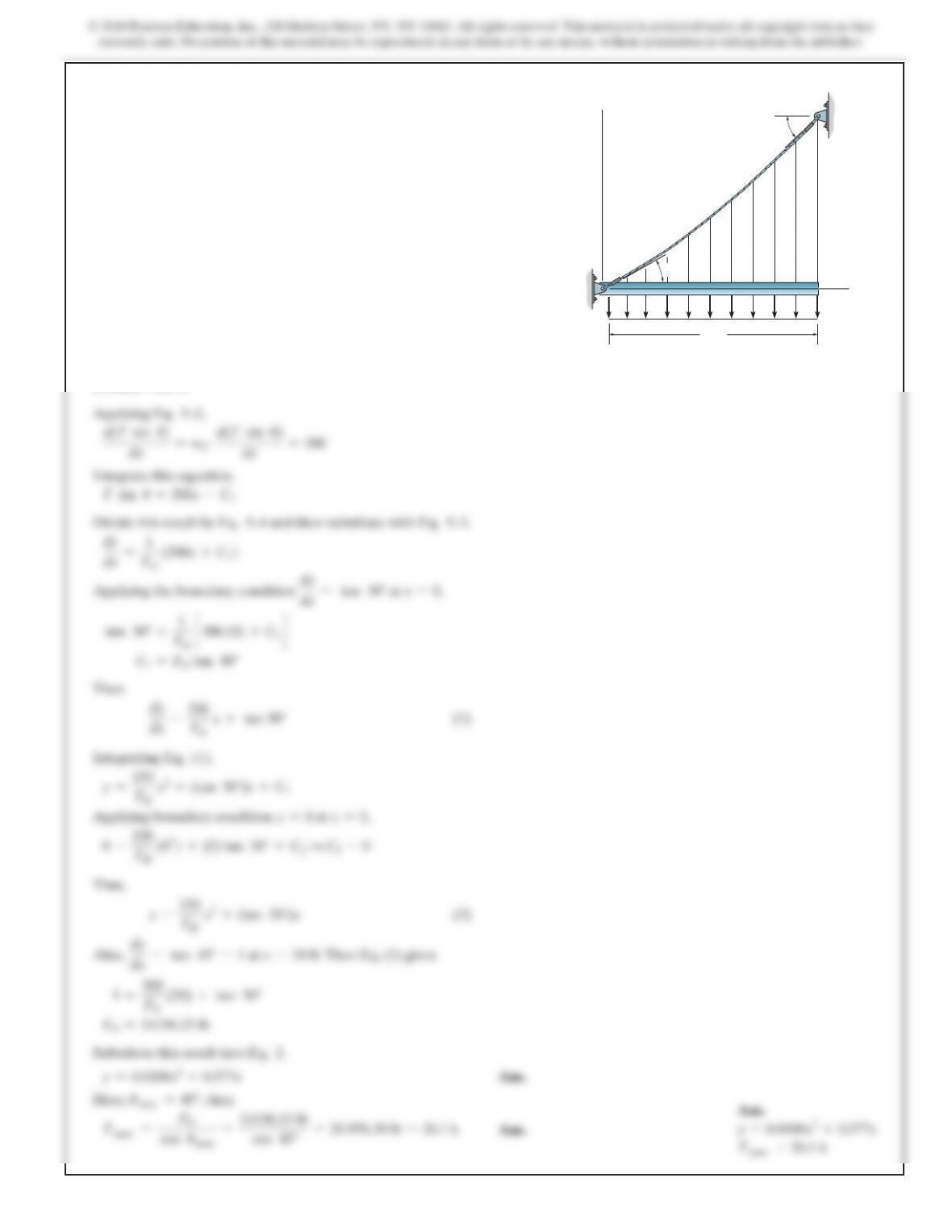
5–19. The beams AB and BC are supported by the cable that
has a parabolic shape. Draw the shear and moment diagrams
for members AB and BC.
A
B
2 m2 m2 m2 m2 m2 m2 m2 m
80 kN
C
DE
3
m
2 m
40 kN
SOULTION
207
*5–20. The cable AB is subjected to a uniform loading of
300
lb>ft.
If the weight of the cable is neglected and the slope
angles at points A and B are
30°
and
45°
, respectively, determine
the curve that defines the cable shape and the maximum
tension developed in the cable.
20 ft
300 lb>ft
y
x
A
B
458
308
SOLUTION
cos u max
cos 45°
T max =20.1 k