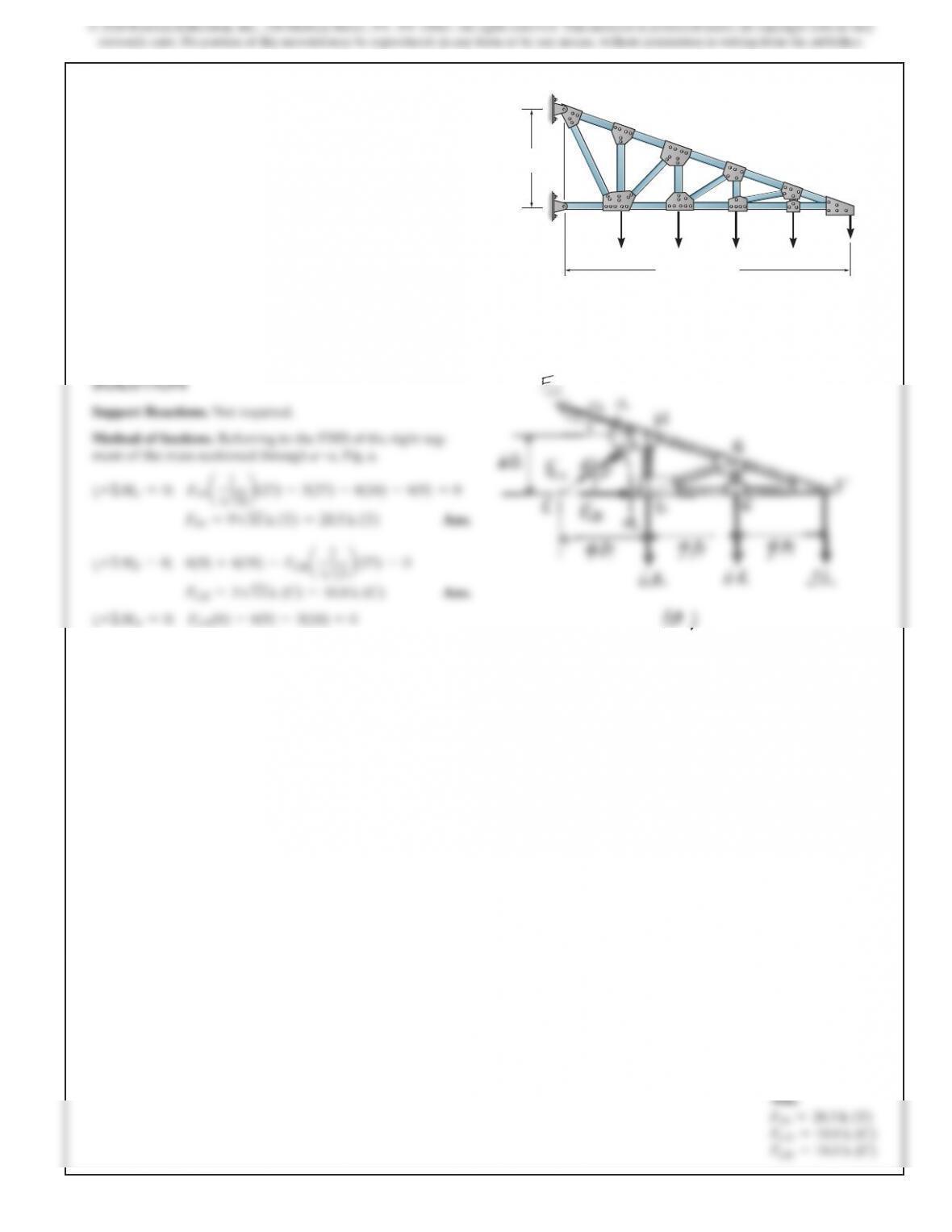
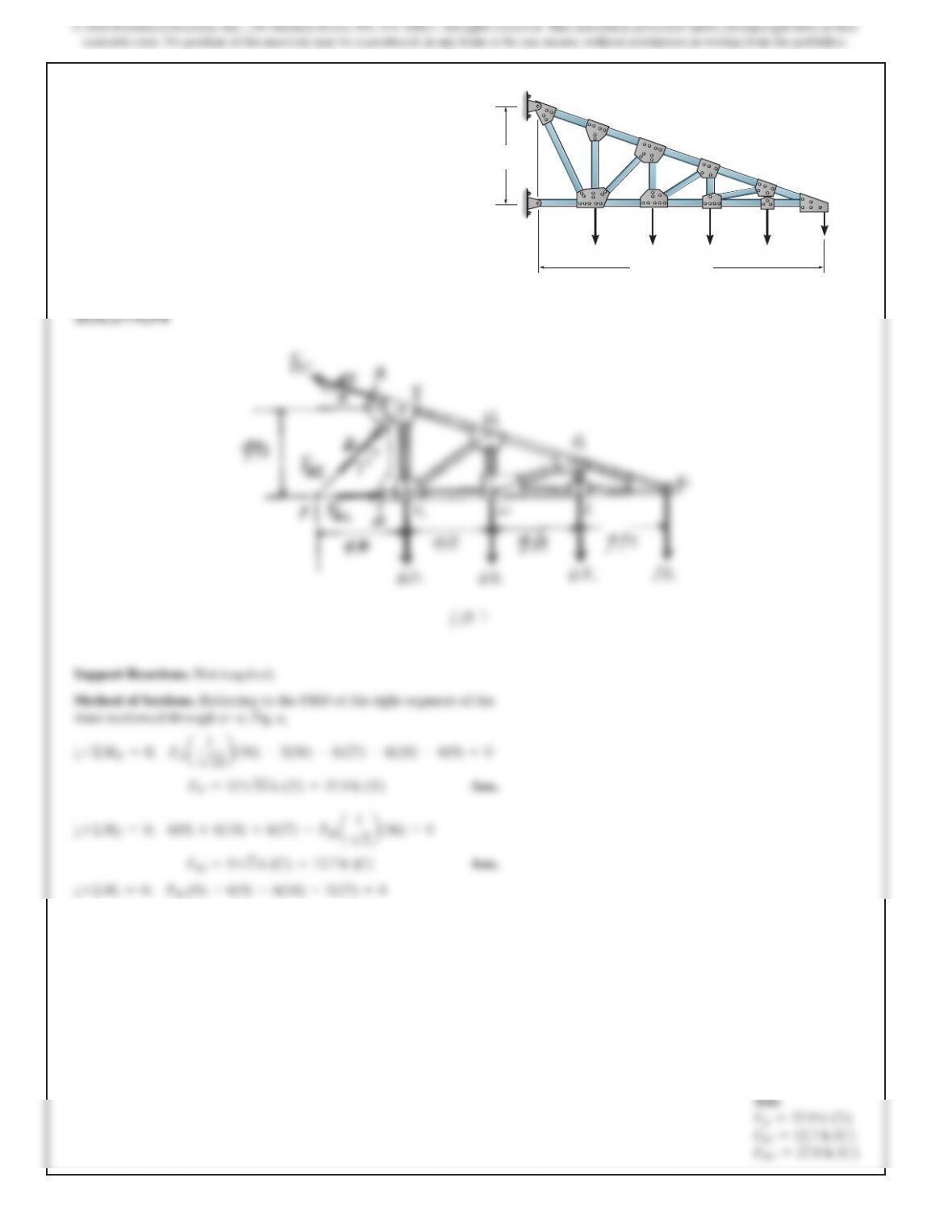
3–30. Determine the force in members HI, CH, and CD of
the truss. State if the members are in tension or compression.
Assume all members are pin connected.
D
H
I
J
K
AC
B
6 k6 k6 k6 k
3
k
E
G
F
15 ft
5 @ 9 ft = 45 ft
111
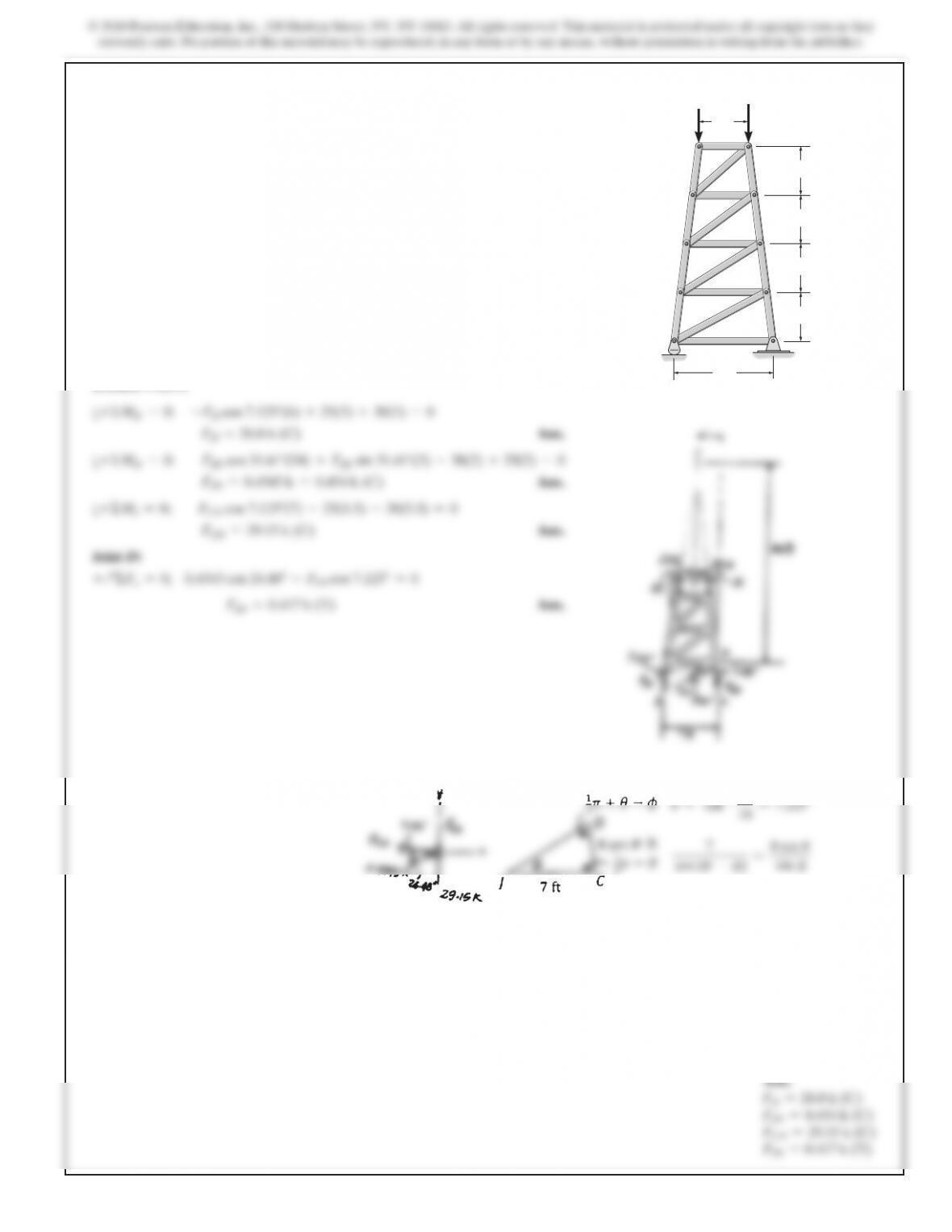
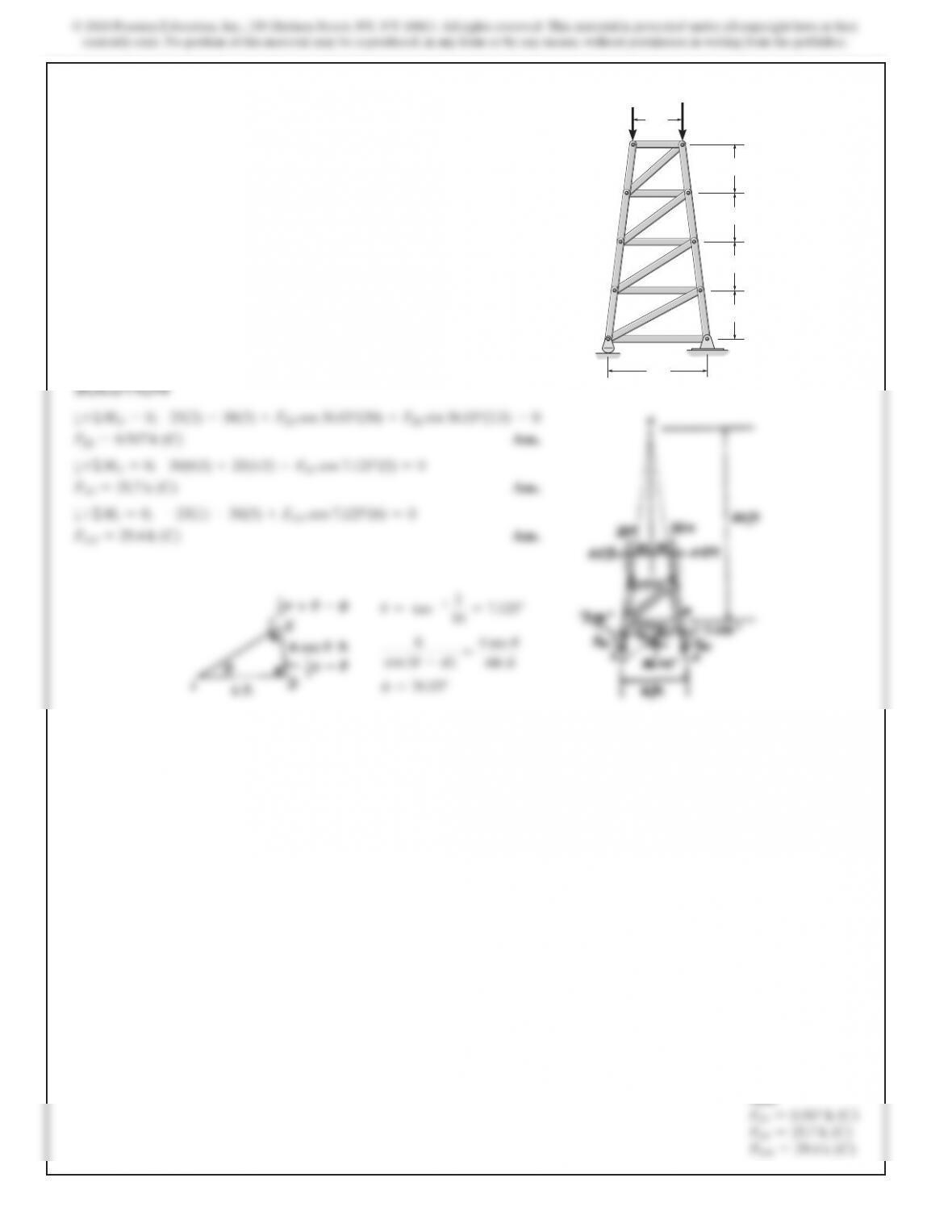
*3–32. The wooden headframe is subjected to the loading
shown. Determine the forces in members JI, JD, and ID. State
if the members are in tension or compression.
AB
C
D
E
F
G
H
I
J
4 ft
4 ft
4 ft
4 ft
4 ft
8 ft
25 k
30 k
SOLUTION
a+ΣMD=0;
–FJI cos 7.125°(6) +25(5) +30(1) =0
FJI =26.0 k (C)
Ans.
a+ΣMO=0;
FJD cos 31.61°(24) +FJD sin 31.61°(3) –30(2) +25(2) =0
FJD =0.4543 k =0.454 k (C)
Ans.
a+ΣMJ=0;
FCD cos 7.125°(7) –25(1.5) –30(5.5) =0
FCD =29.15 k (C)
Ans.
Joint D:
+ QΣFx=0;
0.4543 cos 24.48°–FID cos 7.125°=0
FID =0.417 k (T)
Ans.
Ans.
FJI =26.0 k (C)
FJD =0.454 k (C)
FCD =29.15 k (C)
FID =0.417 k (T)
u= tan–1
2
16
=7.125
°
7
cos (u–f)
=
4 sec u
sin f
f=31.61°
3–33. The wooden headframe is subjected to the loading
shown. Determine the forces in members HI, ED, and EI. State
if the members are in tension or compression.
AB
C
D
E
F
G
H
I
J
4 ft
4 ft
4 ft
4 ft
4 ft
8 ft
25 k
30 k
2
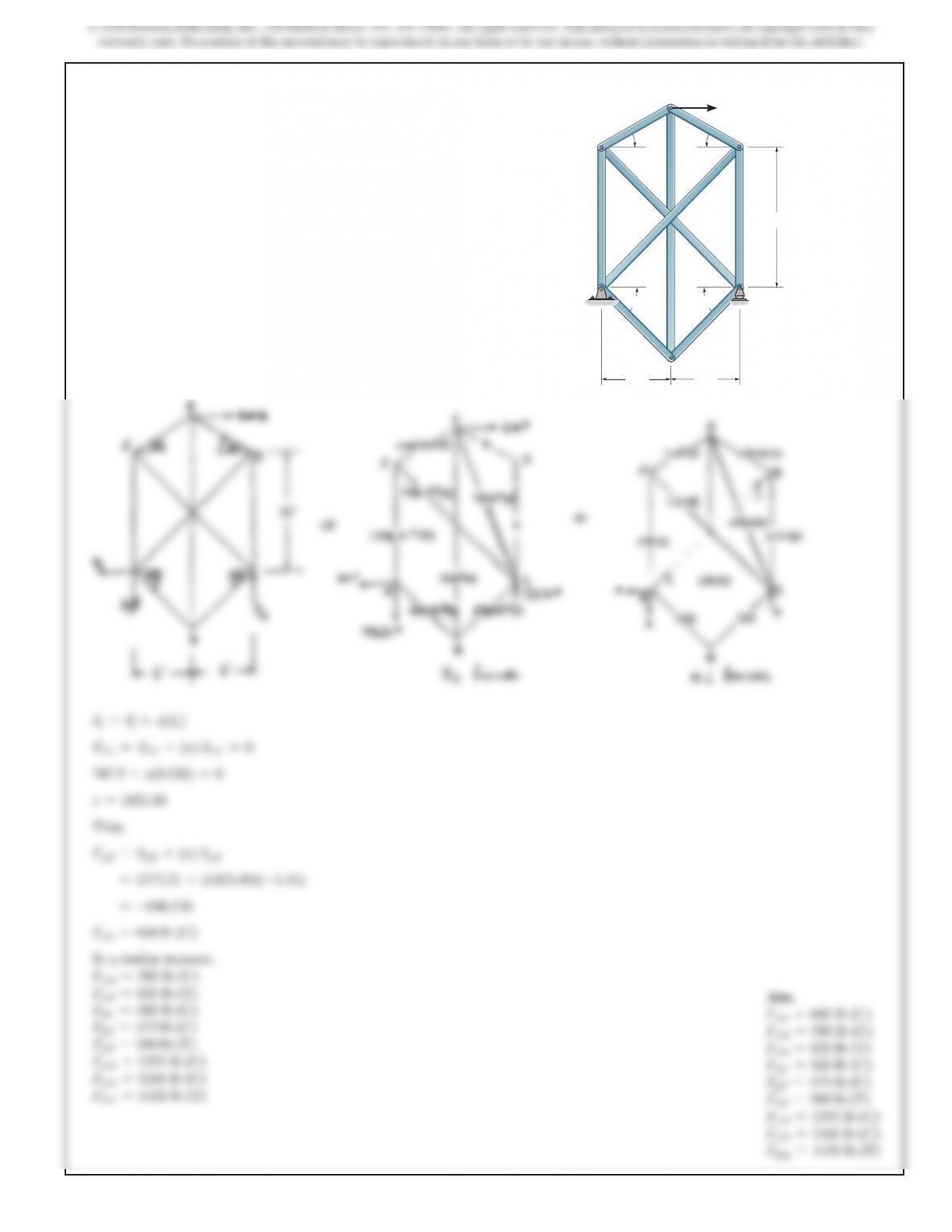
3–34. Determine the forces in all the members of the complex
truss. State if the members are in tension or compression. Hint:
Substitute member AD with one placed between E and C.D
E
B
C
A
F
600 lb
6 ft 6 ft
12 ft
308308
458458
Si=S′
i+x(Si2
FEC =S′
EC +(x) SEC =0
747.9 +x(0.526) =0
x=1421.86
Thus,
FAF =SAF +(x) SAF
=1373.21 +(1421.86)(–1.41)
=–646.3 lb
FAF =646 lb (C)
In a similar manner,
FAB =580 lb (C)
SOLUTION
FEB =820 lb (T)
FBC =580 lb (C)
FEF =473 lb (C)
FCF =580 lb (T)
FCD =1593 lb (C)
114
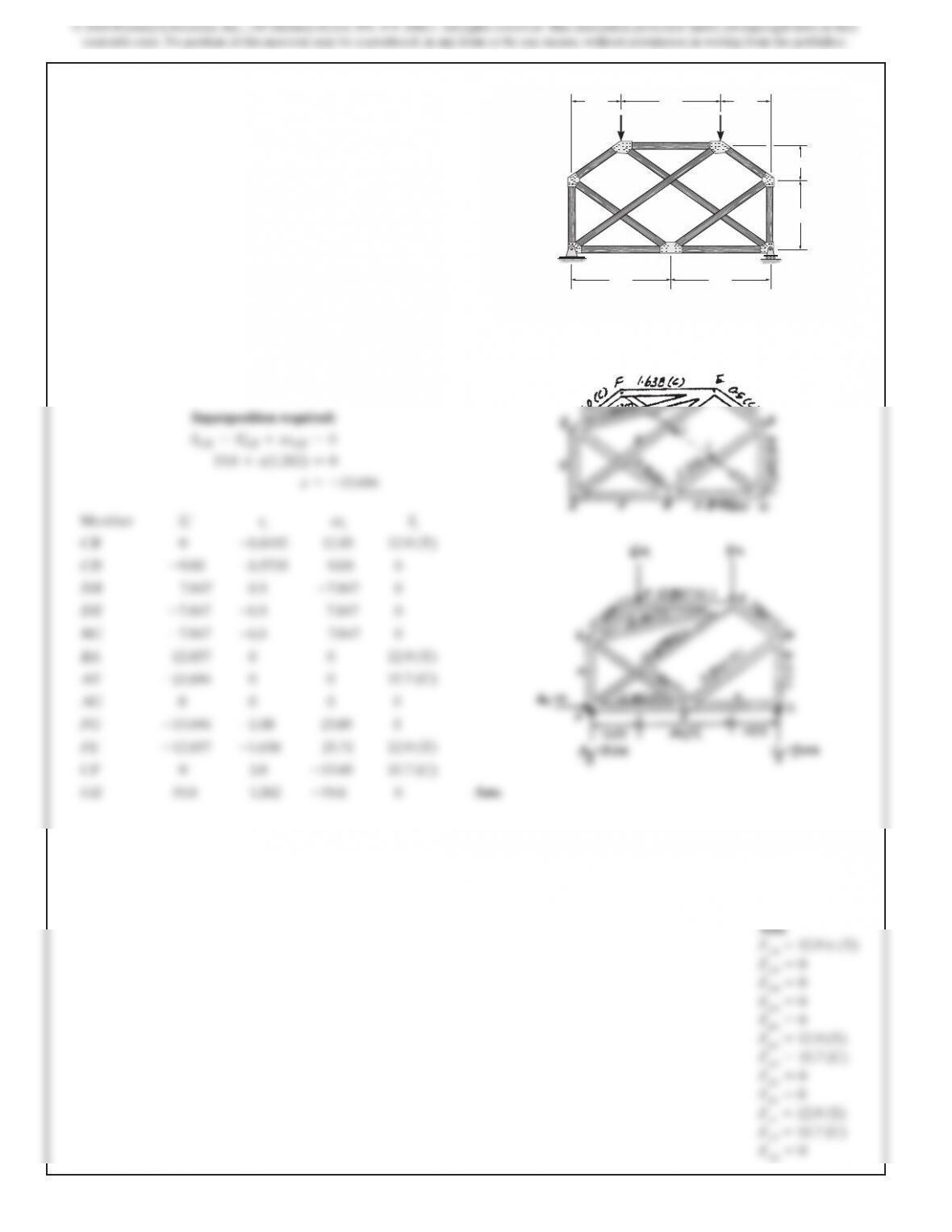
3–35. Determine the forces in all the members of the complex
truss. State if the members are in tension or compression.
Assume all members are pin connected.
A
B
C
D
E
G
F
10 ft 20 ft
20 ft 20 ft
9 k9 k
10 ft
7 ft
14 ft
SOLUTION
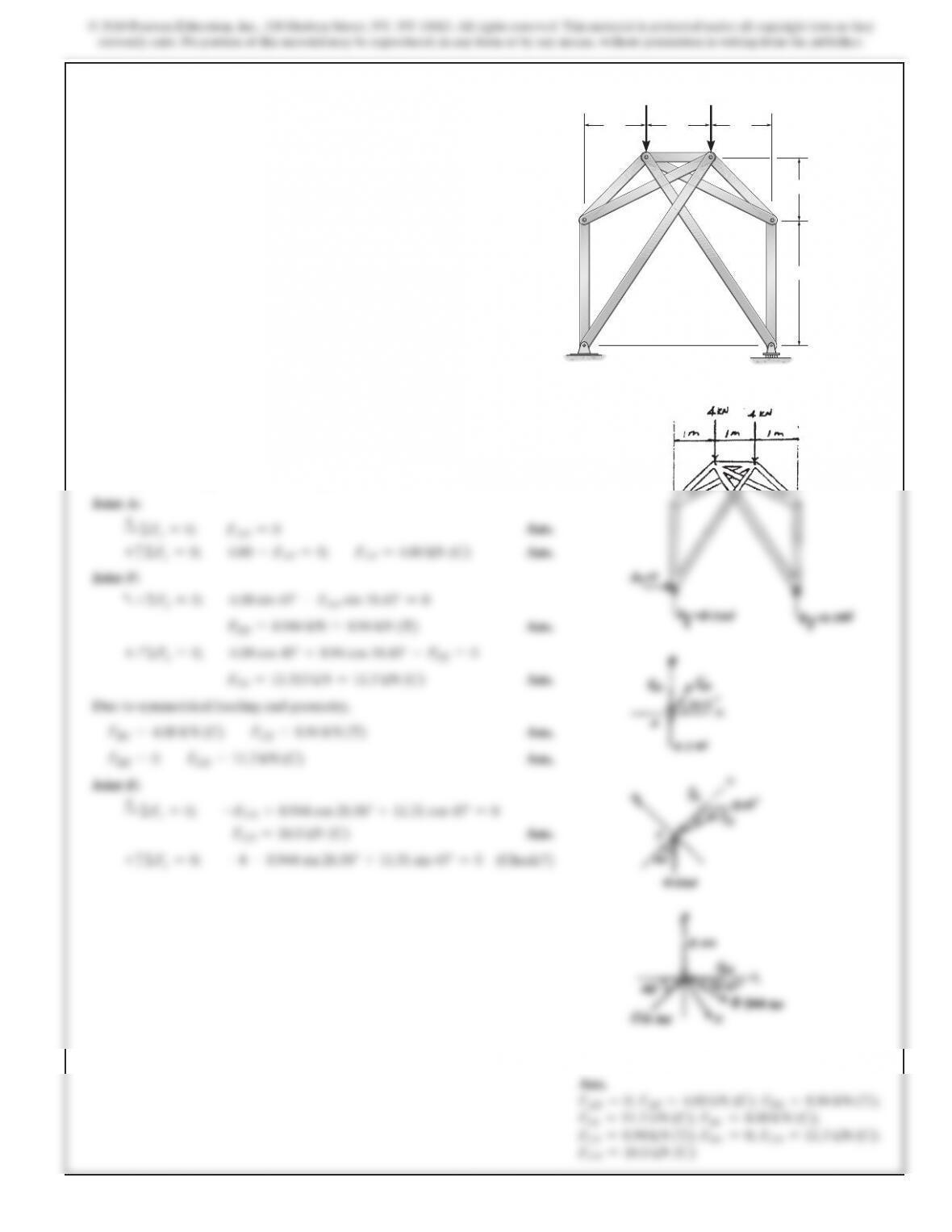
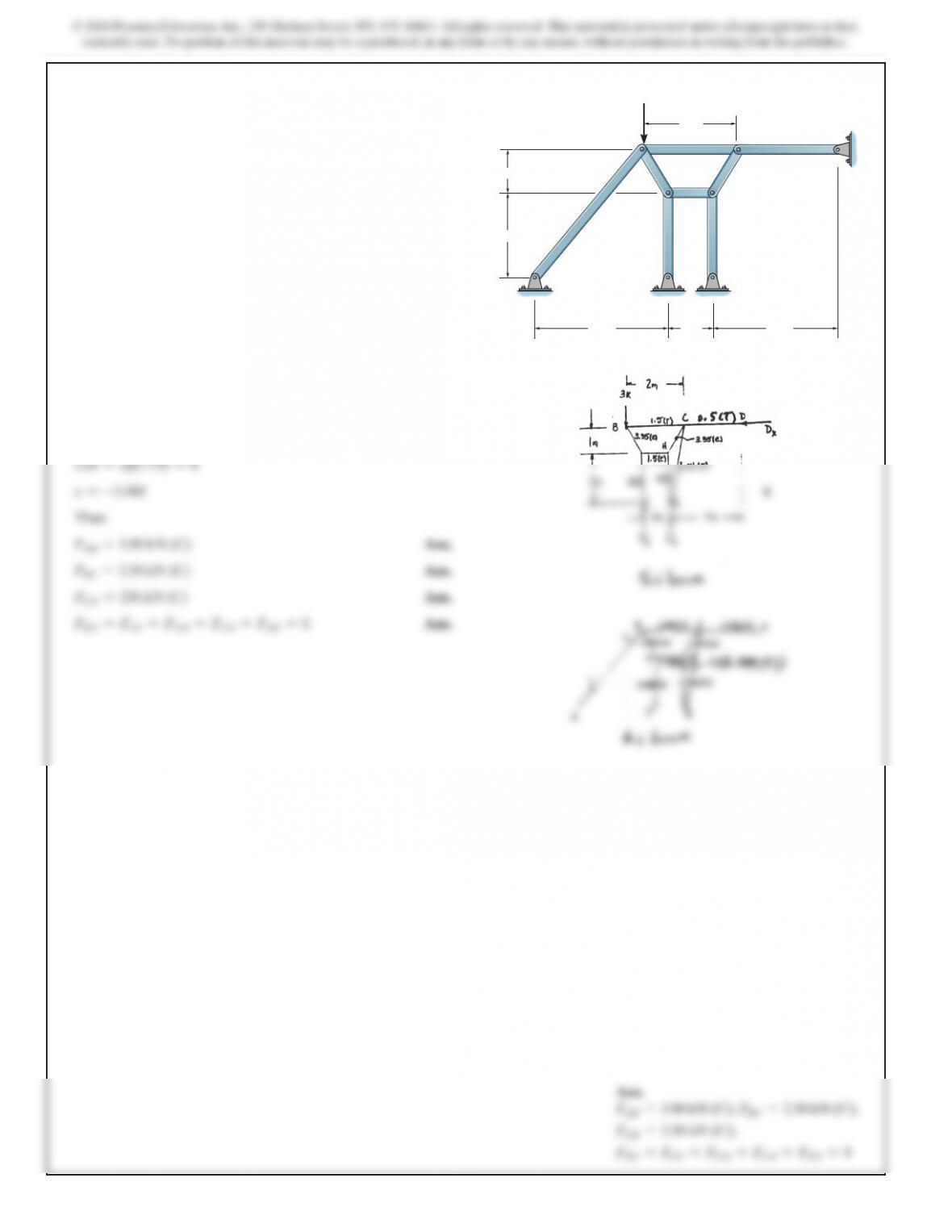
*3–36. Determine the force in each member and state if the
members are in tension or compression.
B
A
E
F
C
D
1 m 1 m 1 m
1
m
2
m
4 kN 4 kN
SOLUTION
Reactions:
Ax=0,
Ay=4.00 kN,
By=4.00 kN
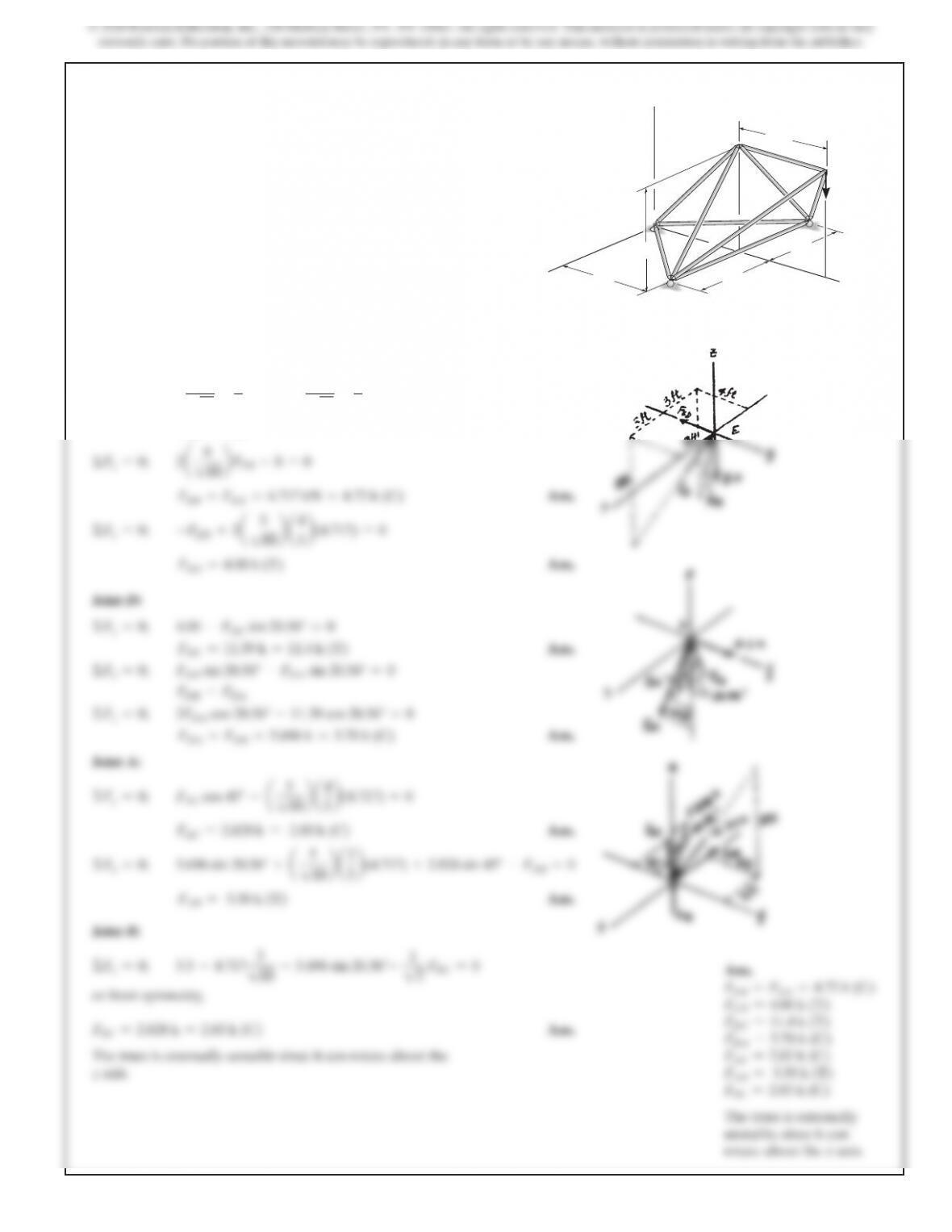
3–38. Determine the force in each member of the space truss.
State if the members are in tension or compression. The
supports at A and B are rollers and C is a ball-and-socket. Is
this truss stable?
x
y
z
C
A
B
E
D4 ft
3 ft
3 ft
8 ft 3 ft
8 k
SOLUTION
Method of Joints: In this case, the support reactions are not
required for determining the member forces.
Joint E:
ΣFx=0;
a5
189 ba3
5b
FEB –
a5
189 ba3
5b
FEA =
0
FEB =FEA
FDB =FDA
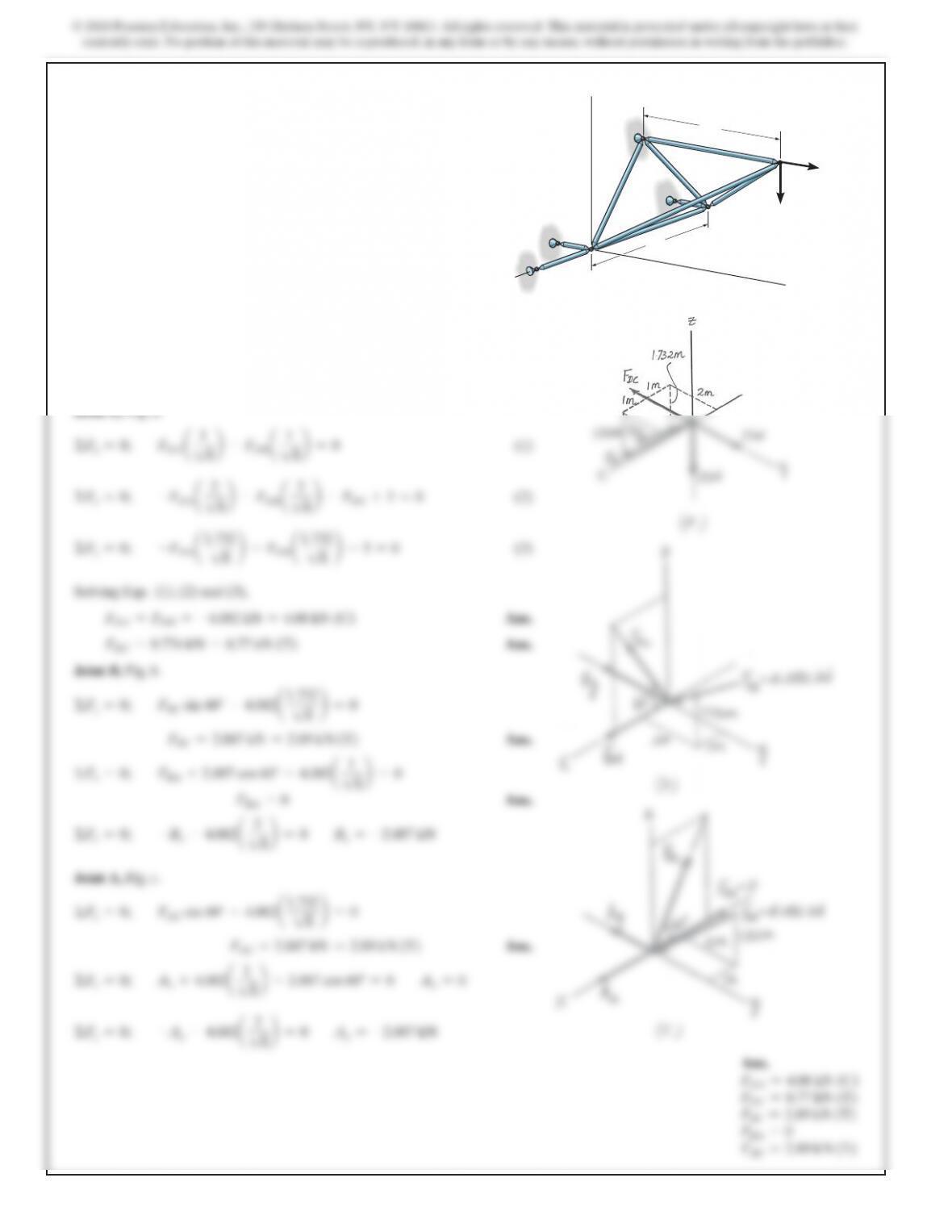
3–39. Determine the force in the members of the space truss,
and state whether they are in tension or compression.
Support Reactions. Not required.
Method of Joints.
Joint D, Fig. a.
x
y
z
A
B
C
2 m
2 m
2 m
2 m
D
5 kN
3 kN
SOLUTION
119
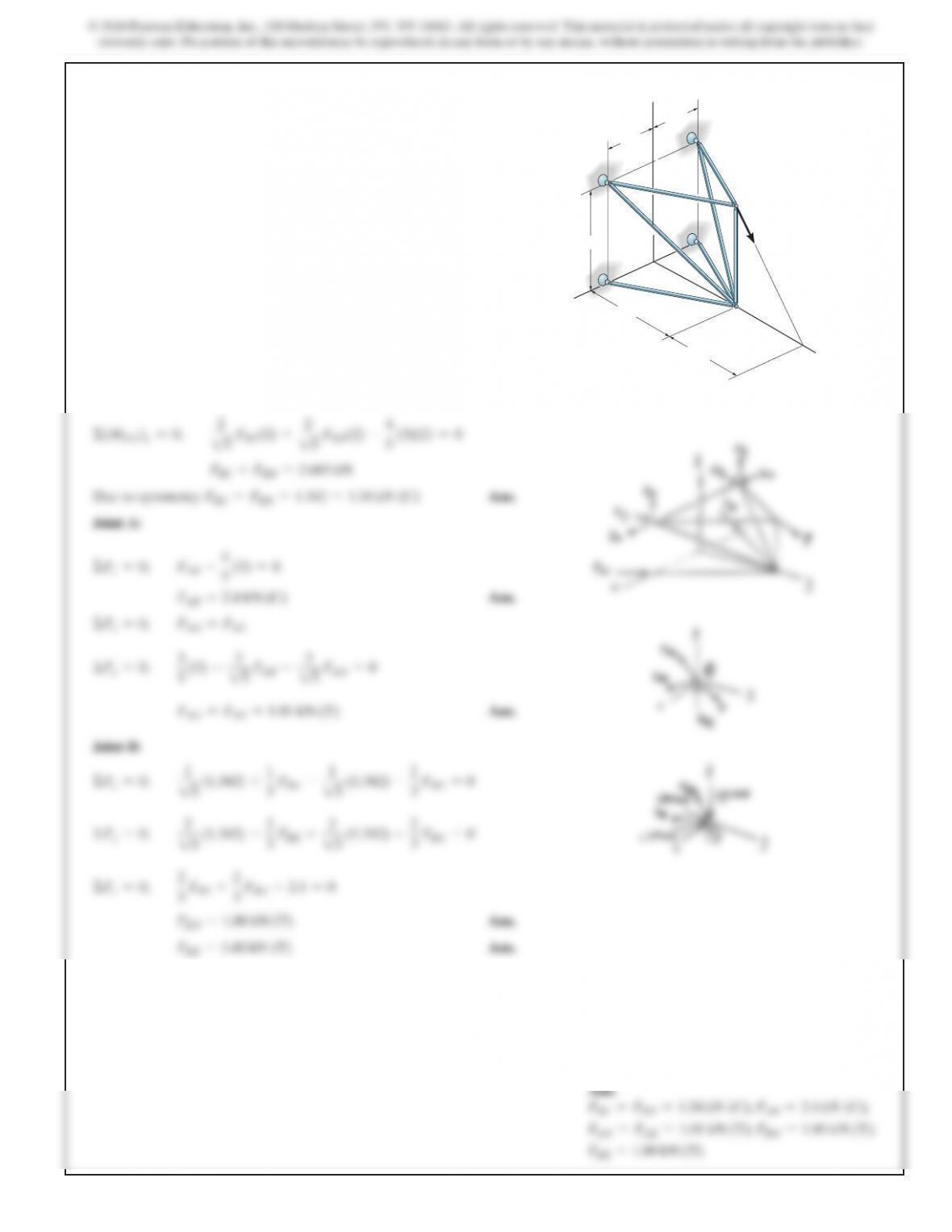
*3–40. Determine the force in each member of the space truss
and state if the members are in tension or compression. The truss is
supported by ball-and socket joints at C, D, E, and G. Note:
Although this truss is indeterminate to the first degree, a solution is
possible due to symmetry of geometry and loading.
G
A
F 5 3 kN
B
C
E
y
z
x
D
1 m
2 m
2 m
1.5 m
1 m
SOLUTION
Σ
(MEG
2
x=0;
2
15
FBC(2) +
2
15
FBD(2) –
4
5
(3)(2) =
0
FBC +FBD =2.683 kN
Due to symmetry:
FBC =FBD =1.342 =1.34 kN (C)
Ans.
Joint A:
Σ
Fz=0;
FAB –
4
5
(3) =
0
FAB =2.4 kN (C)
Ans.
ΣFx=0;
FAG =FAE
Σ
Fy=0;
3
5
(3) –
3
15
FAE –
3
15
FAG =
0
FAG =FAE =1.01 kN (T)
Ans.
Joint B:
Σ
Fx=0;
1
15
(1.342) +
1
3
FBE –
1
15
(1.342) –
1
3
FBG =
0
Σ
Fy=0;
2
15
(1.342) –
2
3
FBE +
2
15
(1.342) –
2
3
FBG =
0
Σ
Fz=0;
2
3
FBE +
2
3
FBG –2.4 =
0
FBG =1.80 kN (T)
Ans.
FBE =1.80 kN (T)
Ans.
Ans.
FBC =FBD =1.34 kN (C); FAB =2.4 kN (C);
FAG =FAE =1.01 kN (T); FBG =1.80 kN (T);
FBE =1.80 kN (T)
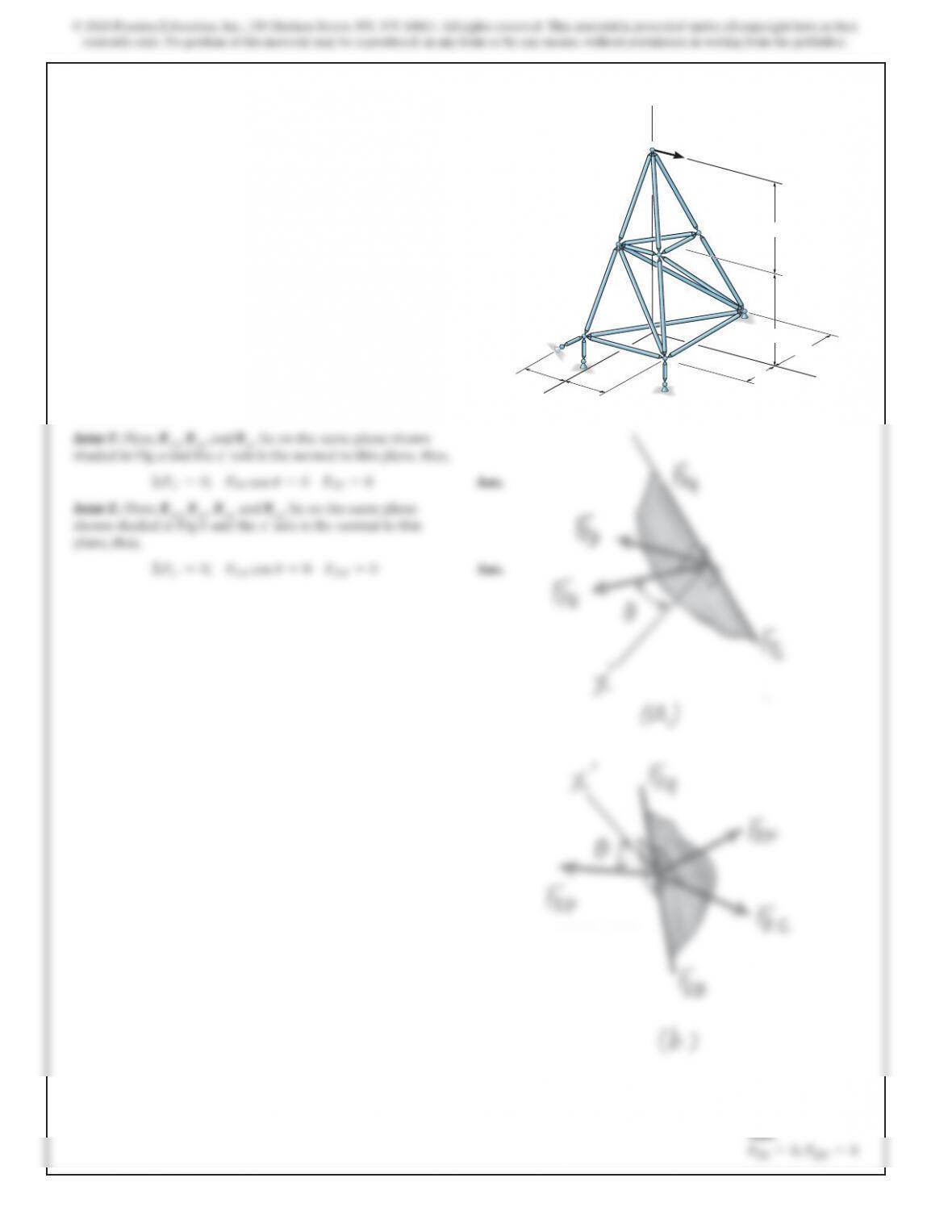
3–41. Determine the force in members FE and ED of the
space truss and state if the members are in tension or
compression. The truss is supported by a ball-and-socket joint
at C and short links at A and B.
z
x
y
4 kN
3 m
3 m
F
E
D
G
C
1.5 m
1 m
0.75
m
0.75 m
A
B
SOLUTION
Method of Joints.
121
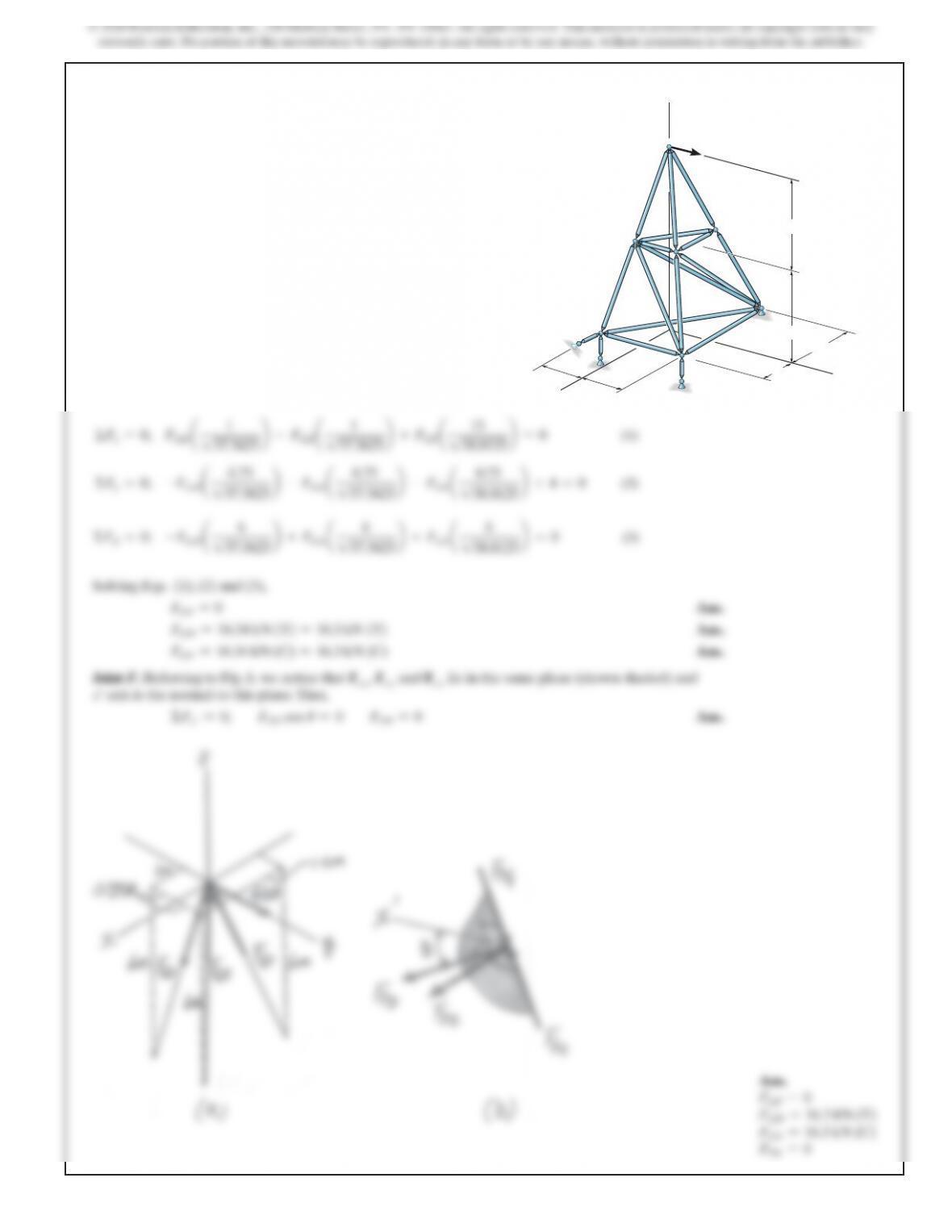
3–42. Determine the force in members GD, GE, GF, and FD
of the space truss and state if the members are in tension or
compression.
z
x
y
4 kN
3 m
3 m
F
E
D
G
C
1.5 m
1 m
0.75
m
0.75 m
A
B
SOLUTION
Support Reactions. Not required.
Method of Joints.
Joint G. Fig. a.
Σ
Fx=0;
FGD
a1
137.5625 b
–FGE
a1
137.5625 b
+FGF
a15
138.8125 b
=
0
(1)
Σ
Fy=0;
–FGD
a0.75
137.5625 b
–FGE
a0.75
137.5625 b
–FGF
a0.75
138.8125 b
+4=
0
(2)
Σ
FZ=0;
–FGD
a6
137.5625 b
+FGE
a6
137.5625 b
+FGF
a6
138.8125 b
=
0
(3)
Solving Eqs. (1), (2) and (3),
FGF =0
Ans.
FGD =16.34 kN (T) =16.3 kN (T)
Ans.
FGE =16.34 kN (C) =16.3 kN (C)
Ans.
Joint F. Referring to Fig. b, we notice that FFG, FFC and FFE lie in the same plane (shown shaded) and
x¿ axis is the normal to this plane. Thus,
ΣFx′=0;
FFD cos u=0
FFD =0
Ans.
Ans.
FGF =0
FGD =16.3 kN (T)
FGE =16.3 kN (C)
FFD =0
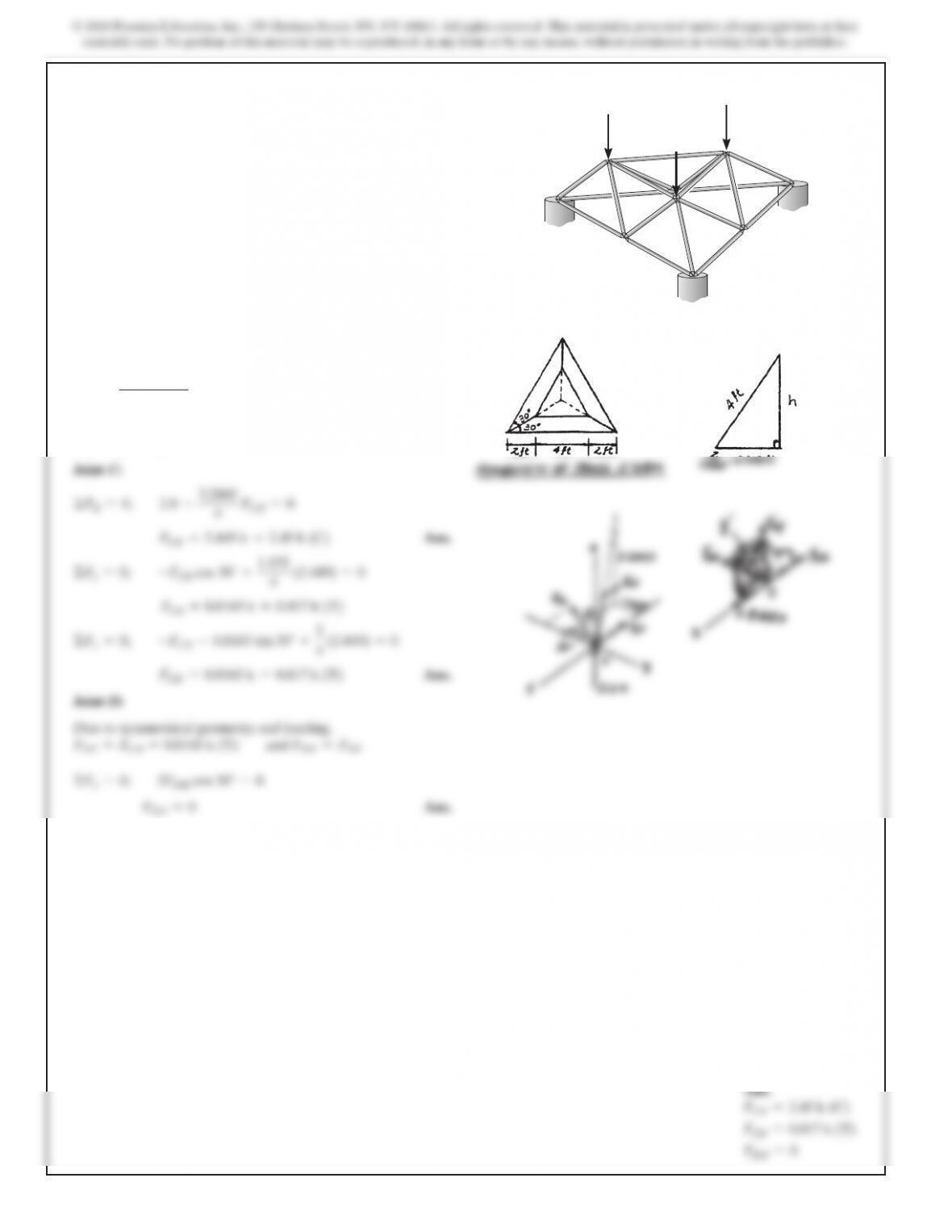
3–43. Three identical trusses are pin connected to produce the
framework shown. If the framework rests on the smooth
supports at A, C, and E, determine the force in members CD,
DH, and CH. State if the members are in tension or compression.
A
4 ft
4 ft
4 ft
4 ft
4 ft
2 k
D
I
G
2 k
4 ft
2 k
E
F
H4 ft
B
C
SOLUTION
h=242–2.3093=3.2660 ft
Due to symmetrical system and loading,
Ay=Cy=Ey=2.0 k
123
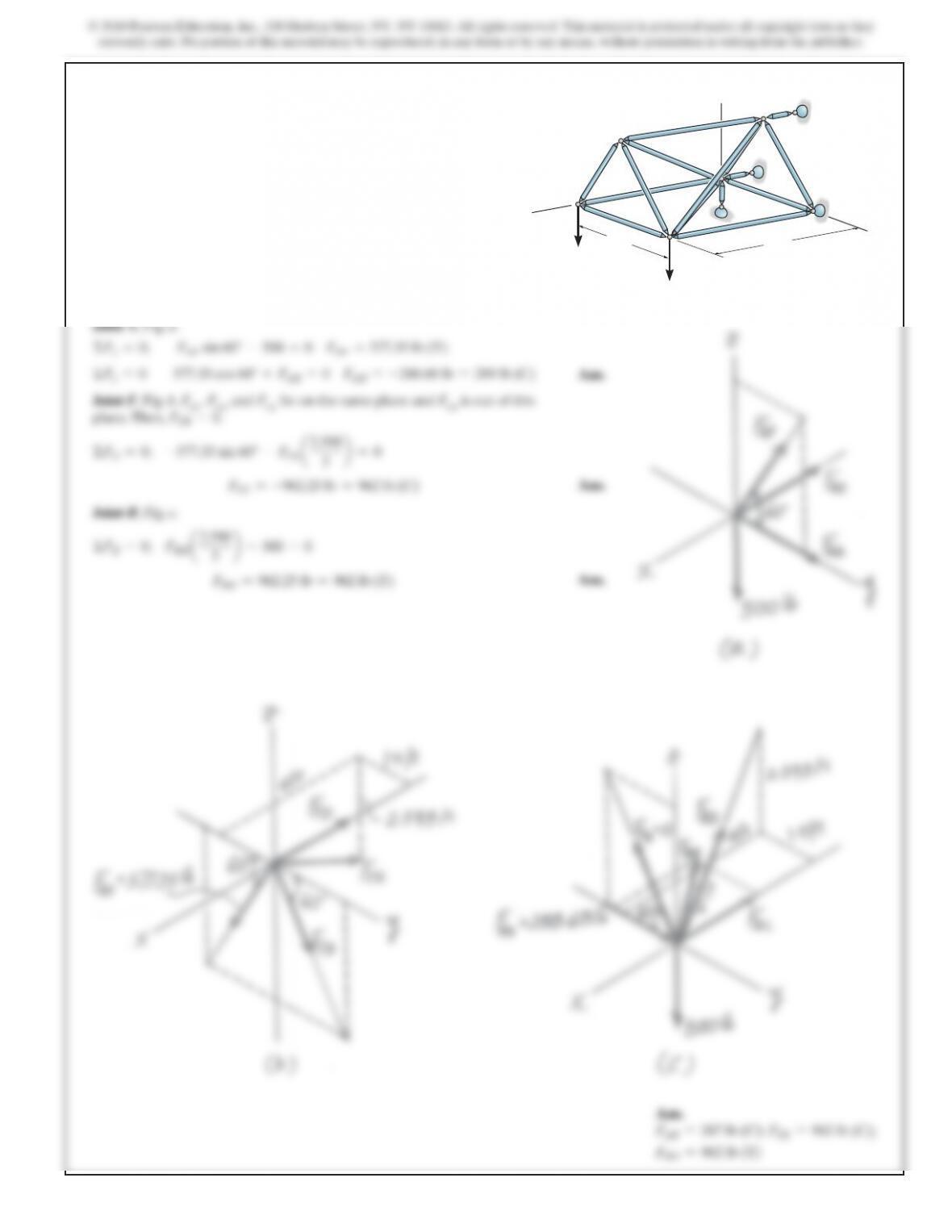
*3–44. Determine the force in members AB, BD, and FE of
the space truss and state if the members are in tension or
compression.
3 ft
3 ft 3 ft E
A
4 ft
F
D
C
B
z
y
x
500 lb
500 lb
SOLUTION
Support Reactions. Not required.
Method of Joints.
Ans.
FAB =287 lb (C); FFE =962 lb (C);
FBD =962 lb (T)
124
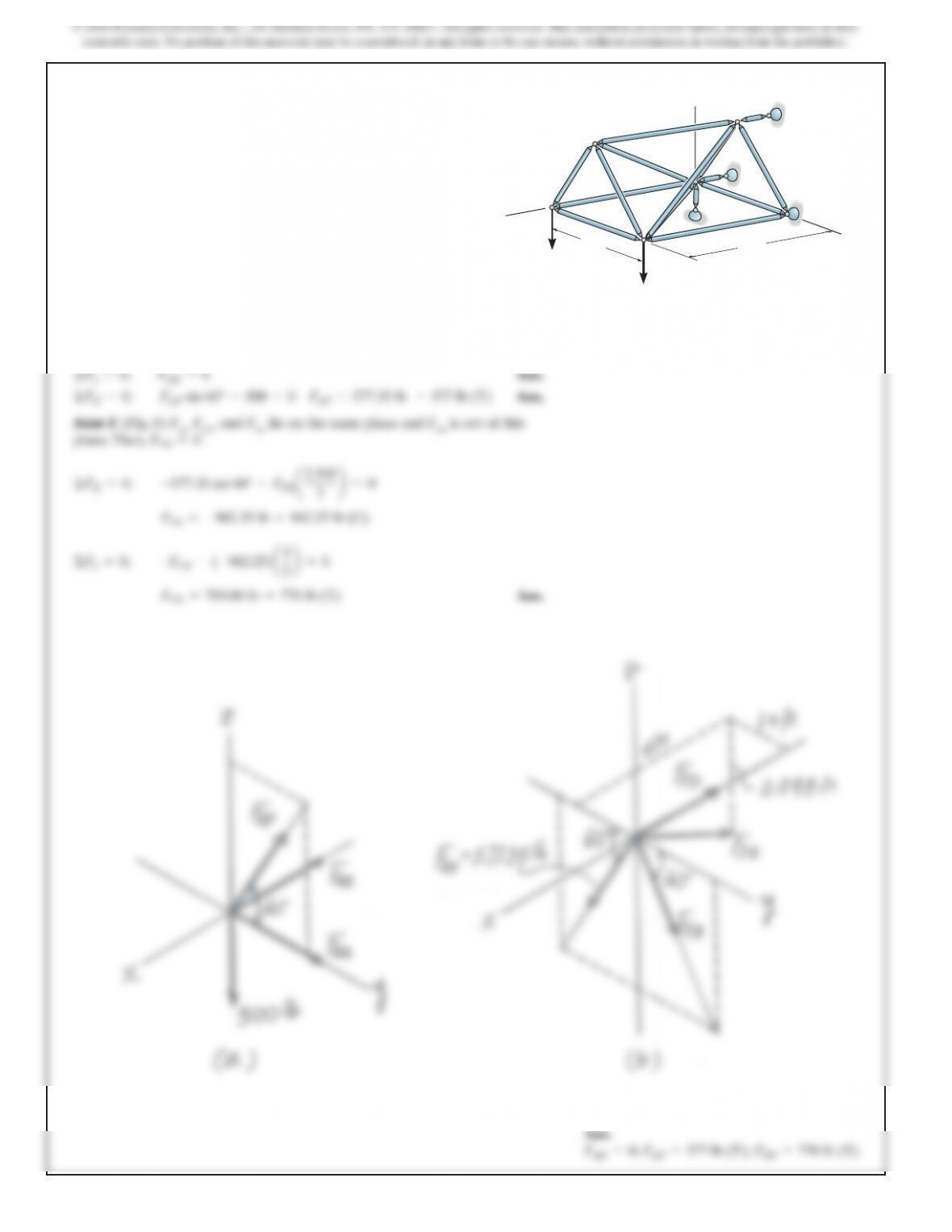
3–45. Determine the force in members AF, AE, and FD of
the space truss and state if the members are in tension or
compression.
3 ft
3 ft 3 ft E
A
4 ft
F
D
C
B
z
y
x
500 lb
500 lb
SOLUTION
Support Reactions. Not required.
Method of Joints.
Joint A. (Fig. a)
ΣFx=0;
FAE =0
Ans.
ΣFZ=0;
FAF sin 60°–500 =0
FAF =577.35 lb =577 lb (T)
Ans.
Joint F. (Fig. b) FAF FFD, and FFE lie on the same plane and FFB is out of this
plane. Then,
FFB =0
.
ΣFZ=0;
–577.35 sin 60°–FFE
a2.598
5b
=
0
FFE =–962.25 lb =962.25 lb (C)
ΣFx=0;
–FFD –(–962.25)
a4
5b
=
0
FFD =769.80 lb =770 lb (T)
Ans.
Ans.
FAE =0; FAF =577 lb (T); FFD =770 lb (T)