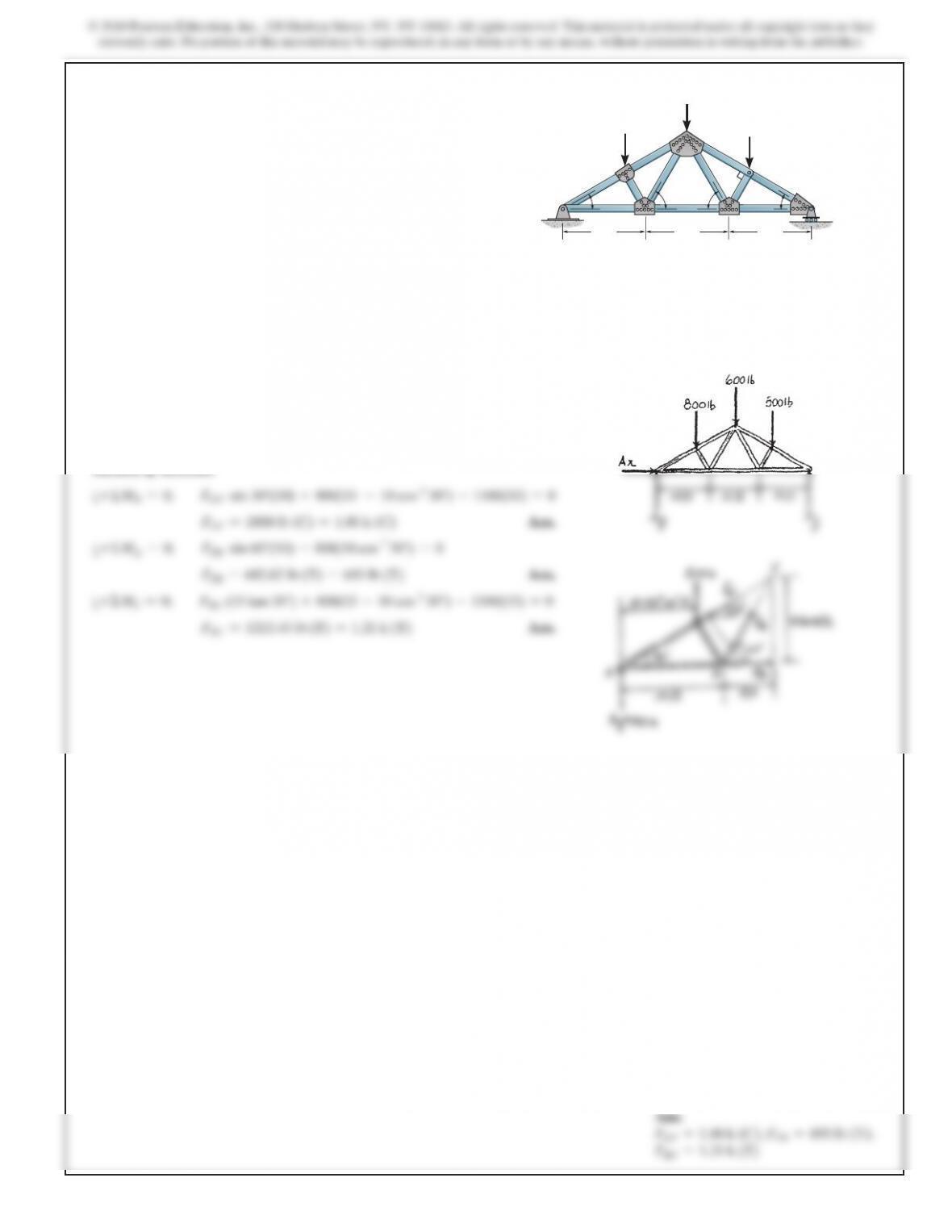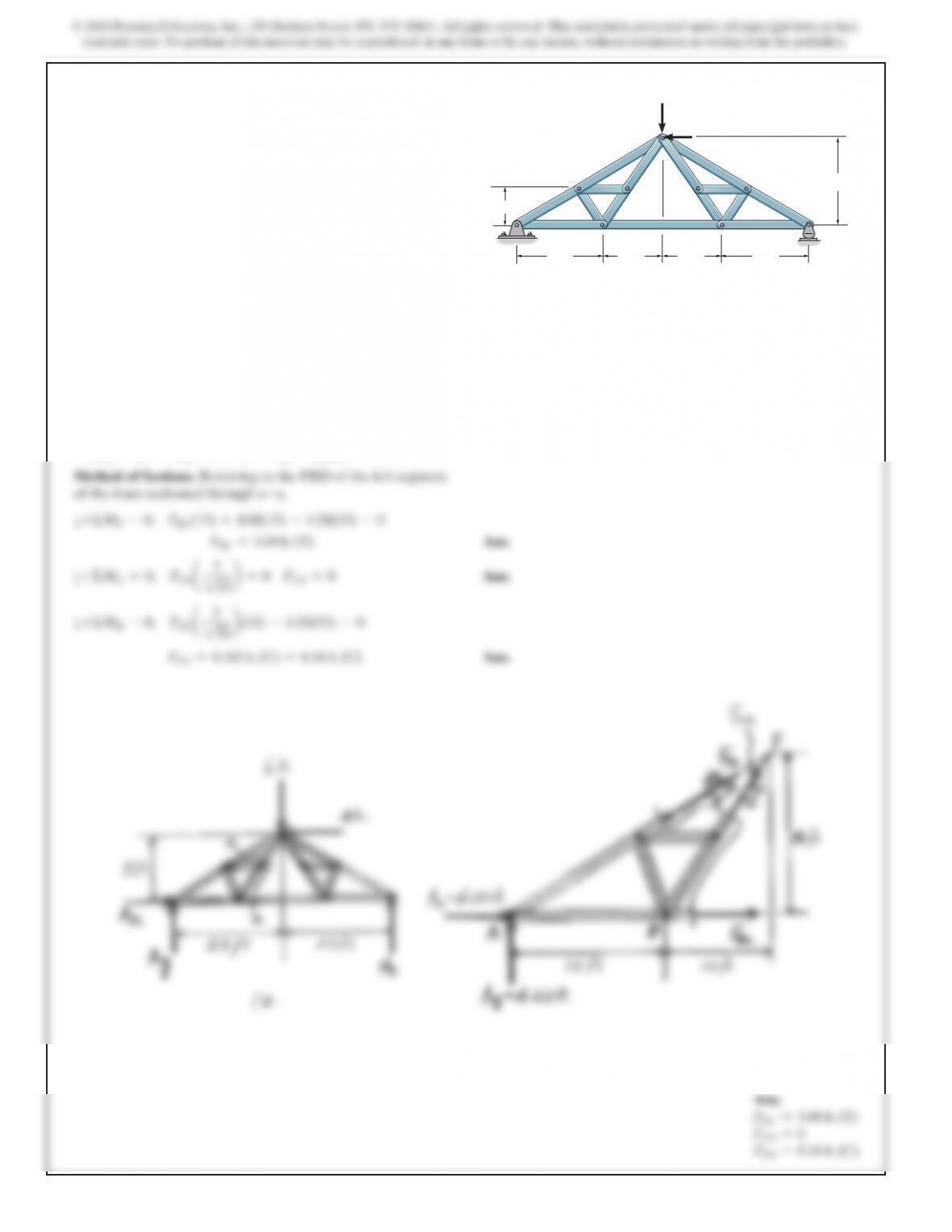
9 2
Ans.
FCE =FEG =FEF =0
FDE =2.00 k
1C2
FFG =3.00 k
1C2
FAG =2.00 k
1C2
FCD =4.375 k
1C2
FAD =2.625 k
1T2
FCF =4.375 k
1C2
FBF =0.625 k
1T2
FAB =0.625 k
1T2
Equations of Equilibrium. Referring to the FBD of the entire
truss shown in Fig. a,
a+ΣMA=0;
ND1122–21122–3162–3182=0
ND=5.50 k
Method of Joints. By inspecting Joints C, B and E, we notice that
members CE, BG and EF are zero force members. Thus,
FCE =FEG =FEF =0
Ans.
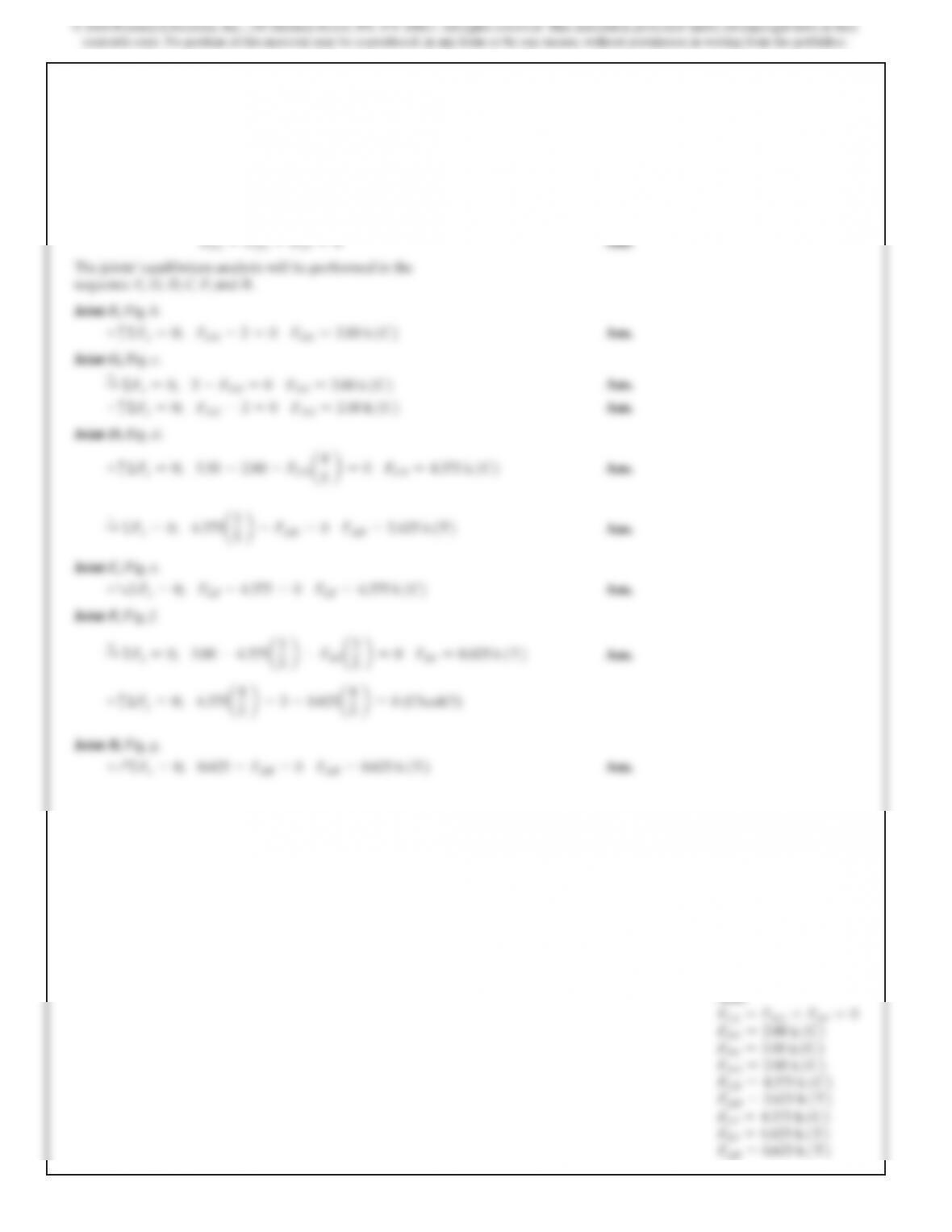
The joints’ equilibrium analysis will be performed in the
sequence E, G, D, C, F, and B.
Joint E, Fig. b.
+
c
ΣFy=0;
FDE –2=0
FDE =2.00 k
1C2
Ans.
Joint G, Fig. c.
+
SΣ
F
x=
0;
3
–
F
EG =
0
F
EG =
3.00 k
1
C
2
Ans.
+
c
ΣFy=0;
FAG –2=0
FAG =2.00 k
1C2
Ans.
Joint D, Fig. d.
+
c
ΣFy=0;
5.50 –2.00 –FCD
a4
5
b
=0
FCD =4.375 k
1
C
2
Ans.
+
S
ΣFx=0;
4.375
a3
5
b
–FAD =0
FAD =2.625 k
1
T
2
Ans.
Joint C, Fig. e.
+ RΣFx=0;
FCF –4.375 =0
FCF =4.375 k
1C2
Ans.
Joint F, Fig. f.
+
S
ΣFx=0;
3.00 –4.375
a3
5
b
–FBF
a3
5
b
=0
FBF =0.625 k
1
T
2
Ans.
+
c
ΣFy=0;
4.375
a4
5
b
–3–0.625
a4
5
b
=
0
(Check!!)
Joint B, Fig. g.
+ QΣFx=0;
0.625 –FAB =0
FAB =0.625 k
1T2
Ans.
3–15. (Continued)
9 3
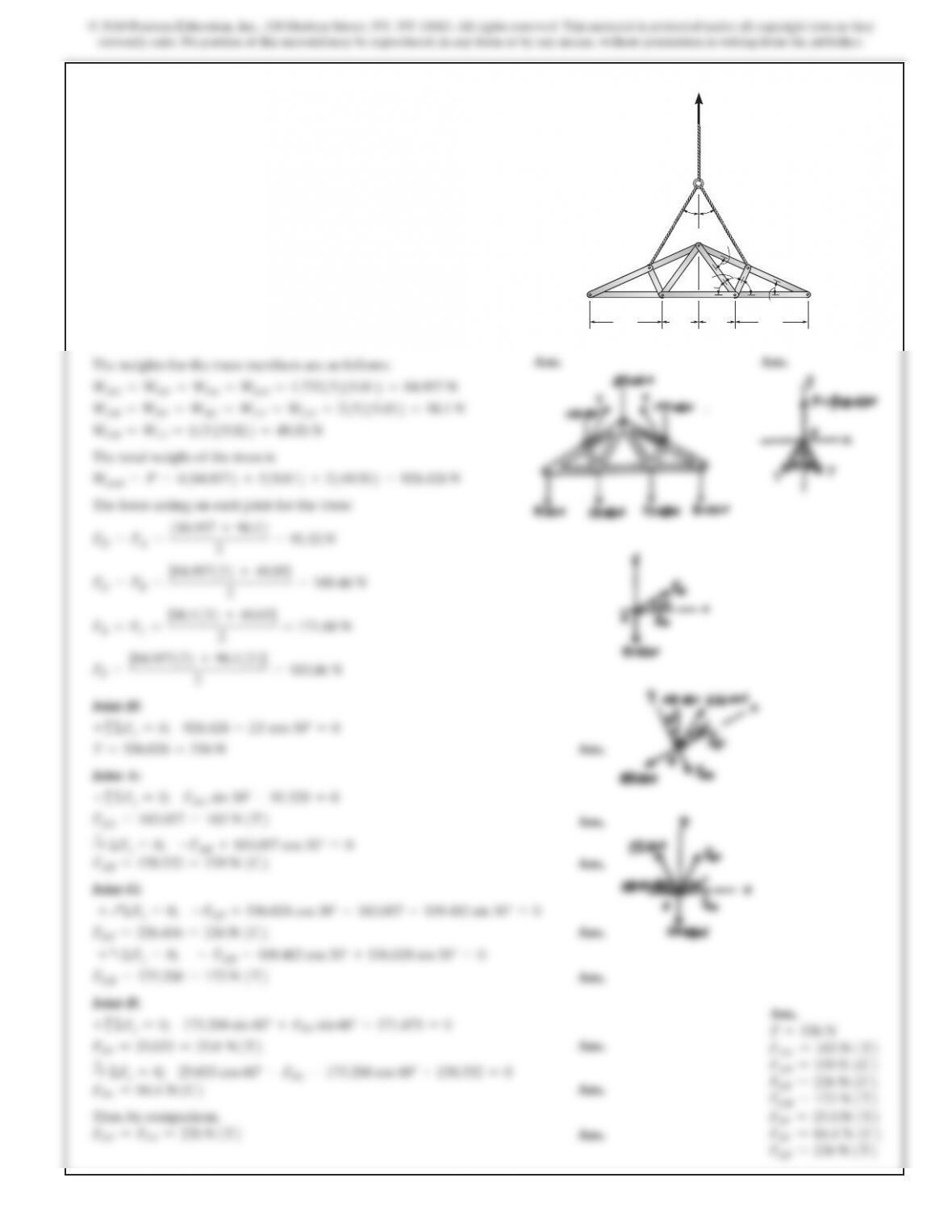
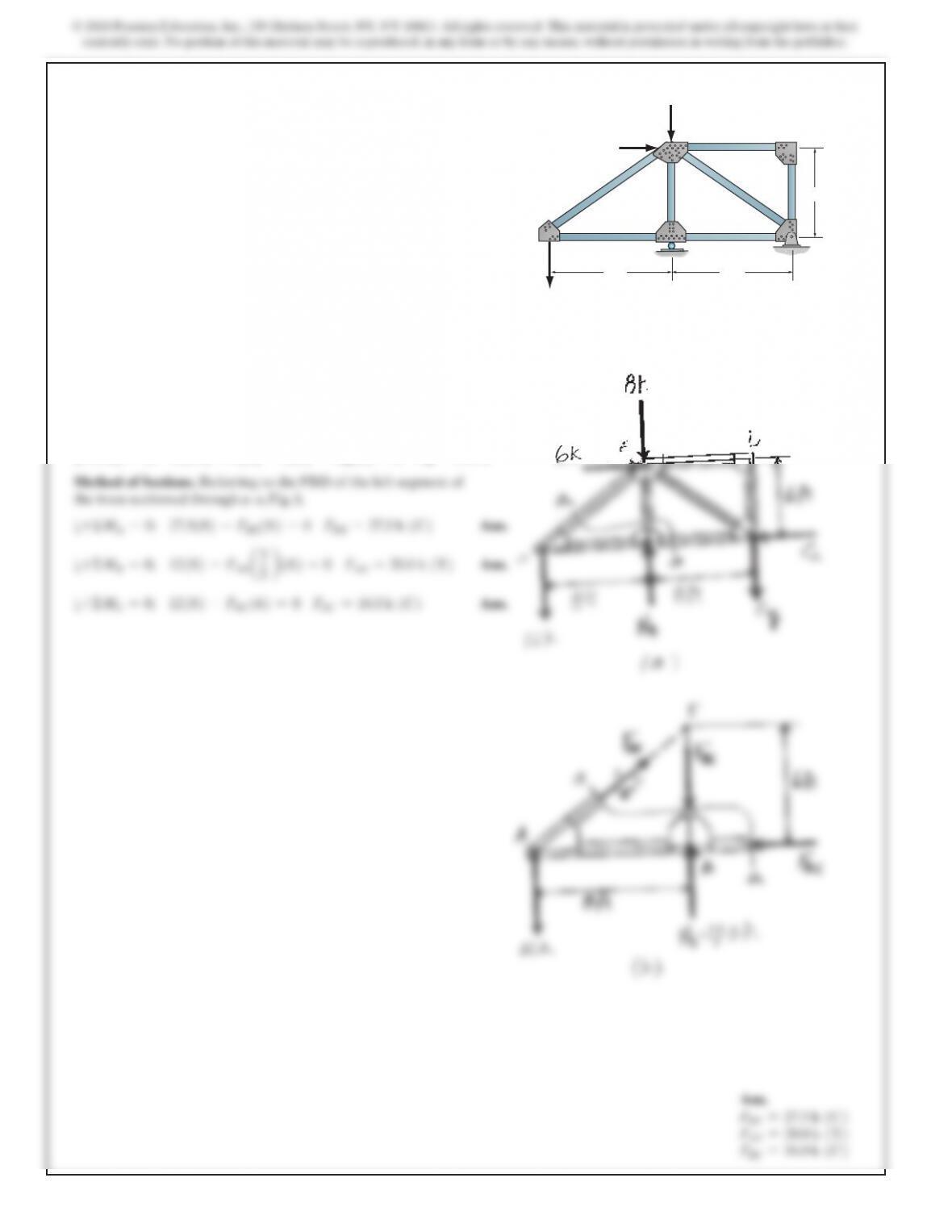
*3–16. The members of the truss have a mass of
5
kg>m.
Lifting is done using a cable connected to joints E and G.
Determine the largest member force and specify if it is in
tension or compression. Assume half the weight of each
member can be applied as a force acting at each joint.
2 m 1 m 1 m 2 m
A
BC
D
E
F
G
308
308308
308
608
608
P
H
SOLUTION
+
c
ΣFy=0;
T=536.028 =536 N
+
c
ΣFy=0;
FAG =183.057 =183 N 1T2
FAB =158.532 =159 N 1C2
Joint G:
+ QΣFx=0;
–FGF +536.028 cos 30°–183.057 –109.482 sin 30°=0
FGF =226.416 =226 N 1C2
+ aΣFy=0;
–FGB –109.482 cos 30°+536.028 sin 30°=0
FGB =173.200 =173 N 1T2
Joint B:
+
c
ΣFy=0;
173.200 sin 60°+FBF sin 60°–171.675 =0
FBF =25.033 =25.0
N
1T2
+
SΣ
F
y=
0;
25.033 cos 60
°–
F
BC –
173.200 cos 60
°+
158.532
=
0
FBC =84.4
N
1C2
Thus, by comparison,
FGF =FEF =226 N
1T2
Ans.
T=536 N
FAG =183 N 1T2
FAB =159 N 1C2
FGF =226 N 1C2
FGB =173 N 1T2
FBF =25.0 N 1T2
FBC =84.4 N 1C2
FGF =226 N 1T2
Ans.
Ans.
Ans.
Ans.
Ans.
9 4
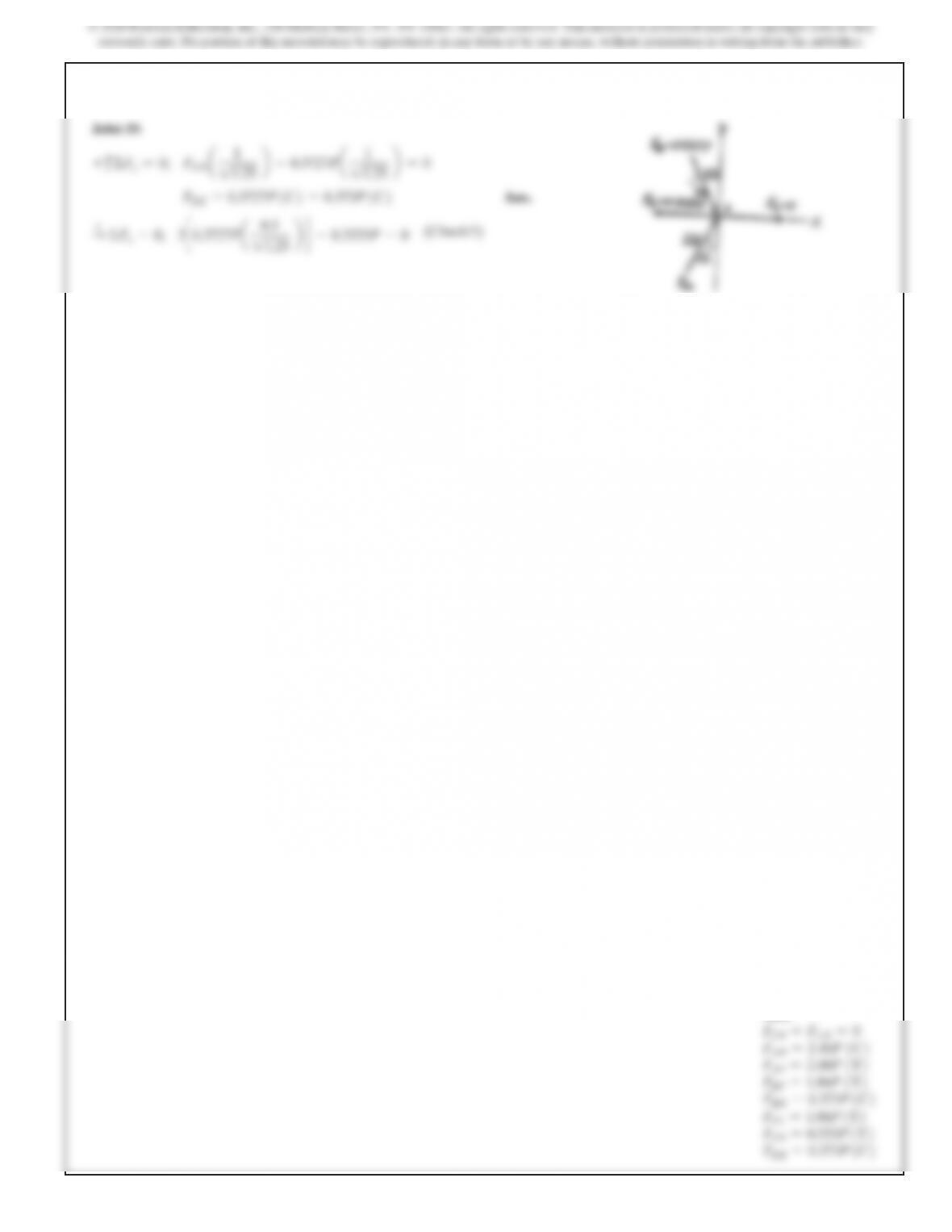
3–17. Determine the force in each member of the truss in
terms of the load P, and indicate whether the members are in
tension or compression.
A
B
C
D
F
E
P
d
d
dd/2d/ 2d
SOLUTION
Support Reactions:
a
+ΣMB=0;
P
1
2d
2
–Ay
a3
2
d
b
=0
Ay=
4
3
P
+
c
ΣFy=0;
4
3
P–Ey=0
Ey=
4
3
P
+
SΣFx=0
Ex–P=0
Ex=P
Method of Joints: By inspection of joint C, members CB and
CD are zero-force members. Hence,
FCB =FCD =0
Ans.
Joint A:
+
c
ΣFy=0;
FAB
a1
13.25
b
–
4
3
P=0
FAB =2.404P
1C2=2.40P
1C2
Ans.
+
S
ΣFx=0;
FAF –2.404P
a1.5
13.25
b
=0
FAF =2.00P
1T2
Ans.
Joint B:
+
S
ΣFx=0;
2.404P
a1.5
13.25
b
–P
–FBF
a0.5
11.25
b
–FBD
a0.5
11.25
b
=
0
1.00P–0.4472FBF –0.4472FBD =0
(1)
+
c
ΣFy=0;
2.404P
a1
13.25
b
+FBD
a1
11.25
b
–FBF
a1
11.25
b
=
0
1.333P+0.8944FBD –0.8944FBF =0
(2)
Solving Eqs. [1] and [2] yields
FBF =1.863P 1T2=1.86P 1T2
Ans.
FBD =0.3727P 1C2=0.373P 1C2
Ans.
Joint F:
+
c
ΣFy=0;
1.863P
a1
11.25
b
–FFE
a1
11.25
b
=
0
FFE =1.863P 1T2=1.86P 1T2
Ans.
+
S
ΣFx=0;
FFD +2
c
1.863P
a0.5
11.25
bd
–2.00P=0
FFD =0.3333P 1T2=0.333P
1T2
Ans.
9 5
11.25
Ans.
FCB =FCD =0
FAB =2.40P 1C2
FAF =2.00P 1T2
FBF =1.86P 1T2
FBD =0.373P
1C2
FFE =1.86P
1T2
FFD =0.333P
1T2
FDE =0.373P
1C2
9 6
3–18. If the maximum force that any member can support is
4 kN in tension and 3 kN in compression, determine the
maximum force P that can be supported at point B. Take
d=1
m.
A
B
C
D
F
E
P
d
d
dd/2d/ 2d
SOLUTION
Support Reactions:
a
+ΣME=0;
P
1
2d
2
–Ay
a3
2
d
b
=0
Ay=
4
3
P
+
c
ΣFy=0;
4
3
P–Ey=0
Ey=
4
3
P
+
SΣFx=0
Ex–P=0
Ex=P
Method of Joints: By inspection of joint C, members CB and
CD are zero-force members. Hence,
FCB =FCD =0
Joint A:
+
c
ΣFy=0;
FAB
a1
13.25
b
–
4
3
P=0
FAB =2.404P
1
C
2
+
S
ΣFx=0;
FAF –2.404P
a1.5
13.25
b
=0
FAF =2.00P
1
T
2
Joint B:
+
S
ΣFx=0;
2.404P
a15
13.25
b
–P
–FBF
a0.5
11.25
b
–FBD
a0.5
11.25
b
=
0
1.00P–0.4472FBF –0.4472FBD =0
(1)
+
c
ΣFy=0;
2.404P
a1
13.25
b
+FBD
a1
11.25
b
–FBF
a1
11.25
b
=
0
1.333P+0.8944FBD –0.8944FBF =0
(2)
Solving Eqs. [1] and [2] yields
FBF =1.863P 1T2
FBD =0.3727P 1C2
Joint F:
+
c
ΣFy=0;
1.863P
a1
11.25 b
–FFE
a1
11.25 b
=
0
FFE =1.863P 1T2
+
S
ΣFx=0;
FFD +2
c
1.863P
a0.5
11.25
bd
–2.00P=0
FFD =0.3333P 1T2
9 8
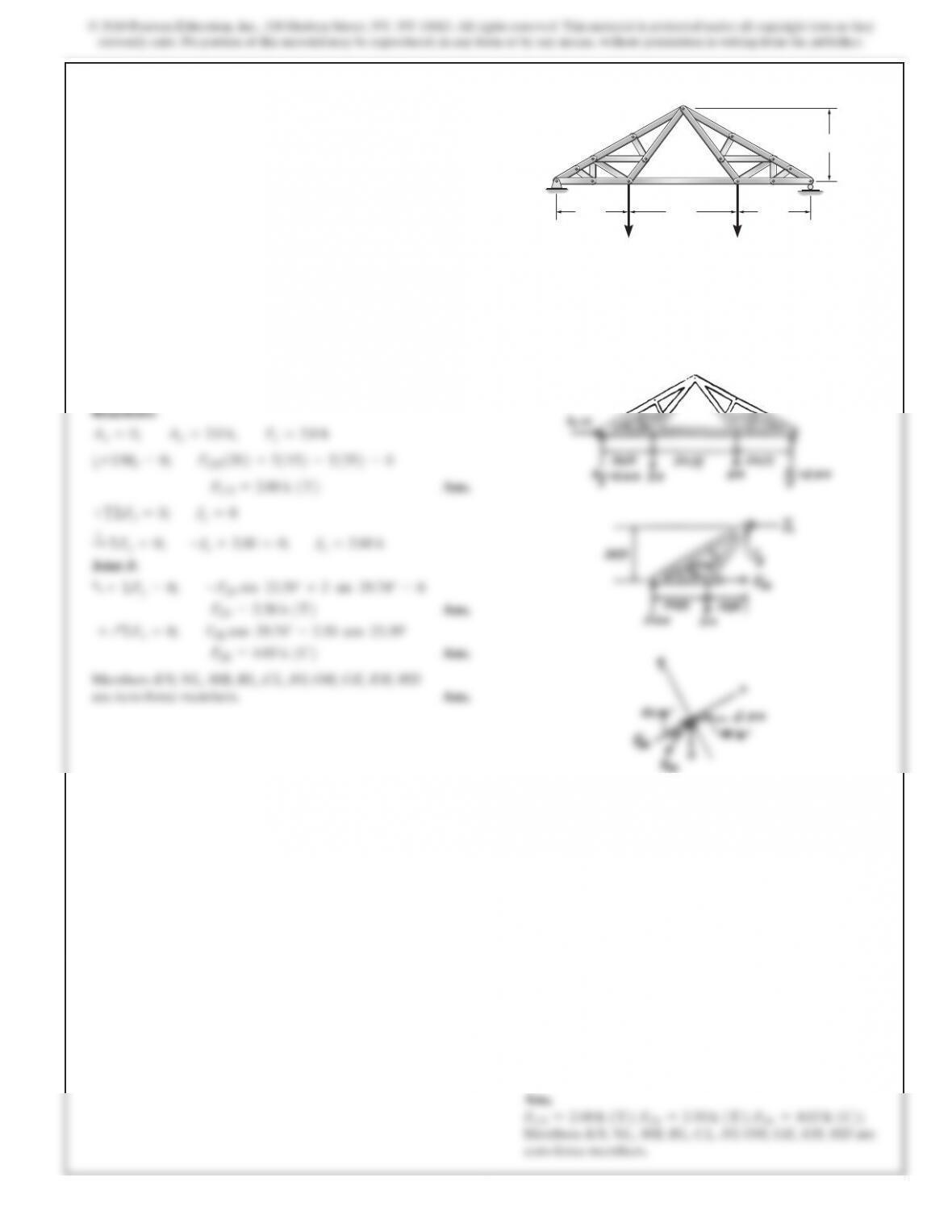
3–19. Determine the force in members AE, BE, and BC of the
truss and indicate if the members are in tension or compression.
12 k
6 k
A
D
B
C
E
8 ft 8 ft
6 ft
8 k
SOLUTION
Support Reactions. Referring to the FBD of the entire truss shown
in Fig. a,
a+ΣMC=0;
121162+8182–6162–NB182=0
NB=27.5 k
a+ΣMA=0;
27.5182–FBE182=0
FBE =27.5 k 1C2
Ans.
a
+ΣMB=0;
12
1
8
2
–FAE
a3
5
b1
8
2
=0
FAE =20.0 k
1
T
2
Ans.
a+ΣME=0;
12182–FBC162=0
FBC =16.0 k 1C2
Ans.
Ans.
FBE =27.5 k 1C2
FAE =20.0 k 1T2
FBC =16.0 k 1C2
9 9
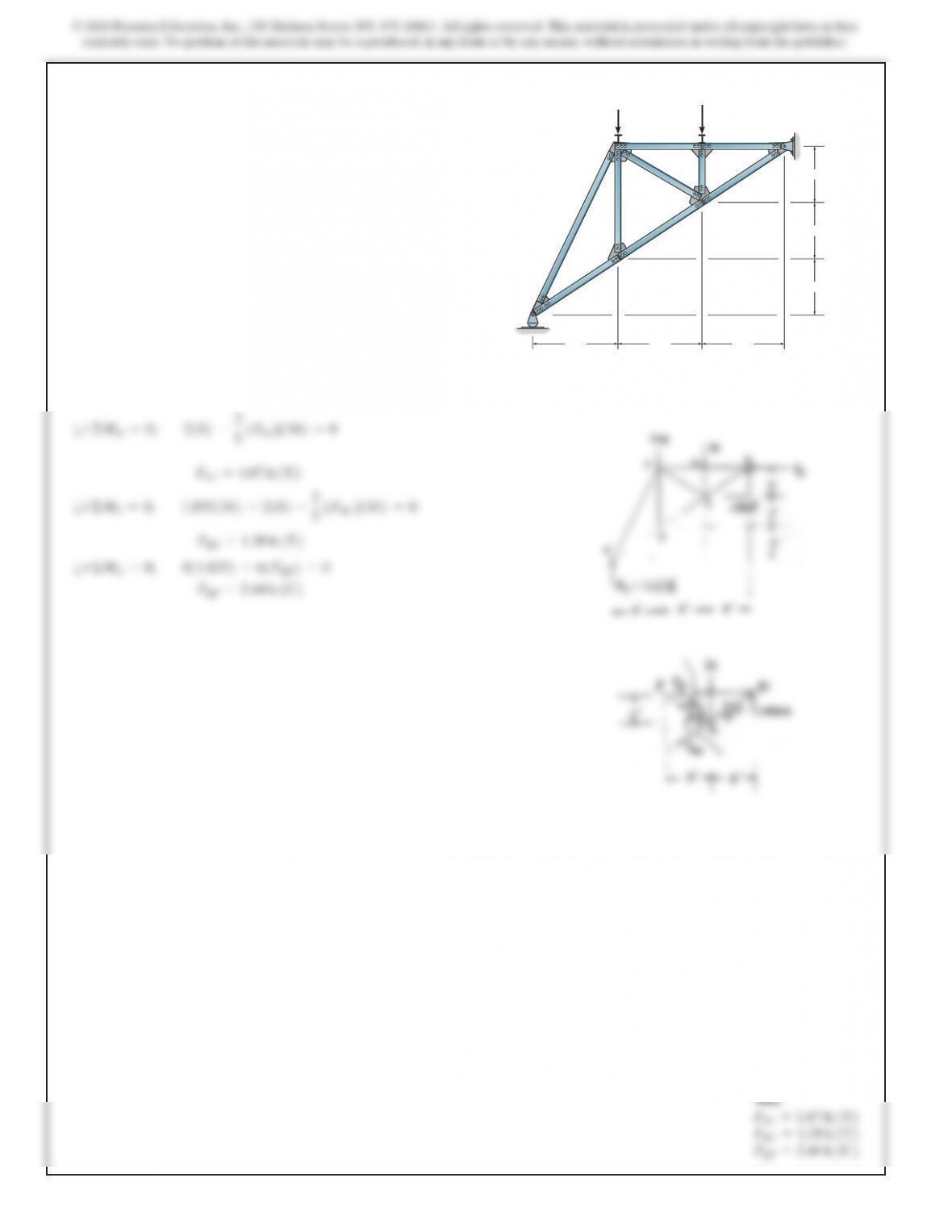
*3–20. Determine the force in members JK, JN, and CD.
State if the members are in tension or compression. Identify all
the zero-force members.
BC
NO
E
F
G
H
I
J
K
L
M
D
A
2 k
20 ft 20 ft
20 ft
30 ft
2 k
SOLUTION
100
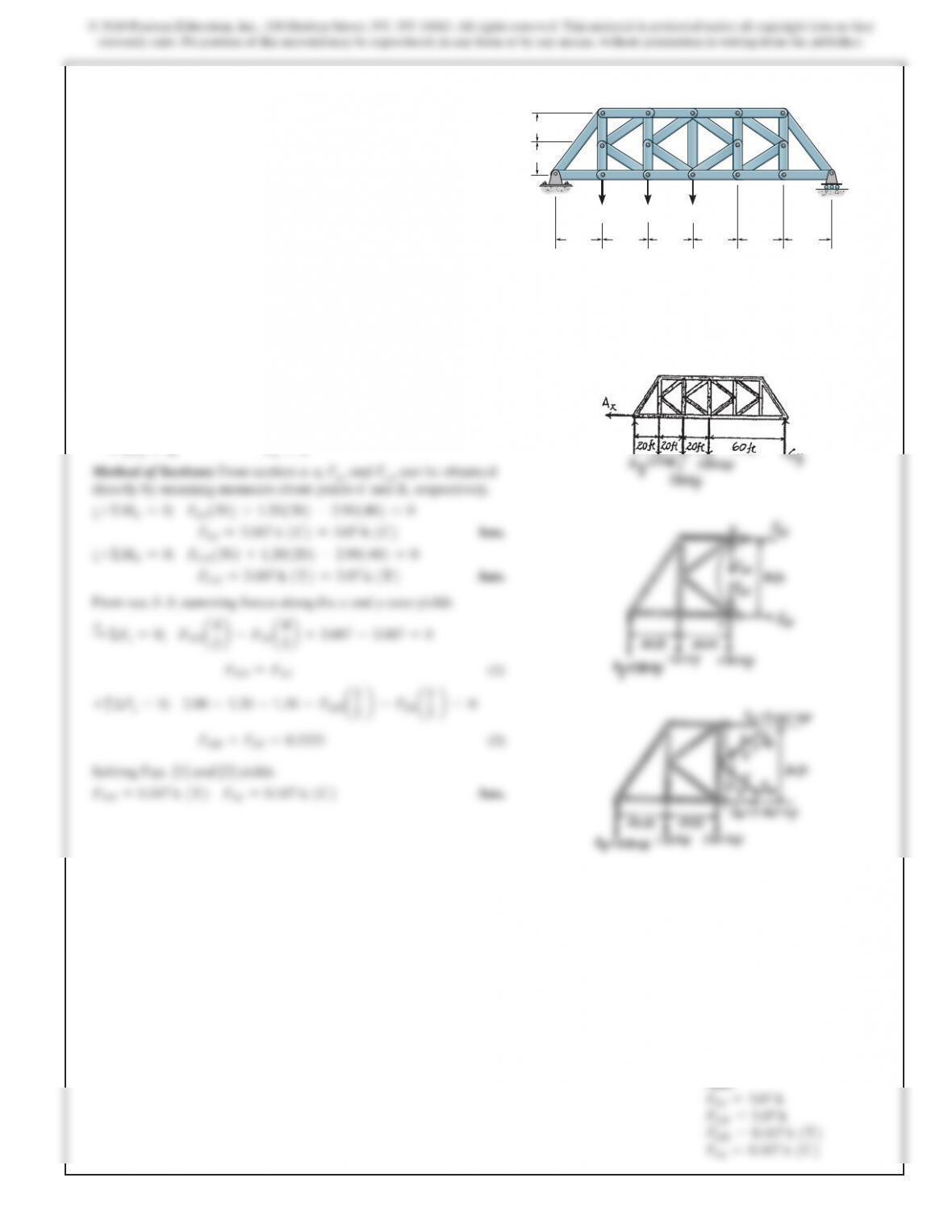
3–21. Determine the force in members FC, BC, and FE. State
if the members are in tension or compression. Assume all
members are pin connected. E
C
D
8 ft8 ft8 ft
6 ft
6 ft
6 ft
B
A
2 k
F
1.5 k
SOLUTION
a
+ΣMD=0;
2
1
8
2
–
3
5
1
FFC)
1
16
2
=
0
FFC =1.67 k
1T2
a
+ΣMF=0;
1.833
1
16
2
–2
1
8
2
–
3
5
1
FBC
21
16
2
=
0
FBC =1.39 k
1T2
a+ΣMC=0;
811.8332–61FEF2=0
FEF =2.44 k
1C2
Ans.
FFC =1.67 k
1T2
FBC =1.39 k
1T2
FEF =2.44 k
1C2
101
Support Reactions at A:
a+ΣMG=0;
1.2011002+1.501802+1.801602–Ay
11202=0
Ay=2.90
k
+
SΣFx=0;
Ax=0
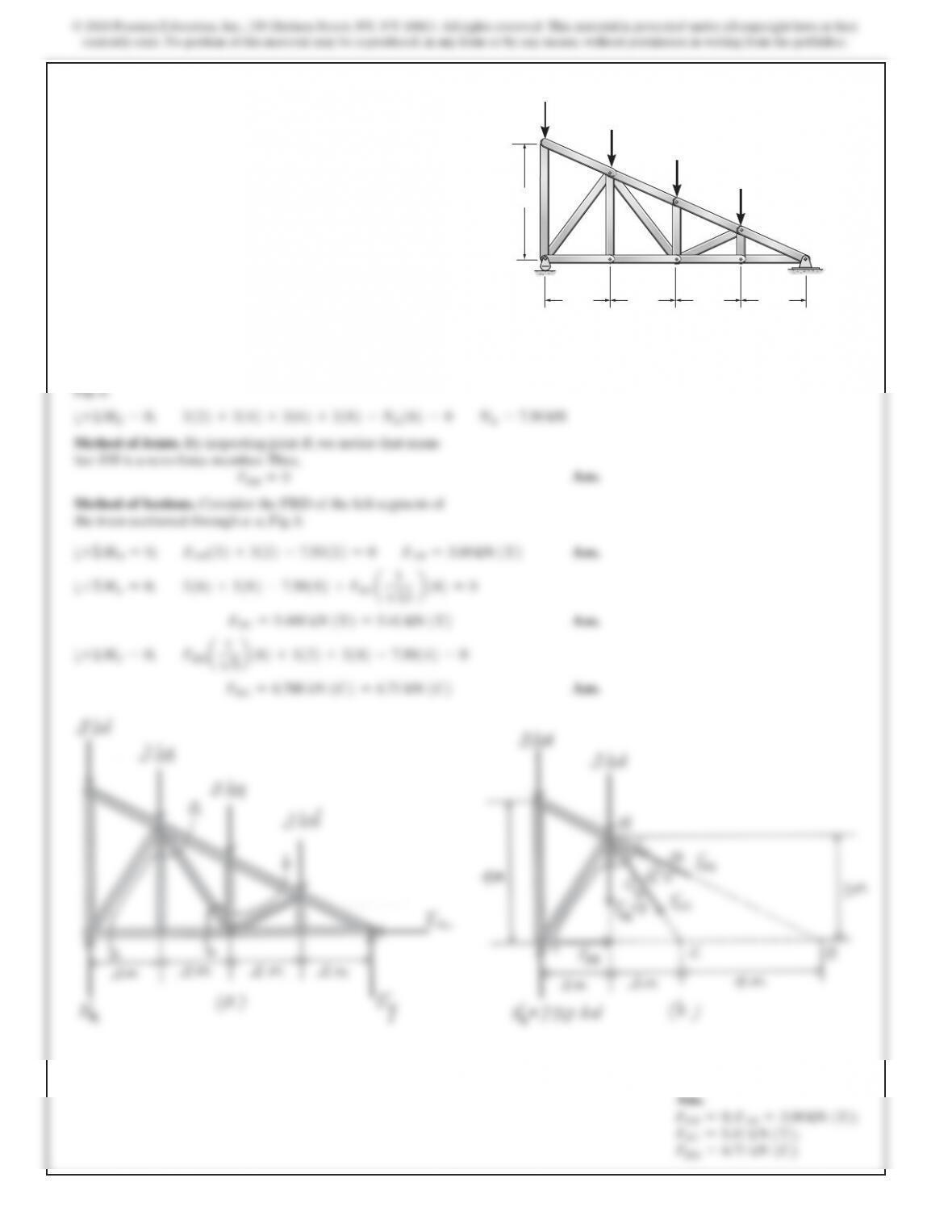
3–22. Determine the force in members KJ, NJ, ND, and CD
of the K-truss. Indicate if the members are in tension or
compression.
B
A
M
LK JI H
G
N
20 ft 20 ft 20 ft 20 ft 20 ft 20 ft
15 ft
15 ft
1200 lb
C
1500 lb
DEF
1800 lb
OP
Ans.
FKJ =3.07 k
FCD =3.07 k
FND =0.167 k 1T2
FNJ =0.167 k 1C2
SOLUTION
102
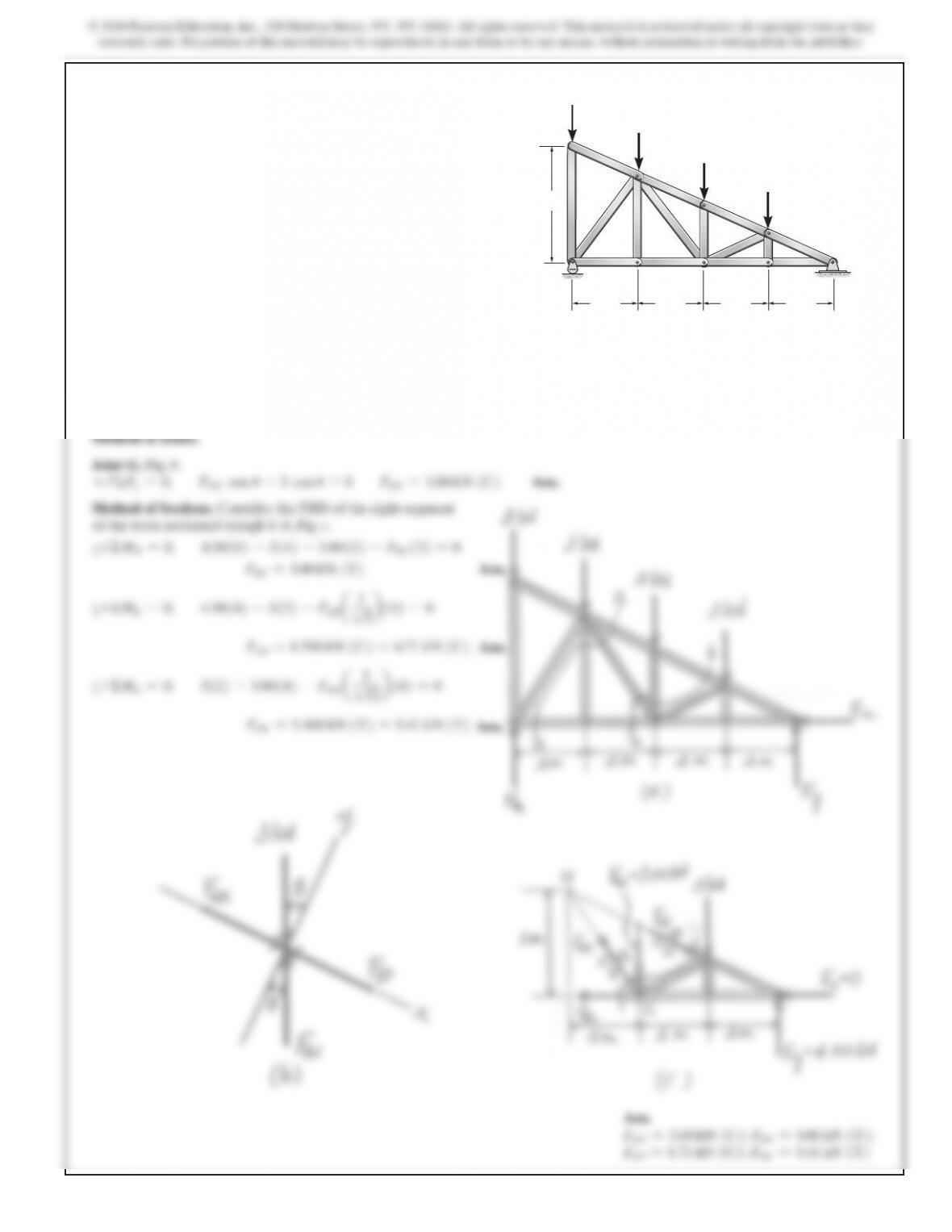
3–23. Determine the force in members HG, HC, HB, and AB
of the truss. State if the members are in tension or compression.
Assume all members are pin connected.
BC
E
F
G
H
I
D
A
2 m 2 m 2 m 2 m
4 m
3 kN
3 kN
3 kN
3 kN
SOLUTION
Support Reactions. Referring to the FBD of the entire truss,
FHB =0
Ans.
FHB =0;
FAB =3.00 kN 1T2;
FHC =5.41 kN 1T2;
FHG =6.71 kN 1C2
103
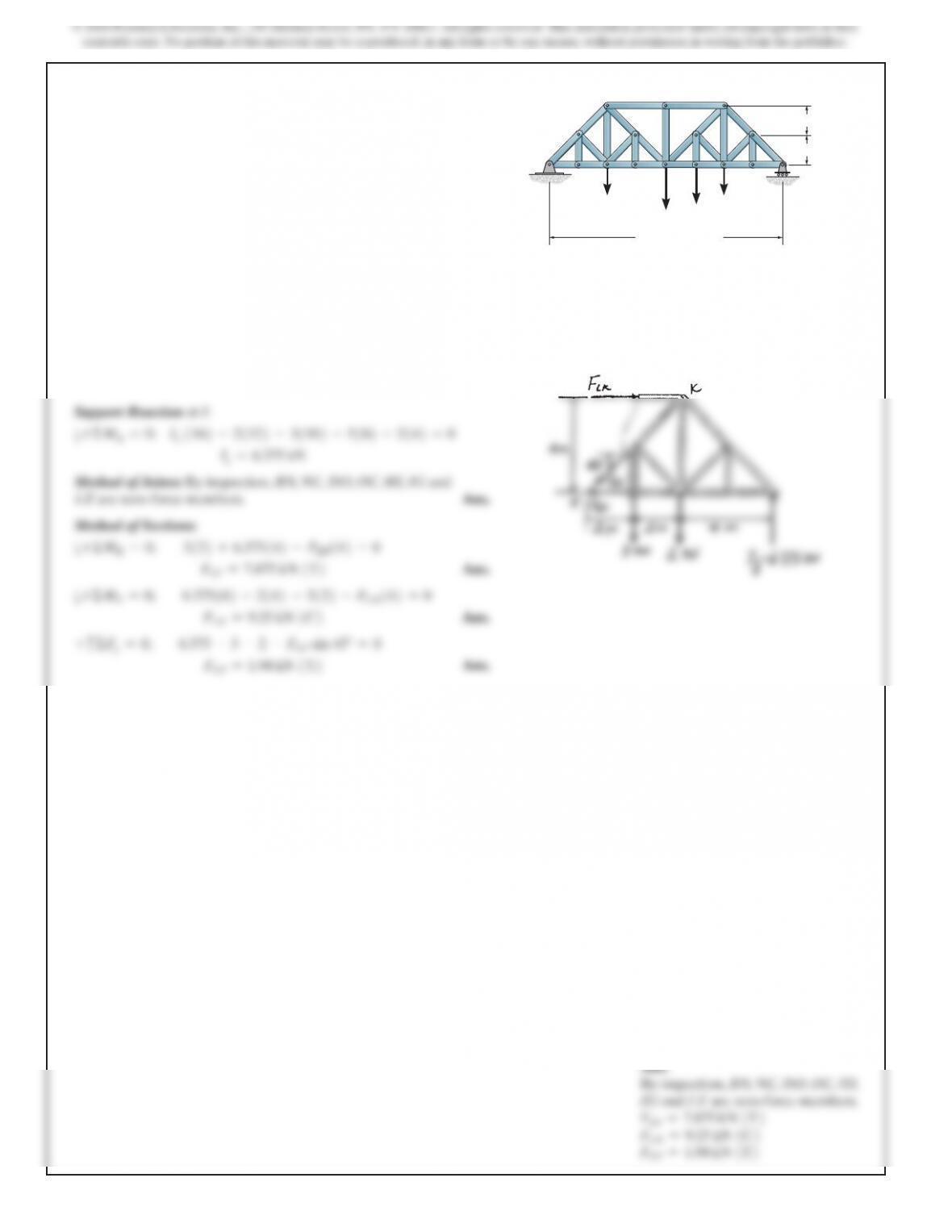
*3–24. Determine the force in members GF, GC, HC, and BC
of the truss. State if the members are in tension or compression.
Assume all members are pin connected.
BC
E
F
G
H
I
D
A
2 m 2 m 2 m 2 m
4 m
3 kN
3 kN
3 kN
3 kN
SOLUTION
Support Reactions. Referring to the FBD of the entire truss,
Fig. a,
S
+ΣFx=0;
Ex=0
a+ΣMA=0;
Ey182–3122–3142–3162=0
Ey=4.50 kN
Ans.
FGC =3.00 kN 1C2;
FBC =3.00 kN 1T2;
FGF =6.71 kN 1C2;
FHC =5.41 kN 1T2
104
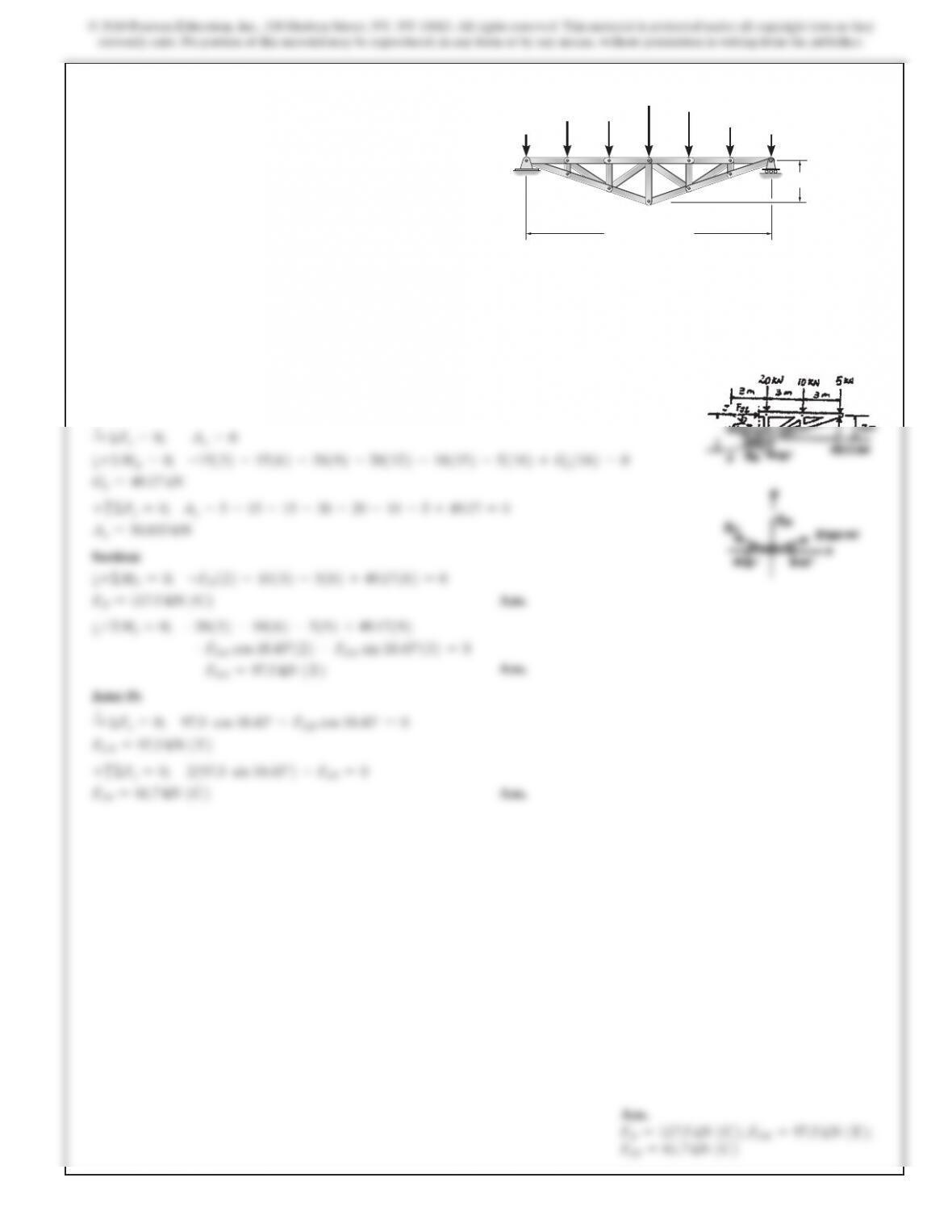
3–25. Determine the force in members EF, EP, and LK of the
Baltimore bridge truss and state if the members are in tension
or compression. Also, indicate all zero-force members.
8 @ 2 m = 16 m
A
BC DE FG H
J
KLM
NOP2
m
2
m
2 kN
5 kN
2 kN
3 kN
I
SOLUTION
Ans.
By inspection, BN, NC, DO, OC, HJ,
JG and LE are zero-force members.
FEF =7.875 kN 1T2
FLK =9.25 kN 1C2
FEP =1.94 kN 1T2
105
3–26. Determine the forces in members JI, JD, and DE of the
truss. State if the members are in tension or compression.
B
CE
F
G
HIJKL
D
A
5 kN 5 kN
15 kN 15 kN 10 kN
30 kN
20 kN
3 @ 1 m 5
3 m
6 @ 3 m 5 18 m
SOLUTION
Entire truss:
+
SΣFx=0;
Ax=0
a+ΣMA=0;
–15132–15162–30192–201122–101152–51182+Gy1182=0
Gy=49.17 kN
+
c
ΣFy=0;
Ay–5–15 –15 –30 –20 –10 –5+49.17 =0
Ay=50.833 kN
Section:
a+ΣME=0;
–FJI122–10132–5162+49.17162=0
FJI =117.5 kN 1C2
a+ΣMJ=0;
–20132–10162–5192+49.17192
–FDE cos 18.43°122–FDE sin 18.43°132=0
FDE =97.5 kN 1T2
Joint D:
+
SΣFx=0;
97.5 cos 18.43°–FCD cos 18.43°=0
FCD =97.5 kN 1T2
+
c
ΣFy=0;
2197.5 sin 18.43°2–FJD =0
FJD =61.7 kN 1C2
Ans.
FJI =117.5 kN 1C2; FDE =97.5 kN 1T2;
FJD =61.7 kN 1C2
Ans.
Ans.
Ans.
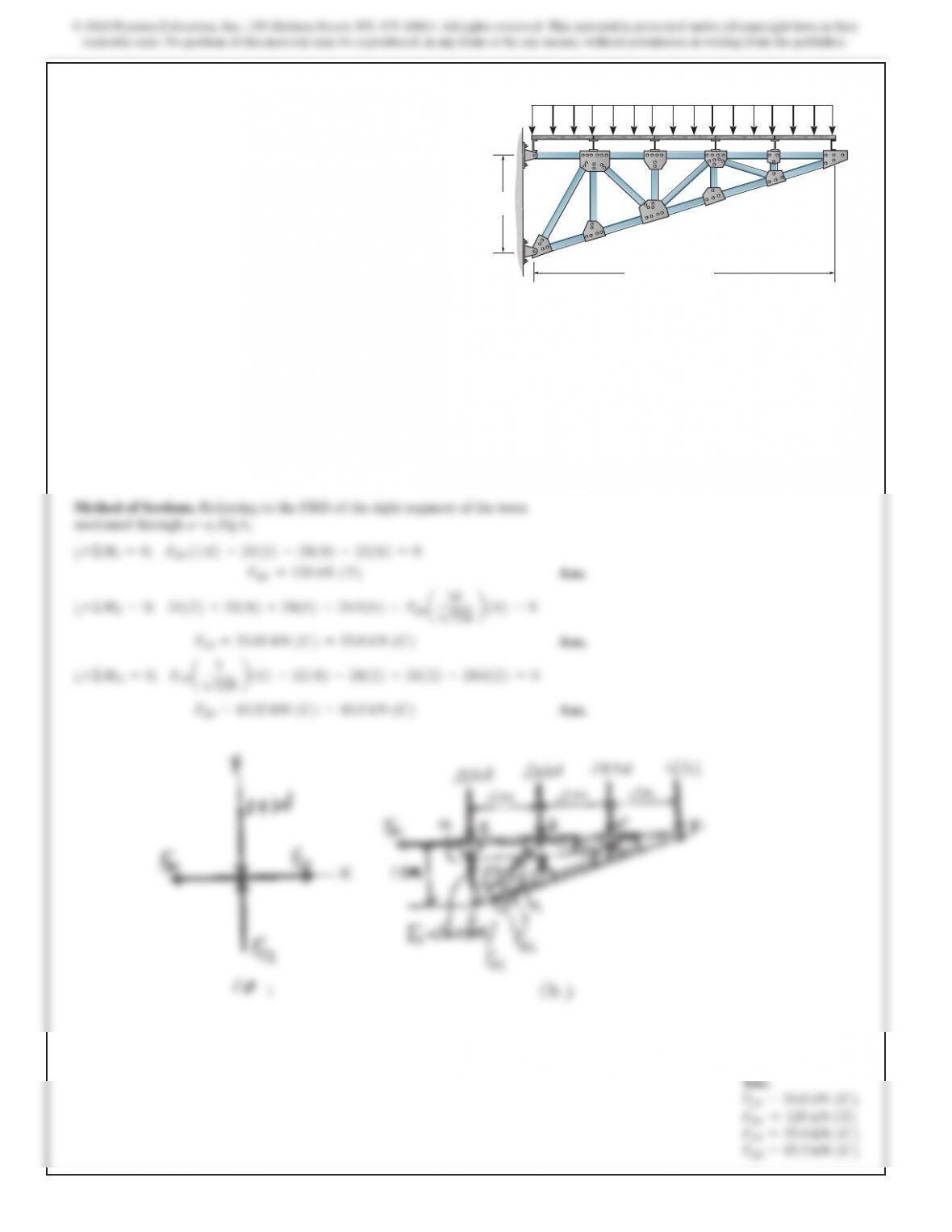
3–27. Determine the force in members BC, CI, DI, and HI of
the truss and state if the members are in tension or compression.
H
A
K
J
I
CDEF
B
G
3
m
5 @ 2 m = 10 m
12 kN/m
Support Reactions. Not required. The concentrated load acting on joints
A and F is (12 kN/m)(1m) = 12 kN and joints B, C, D and E is
(12 kN/m)(2m)
–
24 kN.
Method of Joints. The force in member CI can be determined by analyzing
the equilibrium of joint C, Fig a.
+
c
ΣFy=0;
FCI –24 =0
FCI =24.0 kN 1C2
SOLUTION
Ans.