7 2
7 3
SOLUTION
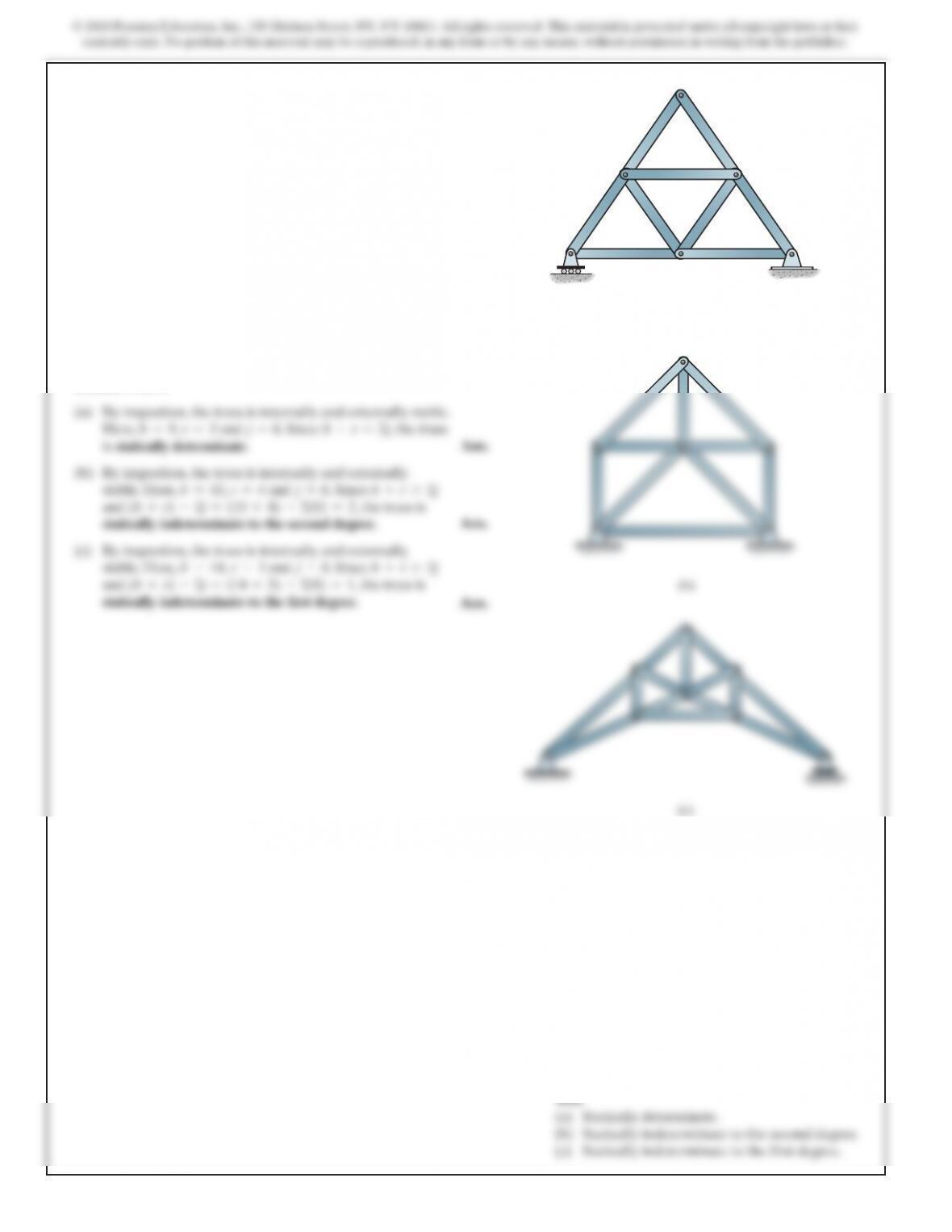
3–2. Classify each of the following trusses as statically
determinate, statically indeterminate, or unstable. If
indeterminate, state its degree.
(a)
7 4
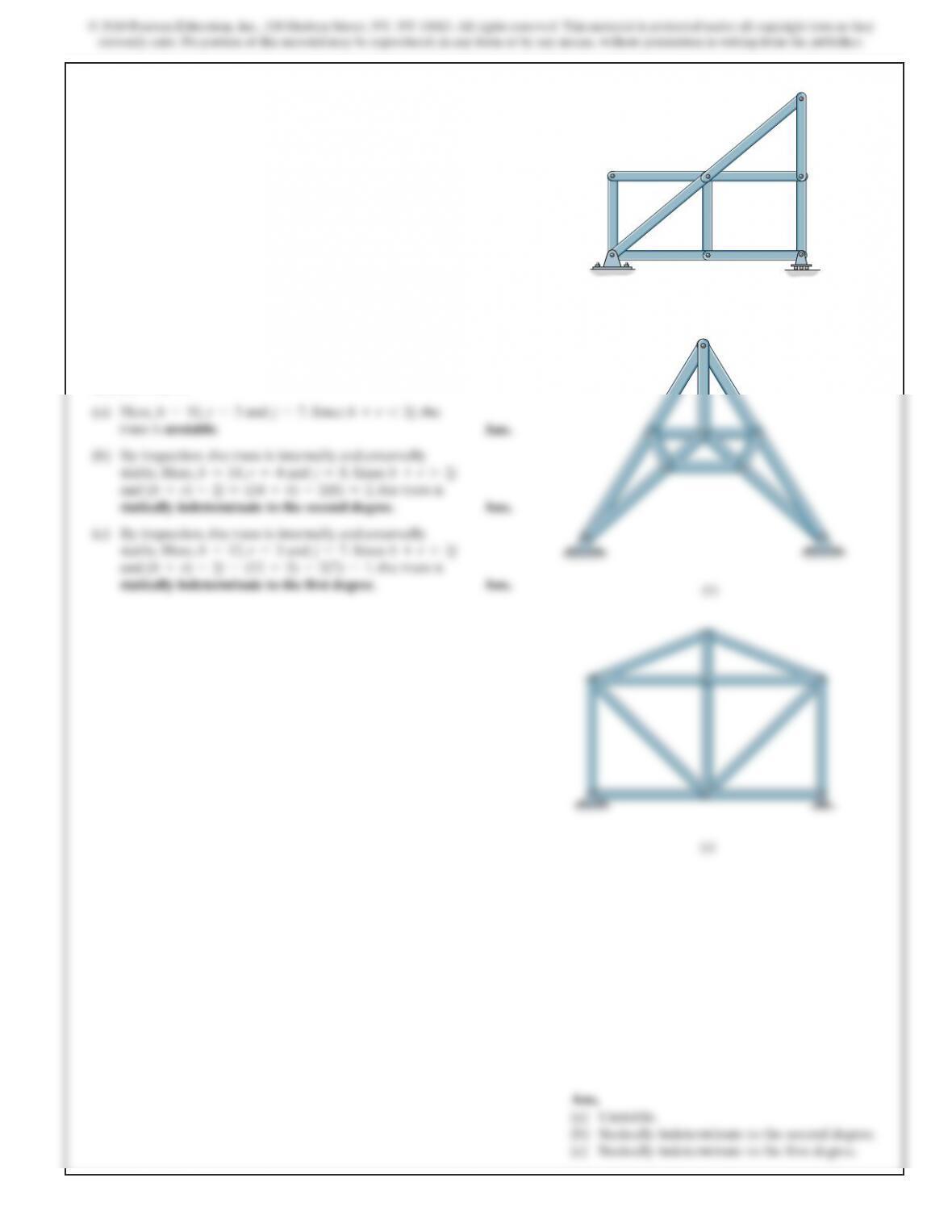
3–3. Classify each of the following trusses as statically
determinate, statically indeterminate, or unstable. If indeterminate
state its degree.
SOLUTION
(a)
(c)
7 5
SOLUTION
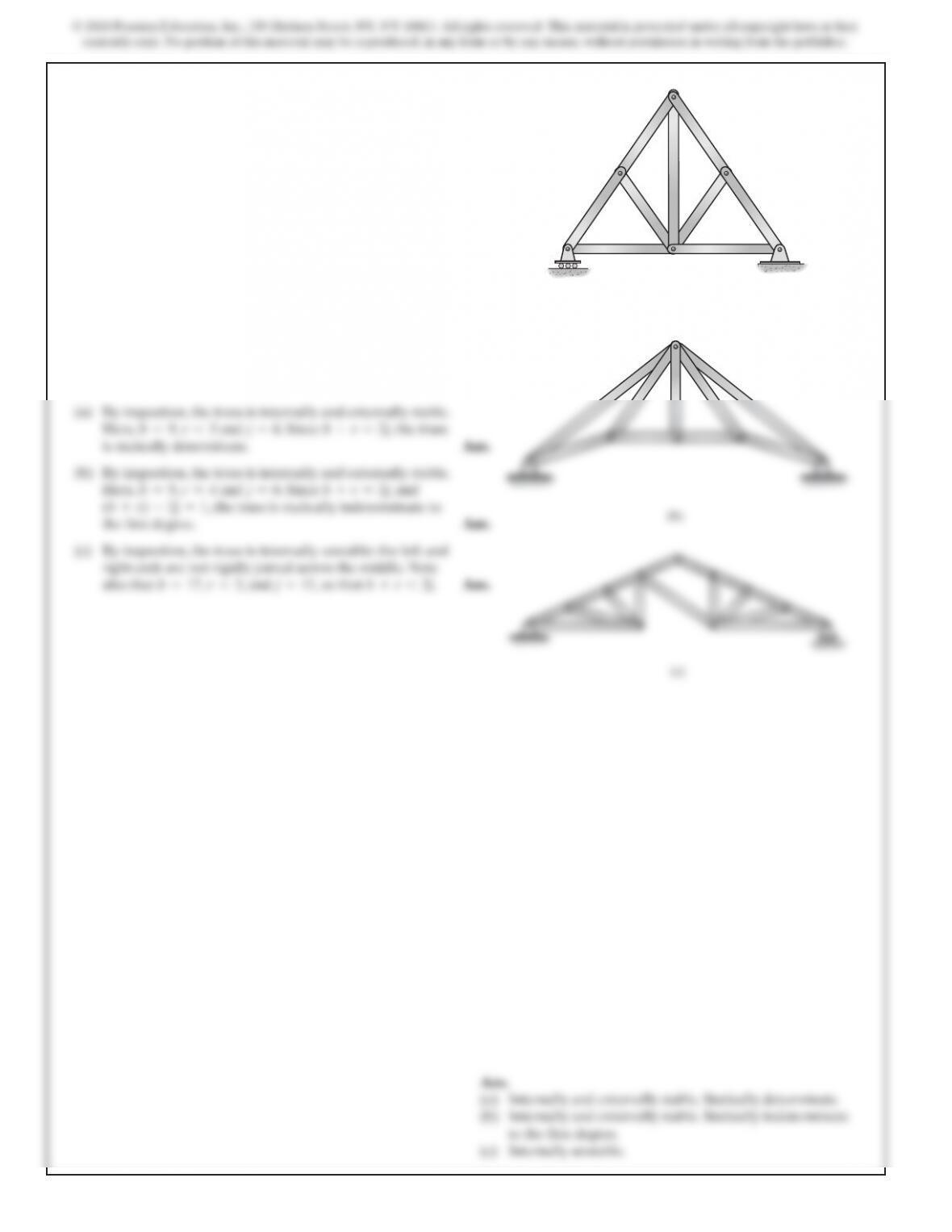
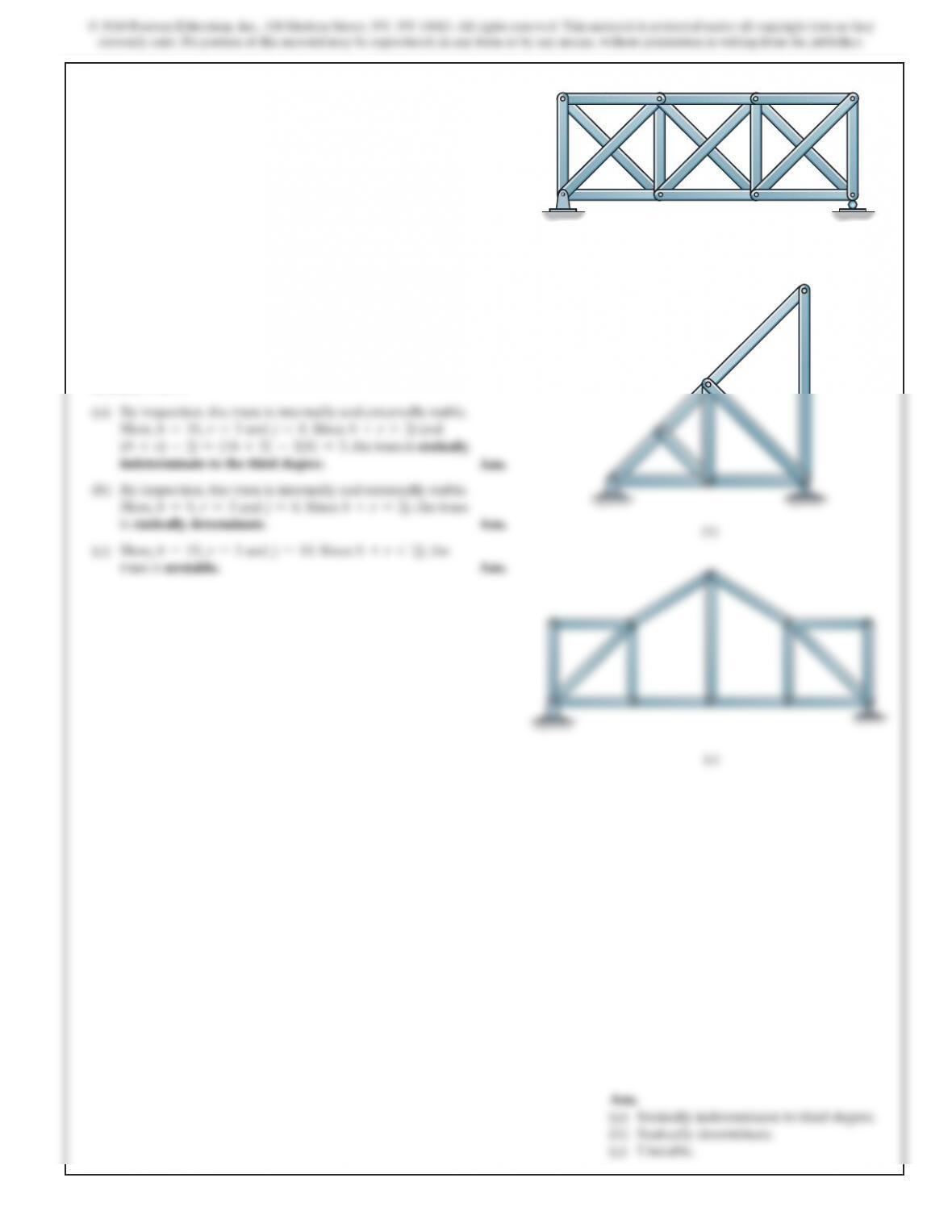
*3–4. Classify each of the following trusses as statically
determinate, statically indeterminate, or unstable. If
indeterminate state its degree.
(a)
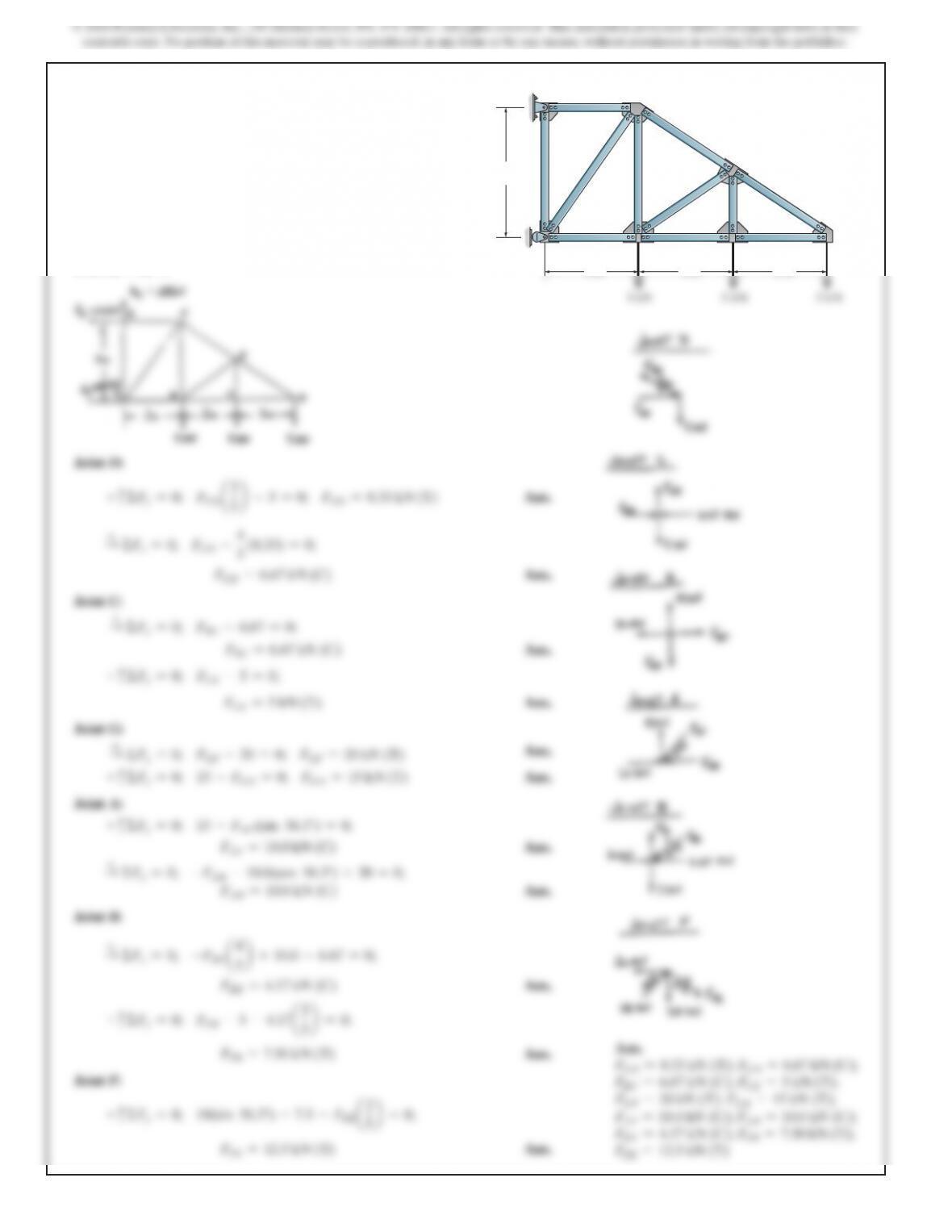
3–5. Determine the force in each member of the truss. State if
the members are in tension or compression. Assume all
members are pin connected.
SOLUTION
A
G
F
E
BCD
3
m
2 m2 m2 m
5 kN 5 kN 5 kN
7 7
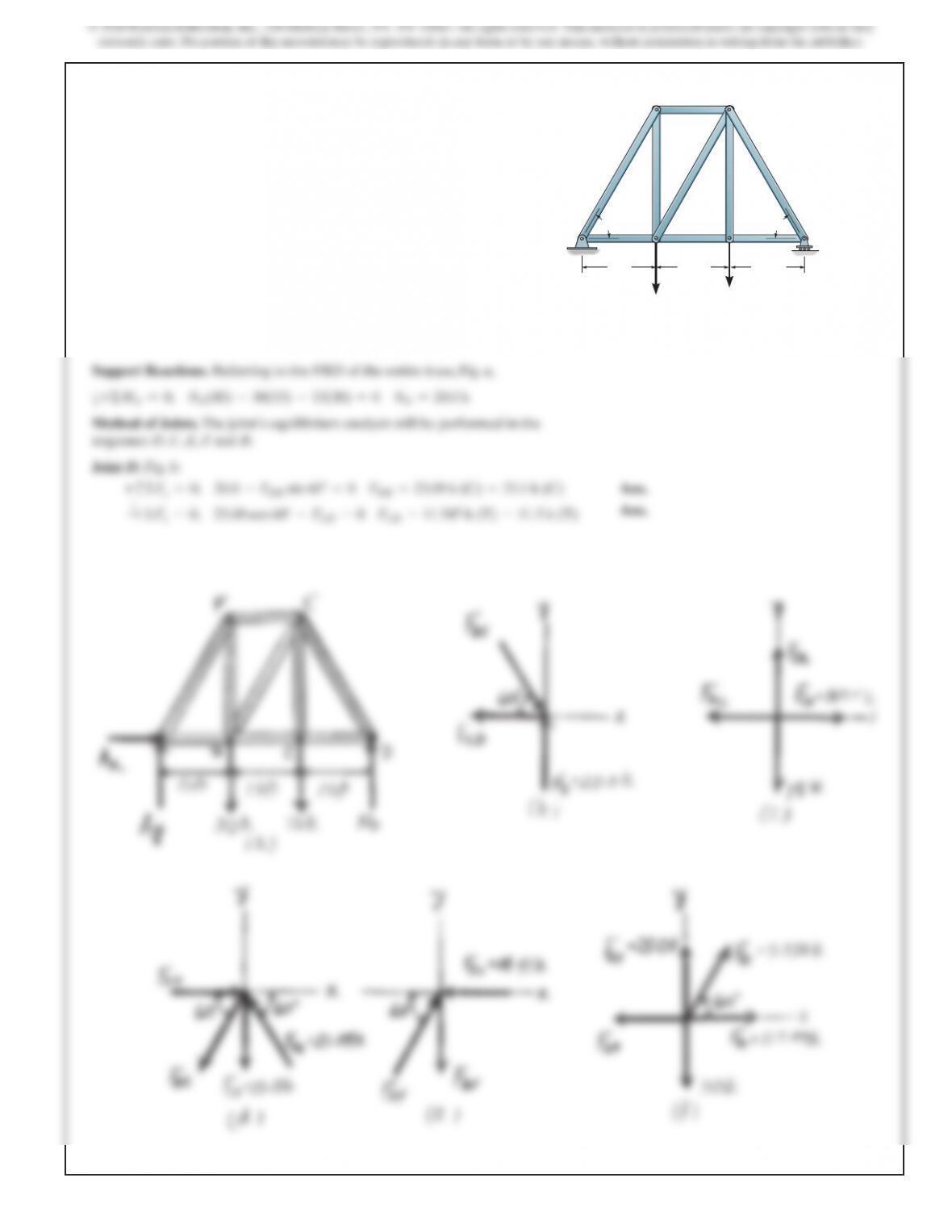
3–6. Determine the force in each member of the truss. State if
the members are in tension or compression.
SOLUTION
x=0;
CD =0
CD =11.547 k (T) =11.5 k (T)
608
608
15 ft 15 ft 15 ft
D
E
F
A
BC
30 k
15 k
7 8
Joint C. Fig. c:
+
SΣ
F
x=0;
11.547 –
F
BC =0
F
BC =11.547 k (T) =11.5 k (T)
+
c
ΣFy=0;
FCE –15 =0
FCD =15.0 k (T)
Joint E. Fig. d:
+
c
ΣFy=0;
23.09 sin 60°–15 –FBE sin 60°=0
FBE =5.774 k (T) =5.77 k (T)
+
SΣFx=0;
FEF –5.774 cos 60°–23.09 cos 60°=0
FEF =14.43 k =14.4 k (C)
Joint F. Fig. e:
+
SΣ
F
x=0;
F
AF cos 60°–14.43 =0
F
AF =28.87 k (C) =28.9 k (C)
+
c
ΣFy=0;
28.87 sin 60°–FBF =0
FBF =25.0 k (T)
Joint B. Fig. f:
+
SΣ
F
x=0;
11.547 +5.774 cos 60°–
F
AB =0
F
AB =14.43 k (T) =14.4 k (T)
+
c
ΣFy=0;
5.774 sin 60°+25.0 –30 =0
(Check!!)
Ans.
Ans.
Ans.
Ans.
Ans.
Ans.
Ans.
Ans.
FDE =23.1 k (C)
FCD =11.5 k (T)
FBC =11.5 k (T)
FCE =15.0 k (T)
FBE =5.77 k (T)
FEF =14.4 k (C)
FAF =28.9 k (C)
FBF =25.0 k (T)
FAB =14.4 k (T)
3–6. (Continued)
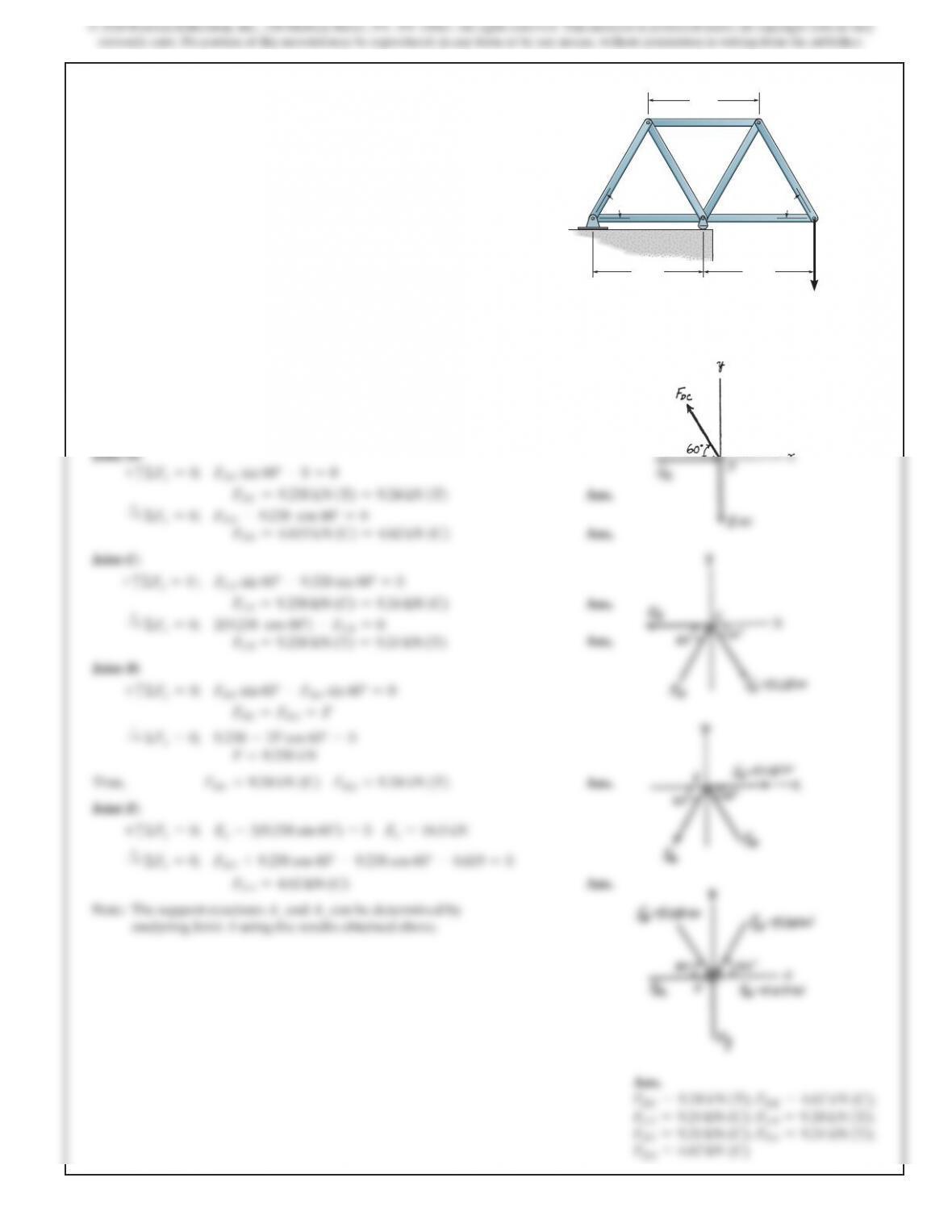
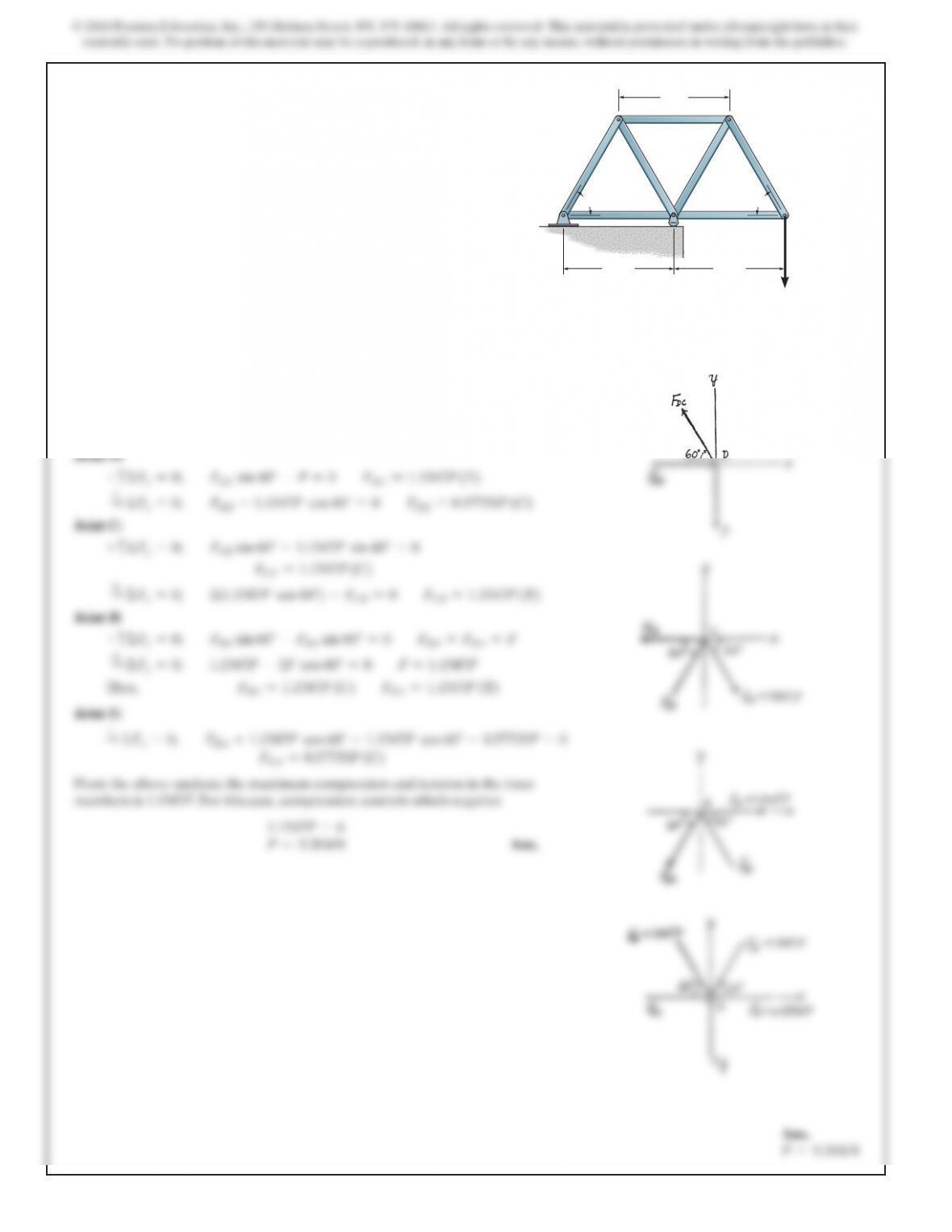
3–7. Determine the force in each member of the truss. State
whether the members are in tension or compression. Set
P=8
kN
.
SOLUTION
Method of Joints: In this case, the support reactions are not
required for determining the member forces.
608
608
4
m4
m
B
E
D
C
A
4 m
P
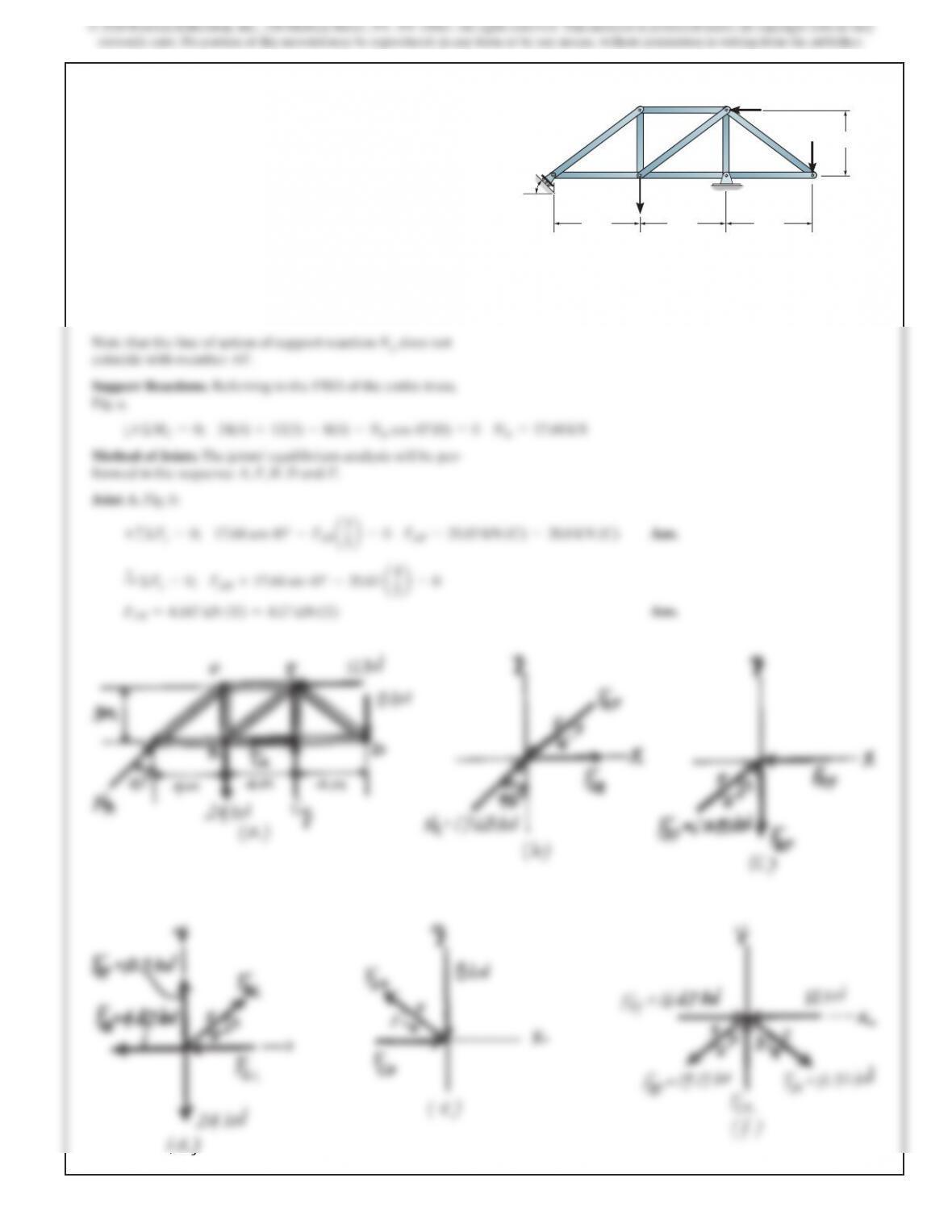
*3–8. If the maximum force that any member can support is
8 kN in tension and 6 kN in compression, determine the
maximum force P that can be supported at joint D.
608
608
4
m4
m
B
E
D
C
A
4 m
P
SOLUTION
Method of Joints: In this case, the support reactions are not required for
determining the member forces.
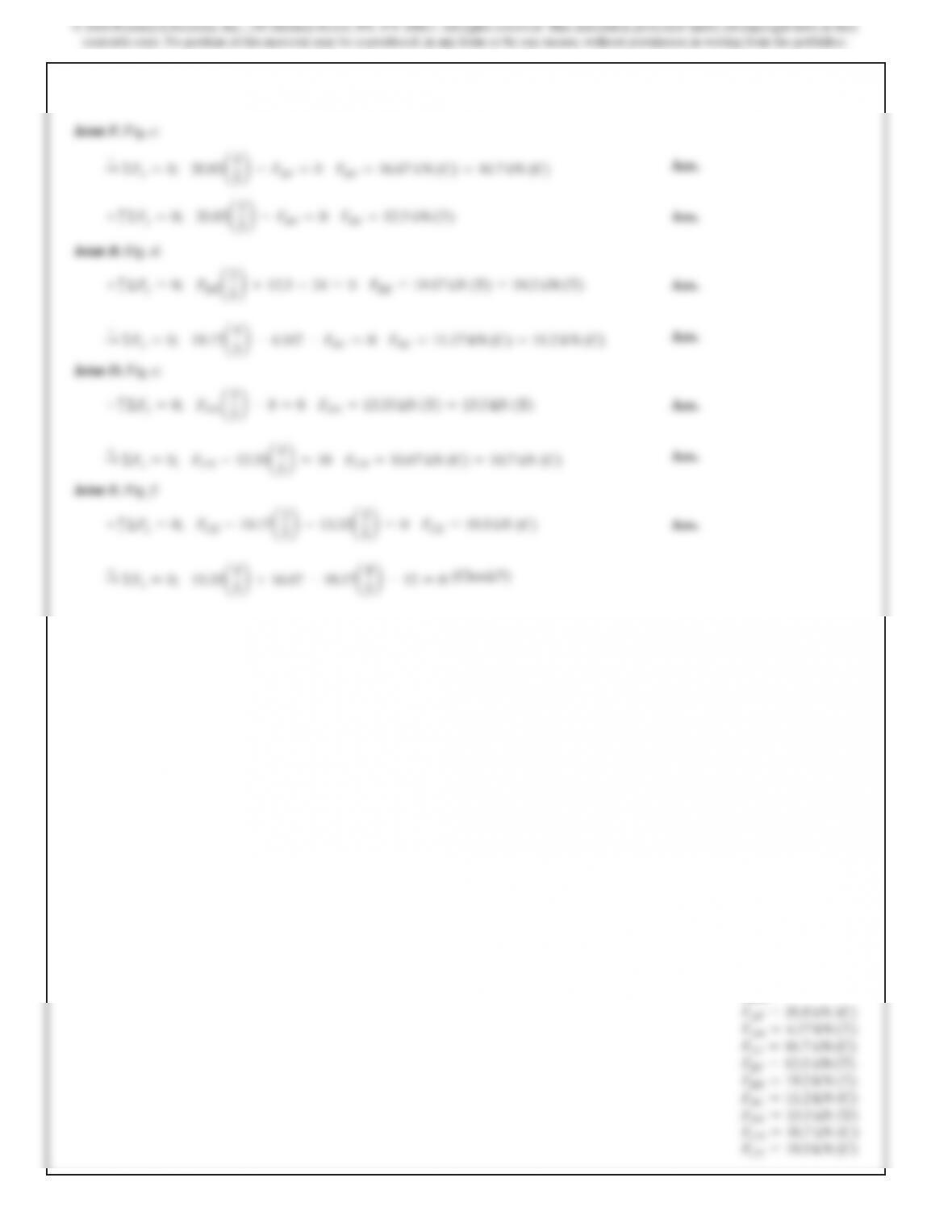
3–9. Determine the force in each member of the truss. State if
the members are in tension or compression.
SOLUTION
A
BC
FE
D
4 m 4 m
24 kN
12 kN
4 m
3
m
8 kN
45
8
8 2
5b
5b
Ans.
FAF =20.8 kN (C)
FAB =4.17 kN (T)
FEF =16.7 kN (C)
FBF =12.5 kN (T)
FBE =19.2 kN (T)
FBC =11.2 kN (C)
FDE =13.3 kN (T)
FCD =10.7 kN (C)
FCE =19.5 kN (C)
5b
5b
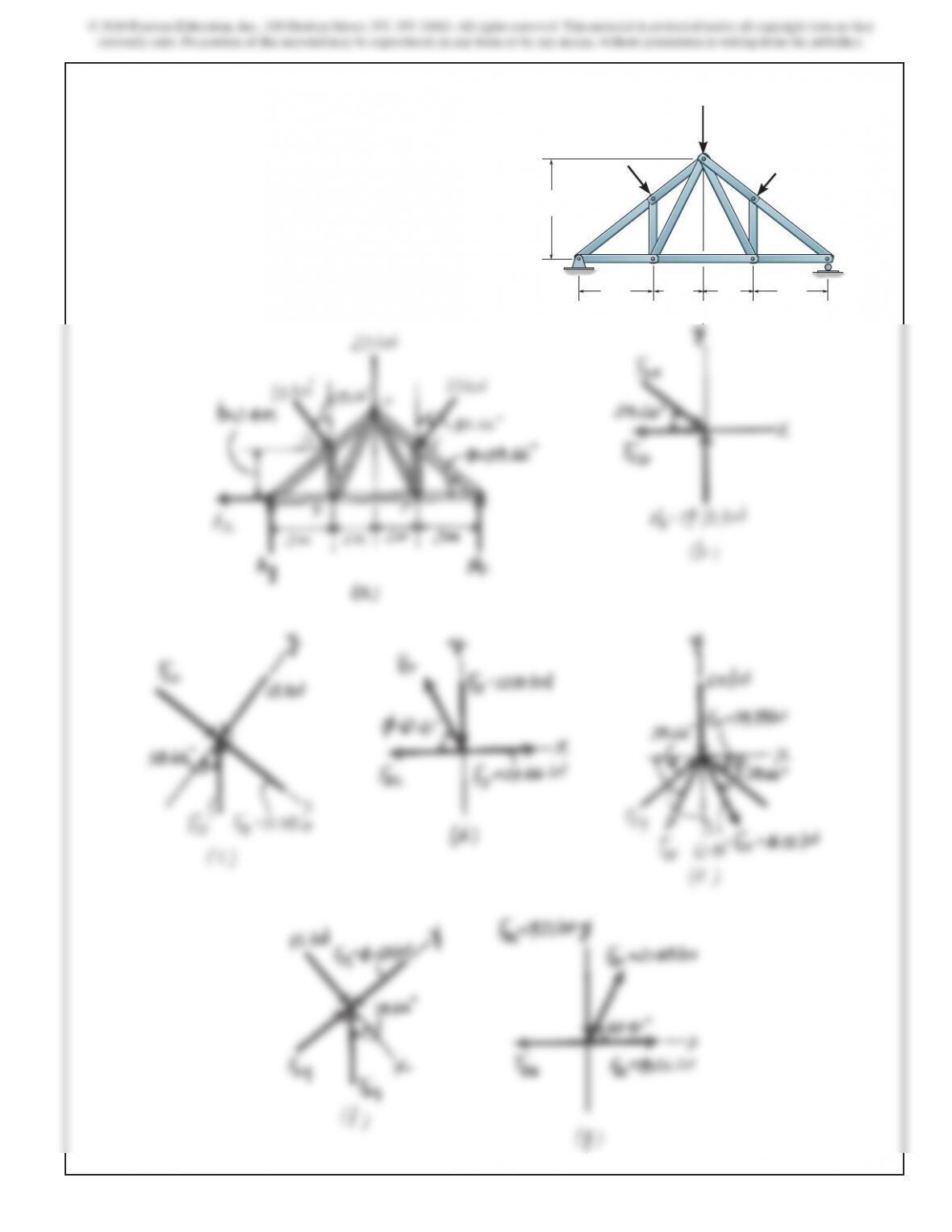
8 3
3–10. Determine the force in each member of the truss. State
if the members are in tension or compression.
20 kN
10 kN
15 kN
A
BC
F
GE
D
3 m
4
m
2 m 2 m 3 m
SOLUTION
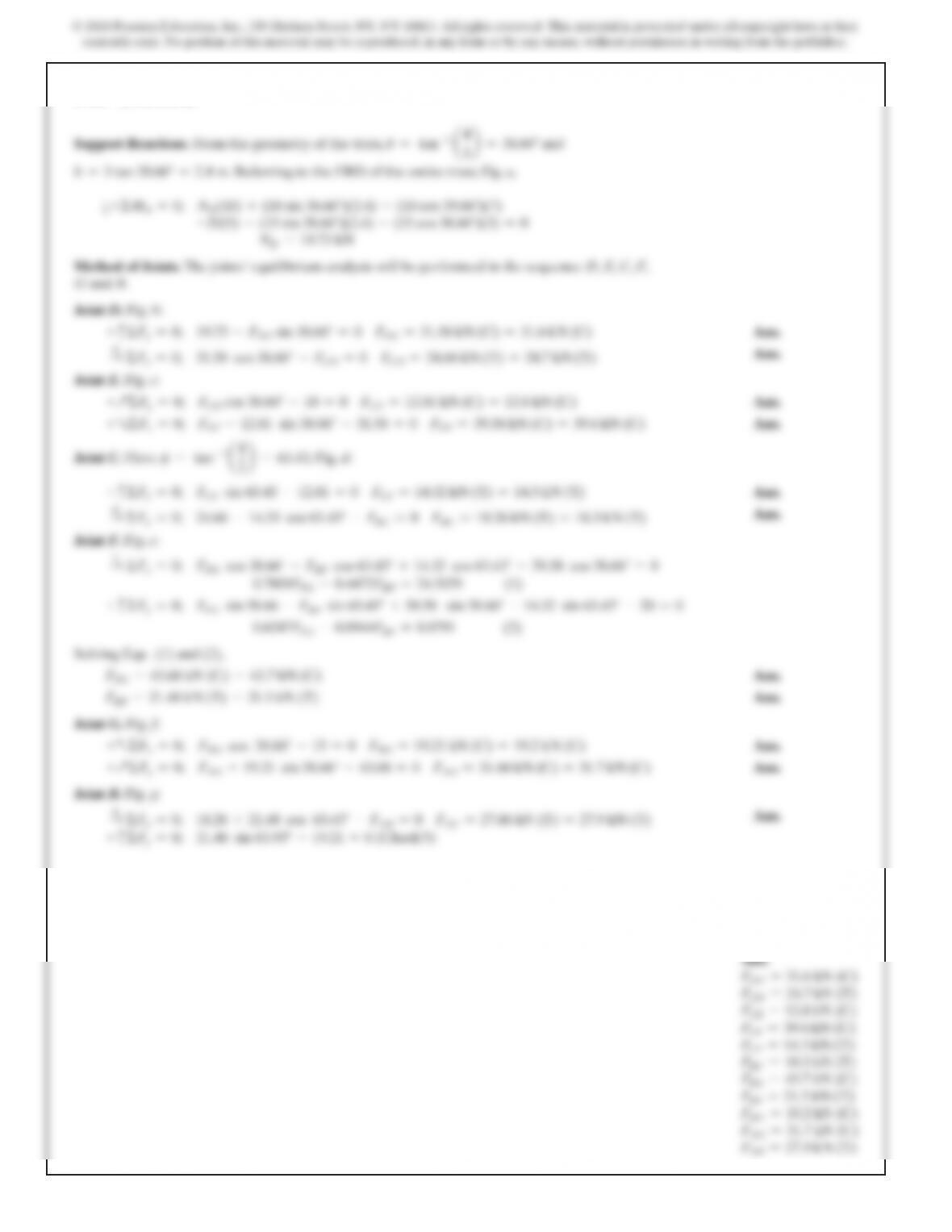
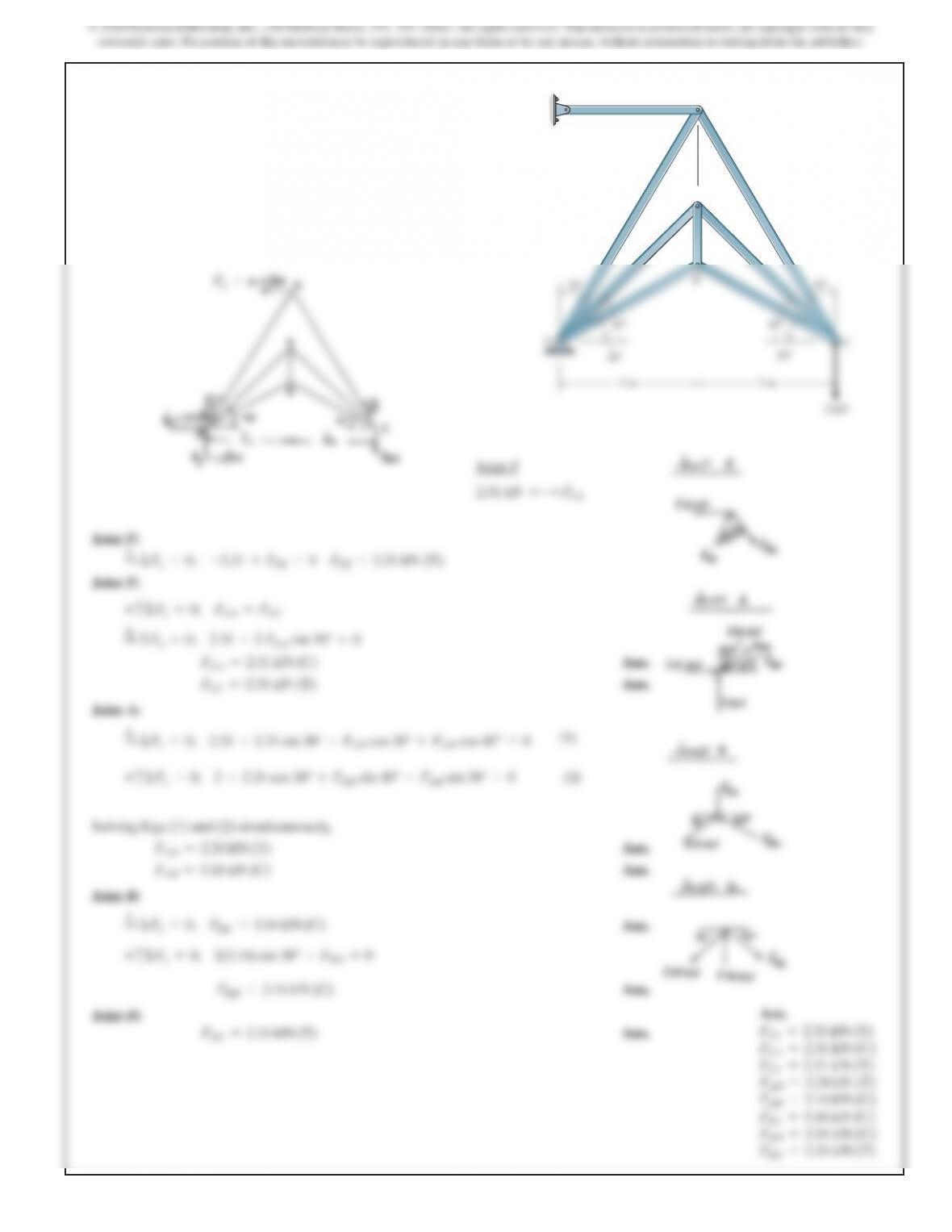
3–11. Determine the force in each member of the truss. State
if the members are in tension or compression.
C
E
A
2 kN
2 m 2 m
30 30
D
F
Joint F
2.31 kN d
SFFE
SOLUTION
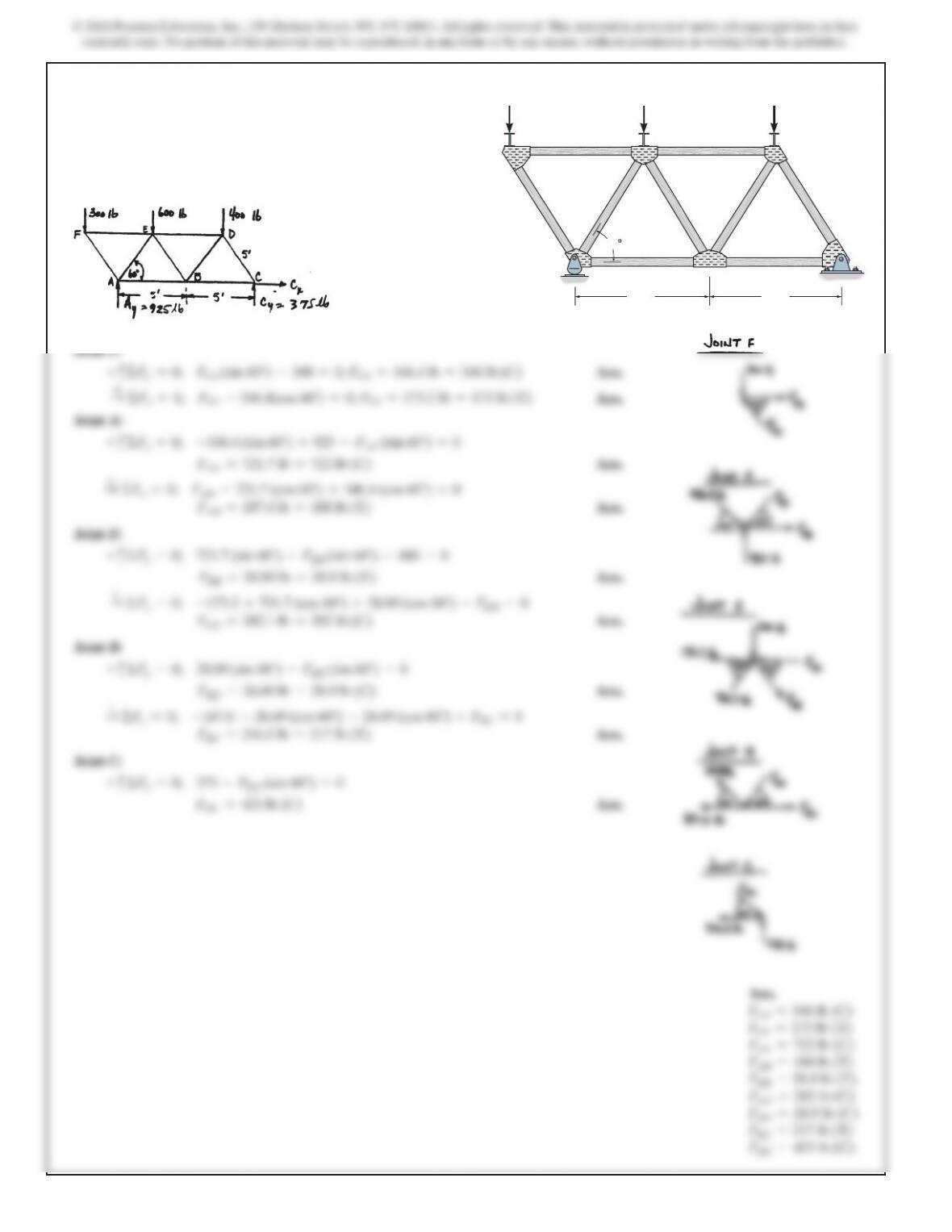
*3–12. Determine the force in each member of the truss. All
interior angles are 60°. State if the members are in tension or
compression. Assume all members are pin connected.
5 ft
400 lb
300 lb
600 lb
5 ft5 ft
C
DE
F
A
B
60
SOLUTION
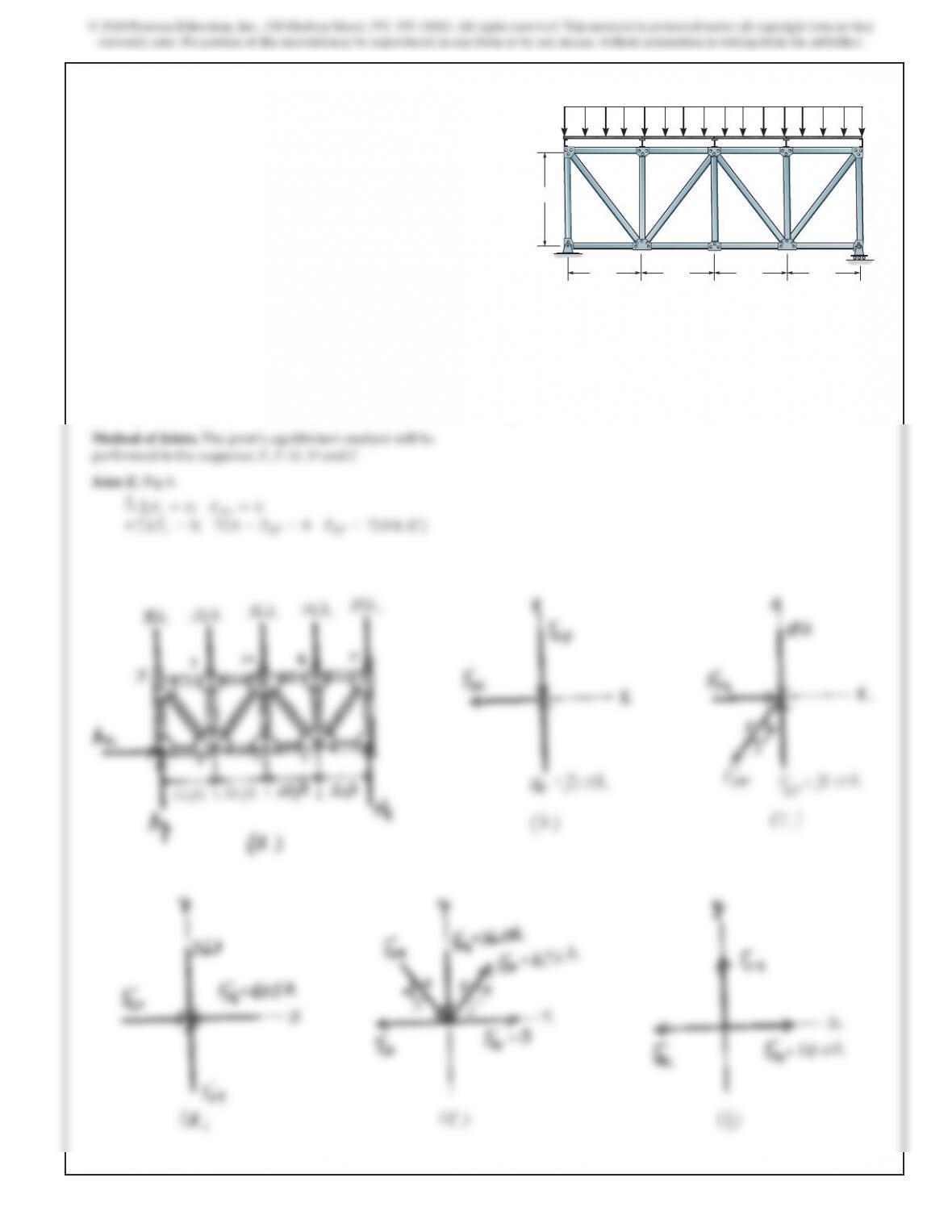
3–13. The truss shown is used to support the floor deck. The
uniform load on the deck is
3
k>ft.
This load is transferred from
the deck to the floor beams, which rest on the top joints of the
truss. Determine the force in each member of the truss, and
state if the members are in tension or compression. Assume all
members are pin connected.
SOLUTION
Support Reactions. The concentrated load acting on joints J, F
is
3(6) =18 k
and joints G, H, I is
3(12) =36 k
. Referring to
the FBD of the entire truss shown in Fig. a,
a+ΣMA=0;
NE(48) –18(48) #36(36) –36(24) –36(12) =0
NE=72.0 k
3 k/ft
A
B
JI
CD
E
F
G
H
12 ft
16 ft
12 ft 12 ft 12 ft
8 9
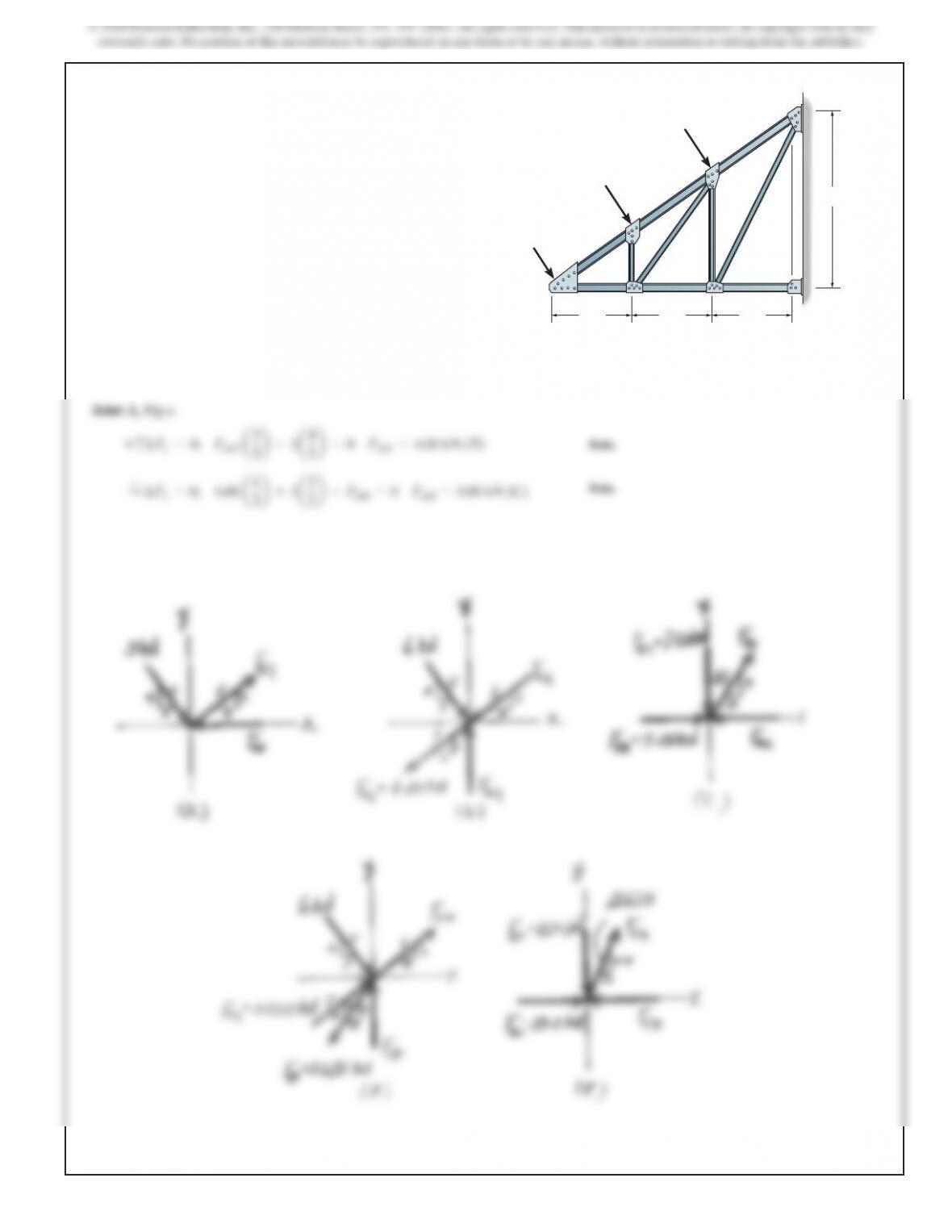
3–14. Determine the force in each member of the truss.
Indicate if the members are in tension or compression. Assume
all members are pin connected.
2 m2 m2 m
ABCD
E
F
G
4.5
m
3 kN
6 kN
6 kN
SOLUTION
Support Reactions. Not required.
Method of Joints. The joints’ equilibrium analysis will be
performed in the sequence A, G, B, F and C.
5b
5b
Joint G, Fig. b.
3–14. (Continued)
9 1
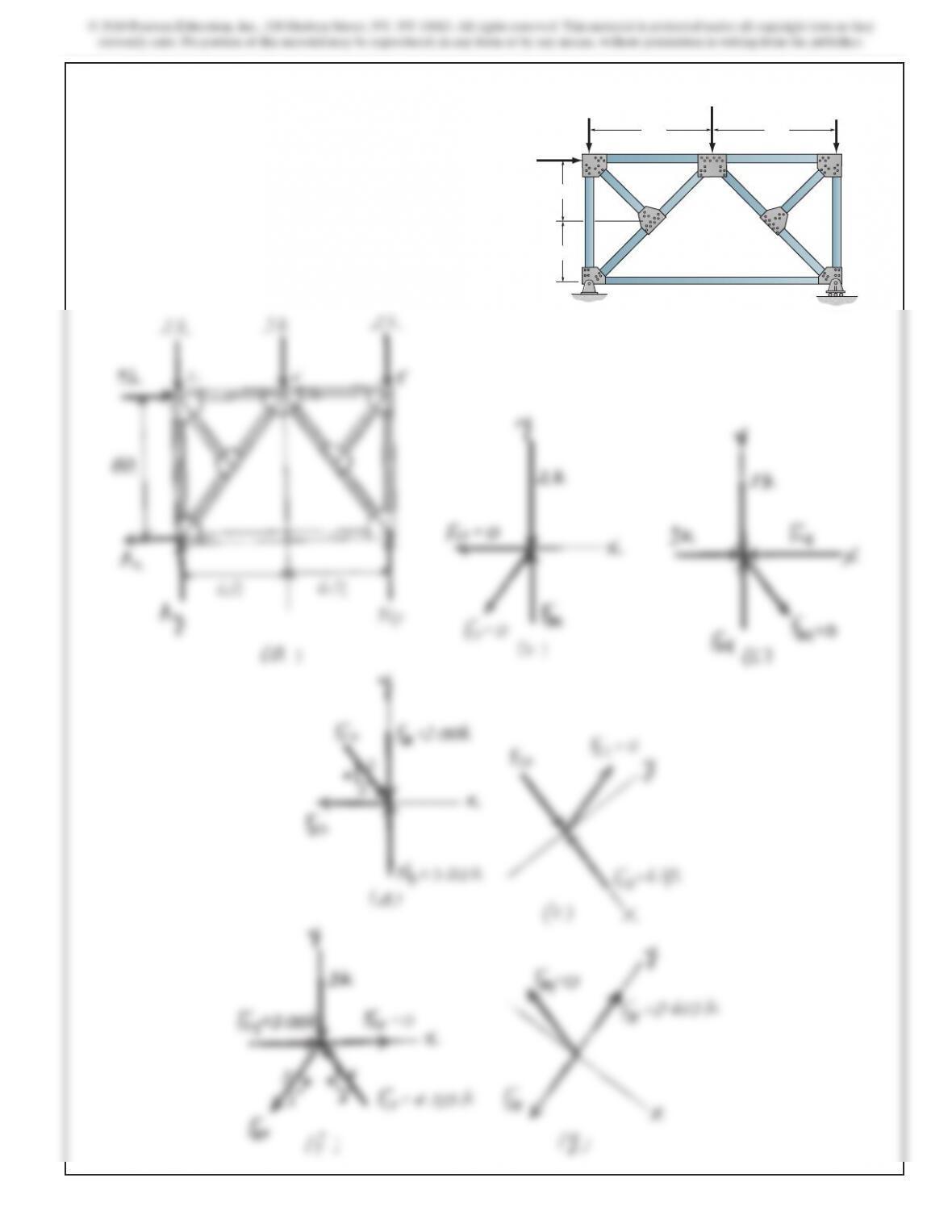
3–15. Determine the force in each member of the truss. State
if the members are in tension or compression. Assume all
members are pin connected.
A
BC
D
FE
G
4 ft
4 ft
2 k
3
k
2 k
3 k
6 ft
6 ft
SOLUTION