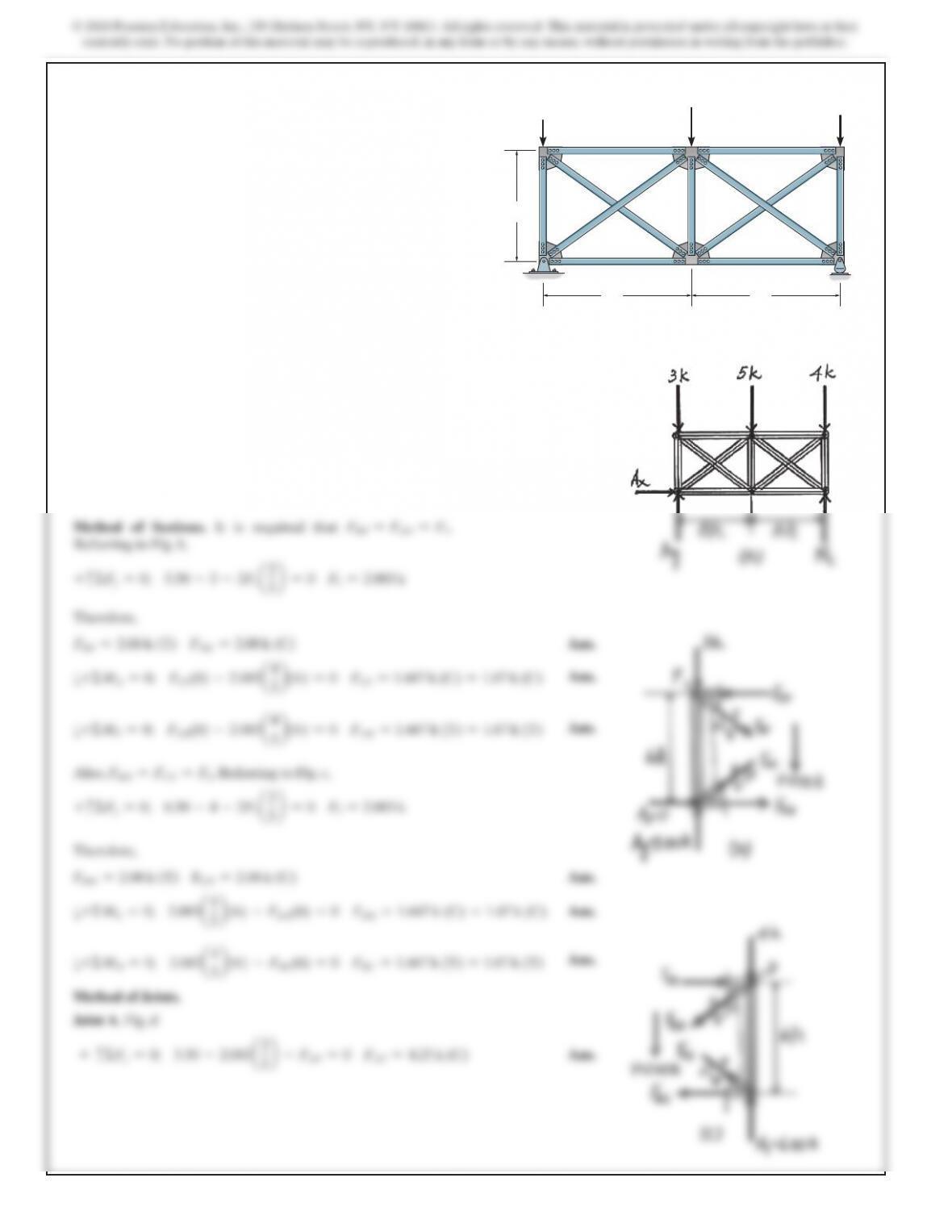
SOLUTION
Support Reactions Referring to Fig. a,
a+ΣMA=0;
NC(16) –5(8) –4(16) =0
NC=6.50
k
a+ΣMC=0;
5(8) +3(16) –Ay(16) =0
Ay=5.50
k
+
SΣFx=0;
Ax=0
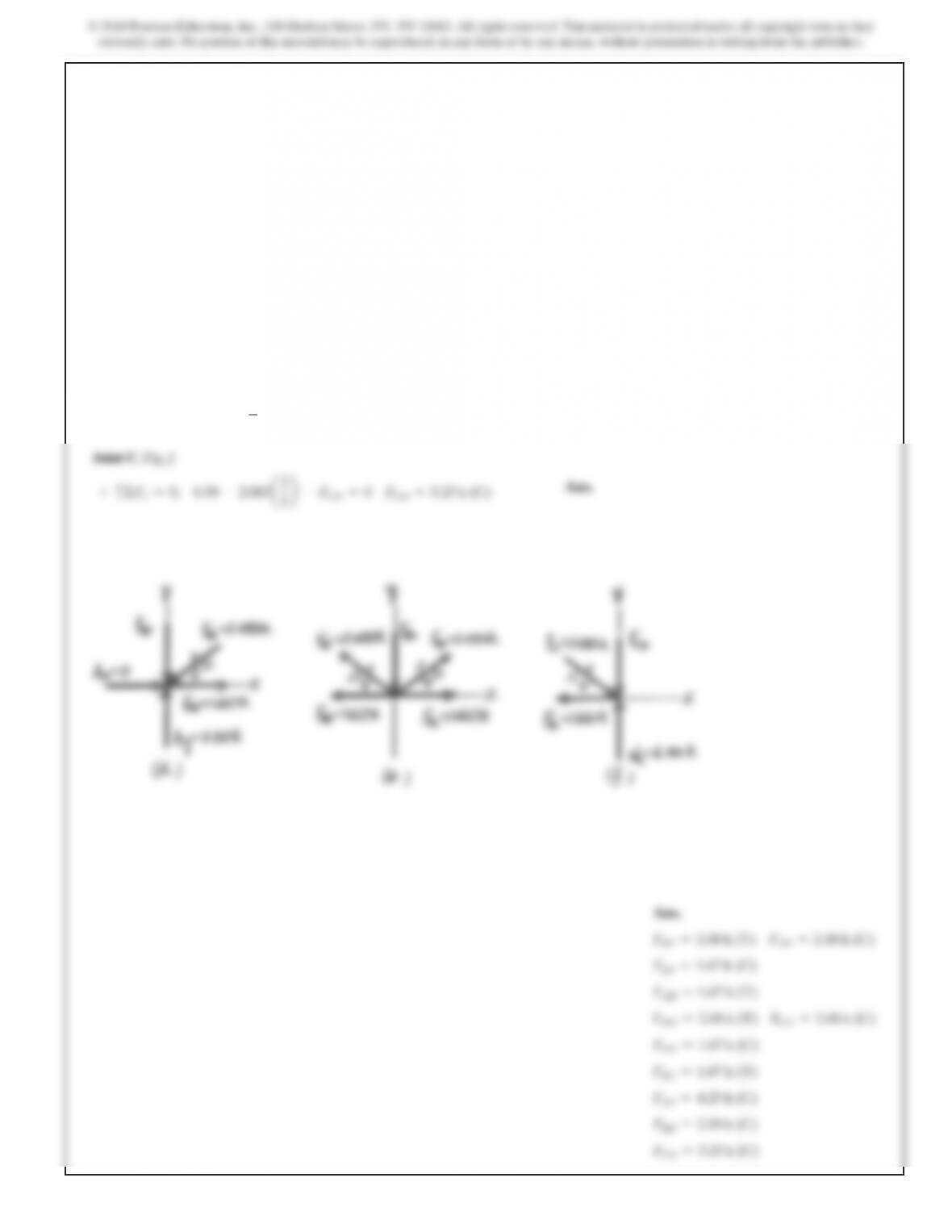
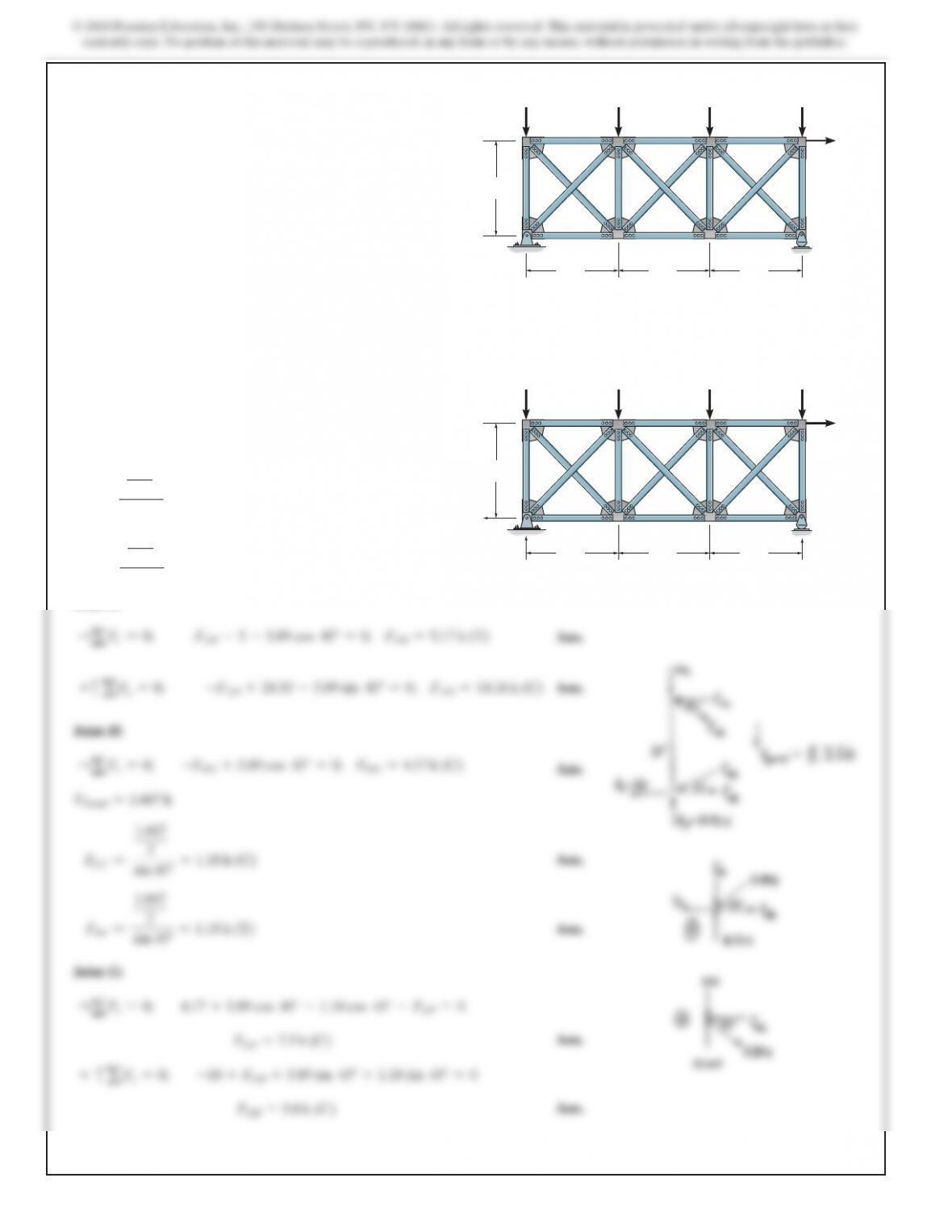
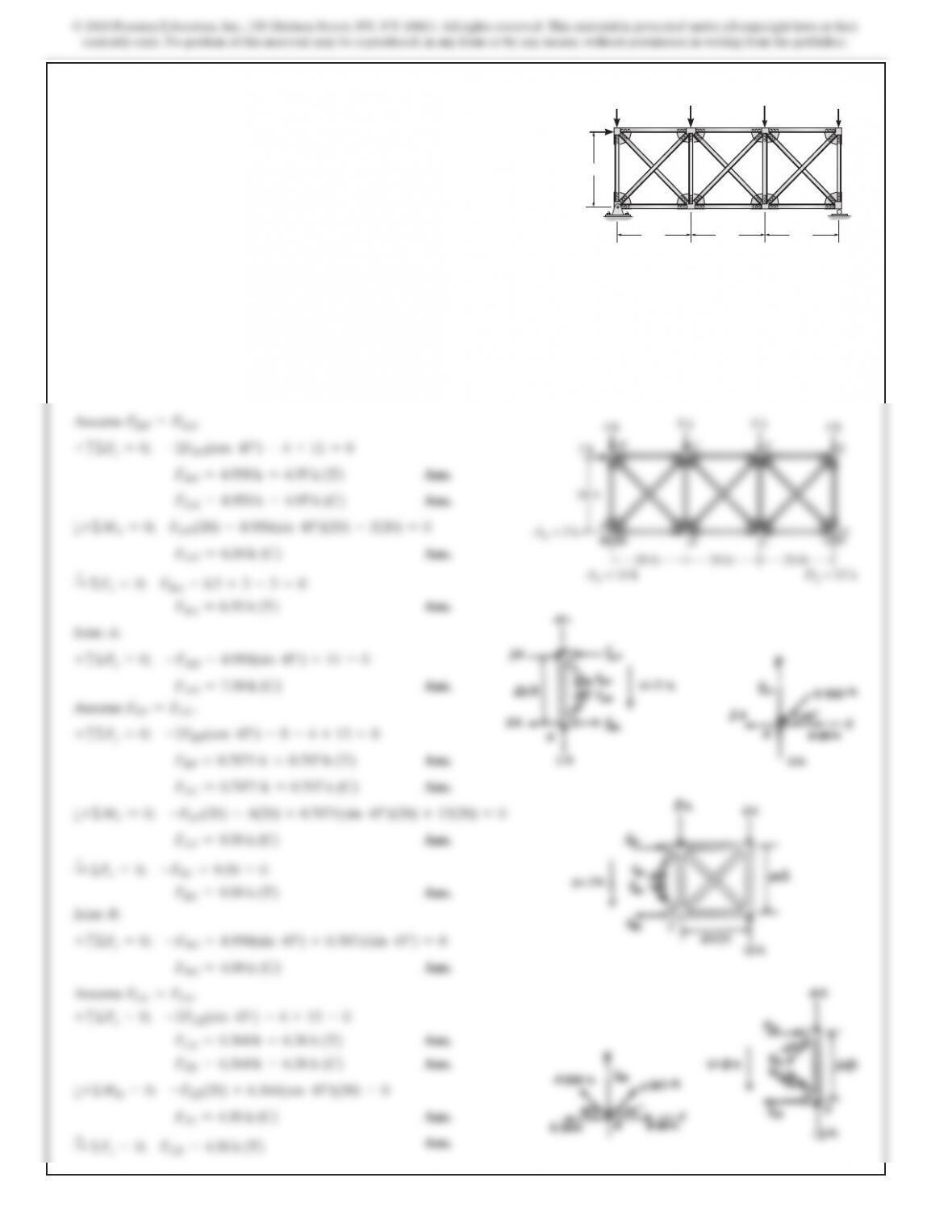
12–1. Determine (approximately) the force in each member of
the truss. Assume the diagonals can support either a tensile or a
compressive force.
8 ft
6 ft
5 k
E
8 ft
4 k
D
3 k
F
A
B
C
560
SOLUTION
Support Reactions. Referring to Fig. a,
a+ΣMA=0;
NC(16) –5(8) –4(16) =0
NC=6.50
k
a+ΣMC=0;
5(8) +3(16) –Ay(16) =0
Ay=5.50
k
+
SΣFx=0;
Ax=0
c
5b
a
a4
5b
a+ΣMF=0;
FAB(6) =0
FAB =0
Ans.
Referring to Fig. c,
+
c
ΣFy=0;
6.50 –4–FBD
a3
5b
=0
FBD =4.167
k (T) =4.17
k (T
)
Ans.
a
+ΣMC=0;
4.167
a4
5b
(6) –FDE(6) =0
FDE =3.333
k (C) =3.33
k (C
)
Ans.
a+ΣMD=0;
–FBC(6) =0
FBC =0
Ans.
Method of Joints. Joint A, Fig. d.
+
c
ΣFy=0;
5.50 –FAF =0
FAF =5.50
k (C)
Ans.
Joint B, Fig. e.
c
+
c
ΣFy=0;
6.50 –FCD =0
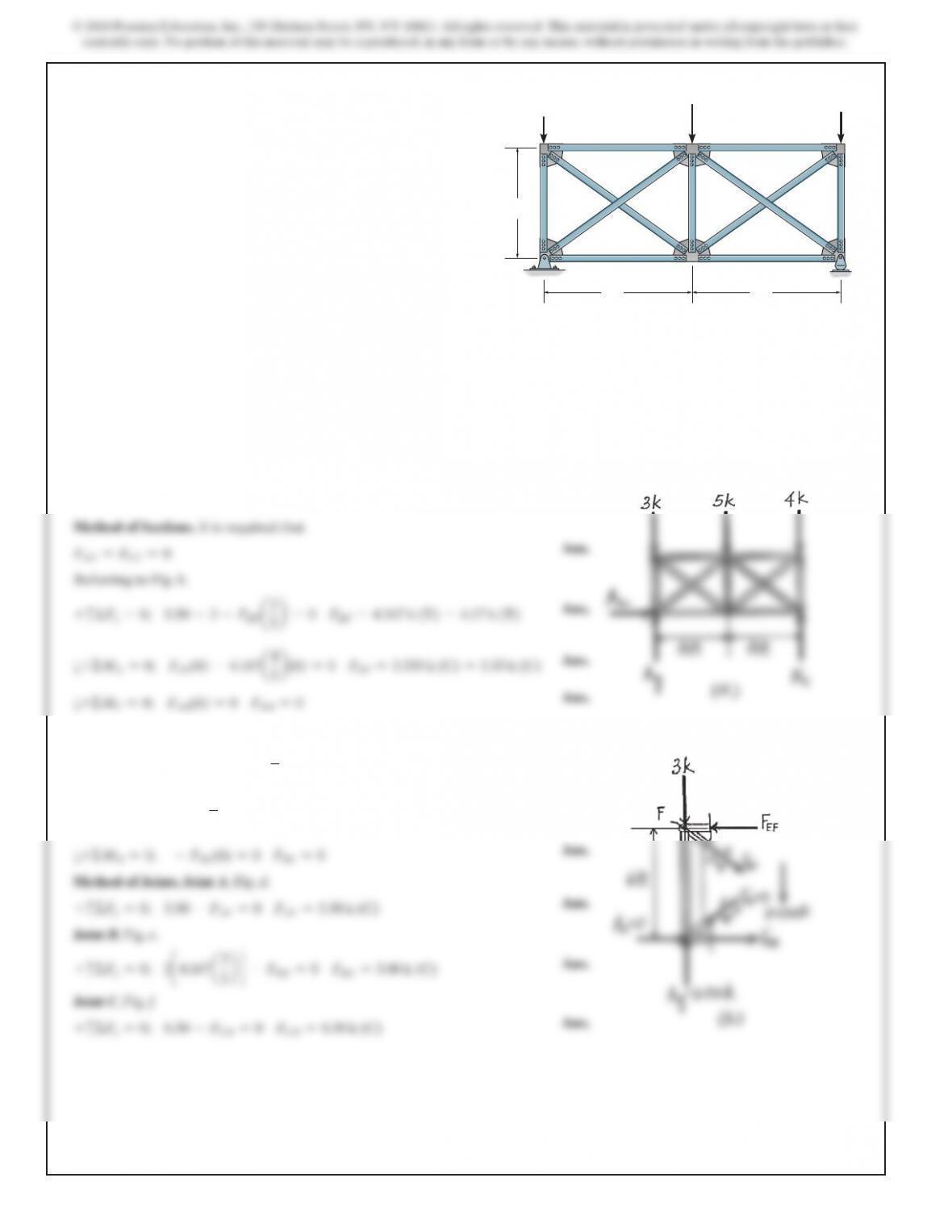
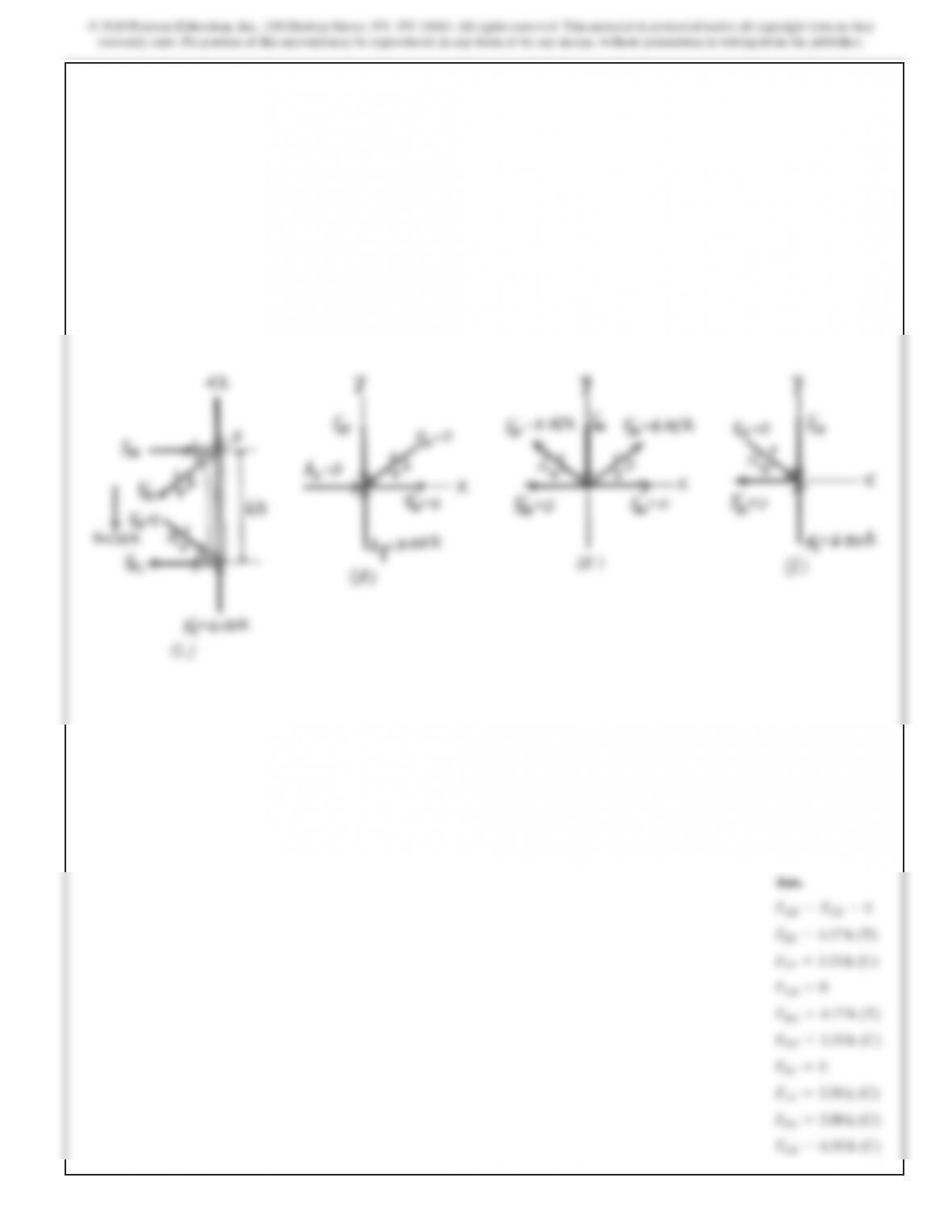
12–2. Solve Prob. 12–1 assuming that the diagonals cannot
support a compressive force.
8 ft
6 ft
5 k
E
8 ft
4 k
D
3 k
F
A
B
C
12–2. (Continued)
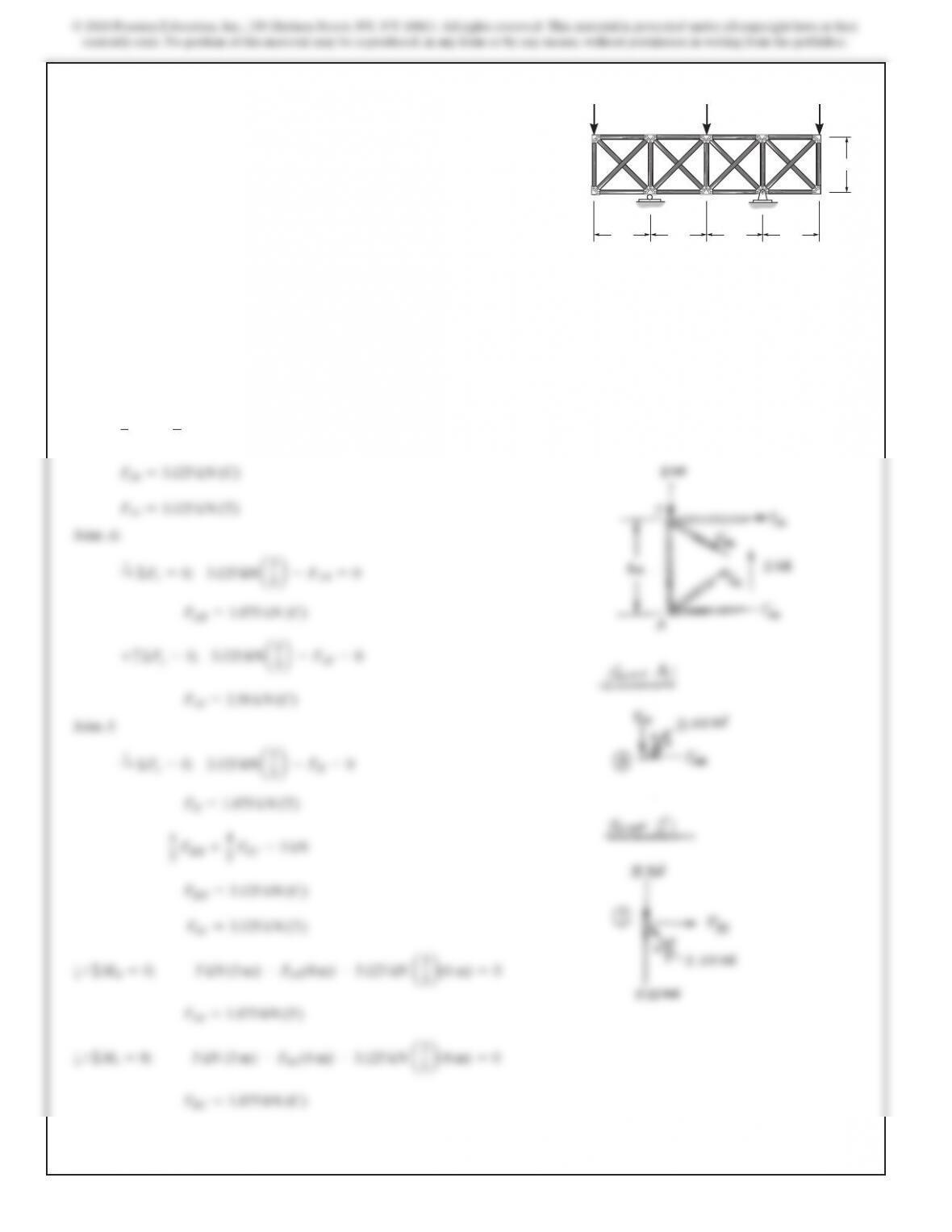
SOLUTION
4
5
FJB +
4
5
FAI =5
k
N
FJB =3.125
kN
(C)
FAI =3.125
kN
(T)
Joint A:
+
S
ΣFx=0;
3.125
kN
a3
5b
–FAB =0
FAB =1.875
kN
(C)
+
c
ΣFy=0;
3.125
kN
a4
5b
–FAJ =
0
FAJ =2.50
kN
(C)
Joint J:
+
S
ΣFx=0;
3.125
kN
a3
5b
–FJI =0
FJI =1.875
kN
(T)
4
4
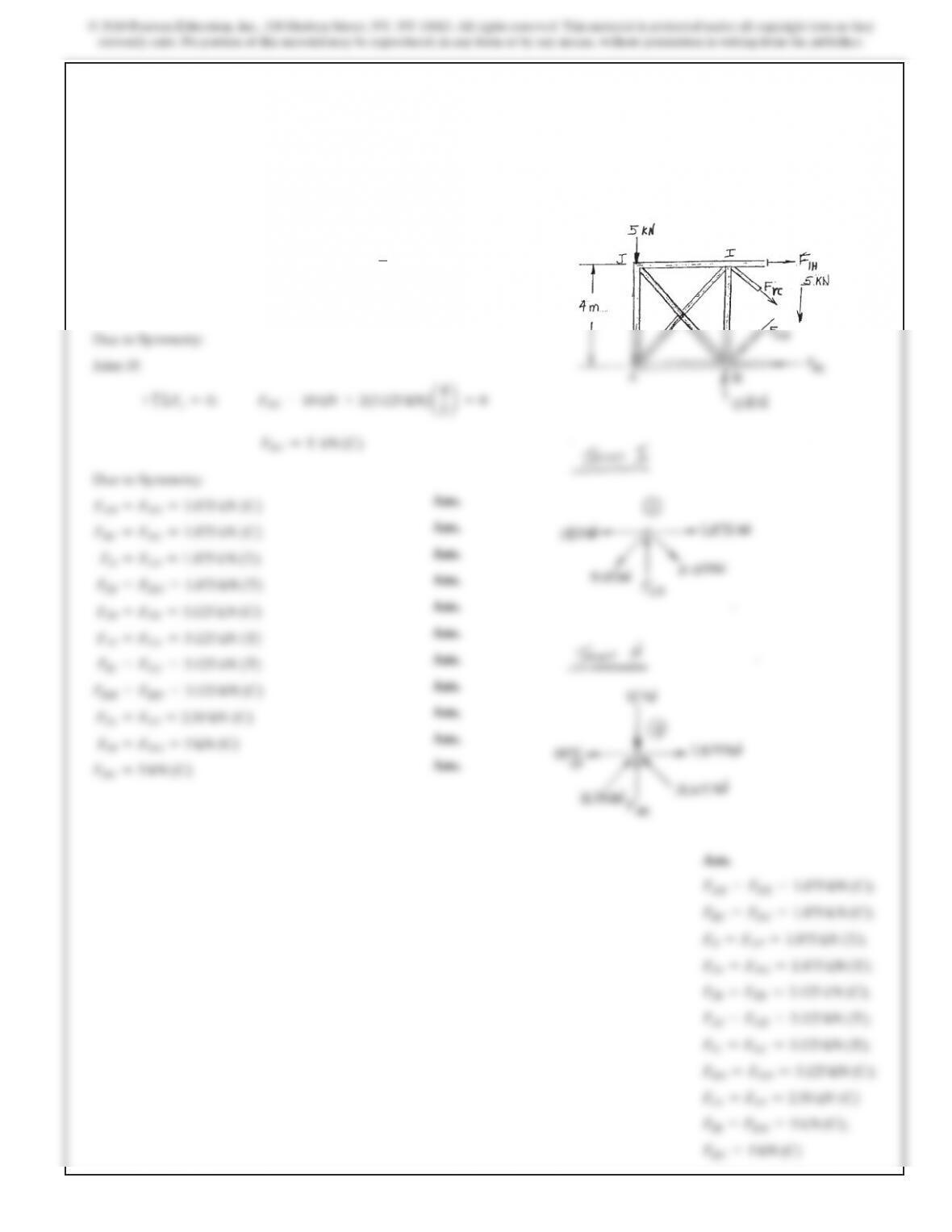
12–3. Determine (approximately) the force in each member of
the truss. Assume the diagonals can support either a tensile or a
compressive force. I
J
HGF
A
BCE
4 m
3 m
5 kN 10 kN 5 kN
D
3 m 3 m 3 m
5
FBH =3.125
kN
(C)
FFC =3.125
FIH =1.875
kN
(T)
563
FAB =FDE =1.875
kN
(C);
FBC =FDC =1.875
kN
(C);
FJI =FGF =1.875
kN
(T);
FIH =FHG =1.875
kN
(T);
FJB =FFD =3.125
kN
(C);
FAI =FGE =3.125
kN
(T);
FIC =FGC =3.125
kN
(T);
FBH =FHD =3.125
kN
(C);
FJA =FEF =2.50 kN
(C)
FIB =FDG =5
kN
(C);
FHC =5
kN
(C)
FIB =5
FHC =5
(C)
(C)
kN
(T)
kN
(C)
(T)
(T)
(C)
(C)
564
SOLUTION
4
5
FAI =5
k
N
FAI =6.25
kN
(T)
FJB =0
Joint A:
FAB =3.75
+
c
ΣFy=0;
6.25
kN
a4
5b
–FAJ =
0
FAJ =5
kN
(C)
Joint J:
+
SΣFx=0;
FJI =0
N
4
5
FIC =6.25
kN
(T)
FBC =3.75
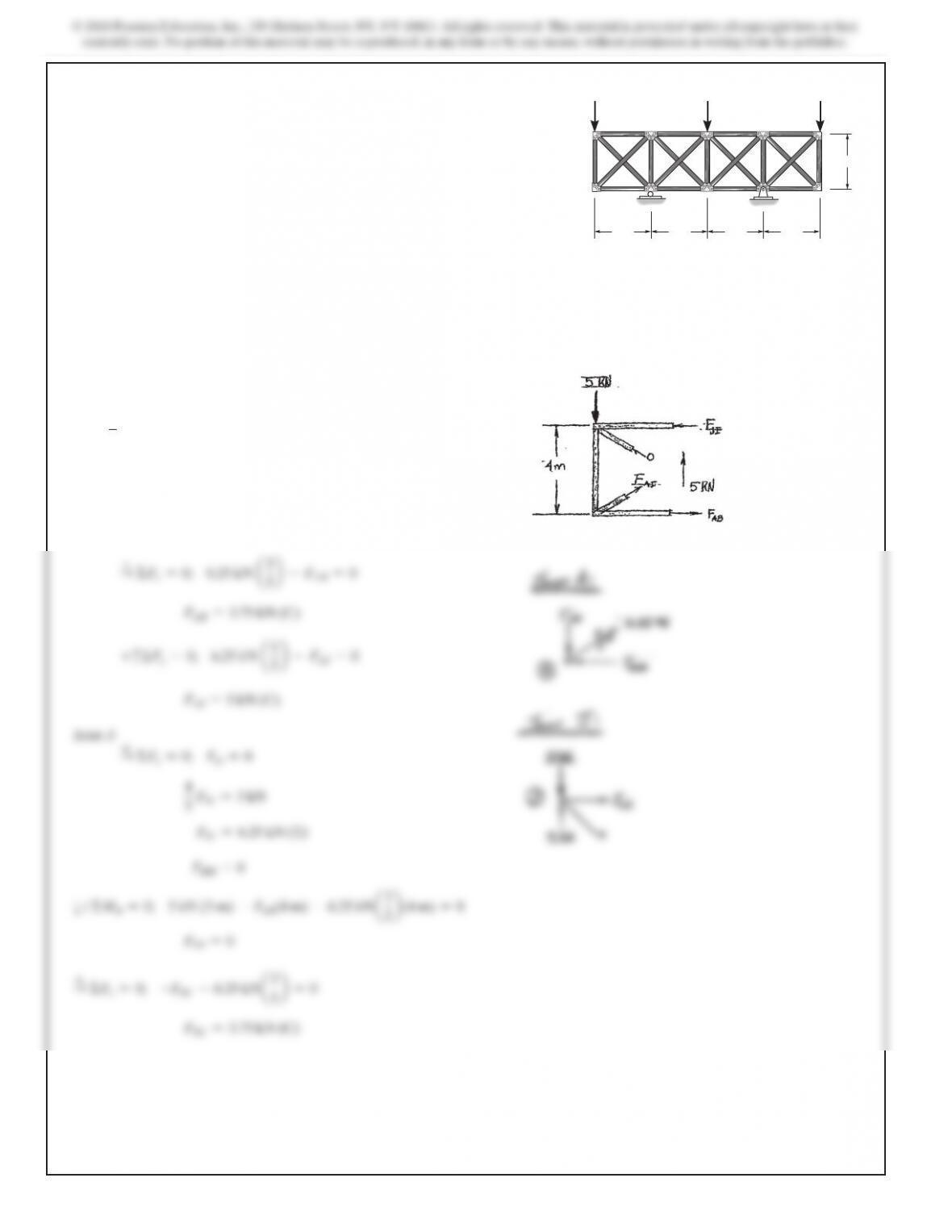
*12–4. Determine (approximately) the force in each member
of the truss. Assume the diagonals cannot support a compressive
force. I
JHGF
ABCE
4 m
3 m
5 kN 10 kN 5 kN
D
3 m 3 m 3 m
565
Joint I:
+
c
ΣFy=0;
FIB –2(6.25
kN)
a4
5b
=
0
FIB =10
kN
(C)
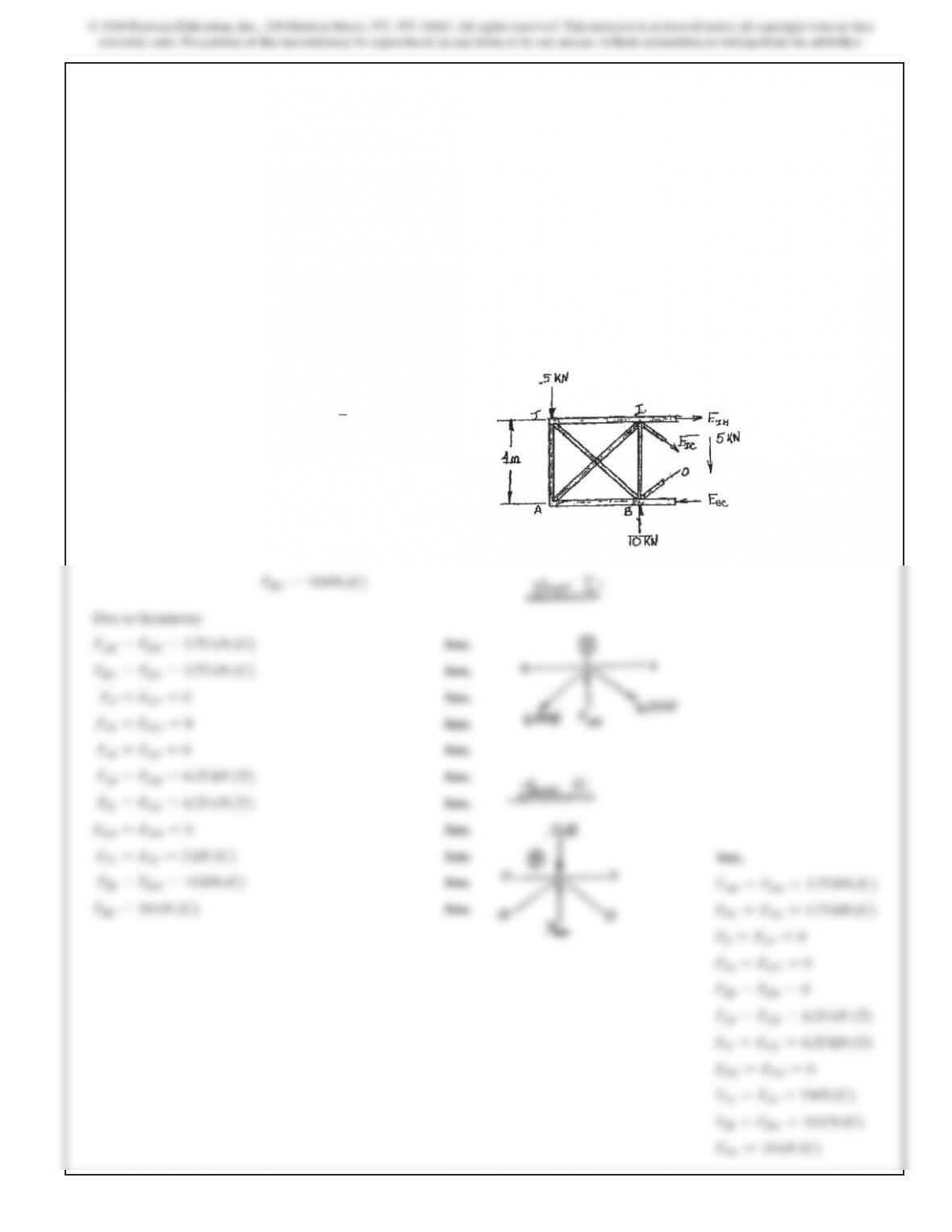
Due to Symmetry:
Joint H:
+
c
ΣFy=0;
FHC –10
kN =0
FHC =10
kN
(C)
Due to Symmetry:
FAB =FDE =3.75
kN
(C)
Ans.
FBC =FDC =3.75
kN
(C)
Ans.
FJI =FGF =0
Ans.
FIH =FHG =0
Ans.
FJB =FFD =0
Ans.
FAI =FGE =6.25
kN
(T)
Ans.
FIC =FGC =6.25
kN
(T)
Ans.
FBH =FHD =0
Ans.
FJA =FEF =5
(C)
FIB =FDG =10
kN
(C)
Ans.
FHC =10
kN
(C)
Ans.
*12–4. (Continued)
FAB =FDE =3.75
kN
(C)
FBC =FDC =3.75
kN
(C)
FJI =FGF =0
FIH =FHG =0
FJB =FFD =0
FAI =FGE =6.25
kN
(T)
FIC =FGC =6.25
kN
(T)
FBH =FHD =0
FJA =FEF =5
kN
(C)
FIB =FDG =10
kN
(C)
FHC =10
kN
(C)
SOLUTION
VPanel =8.33
k
Assume
VPanel
is carried equally by
FHB
and
FAG
, so
F
HB =
8.33
2
sin 45°
=5.89
k
(T
)
Ans.
F
AG =
8.33
2
sin 45°
=5.89
k
(C
)
Ans.
Joint A:
+a
VPanel =1.667
+a
F
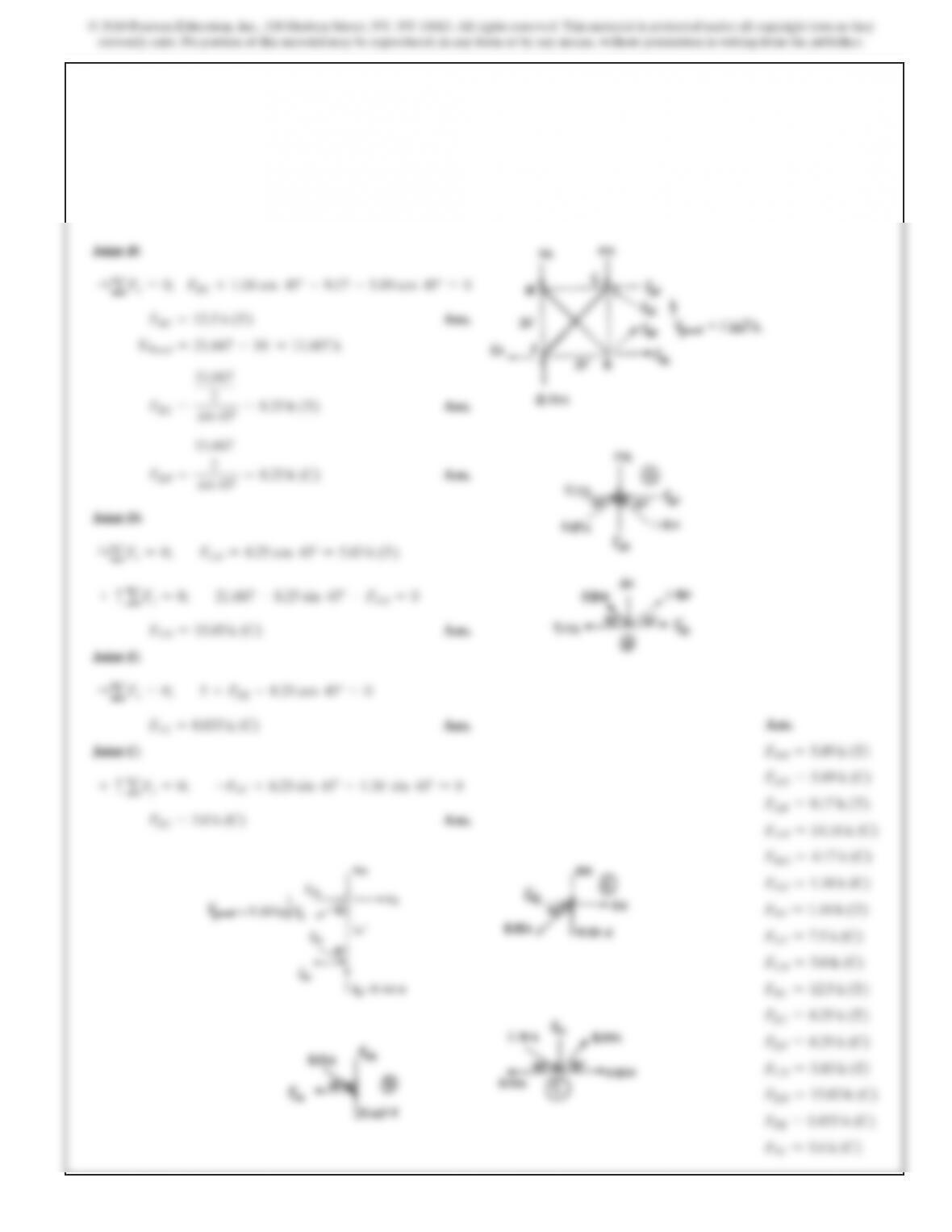
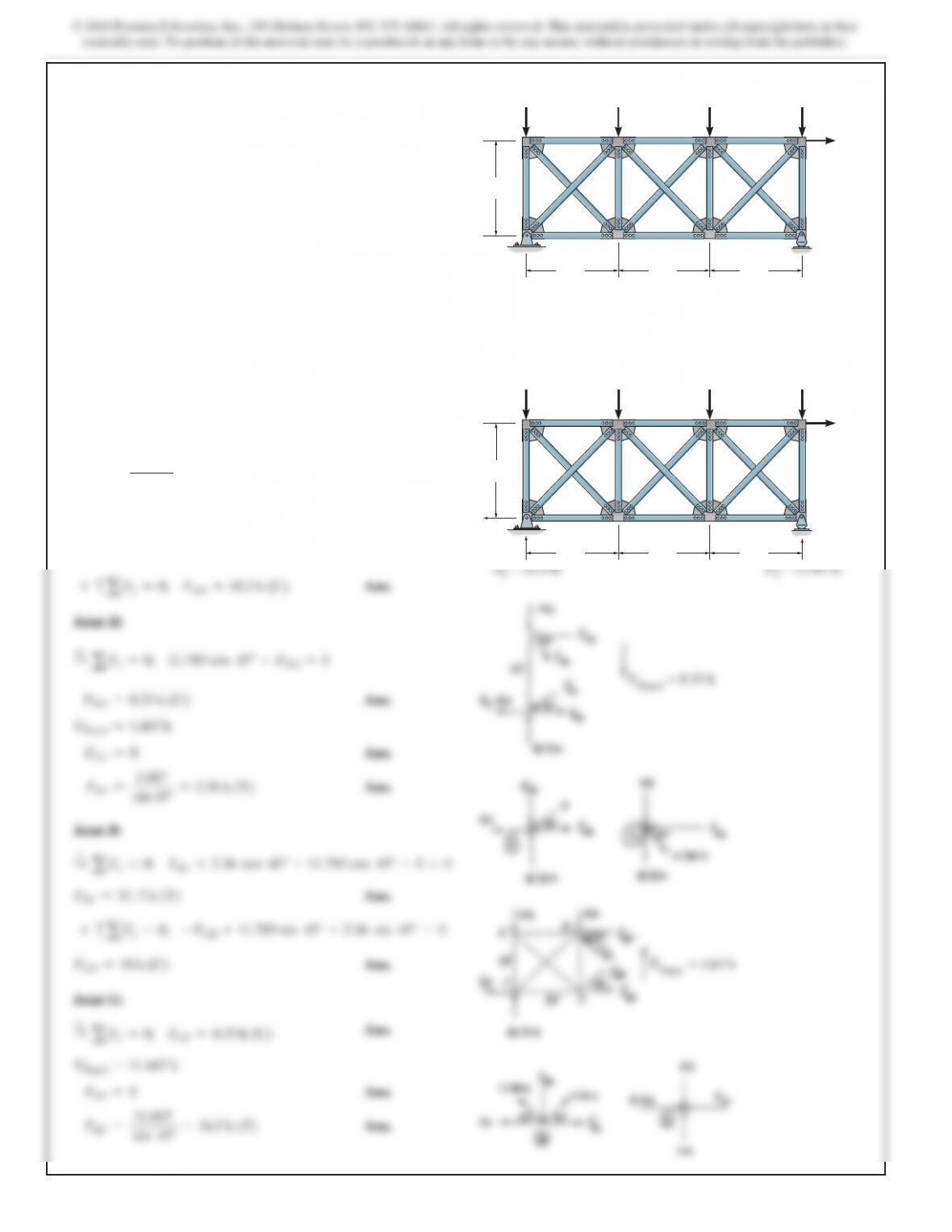
12–5. Determine (approximately) the force in each member
of the truss. Assume the diagonals can support either a tensile
or a compressive force.
20 ft
20 ft
20 ft 20 ft
10 k
H
AD
BC
10 k
G
10 k
F
10 k
5
k
E
20 ft
A
x = 5k
A
y
= 18.33 k D
y
= 21.667 k
20 ft
20 ft 20 ft
10 k
H
AD
BC
10 k
G
10 k
F
10 k
5
k
E
sin 45°
F
+a
567
FAH =14.16
k
(C)
FHG =4.17
k
(C)
FGC =1.18
k
(C)
FBF =1.18
k
(T)
FGF =7.5
k
(C)
FGB =5.0
k
(C)
FBC =12.5
k
(T)
FEC =8.25
k
(T)
FDF =8.25
k
(C)
FCD =5.83
k
(T)
FED =15.83
k
(C)
FFE =0.833
k
(C)
FFC =5.0
k
(C)
FHB =5.89
k
(T)
FAG =5.89
k
(C)
FAB =9.17
k
(T)
FBC =12.5
k
(T)
FED =15.83
FFE =0.833
FFC =5.0
(C)
568
SOLUTION
VPanel =8.33
k
FAG =0
Ans.
FHB =
8.33
sin 45°
=11.785 =11.8
k
Ans.
Joint A:
+
Sa
Fx=0;
FAB =5
k
(T) Ans.
+
+
+
sin
45°
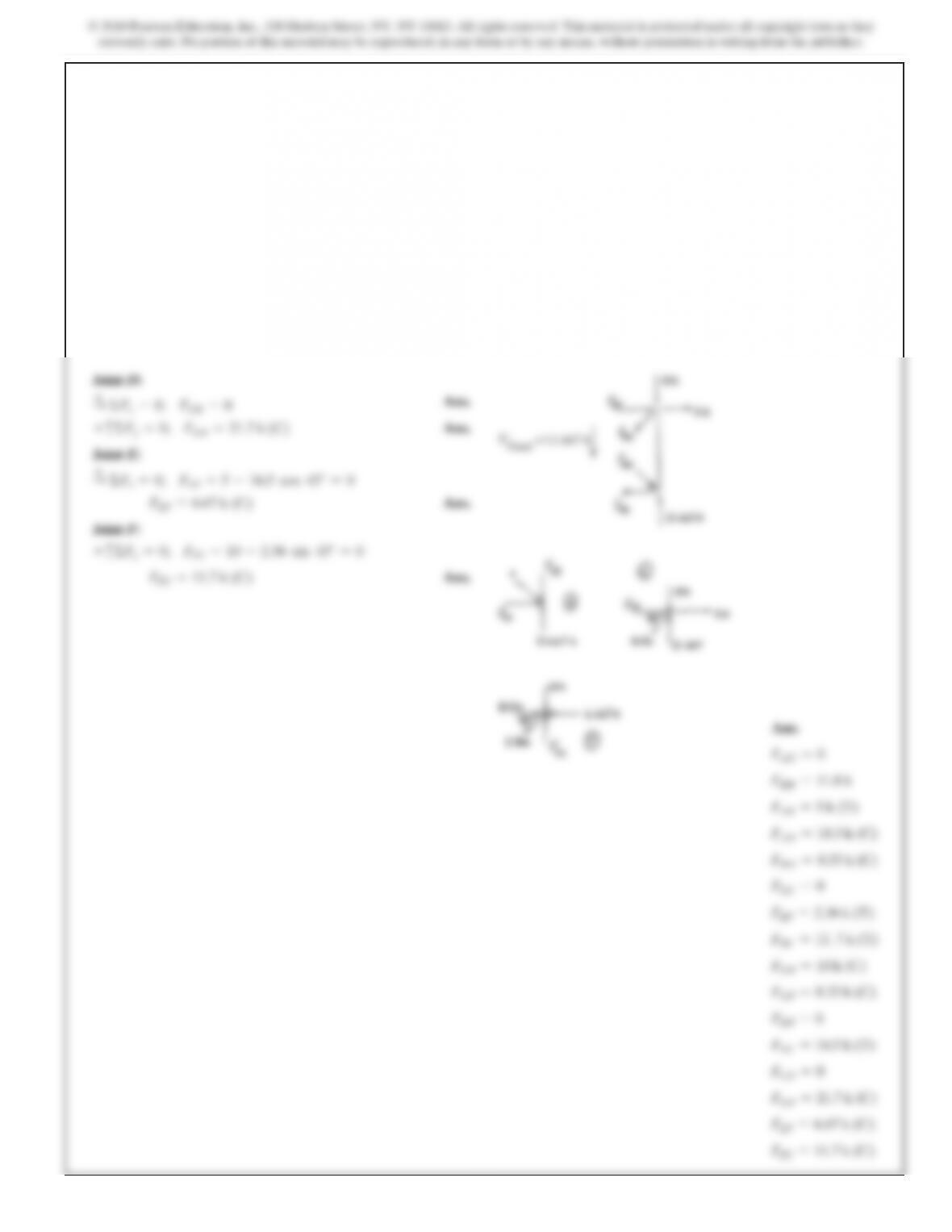
12–6. Solve Prob. 12–5 assuming that the diagonals cannot
support a compressive force.
20 ft
20 ft
20 ft 20 ft
10 k
H
AD
BC
10 k
G
10 k
F
10 k
5
k
E
20 ft
A
x = 5k
20 ft
20 ft 20 ft
10 k
H
AD
BC
10 k
G
10 k
F
10 k
5
k
E
569
Ans.
FAG =0
FHB =11.8
k
FAB =5
k
(T)
FAH =18.3
k
(C)
FHG =8.33
k
(C)
FGC =0
FBF =2.36
k
(T)
FBC =11
.7
k
(T)
FGB =10
k
(C)
FGF =8.33
k
(C)
FDF =0
FEC =16.5
k
(T)
FCD =0
FED =21.7
k
(C)
FEF =6.67
k
(C)
FFC =11.7
k
(C)
FEF =6.67
k
(C)
FFC =11.7
k
(C)
SOLUTION
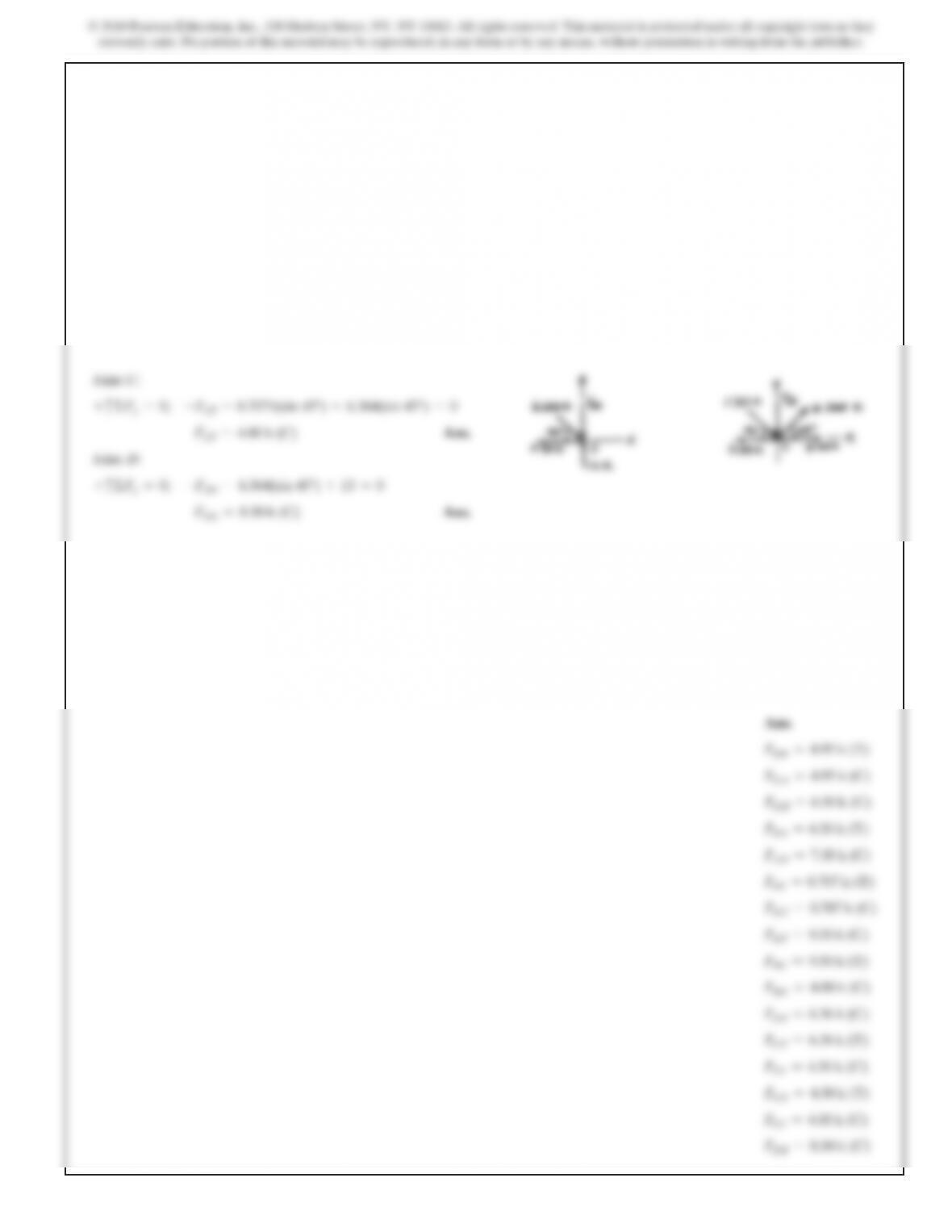
12–7. Determine (approximately) the force in each member of
the truss. Assume the diagonals can support either a tensile or
compressive force.
D
4 k
3 k
8 k 8 k
4 k
HGFE
A
BC
20 ft 20 ft 20 ft
20 ft
571
Ans.
FBH =4.95
k
(T)
FGA =4.95
k
(C)
FGH =6.50
k
(C)
FBA =6.50
k
(T)
FAH =7.50
k
(C)
FBF =0.707
k
(T)
FGC =0.707
k
(C)
FGF =9.50
k
(C)
FBC =9.50
k
(T)
FBG =4.00
k
(C)
FFD =6.36
k
(C)
FCE =6.36
k
(T)
FFE =4.50
k
(C)
FCD =4.50
k
(T)
FCF =4.00
k
(C)
FDE =8.50
k
(C)
FCF =4.00
k
(C)
FDE =8.50
k
(C)
573
Ans.
FGA =0
FBH =9.90
k
(T)
FGH =10.0
k
(C)
FBA =3.00
k
(T)
FAH =11.0
k
(C)
FGC =0
FBF =1.41
k
(T)
FGF =10.0
k
(C)
FBC =9.00
k
(T)
FBG =8.0
k
(C)
FFD =0
FCE =12.7
k
(T)
FFE =9.00
k
(C)
FCD =0
FCF =9.00
k
(C)
FDE =13.0
k
(C)
Joint C:
+
c
ΣFy=0;
–FCF +12.73(sin
45°)=0
FCF =9.00
k
(C)
Ans.
Joint D:
+
c
ΣFy=0;
FDE =13.0
k
(C)
Ans.
*12–8. (Continued)
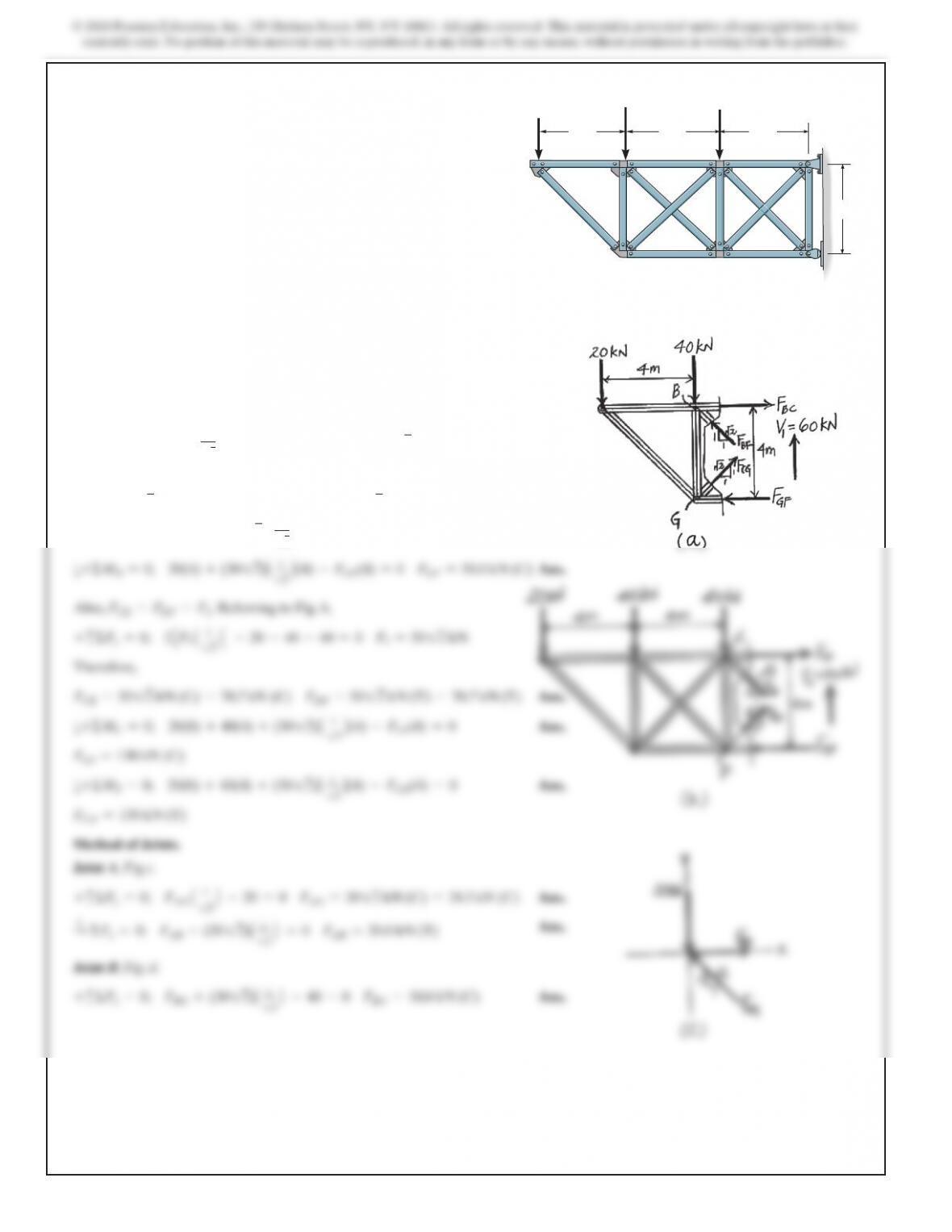
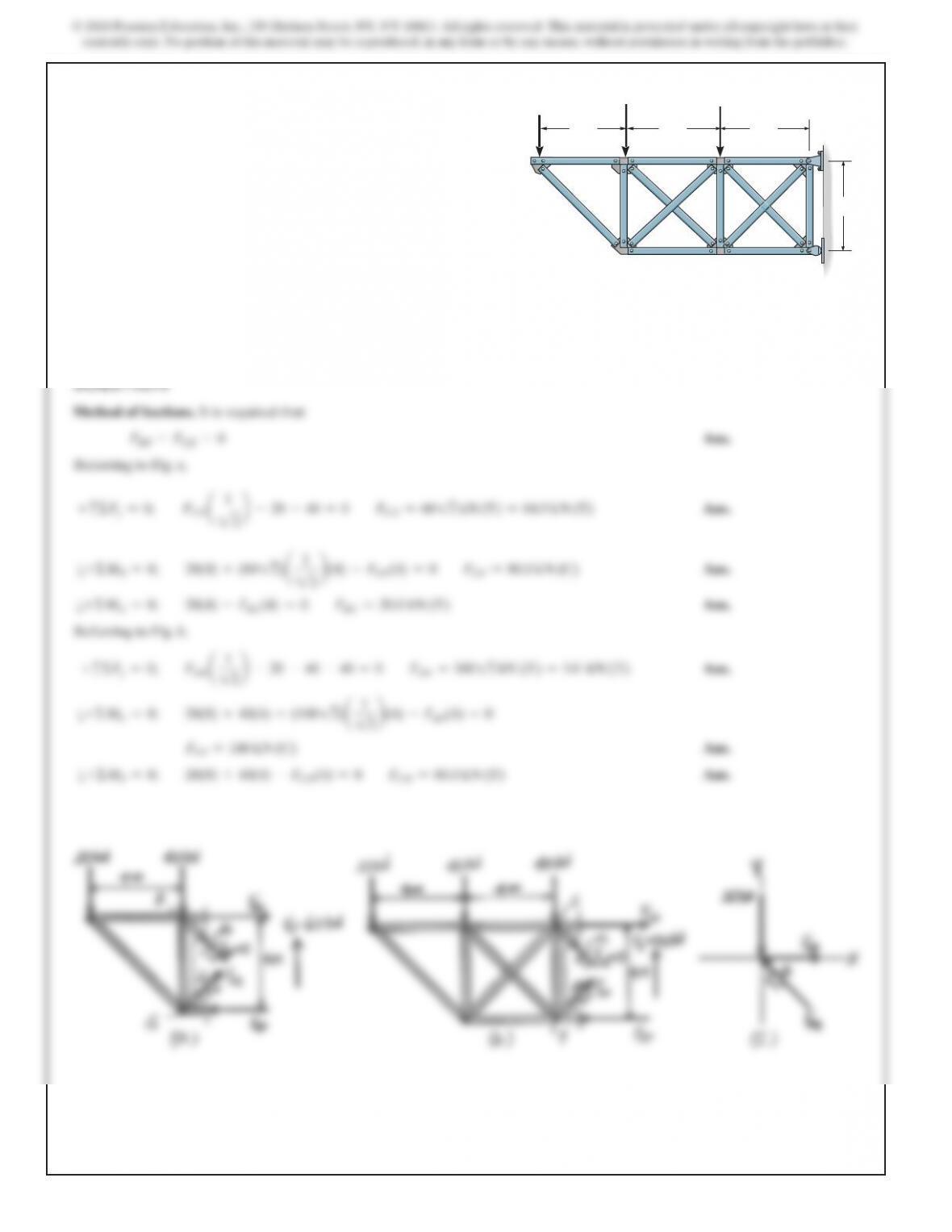
12–9. Determine (approximately) the force in each member of
the truss. Assume the cross diagonals can support both tensile
and compressive forces.
20 kN
40 kN 40 kN
E
F
A
BC
G
D
4 m4 m4 m
4
m
SOLUTION
Method of Sections. It is required that
FBF =FCG =F1
. Referring to Fig. a,
+
c
ΣF
y=
0;
2
3
F
1
1
1
12
24
–20 –40
=
0
F
1=
3012
kN
Therefore,
FCG =3012
kN
(T) =42.4
kN (T)
FBF =3012
kN
(C) =42.4
kN
(C)
Ans.
a+ΣM
G=
0;
20(4) +(3012)
1
1
12
2
(4) –F
BC
(4)
=
0
F
BC =
50.0
kN
(T)
Ans.
a+ΣM
50.0
1
12
Also,
FCE =FDF =F2
. Referring to Fig. b,
+
c
0;
2
3
F
1
24
1
12
Therefore,
kN (C)
(T)
1
a+ΣM
a+ΣM
+
c
ΣF
0;
+
c
ΣF
0;
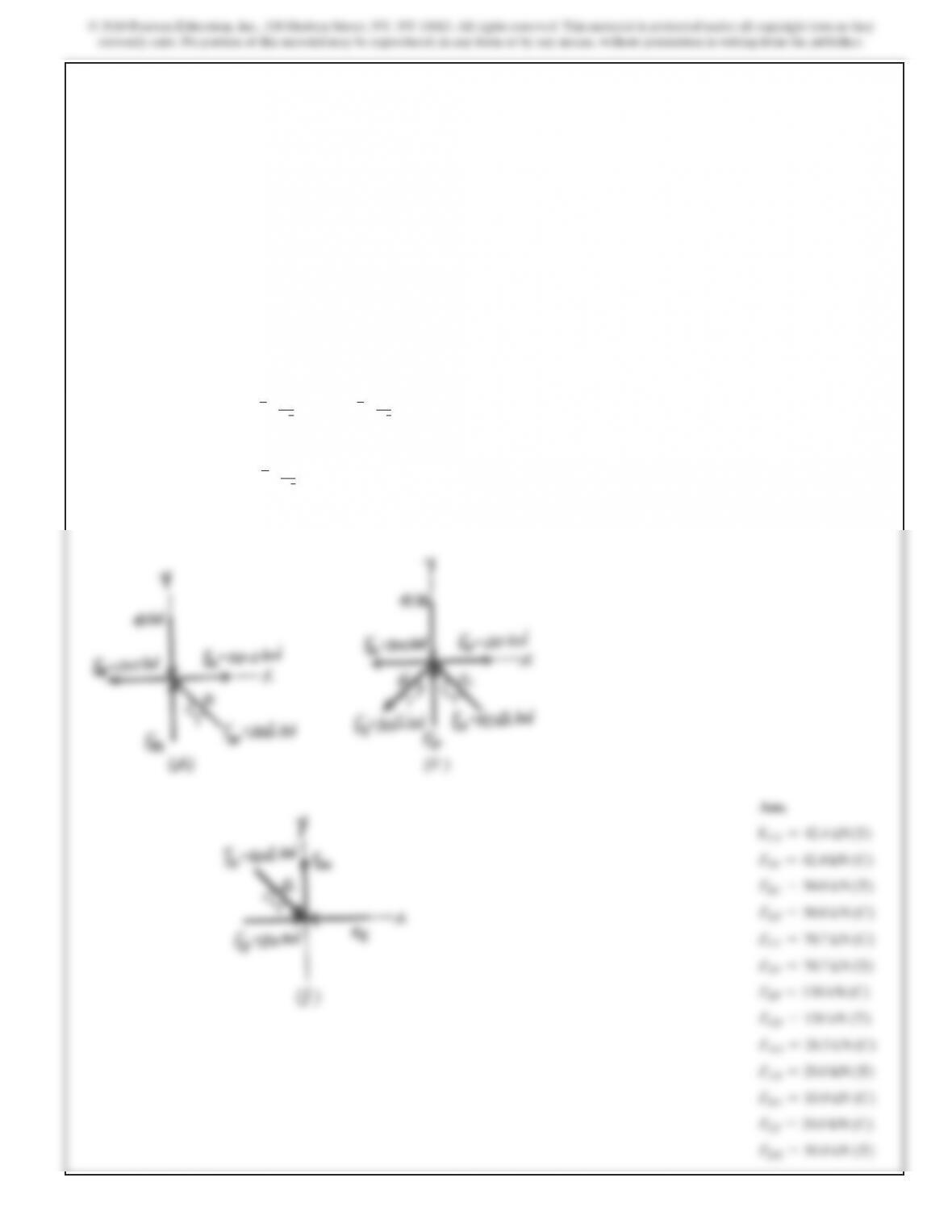
576
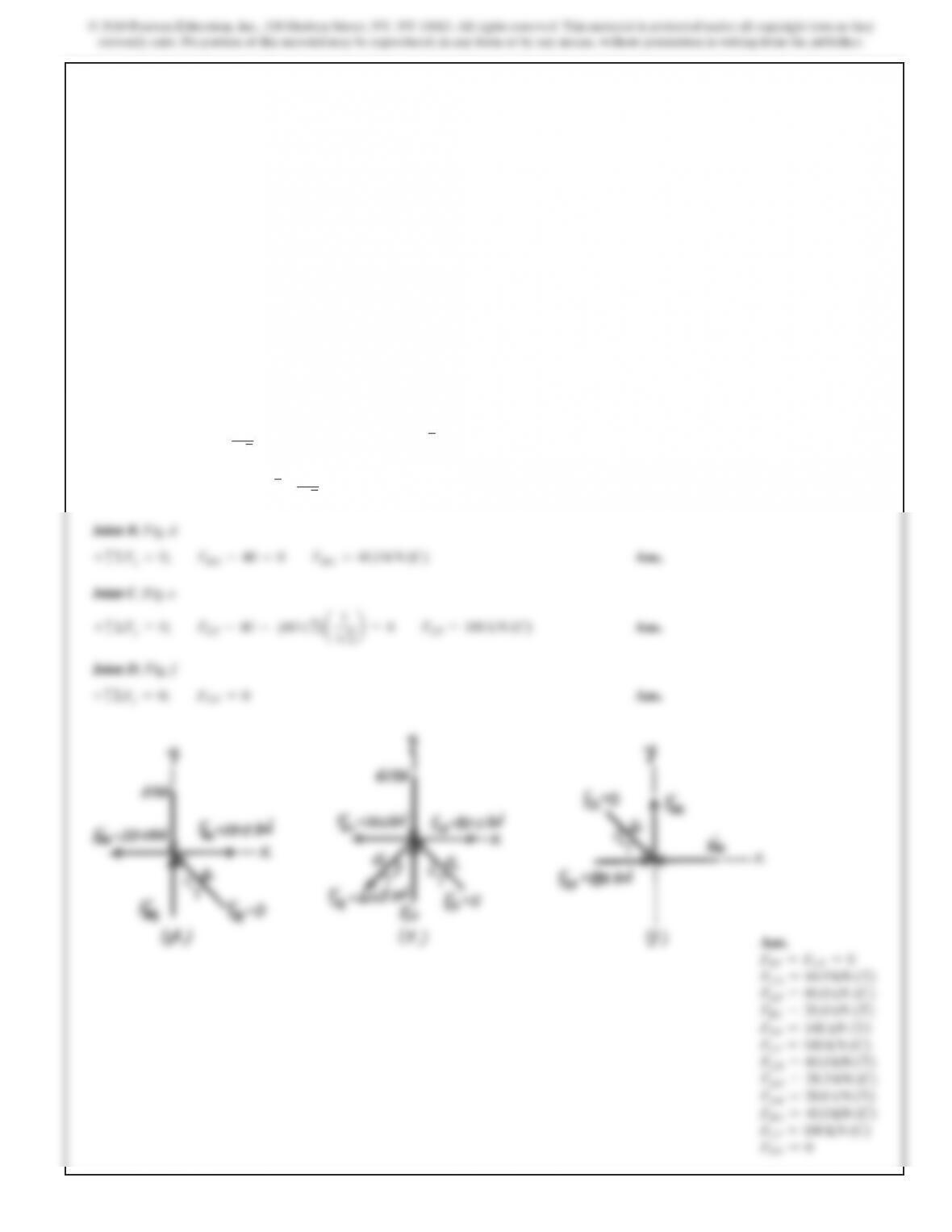
Method of Joints.
Joint A, Fig. c.
+
c
ΣFy=0;
FAG
a1
12b
–20 =0
FAG =20
1
2
kN
(C) =28.3
kN
(C
)
Ans.
+
SΣFx=0;
FAB –(20
1
2)
a1
12b
=0
FAB =20.0
kN
(T) Ans.
c
12–10. (Continued)