
Chapter 4
Specific Factors and Income Distribution
■ Chapter Organization
The Specific Factors Model.
Box: What Is a Specific Factor?
Assumptions of the Model.
Production Possibilities.
Prices, Wages, and Labor Allocation.
Relative Prices and the Distribution of Income
International Trade in the Specific Factors Model.
Income Distribution and the Gains from Trade.
The Political Economy of Trade: A Preliminary View.
Income Distribution and Trade Politics.
Case Study: Trade and Unemployment.
International Labor Mobility.
Case Study: Wage Convergence in the European Union.
Case Study: Immigration and the U.S. Economy.
Summary
APPENDIX TO CHAPTER 4: Further Details on Specific Factors.
Marginal and Total Product
Relative Prices and the Distribution of Income

14 Krugman/Obstfeld/Melitz • International Economics: Theory & Policy, Eleventh Edition
■ Chapter Overview
In Chapter 3, the Ricardian model of trade was introduced with labor as the single factor of production
exhibiting constant returns to scale. Although informative, this model fails to highlight the observed
opposition to free trade. In this chapter, the Specific Factors model is presented to gain a better
understanding of the distributional effects of trade. After trade, the exporting industry expands, while the
import competing industry shrinks. As a result, the factor specific to the exporting industry gains from
trade, while the factor specific to the import competing industry loses from trade. However, the aggregate
gains from trade are greater than the losses.
The Specific Factors model assumes that there is one factor that is mobile between sectors (commonly
thought of as labor) and production factors that are specific to each sector. The chapter begins with a
simple economy producing two goods: cloth and food. Cloth is produced using labor and its specific
factor, capital. Food is produced using labor and its specific factor, land. Given that capital and labor are
specific to their respective industries, the mix of goods produced by a country is determined by share of
labor employed in each industry. The key difference between the Ricardian model and the Specific Factors
model is that in the latter, there are diminishing returns to labor. For example, production of food will
increase as labor is added, but given a fixed amount of land, each additional worker will add less and less
to food production.
As we assume that labor is perfectly mobile between industries, the wage rate must be identical between
industries. With competitive labor markets, the wage must be equal to the price of each good times the
marginal product of labor in that sector. We can use the common wage rate to show that the economy will
produce a mix of goods such that the relative price of one good in terms of the other is equal to the relative
cost of that good in terms of the other. Thus, an increase in the relative price of one good will cause the
economy to shift its production toward that good.
With international trade, the country will export the good whose relative price is below the world relative
price. The world relative price may differ from the domestic price before trade for two reasons. First, as in
the Ricardian model, countries differ in their production technologies. Second, countries differ in terms of
their endowments of the factors specific to each industry. After trade, the domestic relative price will equal
the world relative price. As a result, the relative price in the exporting sector will rise, and the relative
price in the import competing sector will fall. This will lead to an expansion in the export sector and a
contraction of the import competing sector.

Chapter 4 Specific Factors and Income Distribution 15
Suppose that after trade, the relative price of cloth increases by 10%. As a result, the country will increase
production of cloth. This will lead to a less than 10% increase in the wage rate because some workers will
move from the food to the cloth industry. The real wage paid to workers in terms of cloth (w/PC) will fall,
while the real wage paid in terms of food (w/PF) will rise. The net welfare effect for labor is ambiguous
and depends on relative preferences for cloth and food. Owners of capital will unambiguously gain
because they pay their workers a lower real wage, while owners of land will unambiguously lose as they
now face higher costs. Thus, trade benefits the factor specific to the exporting sector, hurts the factor
specific to the import competing sector, and has ambiguous effects on the mobile factor. Despite these
asymmetric effects of trade, the overall effect of trade is a net gain. Stated differently, it is theoretically
possible to redistribute the gains from trade to those who were hurt by trade and make everyone better off
than they were before trade.
Given these positive net welfare effects, why is there such opposition to free trade? To answer this
question, the chapter looks at the political economy of protectionism. The basic intuition is that the though
the total gains exceed the losses from trade, the losses from trade tend to be concentrated, while the gains
are diffused. Import tariffs on sugar in the United States are used to illustrate this dynamic. It is estimated
that sugar tariffs cost the average person $7 per year. Added up across all people, this is a very large loss
from protectionism, but the individual losses are not large enough to induce people to lobby for an end to
these tariffs. However, the gains from protectionism are concentrated among a small number of sugar
producers, who are able to effectively coordinate and lobby for continued protection. When the losses
from trade are concentrated among politically influential groups, import tariffs are likely to be seen. Ohio,
a key swing state in U.S. presidential elections and a major producer of both steel and tires, is used as an
example to illustrate this point with both Presidents Bush and Obama supporting tariffs on steel and tires,
respectively.
Although the losers from trade are often able to successfully lobby for protectionism, the chapter
highlights three reasons why this is an inefficient method of limiting the losses from trade. First, the actual
impact of trade on unemployment is fairly low, with estimates of only 2.5% of unemployment directly
attributable to international trade. This fact is highlighted in a case study on the decline in U.S.
manufacturing employment, which is often blamed on competition from China. Manufacturing
employment had been falling long before the United States had any significant trade with China,
suggesting that factors other than trade (at least with China) are responsible. Second, the losses from trade
are driven by one industry expanding at the expense of another. This phenomenon is not specific to
international trade and is also seen with changing preferences or new technology. Why should policy be
16 Krugman/Obstfeld/Melitz • International Economics: Theory & Policy, Eleventh Edition
singled out to protect people hurt by trade and not for those hurt by these other trends? Finally, it is more
efficient to help those hurt by trade—by redistributing the gains from trade in the form of safety nets for
those temporarily unemployed and worker retraining programs to ease the transition from import
competing to export sectors—than it is to limit trade to protect existing jobs.
Finally, the chapter uses the framework of the Specific Factors model to analyze the distributional effects
of international labor migration. With free migration of labor across borders, wages must equalize among
countries. Workers will migrate from low-wage countries to high-wage countries. As a result, wages in the
low-wage countries will rise, and those in the high-wage countries will fall. Though the net effect of free
migration is positive, there will be both winners and losers from migration. Workers who stayed behind in
the low-wage country will benefit, as will owners of capital in the high-wage country. Workers in the
high-wage country will be hurt, as will owners of capital in the low-wage country. We also need to
consider the education levels of migrants relative to the country they move to. Immigrants to the United
States, for example, tend to be concentrated in the lowest educational groups. Thus, migration is likely to
only have negative effects on the wages of the least educated Americans while raising the wages of those
with more education.
■ Answers to Textbook Problems
1. Texas and Louisiana are both oil-producing states. A decrease in the price of oil will reduce output in
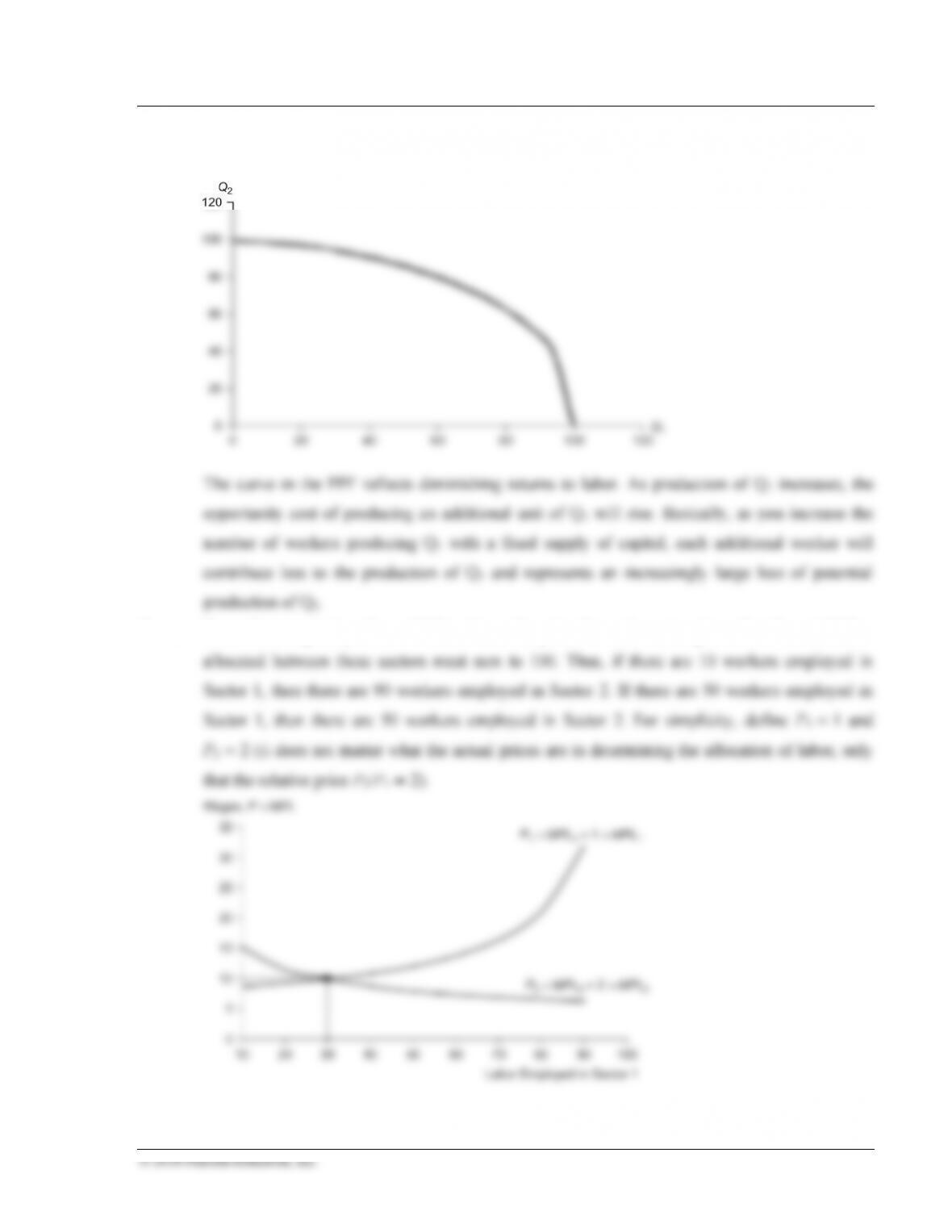
2. a.
Chapter 4 Specific Factors and Income Distribution 17
b.
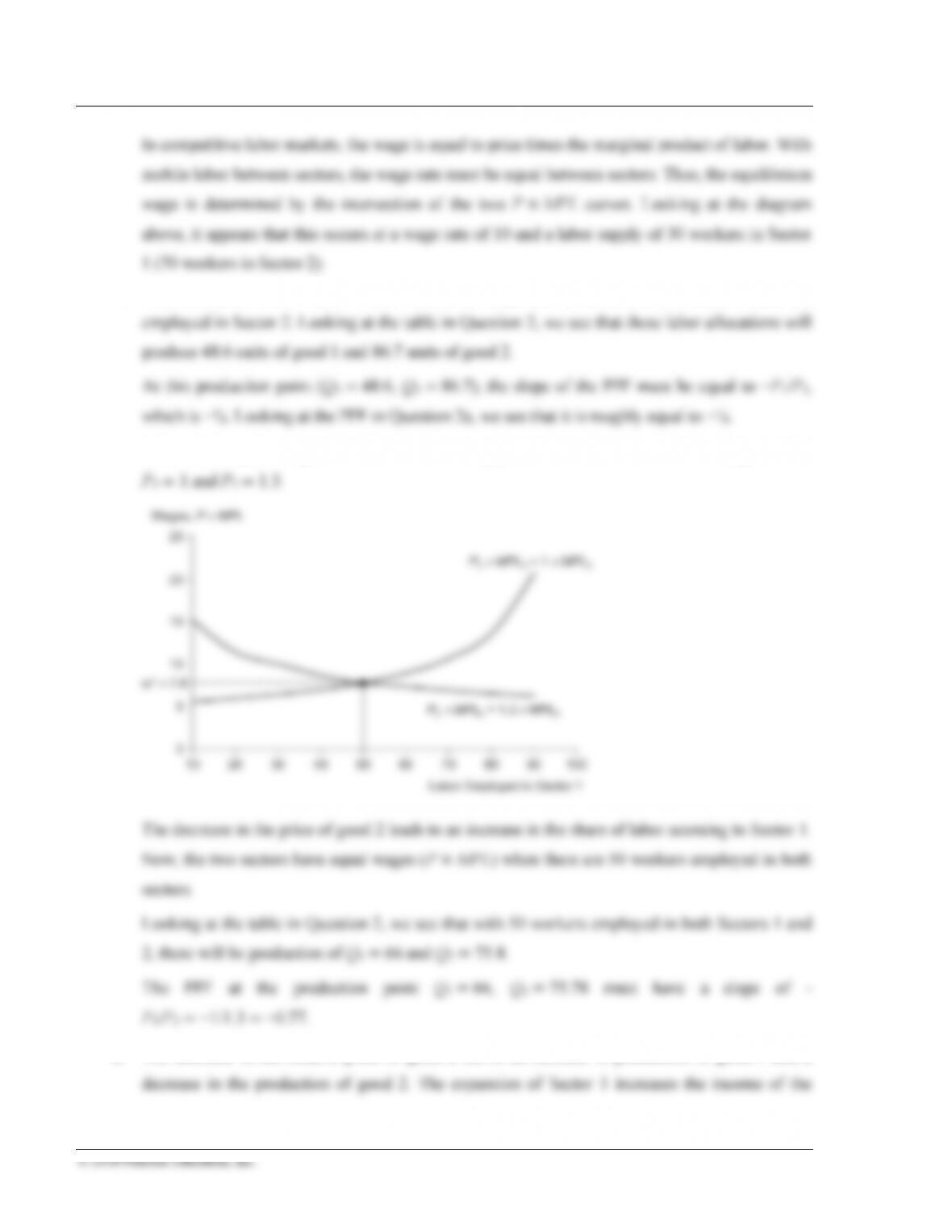
3. a. Draw the marginal product of labor times the price for each sector given that the total labor
18 Krugman/Obstfeld/Melitz • International Economics: Theory & Policy, Eleventh Edition
© 2018 Pearson Education, Inc.
In competitive labor markets, the wage is equal to price times the marginal product of labor. With
mobile labor between sectors, the wage rate must be equal between sectors. Thus, the equilibrium
wage is determined by the intersection of the two P × MPL curves. Looking at the diagram
above, it appears that this occurs at a wage rate of 10 and a labor supply of 30 workers in Sector
1 (70 workers in Sector 2).
b. From part (a), we know that 30 units of labor are employed in Sector 1 and 70 units of labor are
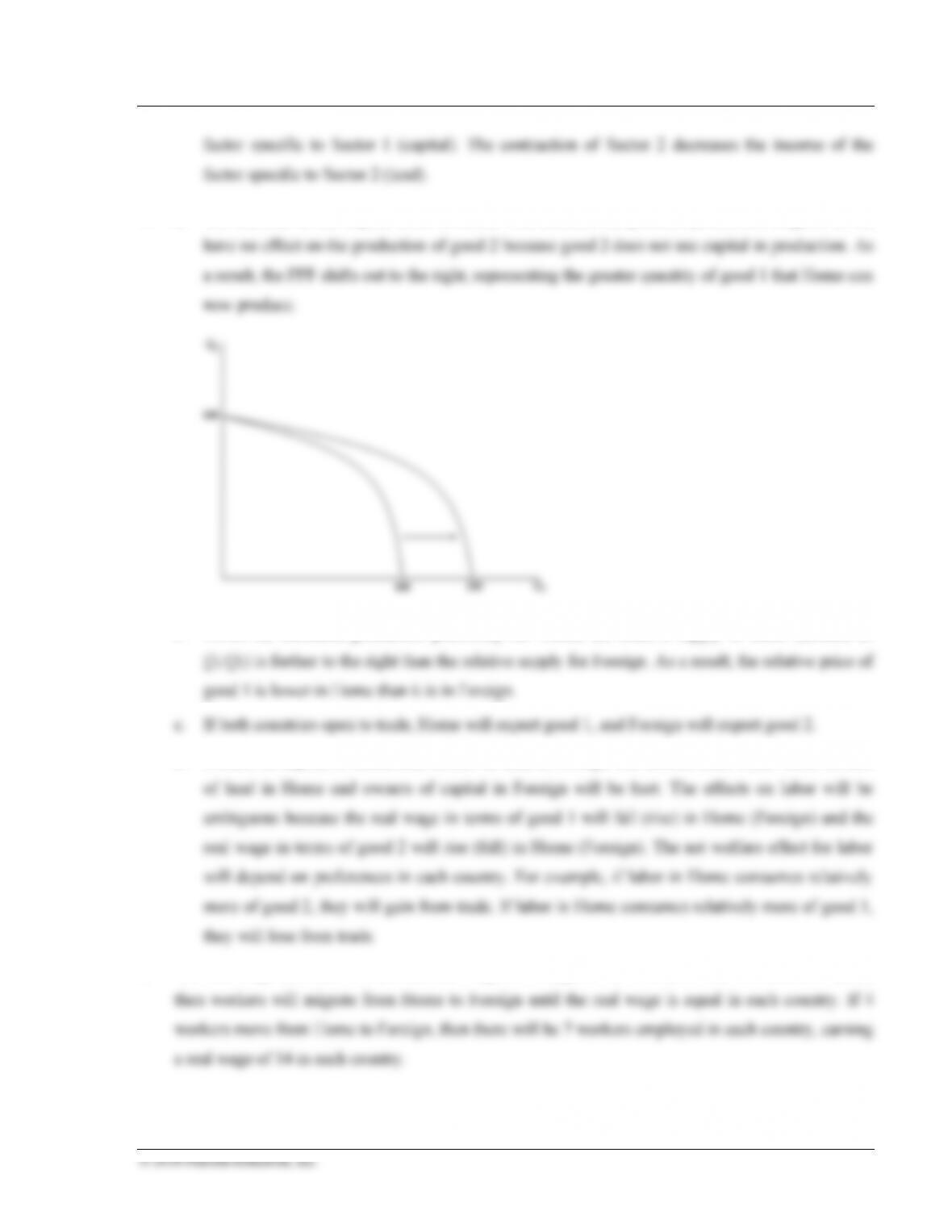
c. If the relative price of good 2 falls to 1.3, we simply need to redraw the P × MPL diagram with
d. The decrease in the relative price of good 2 led to an increase in production of good 1 and a
Chapter 4 Specific Factors and Income Distribution 19
© 2018 Pearson Education, Inc.
factor specific to Sector 1 (capital). The contraction of Sector 2 decreases the income of the
factor specific to Sector 2 (land).
4. a. The increase in the capital stock in Home will increase the possible production of good 1, but
b. Given the increased production possibility for Home, the relative supply of home (defined as
d. Owners of capital in Home and owners of land in Foreign will benefit from trade, while owners
5. The real wage in Home is 10, while real wage in Foreign is 18. If there is free movement of labor,

20 Krugman/Obstfeld/Melitz • International Economics: Theory & Policy, Eleventh Edition
© 2018 Pearson Education, Inc.
We can find total production by adding up the marginal product of each worker. After trade, total
production is 20 + 19 + 18 + 17 + 16 + 15 + 14 = 119 in each country for total world production of
238. Before trade, production in Home was 20 + 19 + 18 = 57. Production in Foreign was
20 + 19 + … + 10 = 165. Total world production before trade was 57 + 165 = 222. Thus, trade
increased total output by 16.
Workers in Home benefit from migration, while workers in Foreign are hurt. Landowners in Home
are hurt by migration (their costs rise), while landowners in Foreign benefit.
6. If only 2 workers can move from Home to Foreign, there will be a real wage of 12 in Home and a
real wage of 16 in Foreign.
7. By restricting immigration, the drop in wages in the high-wage country is not as high as it would