PART II
ANSWERS TO END-OF-CHAPTER QUESTIONS
CHAPTER 7: DEMAND MANAGEMENT, ORDER MANAGEMENT, AND CUSTOMER
SERVICE
7-1. What is the relationship between demand management, order management, and customer service?
There is a key link between order management and demand forecasting in that a firm does not simply
wait for orders to arrive in order to learn what is happening. Forecasts are made of sales and of the
7-2. Discuss the three basic demand forecasting models.
Judgmental forecasting involves using judgment or intuition and is preferred in situations where there
is limited or no historical data, such as with a new product introduction. Judgmental forecasting
techniques include surveys and the analog technique. An underlying assumption of time-series
7-3. Discuss several demand forecasting issues.
Demand forecasting issues include the situation at hand, forecasting costs in terms of time and money,
and the accuracy of various forecasting techniques. With respect to the situation at hand, judgmental
forecasting is appropriate when there is little or no historical data. As for time and money, survey
7-4. Define and describe the order cycle. Why is it considered an important aspect of customer service?
The order cycle is the elapsed time from when a customer places an order until the customer receives
the order. It is an important aspect of customer service in part because the order cycle is frequently
7-5. What are some causes of order cycle variability? What are the consequences of order cycle
variability?
Order cycle variability can occur in each stage of the order cycle. For example, order transmittal by
mail sometimes results in the mailed item never reaching its intended destination; variability, in the
7-6. List the various methods of order transmittal and discuss relevant characteristics of each.
In person greatly reduces the potential for order errors, but it is not always convenient or
practical in situations where the supplier is geographically distant.
Mail is more convenient than ordering in person, but mail is relatively slow and there are
occasions when the order never reaches the intended destination.
7-7. What are some advantages and disadvantages to checking all orders for completeness and
accuracy?
It can be argued that all orders, regardless of transmission method, should be checked for completeness
and accuracy. Incomplete or inaccurate orders can negatively affect customer satisfaction and increase
7-8. Define order triage and explain how it can affect order processing.
Order triage refers to classifying orders according to pre-established guidelines so that a company can
prioritize how orders should be filled. Companies that choose to do order triage must decide the
7-9. Discuss how the effectiveness and efficiency of order processing can be improved without large
expenditures.
One suggestion is to analyze order pickers’ travel time, in part because travel time accounts for
between 60 and 80 percent of total pick time. One way to reduce travel time involves combining
7-10. What is pick-to-light technology, and how can it improve order picking?
In pick-to-light technology, orders to be picked are identified by lights placed on shelves or racks. Pick-
to-light systems simplify the pick process because the worker simply follows the light from pick to
7-11. Discuss the order delivery stage of the order cycle.
Order delivery refers to the time from when a transportation carrier picks up a shipment until it is
received by the carrier. Customers now have increasing power in terms of delivery options, and
companies such as UPS and FedEx offer prospective shippers a diverse menu of transit time options. In
7-12. How can customer service act as a competitive weapon?
Customer service is more difficult for competitors to imitate than other marketing mix variables such as
price and promotion. The text cites an example of Nordstrom’s, a high-end retailer that has a long-
7-13. How are macroenvironmental factors causing organizations and individuals to demand higher
levels of customer service?
Macroenvironmental changes, such as globalization and advances in technology, are causing
organizations and individuals to demand higher levels of customer service. Customer expectations
continue to increase over time; if the associated performance (service) levels fail to keep up, then
7-14. List and discuss the three elements of the dependability dimension of customer service.
The three elements are consistent order cycles, safe delivery, and complete delivery. Quite simply,
inconsistent order cycles necessitate higher inventory requirements. Safe delivery brings loss and
7-15. What are some advantages and disadvantages of technological advances designed to facilitate
buyer–seller communications?
Cell phones, smart phones, and the Internet have certainly helped buyer–seller communications. These
technological advances allow for less costly and more frequent contact between the two parties. Having
7-16. What is customer profitability analysis and how might it be used in logistics?
Customer profitability analysis (CPA) refers to the allocation of revenues and costs to customer
segments or individual customers to calculate the profitability of the segments or customers. From a
7-17. Define and explain how organizations might engage in benchmarking.
Benchmarking refers to a process that continuously identifies, understands, and adapts outstanding
processes found inside and outside an organization. Well-run organizations benchmark not only against
7-18. How do characteristics such as substitutability and product life cycle stage influence the
development of customer service goals and objectives?
If a firm has a near monopoly on an important product (i.e., few substitutes are available), a high level
of customer service is not required because a customer who needs the product will buy it under any
7-19. Describe some of the key issues associated with measuring customer service.
Ideally, an organization might want to collect measurement data from internal (e.g., credit memos) and
external sources (e.g., actual customers). Another key issue associated with customer service

7-20. What is meant by service recovery? How is it relevant to logistics?
Service recovery refers to a process for returning a customer to a state of satisfaction after a service or
product has failed to live up to expectations. Service failure, the precursor to service recovery, is
PART III
CASE SOLUTIONS
CASE 7-1: HANDY ANDY, INC.
Question 1: Is this a customer service problem? Why or why not?
The text defines customer service as the ability of logistics management to satisfy users in terms of
time, dependability, communication, and convenience. While there doesn’t appear to be much of a
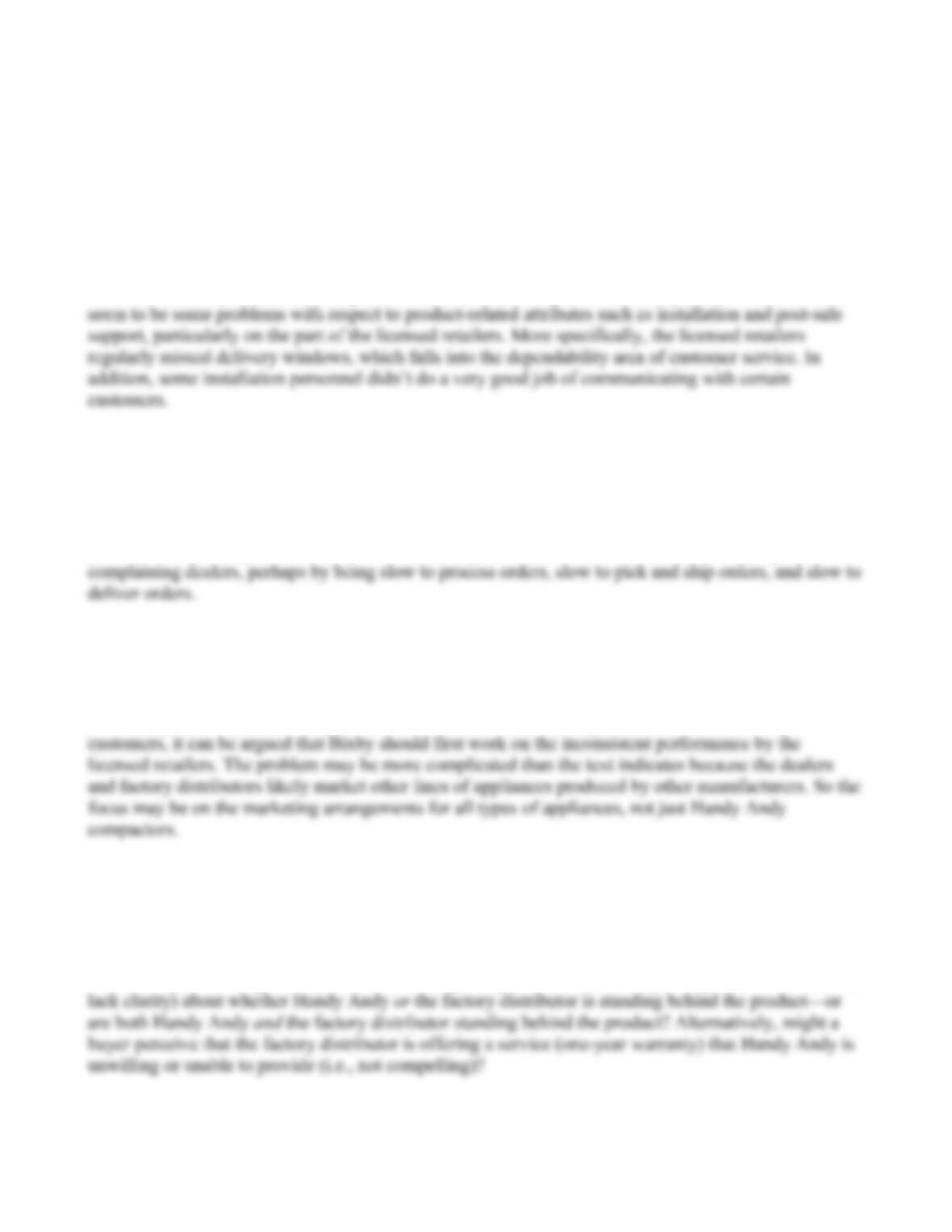
customer service problem with the product itself (i.e., the compactors seem to perform well), there do
Question 2: It appears that the factory distributors are exploiting the licensed retailers. Yet from what
we can tell, Handy Andy in St. Louis has heard no complaints from the licensed retailers. Why
wouldn’t they complain?
The smaller dealers might not complain because they are so dependent on the factory distributors for
product. Complaining about factory distributors might result in some distributors “punishing” the
Question 3: What should Handy Andy’s marketing vice president do? Why?
Bixby is faced with multiple issues, namely, distributors exploiting licensed retailers as well as
inconsistent performance by the licensed retailers. Can both issues be addressed simultaneously? If not,
then Bixby needs to decide which issue to address first. Because organizations can’t exist without
Question 4: In the case is the statement, “The factory distributors in these few cities indicated that
they, not Handy Andy, Inc., stood behind the one-year warranty.” Is this a problem for Handy Andy?
Why or why not?
In today’s business environment, which emphasizes clear, consistent, and compelling messages from
seller to buyer, this might be a problem for Handy Andy. For example, a buyer might be confused (i.e.,
Question 5: Bixby, Booher, and Ortega recognize that Handy Andy needs a better way to learn about
the buyer’s installation experience. One alternative is to add an open-ended question, dealing with the
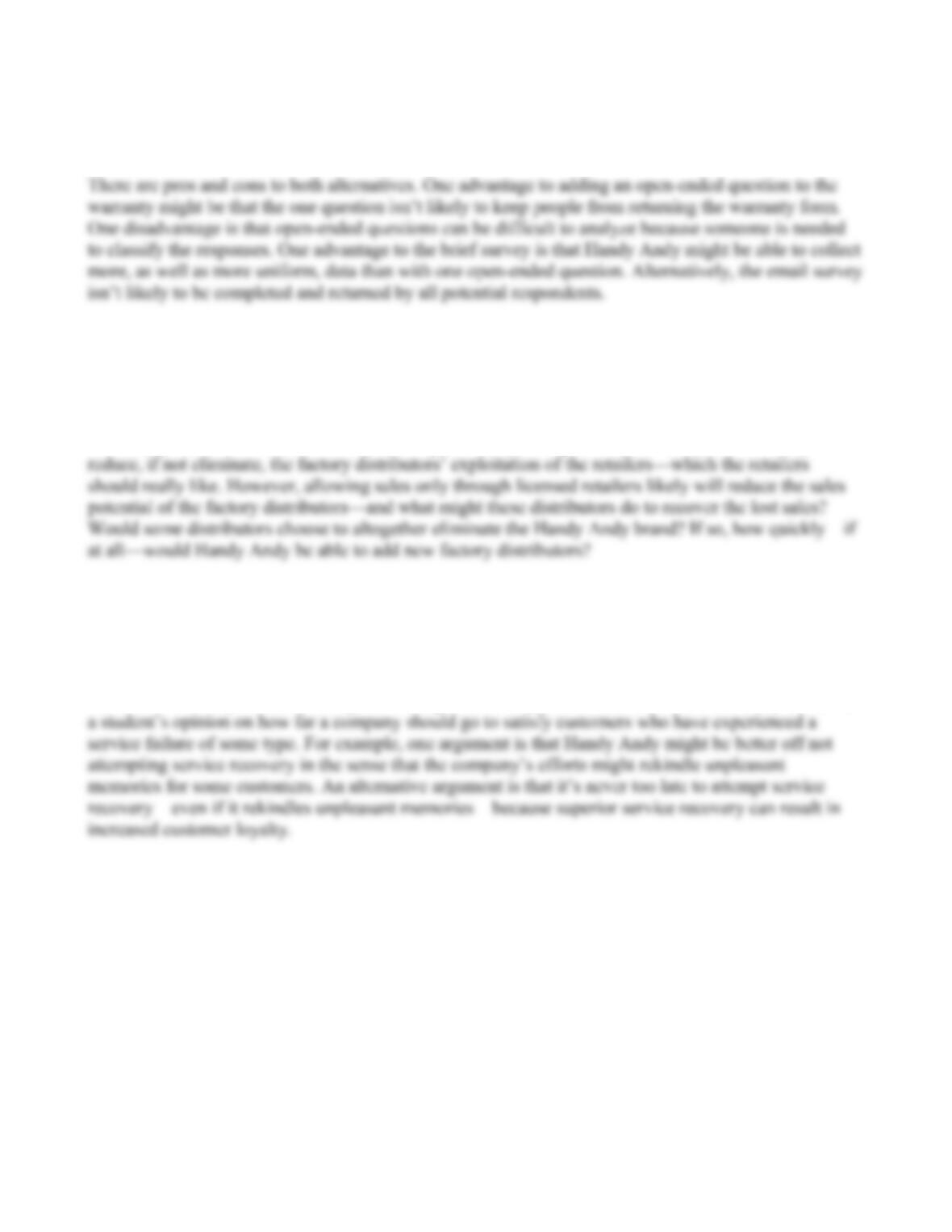
installation experience, to the warranty activation form. Another alternative is to email a brief survey
about the installation experience within three to five days of receiving a warranty activation form.
Which of these alternatives should Handy Andy choose? Why?
Question 6: Discuss the pros and cons of allowing Handy Andy trash compactors to be sold only
through licensed retailers (i.e., factory distributors would no longer be able to sell to consumers).
An initial issue that might be discussed involves determining the pros and cons from each party’s
perspective. For example, the licensed retailers are likely to have a different set of pros and cons than
the factory distributors. At minimum, allowing sales only through licensed retailers would likely
Question 7: Is it too late for Handy Andy to attempt service recovery with customers who reported a
less-than-satisfactory installation experience? Why or why not?
The text defines service recovery as a process for returning a customer to a state of satisfaction after a
service or product has failed to live up to expectations, and also indicates that there is no set formula
for service recovery. There is no right or wrong answer to Question 7, and answers are likely to reflect