PART II
ANSWERS TO END-OF-CHAPTER QUESTIONS
CHAPTER 5: THE SUPPLY CHAIN MANAGEMENT CONCEPT
5-1. Discuss the differences between a supply chain and supply chain management.
A supply chain can be viewed as a combination of processes, functions, activities, relationships, and
pathways along which products, services, information, and financial transactions move in and between
enterprises from original producer to ultimate end user or customer. Supply chains are not a new
concept in the sense that through the years organizations have been dependent on suppliers and
5-2. Discuss the SCOR and GSCF models of supply chain management.
The SCOR model identifies six key processes—plan, source, make, deliver, return, and enable—
associated with supply chain management. Each of the six processes indicates the important role of
logistics in supply chain management. In the GSCF model, there are eight relevant processes—
5-3. Discuss how the logistics function contributes to the supply chain management processes
established in the SCOR and GSCF models.
With respect to the SCOR model, it can be argued that logistics has some involvement in both sourcing
and making. Logistics can also be involved in delivering and returning; the definition of the deliver
process specifically mentions the logistics components of order management, transportation
5-4. What are four key enablers of supply chain management implementation?
The text discussed the implications of increased customer power, establishing appropriate relationship
structures, leveraging technology for enhanced visibility and communication, and the use of supply
chain facilitators.
5-5. What is the difference between a lean and an agile supply chain? Under what circumstances is
each an appropriate supply chain approach to pursue?
An agile supply chain focuses on an organization’s capability to respond to changes in demand with
respect to volume and variety. Lean supply chains focus on eliminating all waste, including time, and
5-6. Discuss some of the ways that inventory can be reduced in the supply chain.
Ways to reduce inventory in the supply chain include, but are not limited to, smaller, more frequent
orders; the use of premium transportation; demand–pull, as opposed to supply–push, replenishment;
5-7. What is the difference between relational and transactional exchanges? Which is more relevant for
supply chain management? Why?
Relational exchanges tend to emphasize a long-term orientation whereas transactional exchanges have
a short-term orientation. Unlike transactional exchanges, relational exchanges are characterized by
5-8. Do you agree or disagree that supply chain collaboration can be classified as transactional, tactical
information sharing, or strategic in nature? Why?
Students could argue that supply chain collaboration is not transactional, tactical information sharing or
strategic in nature, but the text argues for this classification scheme.
5-9. This chapter suggests that technology has been at the center of changes taking place that affect the
supply chain. Do you agree or disagree? Why?
Although students can support either side of the argument, the text does argue that technology has been
5-10. Discuss the impact of the Internet on supply chain management.
The Internet can facilitate supply chain effectiveness and efficiency by providing opportunities to
simultaneously improve customer service and reduce logistics costs. The Internet allows one supply
chain party to have virtually instantaneous visibility to the same data that the other supply chain
5-11. How might regulatory and political conditions act as barriers to supply chain management?
With respect to regulatory conditions, a number of today’s supply chain arrangements were illegal until
the early 1980s. At a minimum, companies should be aware of regulatory considerations before
pursuing supply chain arrangements. Political conditions such as war and governmental stability can
5-12. Why is top management commitment necessary for successful supply chain management?
Top management has the ability to allocate the necessary resources for supply chain endeavors and the
5-13. Some companies are hesitant to use frequent shopper cards because the data provided could
violate the customer’s privacy. Do you agree or disagree? Why?
Although either answer is acceptable, the question of data usage versus customer privacy has generated
impassioned discussions by students. On the one hand, the frequent shopper cards can provide a
plethora of data about the shopping habits of particular consumers, potentially allowing stores to
5-14. Discuss the best-of-breed and single integrator approaches.
In a single integrator approach, a single vendor provides all relevant software applications (e.g.,
inventory management, transportation management, warehouse management, etc.). One advantage of
this approach is that there should be coordination across the various applications. Alternatively, a best
5-15. Do you think corporate cultures are relevant for supply chain management? Why or why not?
Either answer is acceptable. However, the text indicates that incompatible corporate cultures could
present potential obstacles to effective and efficient supply chain management. For example, an
5-16. Why is supply chain integration so difficult in global supply chains?
Integration challenges in global supply chains include cultural, economic, technological, political,
spatial, and logistical differences. Global supply chains translate into both longer and more
5-17. Discuss the strategic and tactical considerations that can drive a company to use the services of a
3PL.
The decision to use 3PL services can be driven by strategic considerations in the sense that an
organization believes that one or more aspects of its supply chain(s) needs to be transformed.
5-18. What are some reasons that third-party logistics arrangements aren’t always successful?
One common cause of 3PL failure is unreasonable and unrealistic expectations, generally from the
user’s perspective. Another cause of failure involves a lack of flexibility. For example, has the
5-19. What is the difference between a 3PL and a 4PL/LLP?
Third-party logistics refers to a situation in which one company (say, a manufacturer) allows a
specialist company to provide it with one or more logistics functions (e.g., warehousing or outbound
5-20. Discuss the three primary methods that organizations can use to integrate their supply chains.
One method is vertical integration, in which one organization owns multiple participants in the supply
chain. A second method involves formal contracts among various participants, such as occurs with

PART III
CASE SOLUTIONS
CASE 5-1: JOHNSON TOY COMPANY
Question 1: From the standpoint of an individual concerned with accounting controls, discuss and
evaluate Johnson Toy Company’s present policies for handling returned items.
The controls are poor from the standpoint of accuracy of financial records because they provide poor
information to management.
Question 2: Answer Question 1, but from the standpoint of an individual interested in marketing.
Marketing people tend to favor less stringent controls in the sense that they provide more flexibility
when bargaining with retailers.
Question 3: Propose a policy for handling returns that should be adopted by the Johnson Toy
Company. Be certain to list circumstances under which exceptions would be allowed. Should it apply
to the Jungle Jim dolls?
One student’s answer is reproduced here.
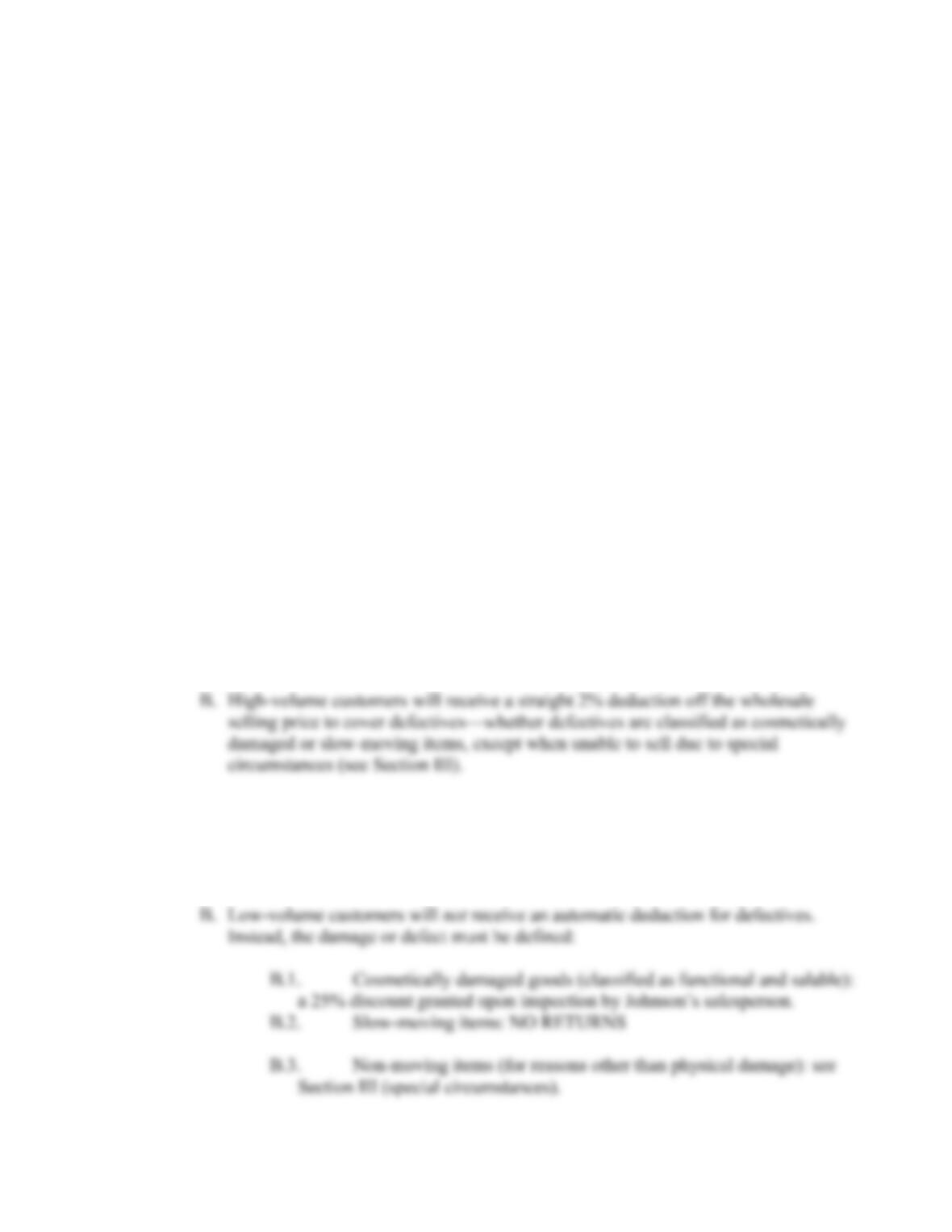
I. HIGH-VOLUME CUSTOMERS (defined as purchasing $75,000 of merchandise from
Johnson’s per year)
A. Functionally damaged goods may be returned to Johnson’s plant at Johnson’s
expense with a full refund.
II. LOW-VOLUME CUSTOMERS
A. Functionally damaged goods may be returned to Johnson’s plant via Johnson’s
salesperson with a full refund.
III. SPECIAL CIRCUMSTANCES When product is not resalable for reasons other than
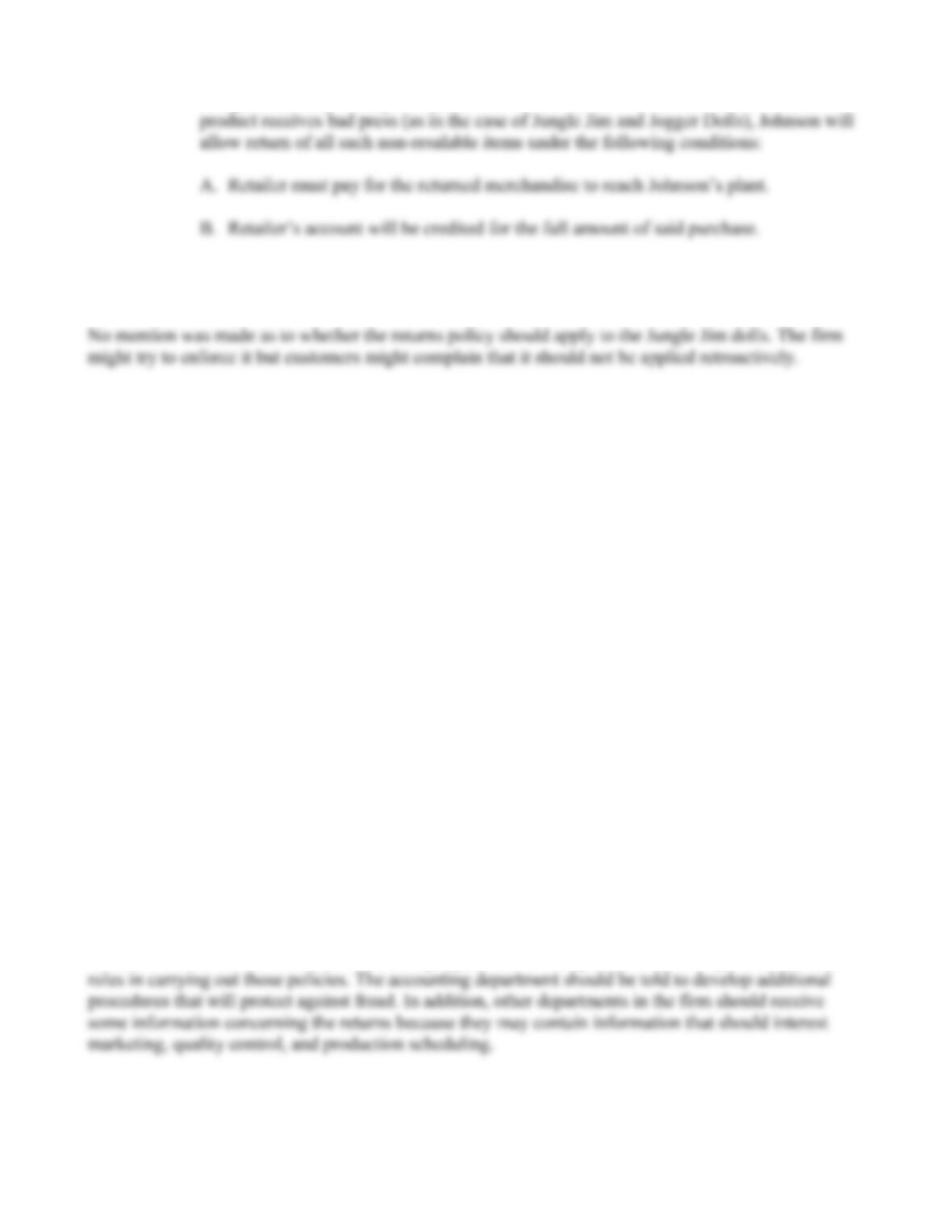
being functionally damaged or just a slow mover in the off season, such as when the
C. Credit is to be used within 30 days of receipt of returned goods at Johnson’s plant;
credit will be void after 30 days.
Question 4: Should this policy, if adopted, be printed and distributed to all of the retailers who handle
Johnson Toy Company products? Why or why not? If it should not be distributed to them, who should
receive copies?
Yes, retailers should know exactly what the returns policy will be. One element of a customer service
policy is to let customers know in advance what the policy is.
Question 5: Assume that it is decided to prepare a statement on returns to be distributed to all retailers
and that it should be less than a single double-spaced page. Prepare such a statement.
The answer provided for Question 3 would suffice here as well.
Question 6: On the basis of the policy in your answer to Question 3, develop instructions for the
Johnson Toy Company distribution and accounting departments with respect to their roles and
procedures in the handling of returns.
One could take the information (as developed in the answers to Questions 3 and 5) and draft a memo to
be sent to both the distribution and accounting departments, telling them of the new policies and their
Question 7: Assume that you are Cheryl Guridi, the firm’s logistics manager. Do you think that the
returns policy favored by the logistics manager would differ from what would be best for the firm?
Why or why not?
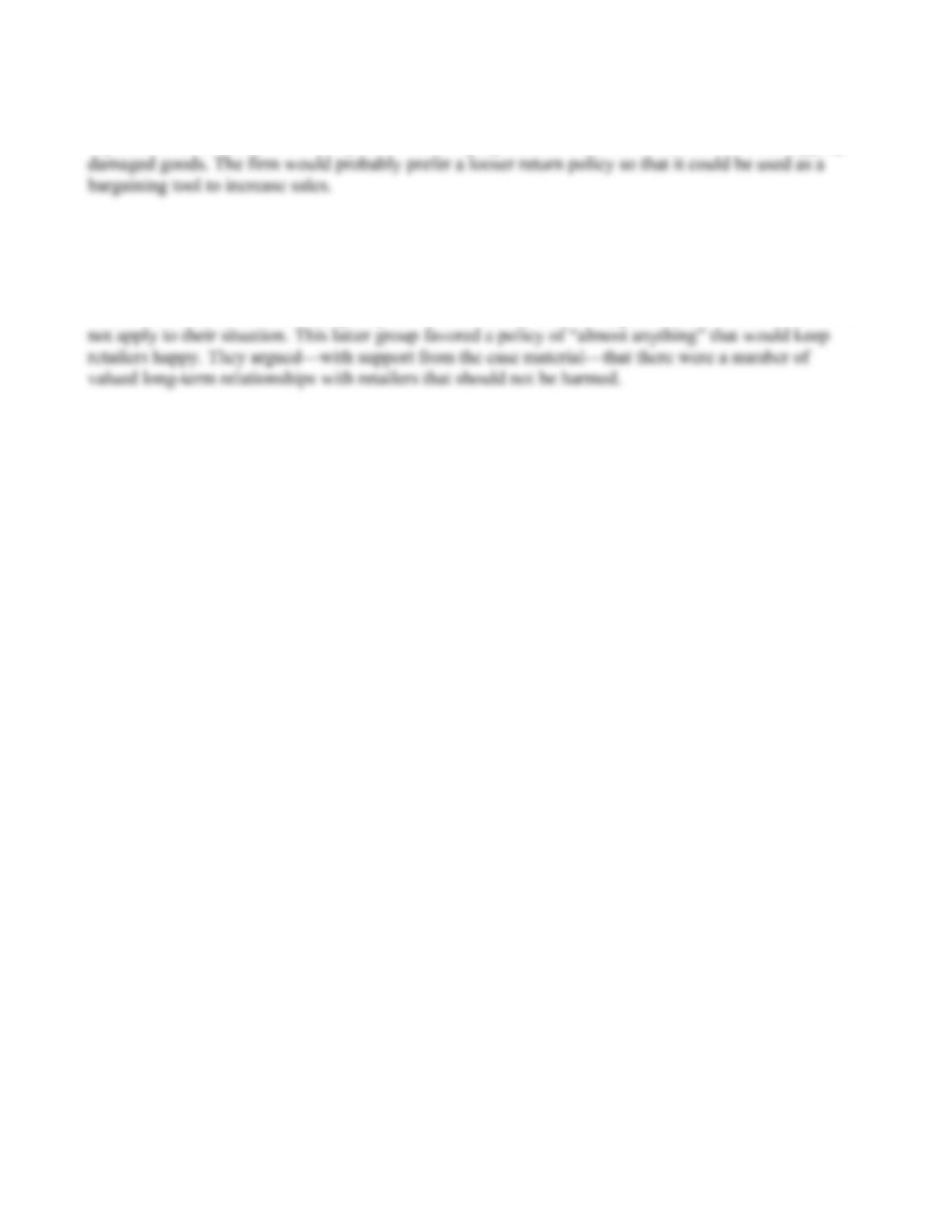
Yes, the returns policy favored by the logistics manager will favor a tight return policy so that her
department does not have to be responsible for keeping track of returned inventories and for shipping
Question 8: Until the policy you recommend in your answer to Question 3 takes effect, how would you
handle the immediate problem of retailers wanting to return unsold Jungle Jim the Jogger dolls?
There are several approaches to this question. Some students have provided very specific policies.
Others have said that because the policy was not in effect when the Jungle Jim dolls went out, it should