PART II
ANSWERS TO END-OF-CHAPTER QUESTIONS
CHAPTER 11: PACKAGING AND MATERIALS HANDLING
11-1. How do product characteristics influence packaging and materials handling considerations?
One consideration is a product’s physical characteristics. Substances exist in three forms—solid, liquid,
gas—and each form has specific packaging requirements. For instance, metal cylinders are one method
for the packaging of gases, whereas metal pails can be used for the packaging of liquids. Another
11-2. What is the building-blocks concept? How is it applied to the handling of packaged goods?
With the building-block concept, a very small unit is placed into a slightly larger unit, which then
might be placed into a larger unit, and so on. The building-blocks hierarchy is important to remember
11-3. What are the three general functions of packaging? How might they come into conflict?
Packaging serves three general functions: to promote, protect, and identify (label) the relevant product.
As an example of how they might come into conflict, while attractive packaging might encourage
11-4. What information is needed to design a protective package properly?
Three important kinds of information are required: the severity of the distribution environment; the
materials.
11-5. Describe some of the devices that are used to monitor conditions during the journey that a
shipment makes.
Actual monitoring of the environment the package must pass through can be done by enclosing
recording devices within cartons of the products that are shipped. The measuring devices may be very
11-6. Why is it important to recognize that labeling requirements may differ from country to country?
Failure to comply with the labeling requirements of different countries could subject the offending
organization to surcharges, administrative fees, and penalty charges. As a general rule, labeling
11-7. Discuss some of the labeling requirements associated with hazardous materials.
Because hazardous materials are increasingly being stored and transported across country borders, the
United Nations (UN) has played an active role in developing a global system to classify and label
11-8. What are some environmental disadvantages to plastic packaging?
One of plastic’s most frequently cited shortcomings is the length of time that it takes to biodegrade,
which can be up to several hundreds of years. Another environmental concern with plastic packaging is
11-9. What environmentally friendly packaging strategies might a firm adopt?
One strategy is to reduce the amount of packing materials used, such as the use of a single material,
which should improve recyclability, as well as change a product or format to minimize packaging
waste. A second packaging strategy is to use environmentally friendly packaging materials, such as
11-10. Discuss some of the potential challenges to adopting the metric system in the United States.
One potential challenge is that certain taxes, such as in the liquor industry, were developed to be
applicable to pints, quarts, and other American units of measure, as opposed to liters and half liters.
11-11. How can reducing packaging inefficiencies improve the performance of a logistics system?
Packaging inefficiency can have a number of undesirable logistics consequences, including increased
loss, increased damage, slower materials handling, higher storage costs, and higher transportation costs.
11-12. How do transportation tariffs and classifications influence the type of packaging and packing
methods?
Packaging specifications determined by product density encourage shippers to tender loads in densities
that will make the best use of the equipment’s weight and volume capabilities. IKEA, a home
11-13. Discuss the advantages and disadvantages of the unit load.
One unit load advantage is additional protection to the cargo because cartons and boxes are secured to
the pallet by straps, shrink-wrapping, or some other bundling device. A second advantage is that
pilferage is discouraged because it can be difficult to remove a single package or its contents. The main
11-14. What trade-offs exist between wood, plastic, and metal pallets?
Wood pallets are relatively inexpensive compared with plastic and metal pallets. However, plastic and
metal pallets have much greater longevity relative to wood. Plastic pallets last at least five years and
11-15. What issues does the logistics manager face once unit loads have been placed onto a
transportation vehicle?
One consideration is how to load pallets, cartons, and the like into a transportation vehicle. For
example, some cartons cannot be laid on their sides or have other cartons placed on top of them.
11-16. Distinguish between weighing out and cubing out and explain how these concepts impact the
logistician’s job.
Weighing out refers to when goods are so heavy that they utilize a vehicle’s weight capacity without
filling its cubic capacity. These loads must be carefully braced and the weight must be distributed as
11-17. Discuss the various handling characteristics associated with bulk cargoes.
Bulk materials are loose rather than in packaged form, and they are handled by pumps, shovel devices,
conveyor belts, or the mere force of gravity. One handling characteristic for bulk materials is density,
which can affect the amount of product that can be loaded onto a transport vehicle. A material’s angle
11-18. Of the 10 materials handling principles discusses in the chapter, which two are most surprising
to you? Why?
The text lists 10 materials handling principles developed by the Material Handling Institute. Any two of
these principles can be chosen, and the student can justify which two he believes to be most surprising.
11-19. Why is it important that materials handling be aligned with an organization’s objectives,
customers, and products?
The text indicates that this alignment should be common sense but relates an anecdote about a
consumer products company that redesigned one of its storage facilities with the primary purpose to be
11-20. How might an organization’s order picking and assembly system influence its decisions on
materials handling equipment?
In a picker-to-part system, an order picker goes to where a product is located, such as with a forklift,
whereas in a part-to-picker system the pick location is brought to the picker, such as with carousels.
PART III
CASE SOLUTIONS
CASE 11-1: LET THERE BE LIGHT LAMP SHADE COMPANY
Question 1: How many Style A shades can be loaded into a 40-foot container?
The intermodal container holds 2,720 cubic feet, however, the top six inches are of no use. The
Question 2: How many Style B shades can be loaded into a 40-foot container?
Style B shades could be stacked two packages high with the square foot on the bottom. Each column
would hold 12 shades. There would be 8 x 40, or 320 columns of 12, yielding 3,840 lamp shades, and
Question 3: How many Style C shades can be loaded into a 40-foot container?
Style C shades could be stacked the same way as Style B, and a container would hold 320 columns of
20, yielding 6,400 shades. However, this would exceed the 44,000-pound weight limit. Each shade
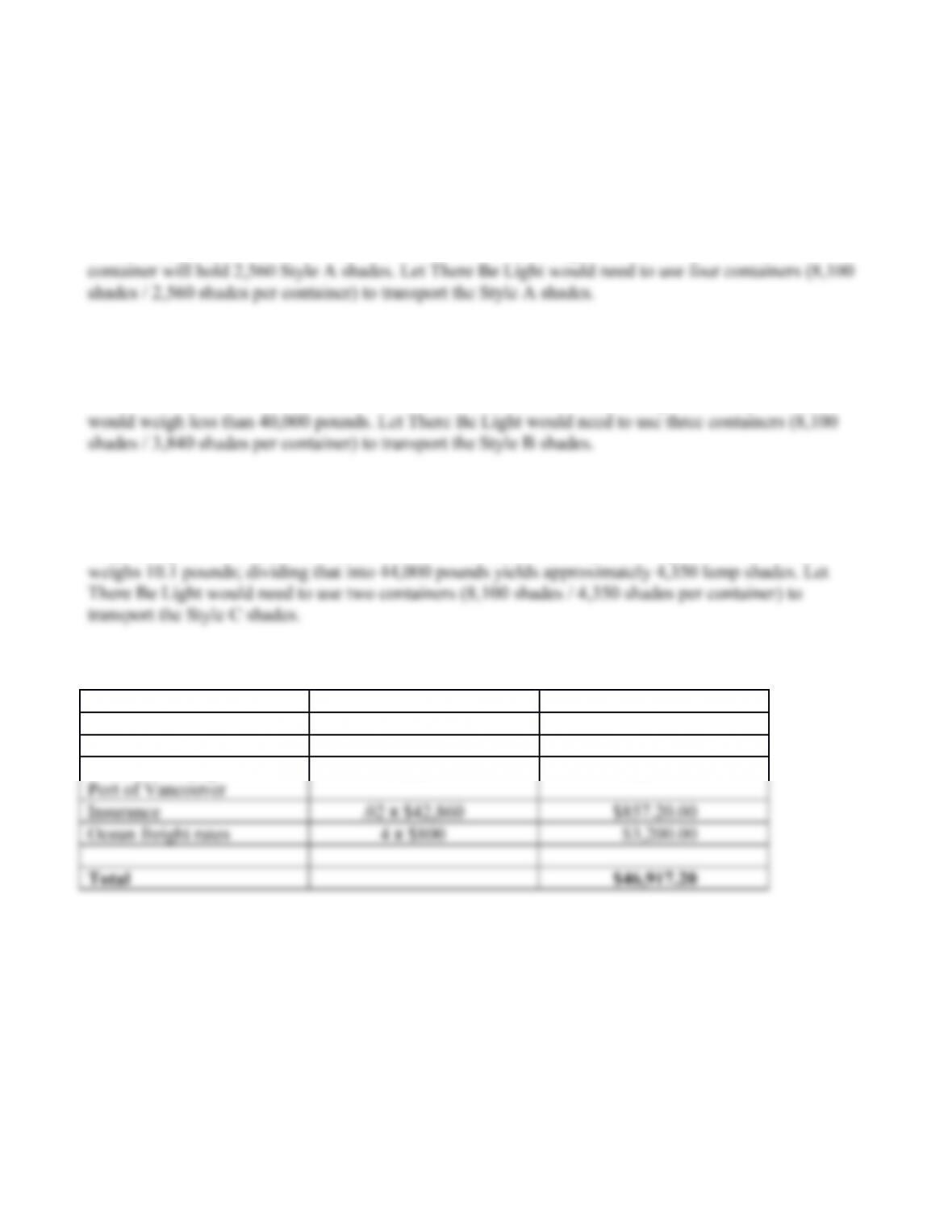
Question 4: What are the total costs of delivering the Style A shades to the Port of Shanghai?
Item Cost Parameters Total Cost
Shade manufacturing $4.00 x 8,100 $32,400.00
Packaging $.60 x 8,100 $4,860.00
Container drayage to
4 x $1,400 $5,600.00
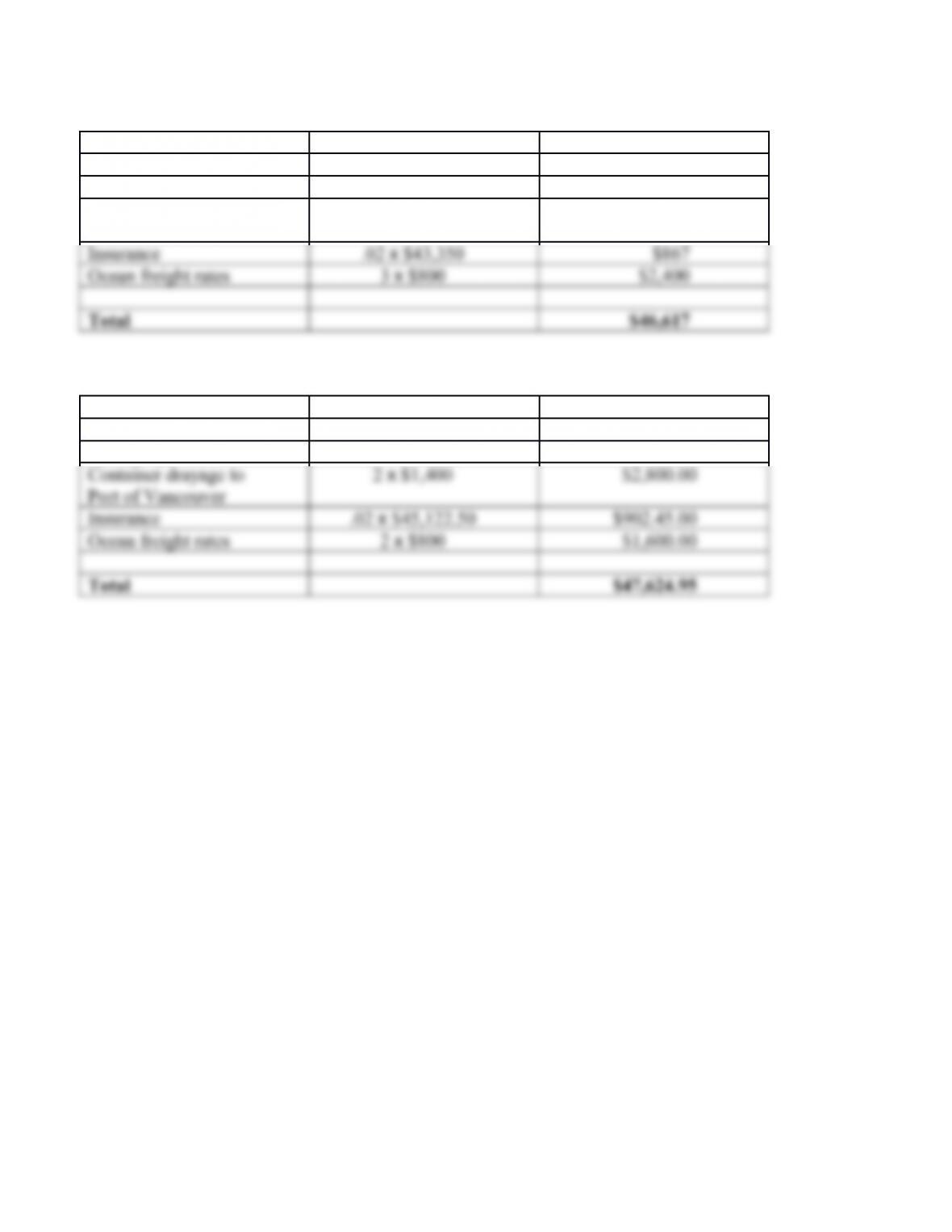
Question 5: What are the total costs of delivering the Style B shades to the Port of Shanghai?
Item Cost Parameters Total Cost
Shade manufacturing $4.50 x 8,100 $36,450
Packaging $2.00 x 1,350 $2,700
Container drayage to
Port of Vancouver
3 x $1,400 $4,200
Question 6: What are the total costs of delivering the Style C shades to the Port of Shanghai?
Item Cost Parameters Total Cost
Shade manufacturing $5.00 x 8,100 $40,500.00
Packaging $2.25 x 810 $1,822.50
Question 7: Which style would you recommend? Why?
From the relevant data, Style B is slightly less expensive than Style A.