PART II
ANSWERS TO END-OF-CHAPTER QUESTIONS
CHAPTER 10: WAREHOUSING MANAGEMENT
10-1. Why does warehousing exist in a supply chain?
A key reason for warehousing is because patterns of production and consumption do not coincide and
warehousing serves to match different rates or volumes of flow. Sometimes, larger quantities of goods
10-2. Explain the four ways that warehousing facilitates the regrouping function.
Regrouping involves rearranging the quantities of products as they move through the supply chain, and
it takes four forms: accumulating (also referred to as bulk-making), allocating (also referred to as bulk-
10-3. Distinguish among warehouses, distribution centers, fulfillment centers, and cross-docking
facilities.
Warehouses emphasize the storage of products, and their primary purpose is to maximize the use of
storage space. In contrast, distribution centers emphasize the rapid movement of products through a
facility and thus attempt to maximize throughput (the amount of product entering and leaving a facility
10-4. Discuss the disadvantages to public warehousing.
Perhaps the biggest drawback to public warehousing is the potential lack of control by the user. For
example, sometimes public warehousing doesn’t have the space availability required by the user; even
10-5. What are the advantages and disadvantages of private warehousing?
As for advantages, private warehousing offers users a great deal of control over their storage needs.
More specifically, private warehouses can be constructed to meet user specifications, and companies
can also control product placement within a facility. In addition, private warehousing offers access to
products when an organization needs or wants them.
10-6. Discuss why contract warehousing is a preferred alternative for many organizations.
Contract warehousing simultaneously mitigates the negative aspects and accentuates the positive
aspects of public and private warehousing. For instance, contract warehousing allows a company to
10-7. How does multiclient warehousing mix attributes of public and contract warehousing?
Whereas contract warehousing is generally dedicated to just one customer and public warehousing may
be used by any number of customers, a limited number of customers (at least two, but no more than one
10-8. Explain how common sense can be helpful in terms of warehousing design.
One common-sense piece of advice is that prior to designing a warehousing facility, the quantity and
character of goods to be handled must be known. For example, the design of fulfillment centers for
online orders should explicitly incorporate key attributes of online commerce such as small orders
10-9. In terms of warehousing design, give examples of trade-offs involving space, labor, and
mechanization.
Spaciousness may not always be advantageous because the distances that an individual or machine
must travel in the storing and retrieving functions are increased. Moreover, unused space is excess
10-10. Distinguish between fixed and variable slot locations. How might they affect warehousing
design?
A fixed slot location refers to a situation where each SKU has one or more permanent slots assigned to
it whereas a variable slot location involves empty slots being assigned to products based on space
availability. Fixed slot location can provide stability in order picking in the sense that a company
10-11. Discuss the trade-offs associated with order-picking versus stock-replenishing functions.
Organizations must decide whether workers who pick outgoing orders and those who are restocking
storage facilities should work at the same time or in the same area. When order pickers and stock
replenishers are allowed to work in the same area, fewer managerial personnel may be needed but it
10-12. Explain the relevance of aisle width in warehouse design.
As aisle space increases, the storage capacity of a facility decreases; for example, narrow aisles can
store 20–25 percent more product than conventional aisles. However, it is easier to operate mechanical
equipment in wider aisles, and wider aisles reduce the chances of accidents and product damage. In
10-13. Discuss some key considerations associated with warehouse automation.
Warehouse automation refers to utilizing mechanical or electronic devices to substitute for human
labor, and key considerations involve noticeable improvement in warehousing effectiveness and
10-14. What are some potential nonstorage space needs that might impact warehousing design?
The text mentions 12 potential nonstorage needs, such as an area where transport drivers and operators
can wait while their equipment is loaded or unloaded. Any combination of these 12 needs is acceptable.
10-15. How can warehousing productivity be improved without significant investment in technology or
equipment?
One suggestion for improving warehousing productivity involves a review of existing procedures and
practices to identify the tasks that are creating the largest inefficiencies without adding to or upgrading
10-16. What is OSHA’s role in warehousing safety?
OSHA is the Occupational Safety and Health Administration, an agency of the U.S. federal
government that has responsibilities for industrial safety practices, and OSHA inspectors make frequent
visits to industrial workplaces to ensure regulatory compliance. OSHA has paid special attention to
10-17. Discuss how fires are a constant threat in warehousing.
Fires are a constant threat in warehousing in part because many materials used for packaging are highly
flammable. In addition, although plastic pallets last longer, are cleaner, and are less likely to splinter
10-18. What is a hazardous material? What design elements should be considered when storing
hazardous materials?
A hazardous material (hazmat) is any item or agent (biological, chemical, physical) that has the
potential to cause harm to humans, animals, or the environment, either by itself or through interactions
10-19. Discuss how warehousing security can be enhanced by focusing on people, facilities, and
processes.
With respect to people, a starting point might be determining if a facility even has a formal hiring
process. As for facilities, experts recommend a combination of overt (e.g., closed-circuit television
10-20. How are cleanliness and sanitation issues relevant to warehousing operations?
Warehousing cleanliness and sanitation are extremely important in many industries, such as the
foodservice industry where clean and sanitary warehouses reduce the likelihood of foodborne illnesses.
PART III
CASE SOLUTIONS
CASE 10-1: MINNETONKA WAREHOUSE
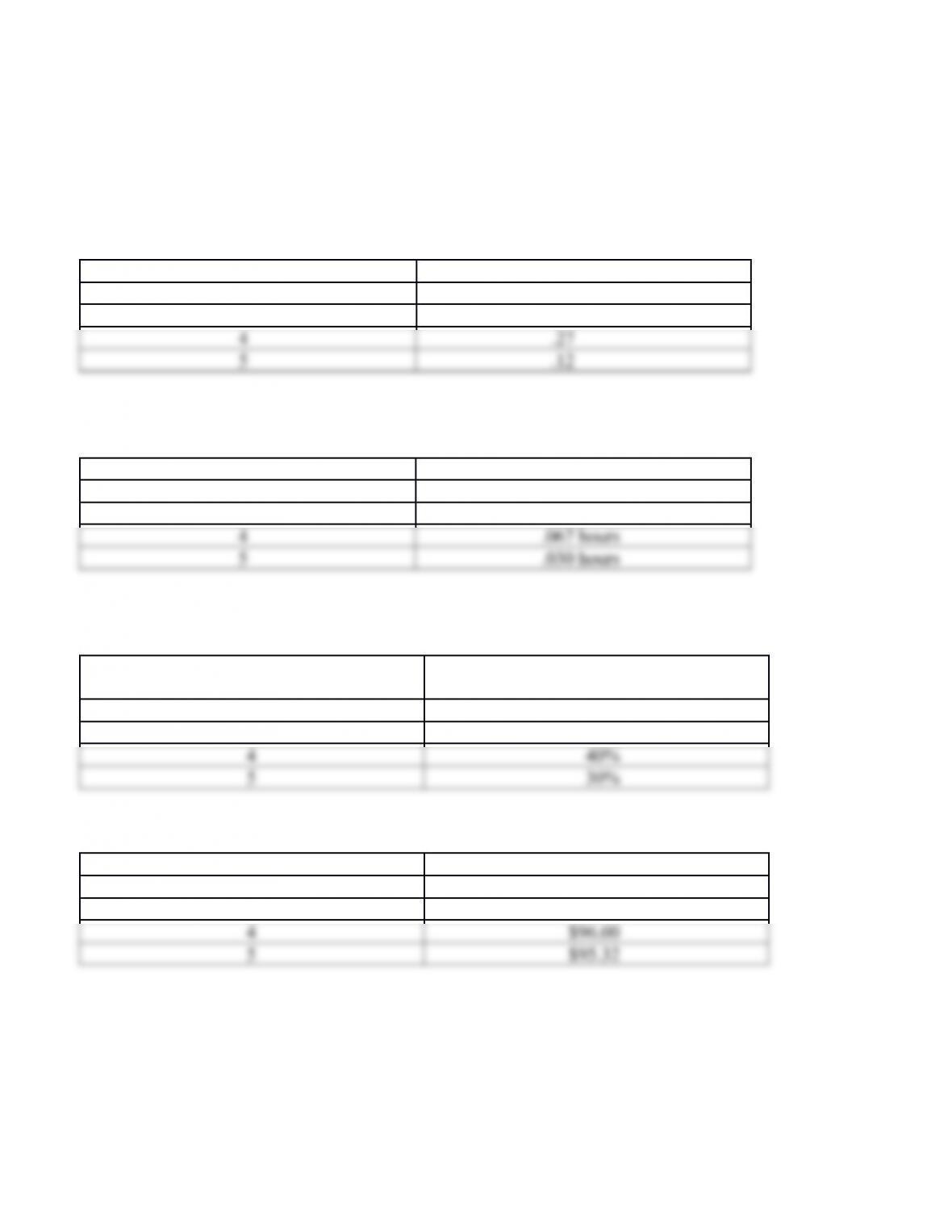
Question 1: For each of the four work team sizes, calculate the expected number of trucks in the queue
to be unloaded.
Size of Team Number of Trucks in Queue
2 3.2
3 .5
Question 2: For each of the four work team sizes, calculate the expected time in the queue—that is, the
expected time a truck has to wait in line to be unloaded.
Size of Team Expected Time in Queue
2 .8 hours
3 .125 hours
Question 3: For each of the four work team sizes, what is the probability that a truck cannot be
unloaded immediately?
Size of Team Probability That Truck Must
Wait upon Arrival
2 80%
3 50%
Question 4: Which of the four work team sizes results in the lowest cost to Wayne?
Size of Team Total Cost
2 $268.00
3 $102.00
Question 5: Wayne is also considering rental of a forklift to use in truck unloading. A team of only two
would be needed, but the hourly cost would be $38 per hour ($28 for the workers and $10 for the
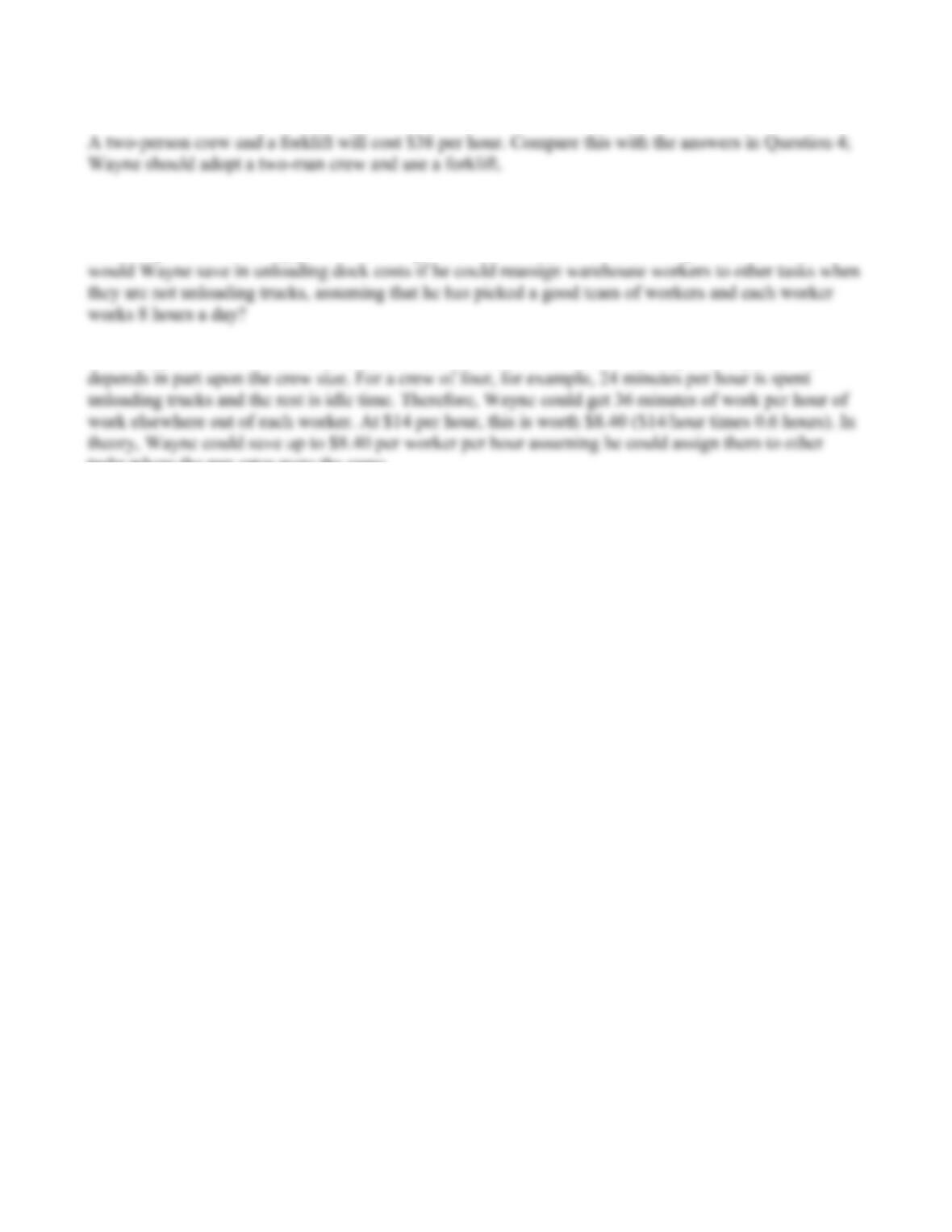
forklift). The two workers could unload a truck in 5 minutes. Should Wayne rent the forklift?
Question 6: Disregard your answer to Question 5. Labor negotiations are coming up, and Wayne
thinks he can get the union to give way on the work rule that prohibits warehouse workers on the
unloading dock from being given other assignments when they are not unloading trucks. How much
From the printouts, we must determine how much “idle time” there is with the present system. This
tasks where the pay rates were the same.