END OF CHAPTER MATERIAL
Discussion Questions
8-1 What is a consumer product? Describe the characteristics of each type of consumer product
and give examples of each. (AACSB: Communication; Reflective Thinking)
8-2 Compare and contrast the two dimensions of product quality. (AACSB: Communication)
Answer:
Product quality is one of the marketer’s major positioning tools. Quality has a direct impact
on product or service performance. Thus, it is closely linked to customer value and
satisfaction. In the narrowest sense, quality can be defined as “freedom from defects.” But
8-3 What is a product line? Discuss the various product line decisions marketers make and
how a company can expand its product line. (AACSB: Communication)
8-4 Discuss brand equity and brand value. How do marketers use these concepts to build
powerful brands? (AACSB: Communication; Reflective Thinking)
Answer:
Brand equity is the differential effect that knowing the brand name has on customer response
Copyright© 2018 Pearson Education
Thus, positive brand equity derives from consumer feelings about and connections with a
High brand equity provides a company with many competitive advantages. A powerful brand
enjoys a high level of consumer brand awareness and loyalty. Because consumers expect
Brands vary in the amount of power and value they hold in the marketplace. Some brands—
such as Coca-Cola, Nike, Disney, GE, McDonald’s, Harley-Davidson, and others—become
8-5 Explain the four choices companies have when developing brands. Provide an example of
each. (AACSB: Communication; Reflective Thinking)
Critical Thinking Exercises
8-6 Walt Disney created the Disney brand from humble beginnings based on his love of drawing
and animation. The Walt Disney Company has since expanded successfully into a global
entertainment and media brand. Using the internet, research the components that make up the
Disney brand and discuss how The Walt Disney Company has expanded its product mix.
(AACSB: Communication; Use of IT; Reflective Thinking)
Copyright© 2018 Pearson Education
Answer:
Simply beginning with the Disney website at www.disney.com provides a head start on
Student responses will vary. However discussion should include ways in which the Disney
brand has expanded its initial product offering of animated films to positioning itself as a top
According to The Walt Disney Company Web site and Forbes.com, Disney landed in the No.
1 most powerful brand spot for 2016, with Brand Finance noting that the company’s strength
8-7 Companies must consider four special service characteristics when designing service
marketing programs. Discuss a recent service experience using the four characteristics.
Compare your service experience with that of a classmate. How do they differ? (AACSB:
Communication, Reflective Thinking)
8-8 What is “genericide”? Discuss a recent case and make recommendations regarding how
marketers can avoid it. (AACSB: Communication; Reflective Thinking)
Answer:
Another case is Costco alleging that “Tiffany setting,” which refers to the iconic Tiffany
diamond ring, is a generic term for that type of ring setting after Tiffany sued Costco for
trademark infringement (www.brandchannel.com/2015/09/09/tiffany-costco-suit-090915/).
Online, Mobile, and Social Media Marketing: Feeding Pets from Your Smartphone
People lead busy lives, often taking time away from their pets. So Petnet has developed the
Smartfeeder, allowing pet owners to schedule feeding times, monitor food intake, and
personalize pet nutrition information. The Smartfeeder measures out the appropriate amount of
food for a pet based on age, activity, and weight. Additional features include the ability to
conveniently store five to seven pounds of pet food in an attached hopper. Petnet has also
seamlessly integrated its products with a smartphone app, available with iOS (Apple) products.
Pet owners can now control feeding times, portion sizes, and food supply and even order pet
food to be delivered directly to their homes, all from a mobile device.
8-9 What kind of product is Petnet’s Smartfeeder? How should this type of product be marketed?
(AACSB: Communication; Reflective Thinking)
Answer:
The Petnet Smartfeeder is best classified as a consumer product, used for personal
consumption. More specifically, it can be classified as a shopping product. The buyer will
Copyright© 2018 Pearson Education
8-10 What are customers really buying when they purchase a Petnet Smartfeeder? Identify the
core, actual, and augmented product levels for this product. (AACSB: Communication;
Reflective Thinking)
Answer:
The core benefit of the Smartfeeder is automated pet feeding and food monitoring. Many
consumers would purchase the product simply for solving this one problem. Petnet’s actual
product is the nuts and bolts, design, packaging, and other features of the Smartfeeder. The
Marketing Ethics: Geographical Indication
Scotch whiskey, Champagne sparkling wine, Parmesan cheese, Dijon mustard—what do all of
these have in common? They are not brand names but rather geographical indicators (GIs) of the
origin of these foodstuffs. Europe has a long history of gastronomical delicacies that the
European Union has been strong to protect for economic reasons. For example, not just any
sparkling wine can be labeled “champagne” because only sparkling wine produced in the
Champagne region of France can put that on the label. The British government is launching a
registry of Scottish whiskey makers to protect its $4 billion industry from imitators who label
their whiskey as Scotch. True Scotch must be aged in oak casks in Scotland for at least three
years. Dijon mustard must be produced in Dijon, France, made with chardonnay wine from the
Burgundy wine region. Parmesan cheese was developed more than 2,000 years ago in Parma,
Italy, which also boasts of Parma ham (Prosciutto di Parma). True Swiss cheeses, such as
Emmental, Gruyere, and other varieties, are produced in Switzerland following strict rules to
guarantee purity, and the authorities there identify counterfeits with DNA fingerprinting based on
the 10,000 strains of milk bacteria that are used for authentic Swiss cheeses. All of these come
with a higher price tag for consumers. For example, Portugal Algarve Salt or French Fleur de Sel
sea salt cost about $80 per pound compared with 30¢ per pound for regular table salt.
8-11 Are products with geographical indications actually superior to other similar ones not
originating from that geographical region? Is it ethical for makers of these products to
command higher prices when others can make or grow them just as well? (AACSB:
Communication; Reflective Thinking; Ethical Reasoning)
Answer:
Students’ answers will vary. Some will argue that geographical indications (GIs) are similar
to brand names, which offer consumers several benefits, such as guarantees of quality. Others
will argue that it is not fair that a geographical region can claim superiority over products that
Copyright© 2018 Pearson Education
8-12 Do geographical indications (GIs) offer benefits to consumers? Are there disadvantages for
sellers? Explain. (AACSB: Communication; Reflective Thinking)
Answer:
GIs may offer the same benefits to buyers as do brands. Like brand names, GIs may help
consumers identify products that might benefit them and also say something about product
Marketing by the Numbers: Pop-Tarts Gone Nutty!
Kellogg’s, maker of Pop-Tarts, recently introduced Pop-Tarts Gone Nutty! The new product
includes flavors such as peanut butter and chocolate peanut butter. Although the new Gone
Nutty! product will reap a higher wholesale price for the company ($1.20 per eight-count
package of the new product versus $1.00 per package for the original product), it also comes
with higher variable costs ($0.55 per eight-count package for the new product versus $0.30 per
eight-count package for the original product).
8-13 What brand development strategy is Kellogg’s undertaking? (AACSB: Communication;
Reflective Thinking)
Answer:
Pop-Tarts Gone Nutty! is a line extension. A line extension occurs when a company extends
Unite d State s
Numb e r o f Bra nds
8-14 Assume the company expects to sell 5 million packages of Pop-Tarts Gone Nutty! in the
first year after introduction but expects that 80 percent of those sales will come from buyers
who would normally purchase existing Pop-Tart flavors (that is, cannibalized sales).
Assuming the sales of regular Pop-Tarts are normally 300 million packages per year and that
the company will incur an increase in fixed costs of $500,000 during the first year to launch
Gone Nutty! will the new product be profitable for the company? Refer to the discussion of
cannibalization in Appendix 2: Marketing by the Numbers for an explanation regarding how
to conduct this analysis. (Objective 4) (AACSB: Communication; Analytical Reasoning)
Answer:
This is a cannibalization problem. To analyze this problem, we need to determine unit
contributions:
Copyright© 2018 Pearson Education
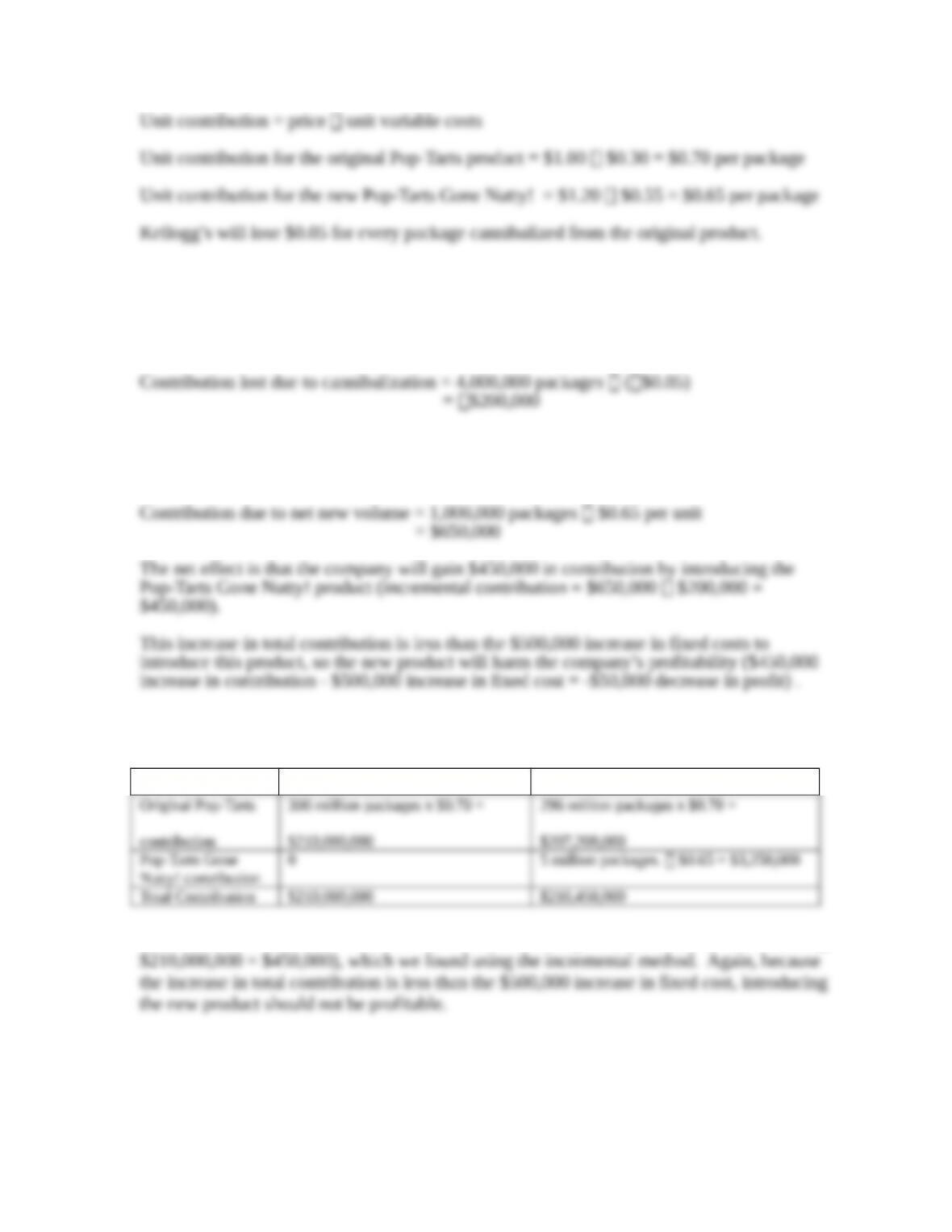
One way to analyze this is to assess the incremental contribution gained (or lost) by adding
the new product. The company estimates that the first year’s sales of the new Pop-Tarts
Gone Nutty! would be 5 million packages, but 4 million packages (80 percent of 5 million)
will be cannibalized from the original product. Thus, if the company loses $0.05 in
contribution for every package cannibalized:
However, it is estimated that the new product will generate an additional 1 million packages
in sales (5 million packages 4 million cannibalized units), which generate an additional
$0.65 per package in contribution. Thus,
Another way to see this is to compare total contribution with and without the introduction of
the new product:
Original Pop-Tarts Pop-Tarts Gone Nutty!
Notice that the difference in the total contribution is a net gain of $450,000 ($210,450,000
Company Case Notes
Airbnb: Making Hospitality Authentic
Copyright© 2018 Pearson Education
Synopsis
This case focuses on the hospitality services industry. Airbnb has pulled off a truly amazing rise
to market leadership. Attacking an industry that has been set in stone for more than 100 years,
Airbnb has become bigger than any hotel chain in terms of rooms available, annual revenue, and
stock price. And, it has done it all in less than a decade. Airbnb has accomplished the impossible
by focusing on providing a customer experience that the standardized hotel model simply cannot.
By building a network of private property owners who rent all or part of their homes in a
convenient and price competitive manner, Airbnb has discovered a huge market that previously
was left underserved—travelers who want to experience the world as locals do.
Teaching Objectives
The teaching objectives for this case are to:
1. To learn the four characteristics of services.
2. Gain an understanding of the service-profit chain through application.
3. To be able to apply the concepts of differentiation and positioning to services.
4. To understand the competitive challenges that service providers face.
Discussion Questions
8-18 How do the four characteristics of services apply to Airbnb? How does Airbnb deal with
each characteristic?
Intangible – in a manner similar to the conventional hotel industry, buyers may
Inseparable – the service is performed at the same location that it is consumed.
Inconsistent – This characteristic does not affect Airbnb as much as it does
Copyright© 2018 Pearson Education
Inventory (perishable) – This characteristic of services is all about matching
8-19 Apply the service profit chain concept to Airbnb.
The relevance of the service profit chain to Airbnb is a bit different because they do not
directly employ any of the service providers. However, conceptually, the concept still
plays out.
Internal service quality. Airbnb hosts must register and be vetted to ensure
Satisfied and productive service employees. Hosts are given good terms. Airbnb
Greater service value. Hosts that are profitable and who see the link between the
Satisfied and loyal customers. The customer experience determines the level of
Healthy service profits and growth. The more bookings hosts make, the more
8-20 How does Airbnb differentiate its offer, delivery, and image?
Offer – No two rooms are alike. See the world from the perspective of locals.
Copyright© 2018 Pearson Education
8-21 How much of a threat is competition to Airbnb?
While there are numerous services similar to Airbnb that have developed into large networks,
While the conventional hotel chains are building more hotels and rooms in places where
8-22 Will Airbnb last as long as Hilton Worldwide has? Explain.
This one is open for discussion and students will have differing opinions. There is certainly a
However, future generations will likely only be more open to the product sharing than
customers are today. So, the market should grow.
Teaching Suggestions
Prior to digging in to the details of the case and the discussion questions, generate a discussion
based on students’ experiences with property rental services. Most specifically, focus on Airbnb
and possibly CouchSurfing.com, services that put people in places where
This case was developed for use with Chapter 8. However, this case is very versatile, working
well with numerous other chapters including the customer value chapter (Chapter 1), the
marketing environment chapter (Chapter 3), the consumer behavior chapter (Chapter 5), the new
products chapter (Chapter 9), and the distribution chapter (Chapter 12).
Copyright© 2018 Pearson Education
Go to mymktlab.com for the answers to the following assisted-graded writing questions:
8-23 Describe the four characteristics of services that marketers must consider
when designing marketing programs. How do the services offered by a
doctor’s office differ from those offered by a bank?
8-24 List the names of the store brands found in the following stores: Walmart,
Best Buy, and Whole Foods. Identify the private label brands of another
retailer of your choice and compare the price and quality of one of the
products to a comparable national brand.
ADDITIONAL PROJECTS, ASSIGNMENTS, AND EXAMPLES
Projects
1. What is your all-time favorite brand? What do you most like about the product and/or brand
name? What (if anything) do you dislike? What image does the brand have in your mind?
How loyal are you toward the brand? Why? (Objective 2)
2. Go to the supermarket and take a look at the brand extensions that exist for Coke. Do you
think this makes sense or not? When is brand extension a good strategy? When is it a poor
one? (Objective 2)
3. Consider Starbucks coffee. Consumers sometimes bond very closely with their preferred
brands. What type of brand equity do you believe they have established over the years? How
did this happen? (Objective 4)
4. What do you like about your bank? How would you compare the services you receive from
your bank to other competing banks and to your “ideal” bank? What is good about the
service you currently receive? Review the service using the material from the chapter. What
specifics about the service make it very good from a marketing standpoint? (Objective 3)
Small Group Assignments
1. Read the chapter-opening vignette on GoPro. Form students into groups of three to five. Each
group should then answer the following questions and share those answers with the class.
(Objective 1 and 4)
a. What “product” is GoPro really selling?
b. How does GoPro successfully promote bonding between customers and its products?
c. How would you compare the GoPro “brand” to that of other camera companies?
What other industry might you believe GoPro belongs in?
2. Form students into groups of three to five. Each group should review Table 8.1 (Marketing
Considerations for Consumer Products). Each group should then answer the following
questions and share those answers with the class. (Objective 1)
Copyright© 2018 Pearson Education
a. Make a list of five specialty products with which you are familiar (not covered in the
book). Discuss the promotion methods used to reach customers and typical customer
buyer behavior.
b. Make a list of five unsought products with which you are familiar, but have little or no
interest in purchasing. Discuss promotion methods that you would employ to successfully
market these products.
Individual Assignments
1. Review the gaming industry in Mississippi. How has that industry positioned itself in the
overall gaming market? How have they attempted to build customer value? How successful
do you believe they have been in this effort? (Objective 2)
2. Take a look at Saab automobiles (http://www.saabcars.com). Discuss the product width,
length, depth, and consistency of the company. (Objective 2)
Think-Pair-Share
Consider the following questions, formulate an answer, pair with the student on your right, share
your thoughts with one another, and respond to questions from the instructor.
1. Define “product.” (Objective 1)
2. Your text states, “The product is a key element in the overall market offering.” What does
this mean? (Objective 1)
3. When a buyer purchases a product, what are they really buying? (Objective 1)
4. What is the difference between shopping goods and specialty goods? (Objective 1)
5. How do products and services really differ? (Objective 3)
Outside Examples
1. In many parts of the world, birth control is an unsought product. Assume you have been
given the task of promoting birth control in a region of the world where it has traditionally
been unused. How would you attempt to make inroads? (Objective 1)
Possible Solution:
This is a very difficult and touchy subject in many societies. Remember, unsought products
are consumer products that the consumer either does not know about or knows about but
2. Restaurants embody many of the fundamental service characteristics discussed in the chapter.
Everyone is familiar with fast food and McDonald’s. Visit a local McDonald’s (or other fast
food establishment) and discuss the basic characteristics of service you experienced.
(Objective 3)
Possible Solution:
Service characteristics are often difficult for students to fully comprehend. The services we
are dealing with in this situation pertain to the interaction between restaurant employees and
Copyright© 2018 Pearson Education