END OF CHAPTER MATERIAL
Discussion Questions
7-1 Why have companies moved away from mass marketing and toward target marketing?
Outline the steps in a customer value-driven strategy. (AACSB: Communication)
7-2 How is demographic segmentation used in consumer markets? Provide an example where
marketers have used demographic segmentation. (AACSB: Communication; Reflective
Thinking)
Answer:
7-3 Discuss the challenges marketers face with international market segmentation. (AACSB:
Communication)
Answer:
Copyright© 2018 Pearson Education
7-4 There are many ways to segment a market, but not all segmentations are effective. Explain
the five requirements for effective market segmentation. (AACSB: Communication)
7-5 Describe micromarketing, local marketing, and individual marketing. When should
marketers consider using these segmentation strategies? (AACSB: Communication;
Reflective Thinking)
Answer:
Micromarketing is the practice of tailoring products and marketing programs to suit the tastes
of specific individuals and local customer segments. Rather than seeing a customer in every
individual, micromarketers see the individual in every customer. Local marketing involves
Differentiated and concentrated marketers tailor their offers and marketing programs to meet
Copyright© 2018 Pearson Education
7-6 How can a company gain competitive advantage through differentiation? Describe an
example of a company that illustrates each type of differentiation discussed in the chapter.
(AACSB: Communication)
Critical Thinking Exercises
7-7 Identify a product you use every day. Assume you are the marketer of the product and want
to convey the ways your product differs from competing products in the marketplace. Create
a differentiation strategy to promote your product and create a competitive advantage.
(AACSB: Communication; Reflective Thinking)
Answer:
Students’ examples will vary. The strategy needs to address the points of differentiation,
One example is Blue Buffalo pet foods. Pet owners purchase Blue Buffalo products because
they contain superior quality ingredients. The company is very clear in communicating to
7-8 Manfluencers is a terms that describes a new marketing trend. To what does this term refer?
Describe two examples of how marketers have responded to the manfluencers trend.
(AACSB: Communication; Reflective Thinking)
Answer:
Students’ examples will vary. The term refers to males who shop and prepare meals at least
half of the time. (Source:
Copyright© 2018 Pearson Education
For more examples see Sarah Halzack, “Major Food Brands Go After a Once-Ignored
Customer: Men,” The Washington Post, September 25, 2014, at
www.washingtonpost.com/business/economy/major-food-brands-go-after-a-once-ignored-cus
tomer-men/2014/09/25/6c0ebb6c-337b-11e4-9e92-0899b306bbea_story.html.
7-9 In a small group, create an idea for a new business. Using the steps described in the chapter,
develop a customer value–driven marketing strategy. Describe your strategy and conclude
with a positioning statement for this business. (AACSB: Communication; Reflective
Thinking)
Answer:
The four major steps in designing a customer value-driven marketing strategy are market
segmentation, market targeting (or targeting), differentiation, and positioning. Students
APPLICATIONS AND CASES
Online, Mobile, and Social Media Marketing: Get Your Groupon
Local marketing is an effective tool used by marketers to reach intended market segments.
Groupon has capitalized on this concept by tailoring brands and marketing to the needs and
wants of local customer segments—cities, neighborhoods, and even specific stores. According to
its website, Groupon “offers a vast mobile and online marketplace where people discover and
Copyright© 2018 Pearson Education
save on amazing things to do, see, eat, and buy. By enabling real-time commerce across local
businesses, travel destinations, consumer products, and live events, shoppers can find the best a
city has to offer. Groupon is redefining how small businesses attract and retain customers by
providing them with customizable and scalable marketing tools and services to profitably grow
their businesses.” This concept lies at the heart of Groupon’s mission: “to connect local
commerce, increasing consumer buying power while driving more business to local merchants
through price and discovery.” To help consumers make those connections, Groupon offers a
mobile app, online marketplace, and social media touchpoints where customers can readily
access information on its daily deals.
7-10 How does Groupon use target marketing? Provide examples. Discuss the ways in which
small businesses can utilize local social media marketing in your community. (AACSB:
Communication; Use of IT; Reflective Thinking)
Answer:
Groupon targets local consumers offering deals and discounts on products, services, and
7-11 Do you use Groupon? Is it effective in helping local businesses to meet the challenges of
local marketing? Why or why not? (AACSB: Communication; Reflective Thinking)
Answer:
Students’ answers will vary but many students will be familiar with Groupon. Groupon may
Marketing Ethics: Targeting to Teens
Discretionary income. It’s the amount of money we have left over after paying for life’s
necessities. And many teens have plenty of it. According to a recent Nielsen survey, 29 percent
of teens live in homes where household income is $100,000 or higher. These teens aren’t just
buying for themselves, either. In addition to having discretionary income, teens have a strong
influence on the purchasing decisions of their parents. According to Mary Leigh Bliss, trends
Copyright© 2018 Pearson Education
editor at youth-focused market research firm YPulse, “Teens are now passing technology down
to their parents, not the other way around.” This presents significant opportunities for marketers.
However, some critics worry that teens may be especially vulnerable to targeted marketing
messages and offers from high-powered or unscrupulous marketers.
7-12 Discuss how companies can reach their teen markets using socially responsible target
marketing. Cite an example of a company being responsible in targeting teens and another
example where a company is not responsible.
Answer:
The issue is not really who is targeted but rather how and for what. Controversies arise when
Some examples—good and bad—of companies targeting teens: PepsiCo unveiled an
expanded, revamped lineup for its Aquafina FlavorSplash brand with an eye toward
Sex sells. But most students will agree that marketers who “sex-up” their brands to sell to
7-13 The bombardment of commercial messages is turning teens into some of the most
sophisticated and skeptical consumers in the world, increasing their resistance to
conventional advertising tactics. As this highly sought-after teen target market ages, how can
marketers prepare to tap into the consumers of the future?
Answer:
Previous generations might have bought into a brand’s undelivered promises. But for this
Copyright© 2018 Pearson Education
Through targeted efforts, marketers hope that teens will develop deep loyalty to products
even before they are able to purchase them. Teens are marketed to more now than ever
Marketing by the Numbers: USAA
USAA is a financial services company formed in 1922 by 25 Army officers who came together
to insure each other’s automobiles because they were deemed too high-risk to insure. USAA now
has almost 25,000 employees and more than 9 million member customers. It consistently ranks
in the top 10 automobile insurance companies and offers other types of insurance as well as
banking, investment, retirement, and financial planning services. USAA practices a niche
marketing strategy—it targets only active and former military personnel and their immediate
families. Members earn the right to be customers by serving in the military and can pass that on
to their spouses and children. The company was originally even more restrictive, targeting only
military officers. However, in 1996, eligibility was extended to enlisted personnel and is now
extended to anyone who served and was honorably discharged from the military and his or her
immediate family members.
7-14 Discuss the factors used to evaluate the usefulness of the military segment. (AACSB:
Communication; Reflective Thinking)
Answer:
To be useful, market segments must be:
Measurable: The size, purchasing power, and profiles of the segments can be
Accessible: The market segments can be effectively reached and served. There
Substantial: The market segments are large or profitable enough to serve. A
Copyright© 2018 Pearson Education
7-15 Using the chain ratio method described in Appendix 2: Marketing by the Numbers, estimate
the market potential in the military (active duty and veterans) market. Be sure to state any
assumptions you make. (AACSB: Communication; Use of IT; Analytical Reasoning)
Answer:
Students’ assumptions and estimates will vary, and instructors can use this exercise as an
illustration that estimating market potential is not an exact science. The aim of this exercise
Market demand can be determined as follows:
Copyright© 2018 Pearson Education
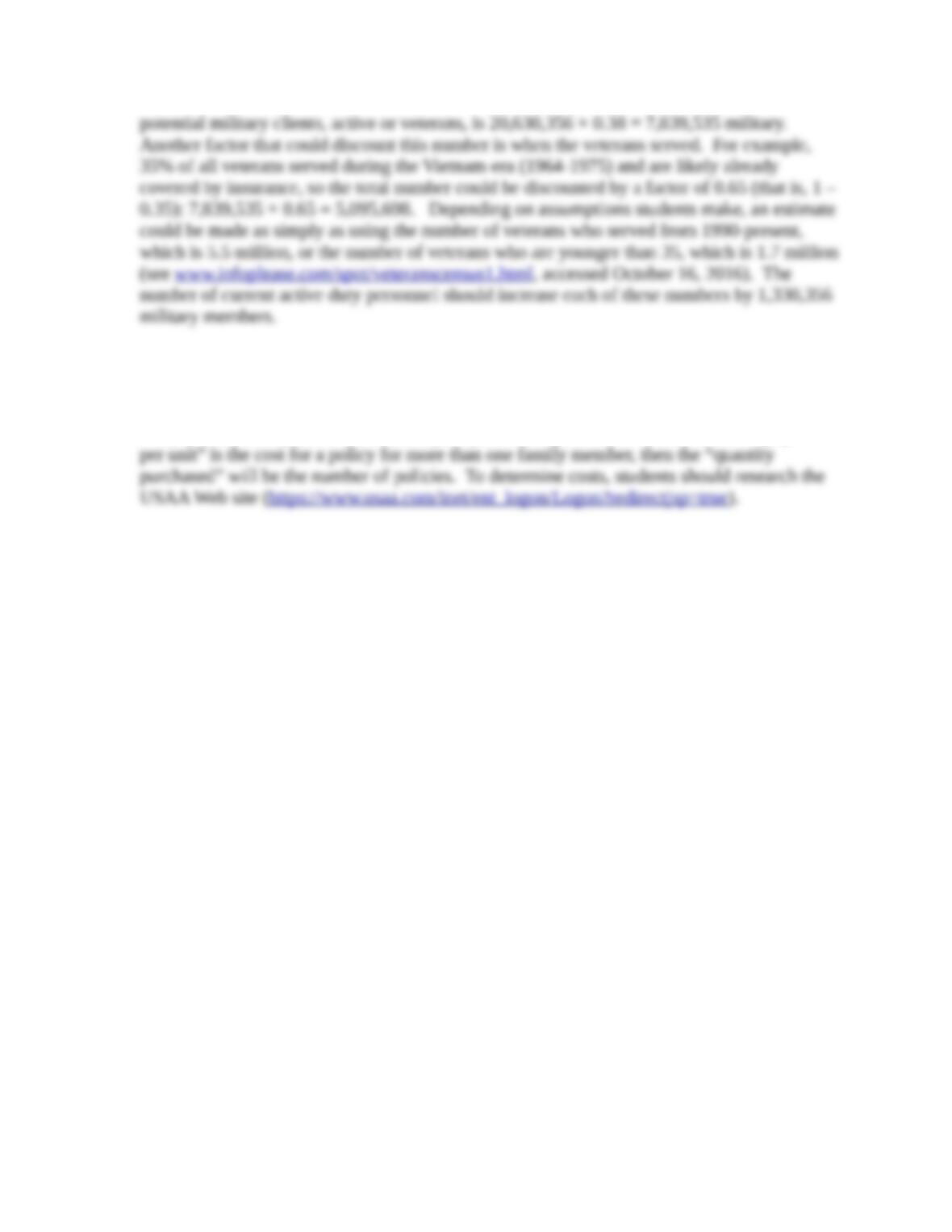
To determine the other elements of the chain ratio method, students will have to state their
assumptions. For example, if using the cost of a policy as the “average price per unit,” then
the “quantity purchased” would be 1 because most veterans and active duty personnel will
likely purchase only one life insurance policy, for example. However, if the “average price
Company Case Notes
Virgin America: Flight Service for the Tech Savvy
Synopsis
There are far more failures among airline startups than there are successes. In the past few
decades, the most notable successes have pursued a low-cost/low-fare model (Southwest,
Allegiant, Spirit, Frontier, etc.). This case shows there is room in the market for an airline that
doesn’t try to beat the competition by offering the lowest price, but by offering the best service
and the most appealing amenities. Virgin America is succeeding by doing these things and by
targeting the right customer.
Teaching Objectives
The teaching objectives for this case are to:
1. Provide a practical application for possible ways that companies can segment markets.
2. Underscore the difference between segmentation and targeting.
3. Show the importance of establishing a positioning for a brand that is consistent with a
targeting strategy.
4. Illustrate that established brands can reinvent themselves through modifications to a
targeting strategy.
Discussion Questions
Copyright© 2018 Pearson Education
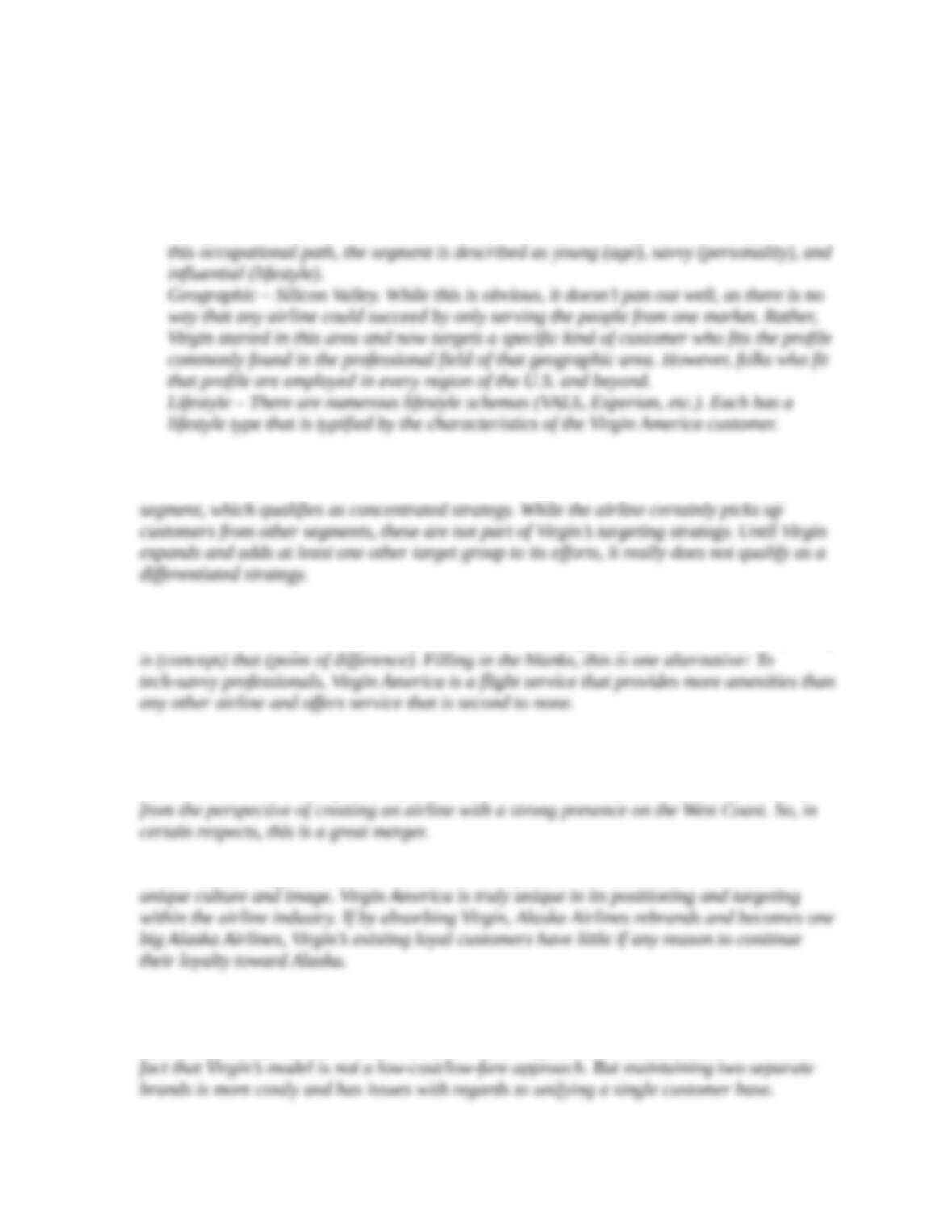
7-19 Using the full spectrum of segmentation variables, describe how Virgin America segments
and targets the market for airline services.
While there are numerous segmentation variables that can factor in to Virgin’s strategy, start
with the ones that make the most sense. Then, describe the profile based on others. For
example:
Occupation – Professional and technical (specifically in the high-tech industry). Within
7-20 Which market targeting strategy is Virgin America following? Justify your answer.
Based on the information in the case, it seems that Virgin America is focused on a single
7-21 Write a positioning statement for Virgin America.
Follow the basic template set forth by the textbook: To (target segment and need) our (brand)
7-22 What are the potential issues for Virgin America following the Alaska Airlines acquisition?
Will Virgin America continue to appeal to the same types of customers? Why or why not?
Both airlines have a strong record for customer service. The acquisition also makes sense
But clearly, the biggest issue is whether or not Virgin America will continue to maintain its
In the long-term, if Alaska maintains Virgin as a separate brand, it can continue to court the
existing Virgin base. The fact that Virgin America has recently turned a profit for an entire
year is a good sign. This is especially true considering all the barriers to entry as well as the
Copyright© 2018 Pearson Education

Teaching Suggestions
Ask students to consider their most recent airline experience. Ask them what they loved about it
(not just what the airline did well, but what they loved about it). The list will likely be pretty
short. Then, ask students what aspects of the experience were negative. List both sets of
responses on the board. After they have read the case, make a list of all the amenities on Virgin
America that are unique. Finally, ask the class if they would be willing to pay more for that kind
of experience. Finish by asking how much more.
Go to mymktlab.com for the answers to the following Assisted-graded writing questions:
7-23 Describe how marketers segment international markets. What is intermarket segmentation?
7-24 Describe how marketers manage service differentiation, other than through pricing, and
describe an example of a service provider that has successfully differentiated its offering
from its competitors.
ADDITIONAL PROJECTS, ASSIGNMENTS, AND EXAMPLES
Projects
1. Go to iTunes (www.apple.com) or Napster (www.napster.com). What unique market
segments appear to be the target of specific genres of music? How did you determine the
segments? (Objective 2)
2. You’ve agreed to help a friend with a home furnishings business segment her market.
Suggest a way to segment the market for her. Select a target market to go after, keeping in
mind segment size and growth, structural attractiveness, and probable company
resources. What target marketing strategy would you use? Explain your answers.
(Objective 2)
3. There are many ways to segment a market. Using the four segmentation variables
discussed in the chapter, discuss which variables would be most important for segmenting
(a) candidates for cataract surgery and (b) possible enrollees in a culinary school. Explain
your choices. (Objective 2)
4. Collect advertisements that demonstrate the positioning of different watch brands. Sort
the various brands into categories of brands with similar positions. (Objective 4)
Small Group Assignments
1. Form students into groups of three to five. Each group should read Real Marketing 7.1:
Mountain Dew: “Doin’ the Dew” with Brand Superfans. Then have them answer the
following questions and share their answers with the class. (Objective 2 and 4)
a. How would you describe Mountain Dew’s approach to market segmentation?
b. Picture a typical member of “Dew Nation.” How does he/she dress? In what type of
neighborhood does he/she live? What kind of job might he/she have? What kind of
Copyright© 2018 Pearson Education

vehicle does he/she drive? What might be his/her attitude toward spending money?
Now, do the same thing for a typical cola drinker. What key differences can you find,
and how are they important to Mountain Dew?
c. How does the Mountain Dew story relate to the segmentation and positioning
concepts that follow in Chapter 7?
2. The Federal Trade Commission (FTC) and citizen action groups have accused tobacco
and beer companies of targeting underage smokers and drinkers. For instance, in recent
Super Bowls, Bud Light and Budweiser ads ranked first through fourth in popularity
among viewers under the age of 17. Also, underage listeners hear more than a third of
radio ads for alcoholic beverages. Considering the foregoing, answer the following
questions. (Objective 3)
a. Do you believe the criticism that tobacco and alcohol companies have received is
justified? Why or why not?
b. What do you believe to be the most effective manner to advertise these products
without exposing underage consumers?
Individual Assignments
1. You have been asked by your college/university to help develop a market segmentation
strategy for them. What market segments would you encourage them to pursue and why?
(Objective 2)
2. Consider the following comments by a reporter regarding Victoria’s Secret Pink line.
“The message we’re telling our girls is a simple one. You’ll have a great life if people
find you sexually attractive… Do we really need to start worrying about it at 11?” Do you
believe this criticism is justified? Why or why not? (Objective 3)
Think-Pair-Share
Consider the following questions, formulate an answer, pair with the student on your right, share
your thoughts with one another, and respond to questions from the instructor.
1. How would you define market segmentation? (Objective 1)
2. How do geographic segmentation and demographic segmentation differ? (Objective 2)
3. Which one segmentation form do you consider the most valuable? Why? (Objective 2)
4. What is benefit segmentation? Give a good example. (Objective 2)
Outside Examples
1. Review the requirements for effective market segmentation. Now, log on
to Napster (www.napster.com/). How are they attempting to segment their markets? Rate
Napster on each of the five requirements for effective segmentation. Do you believe they
are doing a good job on each? What suggestions for improvement would you
recommend? (Objective 2)
Possible Solution:
Copyright© 2018 Pearson Education
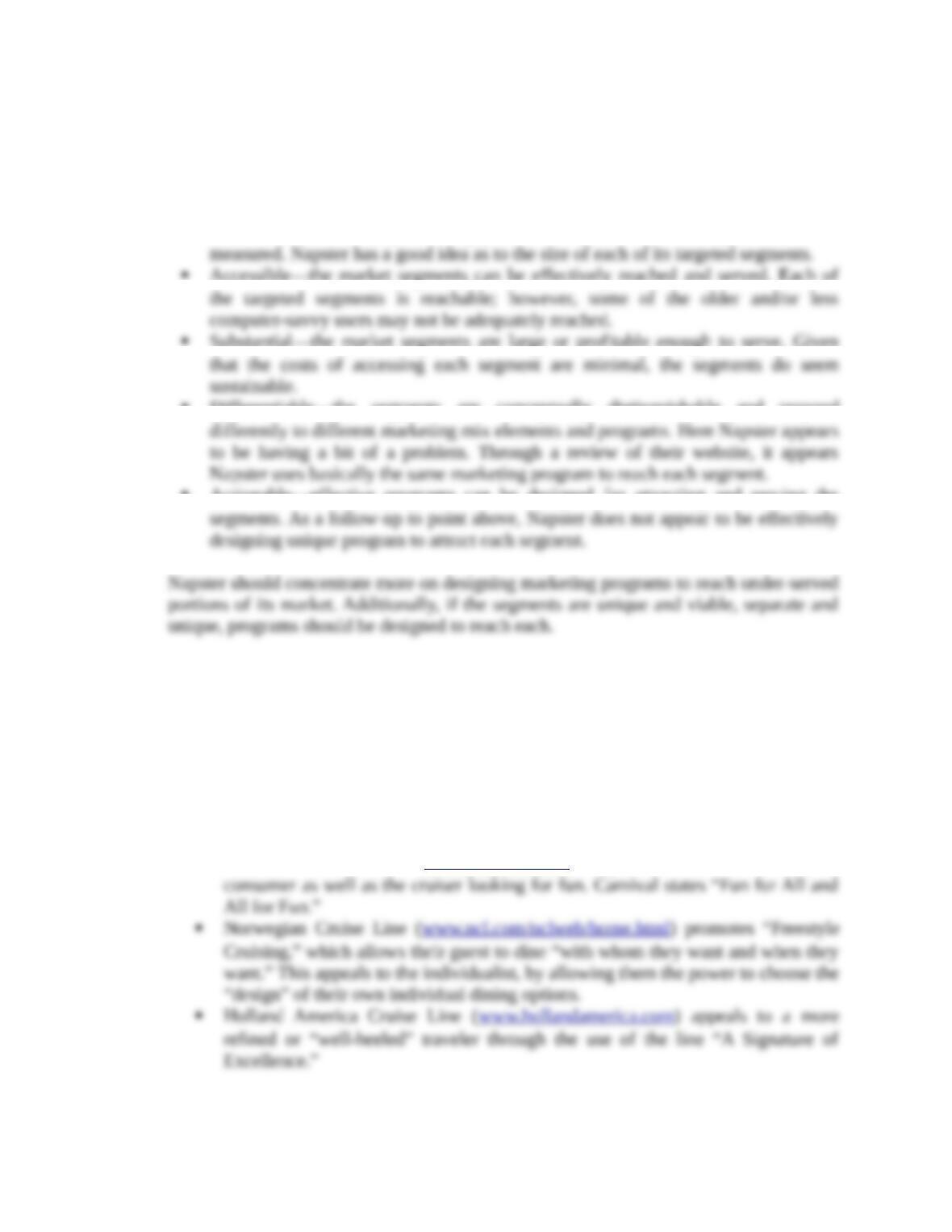
Napster uses a differentiated marketing strategy. More specifically, they are using
demographic, psychographic, and (to a lesser extent) behavioral-based segmentation
variables. The requirements for effective segmentation and how well Napster is doing in
meeting each are:
Measurable—the size, purchasing power, and profiles of the segments can be
Accessible—the market segments can be effectively reached and served. Each of
Substantial—the market segments are large or profitable enough to serve. Given
Differentiable—the segments are conceptually distinguishable and respond
Actionable—effective programs can be designed for attracting and serving the
2. Lifestyle segmentation has many potential advantages. Your text discusses
how lifestyle segmentation has been used by the cruise industry by citing Royal
Caribbean and Regent Seven Seas as examples. Go to the home pages of three additional
cruise lines and discuss how each uses lifestyle segmentation (Objective 2).
Possible Solution:
Students may come up with any number of examples.
Carnival Cruise Line (www.carnival.com/) appeals to the value-oriented
Copyright© 2018 Pearson Education

Copyright© 2018 Pearson Education