END OF CHAPTER MATERIAL
Discussion Questions
6-1 Explain how the market structure and demand differ for business markets compared to
consumer markets. (AACSB: Communication; Reflective Thinking)
6-2 Describe the tools B-to-B marketers use to engage customers. What are the challenges with
B-to-B social media marketing? (AACSB: Communication; Reflective Thinking)
6-3 Briefly discuss the straight rebuy and modified rebuy strategies. What are the similarities
and differences? When might it be beneficial to use one approach over the other? (AACSB:
Communication; Reflective Thinking)
6-4 List the participants in the business buying process. What factors influence the buying
decision? Discuss the major influences on business buyers. (AACSB: Communication,
Reflective Thinking)
Answer:
Participants in the business buying decision process are members of the buying center. The
The buying center includes all members of the organization who play any of five roles in the
purchase decision process.
• Users are members of the organization who will use the product or service. In many cases,
users initiate the buying proposal and help define product specifications.
• Influencers often help define specifications and also provide information for evaluating
alternatives. Technical personnel are particularly important influencers.
Copyright© 2018 Pearson Education
The major influences on business buyers are broken down into environmental,
organizational, interpersonal, and individual categories. Business buyers are heavily
Organizational factors are also important. Each buying organization has its own objectives,
strategies, structure, systems, and procedures, and the business marketer must understand
these factors well.
Each participant in the business buying decision process brings in personal motives,
perceptions, and preferences. These individual factors are affected by personal characteristics
6-5 Compare the institutional and government markets and explain how institutional and
government buyers make their buying decisions. (AACSB: Communication)
Answer:
The institutional market consists of schools, hospitals, prisons, and other institutions that
provide goods and services to people in their care. These markets are characterized by low
budgets and captive patrons. Because the purchases are part of a total service package, the
buying objective is not profit. Nor is strict cost minimization the goal. Many marketers set up
Copyright© 2018 Pearson Education
Critical Thinking Exercises
6-6 Business buying can be a very involved process. Many companies employ procurement or
purchasing experts dedicated to managing the firm’s buying process. Visit
www.glassdoor.com/salaries and www.indeed.com/salary to conduct a search of the salary
ranges for “procurement specialists” and similar positions in purchasing. Present your
findings. Can e-procurement help to streamline the buying process? Might it eventually
replace employees in these careers? Discuss if it is possible for all buying functions to be
performed through e-procurement. (AACSB: Communication, Reflective Thinking, Use of
IT)
Answer:
In October 2016, the national average salary for a “procurement specialist” position was
E-procurement has grown exponentially with advances in IT, and was virtually unknown a
decade and a half ago. Now, online purchasing is standard for many companies.
E-procurement gives buyers access to new suppliers, lowers purchasing costs, and speeds
order processing and delivery. Additionally, business marketers can connect with customers
Students should discuss the streamlined, simplified process made available by e-procurement
and the impact of e-procurement on purchasing careers. It may not completely eliminate the
Copyright© 2018 Pearson Education
6-7 Interview a businessperson to learn how purchases are made in his or her organization. Ask
this person to describe a straight rebuy, a modified rebuy, and a new-task buying situation
that took place recently or of which he or she is aware (define them if necessary). Did the
buying process differ based on the type of product or purchase situation? Ask the
businessperson to explain the role he or she played in a recent purchase and to discuss the
factors that influenced the decision. Write a brief report of your interview by applying the
concepts you learned in this chapter regarding business buyer behavior. (AACSB:
Communication; Reflective Thinking)
Answer:
Student answers will vary. The point of the activity is to provide the students with
information about how actual businesses go through purchasing decisions and see how the
process matches with the concepts in the chapter. Students should demonstrate an
6-8 The U.S. government is the world’s largest purchaser of goods and services, spending more
than $460 billion per year. By law, 23 percent of all government buying must be targeted to
small firms. In a small group, visit the Small Business Administration’s Government
Contracting Classroom at
<URL>www.sba.gov/content/government-contracting-classroom</URL> to learn how small
businesses can take advantage of government contracting opportunities. Complete one of the
self-paced online courses and develop a brochure explaining the process to small business
owners. (AACSB: Communication; Reflective Thinking; Use of IT)
Answer:
Students’ brochures will vary. This website provides information in easy-to-understand,
short (less than thirty minutes) courses and organizes it into a brochure format should make
Copyright© 2018 Pearson Education
APPLICATIONS AND CASES
Online, Mobile, and Social Media Marketing: E-Procurement and Mobile Procurement
Gone are the days of tedious, paper-laden, and labor-intensive procurement duties.
E-procurement is changing the way buyers and sellers do business, specifically via mobile
procurement that offers cloud-based platforms that reduce the search, order, and approval cycle.
Most large companies have adopted some form of e-procurement. A recent study found that
almost 70 percent of companies utilize some form of e-procurement, mobile procurement, or
supply chain management applications. A leading industry platform, Coupa, provides a suite of
cloud-based applications for finance, including accounts payable, sourcing, procurement, and
expense management that allows customers full functionality from their mobile devices.
Employees now enjoy the flexibility and time savings of viewing, approving, or denying
requisitions, purchase orders, and invoices. One of Coupa’s large retail clients claimed a
reduction from 10 days to 5 hours in their requisition-approval-process cycle by implementing
Coupa’s mobile procurement platform. Talk about savings! Visit
www.coupa.com/software/procurement/to learn more about how this company is revolutionizing
the e-procurement and mobile procurement environments.
6-9 Discuss the advantages of e-procurement to both buyers and sellers. What are the
disadvantages? (AACSB: Communication; Reflective Thinking)
6-10 Research mobile procurement and discuss the roles in the buying center that are impacted
most by this technology. (AACSB: Communication; Reflective Thinking)
Answer:
The two members of the buying center impacted most by mobile procurement are buyers
and deciders. Buyers have formal authority to select the supplier and arrange terms of
Mobile procurement applications allow procurement professionals to complete tasks
while on the go. Software companies like SAP
Copyright© 2018 Pearson Education
Marketing Ethics: What Are Our Kids Eating?
Many institutional markets are characterized by low budgets and captive patrons. One
institutional food program that has gotten much recent attention is the National School Lunch
Program. Although the federal government mandates that schools receiving federal money serve
free lunches to children from low-income families, the funds don’t cover the entire cost of the
meal. The difference comes out of school budgets and that means fewer dollars for the
classroom.
According to one study (www.cnn.com/2010/HEALTH/09/29/ school.food.investigation/), the
number-one meal served to children in U.S. schools is chicken fingers and French fries.
Processed food is much cheaper to serve than fresh produce. Another study published in the
Journal of the American Dietetic Association found that 94 percent of school lunches failed to
meet the U.S. Agriculture Department’s regulatory standards. Purchasing agents for school
systems must search for institutional food vendors whose quality meets or exceeds a minimum
standard while offering low prices.
The goal of the federal Healthy, Hunger-Free Kids Act of 2010 is to improve the overall
nutritional quality of what students eat at school. The law, which is being implemented over a
five-year period, affects several parts of school food. It changes what’s in vending machines and
how much food students get, rules out fried food, and makes all milk low-fat or fat-free. But it’s
also changing the way lunches are priced. These changes have dieticians and food service
directors facing significant challenges.
6-11 Research what constitutes a healthy lunch in a public school system. Should food
companies selling to school systems take responsibility for working with buyers to address
this issue? Why or why not?
Answer:
A healthy lunch is 3 ounces of protein, a whole grain, a vegetable, and fresh fruit. This lunch
is difficult to provide for $2.50. Food service directors (buyers) need to work with food
Marketing is all about helping customers to solve problems. So it makes good sense for food
Copyright© 2018 Pearson Education
6-12 How can food marketers go about helping schools to meet the national guidelines for
healthy school lunches? What are the benefits of doing so?
Answer:
Marketers can set up separate divisions to meet the special needs and characteristics of the
institutions being served. Nestlé Professional helps institutional food service customers find
creative meal solutions using Nestlé’s broad assortment of food and beverage brands.
Marketing by the Numbers: NAICS
The North American Industry Classification System (NAICS) code is very useful for marketers.
It replaces the old product-based Standard Industrial Classification (SIC) system introduced in
the 1930s. The NAICS system classifies businesses by production processes, better reflecting
changes in the global economy, especially in the service and technology industries. It was
developed jointly by the United States, Canada, and Mexico in 1997 in concert with the North
American Free Trade Agreement (NAFTA), providing a common classification system for the
three countries and better compatibility with the International Standard Industrial Classification
(ISIC) system. This six-digit number (in some cases, 7 or 10 digits) is very useful for
understanding business markets.
6-13 What do the six digits of the NAICS code represent? What industry is represented by the
NAICS code 721110? How many businesses comprise this code? (AACSB:
Communication)
Answer:
The NAICS code has a hierarchical structure:
Copyright© 2018 Pearson Education
The code 721110 refers to hotels (except casino hotels) and motels. This industry comprises
establishments primarily engaged in providing short-term lodging in facilities known as
6-14 How can marketers use NAICS codes to better deliver customer satisfaction and value?
(AACSB: Communication; Reflective Thinking)
Answer:
The NAICS has a white paper addressing how marketers can use the NAICS codes for
marketing (http://www.naics.com). It discusses using the codes to more effectively identify
Company Case Notes
Procter & Gamble: Treating Business Customers As Strategic Partners
Synopsis
When it comes to B2B marketing, Procter & Gamble (P&G) has long been considered one of the
best. In addition to a stable of top-selling brands and the fact that P&G is the world’s largest
advertiser, P&G is an American icon for building strategic partnerships with its distributors. At
P&G, this happens through what it calls “Customer Business Development” (CBD). The CBD
approach involves truly partnering with retail clients. P&G understands that in order for its own
Copyright© 2018 Pearson Education
business to grown, the retail client’s business must grow. That’s a complex task with clients like
Walmart, Walgreen’s, and Kroger. For this reason, P&G assigns a full CBD team to its clients
that include salespeople as well as specialists for every aspect of P&G’s consumer brands. With
5,000 employees in this sales force, CBD teams can vary from 350 for a client like Walmart
(which accounts for 20 percent of all P&G sales) to 30 for Dollar General. In this manner, CBD
team members have all the resources they need to resolve customer problems. CBD teams focus
on meeting customer needs, help clients manage entire categories of products, and help manage
competitor brands. P&G believes that if it can help grow the category, then everyone wins. It’s
this kind of interaction that builds high levels of trust between P&G and its clients.
Teaching Objectives
The teaching objectives for this case are to:
1. Allow students to understand and appreciate the differences between consumer and
business markets.
2. Identify real-world examples for the different buying situations.
3. Help students understand the differences between consumer and business buyer behavior.
4. Provide an opportunity for students to analyze product features and benefits that result for
commercial customers.
Discussion Questions
6-18 Compare and contrast the nature of the business market structure and demand relative to
consumer market structure and demand for a specific P&G product.
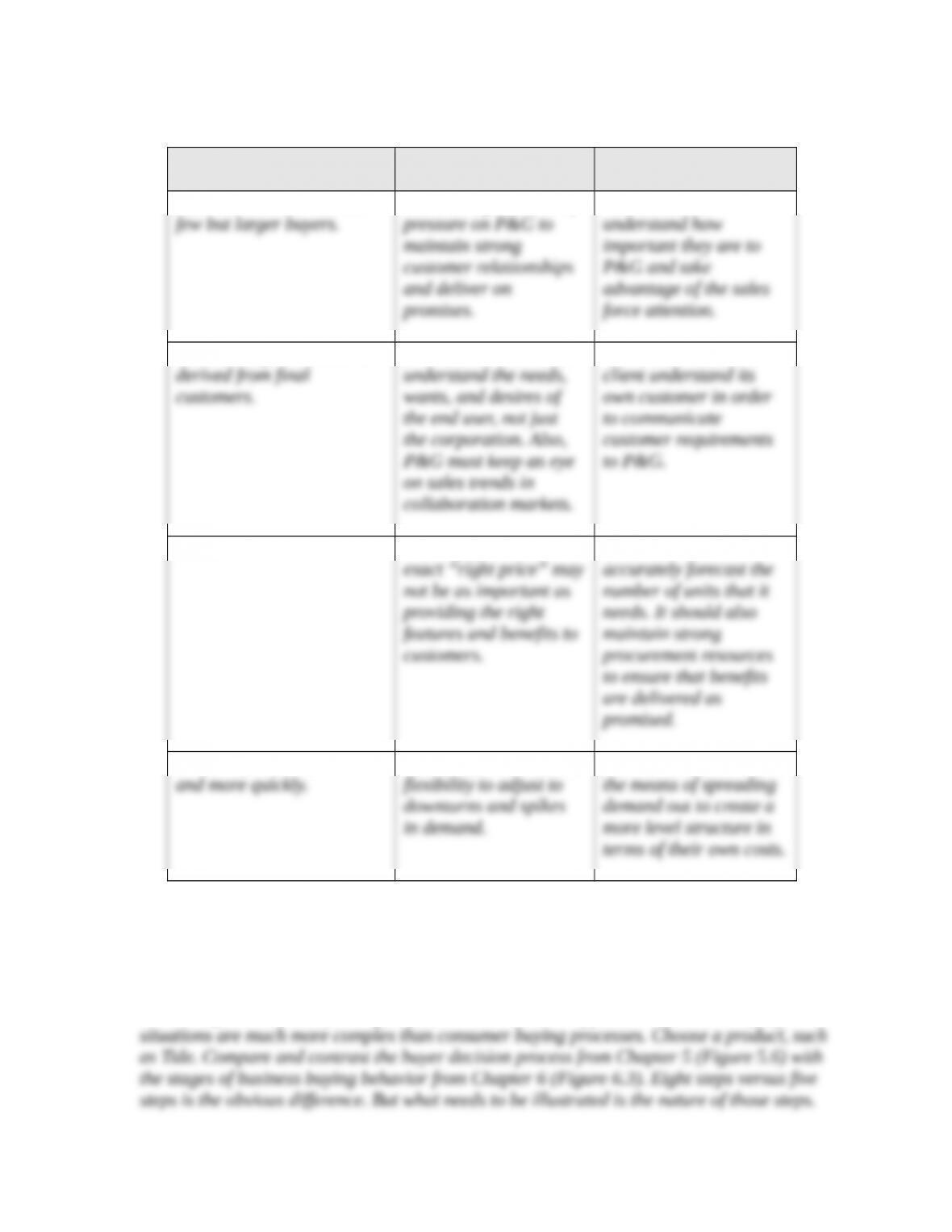
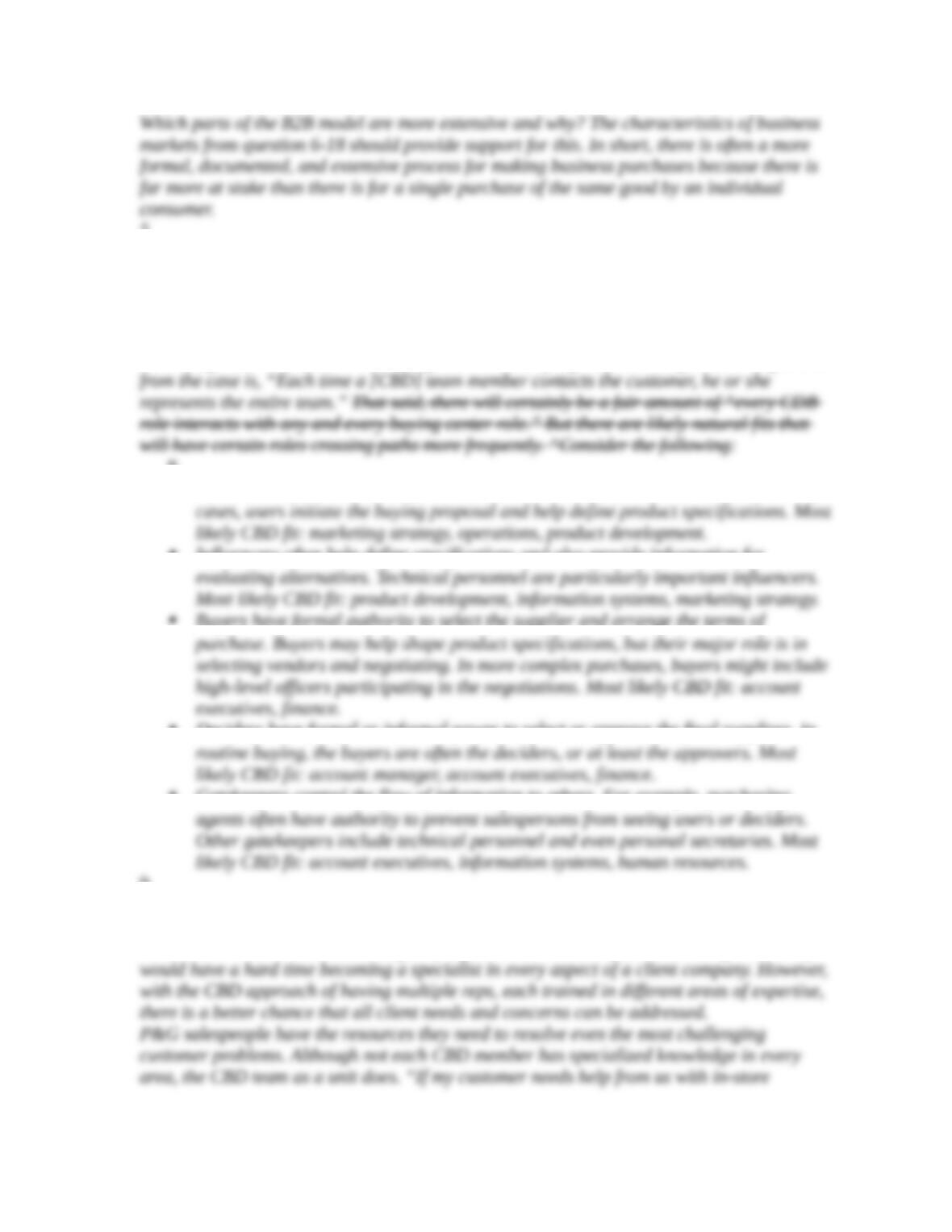
Table 6.1 from the text provides the foundation for discussing this question. The
implications for any and all of these points may be discussed. Suggestions for the points
that are most relevant to this case are given below.
Copyright© 2018 Pearson Education
1. ============================================================
2.
3. 6-19 For the same product, discuss the differences in the types of decisions and the
decision process for business and consumer markets.
4. Through discussion of this question, it should become apparent that P&G’s buying
Copyright© 2018 Pearson Education
Implications for P&G Implications for clients
Business markets contain
There is a great deal of
Clients should
Business buyer demand is
It is essential that P&G
It is essential that the
Demand is more inelastic. Coming up with the
The client must
Demand fluctuates more
P&G needs to maintain
Clients need to consider
5.
6. 6-20 This case covers the various members of a P&G Customer Business Development
team. For a P&G corporate client, illustrate how the different roles of the buying center might
interact with that CBD team. Be specific.
7. P&G’s CBD teams are sales oriented while the buying center is purchasing oriented.
Thus, the purpose of this question is to figure out if there are some natural matches between
the selling roles in CBD and the buying roles in the buying center. An important thing to note
8.
Users are members of the organization who will use the product or service. In many
Influencers often help define specifications and also provide information for
Buyers have formal authority to select the supplier and arrange the terms of
Deciders have formal or informal power to select or approve the final suppliers. In
Gatekeepers control the flow of information to others. For example, purchasing
9.
10. 6-21 Discuss some ways that P&G’s CBD structure is more effective than a single sales
rep.
11. This boils down to the advantages of a generalist versus a specialist. A single sales rep
Copyright© 2018 Pearson Education
12.
13. 6-22 Why have P&G’s competitors not been able to duplicate its customer relationship
strategy?
14. P&G has developed CBD over decades. It is complex, requires resources, and requires a
15.
16. 6-23 Will P&G’s divestment of 100 brands pay off? Why or why not?
P&G is a master at managing brands. Based on that alone, it is hard to imagine that the
company would make a move like this if it were not very confident that it would pay off.
Consider the following reasons for this move, and it becomes even more likely that the
return-on-divestment will be strong:
The 65 brands not sold off were the strongest performing, responsible for 90 percent
Resources allocated to the divested brands can be reassigned to the retained brands
Managing fewer brands is easier.
The weaker brands accounted for an overall flattening out of P&G’s financial
The now leaner brand portfolio is a much better fit with P&G’s approach to strategic
17.
18.
19. Teaching Suggestions
20.
21. To get the discussion started, show this P&G produced recruiting video
22.
This case was developed for use with Chapter 6. This case also works well with the sales
chapter (Chapter 16).
23.
24. Go to mymktlab.com for the answers to the following assisted-graded writing
questions:
25.
26. 6-24 What is supplier development and why are companies practicing it?
Copyright© 2018 Pearson Education
27.
28.
29. 6-25 Describe how online purchasing has changed the business-to-business marketing
30. process and discuss the advantages and disadvantages of electronic purchasing.
31.
32. ADDITIONAL PROJECTS, ASSIGNMENTS, AND
EXAMPLES
33.
34.Projects
35.
1. Identify a product that is bought and sold in a business-to-business context. Identify
individuals within the buying organization who fulfill the different roles of the buying
center. Identify as many for each role as possible, doing research where necessary. Point
out how some individuals might play more than one role. Is there a relationship between
some of the roles? Is that relationship always present?
2. Interview a purchasing agent from a company with regard to the major types of buying
situations. Have him or her identify at least one example for each of the three major
types. What are the main differences for them in these types of buys?
36.
37.Small Group Assignments
38.
1. Form students into groups of three to five. Each group should read Real Marketing 6.1:
International Marketing Manners. Then, answer the following questions and share their
answers with the class.
a. What can be done to keep us all from becoming “ugly Americans”?
b. What does the saying “When in Rome, do as the Romans do” mean to American
businesses? Provide an example or two.
c. Go online and further research business customs for any of the countries mentioned in
Real Marketing 6.1. What else did you discover about their practices that Americans
should know?
39.
2. Form students into groups of three to five. Each group should read Real Marketing 6.2:
GE: A Model for B-to-B Digital and Social Media Marketing. Then, answer the following
questions and share their answers with the class.
a. Try to imagine the profile of the typical business buyer. How might that person differ
from the social media users you know at your college or university? How could these
differences affect the content and messaging you create on social media sites designed
for business customers?
b. Does it surprise you that the business community has embraced social media on such
a large scale? Why or why not?
c. Discuss a few of the marketing tasks for which social media is particularly well suited
to serve the business market.
40.
41.Individual Assignments
42.
Copyright© 2018 Pearson Education
1. Read Real Marketing 6.1: International Marketing Manners, and then answer the
following questions.
a. What is the “ugly American”?
b. How has American business gotten to the point where we believe everything should
be “American” when we travel? What does this say about us as a society?
c. Find a classmate from another country and speak with him or her about their
country’s customs. Which ones translate to business settings? What else did you learn
from this exercise?
43.
2. Read Real Marketing 6.2: GE: A Model for B-to-B Digital and Social Media Marketing.
Then, answer the following questions.
a. When customers choose GE, what are they purchasing beyond an actual piece of
equipment? What does it mean to be an “industrial infrastructure company?”
b. Analyze the quote, “We are selling business-to-people.” What does it mean for
anyone engaged in B-to-B marketing?
c. Do you believe that digital and social marketing are passing B-to-B fads, or are they
here to stay? Explain your answer.
44.
45.Think-Pair-Share
46.
47. Consider the following questions, formulate an answer, pair with the student on your
right, share your thoughts with one another, and respond to questions from the instructor.
48.
1. What are the primary differences between the consumer market and the business market?
2. What are the roles in the business purchase decision process? Can these same roles be
applied in the consumer decision process? Give a detailed example.
3. What are the advantages to business buying on the Internet?
4. How might a government buyer differ from a non-government institutional buyer?
49.
50. Outside Examples
51.
1. Intel microprocessors power just about all of the personal computers on the planet. Take a
look at Intel’s homepage and go to the section pertaining to the company
52.
53. Possible Solution:
54.
55. A review of this website provides a substantial amount of information regarding
Intel’s clients. Specifically, students will find that Intel does not sell to resellers directly.
Intel has made a practice of selling only to a limited number of distributors. Any
company wishing to use Intel microprocessors is encouraged to contact and work through
the authorized distributor.
56.
Copyright© 2018 Pearson Education

2. Walmart goes to great lengths to develop suppliers. Imagine you are a small manufacturer
of a new product and you want to sell to Walmart. How would you accomplish this feat?
(Go to http://walmartstores.com/suppliers/ for information to assist your work.)
57.
58. Possible Solution:
59.
60. This website gives potential suppliers everything they need to know to submit a
successful proposal to Walmart. Given that the students are to imagine themselves as a
small manufacturer, they will most likely make the decision to try and become a “local
supplier.” It is important for students to gain an understanding of the complexity involved
in business marketing. Additionally, it is just as important for them to realize that even a
small company has the potential to compete for business with a major national
organization.
61.
62.
Copyright© 2018 Pearson Education