END OF CHAPTER MATERIAL
Discussion Questions
4-1 What is big data, and what opportunities and challenges does it provide for marketers?
(AACSB: Communication; Reflective Thinking)
4-2 Explain how marketing intelligence differs from marketing research. Which is more
valuable to a company? Why? (AACSB: Communication; Reflective Thinking)
4-3 What is customer relationship management (CRM)? How are firms integrating this
information into their marketing and general business practices? Provide an example of CRM
in a firm. (AACSB: Communication, Reflective Thinking)
4-4 Marketers make heavy use of both primary and secondary data. What is primary data? What
is secondary data? What are possible benefits or drawbacks of using each of these data types?
(AACSB: Communication, Reflective Thinking)
Answer:
Primary data consist of information collected for the specific purpose at hand. Secondary
Benefits of primary data: It has been collected for a specific purpose, to gather certain
information. Marketers have greater control over the data collection and research process and
Copyright© 2018 Pearson Education
4-5 What are the similarities and differences when conducting research in another country versus
the domestic market? What research strategies might a company use to address the
differences in various markets? (AACSB: Communication; Reflective Thinking)
Answer:
International researchers follow the same steps as domestic researchers, from defining the
In many foreign markets, the international researcher may have a difficult time finding good
secondary data. Whereas U.S. marketing researchers can obtain reliable secondary data from
Because of the scarcity of good secondary data, international researchers often must collect
Cultural differences from country to country cause additional problems for international
researchers. Language is the most obvious obstacle. For example, questionnaires must be
prepared in one language and then translated into the languages of each country researched.
Critical Thinking Exercises
4-6 In a small group, identify a problem faced by a local business or charitable organization
and propose a research project addressing that problem. Develop a research proposal that
Copyright© 2018 Pearson Education

implements each step of the marketing research process. Discuss how the research results
will help the business or organization. (AACSB: Communication; Reflective Thinking)
4-7 Suppose you are conducting market research for your favorite soda brand. Sales have been
lagging for two quarters, and you are determined to find out why. You decide to host an
in-person focus group to gain customer insights into your brand’s current product offerings.
You are also interested in obtaining feedback on a new product that your brand plans to
launch in the next six months. Determine the makeup of your focus group. Who should be
invited to the focus group, and why? What types of information would you want to obtain?
Identify possible questions to present to the focus group. (AACSB: Communication;
Reflective Thinking)
Answer:
Student answers will vary, but should discuss some of the following issues.
The target population for the focus group will be consumers that already use the product.
As a market researcher, the job is to find out what consumers really think. The first issue
would be finding out why sales are down. Is it because consumers no longer like the product?
Does it taste bad? Is it because of the ingredients it contains? Is it because they are
consuming less soda or have made a lifestyle change to become more health-conscious? Is
the price too high? Has there been an economic downturn leaving consumers with less
discretionary money to spend? Have all soda brands experienced this sales lag, or is it just
your brand? Market researchers will want to dig into spending habits and consumption
patterns of the focus group.
Regarding the new product being tested with the focus group, providing samples will result
in obtaining valuable feedback. Asking the group what they think about the product’s taste,
packaging, pricing, and where they would prefer to purchase the product are key questions.
Asking for feedback about possible promotional strategies would obtain effective ideas to
target consumers.
As a way to thank the focus group participants for their time and feedback, consider offering
a gift card or another form of an honorarium to demonstrate the value of their participation in
the focus group process.
4-8 Conduct an online search to learn more about the marketing research industry. Develop a
presentation describing the variety of jobs in the marketing research field along with the
compensation for those jobs. Create a graphical representation to communicate your findings.
Copyright© 2018 Pearson Education
(AACSB: Communication; Use of IT; Reflective Thinking)
Answer:
Students’ answers will vary depending upon the websites they access.
APPLICATIONS AND CASES
Online, Mobile, and Social Media Marketing: The Trail You Leave Behind
Marketers are always interested in collecting as much valuable data as possible regarding
customer likes, preferences, and trends. Web activity and social media platforms such as Twitter,
Facebook, Instagram, and various blog sites are gold mines for marketers. All of these access
points create information that can be aggregated and used to a company’s competitive advantage,
which allows firms to stay in tune with what is currently trending in the marketplace. Businesses
can also use these same access points to track competitor activity, which can then be used in
competitive marketing intelligence.
4-9 Have you ever thought about the data you leave behind for marketers to collect? Marketers
are always looking for digital footprints, which are traceable sources of online activities. Visit
www.internetsociety.org/your-digital-footprint-matters and review the various resources
available. Select one of the tutorials and present what you learned from the video. (AACSB:
Communication, Use of IT, Reflective Thinking)
Answer:
Student answers will vary based on the tutorial they choose. Several possible links are:
Copyright© 2018 Pearson Education
4-10 After reviewing the tutorials on
http://www.internetsociety.org/your-digital-footprint-matters, do you plan to alter your online
habits? Are you concerned about your digital footprint and the data trail you leave behind,
and do you plan to actively manage them? Why or why not? (AACSB: Communication, Use
of IT, Reflective Thinking)
Answer:
After watching the following video: How Can I Manage My Digital Footprints?
Marketing Ethics: Metadata
Everyone generates metadata when using technologies such as computers and mobile devices to
search, post, tweet, play, text, and talk. What many people don’t realize, however, is that this
treasure trove of date, time, and location information can be used to identify them without their
knowledge. For example, in analyzing more than a million anonymous credit card transactions,
researchers at the Massachusetts Institute of Technology were able to link 90 percent of the
transactions to specific users with just four additional bits of metadata, such as user locations
based on apps such as Foursquare, the timing of an activity such as a tweet on Twitter, or playing
a mobile game. Since there are more mobile devices than there are people in the United States,
and 60 percent of purchases are made with a credit card, marketing research firms are gobbling
up all sorts of metadata that will let them tie a majority of purchase transactions to specific
individuals.
4-11 Describe at least four applications you use that provide location, time, and date information
that can be tied to your identity. (AACSB Communication; Reflective Thinking)
Answer:
Student answers will vary based on their online habits and device usage. Many mobile device
4-12 Debate whether it is ethical for marketers to use metadata to link individual consumers
with specific credit card transactions. (AACSB: Communication; Ethical Reasoning)
Answer:
Student answers will vary. Some of the information that may be presented may come from
Copyright© 2018 Pearson Education
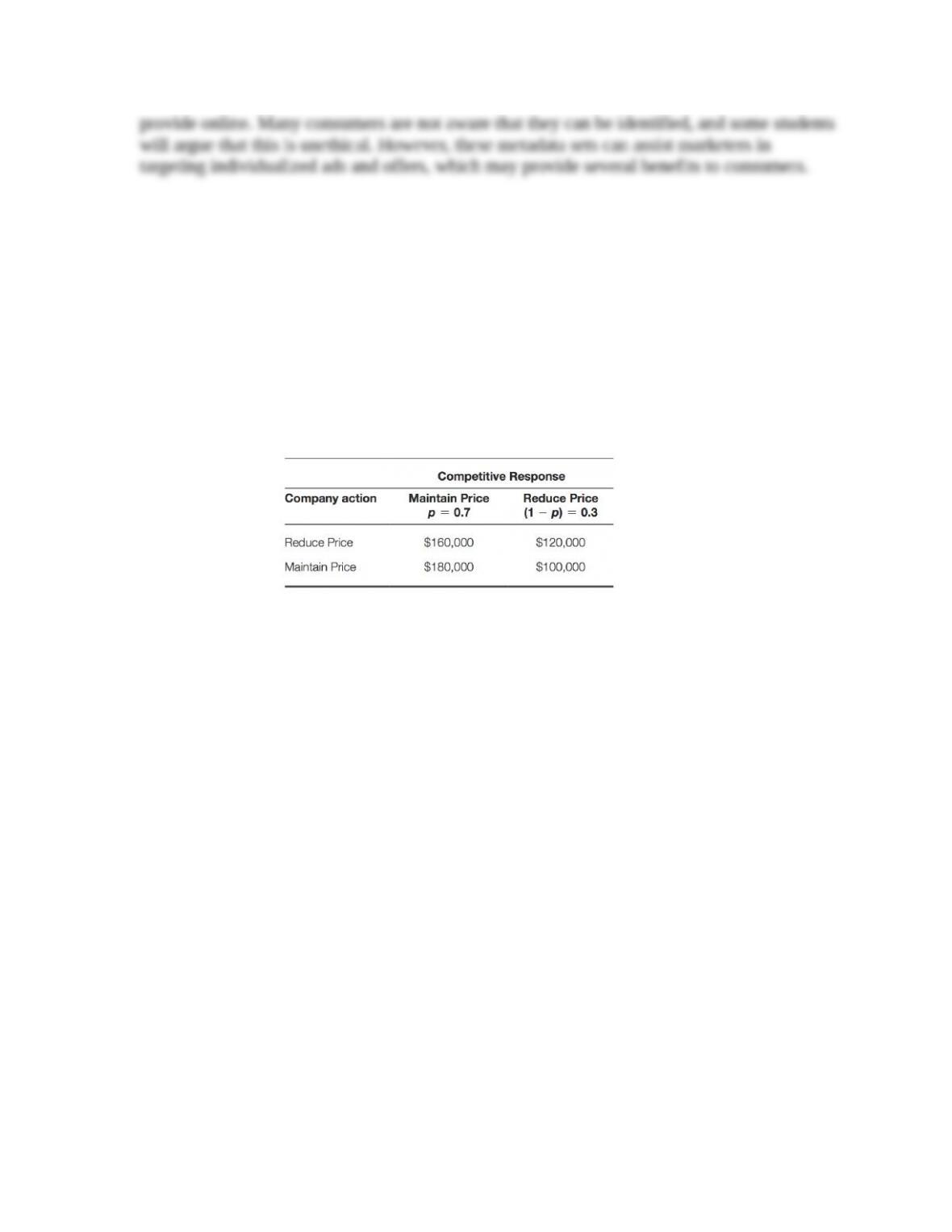
Marketing by the Numbers: The Value of Information
Conducting research is costly, and the costs must be weighed against the value of the information
gathered. Consider a company faced with a competitor’s price reduction. Should the company
also reduce price in order to maintain market share, or should the company maintain its current
price? The company has conducted some preliminary research showing the financial outcomes of
each decision under two competitor responses: the competition maintains its price or the
competition lowers its price further. The company feels pretty confident that the competitor
cannot lower its price further and assigns that outcome a probability (p) of 0.7, which means the
other outcome would have only a 30 percent chance of occurring (1 – p = 0.3). These outcomes
are shown in the table below:
For example, if the company reduces its price and the competitor maintains its price, the
company would realize $160,000, and so on. From this information, the expected monetary value
(EMV) of each company action (reduce price or maintain price) can be determined using the
following equation:
EMV = (p)(financial outcomep)+ (1 – p)(financial outcome(1 – p) )
The company would select the action expected to deliver the greatest EMV. More information
might be desirable, but is it worth the cost of acquiring it? One way to assess the value of
additional information is to determine the expected value of perfect information (EMVPI),
calculated using the following equation:
EMVPI = EMVcertainty – EMVbest alternative
where EMVcertainty = (p) (highest financial outcomep)+ (1 – p) (highest financial outcome(1 – p) )
If the value of perfect information is more than the cost of conducting the research, then the
research should be undertaken (that is, EMVPI 7 cost of research). However, if the value of the
additional information is less than the cost of obtaining more information, the research should
not be conducted.
4-13 Calculate the expected monetary value (EMV) of both company actions. Which action
should the company take? (AACSB: Communication; Analytical Reasoning)
Copyright© 2018 Pearson Education

Answer:
4-14 What is the expected value of perfect information (EMVPI)? Should the research be
conducted? (AACSB: Communication; Analytical Reasoning)
Answer:
Company Case Notes
Campbell Soup Company: Watching What You Eat
Synopsis
The Campbell Soup Company is one of those veteran companies that has been around for a long
time. And, there isn’t a product category much older than “soup.” But Campbell has maintained
growth and dominance by maintaining a strong marketing research focus. This case highlights
how Campbell has gone beyond traditional paper and pencil survey methods by employing
state-of-the-art neuroscience methods as well as contemporary “deep dive” ethnographic
methods.
Teaching Objectives
The teaching objectives for this case are to:
1. Introduce students to the concept of a marketing information system.
2. Illustrate the importance of a marketing research plan.
3. Explore non-traditional methods for marketing research.
4. Gain perspective for integrating traditional and non-traditional research methods.
Discussion Questions
Copyright© 2018 Pearson Education
4-18 What are the strengths and weaknesses of the Campbell Soup Company’s marketing
information system?
Based on the information provided in this case, it is difficult to find weaknesses in
On the other hand, the marketing research program Campbell’s has developed is clearly a
strong point and the basis for a strong marketing information system. The strengths of this
marketing research program are explored in the following questions.
4-19 What objectives does Campbell have for the marketing research efforts described in this
case?
The front portion of the case outlines specific challenges faced by CEO Denise Morrison.
4-20 Compare the effectiveness of Campbell’s biometric research with its deep dive research.
These are two entirely different animals, each effective at different things. The biometric
4-21 Describe how traditional marketing research could be integrated with Campbell’s research
efforts from this case.
Campbell uses all three types: deep dive, biometric, and traditional survey work. There are
Teaching Suggestions
As the case points out, no one covets soup. It is a staple that many people love, but they take it
for granted. Begin this case discussion by asking students, “What comes to mind when you think
about ‘soup’”? Let student responses drive the discussion. But steer the discussion to bring out
Copyright© 2018 Pearson Education
the emotions that students feel about soup. At the same time, ask them how often they buy soup.
Is this a regular item they purchase or consume? Why or why not?
This case was developed for use with Chapter 4. This case also works well with the customer
value chapter (Chapter 1).
Go to mymktlab.com for the answers to the following Assisted-graded writing questions:
4-22 What is neuromarketing and how is it useful in marketing research? Why is this research
approach usually used with other approaches?
4-23 Describe an example in which marketing research could cause harm to participants. Many
companies have a review process similar to that required for following the government’s
“Common Rule.” Write a brief report explaining this rule and how you would apply it to your
example.
ADDITIONAL PROJECTS, ASSIGNMENTS, AND EXAMPLES
Projects
1. Secondary data consists of information that already exists, having been collected for another
purpose. What are some secondary data sources you might take a look at if you were helping
your college or university develop a recruitment strategy?
2. Observational research involves gathering primary data by observing people. Do you see any
potential ethical conflicts with its use?
3. Why would you want to (or not want to) use a mail questionnaire to reach Generation Y
individuals? Give both pros and cons.
4. Focus group interviewing can be an effective interview technique. Under what situations
does it make sense to use this technique?
Small Group Assignments
1. Form students into groups of three to five. Each group should read the opening vignette to
the chapter on The LEGO Group. Each group should answer the following questions.
In this case, did LEGO’s approach to marketing research follow a traditional
marketing research approach or was it a more “contemporary” approach? Explain.
Discuss the key social marketing research tools that The LEGO Group utilized in
researching customer insights. What other tools would you have used, and how would
you use them?
How has the new LEGO approach to toy sets worked with people you know? Does it
have an appeal it did not have before? Do you believe the image of the company has
changed because of the research and new products? Why or why not?
What are some other possible advertising themes you might develop based on
LEGO’s discoveries from its customer insight research?
Copyright© 2018 Pearson Education

2. Form students into groups of three to five. Develop a short questionnaire (seven questions)
designed to determine a respondent’s favorite social media site and the reason why it is the
favorite.
Individual Assignments
1. Take a look at Apple’s Web site (www.apple.com). Examine the pages that discuss the
iPhone 7. What customer insights do you believe Apple paid attention to in the redesign of
its famous mobile device?
2. Construct two simple, 5-question surveys that examine student’s attitudes toward life at your
university. One survey should contain open-ended questions only and the other only
closed-ended questions. Be careful of your wording. Which of the two surveys do you
believe would provide the greatest depth of information? Why?
Think-Pair-Share
Consider the following questions, formulate answers, pair with the student on your right, share
your thoughts with one another, and respond to questions from the instructor.
1. What are the four steps of the marketing research process?
2. What are the differences between causal, exploratory, and descriptive research methods?
3. Why does it make sense to use secondary data before you turn to primary data?
4. What are some of the more substantial drawbacks of observational research?
Outside Examples
1. Secondary data consist of information that already exists somewhere, having been collected
for another purpose. One of the main sources of secondary data is the U.S. Census. Take a
look at the 2010 Census (http://www.census.gov/2010census/). Find data that is relevant to
your home state and/or community. How reliable or accurate do you believe that information
to be?
2. Using observational research, gather data on your roommate’s eating habits. What do your
findings tell you? More importantly, what do your findings NOT tell you about his/her eating
habits?
Possible Solution:
Students will come up with a variety of observations. It is important to pay attention to what the
students believe they are discovering about their roommate’s eating habits. They will be able to
Copyright© 2018 Pearson Education

Copyright© 2018 Pearson Education