END OF CHAPTER MATERIAL
Discussion Questions
3-1 Name and describe the types of publics in a company’s marketing environment. (AASCB:
Communication)
Answer:
The company’s marketing environment includes various publics. A public is any
group that has an actual or potential interest in or impact on an organization’s ability to
achieve its objectives. We can identify seven types of publics:
.Financial publics. This group influences the company’s ability to obtain funds. Banks,
.Media publics. This group carries news, features, editorial opinions, and other content. It
.Internal publics. This group includes workers, managers, volunteers, and the board of
3-2 What are marketing intermediaries, and are they important for marketers? (AACSB:
Communication; Reflective Thinking)
Answer:
Marketing intermediaries help the company promote, sell, and distribute its products to
Copyright© 2018 Pearson Education
3-3 Describe Generation Z. What differentiates GenZers from other demographic groups, such
as baby boomers, Generation X, and millennials? (AACSB: Communication; Reflective
Thinking)
3-4 Discuss the impact of the changing age structure of the population on consumer spending
and buying behavior. Why is this trend important to marketers? (AACSB: Communication;
Reflective Thinking)
Answer:
Changes in demographics mean changes in markets, so they are very important to marketers.
The U.S. population contains several generational groups. Here are the four largest groups—
The Gen Xers are a more skeptical bunch. They are sensible shoppers who research products
heavily before they consider a purchase, prefer quality to quantity, and tend to be less
The approximately 82 million Gen Zers make up the important kids, tweens, and teens
Copyright© 2018 Pearson Education
3-5 Why should marketers pay close attention to the cultural environment? (AACSB:
Communication)
Critical Thinking Exercises
3-6 In 1965, more than 40 percent of American adults were smokers. That percentage has now
fallen to less than 18 percent. Tobacco companies have dealt with this threat by developing
new markets overseas and also developing alternative nicotine products such as electronic
cigarettes (e-cigarettes). Research this product and the regulatory environment regarding this
product, then write a report advising tobacco companies on the opportunities and threats
posed by this technology. (AACSB: Communication; Reflective Thinking)
Answer:
Student answers will vary. As this is a fluid area in terms of regulation, sources of
information are changing. One recommended source is the FDA website, which includes
regulations issued in August 2016:
Copyright© 2018 Pearson Education
3-7 Form a small group and discuss cultural trends in the United States. Research one of them in
depth and create a presentation on the trend’s impact on marketing. (AACSB:
Communication; Reflective Thinking)
Answer:
The major cultural values of a society are expressed in people’s views of themselves and
others as well as in their views of organizations, society, nature, and the universe. Trends
3-8 Visit www.causemarketingforum.com to learn about companies that have won Halo Awards
for outstanding cause-related marketing programs. Present an award-winning case study to
your class. (AACSB: Communication; Use of IT)
Answer:
APPLICATIONS AND CASES
Online, Mobile, and Social Media Marketing: Sharing Economy
Changes in the technological environment have created amazing opportunities for new business
models while at the same time threatening traditional ones. For example, Airbnb has shaken up
the hospitality industry by allowing people to rent out spare rooms or their entire homes to
strangers. The Uber and Lyft ride-sharing businesses allow consumers to find a ride from people
looking to earn extra money with their vehicles. And with Uber you don’t have to worry about
having enough cash or giving your credit card to the driver—payments and tips are all done
through the Uber app. Traditional hotel and cab companies are crying foul, claiming that these
businesses are not playing by the same regulatory rules to which they are subject. Others are
concerned about safety amid reports of riders allegedly being attacked, kidnappings, and driver
accidents, questioning the thoroughness of background checks on the 160,000-plus Uber drivers
around the world. Some countries, states, and cities in the United States have banned Uber
because of these issues.
3-9 Describe how Uber’s business model works and the role technology has played in its
Copyright© 2018 Pearson Education
success. What are the arguments for banning these types of businesses? What are the
arguments for defending them? (AACSB: Communication; Use of IT; Reflective Thinking)
Answer:
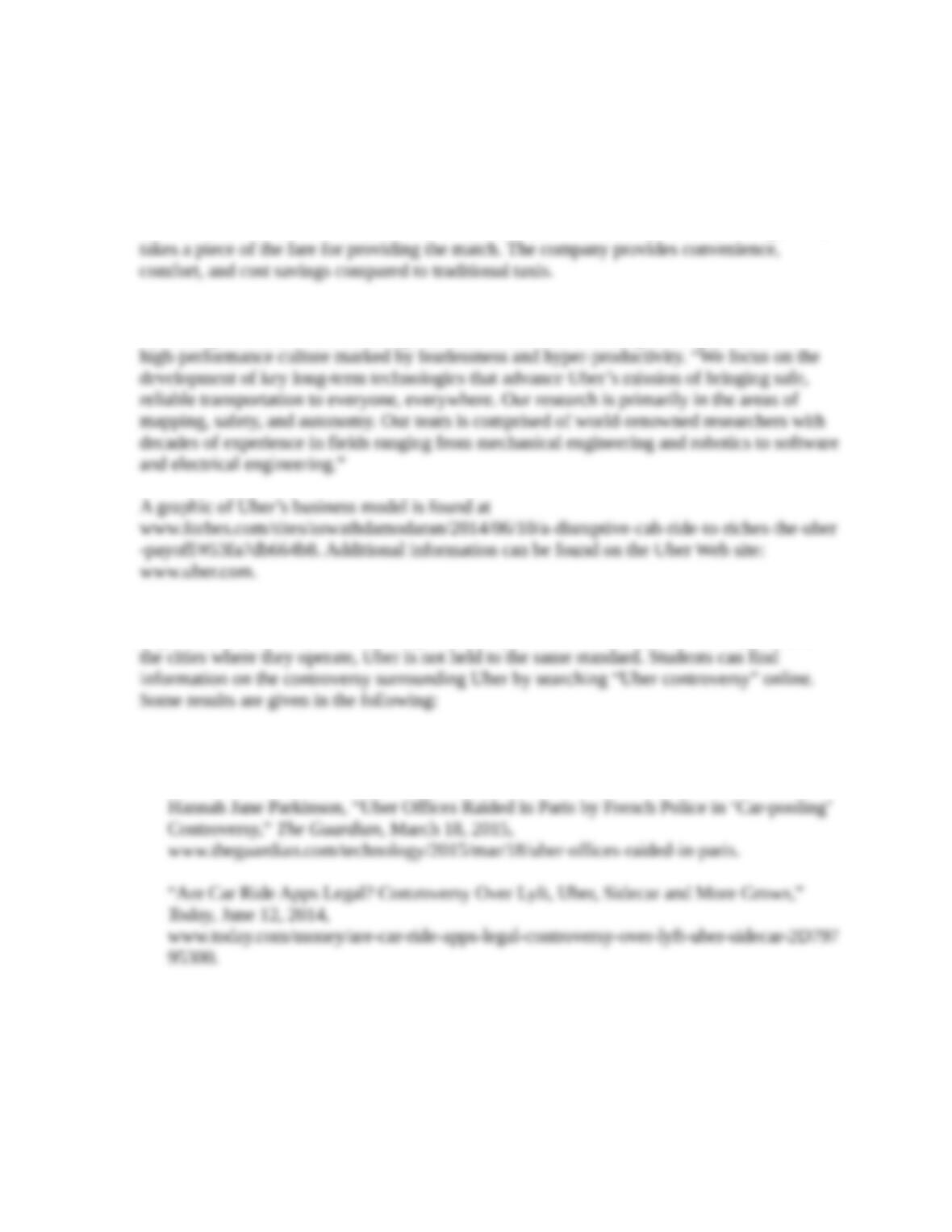
Uber is not in the taxi business; instead it matches drivers in cars to potential passengers and
According to the Web site www.uberatc.com/about, founded in 2015, the Uber Advanced
Technologies Center is the Pittsburgh division of the elite Uber Engineering Team; a
Several issues have surfaced since this non-regulated service began. Taxi services have been
negatively impacted by Uber. Although taxi companies are bound by laws and regulations in
Dara Kerr, “Uber’s Year of Prosperity and Controversy,” cnet, December 26, 2014,
www.cnet.com/news/ubers-year-of-prosperity-and-controversy/.
3-10 Describe examples of two other businesses based on the sharing economy model and create
a new business idea based on this concept. (AACSB: Communication; Reflective Thinking)
Answer:
Copyright© 2018 Pearson Education
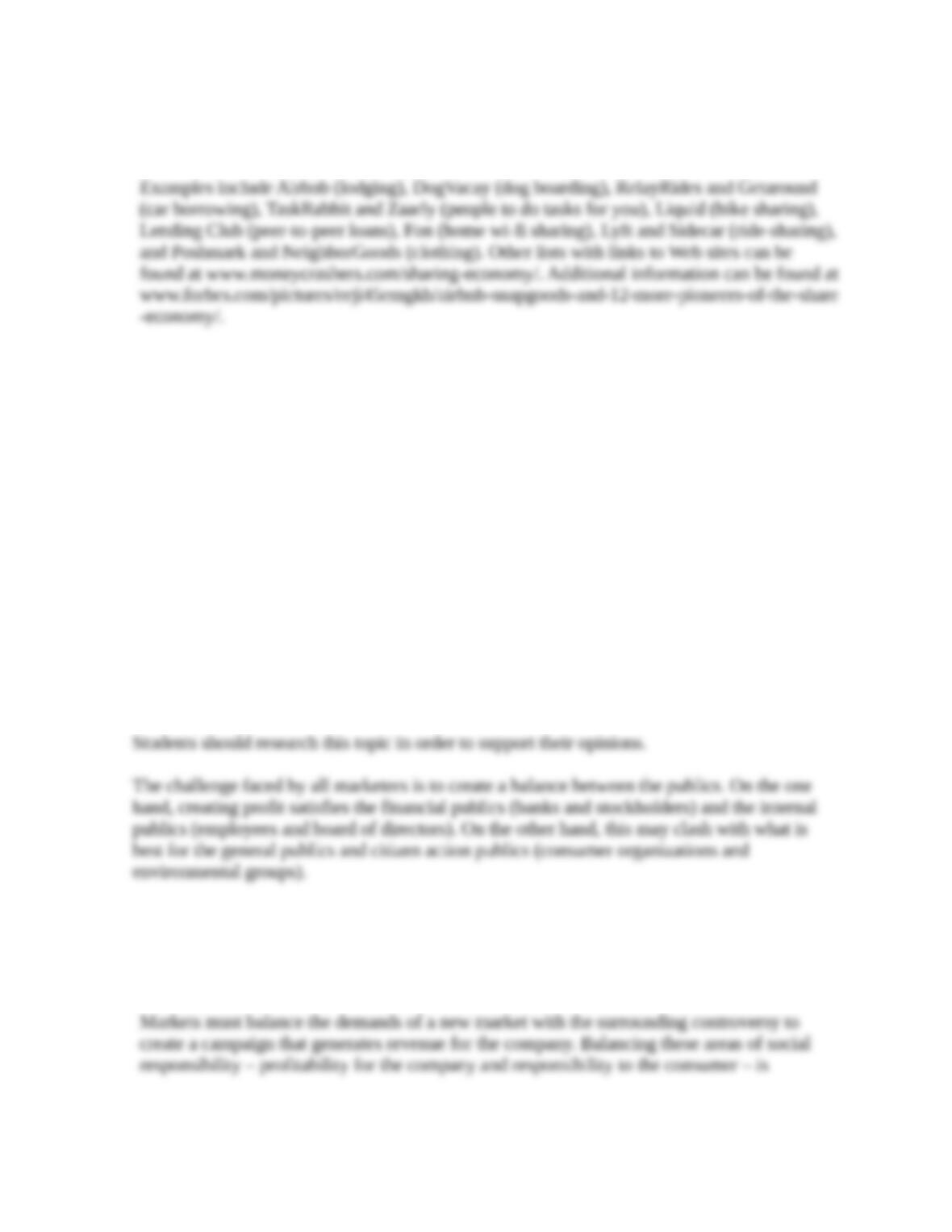
Students can find examples by searching terms such as “sharing economy,” “collaborative
consumption,” or “peer economy.”
Marketing Ethics: How Young Is Too Young?
Walmart rolled out a cosmetics line aimed at girls as young as nine years old. According to The
Wall Street Journal, Walmart introduced this line called geoGirl to meet the demands of “tween”
girls. The geoGirl line was developed free of chemicals (phthalates and parabens), synthetic
colors, and fragrances, allowing marketers to promote the “environmentally friendly” product
offering to parents. Capitalizing on this demand trend, Target launched the Hello Kitty line.
Tween boys are not to be left out: Axe markets a line of chocolate-scented body spray, and Old
Spice developed Swagger body wash. Recently, focus has been placed on girls’ self-images as
they near the teen years. Some child development experts say makeup for young girls places too
much emphasis on appearance while others say a little lipstick shouldn’t cause much concern.
3-11 Is it an appropriate business strategy to use a popular movement such as environmentalism
to market an unrelated product?
Answer:
3-12 Apart from the question of placing undue emphasis on a child’s appearance, what factors
should marketers consider in developing campaigns for these types of products?
Answer:
Copyright© 2018 Pearson Education

Marketing by the Numbers: Demographic Trends
Marketers are interested in demographic trends related to variables such as age, ethnicity, and
population. The U.S. Census Bureau provides considerable demographic information that is
useful for marketers. For example, the following table provides a sample of such population data
(see www.censusscope. org/2010Census/PDFs/RaceEth-States.pdf):
3-13 What percentage change in the total and Hispanic populations occurred in each state
between 2000 and 2010? What conclusions can be drawn from this analysis? (AACSB:
Communication; Analytical Reasoning; Reflective Thinking)
Answer:
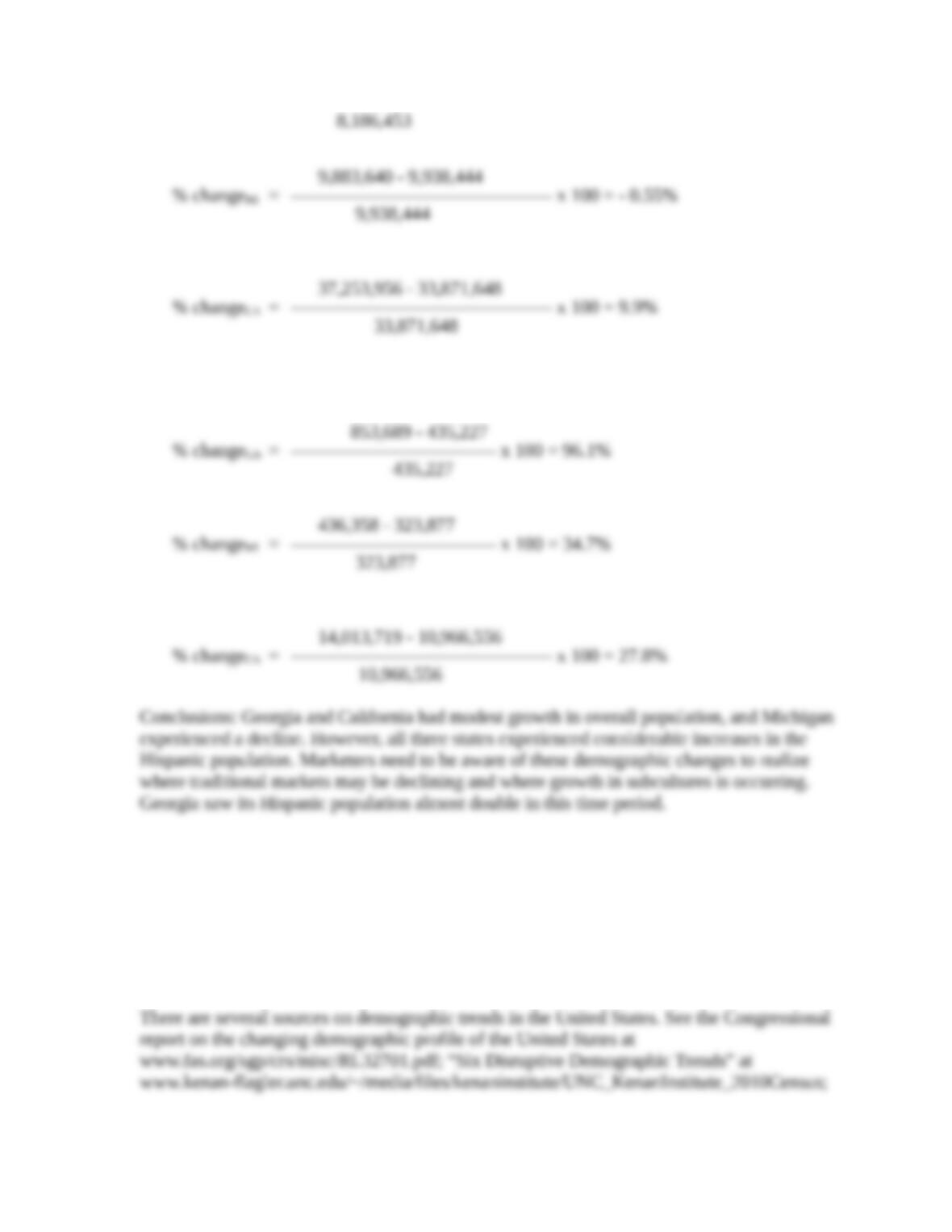
For 2000-2010 percentage change in the Hispanic population by state:
3-14 Research another demographic trend and create a presentation to marketers regarding the
significance of the trend you analyzed. (AACSB: Communication; Reflective Thinking)
Answer:
Students’ responses will vary. Instructors may want to assign specific demographic variables
for students to analyze so that students can learn about a variety of trends.
Copyright© 2018 Pearson Education
Company Case Notes
Fitbit: Riding the Fitness Wave to Glory
Synopsis
This case chronicles how Fitbit went from a tiny startup with little more than a balsa wood box
and a circuit board to the pioneer of one of the hottest tech categories—wearable tech. In just a
handful of years, Fitbit’s product line has expanded, and its revenues have doubled
year-over-year. The company is certainly doing some things right. But it’s also a case of having
the right product at the right time. Based on trends in the marketing environment, Fitbit has
successfully ridden the fitness wave to become a thriving tech company that appears to have a
very promising future.
Teaching Objectives
The teaching objectives for this case are to:
1. Identify how microenvironmental factors can affect a strong, established business.
2. Identify how macronenvironmental factors can affect a strong, established business.
3. Identify strategic issues in responding to environmental factors.
4. Formulate recommendations for a company in crisis.
Discussion Questions
1. What microenvironmental factors have affected Fitbit since it opened for business?
As you discuss both the micro and macro environments, consider a quote from the case:
“To hear Park tell it, ‘It was the right product at the right time at the right price point.’”
There is a certain amount of luck in any business venture. However, it can hardly be said
that Fitbit just fell into success. What can be said is that these two clever founders had
the right idea at the right time. From there, they successfully evaluated the trends and
conditions of the marketing environment to put the pieces together in a way that has
worked.
The Company – New startup company. Hardly a marketing company to begin with,
Marketing intermediaries – This is more challenging than issues with suppliers. As a
Customers – Fitbit clearly has paid attention to customer needs by listening to their
feedback and integrating such needs into successive products.
2. What macroenvironmental factors have affected Fitbit?
Economic – While not discussed, Fitbit launched just after The Great Recession had
Copyright© 2018 Pearson Education
3. How should Fitbit overcome the threats and obstacles it faces?
To a great extent, as it has been in the past—by paying attention to customers, markets,
4. What factors in the marketing environment not mentioned in this case could affect Fitbit?
Teaching Suggestions
Give students a few minutes to respond privately or in small groups to the following questions:
Do you exercise?
How much importance do you place on wellness?
Do you use a wearable fitness device?
What are the biggest reasons why you use one? Or, why have you not adopted one?
For those who own one: What things do you like/not like about your fitness device?
For those who do not own one: What would it take for you to adopt the use of a
wearable fitness device?
Lead a discussion on these questions. Then, transition into a discussion on the Fitbit case.
This case also works well with the consumer behavior chapter (Chapter 5), the new products
chapter (Chapter 9), and the competitive advantage chapter (Chapter 18).
Go to mymktlab.com for the answers to the following Assisted-graded writing questions:
3-21 What is environmental sustainability and why has it grown in importance for marketers?
3-22 Discuss a recent change in the technological environment that impacts marketing. How has
it affected buyer behavior and how has it changed marketing?
ADDITIONAL PROJECTS, ASSIGNMENTS, AND EXAMPLES
Projects
1. Define the marketing environment for Starbucks (www.starbucks.com). Keep in mind that a
company’s marketing environment consists of the actors and forces outside marketing that
affect marketing management’s ability to build and maintain successful relationships with
target customers. (Objective 1)
2. What are the fundamental differences between consumer markets, business markets, and
reseller markets? (Objective 1)
Copyright© 2018 Pearson Education

3. Consider your college/university. What are the publics to which it must pay attention?
(Objective 1)
4. Over 14 percent of the U.S. population moves every year. How is this good for marketers?
(Objective 2)
Small Group Assignments
1. Form students into groups of three to five. Each group should read Real Marketing 3.2: “In
the Social Media Age: When the Dialog Gets Nasty.” Each group should answer the
following questions and share their findings with the class (Objective 3)
a. How has Internet technology, especially social media, shifted the power differential away
from large organizations and toward individual consumers?
b. How has this change enhanced the marketplace for consumers? How might it also
damage the marketplace?
c. As an officer of a major bank or corporation, what would be your philosophical approach
to dealing with highly visible, noisy consumer complaints online? Would you give in to
the angry consumers’ demands every time? Explain.
2. Form students into groups of three to five. Each group should read the opening vignette to
the chapter on Kellogg. Each group should answer the following questions and share their
findings with the class. (Objective 3)
a. How is Kellogg addressing the changing marketing environment?
b. Analyze the company’s attitude toward marketplace change. How has this attitude
impacted its success?
c. Do you believe that Kellogg can regain the stronghold it historically has held in its
markets? Why or why not?
d. In such a rapidly changing marketing environment, what might Kellogg be doing in five
years? Ten years?
Individual Assignments
1. Go online and compare the marketing strategies of McDonald’s (www.mcdonalds.com),
Wendy’s (www.wendys.com), and Burger King (www.burgerking.com). What age group is
each targeting? Do you agree with their strategy?
(Objective 2)
2. Take a look at Apple’s Web site (www.apple.com). What, if anything, do you see them doing
to try and remain successful when the economy softens and consumers become more hesitant
to make purchases? (Objective 2)
Think-Pair-Share
Consider the following questions, formulate and answer, pair with the student on your right,
share your thoughts with one another, and respond to questions from the instructor.
Copyright© 2018 Pearson Education
1. What are the fundamental differences between Generation X and Generation Y?
(Objective 2)
2. How has the typical family changed just in your lifetime? (Objective 2)
3. Overall, the U.S. population is becoming better educated. What implications does this create
for marketers? (Objective 2)
4. What is the one most significant trend in the natural environment, in your opinion, and how
is it impacting marketing activities? (Objective 3)
Outside Examples
1. Take a look at Wendy’s (www.wendys.com). How is this company attempting to set itself
apart from its primary competitors of McDonald’s (www.mcdonalds.com) and Burger
King (www.burgerking.com)? What publics does it appear to be concentrating on? Why
do you believe this is the case? (Objective 1)
Possible solution. Wendy’s positions itself as the homespun, homemade fast-food
hamburger. From a review of its Web site, it becomes evident that Wendy’s is trying to
connect with the everyday American. It portrays a folksier, easygoing personality than
does its primary competitors. Wendy’s concentrates primarily on local publics and the
general public.
2. Most students taking this class and reading the text have probably never watched Spanish
language programming. But as the Hispanic population in the United States has grown at
a feverish pace, one conglomerate has gone about its business quietly. In the process,
Univision Communications, Inc. has the lion’s share of the media market for this
burgeoning demographic group.
Univision’s portfolio includes the television networks Univision, Telefutura, and Galavision. But
the empire also covers other media outlets with Univision Radio, Univision Music Group, and
Univision Online. (Objective 2)
a. Has Univision’s growth and expansion reflected the Hispanic population growth or
facilitated it?
b. What kind of companies should be marketing their products and services on
Univision outlets? Do you think the nature of Spanish language advertising has
changed over time?
Possible Solution:
a. Univision’s growth has both reflected and facilitated the Hispanic population growth
b. Any company interested in reaching this growing market should consider advertising
Copyright© 2018 Pearson Education

Copyright© 2018 Pearson Education