END OF CHAPTER MATERIAL
Discussion Questions
2-1 Define strategic planning and briefly describe the four steps that lead managers and the
firm through the strategic planning process. Discuss the role marketing places in this
process. (Objective 1) (AACSB: Communication).
Answer:
Strategic planning is the process of developing and maintaining a strategic fit between the
Marketing plays a key role in the company’s strategic planning in several ways: (1) it
provides a guiding philosophy—the marketing concept—that suggests the company
strategy should revolve around building profitable relationships with important consumer
2-2 Name and define the four product/market growth strategies in the product/market
expansion grid. Provide an example of a company implementing each strategy. (AACSB:
Communication; Reflective Thinking)
2-3 Describe the differences between a value chain and a value delivery network. (AACSB:
Communication; Reflective Thinking)
Answer:
Each company department can be thought of as a link in the company’s internal value
Copyright© 2018 Pearson Education
2-4 Discuss the elements of the integrated marketing mix. Explain how marketers use these
tools to position products and services. (AACSB: Communication; Reflective Thinking)
2-5 Why must marketers practice marketing control, and how is it done? (AACSB:
Communication)
Answer:
Because many surprises occur during the implementation of marketing strategies and
plans, marketers must practice constant marketing control—evaluating results and
Critical Thinking Exercises
2-6 As a student you have individual experiences with your college or university. These may
include managing the application process, enrolling, orientation, choosing a major,
setting schedules, and many more. Conduct a SWOT analysis for your school from your
perspective. Discuss how your SWOT analysis would provide strategic insight for future
decisions at your college or university. (AACSB: Communication; Reflective Thinking)
Answer:
Students’ analyses and recommendations will vary, but they should be aware of the
elements of a marketing plan. A SWOT analysis evaluates an organization’s overall
Copyright© 2018 Pearson Education
Threats are unfavorable external factors or trends that may present challenges to
performance.
2-7 Examine Starbucks and determine how its marketers have positioned the company
relative to the competition. How has Starbucks used differentiation to create customer
value? (AACSB: Communication)
2-8 Create a mission statement for a nonprofit organization you would be interested in
starting. Have another student evaluate your mission statement while you evaluate the
other student’s statement, suggesting areas of improvement. (AACSB: Communication;
Reflective Thinking)
Answer:
Some organizations define their missions myopically in product or technology terms, but
mission statements should be market oriented and defined in terms of satisfying
APPLICATIONS AND CASES
Copyright© 2018 Pearson Education
Online, Mobile, and Social Media Marketing: Google’s (Alphabet’s) Mission
Founded in 1998 as an Internet search engine, Google’s mission statement remains the same
to this day: to “organize the world’s information and make it universally accessible and
useful.” Google is certainly successful, with revenues growing from $3.2 billion in 2002 to
$74.5 billion in 2015, 90 percent of which comes from advertisers. Google is expanding
rapidly into other areas well beyond its search engine, such as self-driving cars, smart contact
lenses that measure a person’s blood sugar levels, Internet-bearing balloons to create Internet
hotspots anywhere on earth, and even magnetic nanoparticles to search for disease within the
human bloodstream. In fact, Google has innovated into so many diverse new ventures that it
recently created a broader organization—a parent holding company called Alphabet—to
contain them all. Google/Alphabet has been on a buying frenzy recently, purchasing security,
biotech, and robotic companies in a quest to capitalize on the Internet of Things (IoT)
phenomenon. Experts predict there will be 25 million connected devices in our homes and
workplaces by 2020. Google recently announced its new IoT operating system, dubbed Brillo
(after the Brillo scrubbing pad because it is a scrubbed-down version of its Android operating
system), targeted to developers of smart products connected to the Internet, such as ovens,
thermostats, and even toothbrushes. It’s also developed Weave, the corresponding IoT
language that will allow smart products to speak to each other. Perhaps one day you will be
sitting in your Google/Alphabet self-driving car, streaming the news, checking your blood
sugar, and cooling your home by turning down your thermostat on the way home from work.
2-9 Conduct research on Google/Alphabet to learn more about its products and services.
Some say the time has come for Google to create a new mission statement. Do you
agree? Explain. (AACSB: Communication; Reflective Thinking)
Answer:
For a list of Google’s current products, see www.google.com/about/products/. Another
source lists Google’s products as well as discontinued products:
Students could argue that even though Google’s/Alphabet’s products have expanded to
tangible products, the focus is still on making information useful. For example,
Copyright© 2018 Pearson Education
2-10 Create a new mission statement for Google/Alphabet that will take it through the rest of
this century. (AACSB: Communication; Reflective Thinking)
Answer:
Student answers will vary. However, this is an opportunity for the students to review all
the directions in which Google/Alphabet may devote resources in the future. A new
Marketing Ethics: Creating Value or Distracting Consumers?
In early 2014, Chipotle Mexican Grill announced that it would stop using genetically
modified ingredients (GMOs) in its restaurants. Many observers applauded this move.
However, critics of the fast-food chain cited a lack of evidence to support its anti-GMO
stance. They suspected that Chipotle’s anti-GMO claim was simply a ploy to distract
consumers from a larger issue: the company’s risky sanitation practices. Chipotle’s
anti-GMO policies may have won the burrito chain some health-conscious customers, but at
the same time customers were becoming sick after eating at some Chipotle locations, calling
into question the firm’s food handling and safety practices.
Steve Ells, founder and co-CEO of Chipotle, said the GMO decision was “another step
toward the visions we have of changing the way people think about and eat fast food. Just
because food is served fast doesn’t mean it has to be made with cheap raw ingredients, highly
processed with preservatives and fillers and stabilizers and artificial colors and flavors.”
However, ridding Chipotle’s supply chain of genetically altered components proved difficult.
The chain discovered GMOs in basic ingredients such as baking powder, cornstarch, canola
and soy oils, cornmeal, and sugar. And many non-GMO ingredients were in short supply. For
example, at one point, Chipotle found that it could not supply all its locations with enough
non-GMO pork to make carnitas. Given the supply chain challenges, Chipotle decided to use
non-GMO products in its food preparation but to continue to serve some soft drinks with
sweeteners derived from genetically engineered corn.
2-11 Has Chipotle’s focus on eliminating GMOs created value for its customers? Defend this
market strategy. (AACSB: Communication; Ethical Reasoning)
Answer:
Students’ responses will vary, but they should discuss ways Chipotle impacted its value
Copyright© 2018 Pearson Education
Under a company-wide strategic plan, marketing must work closely with other
2-12 From an ethics standpoint, discuss Chipotle’s focus on sourcing non-GMO food
products versus attention to food safety. The company’s oversights in food safety resulted
in numerous customers becoming ill (E. coli, norovirus, and salmonella). Discuss the
challenges Chipotle faces in overcoming the negative image that resulted. (AACSB:
Communication; Reflective Thinking; Ethical Reasoning)
Answer:
Chipotle’s focus was on its health-conscious consumers, specifically those who have
Chipotle’s sales were negatively impacted after directly being linked to several
food-borne illnesses. Its stock price dropped more than 22 percent as a result. Some
Marketing by the Numbers: Apple vs. Microsoft
In 2014, Apple reported profits of more than $50 billion on sales of $182 billion. For that
same period, Microsoft posted a profit of almost $30 billion on sales of $88 billion. So Apple
is a better marketer, right? Sales and profits provide information to compare the profitability
of these two competitors, but between these numbers is information regarding the efficiency
of marketing efforts in creating those sales and profits. Appendix 2, Marketing by the
Numbers, discusses other marketing profitability measures beyond the return on marketing
investment (marketing ROI) measure described in this chapter. Review the Appendix to
answer the questions using the following information from the two companies’ incomes
statements (all numbers are in thousands):
Apple Microsoft
Copyright© 2018 Pearson Education

2-13 Calculate profit margin, net marketing contribution, marketing return on sales (or
marketing ROS), and marketing return on investment (or marketing ROI) for both
companies. Which company is performing better? (AACSB: Communication; Use of IT;
Analytic Thinking)
Answer:
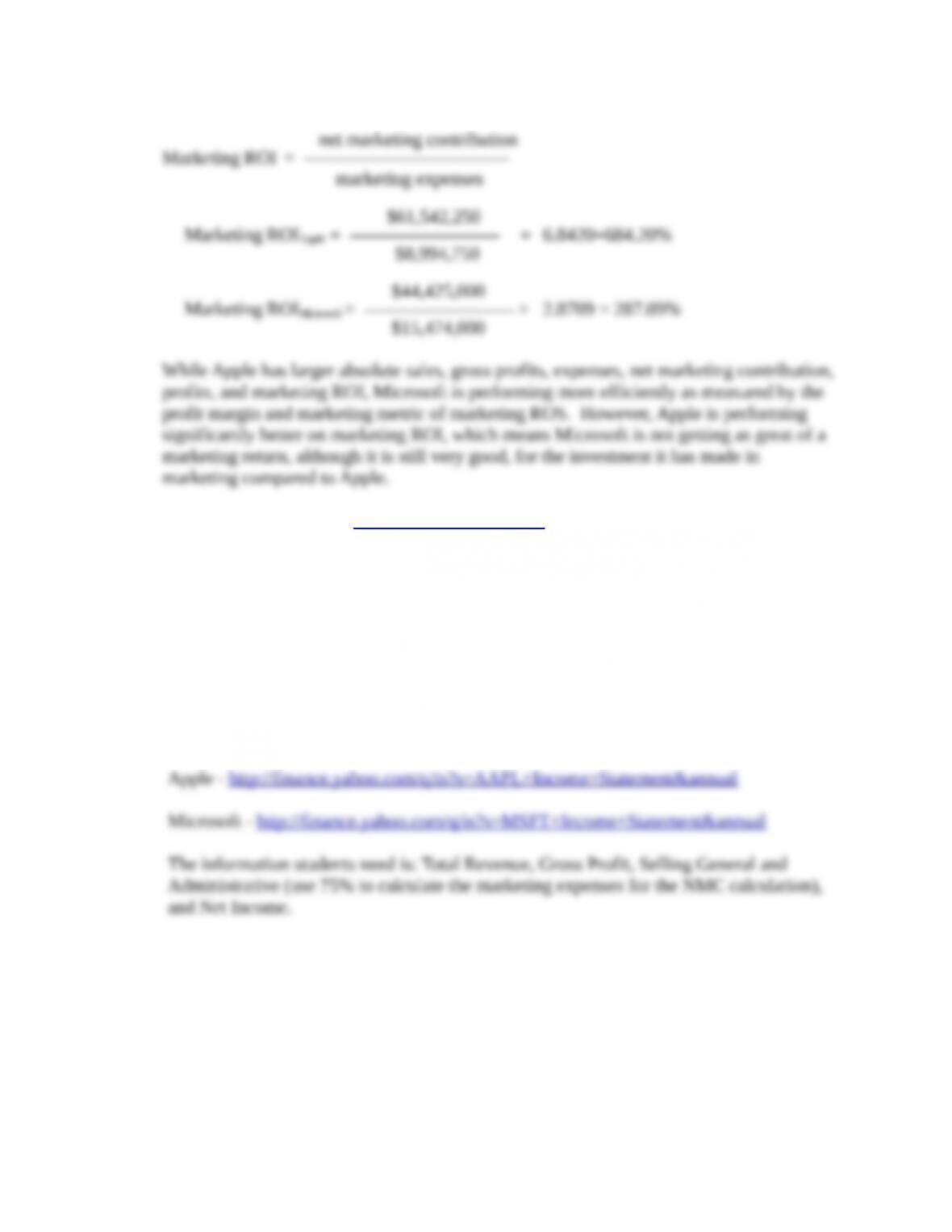
Profit
Net Marketing Contribution (NMC) = net sales cost of goods sold marketing expenses
Because Gross Profit = net sales cost of goods sold, students just need to subtract
marketing expenses from gross profit:
2-14 Go to Yahoo! Finance (http://finance.yahoo.com/) and find the income statements for
two other competing companies. Perform the same analysis for these companies that you
performed in the previous question. Which company is doing better overall and with
respect to marketing? For marketing expenses, use 75 percent of the company’s reported
“Selling General and Administrative” expenses. (AACSB: Communication; Analytic
Reasoning; Reflective Thinking)
Answer:
Students’ answers will vary. The information used in the previous question can be found
at:
Company Case Notes
Facebook: Making the World More Open and Connected
Synopsis
As the world has rapidly adopted social media, Facebook dominates the market. In little more
than a decade, it has accumulated more than 1.6 billion active monthly users—more than 20
percent of the world’s total population—and some 1.5 billion people now access the network
Copyright© 2018 Pearson Education
on a mobile device. More than one billion Facebook members log on daily and five new
Facebook profiles are created every second. In the United States, more collective time is
spent on Facebook than on any other website. Hordes of people have made Facebook their
digital home 24/7. Having achieved such phenomenal impact in such a short period of time,
Facebook’s success can be attributed to tenacious focus on its mission—“to give people the
power to share and make the world more open and connected.”
Teaching Objectives
The teaching objectives for this case are to:
1. Introduce students to the concepts of business and marketing strategy.
2. Highlight the difference between a mission statement and a market-oriented mission
statement.
3. Establish the role of goals and objectives in marketing strategy.
4. Help students understand the importance of the business portfolio in growing a
business.
5. Introduce the marketing mix as a core concept of marketing.
Discussion Questions
2-18 Is Facebook’s mission statement market oriented? Explain.
A market-oriented mission statement is defined in terms of satisfying customer needs.
2-19 How is Facebook’s strategy driven by its mission?
Basically, everything that Facebook has done adheres to the mission of giving people the
power to share and making the world more open and connected. Internal features like
2-20 Is it wise for Facebook to give away it technologies for free? Why or why not?
Different companies have taken different approaches to the “giving it away for free” part
Copyright© 2018 Pearson Education
and done so successfully. Apple is notorious for guarding its technologies and making
them proprietary. In its early years, this hindered its growth. But looking at where Apple
is today, that approach has clearly served it well. Facebook has taken a different
2-21 As it moves forward in fulfilling its mission, what challenges does Facebook face in the
future?
Facebook has had more failures of products and features than it has had successes.
Likely Facebook’s greatest challenge is to avoid the “MySpace” syndrome. That is, the
nature of a social network product is such that users can abandon it as quickly as they
Teaching Suggestions
The only way to really demonstrate the power of Facebook is to take students right inside
that social network that they are all too familiar with. The goal here is to guide them in a way
that will give them a different perspective. To do this, take them inside your own Facebook
page. If this is not possible, prepare ahead of time by asking for a student volunteer to serve
as the tour guide of their own Facebook page. Then ask the following questions to guide the
discussion:
1. How many of you are on Facebook? How many of you check in to it at least a few
times a week? Daily? Why?
2. How is Facebook valuable to marketers?
Copyright© 2018 Pearson Education

This case was developed for use with Chapter 2. This case also works well with the new
products chapter (Chapter 9), the advertising chapter (Chapter 15), and the digital marketing
chapter (Chapter 17).
Go to mymktlab.com for the answers to the following Assisted-graded writing questions:
2-22 How are marketing departments organized? Which organization is best?
2-23 Explain the roles of market segmentation, market targeting, differentiation, and
positioning in implementing an effective marketing strategy.
ADDITIONAL PROJECTS, ASSIGNMENTS, AND EXAMPLES
Projects
1. Pick a company or brand from which you buy frequently. Visit their Web site and find
the portfolio of products/services they sell. Pretend you are the company CEO.
Categorize the products into logical groupings that will become your strategic business
units (SBUs). Using your best judgment, allocate resources, using percentages, not dollar
amounts, to each SBU (make sure the total comes to 100 percent). (Objective 2)
2. Visit the Web site for Food Television’s Rachel Ray (http://www.rachaelray.com/).
Consider the market for television cooking programs. Who do you believe Rachel Ray is
targeting? How is this “product” differentiated in the marketplace? (Objective 4)
3. Get the current issue of Fortune magazine; most college libraries carry it. Read the
cover story and define the four Ps of one of the company’s products mentioned. Then
define the four Cs of the same product. Are there differences? (Objective 4)
Small Group Assignments
1. Form students into groups of three to five. Each group should read the opening
vignette to the chapter on Starbucks. Each group should answer the following
questions and then share their findings with the class. (Objective 1)
a. Define Starbucks’s niche in the coffeehouse marketplace, both in its early
days and today.
b. Discuss the factors that caused Starbucks’s sales to stumble in the mid-to-late
2000s. If you were the CEO at the time, how would you have reversed this
trend?
c. What comes next for Starbucks in the 21st century? What new marketing
strategies might the company develop to remain fresh and relevant?
2. Form students into groups of three to five. Each group should read Real Marketing
2.2 “DuckDuckGo: Google’s Tiniest, Fiercest Competitor”. Each group should then
answer the following questions and share their findings with the class. (Objective 2)
Copyright© 2018 Pearson Education

a. Identify DuckDuckGo’s marketing strategy as it fits into market segmentation,
targeting, positioning, and differentiation, as shown in Figure 2.4, Managing
Marketing Strategies and the Marketing Mix.
b. How has DuckDuckGo been able to compete in an industry that is dominated
by behemoths such as Google and Bing?
Individual Assignments
1. Read the opening chapter vignette on Starbucks. Think about the answers to the
following questions and share your answers with the class. (Objectives 1 and 4)
a. Recap the main points of Starbucks’s Customer-Driven Marketing. How does
it reflect the elements of a customer-driven marketing strategy?
b. In your mind, who was the typical Starbucks customer in the company’s early
days of the 1980s? Who is the typical customer today?
c. If Starbucks were simply a coffee and beverage company, how would you
describe the company’s direction and product offering today?
2. How would you describe a “market niche”? Describe four product/services that you
own or consume that you would consider to be “niche” products. Why do you believe
this to be true? (Objective 2)
Think-Pair-Share
Consider the following questions, formulate an answer, pair with the student on your right,
share your thoughts with one another, and respond to questions from the instructor.
1. Compare the Boston Consulting Group’s portfolio analysis method to the
product/market expansion grid. Which method would you rather use in your own
business? Why? (Objective 2)
2. Why would a focus on the four Cs be more important than the four Ps? What is a
value-delivery network? How does this concept differ from that of the value chain?
(Objective 4)
3. Explain the concept of return on marketing. Why is this important? (Objective 5)
Outside Examples
1. The marketing mix is the set of controllable, tactical marketing tools the firm blends
to produce the responses it wants from the target market. These marketing tools can
all be collected into four sets of variables known as the “four Ps.” Consider
Southwest Airlines (www.southwest.com). Briefly describe the “four Ps” employed
by Southwest. (Objective 4)
Possible Solution:
The product being offered, in the case of Southwest Airlines, is transportation. Just
because it is not a physical entity does not mean it is not a product. Price is the
Copyright© 2018 Pearson Education
2. The marketing mix is composed of the “four Ps.” Take a look at United Airlines
(www.united.com). Let’s concentrate on the P of pricing. Over a two-week period,
track the fares charged for a round-trip ticket between two of your favorite locations
(such as Las Vegas and Chicago). Be certain to keep your departure and return dates
constant so that you can observe how fares change over time. How can you explain
the constant variation in fares? (Objective 4)
Possible Solution:
Copyright© 2018 Pearson Education