END OF CHAPTER MATERIAL
Discussion Questions
18-1 Define competitive advantage. How do companies go about finding their competitive
advantage? (AASCB: Communication)
Answer:
18-2 How does a company identify its competitors? What do marketing managers want to
know about the companies identified as competitors? (AACSB: Communication; Reflective
Thinking)
18-3 Describe the strategies market challengers can adopt and explain why challengers might
have an advantage over market leaders. (AACSB: Communication)
Answer:
These runner-up firms can adopt one of two competitive strategies: They can challenge the
Copyright© 2018 Pearson Education
18-4 What is a market nicher? Discuss the strategies and risks associated with this competitive
position. (AACSB: Communication)
18-5 Compare the evolving company orientations used to adapt to the fast-changing competitive
environment. Is there one orientation that companies should be following? (AACSB:
Communication; Reflective Thinking)
Answer:
Companies might use any of four orientations: product, customer, competitor, or market.
First, they might be product oriented, paying little attention to either customers or
Critical Thinking Exercises
18-6 Form a small group and conduct a customer value analysis for your college or university.
What are the strong and weak competitors? For the strong competitors, what are their
vulnerabilities? (AACSB: Communication; Reflective Thinking)
Answer:
Copyright© 2018 Pearson Education
Students’ answers will vary. Instructors may want to remind students that competition
includes more than just brick-and-mortar colleges and universities. Students should consider
state, private, and online options in their own communities as well as across the country.
18-7 Using the internet, find one company market nicher in each of three different industries.
Identify the competitive strategy each one uses. (AACSB: Communication; Reflective
Thinking)
Answer:
There are market nichers in every industry, so students will come up with a wide variety of
examples. One example of a company in the printing industry using a customer and product
strategy is CS Hyde. See
18-8 The chapter describes Apple, Redbox, and Keurig as examples of companies that have
been successful with a blue-ocean strategy. Find another example of a company that has
successfully pursued a blue-ocean strategy. Explain. (AACSB: Communication; Reflective
Thinking)
Answer: Student answers will vary based on their personal response. Refer to the MyLab for
APPLICATIONS AND CASES
Online, Mobile, and Social Media Marketing: Social Logins
How many times have you left a website or app because of the hassle of setting up a login
account, or because you forgot your username or password for one you had already set up? If
you are like the 90 percent of users bothered by having to log in, you probably just leave the site
and never return. Social networks are helping with that problem by offering social logins on third
party sites and applications. With more than 1.6 billion monthly active, 1.44 billion of whom are
monthly mobile users, Facebook is the largest social network. The company is using that power
to become even more valuable to both users and businesses. Facebook Login allows website
visitors and app users to use their Facebook login credentials to log in other sites and apps
instead of establishing a separate login for each one. Google+, Twitter, LinkedIn, and other social
networks also offer social login capabilities but Facebook is the leader, powering more than half
of all social logins online and more than 60 percent of mobile logins. This seems to be a winning
arrangement for all parties—users conveniently log in to multiple sites with one username and
password, third-party sites and apps gain access to Facebook users’ demographic data, and
Facebook gathers useful information on users’ behavior to better sell advertising.
18-9 How is Facebook Login expanding the total demand for social networks? (AACSB:
Communication; Reflective Thinking)
Copyright© 2018 Pearson Education
Answer:
The ability of internet users to use their logins from their social networks on third-party sites
likely increases their willingness to engage and participate in those sites. This “ease of
18-10 A major criticism of social logins is consumer privacy. How has Facebook addressed this
issue? Do you think it will hurt the company’s competitive advantage in this area? (AACSB:
Communication; Reflective Thinking)
Answer:
Facebook recently announced that users will have greater control over what information is
Marketing Ethics: Creating Competitive Advantage…to What End?
In late September 2015, Volkswagen found itself in the midst of a firestorm. The company, which
captures 70 percent of the U.S. diesel-powered passenger-car market, was caught cheating on
diesel emissions tests. Over the past many years, Volkswagen had installed software on more
than half a million diesel cars in the United States—and roughly 10.5 million more worldwide—
that detected when the cars were undergoing emissions tests and triggered so-called “defeat
devices” that temporarily switched operating modes and allowed them to pass the tests. VW
diesel autos were found to actually be emitting up to 40 times the allowable levels of nitrogen
oxide pollutants.
Volkswagen has long pitched its diesel cars as efficient, non-polluting vehicles. But in 2008,
when U.S. rules on diesel exhaust became stricter, VW faced difficulties meeting the new
standards and living up to its “clean diesel” advertising promises and image. So, under
competitive pressures, it covertly installed the secret “defeat devices.” When the scandal broke,
Volkswagen’s global sales plunged along with its reputation. The company halted sales of
affected diesel models and suspended all of its “clean diesel” marketing and advertising. To
mitigate the damage, Volkswagen created a “Customer Goodwill Package” in which it doled out
$1,000 in cash and dealership purchases to VW diesel owners along with access to free 24-hour
roadside assistance for three years. It also reached a more than $15 billion settlement with U.S.
regulators to cover the costs of possible vehicle buy- backs and other remedial actions. The full
long-run harm to VW’s reputation and market performance remains to be seen.
Copyright© 2018 Pearson Education
18-11 Is Volkswagen a competitor-centered company, customer-centered company, or
market-centered company? Explain your answer. (AACSB: Communication, Reflective
Thinking)
Answer:
Students should discuss ways in which Volkswagen can be viewed as a competitor-centered
company. Competitor-centered companies spend most of their time tracking competitors’
18-12 What competitive thinking moved Volkswagen, one of the world’s major automakers, to
cheat on emission standards rather than comply with them? How could Volkswagen have
prevented this scandal, and what are the lessons for other firms? (AACSB: Ethical
Reasoning, Communication)
Answer:
According to The New York Times, the company culture was “confident, cutthroat, and
insular. Signs of irregularities in Volkswagen cars were first discovered in 2014 by a
Marketing by the Numbers: Market Share
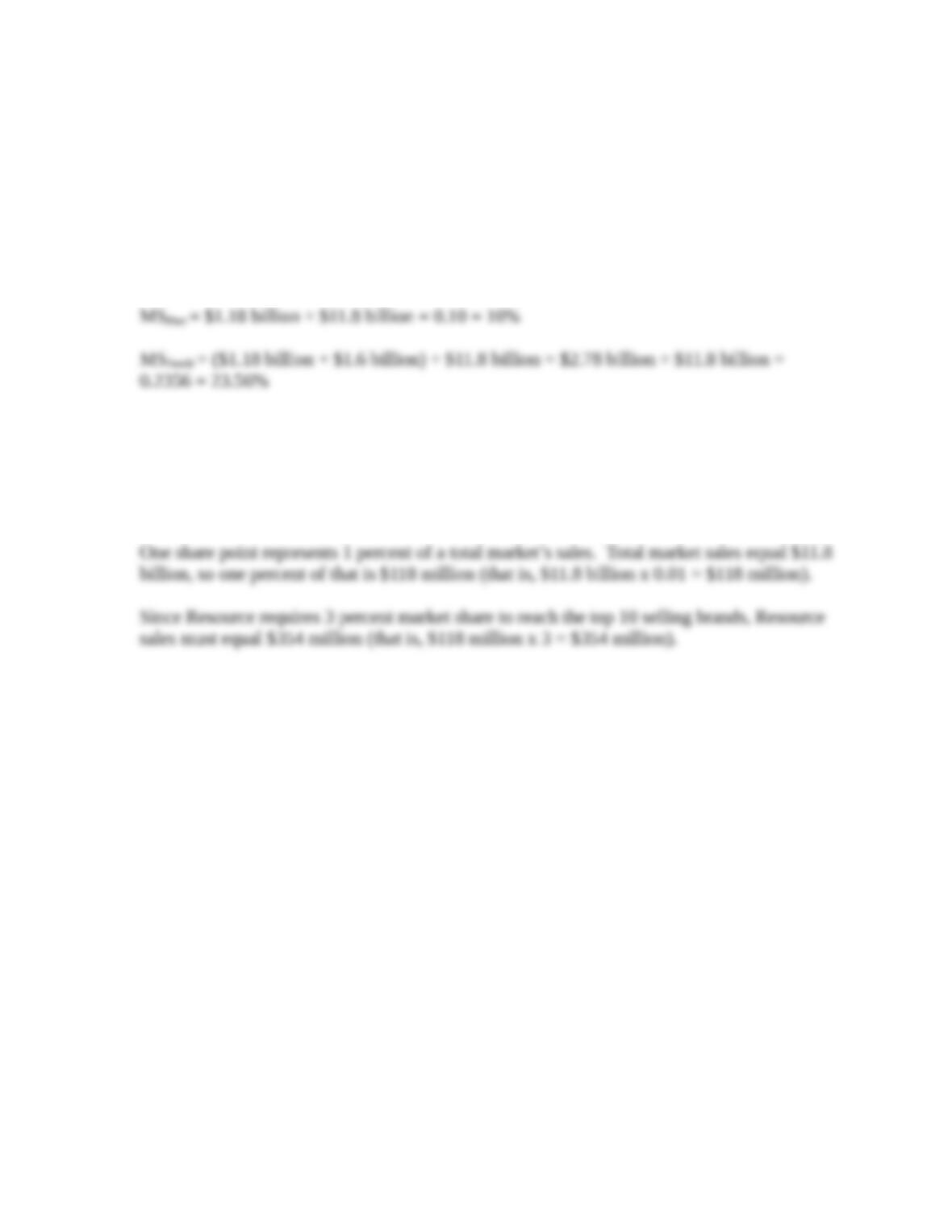
Bottled water is a hot industry with sales of $11.8 billion in the United States. Big players in this
industry include Nestlé, PepsiCo, and Coca-Cola. Nestlé is the market leader with four brands
among the top 10 leading brands. Nestlé’s Pure Life brand was the top-selling brand with sales of
$1.18 billion, but the company’s other brands make up an additional $1.6 billion, giving the
company total overall sales of almost $3 billion. Nestlé saw an opportunity in this market and
launched a new brand called Resource, targeted to affluent women. Resource is fortified with
electrolytes and is promoted as “more than hydration, it’s total electrolytenment.” Nestlé is
attempting to take market share away from Glacéau’s Vitaminwater and Smartwater. If Resource
attains just 3 percent market share, it will be among the top 10 selling brands.
Copyright© 2018 Pearson Education
18-13 Refer to Appendix 2, Marketing by the Numbers, and calculate Nestlé’s Pure Life and the
company’s overall market share in the bottled water industry. (AACSB: Communication;
Analytical Reasoning)
Answer:
Market share = company sales ÷ market sales
18-14 How much revenue does one market share point represent in this industry? Assuming total
market sales remain the same, what sales must Resource attain to be among the top 10 selling
brands? (AACSB: Communication; Reflective Thinking)
Answer:
Company Case Notes
YouTube: Google’s Quest for Video Dominance
Synopsis
YouTube is young, but has already staked a claim in history as the most viewed online video
website in the world. The Google-owned video site has captured 43 percent of the online video
market by successfully navigating the ever-changing marketing environment. YouTube continues
to thrive because it recognized early on that online video was not a static environment. With that
in mind, YouTube’s strategy has not only followed the trends, it has anticipated and even set
them. In addition to the endless hours of user-generated video clips, YouTube boasts full-length
television episodes and movies as well as original content produced through its extensive Partner
Program. YouTube’s goal: to provide something for everyone. It has capitalized on mobile
technologies such that it can be viewed whenever and wherever. But YouTube also aspires to
move beyond the small screen environment and become just as viewed on the big screens of
people’s living rooms. With all this going on, YouTube has already become the world’s first
global TV network.
Teaching Objectives
Copyright© 2018 Pearson Education
The teaching objectives for this case are to:
1. Give students the opportunity to assess the competitive strategy of a fairly new company
that has changed the world.
2. Assess the basic competitive strategies for a company.
3. Consider the nature of a market-centered company and apply it to a major corporation.
4. Analyze a company in terms of competitive advantage.
Discussion Questions
18-18 Define YouTube in terms of competitive advantage.
Competitive advantages: YouTube is free, easy to use, has more engaged users through more
user-generated content than any other site, and is the world’s archive of all things video. As a
result, people rely on YouTube when they want to find a clip of anything. And most of the
time, they find it. YouTube has momentum, and as long as content continues to pile up and
pile on, viewers will continue to go on.
18-19 Of all Google’s competitors, which ones should it attack? Which ones should it avoid?
YouTube reigns supreme in terms of user-generated content (this includes being a venue for
companies to post their own content). There are so many different video sites now, and they
are all narrowing in on different aspects of video. Google must pay attention to—if not attack
—the following:
Netflix – YouTube may still be number one in terms of the number of users and unique
visits (77 percent share. But so far as time spent viewing, Netflix blows it away. Netflix
18-20 Which basic competitive strategy does Google follow?
This is referencing Michael Porter’s three winning strategies (overall cost leadership,
18-21 How would you classify Google in terms of competitive position? Why?
Copyright© 2018 Pearson Education
18-22 Is Google a market-centered company? Support your answer.
There is a great deal of support for Google as a market-centered company. As such, it pays
balanced attention to both customers and competitors in designing its marketing strategies.
Teaching Suggestions
To quickly set up a discussion of YouTube’s changing marketing environment, ask some of the
questions below that will bring out a contrast between the pre-YouTube options for watching
video content and those of today. As the discussion turns toward the YouTube of today, navigate
the website to illustrate. Showing brief portions of YouTube content will help to make it
interesting. But be careful not to let the video take over. Stay focused on the objective of the
discussion and the discussion questions. Be familiar with YouTube’s options and even pre-select
channels and clips to help the discussion move along.
1. How did you watch television and movies when you were growing up?
2. How many of you watch video content on YouTube? What is that experience like and
how does it contrast with the viewing experience of your youth?
3. How does YouTube stack up to other online video viewing options?
This case also works well with the marketing management chapter (Chapter 2), the marketing
environment chapter (Chapter 3), and the direct and online chapter (Chapter 17).
Go to mymktlab.com for the answers to the following Assisted-graded writing questions:
18-23 Explain the difference between a good and a bad competitor.
18-24 Discuss the similarities and differences between Michael Porter’s competitive strategies
and the Treacy and Wiersema “value disciplines.” Which classification of competitive
strategies has more appeal for marketers and why?
ADDITIONAL PROJECTS, ASSIGNMENTS, AND EXAMPLES
Projects
1. For a product category of your choosing, select companies that compete against each
other. Include strong and weak competitors, close and distant competitors, and good and
bad competitors. (Objective 1)
Copyright© 2018 Pearson Education

2. Does an intrapreneurial company always have to pass through the entrepreneurial and
formulated marketing stages? Why or why not? (Objective 2)
3. Apply Michael Porter’s competitive positioning strategies. Find an example of each. Can
you think of an example of a genuine middle-of-the-roader that is successful?
(Objective 2)
4. Research at least one company for each of the Treacy and Wiersema value disciplines.
Write a short paper justifying why each company fits the designation that you suggest.
(Objective 2)
5. Explain the difference between a customer-centered and market-centered company. Find
two examples of each. (Objective 3)
6. What is a competitor-centered company? Give and support three examples. (Objective 3)
Small Group Assignments
1. Form students into groups of three to five. Each group should consider the following
questions, prepare their answers, and share those answers with the class. (Objective 1)
a. What is a strategic group? Your text mentions Tesla in the context of strategic groups.
What strategic group does Tesla belong to? What other companies are in the same
group?
b. What is benchmarking? If you were going to benchmark an automobile, what
automobile would you select and why? If you were going to benchmark a shampoo,
what shampoo would you select and why?
2. Form students into groups of three to five. Each team should consider the following
question, prepare their answer, and share their answers with the class. (Objective 3)
Figure 18.3 shows that companies have moved through four orientations over the years.
Many colleges and universities have done the same. Consider your university. Using
Figure 18.3, show how your university has moved through the four orientations, if it has.
If it has not, through with orientations has it passed and where is it now?
Individual Assignments
1. Identifying competitors is the first stage in competitor analysis. Consider the clothing
retailer Forever 21 (www.forever21.com). Who do you consider to be the major
competitors to this trendy store? Why? (Objective 1)
2. Consider Figure 18.4 (Evolving Company Orientations). Ford Motor Company
(www.ford.com) is a company that has actually moved through the four orientations
depicted. Review the history of Ford and discuss how Ford has evolved over time
through the four evolving company orientations. What is next for the company?
(Objective 3)
Think-Pair-Share
Copyright© 2018 Pearson Education
Consider the following questions, formulate an answer, pair with the student on your right, share
your thoughts with one another, and respond to questions from the instructor.
1. List the steps in analyzing competitors. (Objective 1)
2. What is “competitor myopia”? (Objective 1)
3. What is a strategic group? (Objective1)
4. List and describe Michael E. Porter’s four basic competitive positioning strategies. Which
of the four strategies is to be avoided? Why? (Objective 2)
5. How do Porter’s strategies match those of Treacy and Wiersema? How are they different?
(Objective 2)
6. List and describe each of the competitive position strategies described in the chapter.
Demonstrate the advantages/disadvantages of each position and associated strategies
employed by each of the positions. See Table 18.1. (Objective 2)
7. What strategies can a market “nicher” use to succeed against its larger, more powerful
rivals? (Objective 2)
Outside Examples
1. What is the “blue-ocean strategy”? Cirque du Soleil has used this to strategy to great
advantage. Find another company that you believe has used this strategy and discuss
them. (Objective 1)
Possible Solution:
There are any number of possible solutions to this question that students may come up
with. The home page for the company formed by the creators of this innovative strategy
is www.blueoceanstrategy.com and can provide you with more information.
2. Treacy and Wiersema have offered a classification of competitive strategies that are
decidedly customer oriented. They suggest that companies gain leadership positions by
delivering superior value to their customers. One of those strategies is known as
Copyright© 2018 Pearson Education
“customer intimacy.” What is “customer intimacy” and give an example of a company
you believe is using this strategy. (Objective 2)
Possible Solution:
A company following a customer intimacy strategy strive to provide superior value by
precisely segmenting its markets and tailoring its products or services to match the needs
You automatically receive benefits, including:
3. 10 points per dollar spent or 500 miles per stay
Copyright© 2018 Pearson Education