END OF CHAPTER MATERIAL
Discussion Questions
17-1 Discuss the benefits of direct and digital marketing to buyers and sellers. (AACSB:
Communication)
Answer:
17-2 Define omni-channel retailing. How are retailers responding to the omni-channel
consumer? (AACSB: Communication)
17-3 What are blogs, and how are marketers using them to market their products and services?
What advantages and disadvantages do blogs pose for marketers? (AACSB: Communication)
17-4 Discuss how the traditional forms of direct marketing continue to be important
promotion tools. (AACSB: Communication)
Copyright© 2018 Pearson Education
17-5 What is phishing, and how does it affect internet marketing? (AACSB: Communication;
Reflective Thinking)
Answer:
Critical Thinking Exercises
17-6 In a small group, search the internet to locate a controversial or failed social media
campaign. Present an analysis of the failed campaign. Make a recommendation on how to
address the controversy. (AACSB: Use of IT, Communication, Reflective Thinking)
Answer:
When attempting to fix a social media error, marketers should consider the issue, who is
affected, how the brand is affected, and which teams (management, PR, legal, HR) should be
involved. If possible, delete the social media post in question. The best thing may be to offer
a genuine apology but until ready to offer a statement in regards to the mistake, the company
should remain silent. It should spend time to fix the damage with some hard work.
Copyright© 2018 Pearson Education
17-7 Review the Telephone Consumer Protection Act and discuss a recent case in which a
marketer was fined for violating the act. (AACSB: Communication; Use of IT; Reflective
Thinking)
17-8 Although mobile advertising makes up a small percentage of online advertising, it is one of
the fastest-growing advertising channels. But one obstacle is measuring return on investment
in mobile. How are marketers measuring the return on investment in mobile advertising?
Develop a presentation suggesting metrics marketers should use to measure effectiveness of
mobile advertising. (AACSB: Communication; Use of IT; Reflective Thinking)
Answer:
APPLICATIONS AND CASES
Online, Mobile, and Social Media Marketing: “Buy” Buttons
Amazon is the big gun in e-commerce that has disrupted traditional retailing. But now, it seems,
Amazon is in for some disruptive competition itself. With global e–commerce sales expected to
reach almost $2 trillion a year, Google and social media sites such as Facebook, Twitter,
Pinterest, and Instagram want to get in on the action. Several social media sites are
experimenting with “Buy” buttons on their sites that let consumers purchase directly through the
social medium. Google is experimenting with “Buy” buttons on search results to counter the
almost 40 percent of consumers who now start their shopping searches on Amazon instead of
search engines like Google. The biggest game changer, however, might be Pinterest. Pinterest
started in 1999 as a sharable bulletin board where participants “pin” pictures of things they like.
It is now a multibillion-dollar company with 70 million monthly visitors who have saved more
than 50 billion objects on a billion Pinterest bulletin boards. Lots of people would like to be able
to buy some of those pinned objects, so Pinterest has added a “Buy” button to its mobile app.
Users had already been able to click through to a marketer’s website, but now they can purchase
any of more than 2 million products from retailers such as Macy’s, Bloomingdales, and
Copyright© 2018 Pearson Education
Nordstrom directly through Pinterest without leaving the site. Payments are processed through
Pinterest’s partners Stripe, Brainstorm, or Apply Pay, but the seller provides the order fulfillment.
In the future, Pinterest users may see an appetizing recipe, click the “Buy” button to order the
ingredients from Fresh Direct, and have them delivered to their homes in less than an hour.
17-9 What competitive advantage does Pinterest (www.pinterest.com) have over other social
media that might make its “Buy” button more successful? (AACSB: Communication;
Reflective Thinking)
Answer:
17-10 Discuss advantages and disadvantages of “Buy” buttons for social media sites like
Pinterest and search engines like Google. What are the advantages and disadvantages for
marketers making their goods available through “Buy” buttons on these sites? (AACSB
Communication; Reflective Thinking)
Answer:
Copyright© 2018 Pearson Education
Marketing Ethics: #Fail
According to one survey, 92 percent of U.S. companies now claim that social media marketing is
important for their businesses. Fashion designer Kenneth Cole took advantage of the trend in
2011 by posting the following tweet: “Millions are in uproar in #Cairo. Rumor is they heard our
new spring collection is now available online at http://bit.ly/KCairo -KC.” Kenneth Cole was
criticized on social media for capitalizing on the strife of the Egyptian revolution to promote his
website. The offensive tweet was deleted, and Cole apologized by tweeting: “Re Egypt tweet: we
weren’t intending to make light of a serious situation. We understand the sensitivity of this
historic moment -KC.”
Most marketers would not make the same mistake twice. However, in September 2013, as the
United States deliberated military action in Syria, Cole tweeted the following: “‘Boots on the
ground’ or not, let’s not forget about sandals, pumps and loafers. #Footwear.” To justify this
action, Cole told Details magazine, “Billions of people read my inappropriate, self-promoting
tweet. I got a lot of harsh responses, and we hired a crisis management firm. If you look at lists
of the biggest Twitter gaffes ever, we’re always one through five. But our stock went up that day,
our e- commerce business was better, the business at every one of our stores improved, and I
picked up 3,000 new followers on Twitter. So on what criteria is this a gaffe? Within hours, I
tweeted an explanation, which had to be vetted by lawyers. I’m not even sure I used the words
I’m sorry—because I wasn’t sorry.”
17-11 Kenneth Cole believes that his controversial tweets improve business and provoke
conversation and awareness. Is this an effective use of social media to engage customers with
the brand? Why or why not? (AACSB: Communication, Reflective Thinking)
Answer:
Social media outlets are excellent locations to create brand communities. However, many
companies are still experimenting with how to use these platforms most effectively. Social
Copyright© 2018 Pearson Education
17-12 Many marketers are still learning how to use social media platforms effectively to engage
customers in meaningful relationships. Locate three social media platforms used by the
Kenneth Cole brand to engage customers. Is the brand’s marketing message consistent across
all platforms? Explain. (AACSB: Communication; Use of IT; Reflective Thinking)
Answer:
Kenneth Cole uses Twitter, Facebook, Instagram, Google+, Pinterest, and Snapchat. Students
should discuss how the marketing messages change based on the platforms. For example, the
Marketing by the Numbers: Field Sales versus Telemarketing
Many companies are realizing the efficiency of telemarketing in the face of soaring sales force
costs. Whereas an average cost of a business-to-business sales call by an outside salesperson on
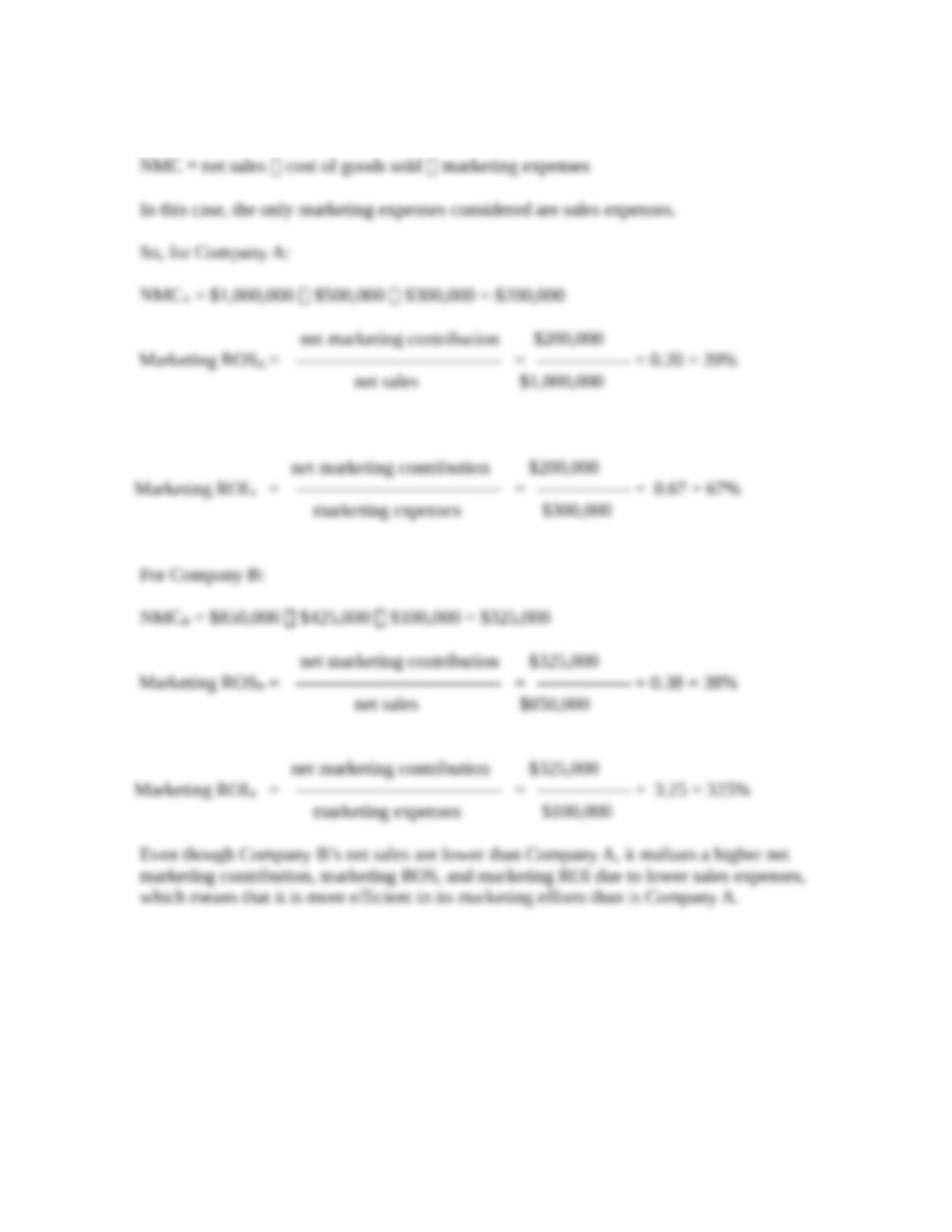
17-13 Refer to Appendix 2, Marketing by the Numbers, to determine the marketing return on
sales (marketing ROS) and return on marketing investment (marketing ROI) for Company A
and Company B in the chart below. Which company is performing better? Explain. (AACSB:
Communication; Analytical Reasoning; Reflective Thinking)
Company A
(sales force only)
Company B
(telemarketing only)
Net sales 1,000,000 $850,000
Answer:
17-14 Should all companies consider reducing their sales forces in favor of telemarketing?
Discuss the pros and cons of this action. (AACSB: Communication; Reflective Thinking)
Answer:
Students will likely agree that it may not be appropriate for all companies to carry out the
selling function solely by telemarketing. However, telemarketing can reduce selling costs by
performing many of the cold calling and qualifying tasks for the sales force. That way,
Copyright© 2018 Pearson Education
Company Case Notes
Alibaba: The World’s Largest E-Tailer Is Not Amazon
Synopsis
As U.S. consumers rapidly add products to their carts on Amazon, Walmart.com, and various
other online retail sites, most have never even heard of Alibaba. But while all the others have
gone about building massive only businesses, Alibaba has been hard at work creating an
enormous online empire. It has done so with one little advantage—1.3 billion potential
customers in its home market. Under the direction of visionary founder Jack Ma, Alibaba has
taken a somewhat different approach to e-commerce than its global counterparts, one that has the
potential to expand and allow Alibaba to become the most pervasive provider of products and
services in the world.
Teaching Objectives
The teaching objectives for this case are to:
1. Illustrate how quickly the Internet changes and how possible it is for startup companies to
have such a huge influence.
2. Introduce elements of ecommerce and show which factors have the greatest influence on
fueling ecommerce.
3. Fuel discussion as to how companies can take advantage of an ever-increasing palette of
Internet tools as a means of integrating their brands into the social structure and
conversation of consumers.
4. Analyze the nature of customer value when it comes to direct and e-marketing.
Discussion Questions
17-18 As a digital retailer, how does Alibaba provide value to Chinese consumers? What sets of
values are unique to the Chinese market?
There is a key quote from the case: “E-commerce in the U.S. is like a dessert. It’s just
supplementary to your main business,” Ma said recently. “In China, because the
Copyright© 2018 Pearson Education
17-19 Given that Alibaba does not own or distribute any of the merchandise exchanged on its
sites, describe what factors had to develop for the company to succeed.
If Alibaba were to have taken an Amazon approach where they fill their own warehouses with
merchandise they purchase from vendors and suppliers, most of the burden for developing
17-20 Analyze Alibaba’s business model relative to all the different forms of digital and online
marketing covered in this chapter.
There are many different forms of digital and online marketing covered in this chapter.
Among them are:
Websites. Unlike most e-tailers, Alibaba has developed and acquired many different
e-commerce websites and established major divisions. Taobao.com is a site that helps
small businesses and private parties sell merchandise. Alipay is akin to PayPal. Tmall is
Online advertising. We don’t have much information available here. What we do know is
Email marketing, videos, blogs, and mobile marketing. There is no information on these
Social media marketing. It can be assumed that Alibaba relies heavily on social media
17-21 Can Alibaba succeed in countries outside of China? Why or why not?
This case outlines that Alibaba has been a tremendous success almost entirely because of its
singular focus on the Chinese market, which was underdeveloped and hungry for commerce
of any kind. Alibaba moved quickly to fill the voids. When Alibaba introduced the concept to
the Chinese market, it was not previously known. However, as it eyes the U.S. and U.K.
markets, it will face a dramatically different environment – one in which every single product
line that it has in China is already alive and thriving in these developed markets. Alibaba has
already made small-scale efforts to penetrate the U.S. market and has not had any notable
success. It is also not yet clear how Alibaba can provide any kind of value to U.S. customers
Copyright© 2018 Pearson Education

Teaching Suggestions
Before having students read the case, ask them what they know about Alibaba. Likely, this
discussion will be very brief. It isn’t on their radar and they don’t care. Then, ask them if they
think there is room for more e-tailers in the U.S. market. Responses to this may vary. Finally, ask
them what kinds of gaps they perceive in the U.S. market (what kinds of needs are not being
served?). Perhaps, this may provide the context for an opportunity for e-commerce entrants.
This case was designed for use with Chapter 17. This case can also be used with the retailing
chapter on (Chapter 13) and the global marketing chapter (Chapter 19).
Go to mymktlab.com for the answers to the following Assisted-graded writing questions:
17-22 What public policy issues are related to direct and digital marketing?
17-23 Compare and contrast a marketing website and a branded community website.
ADDITIONAL PROJECTS, ASSIGNMENTS, AND EXAMPLES
Projects
1 You are the owner of a small hometown brick-and-mortar gourmet meat store. What, if any,
advantage do you see in setting up an online presence? In what ways could this possibly help
your business? Or could it? (Objective 3)
2 What do you believe to be the future of traditional catalog marketing? Find examples of
companies that have discontinued their printed catalog in favor of a fully online version. Has this
been successful for them? (Objective 2)
3 Take a look at the three following similar click-and-mortar companies: The Poisoned Pen
(www.poisonedpen.com/), The Mysterious Bookshop (http://www.mysteriousbookshop.com/)
and The Mystery Bookstore (www.mystery-bookstore.com/). Talk about their similar approaches
(and differences) to online retailing. (Objective 3)
4 How does your college/university use the internet to attract quality prospective students? Are
they doing a good job? What suggestions would you make to your college or university to
improve their web appearance? (Objective 4)
5 Find an example of a company that appears to be doing an absolutely terrible job of connecting
with customers via the web. Make recommendations to improve their “web appeal.” (Objective
4)
Copyright© 2018 Pearson Education

Small Group Assignments
1 Form students into groups of three to five. Each group should read the Real Marketing
17.2: Mobile Marketing: Customers Come Calling, and then answer the following
questions and share their answers with the class. (Objective 3)
a Who do you believe the mobile marketing movement helps more—the marketer or
the consumer? Why?
b Do you believe that smartphones will remain the tool of the 18– to 34-year-old age
group, or will older consumers adapt them too? Explain your answer.
c Rather than irritating consumers, how can marketers develop more useful mobile
applications that make customers say, “Do call me, please—or, I will call you!”?
2. Form students into groups of three to five. Each group should answer the following
questions and share their answers with the class. (Objective 2)
a. Discuss mobile phone marketing. What are the pros and cons of this form of direct
marketing medium?
b. What do you think about the future of interactive TV? Why do you believe it has not
taken off to the extent that visionaries were expecting?
c. Much has been made about the use of podcasts as a direct marketing tool. How
effective do you believe podcasts to be? What would you suggest as a method to
increase its use and effectiveness?
Individual Assignments
1. Go onto to Dell’s website (www.dell.com) and that of major competitor Hewlett-Packard
(www.hpshopping.com). “Build” your ideal laptop on each. Compare the competitors on
product offerings, price, and website ease of navigation, appeal, and use. Who wins?
Why? (Objective 4)
2. Go to the government’s Internet Crime Complaint Center (www.ic3.gov/default.aspx).
Read and report on some of the many Internet crime schemes. (Objective 5)
Think-Pair-Share
Consider the following questions, formulate an answer, pair with the student on your right, share
your thoughts with one another, and respond to questions from the instructor.
1 How would you define direct marketing? (Objective 1)
2 What are the benefits of direct marketing to customers? To companies? (Objective 1)
3 How are companies using online marketing to deliver greater value to consumers?
(Objective 1)
4 What are the major forms of direct marketing? (Objective 2)
5 Give three examples of consumer-to-business (C-to-B) online marketing. (Objective 3)
6 What are some of the significant ethical issues raised by the use of direct marketing?
(Objective 4)
Copyright© 2018 Pearson Education
Outside Examples
1. The University of Phoenix’s “online campus” was established in 1989, well before the
advent of and widespread use of the World Wide Web. Since then, the University of
Phoenix has exploded, and more and more adults are earning their Bachelor’s, Master’s
and even Doctoral degrees online.
Because this model has proven so successful, traditional universities have added online
options to their degree programs. Sometimes courses are only “web-enhanced,” meaning
that the students still gather in a traditional classroom, but some work takes place on the
internet. Many colleges and universities, however, are moving at least some of their
courses completely online. This allows them to reach many non-traditional students, and
students who simply cannot relocate to the city in which their campus is located.
(Objective 4)
a. How has the University of Phoenix affected the college experience? Be specific.
b. What are the benefits of obtaining a degree online? What are the disadvantages, if
any?
c. Visit their website at www.phoenix.edu. Is it an effective website? Defend your
answer.
Possible Solution:
a. The University of Phoenix ushered in a new era of content delivery in higher
education. Before the University of Phoenix, the college experience remained the
b. The benefits of obtaining a degree online are mostly tied to convenience and
c. The University of Phoenix’s website is one of the better college or university sites. It
2. Take a hard look at your university’s web presence. What kind of job are they doing in
reaching and supplying the information needed by their various publics? How easy is it to
accurately navigate? What suggestions would you give to the web designers of your
university to assist in making the web presence more “user friendly”? (Objective 4)
Copyright© 2018 Pearson Education

Possible Solution:
Copyright© 2018 Pearson Education