END OF CHAPTER MATERIAL
Discussion Questions
13-1 Define omni-channel retailing and explain its connection to shopper marketing. (AACSB:
Communication)
Answer:
These days, shopper marketing and the “point of purchase” go well beyond in-store buying.
13-2 Explain the various marketing decisions retailers must consider in designing strategies to
attract and hold customers. (AACSB: Communication)
13-3 Name and describe the three types of off-price retailers. How do off-price retailers differ
from discount stores? (AACSB: Communication)
13-4 Name and describe the three major groups of wholesalers. (AACSB: Communication;
Reflective Thinking)
Answer:
Wholesalers fall into three major groups: merchant wholesalers, brokers and agents, and
Copyright© 2018 Pearson Education
The third major type of wholesaling is that done in manufacturers’ and retailers’ branches
and offices by sellers or buyers themselves rather than through independent wholesalers.
13-5 Discuss the marketing mix decisions faced by wholesalers. What current challenges do
wholesalers face? (AACSB: Communication; Reflective Thinking)
Critical Thinking Exercises
13-6 You need a new pair of jeans and you have several retail options. From Table 13.1,
choose three different major store retailer types and select a specific store for each type
chosen. Visit each store and describe each store’s segmentation and positioning strategy and
retail marketing mix—product, price, place, and promotion. How do the product assortments
differ? What is each store’s pricing approach? What promotional tools are used? Discuss
store locations. (AACSB: Communication; Reflective Thinking; Use of IT)
13-7 In a small group, present a plan for a new retail store. Who is the target market? Describe
the merchandise, atmospherics, price points, services provided, location, and how you would
promote your retail store. Describe how you will differentiate your store from competitors.
(AACSB: Communication; Reflective Thinking)
Answer:
Copyright© 2018 Pearson Education

13-8 Identify a retailer that is currently struggling. Discuss why it is having difficulties and
suggest ways to turn things around. (AACSB: Communication; Reflective Thinking)
Answer:
Students should not have a problem finding retailers that are struggling. The chapter
Apparel retailers targeting teens are shuttering many stores as well. Abercrombie & Fitch and
Aeropostale are discussed in the previous sources, and the following source also discusses
APPLICATIONS AND CASES
Online, Mobile, and Social Media Marketing: Skipping the Checkout Line
The convenience of running to the store for a few grocery items can be hampered by long
checkout lines. The creative geniuses at Selfycart solved this issue by developing an app that
allows shoppers to browse, scan, and pay for products in participating stores using their mobile
devices without waiting in line. Selfycart’s technology continues to change, including a virtual
shopping cart, shopping lists, historical purchase information, list sharing, and a coupon portal
that virtually clips coupons. Selfycart also developed a daily deal section that offers discounts
and special offers specific to each store. Selfycart will eventually introduce online ordering, so
consumers can add products to a virtual shopping cart, pay, and arrange store pick-up at a
specified time. Selfycart continues to discover new ways to create value for its users. Suddenly,
Copyright© 2018 Pearson Education
skipping the line is an extremely appealing prospect!
13-9 Investigate the Selfycart app. What benefits and challenges will stores face in introducing
Selfycart or any other mobile checkout app. (AACSB: Communication; Use of IT; Reflective
Thinking)
Answer:
Benefits include creating value for the customer resulting in customer retention – quick
checkout and no lines. Stores will have a history of customer purchases and the ability to
13-10 If Selfycart or a similar mobile checkout app was available at your grocery store, would
you use it? What benefits would you gain by using this new technology? Discuss the
challenges you would face. (AACSB: Communication; Reflective Thinking)
Answer:
Students’ answers about using the app will depend on their comfort with new technology.
The benefits and challenges for customers are some of the same faced by retailers.
Marketing Ethics: Lilly for Target
The Lilly Pulitzer brand of brightly colored dresses and resort-themed designer items is the
uniform of the preppy, Palm Beach set. Indeed, only select young women belonging to certain
sororities in certain communities are allowed discounts on the $100-$500 items. But Target
created a buying frenzy by debuting its Lilly for Target collection in April 2015. Target’s Pulitzer
line comprised 250 items, such as Lilly dresses at $40, which sold out within minutes of launch,
crashed the store’s website and created a firestorm of negative online comments from customers.
The long lines outside stores caused one manager to name the event “Preppy Black Friday,”
likening it to the frenzied shopping day after Thanksgiving known as Black Friday. Most
shoppers went home empty-handed because others scooped up as much as they could, emptying
the racks within minutes. Items then sold on eBay for much higher prices. This type of launch is
not new for Target. In 2011, the retailer launched a line of Missoni items priced at $30-$40.
Copyright© 2018 Pearson Education
Missoni’s distinctive zig-zag and geometric-patterned knitwear, shoes, and houseware items
normally sell for hundreds of dollars at retailers such as Bloomingdale’s and Saks Fifth Avenue.
During the Missoni event, shoppers grabbed goods by the armload, even poaching items from
others’ shopping carts. While some shoppers went away happy, many more were not. In both
merchandise promotions, Target officials announced the sold-out items would not be replenished.
13-11 Is it ethical for retailers to create a promotion but not have sufficient merchandise for all
shoppers who want to buy the items? (AACSB: Communication; Ethical Reasoning)
Answer:
Students’ opinions will vary. Oftentimes there are limited quantities of deeply promoted
items, and shoppers usually understand that. However, some of the online comments
13-12 Is it smart for Target to create such shopping frenzies even though some customers are
dissatisfied? Explain why or why not. (AACSB: Communication; Reflective Thinking)
Answer:
Students’ answers will vary. Some will argue that it created considerable publicity for Target,
and as some say, “any publicity is good publicity.” The event was covered in the news and
Marketing by the Numbers: Stockturn Rate
Retailers need merchandise to make sales. In fact, a retailer’s inventory is its biggest asset. Not
stocking enough merchandise can result in lost sales, but carrying too much inventory increases
costs and lowers margins. Both circumstances reduce profits. One measure of a reseller’s
inventory management effectiveness is its stockturn rate (also called inventory turnover rate for
manufacturers). The key to success in retailing is realizing a large volume of sales on as little
inventory as possible while maintaining enough stock to meet customer demands.
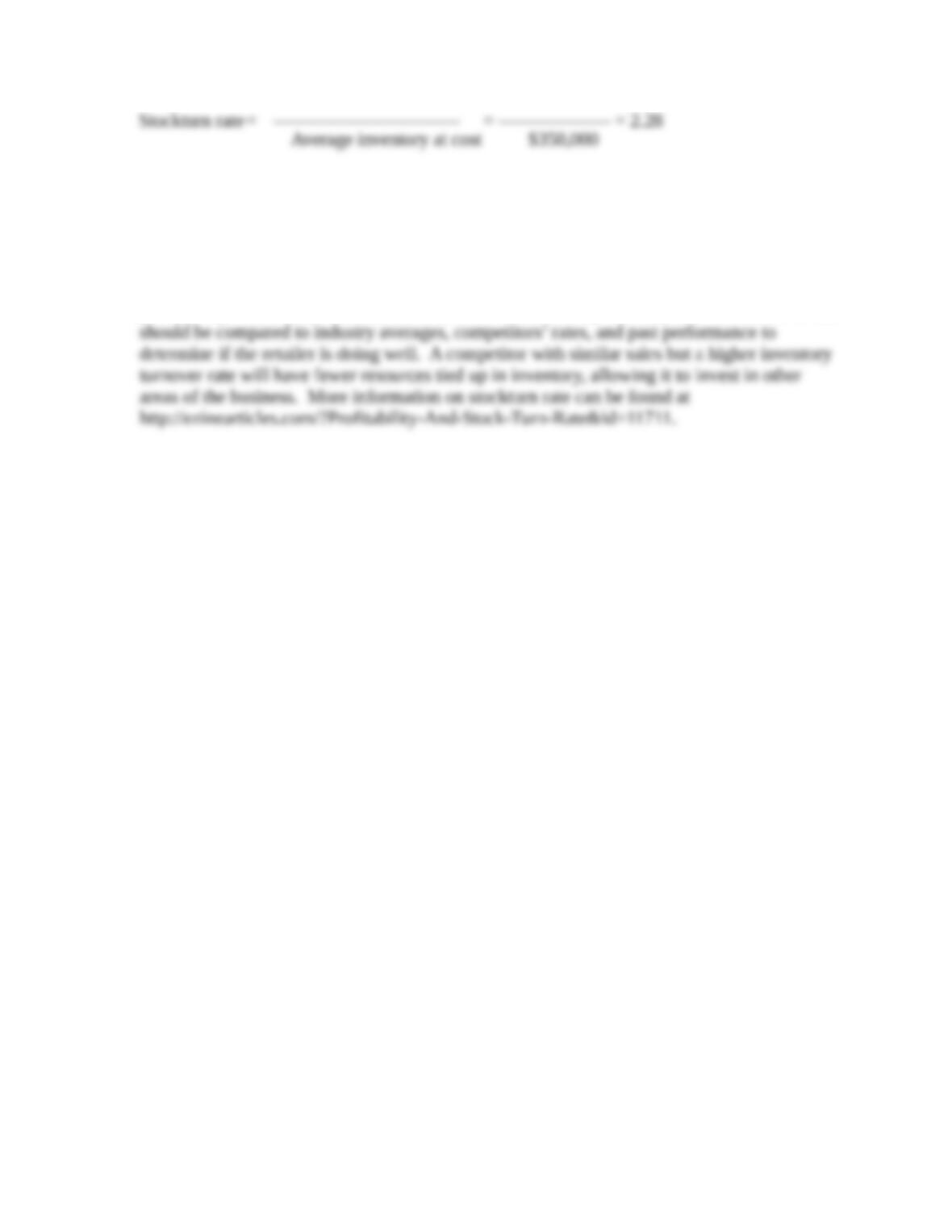
13-13 Refer to Appendix 2, Marketing by the Numbers, and determine the stockturn rate of a
retailer carrying an average inventory at cost of $350,000, with a cost of goods sold of $800,000.
(AACSB: Communication; Analytical Reasoning)
Answer:
Copyright© 2018 Pearson Education
13-14 If this company’s stockturn rate was 3.5 last year, is the stockturn rate calculated above
better or worse? Explain. (AACSB: Written and Oral Communication; Reflective Thinking)
Answer:
Normally, the higher the turnover rate, the higher the management efficiency and company
profitability. So, the current stockturn rate is worse than the previous year. However, this rate
COMPANY CASE NOTES
Bass Pro Shops: Creating Nature’s Theme Park for People Who Hate to Shop
Synopsis
Outdoor-products megaretailer Bass Pro Shops has built an empire by seemingly breaking the
rules of retail. With more than 90 retail stores throughout the United States and Canada, the
privately-held Springfield, Missouri-based company reeled in $4.3 billion in revenues last year—
nearly $50 million per store—making it the nation’s number one outdoor-products retailer. Going
against common retail wisdom, Bass Pro Shops stores are enormous and packed to the rafters
with overhead. Even more daring, the chain has achieved retail success by targeting customers
who hate to shop. The typical Bass Pro Shops customer is a reclusive male outdoorsman who
yearns for the great outdoors but detests jostling crowds and shopping. Bass Pro Shops has
accomplished this impossible task by executing a two-hook strategy: delivering unparalleled
variety of product under one roof and creating a retail experience that basically amounts to a
natural history theme park.
Teaching Objectives
The teaching objectives for this case are to:
1. Classify a retailer according to the different retailer types.
2. Understand how segmentation, targeting, differentiation, and positioning apply to
retailers.
3. Learning the connection between segmentation/targeting and the retail marketing mix.
4. Analyze a retailer’s success factors.
Discussion Questions
13-18 Define Bass Pro Shops’ targeting strategy. Does the chain provide a truly differentiated
Copyright© 2018 Pearson Education

experience?
Based on the four types of targeting strategies outlined in the text, there is no question that
Bass Pro Shops (BPS) executes a differentiated strategy. Some might argue that because its
primary customer is the “reclusive male outdoorsman who yearns for the great outdoors but
detests jostling crowds and shopping,” BPS really pursues more of a concentrated strategy.
However, BPS actually targets numerous different consumer segments:
Reclusive male outdoorsman. This is a huge category, and not all are created equal.
BPS seems to further segment this core customer segment and target sub-segments of
it by focusing on these factors:
oActivities – hunting, fishing, camping, and other outdoor activities not mentioned in the case like
hiking, kayaking, etc.
oGeographic – not mentioned in the case, but BPS carries different kinds of gear and apparel
depending on the location of the store.
oDemographic – again, not mentioned in the case, but BPS certainly carves up the male
outdoorsman into different segments based on income, age, and other demographic
characteristics.
Something for everyone – product offerings and entertainment features targeting women and
children.
Benefits – the case mentions BPS’ very successful catalogue/online business. Relative to the
in-store shopper, this is a different strategy for a different type of customer.
Loyalty status – BPS has a well-developed rewards program. Thus, a different strategy for loyal
customers versus non-loyal customers.
The second part of this question, does BPS truly provide a differentiated experience, there
might be more than one take on this. Based on the answer given so far, BPS clearly
differentiates its marketing mix across numerous segments. But relative to the competition,
some might say that BPS and Cabela’s are far too similar to qualify as truly different from
one another. However, consider a few factors:
BPS is heavier on fishing; Cabela’s is heavier on hunting.
Neither company builds stores right next to each other. Thus, they have
differentiated based on locations.
BPS has a better store-owned brand strategy, including its boat division/brands.
Last but not least, as of the writing of this case, BPS has purchased Cabela’s for
$5.5 billion (announced October 3, 2016). As of the writing of this note, BPS
asserts that both brands will continue to operate under their given retail
names/labels and gives the impression that as the shopper is concerned, nothing
will change. Whatever the case moving forward, now that both chains are under
a single ownership, BPS is even more differentiated across different segments of
customers. It is also clearly differentiated from the competition.
13-19 Describe how Bass Pro Shops became the nation’s leading outdoor retailer based on the
retail marketing mix.
Product – Inventory across numerous outdoor activities in more variety (breadth and depth)
Copyright© 2018 Pearson Education
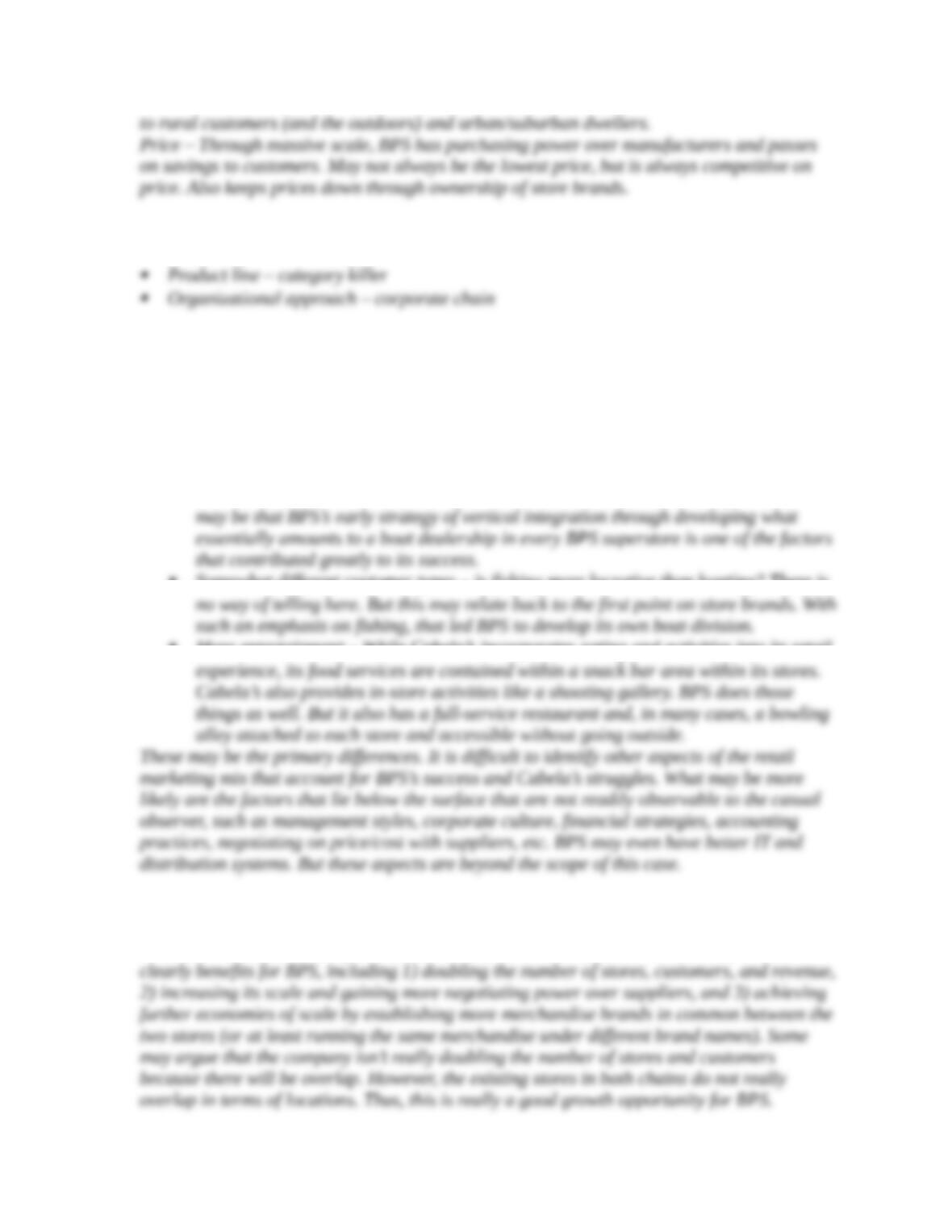
13-20 It terms of the major types of retailers, how would you classify Bass Pro Shops?
Amount of Service – limited service
13-21 Why is Bass Pro Shops succeeding while Cabela’s is floundering?
This question should lead to a healthy discussion on factors that contribute to marketing
success since these two companies are so similar. (Ask students how many have been to both
retailers. Then ask, what are the differences? You might find that the answer is “not a whole
lot.”) It is not clear why Cabela’s has struggled financially over the past decade while BPS
has thrived; however, professors and students can draw some assumptions and take some
educated guesses.
Store brands –BPS has likely made better use of the store brand strategy. In fact, it
Somewhat different customer types – is fishing more lucrative than hunting? There is
More entertainment – While Cabela’s incorporates eating and activities into its retail
13-22 Is it a good idea for Bass Pro Shops to acquire Cabela’s? Explain.
Student answers will vary. Whether BPS keeps the two chains as independently operating
brands under one ownership or combines the two into one outdoor retail chain, there are
Copyright© 2018 Pearson Education
Teaching Suggestions
It is clear that the core customer for BPS is the male outdoor enthusiast. However, start by asking
how many of the female students have been to a BPS Outdoor World store (or a Cabela’s). Ask
them to share their reasons for going and their experience while there. Use this as a springboard
into the retail strategy that will unfold through the discussion of the questions.
This case also works well with the marketing strategy chapter (Chapter 2), the products and
brands chapter (Chapter 8), and the competitive advantage chapter (Chapter 18).
Go to mymktlab.com for the answers to the following Assisted-graded writing questions:
13-23 What is retail convergence? Has it helped or harmed small retailers?
13-24 Describe the types of shopping centers and identify specific examples in your community
or a nearby city.
ADDITIONAL PROJECTS, ASSIGNMENTS, AND EXAMPLES
Projects
1. Go to a local power center. Make a list of all the stores located there. Which of these
stores serve as the anchor and which stores are dependent on the anchor? (Objective 2)
2. Visit a local discount store (Walmart, Target, etc.) and a local off-price store (T.J.Maxx,
Stein Mart, etc.). Examine the product mix and pricing strategies of these stores. Who
would you say is the target market of each? Why? (Objective 2)
3. Who are the major wholesalers that service the restaurants in your town? What are the
principle functions they serve? (Objective 4)
Small Group Assignments
1. Form students into groups of three to five. Each group should read Real Marketing 13.2:
Omni-Channel Retailing: Creating a Seamless Shopping Experience. Each group should then
answer the following questions and share their answers with the class. (Objective 3)
a. Based on this reading, who is targeted by digitizing the in-store retail experience?
Consider the examples as groups discuss this.
b. What are the advantages of this shift in the customer experience? Are there any
drawbacks to this approach?
c. What other retail companies could you see moving toward this level of digitization in the
shopping experience?
d. Picture yourself as a consumer. Are you a “showroomer?” On which products have you
tried this tactic? How successful were you? Explain.
Copyright© 2018 Pearson Education
e. Besides the strategies listed in this story, what other ideas can you think of that
brick-and-mortar stores might try to stem the tide of consumers walking out of their
stores, headed for the nearest online retailer?
f. Do you believe that stores like Best Buy or Target, which rely on “atmosphere” to sell
their products, are doing the customer an injustice? After all, isn’t the product itself the
most important part of the purchase decision? Explain your reasoning.
2. Form students into groups of three to five. Each group should read the opening vignette on
Walmart. Each group should then answer the following questions and share their answers
with the class. (Objective 2)
a. Do you believe that Walmart engages fairly with its competitors in the marketplace?
Defend your answer.
b. What specific advantages does Walmart’s distribution system provide the company?
c. Besides offering low prices, what does Walmart do better than its competitors to
attract customers?
Individual Assignments
1. Reread Real Marketing 13.1: Costco: Merchandising Magic That Competitors Can’t
Match. Then answer the following questions. (Objective 2)
a. How is Costco beating Sam’s Club at its own low-price game?
b. Why do people go to Costco and “treasure hunt,” especially when they don’t need to
focus on saving money?
c. If “atmosphere” is so important in attracting and keeping customers, how do
warehouse clubs like Costco and Sam’s Club succeed? Explain your reasoning.
2. Review the concept of retail convergence. Identify stores in your area that fit this
concept. Do you believe all those stores can succeed longer-term? Justify your answer.
(Objective 3)
Think-Pair-Share
Consider the following questions, formulate an answer, pair with the student on your right, share
your thoughts with one another, and respond to questions from the instructor.
1. How would you define retailing? How does it fundamentally differ from wholesaling?
(Objective 1)
2. What is a category killer? Why do you believe they have become so popular in recent
years? (Objective 1)
3. Cite at least three examples of retail convergence. What advantages and disadvantages do
the converged organizations have? (Objective 3)
4. What are the functions of wholesalers? Can these be replaced? If so, how? (Objective 4)
5. What are the differences between merchant wholesalers, brokers and agents, and
manufacturers’ agents? (Objective 4)
Copyright© 2018 Pearson Education
Outside Examples
1. Traditional department stores have had a hard go of it in recent years. It seems as though
they keep seeing their business being siphoned off by either the specialty stores or the
discounters. Review Table 13.1. If you were hired by Macy’s (the nation’s largest
department store) to advise them on a strategy to stop the bleeding-off of their clientele,
how would you advise them? (Objective 1)
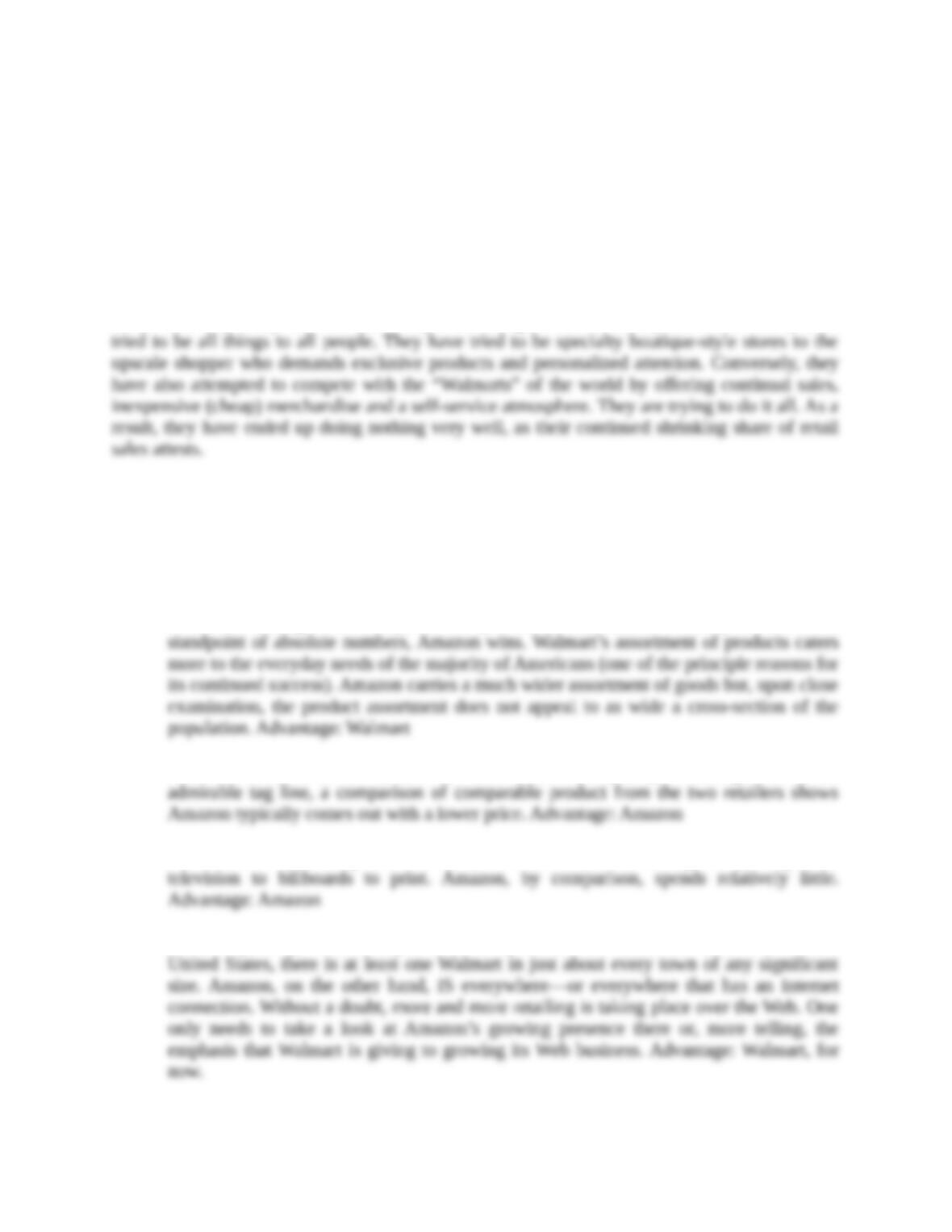
Possible Solution: Student answers will vary. It is important for department stores to
decide who they really are. One of the major stumbling blocks of recent years has been they have
2. Consider both Walmart (www.walmart.com) and Amazon (www.amazon.com). In what
ways do these two companies compete? Compare them using the variables of the
marketing mix. Which do you believe has the upper hand? Why? (Objective 2)
Possible Solution:
Product. Although both companies carry a tremendous assortment of product from a
Price. Walmart touts the mantra of “Low Prices Every Day.” Although this is an
Promotion. Walmart spends a fortune on consumer advertising, everything from
Place. Physically, Walmart is just about everywhere. With more than 2,500 stores in the
Copyright© 2018 Pearson Education
Copyright© 2018 Pearson Education