END OF CHAPTER MATERIAL
Discussion Questions
12-1 Compare and contrast upstream and downstream partners in a company’s supply chain.
Explain why value delivery network might be a better term to use than supply chain.
(AACSB: Communication)
Answer:
Producing a product or service and making it available to buyers requires building
relationships not only with customers but also with key suppliers and resellers in the
The term supply chain may be too limited, as it takes a make-and-sell view of the business. It
suggests that raw materials, productive inputs, and factory capacity should serve as the
starting point for market planning. A better term would be demand chain because it suggests
Yet, even a demand chain view of a business may be too limited because it takes a
Discuss direct marketing channels and indirect marketing channels. Provide examples of
each type of marketing channel. (AACSB: Communication; Reflective thinking)
Answer:
Direct marketing channels have no intermediary levels; the company sells directly to
consumers. For example, Mary Kay Cosmetics and Amway sell their products through home
and office sales parties, web sites, and social media; companies ranging from GEICO
Copyright© 2018 Pearson Education
12-3 What channel design decisions do manufacturers face for maximum effectiveness?
Answer:
Marketing channel design should be purposeful, and it calls for analyzing consumer
needs, setting channel objectives, identifying major channel alternatives, and evaluating the
alternatives. When analyzing consumer needs, each channel member and level adds value for
12-4 Name and describe the three strategies available when determining the number of
marketing intermediaries. (AACSB: Communication; Reflective Thinking)
12-5 List and briefly describe the major logistics functions. Provide an example of a decision a
logistics manager would make for each major function. (AACSB: Communication;
Reflective Thinking)
Answer:
The major logistics functions include warehousing (storing their tangible goods while they
Critical Thinking Exercises
12-6 Form a small group and research the distribution challenges faced by companies expanding
into emerging international markets such as China, Africa, and India. Develop a multimedia
Copyright© 2018 Pearson Education
presentation on how one company overcame these challenges. (AACSB: Communication;
Reflective Thinking; Use of IT)
Answer:
Although emerging markets such as India and China have populations exceeding a billion
people, much of the population in such countries is logistically challenging to reach. Some
Coca-Cola’s Micro-Distribution Center (MDC) in Africa:
www.businesscalltoaction.org/wp-content/files_mf/1286826974CocaColaCaseStudyFORWe
b.pdf
12-7 The term last mile is often used in the telecommunications industry. Research what is going
on in this industry and how the last mile has evolved in recent years, and then predict where
it is heading in the future. What companies are major players in the last mile and how does
the concept of net neutrality fit in? (AACSB: Communication; Reflective Thinking)
Answer:
The last mile term refers to the relatively short distance to deliver telecommunication
services to and from homes or businesses. Technologies include telephone systems, ISDN,
DSL lines, coaxial cables used to deliver cable television and broadband internet, wireless
services such as satellites, and optical fiber. Comcast, a cable television provider, is the
Net neutrality is a principle that holds that everyone should have unfettered access to the
internet and that service providers should treat data on the internet equally. However, some
users and content providers are “data hogs,” requiring greater amounts of the limited
Copyright© 2018 Pearson Education
12-8 Multimodal transportation is a crucial component of the logistics industry. Search the
internet to find the largest multimodal facilities in the United States. Review the key features
offered at these terminals and report your findings on their similarities and differences.
(AACSB: Communication; Use of IT; Reflective Thinking)
Answer:
Students’ responses will vary depending on websites accessed. The resource
www.globaltrademag.com/global-trade-daily/commentary/americas-top-intermodal-facilities
will provide students with information on America’s top multimodal options for rail, ground,
air, and ocean transportation. For example:
Centerpoint Intermodal Center (CIC) is North America’s largest master-planned inland
APPLICATIONS AND CASES
Online, Mobile, and Social Media Marketing: Fabletics Changing Channels
According to Fabletics company website, www.fabletics.com, “JustFab Inc. co-CEOs, Don
Ressler and Adam Goldenberg, launched Fabletics with Kate Hudson after they saw a gap in the
activewear marketplace. There were plenty of luxury brands, but none that offered stylish and
high-quality gear at an accessible price point. These three unstoppable innovators joined forces
to create the Fabletics brand in 2013.” Fabletics, a division of Just- Fab, offers affordable,
high-quality, and stylish workout clothes including yoga pants, leggings, joggers, tops, tees, and
Copyright© 2018 Pearson Education
more for women and men at every fitness level. After being in business just a few short years, the
company ranked number 98 in the Internet Retailer 2015 Top 500 Guide with revenues of $150
million. Although initially internet-based, Fabletics moved into brick-and-mortar retailing in
2015. It plans to open 75 to 100 stores by 2020. (AACSB: Communication; Reflective Thinking;
Use of IT)
12-9 Conduct your own research to learn more about Fabletics. Discuss how Fabletics is
meeting customer needs through its value delivery network. What controversy surrounds the
company?
Answer:
Athleisure wear is a highly competitive industry and has grown over the past several years
because of consumers’ increasing attention to fitness and comfort. Fabletics competes on
12-10 What type of marketing channel is Fabletics using? What is its distribution strategy?
Does opening brick- and-mortar stores make sense for Fabletics? Explain.
Marketing Ethics: Trucker Rest Rules
Large trucks are an important piece of the logistics chain. However, there were 333,000 large
truck crashes in 2012, resulting in almost 3,800 fatalities, the majority being drivers or
passengers of other vehicles, not the truck driver. One accident in 2014 caused a public uproar
when a Walmart truck driver fell asleep at the wheel after being awake for 24 hours and crashed
into another car, killing one person and critically injuring others, including a well-known
comedian. The U.S. Department of Transportation’s Federal Motor Carrier Safety Administration
enacted tougher hours-of-service rules that went into effect in July 2013. However, the new rules
have caused considerable controversy and have caused hardships for truck drivers. As one driver
put it, “If the wheels aren’t turning, you’re not earning.” One report claimed that the trucking
industry would lose $1 billion in lost productivity as a result of these rules. But another analysis
concluded that the industry would realize almost $500 million in benefits from reduced driver
mortality.
12-11 Research the DOT’s trucker hours-of-service rules and write a brief report outlining the
rules. What is the current status of the 2013 rules? (AACSB: Communication; Reflective
Thinking)
Copyright© 2018 Pearson Education
Answer:
In 2003, rules stated that drivers can drive no more than 14 hours at a time. The rules that
took effect in July 2013 added that total hours driving per week dropped from 82 hours to 70
hours. Additionally, every seven days, drivers must take a 34-hour rest that covers two
12-12 Is it ethical that the trucking industry wants the hours-of-service rules repealed? Why or
why not. (AACSB: Communication; Reflective Thinking; Ethical Reasoning)
Answer:
Students’ responses will vary. Some students will cite the number of large truck crashes to
Marketing by the Numbers: Tyson Expanding Distribution
Tyson Foods is the largest U.S. beef and chicken supplier, processing more than 100,000 head of
cattle and 40-plus million chickens weekly. Their primary distribution channels are supermarket
meat departments. However, the company is now expanding distribution into convenience stores.
There are almost 150,000 gas stations and convenience stores where the company would like to
sell hot buffalo chicken bites near the checkout. This is a promising channel, as sales are growing
considerably at these retail outlets and profit margins on prepared foods are higher than selling
raw meat to grocery stores. Tyson will have to hire 10 more sales representatives at a salary of
$45,000 each to expand into this distribution channel because many of these types of stores are
independently owned. Each convenience store is expected to generate an average of $50,000 in
revenue for Tyson. Refer to Appendix 2: Marketing by the Numbers to answer the following
questions.
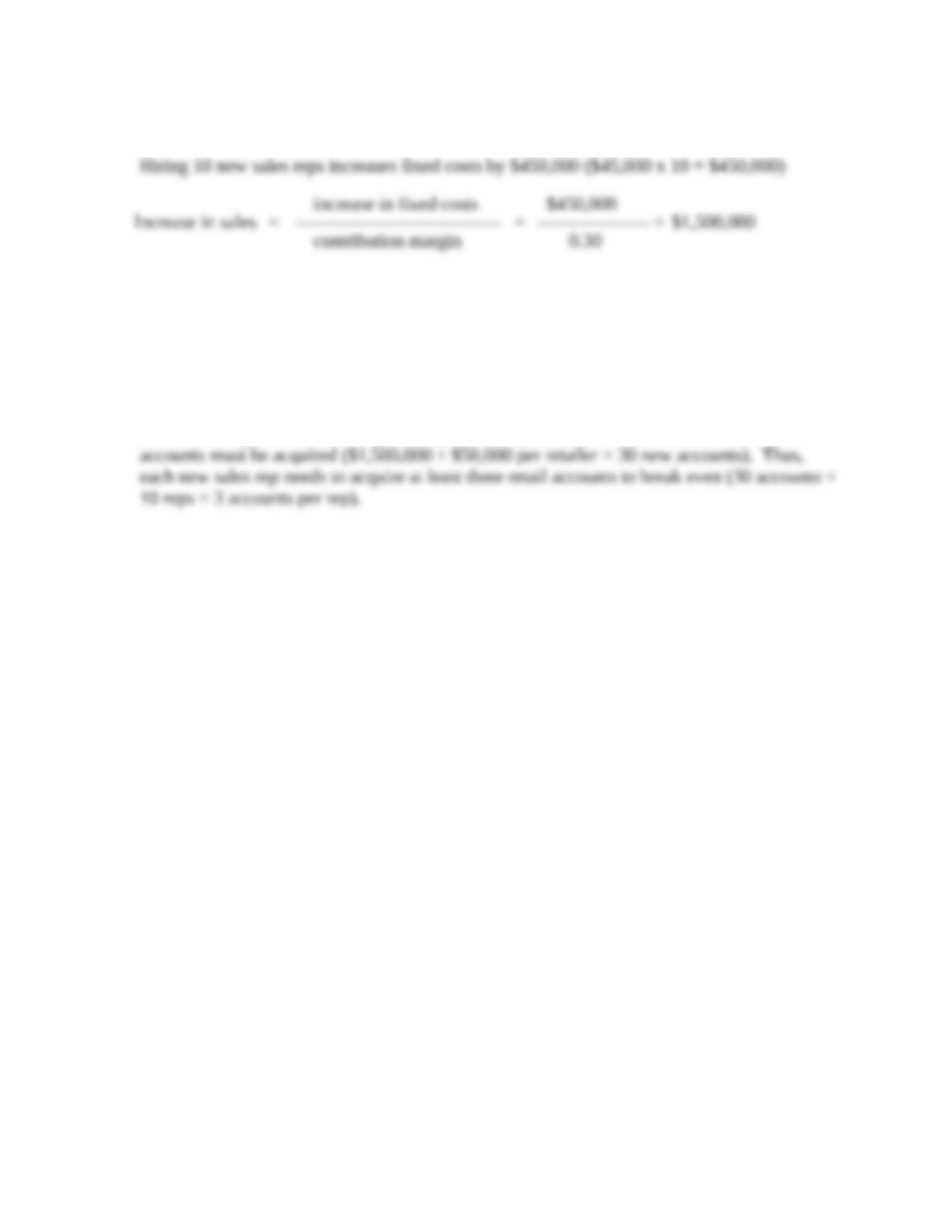
12-13 If Tyson’s contribution margin is 30 percent on this product, what increase in sales will it
need to break even on the increase in fixed costs to hire the new sales reps? (AACSB:
Communication; Analytical Reasoning)
Copyright© 2018 Pearson Education
Answer:
12-14 How many new retail accounts must the company acquire to break even on this tactic?
What average number of accounts must each new rep acquire? (AACSB: Communication;
Analytical Reasoning)
Answer:
Each retailer generates an average of $50,000 for Tyson, so to break even, 30 new retail
COMPANY CASE NOTES
Apple Pay: Taking Mobile Payments Mainstream
Synopsis
After years of predictions that mobile payments would replace cash and credit cards, there are
finally signs that it might be happening, with Apple Pay leading the way. Although Apple Pay is
quickly gobbling up market share, Apple is far from being the first to market. This case
highlights how Apple jumped into the market and vaulted right over the competition. Taking
advantage of its vast network of loyalists and strong distribution relationships, Apple designed a
product with security measures that have allowed skeptical U.S. customers to trust digital
payments.
Teaching Objectives
The teaching objectives for this case are to:
1. Understand the different roles played in the value chain.
2. Comprehend that the value chain can function as a unit.
3. Learn the different channel management procedures and how a company must have an
active plan for managing its channel partners.
4. Identify the different benefits that can be received from channel partners.
Discussion Questions
12-18 As completely as possible, sketch the value delivery network for Apple Pay.
Copyright© 2018 Pearson Education
Student responses should identify the suppliers, distributors, and consumers of Apple
Pay. Like credit cards, Apple Pay is a replacement for cash when it comes to payments as
12-19 With respect to Apple Pay, is Apple a producer, a consumer, or an intermediary? Explain.
In this case, Apple is a producer of the app and the service the app provides (that of making
12-20 Identify all the reasons why Apple’s partnerships are essential to the success of Apple Pay.
It is not clear whether Apple needs the permission of banks and credit card issuers to
12-20 With respect to marketing channels, what are some threats to Apple Pay’s future?
Consumer acceptance. The biggest threat is still consumer acceptance. While Apple and
others have taken strong measures to make the process secure (in many respects, more secure
Teaching Suggestions
Copyright© 2018 Pearson Education
Every student has a cellphone—most likely a smartphone. Take a brief informal survey as to how
many students are using mobile payments of some kind. Then, ask which brands they are using.
Go to mymktlab.com for the answers to the following Assisted-graded writing questions:
12-22 Describe multichannel distribution systems and the advantages and disadvantages
of using them.
12-23 Why does channel conflict occur? Name and describe the various types of channel
conflict.
ADDITIONAL PROJECTS, ASSIGNMENTS, AND EXAMPLES
Projects
1. How do channel members add value? Give specific examples. (Objective 1)
2. Why do some manufacturers establish contractual relationship with their dealers instead
of owning them? (Objective 2)
3. Draw the diagram of the channel of distribution for Green Giant canned corn and Rolex
watches. (You may have to do a little Internet research, if you’re not familiar with the
brands.) How does distribution differ between these two products? (Objective 3)
4. Interview a manager of a retail store with regard to the channel of distribution that is used
to bring one of the store’s products to the marketplace. (Objective 3)
5. College students frequently want food late at night, and many of them don’t have cars to
go get it. You are going to launch a business that picks up and delivers food to on-campus
dormitories. Using the information in the text, design your channel of distribution. What
are the needs of the consumer? What are your channel objectives? Do you want to use
any intermediaries? (Objective 3)
Small Group Assignments
1. Form students into groups of three to five. Each group should read Real Marketing 12.2:
Working with Channel Partners to Create Value for Customers. Each group should then
answer the following questions and share their answers with the class. (Objective 5)
a. Describe the advantages to both Amazon and P&G of Amazon’s Vendor Flex
program.
Copyright© 2018 Pearson Education

b. How does Toyota build its supplier relationships?
c. How do L’Oréal’s channel partnerships benefit the company?
d. Can these kinds of partnerships be financially profitable to all the companies?
e. How do consumers benefit from the partnerships described in this selection?
2. Form students into groups of three to five. Each group should read Real Marketing 12.1:
Netflix: Disintermediate or Be Disintermediated. Each group should then answer the
following questions and share their answers with the class. (Objective 5)
a. Why does greening a company’s supply chain help its bottom line?
b. Can this greening movement impact companies, regardless of company size?
c. How should companies approach the transition to greening their supply chain?
Individual Assignments
1. Mobile phone manufacturers largely distribute their products through service providers
like T-Mobile and AT&T and not directly to the customer. Why do you believe this is so?
Do you think this is the most efficient method? (Objective 1)
2. Channel conflict may arise when there is a disagreement among marketing channel
members on goals and roles—who should do what and for what rewards. Take a look at
Tommy Bahama (www.tommybahama.com). From their website, find a merchant (or
merchants) near you that carries their products. Discuss possible channel conflicts that
you can see arising. (Objective 2)
Think-Pair-Share
Consider the following questions, formulate an answer, pair with the student on your right, share
your thoughts with one another, and respond to questions from the instructor.
1. What is a distribution channel? (Objective 1)
2. What is the difference between an “upstream” channel member and a “downstream”
member? (Objective 1)
3. Explain the difference between horizontal and vertical channel conflict. What is generally
the remedy to channel conflict? (Objective 2)
4. What are the major channel alternatives open to a company? (Objective 3)
5. What are some of the ways that companies have to evaluate channel members?
(Objective 3)
6. The term “supply chain” seems limiting. What phrase would you use to replace it? Why?
(Objective 5)
Outside Examples
Copyright© 2018 Pearson Education

1. Read about Starbucks’ commitment to helping out indigenous farmers in underdeveloped
countries (www.starbucks.com). After reading, write up your interpretation of the full
distribution channel—from beans in the field to company headquarters. (Objective 2)
Possible Solution:
Starbucks has gone to great effort and expense to develop sustainable relationships with
indigenous farmers in underdeveloped countries. A review of Starbucks’ Corporate Social
Responsibility Annual report provides the information needed to fully address this
question.
In fiscal 2007, Starbucks purchased 352 million pounds of coffee (2 percent of total
world production). The coffee was grown in 25 countries, with the majority being from
Guatemala, Colombia, and Indonesia.
Here is an example of the supply chain for Guatemalan coffee purchases in fiscal 2007.
Starbucks paid $1.37 per pound for coffee from a local Guatemalan coffee exporter. The
exporter paid $1.32 per pound to the producer who grew and milled the coffee. The
exporter retained 5 cents per pound for financing, documentation, and profit.
Starbucks’ supply chain is diverse and complex, so the price distribution varies around
the globe. This is due to different purchase and delivery structures, production costs,
quality premiums, and the margin distribution within each country.
2. Many online travel intermediaries have popped up since the internet went public in the
mid-1990s. Travelocity, Orbitz, Cheaptickets, Hotwire, Priceline, and others have
succeeded in disintermediating the travel business and nearly extinguishing the traditional
travel agent. But what happens when an intermediary comes along that disintermediates
the same intermediaries who have just displaced some other intermediary? Enter Kayak.
Rather than checking multiple travel sites to see who has the best deal on airfare, one can
go to www.kayak.com, type in their departure and destination locations, and in a matter
of seconds, view the fares available on all airlines servicing the route.
Actually, this is not true disintermediation. Kayak is not taking away business from the
online travel sites as a whole. Rather, it is a referral site. Once customers have found the
fare and carrier they prefer, they can then click on that fare and be taken to directly to the
supplier’s site (e.g. Expedia, Delta, Continental, CheapTickets, etc.) to complete the
transaction. But the effect of this new intermediary is increasing price competition among
the intermediaries (and airlines). The result is likely to be a shift in which travel sites and
airlines get any given customer’s business, rather than a decrease in the category of travel
Web sites. (Objective 2)
a. Discuss the activities of Kayak in the context of disintermediation. How is this new
service affecting the disintermediated travel agents, the disintermediated travel
websites, and the airlines?
b. How might Kayak be contributing to channel conflict?
c. How is Kayak adding value for customers?
Copyright© 2018 Pearson Education
Possible Solution:
a. Disintermediation occurs when product or service producers cut out intermediaries
b. Kayak may be viewed as contributing to channel conict by providing the consumer with a new source
c. The consumer is the clear winner here. Kayak is providing the consumer with additional information
Copyright© 2018 Pearson Education