END OF CHAPTER MATERIAL
Discussion Questions
11-1 Name and describe the two broad new-product pricing strategies. When would each
be appropriate? (AACSB: Communication)
Answer:
Companies bringing out a new product face the challenge of setting prices for the first
time. They can choose between two broad strategies: market-skimming pricing and
market-penetration pricing.
11-2 Define product bundle pricing. Give examples where companies have used this
pricing strategy. (AACSB: Communication; Reflective Thinking)
11-3 What is psychological pricing and how is it used by sellers? Give an example.
(AACSB: Communication)
Answer:
Copyright 2018 Pearson Education
11-4 Discuss the decisions companies face when initiating price increases. (AACSB:
Communication)
11-5 Discuss the major public policy issues in pricing practices within a given channel
level and across channel levels. (AACSB: Communication)
Answer:
The primary public policy issues in pricing across levels of the channel of distribution
are price discrimination, retail price maintenance, and deceptive pricing.
Laws prohibit retail price maintenance, a requirement by a manufacturer that
The Robinson-Patman Act seeks to prevent unfair price discrimination by
Deceptive pricing occurs when a seller states prices or price savings that
Copyright 2018 Pearson Education
Critical Thinking Exercises
11-6 Alicia is a self-employed hair stylist who owns her own salon. She has asked you to
consult with her on how to generate more revenue. Using the price adjustment strategies
discussed in the chapter, advise Alicia on her options to increase overall sales. (AACSB:
Communication; Reflective Thinking)
11-7 Bridgestone Corporation, the world’s largest tire and rubber producer, recently
agreed to plead guilty to price-fixing along with 25 other automotive suppliers. What
is price-fixing? Discuss other recent examples of price fixing. (AACSB:
Communication; Reflective Thinking)
Answer:
11-8 Identify three online price-comparison shopping sites or apps and shop for a product
you are interested in purchasing. Compare the price ranges given at the three sites.
Based on your search, determine a “fair” price for the product. (AACSB:
Communication; Use of IT; Reflective Thinking)
Answer:
Copyright 2018 Pearson Education
APPLICATIONS AND CASES
Online, Mobile, and Social Media Marketing: Krazy Coupon Lady
Price-conscious consumers are all about finding the best deal. Some even make a sport of
it! Krazy couponers, Heather and Joanie, have been showcased on many national
television shows and in web and print articles. The two friends run a highly successful
company that works tirelessly to uncover the best deals, enabling families to save money.
Posted on their website, www. krazycouponlady.com, is the company mantra “You’d be
krazy not to be one of us!” The website features promotions and alerts to special pricing
on products as well as coupons and discounts to help consumers stretch their dollars. Also
featured are retailers with sale-priced merchandise, coupons, and promotions.
Community members post their best deals in the brag section.
11-9 Visit www.krazycouponlady.com and browse a deal you would consider
purchasing. After identifying the deal, conduct an online price comparison at various
retailers to determine the range of prices you would typically pay for the product.
Present your conclusions. (AACSB: Communication; Use of IT; Reflective Thinking)
Answer:
11-10 Using www.krazycouponlady.com, click on Stores, Coupons, and Deals on the
navigation bar and make a list of the featured products. Identify the pricing strategy
used by the retailer. (AACSB: Communication; Use of IT; Reflective Thinking)
Answer:
Deals and offers change each week, so students’ lists will vary. Promotional pricing is
used consistently throughout the site. For example, if all Oil of Olay skin care
Copyright 2018 Pearson Education
Marketing Ethics: Less Bang for Your Buck
Over the past several years, careful shoppers may be spending about the same amount of
money at the grocery store but leaving the store with a lighter load in their grocery bags.
Food prices on many items have increased, and food manufacturers are facing the same
challenges as consumers. With increases in raw materials and transportation, making a
profit requires a very sharp pencil. According to Phil Lempert, editor of
SupermarketGuru.com, “The reality is, if you look at USDA projections, food is going to
get more expensive. And as a result, food companies are going to do one of two or three
things: Raise prices and keep packages the same, or reduce the quantity in the package.
Or do a little of both.”
11-11 Week after week, consumers shop for many of the same groceries. At some point,
the product may be priced the same and look the same as before but with less in the
package. If consumers are not made aware of the change, is this deception? Is this
different from deceptive pricing? Explain. (AACSB: Communication; Ethical
Reasoning; Reflective Thinking)
Answer:
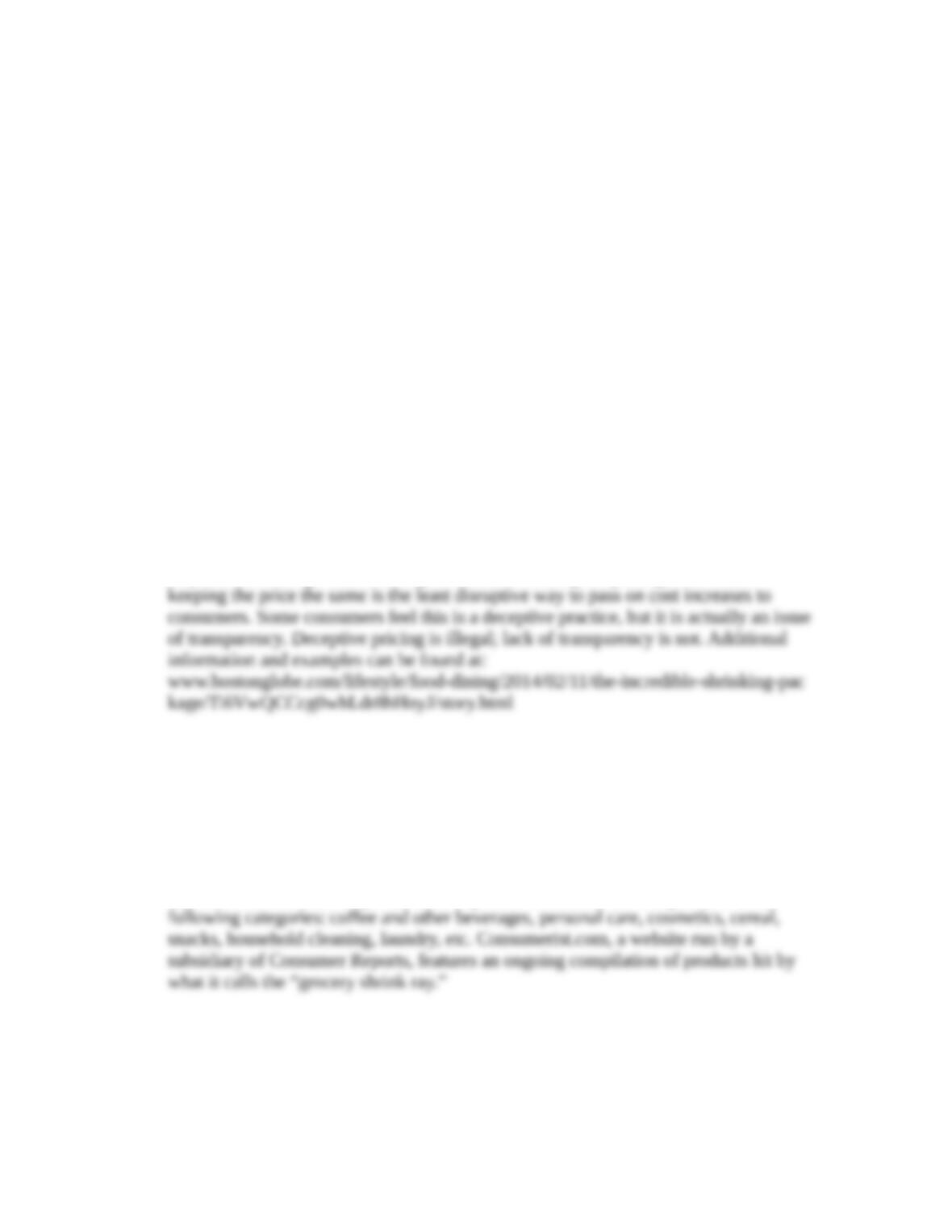
Companies are entitled to make a profit. When costs increase, companies must
respond. According to the Washington Post, decreasing the package size while
11-12 Develop a list of the products you buy from a grocery store, dollar store, or
convenience store where one of two things has occurred: The price has increased or
the quantity in the package has decreased. Were you aware of the changes? Explain.
(AACSB: Communication; Reflective Thinking)
Answer:
Students’ answers will vary with their experiences but will include products in the
Marketing by the Numbers: Louis Vuitton Price Increase
One way to maintain exclusivity for a brand is to raise its price. That’s what luxury
fashion and leather goods maker Louis Vuitton did. The company did not want the brand
Copyright 2018 Pearson Education
to become overexposed and too common, so it raised prices 10 percent and is slowing its
expansion in China. The Louis Vuitton brand is the largest contributor to the company’s
$13.3 billion revenue from its fashion and leather division, accounting for $8 billion of
those sales. It might seem counterintuitive to want to encourage fewer customers to
purchase a company’s products, but when price increases, so does the product’s
contribution margin, making each sale more profitable. Thus, sales can drop and the
company can still maintain the same profitability as before the price hike.
11-13 If the company’s original contribution margin was 40 percent, calculate the new
contribution margin if price is increased 10 percent. Refer to Appendix 2, Marketing
by the Numbers, paying attention to endnote 6 on the price change explanation in
which the analysis is done by setting price equal to $1.00. (AACSB: Communication;
Analytic Reasoning)
Answer:
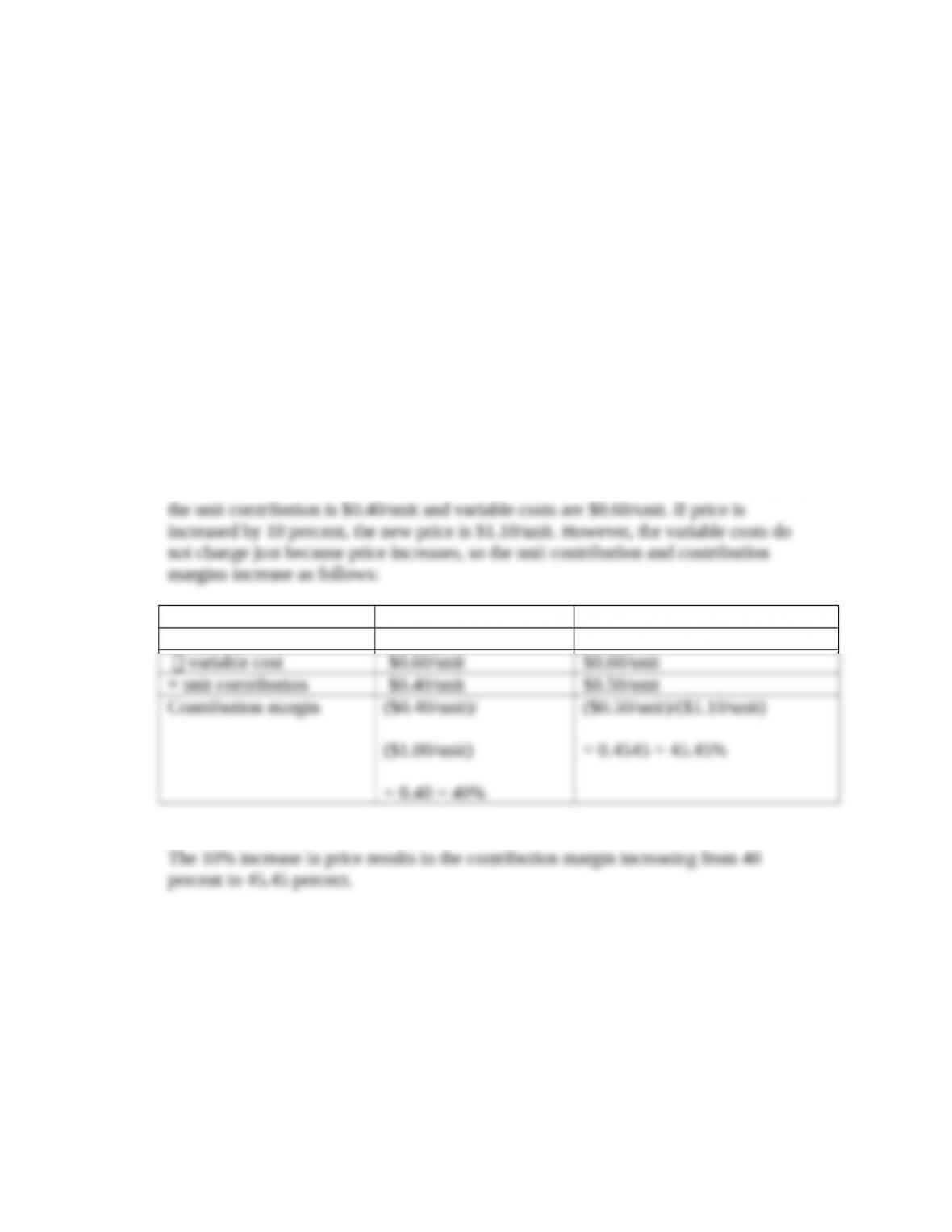
If we do not know the price but know the original contribution margin (in this case 40
percent), we can set the old price to $1.00/unit. If price equals $1.00, then that means
Old New (10% increase)
Price $1.00/unit $1.10/unit
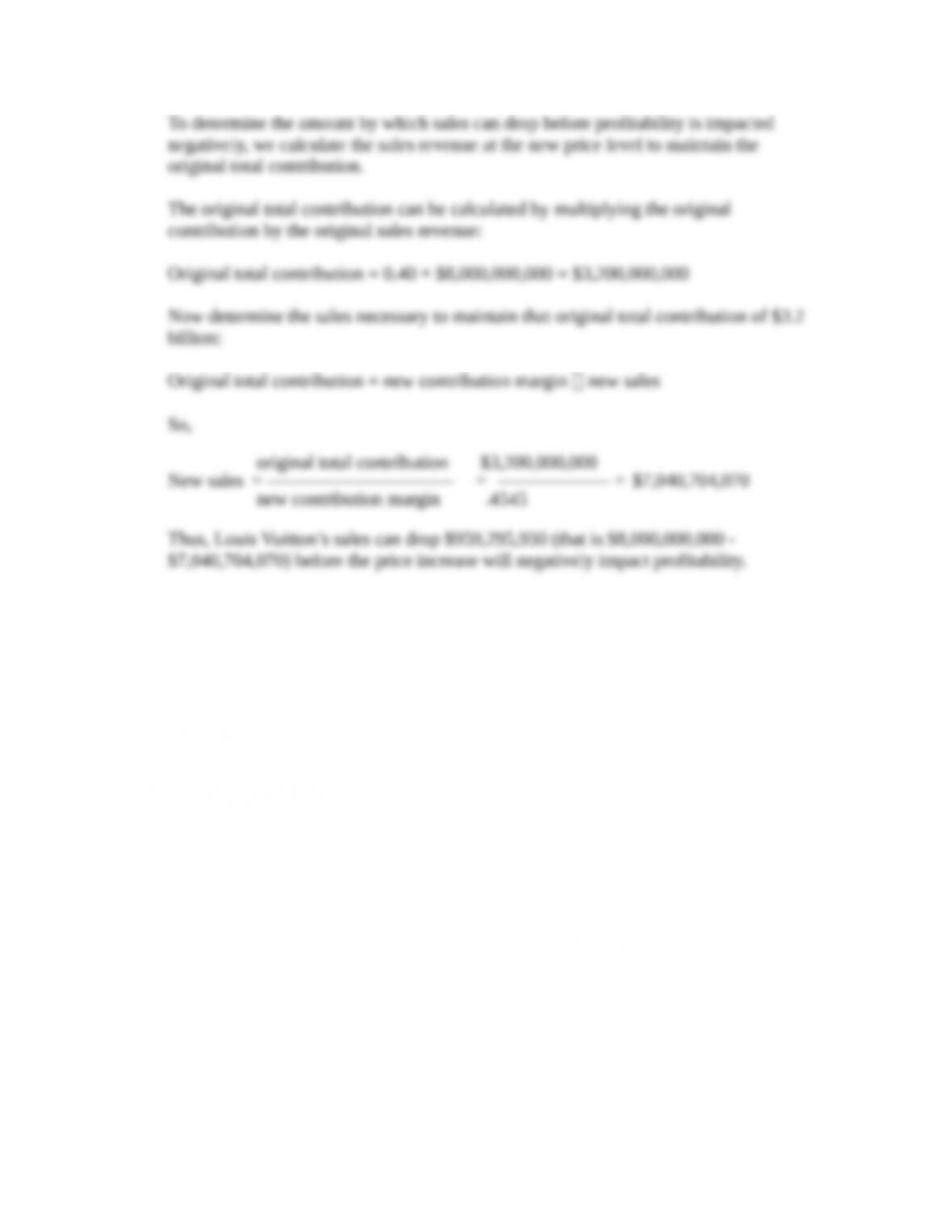
11-14 Determine by how much sales can drop and still let the company maintain the total
contribution it had when the contribution margin was 40 percent. (AACSB:
Communication; Analytic Reasoning)
Answer:
Copyright 2018 Pearson Education
Company Case Notes
Lululemon: Indulging Customers at a Premium Price
Synopsis
Lululemon has quickly risen to the top of a bustling market that it played a major role in
defining. With approximately 400 stores around the world, Lululemon peddles its own
brand of yoga-inspired apparel with its instantly recognizable logo—an iridescent
lower-case “a” that resembles an “omega.” But far more than selling clothing, Lululemon
inspires an image and a lifestyle. The company exudes the philosophy captured by its
manifesto—“We are passionate about sweating every day and we want the world to know
it. Breathing deeply, drinking water, and getting outside also top the list of things we
can’t live without.” In other words, this brand is about active, healthy, back-to-nature
lifestyles and isn’t shy about saying so. That image, complimented by a “no discounts”
credo, has a fanatically loyal customer-base willing to buy everything Lululemon without
any concern about the premium prices.
Teaching Objectives
The teaching objectives for this case are to:
1. Discuss the different aspects of price.
Copyright 2018 Pearson Education
2. Examine the nature of establishing an image of low price.
3. Evaluate the different ways (and outcomes) for responding to price changes.
4. Consider the role that price plays in the marketing mix.
Discussion Questions
11-18 Relative to customer value, explain customers’ willingness to pay premium prices
for Lululemon’s products.
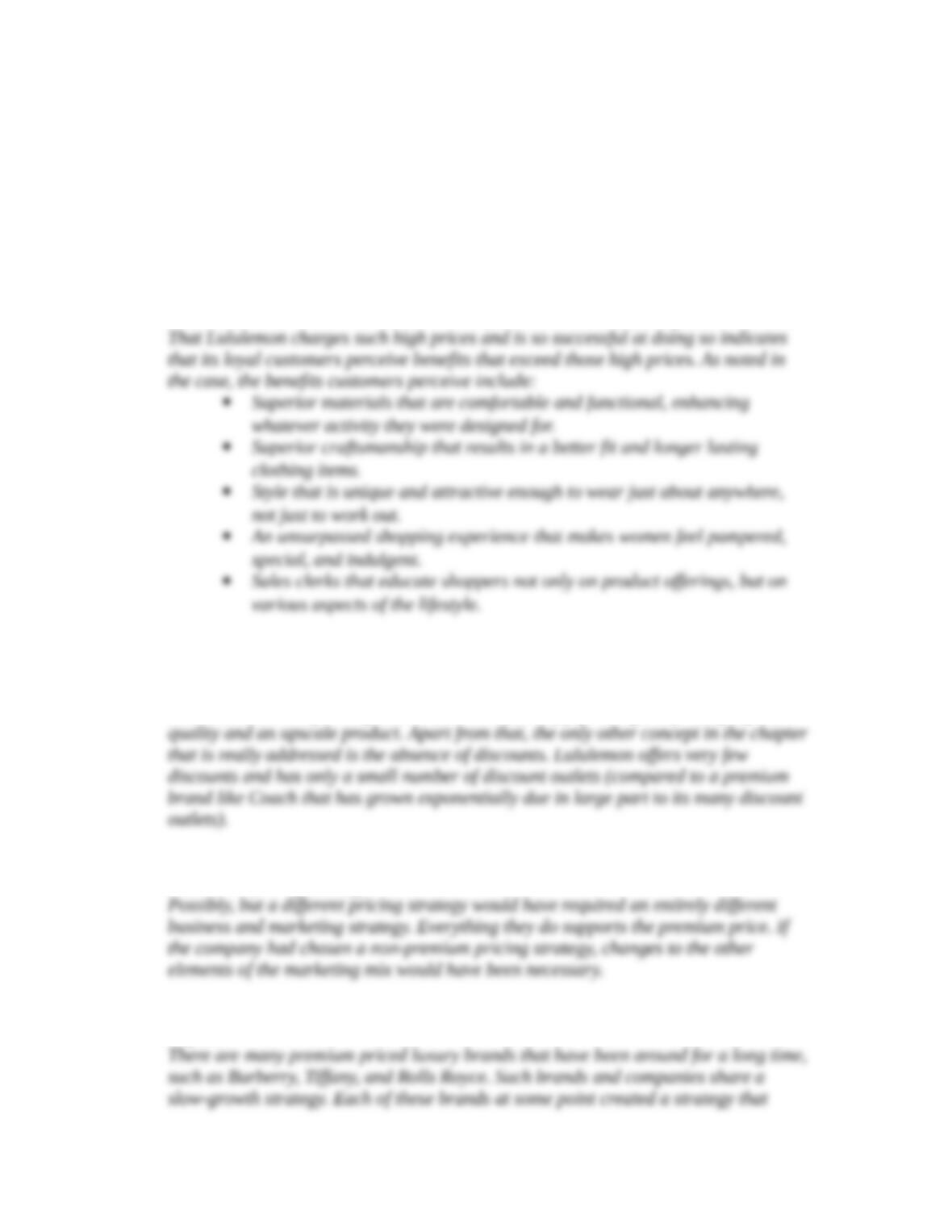
Customer-perceived value is defined by products that exhibit customer benefits that
exceed customer costs. The more that benefits exceed the costs, the greater the value.
11-19 Based on principles from the chapter, explain how price affects customer
perceptions of the Lululemon brand.
Lululemon uses price points without a decimal point. Rather than pricing products at
$97.99, Lululemon prices goods at $98. This form of psychological pricing signals
11-20 Could Lululemon have achieved the same level of success had it executed an
alternative pricing strategy?
11-21 Can Lululemon continue to succeed with the current premium-pricing strategy?
Explain.
Copyright 2018 Pearson Education
Brands like Coach that exploded by marketing to the masses at some point begin to
feel growing pains. They hit a wall and slow down. Some premium brands that grew
If Lululemon is to sustain its premium pricing strategy, it must maintain all the
benefits that its customers value. Additionally, it will likely have to enhance the
benefits of the products without raising prices. If it loses its edge, customers will have
no real reason to continue to pay such high prices.
Teaching Suggestions
Conduct a discussion of this case built around the discussion questions. Spend some time
on Question 4, even getting a debate going if possible surrounding the issue of whether or
not Lululemon can continue to be so successful based on its pricing strategy. Then, give
students five or ten minutes to do some research on the current state of Lululemon and
the challenges and controversies that have plagued the company. Revisit Question 4 and
see if the overall opinion has changed at all.
This case was developed for use with Chapter 11. This case also works well with the first
pricing chapter (Chapter 10), the branding chapter (Chapter 8), the segmentation chapter
(Chapter 7), and the consumer behavior chapter (Chapter 5).
Go to mymktlab.com for the answers to the following Assisted-graded writing questions:
11-22 Explain how businesses implement segmented pricing and discuss conditions
necessary for success.
11-23 Any charge that is not airfare is referred to as ancillary revenue for airlines—
and they are cleaning up on it to the tune of $20 billion a year. While consumers can
avoid some fees, such as those for food, preferred seating, and wi-fi, the majority
can’t avoid baggage fees. What type of pricing strategies are airlines using? Is it
ethical for airlines to charge baggage fees?
ADDITIONAL PROJECTS, ASSIGNMENTS, AND
EXAMPLES
Copyright 2018 Pearson Education
Projects
1. Create a scenario for the use of a market-skimming strategy. Create a second for a
market-penetration strategy. (Objective 1)
2. Using the categories found in Table 11.1, find an advertisement that illustrates each of
the strategies. Demonstrate why the advertisement fits the category. (Objective 2)
3. The opening vignette deals with a unique price and value strategy. Think of two
restaurants or other services that utilize unique price and value strategies and defend
your answers. (Objective 2)
4. Product bundle pricing has the potential to bring in a lot of additional revenue. Think
of three different products that rely on product bundle pricing. (Objective 2)
Small Group Assignments
1. Form students into groups of three to five. Each group should read Real Marketing
11.1: Dynamic Pricing: The Wonders and Woes of Real-Time Price Adjustments.
Each group should then answer the following questions and share their answers with
the class. (Objective 1)
a. Based on this reading, how well do you believe that consumers actually
understand how online pricing changes based on characteristics of the individual
consumer or buying situation? Explain your answer.
b. While dynamic pricing can help sellers to optimize sales and profits by tracking
competitive pricing and making adjustments, what are the risks to the relationship
with the consumer? Can the strategy harm that relationship? How? Explain.
c. With this focus on pricing, can companies lead consumers to focus on price to the
exclusion of other factors such as customer service, convenience, and assortment?
What long-term impacts could this have on a company’s business?
2. Form students into groups of three to five. Each group should read Real Marketing
11.2: Pharmaceutical Pricing: No Easy Answers. Each group should then answer the
following questions and share their answers with the class. (Objective 3)
a. What are some of the broader societal pricing concerns faced by companies that
sell prescription medications?
b. Pharmaceutical companies spend a tremendous amount of money advertising to
consumers who simply take the medications the physician orders. Is this ethical?
c. Do you believe that the pharmaceutical companies mentioned here price their
product offering fairly? Explain.
Individual Assignments
1. Market-skimming pricing is used many times when companies invent new
products and first introduce them to the market. Think of five “new” products that
you believe are employing a price skimming strategy. Back up your answers.
(Objective 1)
Copyright 2018 Pearson Education
Think-Pair-Share
Consider the following questions, formulate an answer, pair with the student on your
right, share your thoughts with one another, and respond to questions from the instructor.
1. Under what conditions does market-skimming pricing make sense? (Objective 1)
2. When can promotional pricing be unethical? (Objective 3)
3. Provide an illustration of each of the geographical pricing situations. Which is
used most often in delivering products sold via the Internet? (Objective 3)
4. What is dynamic pricing and when should a company use this strategy?
(Objective 3)
5. What issues should marketers anticipate with respect to buyer reactions to price
changes? (Objective 4)
Outside Examples
1. Take a look at Zenith watches (www.zenith-watches.com). Take time to fully
explore the company and the product offering. Next, look up two or three
merchants that carry the Zenith brand. Discuss the pricing strategies you believe
Zenith is employing. (Objective 1)
Possible Solution:
This question requires students to combine information from the previous chapter
(Chapter 10) and this chapter. Zenith is using a combination of pricing strategies.
From information contained in this chapter, it is clear that Zenith is employing a
2. Research GlaxoSmithKline, the pharmaceutical company. Now, go to their Web
site (www.gsk.com) to learn about the company. Pay particular attention to
sections dealing with corporate responsibility, marketing practices, and their stand
on providing medicine to underprivileged individuals and populations. Download
their Corporate Responsibility Review and read it. Discuss how GSK is
attempting to walk the line between corporate profitability and social
responsibility. (Objective 4)
Possible Solution:
GlaxoSmithKline devotes much of its efforts to acting in a socially responsible
manner. Its Web site states, “Millions of poor people in both developed and
developing countries cannot obtain the medicines they need. The primary
Copyright 2018 Pearson Education

Copyright 2018 Pearson Education