END OF CHAPTER MATERIAL
Discussion Questions
1-1 Define marketing and outline the steps in the marketing process. (AASCB:
Communication)
Answer: Student answers will vary based on their personal response. Refer to the MyLab for
an opportunity to assign this question, and all starred MyLab questions, to a student
discussion board.
1-2 What is a market offering? Give a recent example of a market offering that has satisfied your
need or want. (AACSB: Communication; Reflective Thinking)
Answer:
1-3 Describe the key elements of a customer-driven marketing strategy and discuss the
marketing management orientations that guide marketing strategy. (AACSB:
Communication; Reflective Thinking)
Answer: Student answers will vary based on their personal response. Refer to the MyLab for
1-4 Discuss the concept of customer satisfaction. How do customer relationship management and
customer-perceived value affect customer satisfaction? (AACSB: Communication; Reflective
Thinking)
Answer:
Customer satisfaction depends on the product’s perceived performance relative to a buyer’s
Copyright© 2018 Pearson Education, Inc.
1-5 Explain the growing importance of digital and social media marketing. (AACSB:
Communication; Reflective Thinking)
Critical Thinking Exercises
1-6 Select a publicly traded company and research how much was spent on marketing activities
in the most recent year of available data. What percentage of sales does marketing
expenditures represent for the company? Have these expenditures increased or decreased
over the past five years? Write a brief report of your findings. (AACSB: Communication;
Analytic Reasoning)
Answer: Student answers will vary. Examples include Kohl’s Corp. increasing its advertising
1-7 Visit the Tide website at tide.com/en-us. Scroll to the bottom of the page and notice how
Tide is currently connecting with customers on social media platforms including Facebook,
Twitter, Pinterest, Google+, and YouTube. Click on one or more of the platforms to view
ways in which Tide is building and maintaining customer linkages while illustrating value
and providing information behind the brand. Evaluate Tide’s effectiveness in creating
customer engagement through its web and social media sites. (AACSB: Communication, Use
of IT, Reflective Thinking)
1-8 Search the internet for salary information regarding jobs in the marketing industry using
www.glassdoor.com, www.payscale.com, or a similar website. Choose five different jobs in
marketing. For each position, review the national average salaries and compare them to the
salaries in your local area. Discuss your findings. (AACSB: Communication; Use of IT;
Reflective Thinking)
Copyright© 2018 Pearson Education, Inc.
APPLICATIONS AND CASES
Online, Mobile, and Social Media Marketing: The ALS Ice Bucket Challenge
In the summer of 2014, people with connections to ALS (Lou Gehrig’s disease) raised awareness
of the condition by urging people to post videos of themselves dumping buckets of ice water
over their heads and challenge others to do the same. The efforts raised millions of dollars in
online donations to the ALS Association for enhanced research and patient services. This real-
time marketing campaign generated 17 million videos uploaded to social media platforms from
159 countries. Celebrities posting videos included Will Smith, Bill Gates, Oprah Winfrey, and
Mark Zuckerberg. The Ice Bucket Challenge generated 70 billion video views while raising $220
million. The best part? Zero dollars were spent to promote the Ice Bucket Challenge, yet 440
million people saw it. The ALS Association has now turned the wildly successful challenge into
an annual social media campaign, bringing back the original Ice Bucket Challenge
#EveryAugustUntilACure. For more information, visit www.alsa.org/fight-als/ice-bucket-
challenge.
1-9 Real-time marketing is a shift for traditional marketers who can now digitally link brands to
important moments in customers’ lives. Explain how real-time marketing was used in the Ice
Bucket Challenge. Why was this campaign successful? (AACSB: Communication;
Reflective Thinking)
Answer: The Ice Bucket Challenge became an extremely successful example of a viral
1-10 Create a real-time marketing campaign for a product or service of your choice to create
customer engagement using online, mobile, and social media. How would you measure the
success of your campaign? (AACSB: Communication; Reflective Thinking)
Marketing Ethics: Is Big Brother Watching?
Retailers commonly track customers’ shopping patterns and target them with special offers. For
example, CVS has an Extracare card that, when swiped at checkout, applies discounts to
purchases and provides rebates called Extra Bucks to be used as cash on future purchases.
Behind the scenes, CVS is gathering data on customers’ purchases and using aggregated data
to target individuals with special offers. Customers who haven’t recently shopped may receive a
discount in the mail or an online offer to incentivize them to return. Frequent shoppers can scan
Copyright© 2018 Pearson Education, Inc.
their Extracare cards to get discounts and offers in the store,
1-11 Is it right for marketers to track consumer purchases? Should consumers be concerned with
what information is being used? (AACSB: Communication; Ethical Reasoning; Reflective
Thinking)
1-12 Discuss other examples of marketers using data collection to sell products. Is this ethical?
(AACSB: Communication; Ethical Reasoning)
Marketing by the Numbers: What’s a Customer Worth?
How much are you worth to a given company if you continue to purchase its brand for the rest of
your life? Many marketers are grappling with that question, but it’s not easy to determine how
much a customer is worth to a company over his or her lifetime. Calculating customer lifetime
value can be very complicated. Intuitively, however, it can be a fairly simple net present value
calculation, which incorporates the concept of the time value of money. To determine a basic
customer lifetime value, each stream of profit (C, the net cash flow after costs are subtracted) is
discounted back to its present value (PV) and then summed. The basic equation for calculating
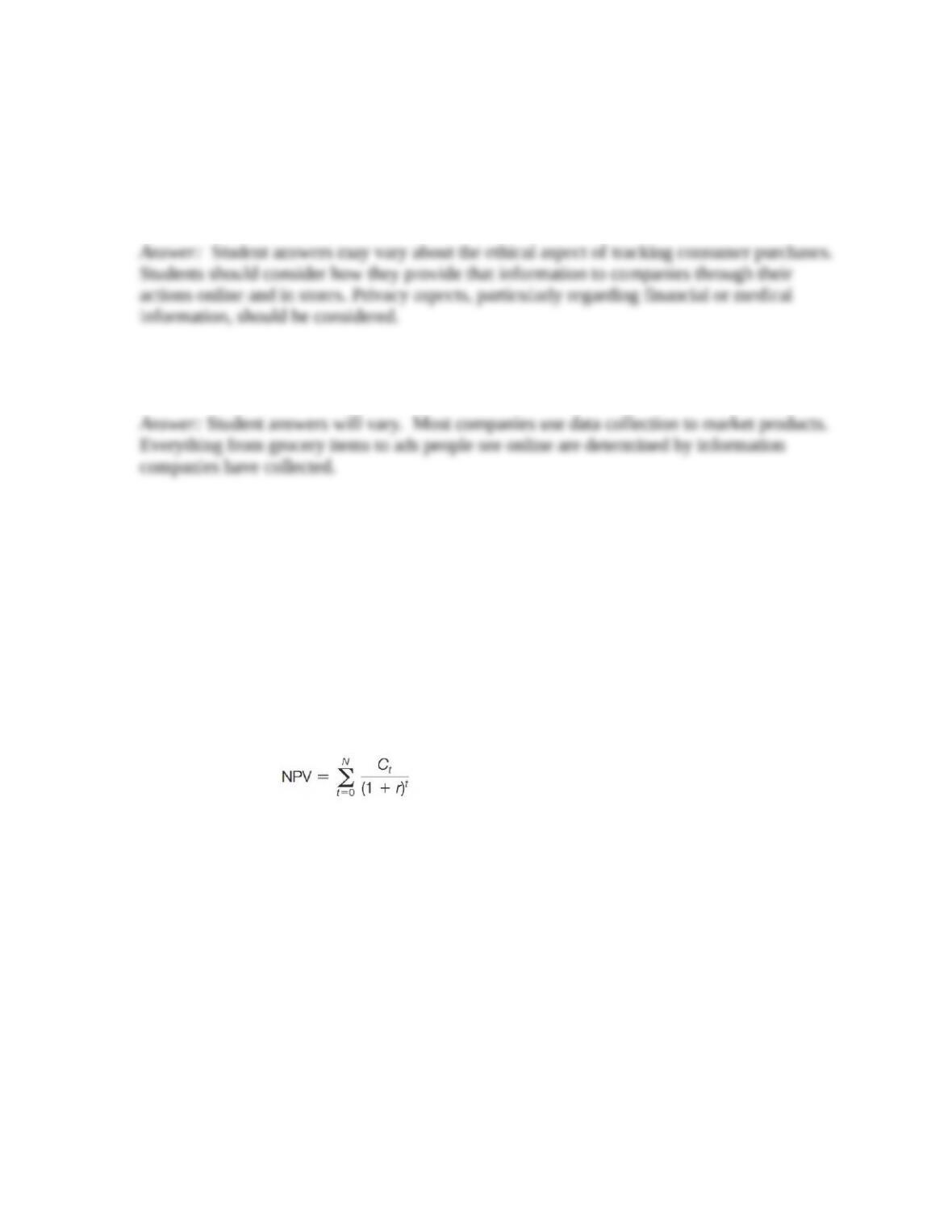
net present value (NPV) is:
Where,
t: time of the cash flow
N: total customer lifetimer: discount rate
Ct: net cash flow (the profit) at time t (The initial cost of acquiring a customer would be a
negative net cash flow at time 0.)
NPV can be calculated easily on most financial calculators or by using one of the calculators
available on the internet, such as the one found at www.investopedia.com/calculator/
NetPresentValue.aspx.
1-13 Assume that a customer shops at a local grocery store, spending an average of $200 a week
and resulting in a retailer profit of $10 each week from this customer. Assuming the shopper
visits the store all 52 weeks of the year, calculate the customer lifetime value if this shopper
Copyright© 2018 Pearson Education, Inc.
remains loyal over a 10-year life span. Also assume a 5 percent annual interest rate and no
initial cost to acquire the customer. (AACSB Communication; Analytic Reasoning)
Answer:
1-14 Describe ways marketers can increase the lifetime value of a customer. (AACSB
Communication; Reflective Thinking)
Answer:
Company Case Notes
Chick-fil-A: Getting Better Before Getting Bigger
Synopsis
Chick-fil-A may not be the biggest fast-food chain, but the up and coming purveyor of poultry
sells more food per store than any of its competition—even McDonald’s. Its annual growth rate
blows away all other top-10 chains. How does it do it? By making customers the number one
priority. Chick-fil-A has a great product in its breaded chicken sandwich. But its real secret is the
exceptional way all its employees treat customers. Beyond the point-of-purchase customer
experience, Chick-fil-A also places customer engagement at the core of its strategy.
Teaching Objectives
The teaching objectives for this case are to:
1. Introduce students to the concept of customer value creation and its central role in
marketing.
2. Provide a case for the analysis of customer satisfaction.
3. Consider the business model for a company and how it fits into marketing management
orientations.
4. Introduce the concepts involved in customer relationship management.
Discussion Questions
1-18 Give examples of needs, wants, and demands of Chick-fil-A customers, differentiating these
three concepts.
Needs. When considered in a purely “Maslow” sense, the needs experienced by Chick-fil-A
Copyright© 2018 Pearson Education, Inc.
Wants. Wants fulfill a consumer need, but in a specific way that isn’t necessary for the
Demands. You need reliable transportation. You want a high-performing luxury sport sedan.
1-19 Describe Chick-fil-A in terms of the value it provides customers. How does Chick-fil-A
engage customers?
Value = benefits – costs.
Benefits
Costs
If the total of the benefits exceeds the total of the costs, then value is provided.
At first glance, customer engagement may not seem to fit in the same question as customer
1-20 Evaluate Chick-fil-A’s performance relative to customer expectations.
This question references the concept of customer satisfaction. Customers are satisfied when
Copyright© 2018 Pearson Education, Inc.

1-21 Which of the five marketing management orientations best applies to Chick-fil-A?
1-22 Can Chick-fil-A continue to provide exceptional customer service and sustain the level of
growth it now enjoys? Why or why not?
Teaching Suggestions
A discussion based on this case is optimal when the concepts of needs/wants/desires, customer
value, customer satisfaction, and marketing management orientations have been discussed. After
these concepts have been covered, ask students to consider the classic scenario of making a
choice as to which fast-food option they might choose for a given meal. What did that situation
feel like? Is that decision only based on how certain food items taste? Or, is it based on far more
than that? Ask how many students like Chick-fil-A and why.
This case also works well with the marketing environment chapter (Chapter 3), the marketing
channels chapter (Chapter 12), and the competitive advantage chapter (Chapter 18).
Go to mymktlab.com for Auto-graded writing questions as well as the following
Assisted-graded writing questions:
1-23 When implementing customer relationship management, why might a business desire fewer
customers over more customers? Shouldn’t the focus of marketing be to acquire as many
customers as possible?
1-24 Compare and contrast needs wants, and demands. Which one(s) can marketers influence?
ADDITIONAL PROJECTS, ASSIGNMENTS, AND EXAMPLES
Projects
1. Why is it important to truly understand the customer? Make a list of 10 “wants” that you
have. What would have to occur to move each of these from “wants” to “needs”?
(Objective 2)
2. Review the five alternative concepts under which organizations design and carry out their
marketing strategies. Now, take a look at one of the automobile dealerships in your town.
Copyright© 2018 Pearson Education, Inc.

Which one of these five concepts do you believe they are typically employing? Why?
(Objective 3)
3. Think of a product or retailer to which you are loyal. What has caused this loyalty? What
could a competing product/retailer do to break this loyalty? (Objective 4)
Small Group Assignments
1. Form students into groups of three to five. Each group should read the opening vignette
to the chapter on Nike. Each group should answer the following questions. (Objective 2)
a. How does Nike succeed in developing unique customer experiences? Which chapter
marketing objectives does this help the company to achieve?
b. Based on your study of Nike, do you believe that customers really want long-term
relationships with a company? Why or why not?
2. Form students into groups of three to five. Each group should read Real Marketing 1.1:
“Buffalo Wild Wings: Fueling the Sports Fan Experience.” Each group should then
answer the following questions and share their findings with the class. (Objective 3)
a. With plenty of casual-dining choices available, what is it about the Buffalo Wild
Wings customer service philosophy that wins over diners every time?
b. What does Buffalo Wild Wings’ legendary customer service begin with? What are the
most important steps in ensuring that the company delivers on its promise every time?
c. Discuss the connection between selecting and training the right employees, and
consistently delivering outstanding customer service.
Individual Assignments
1. Companies are realizing that losing a customer means more than losing a single sale. It
means losing a stream of revenue from that customer over their lifetime. Reread the story
of Stew Leonard (under Creating Customer Loyalty and Retention). (Objective 4)
Is it possible to take his idea of “the customer is always right” too far so that it becomes a
negative on the company? Why or why not?
2. Marketing activities by not-for-profit organizations have increased substantially in recent
years. Organizations such as hospitals and churches now spend significant monies to get
their individual messages out and draw in new customers, clients, members, etc. Discuss
whether or not you consider this a good long-term strategy to grow the organization.
Does the condition of the economy affect your thinking? (Objective 5)
Think-Pair-Share
Copyright© 2018 Pearson Education, Inc.
Consider the following questions, formulate answers, pair with the student on your right, share
your thoughts with one another, and respond to questions from the instructor.
1. How is marketing different from selling? (Objective 1)
2. Do marketers create needs? (Objective 2)
3. What is Target’s value proposition? (Objective 2)
4. What are two companies with which you have an emotional bond? Describe that bond.
(Objective 4)
Outside Examples
1. Five core customer and marketplace concepts are critical to success: (1) needs, wants,
and demands; (2) marketing offers (products, services, and experiences); (3) value and
satisfaction; (4) exchanges and relationships; and (5) markets.
Take a look at Sea Ray boats (www.searay.com). Answer the following questions.
(Objective 2)
a. What needs, wants, and/or demands is Sea Ray attempting to fill?
b. Describe their marketing offers.
c. Describe the relationships they have with their customers.
d. What are their markets?
Possible Solution:
a. Sea Ray is primarily appealing to the wants. Wants are the form human needs take as
b. Market oerings are some combination of products, services, information, or
c. Through a review of the Web site, you will realize that Sea Ray makes a strong effort
to maintain close relationships with their customers. The annual AquaPalooza is an
example of Sea Ray’s relationship-building efforts.
d. Sea Ray’s markets are quite varied. Depending on the size and type of boat, their
2. One of the great new “marketplaces” of our time is eBay. Spend some time on the eBay
Web site (www.ebay.com). Find a product that you are interested in and follow the
bidding. How much would you be willing to pay? Consider the following questions.
(Objective 2)
a. How is eBay providing value to its customers?
Copyright© 2018 Pearson Education, Inc.
b. Describe the relationship they have with their customers.
c. What are their markets?
Possible Solution:
a. A company’s value proposition is the set of benefits or values it promises to deliver to
b. eBay takes great effort to maintain a close, almost personal relationship with their
Copyright© 2018 Pearson Education, Inc.