
APPENDIX 3 Marketing by the Numbers
Learning Objectives
1. Conduct pricing, breakeven, and margin analysis.
2. Estimate demand, develop a pro forma and actual profit-and-loss statement, and
calculate various marketing performance measures.
3. Conduct financial analyses of marketing tactics.
Appendix Overview
This appendix provides a basic introduction to measuring marketing financial analysis
and is built around a hypothetical manufacturer of consumer electronics products—HD.
This company is launching a new product (a device that plays videos and television
programming streamed over the Internet on multiple devices in a home including
high-definition televisions, tablets, and mobile phones), and we discuss and analyze the
various decisions HD’s marketing managers must make before and after launch.
The appendix is organized into three sections, and while the HD scenario is carried
throughout all sections, instructors can select one or more sections at their discretion. At
the end of each section, quantitative exercises provide students with an opportunity to
apply the concepts in that section to contexts beyond the HD example. The sections are
broken down as follows:
1. Pricing, Breakeven, and Margin Analysis. This section covers pricing
considerations and break-even and margin analysis assessments that guide the
introduction of HD’s new product launch.
2. Demand Estimates, the Marketing Budget, and Marketing Performance
Measures. This section begins with a discussion of estimating market
potential and company sales. It then introduces the marketing budget, as
illustrated through a pro forma profit-and-loss statement followed by the
actual profit-and-loss statement. Next, the section discusses marketing
performance measures, with a focus on helping marketing managers to better
defend their decisions from a financial perspective.
3. Financial Analysis of Marketing Tactics. The final section analyzes the
financial implications of various marketing tactics, such as increasing
advertising expenditures, adding sales representatives to increase distribution,
lowering price, or extending the product line.
In this manual, solutions to the quantitative exercises follow the outline of the section in
which each set of exercises appears. Additionally, fifteen additional quantitative
exercises similar to those in the appendix are provided at the end of the material for this
manual. These may be used in lectures, for additional student practice, or for exams.
Copyright © 2015 Pearson Education, Inc.
A3-1

Appendix Outline
I. Pricing, Breakeven, and Margin Analysis
A. Pricing Considerations
1. The limiting factors are demand and costs.
2. Determining Costs
a) Fixed costs do not vary with production or sales (e.g., rent,
interest, depreciation, clerical and managerial salaries).
b) Variables costs vary directly with the level of production
(e.g., cost of goods sold and many marketing costs).
c) Total costs are the sum of the fixed and variable costs.
3. Setting Price Based on Costs
a) Cost-plus pricing (or markup pricing) simply adds a
standard markup to the cost of the product.
(1) Unit cost for HD:
fixed costs $20,000,000
Unit cost = variable cost + —————— = $125 + ————— = $145
unit sales 1,000,000
(2) If HD desires a 25% markup on sales:
unit cost $145
Markup price = ——————————— = ——— = $193.33
(l – desired return on sales) (l – 0.25)
b) Relevant costs are those that will occur in the future and
that will vary across the alternatives being considered.
c) Sunk costs are past costs that will not reoccur in the future
and should not be considered.
d) Break-even price is the price at which unit revenue (price)
equals unit cost and profit is zero.
(1) For HD: breakeven price equals $145, which is the
unit cost determined above.
e) Return on investment (ROI) pricing is determined by
multiplying the desired return on investment by the
investment and adding this figure to the fixed costs.
(1) If HD desires a 30% return on an initial $10 million
investment:
Copyright © 2015 Pearson Education, Inc.
A3-2

ROI investment 0.3 $10,000,000
ROI price = unit cost + —————— = $145 + —————— = $148
unit sales 1,000,000
4. Setting Price Based on External Factors
a) Manufacturers do not have the final say concerning the
final price to consumers–retailers do, so HD must start with
its suggested retail price (MSRP) and work back through
reseller margins to determine the price at which to sell the
product to wholesalers.
b) Dollar markup is the difference between a company’s
selling price for a product and its cost to manufacture or
purchase it:
Dollar markup = selling price – cost
c) Markups are usually expressed as a percentage, and there
are two different ways to compute markups–on cost or on
selling price:
Teaching Note: Sometimes a retailer wants to convert markups based on
selling price to markups based on cost, and vice versa. The formulas are:
Suppose a retailer uses a markup of 25% based on selling price and found
that his competitor was using a markup of 30% based on cost and wanted
to know what this would be as a percentage of selling price. The
calculation is:
Copyright © 2015 Pearson Education, Inc.
price sellingon percentage markup – 100%
price sellingon percentage markup
=cost on percentage Markup
coston percentage markup + 100%
coston percentage markup
= price sellingon percentage Markup
A3-3
price selling
markupdollar
= price sellingon percentage Markup
cost
markupdollar
=cost on percentage Markup
23% =
130%
30%
=
30% + 100%
30%

Because the retailer is using a 25% markup on selling price for similar
products, his markup is comparable with that of the competitor.
See additional quantitative exercise 6 for another application.
d) Value-based pricing uses buyers’ perceptions of value and
not the seller’s cost to determine the MSRP.
e) HD example: MSRP = $299.99, but $300 is used in
calculations for simplicity; retailer’s margin is 30% and
wholesaler’s is 20%, both based on their selling prices.
(1) Thus, the markup chain is:
Suggested retail price: $300
minus retail margin (30%): $ 90
Retailer’s cost/wholesaler’s price: $210
minus wholesaler’s margin (20%): $ 42
Wholesaler’s cost/HD’s price: $168
Teaching Note: Students should also be able to calculate prices when
cost and markup information is known. For example, suppose a retailer
knew his cost ($12) and desired markup on price (25%) for a product and
wanted to compute the selling price. Substituting (selling price – cost) for
dollar markup in the equation for markup percentage on selling price
given previously and solving for selling price gives the following formula
for determining the selling price:
See quantitative exercise 1.4 and additional quantitative exercises 4 and 5
for more applications of this equation.
B. Break-Even and Margin Analysis
1. Determining Breakeven Unit Volume and Dollar Sales
a) Break-even analysis determines the unit volume and dollar
sales needed to be profitable given a particular price and
cost structure.
b) Formula for determining break-even unit volume:
Copyright © 2015 Pearson Education, Inc.
A3-4
$16 =
.750
$12
= price Selling
markup – 1
cost
= price Selling
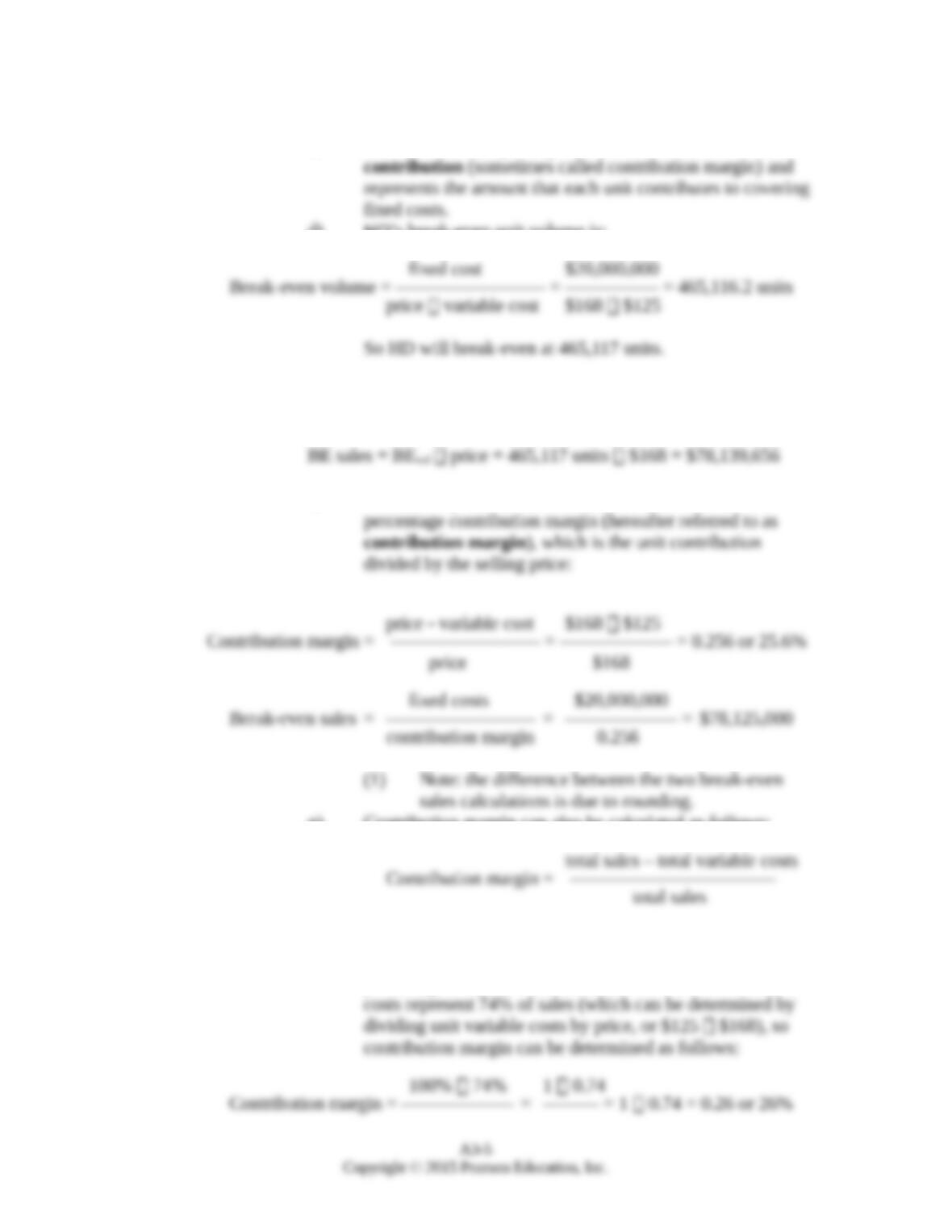
c) The denominator (price unit variable cost) is called unit
d) HD’s break-even unit volume is:
e) Break-even dollar sales can be determined by multiplying
unit breakeven volume by selling price:
f) Another way to calculate break-even sales is to use the
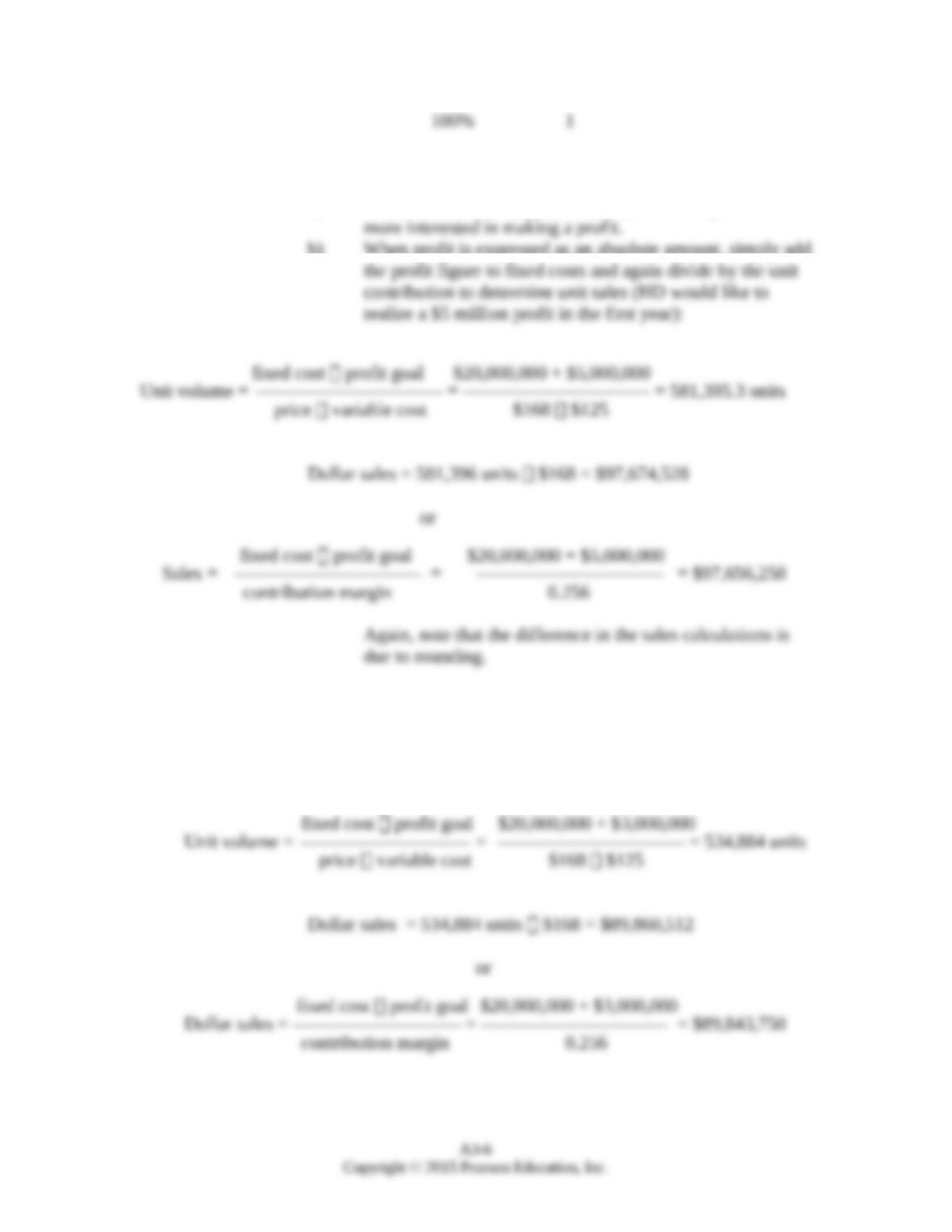
g) Contribution margin can also be calculated as follows:
h) Another way to determine contribution margin for any sales
level is by setting sales equal to 100% and subtracting the
percentage of variable costs from sales. For HD, variable
2. Determining “Break-even” for Profit Goals
a) While break-even analysis is useful, most companies are
b) When profit is expressed as an absolute amount, simply add
c) Profit can also be stated as a return on investment goal.
Determine the absolute profit goal by multiplying the
investment by the desired ROI (HD wants a 30% return on
its $10 million investment ($10,000,000 0.30)):
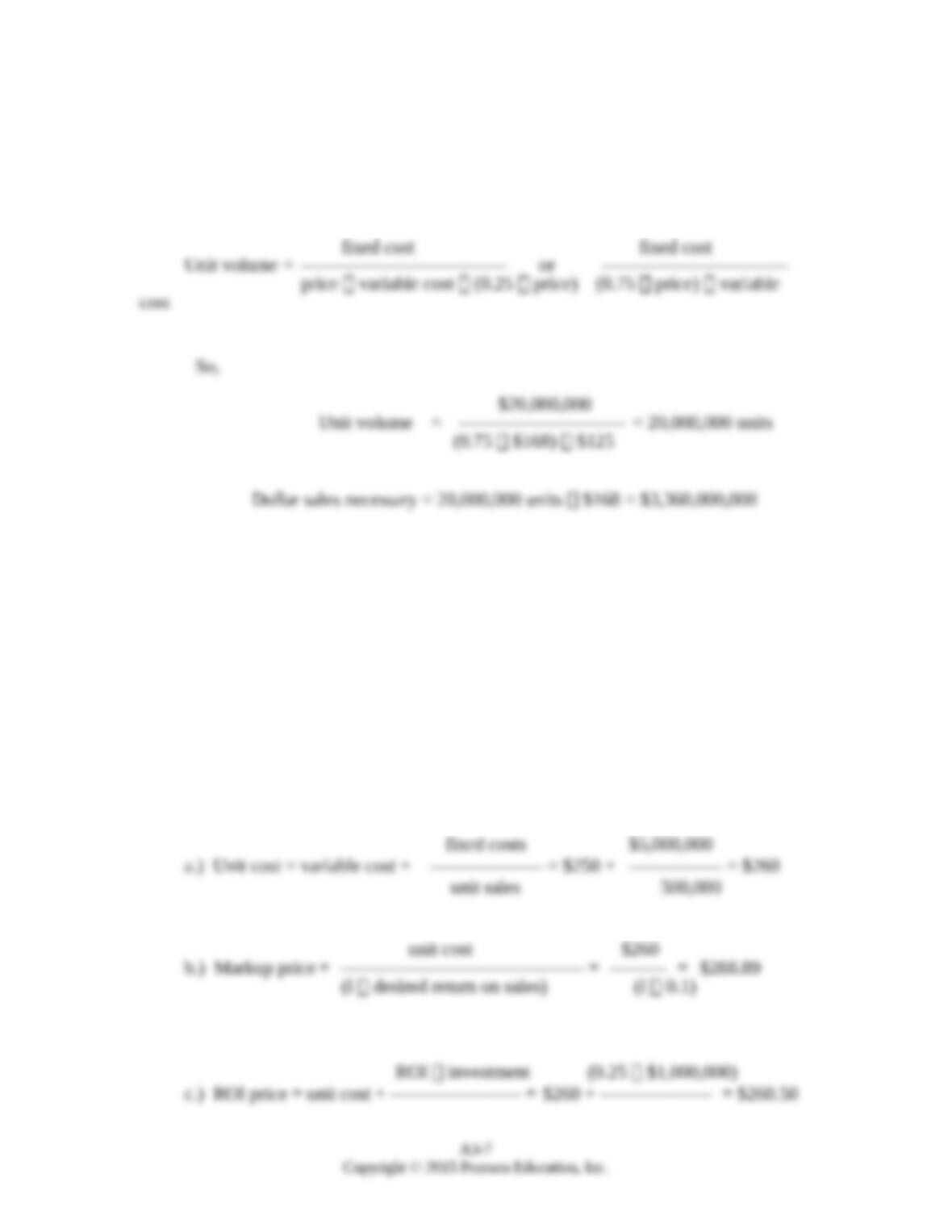
d) Profit goals can also be expressed as a percentage of sales.
In this case, we incorporate the profit goal into the unit
contribution as an additional variable cost (HD wants a
25% return on sales):
C. Marketing by the Numbers Exercise Set One
1.1. Elkins, a manufacturer of ice makers, realizes a cost of $250 for every unit it
produces. Its total fixed costs equal $5 million. If the company manufactures
500,000 units, compute the following:
a. unit cost
b. markup price if the company desires a 10% return on sales
c. ROI price if the company desires a 25% return on an investment of $1
million
Answer:
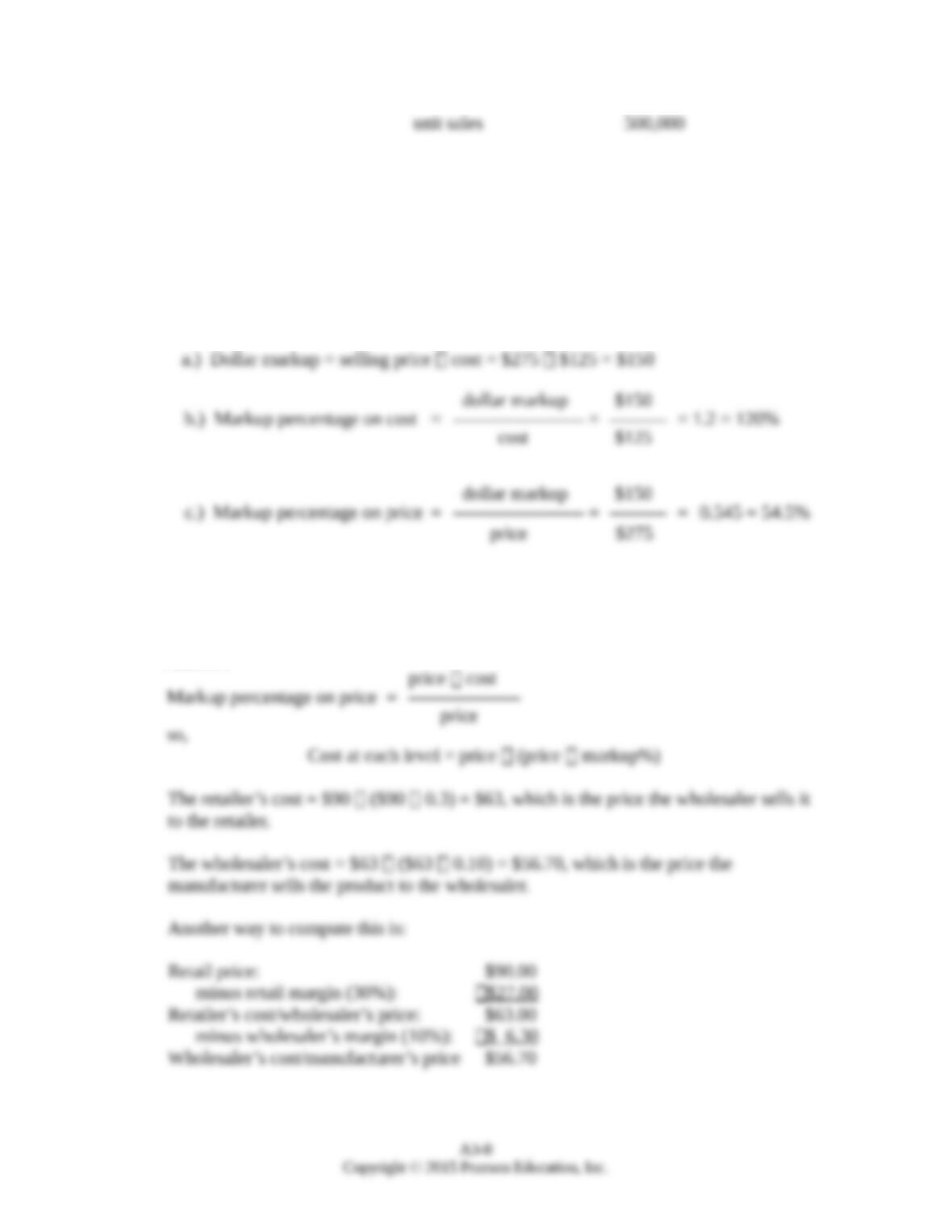
1.2. A gift shop owner purchases items to sell in her store. She purchases a chair for
$125 and sells it for $275. Determine the following:
a. dollar markup
b. markup percentage on cost
c. markup percentage on selling price
Answer:
1.3. A consumer purchases a coffee maker from a retailer for $90. The retailer’s
markup is 30%, and the wholesaler’s markup is 10%, both based on selling price.
For what price does the manufacturer sell the product to the wholesaler?
Answer:
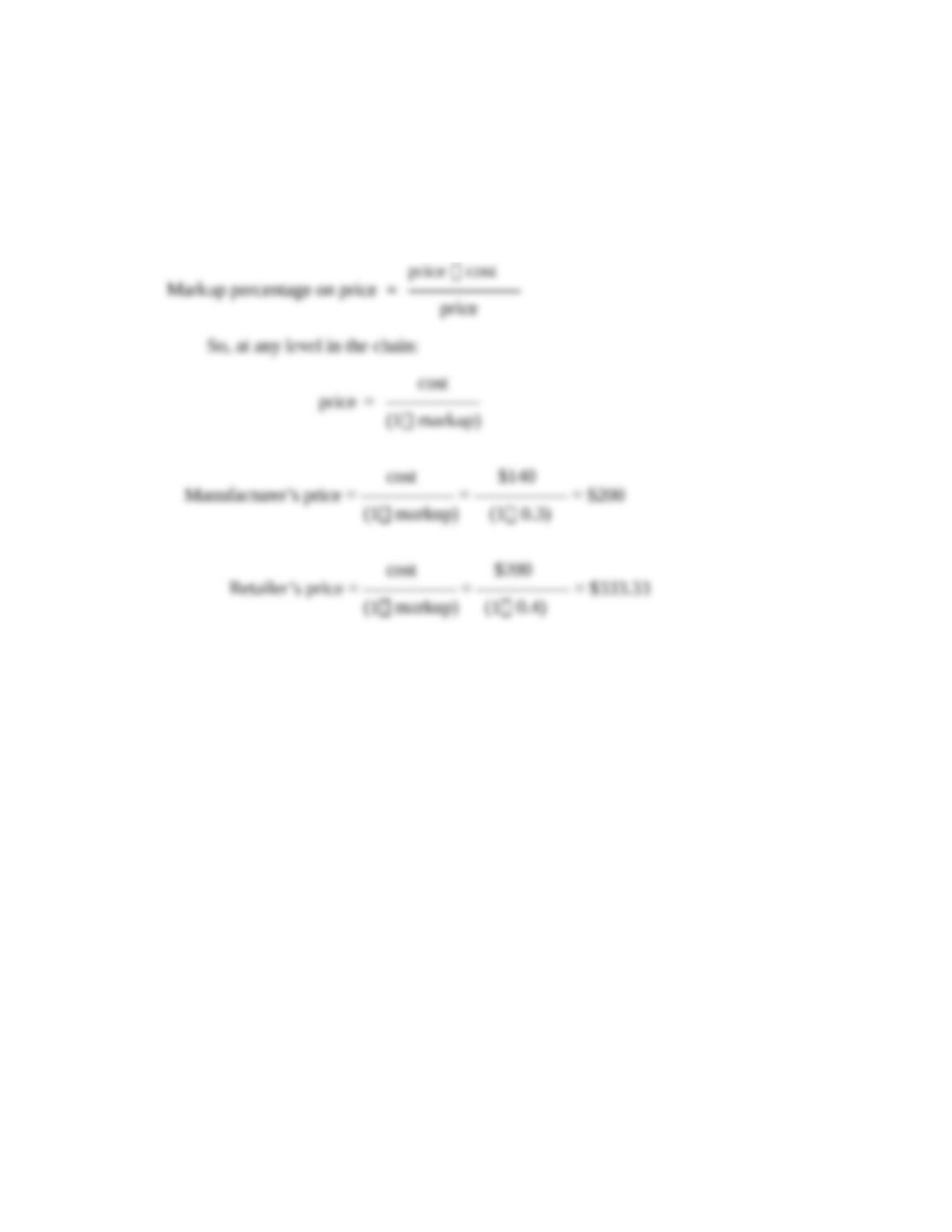
1.4. A lawnmower manufacturer has a unit cost of $140 and wishes to achieve a
margin of 30% based on selling price. If the manufacturer sells directly to a
retailer who then adds a set margin of 40% based on selling price, determine the
retail price charged to consumers.
Answer:
1.5. Advanced Electronics manufactures DVDs and sells them directly to retailers who
typically sell them for $20. Retailers take a 40% margin based on the retail
selling price. Advanced’s cost information is as follows:
DVD package and disc $2.50/DVD
Royalties $2.25/DVD
Advertising and promotion $500,000
Overhead $200,000
Calculate the following:
a. contribution per unit and contribution margin
b. break-even volume in DVD units and dollars
c. volume in DVD units and dollar sales necessary if Advanced’s profit goal
is 20% profit on sales.
d. net profit if 5 million DVDs are sold
Answer:
a.) Unit contribution = selling price unit variable cost
Copyright © 2015 Pearson Education, Inc.
A3-9
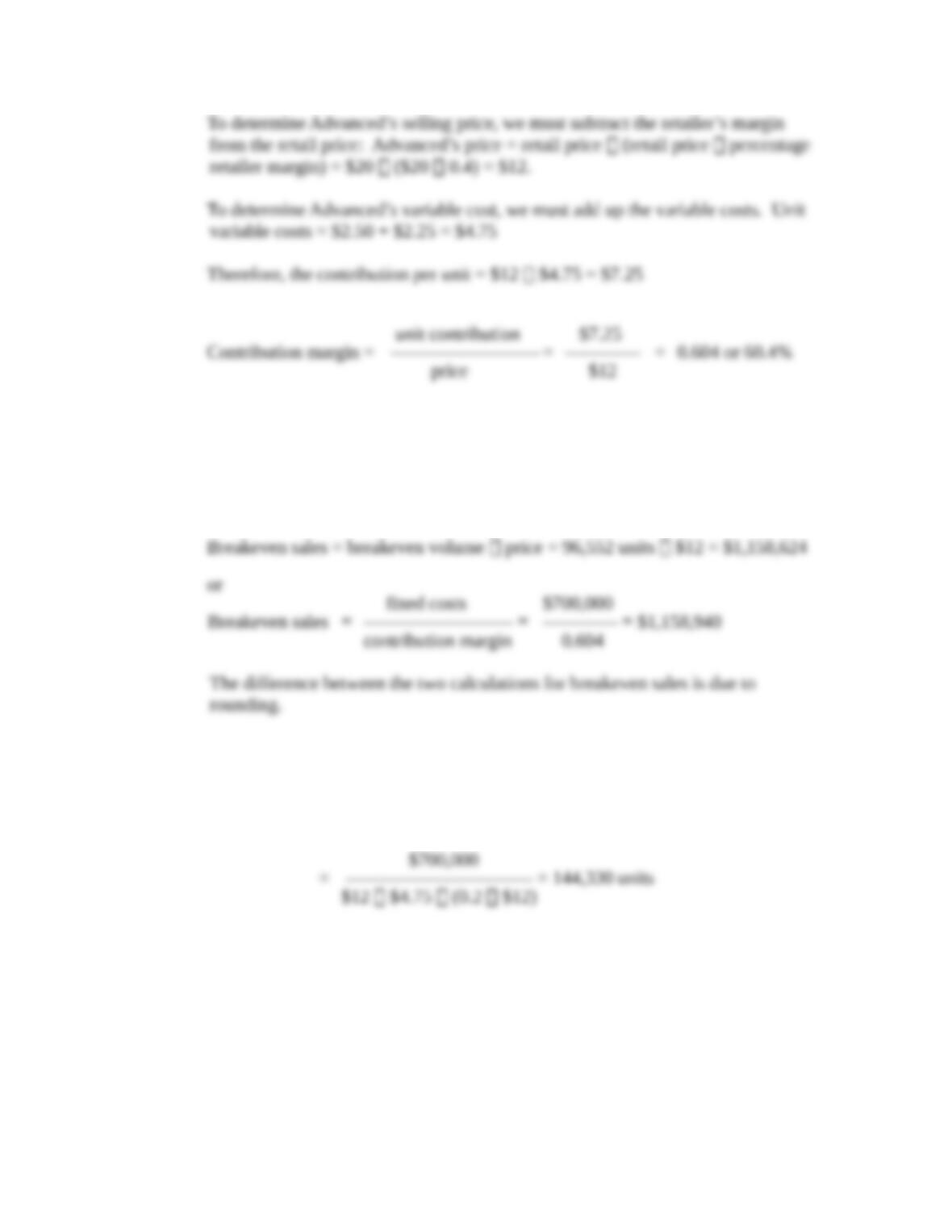
fixed costs $700,000
b.) Breakeven volume = ———————— = ———— = 96,552 units
unit contribution $7.25
fixed costs
c.) Unit volume = ——————————————
price variable cost (0.2 price)
Copyright © 2015 Pearson Education, Inc.
A3-10