Continuing Problem
P15-38 Using ratios to evaluate a stock investment
This problem continues the Canyon Canoe Company situation from Chapter 14. The company wants to
invest some of its excess cash in trading securities and is considering two investments, The Paddle
Company (PC) and Recreational Life Vests (RLV). The income statement, balance sheet, and other data
for both companies follow for 2019 and 2018, as well as selected data for 2017:
THE PADDLE COMPANY RECREATIONAL LIFE VESTS
Comparative Financial Statements Comparative Financial Statements
Years Ended December 31 Years Ended December 31
Income Statement 2019 2018 2017 2019 2018 2017
Net Sales Revenue $ 430,489 $ 425,410 $ 410,570 $ 383,870
Cost of Goods Sold 258,756 256,797 299,110 280,190
Assets
Cash & Cash Equivalents $ 69,159 $ 70,793 $ 65,730 $ 55,270
Accounts Receivable 44,798 44,452 $ 44,104 39,810 38,650 $ 36,460
Merchandise Inventory 79,919 66,341 76,363 68,500 65,230 59,930
Other Current Assets 15,494 16,264 24,450 37,630
Total Current Assets 209,370 197,850 198,490 196,780
Long-term Assets 89,834 90,776 116,760 116,270
Total Assets $ 299,204 $ 288,626 $ 276,482 $ 315,250 $ 313,050 $ 310,640

Stockholder’s Equity
Other Data
Market price per share $ 21.38 $ 33.82 $ 46.37 $ 51.64
Annual dividend per share 0.32 0.30 0.53 0.45
Weighted average number of
shares outstanding
9,000 8,000 9,000 8,000
Requirements
1. Using the financial statements given, compute the following ratios for both companies for 2019 and
2018. Assume all sales are credit sales. Round all ratios to two decimal places.
a. Current ratio
b. Cash ratio
c. Inventory turnover
d. Accounts receivable turnover
e. Gross profit percentage
f. Debt ratio
g. Debt to equity ratio
h. Profit margin ratio
i. Asset turnover ratio
j. Rate of return on common stockholders’ equity
k. Earnings per share
l. Price/earnings ratio
m. Dividend yield
n. Dividend payout
2. Compare the companies’ performance for 2019 and 2018. Make a recommendation to Canyon Canoe
Company about investing in these companies. Which company would be a better investment, The
Paddle Company or Recreational Life Vests? Base your answer on ability to pay current liabilities,
ability to sell merchandise and collect receivables, ability to pay long-term debt, profitability, and
attractiveness as an investment.
SOLUTION
Requirement 1
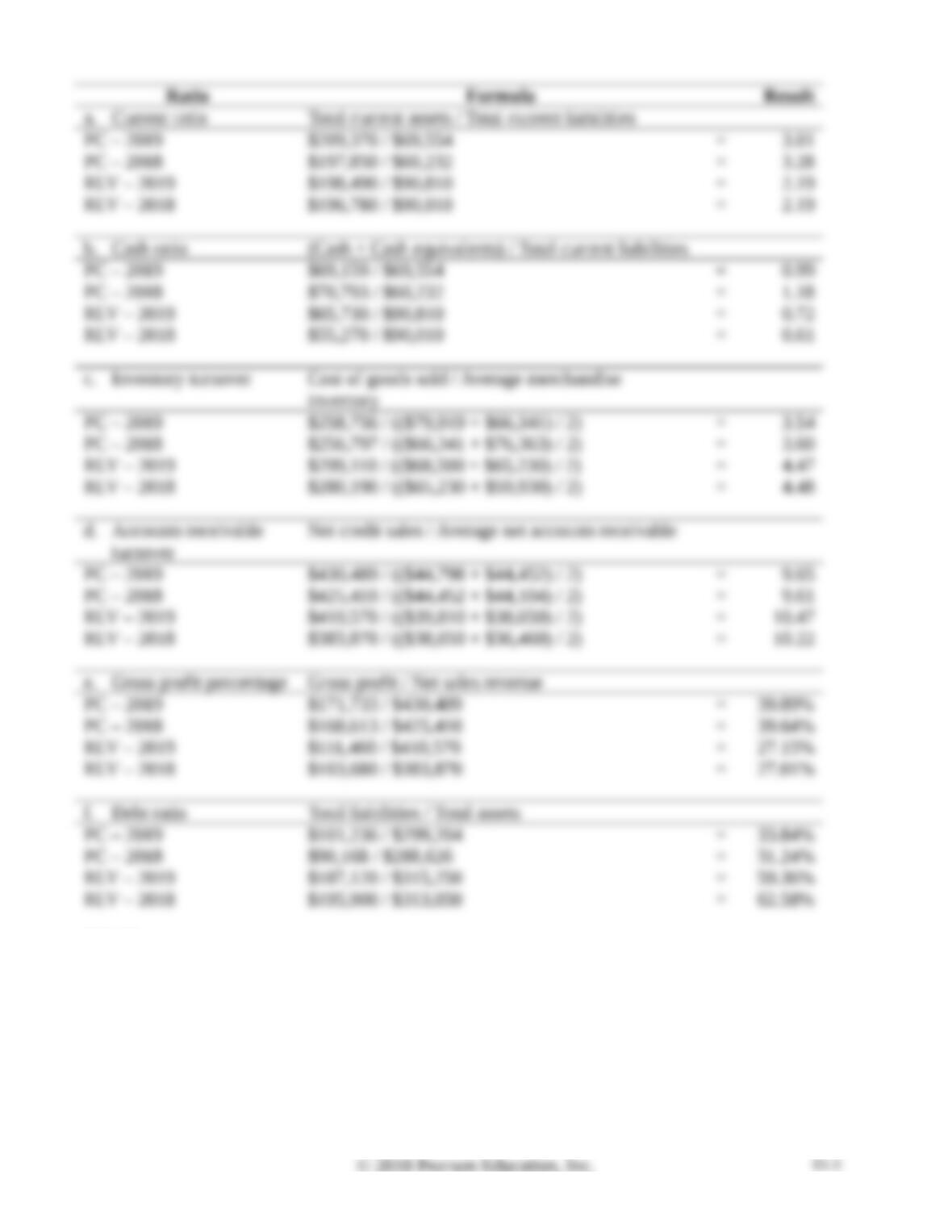
P15-38, cont.
Requirement 1, cont.
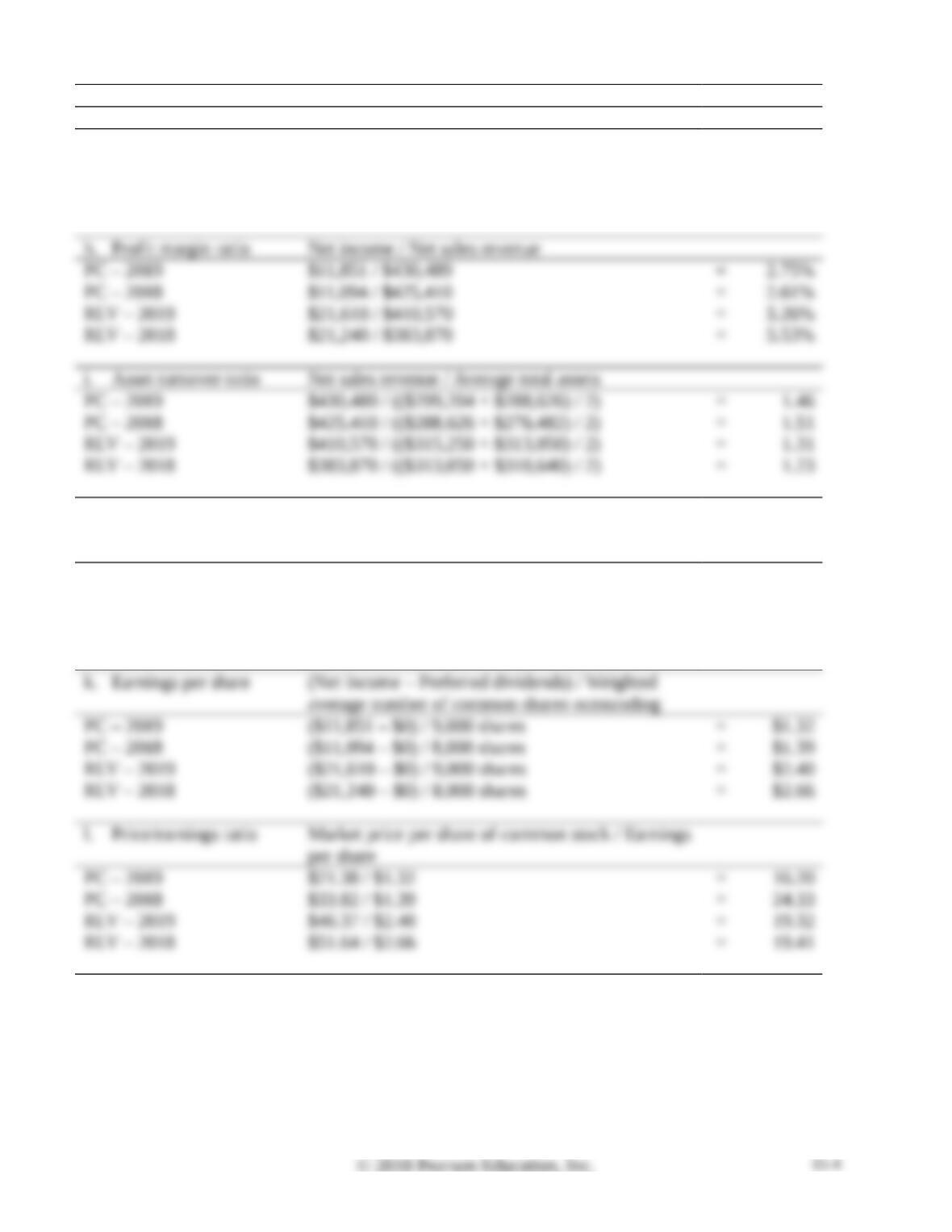
Ratio Formula Result
g. Debt to equity ratio Total liabilities / Total equity
PC – 2019 $101,236 / $197,968 = 0.51
PC – 2018 $90,168 / $198,458 = 0.45
RLV – 2019 $187,120 / $128,130 = 1.46
RLV – 2018 $195,900 / $117,150 = 1.67
j. Rate of return on
common stockholders’
equity
(Net income – Preferred dividends) / Average
common stockholders’ equity
PC – 2019 ($11,851 – $0) / (($197,968 + $198,458) / 2) = 5.98%
PC – 2018 ($11,094 – $0) / (($198,458 + $197,668) / 2) = 5.60%
RLV – 2019 ($21,610 – $0) / (($128,130 + $117,150) / 2) = 17.62%
RLV – 2018 ($21,240 – $0) / (($117,150 + $103,840) / 2) = 19.22%
P15-38, cont.
Requirement 1, cont.
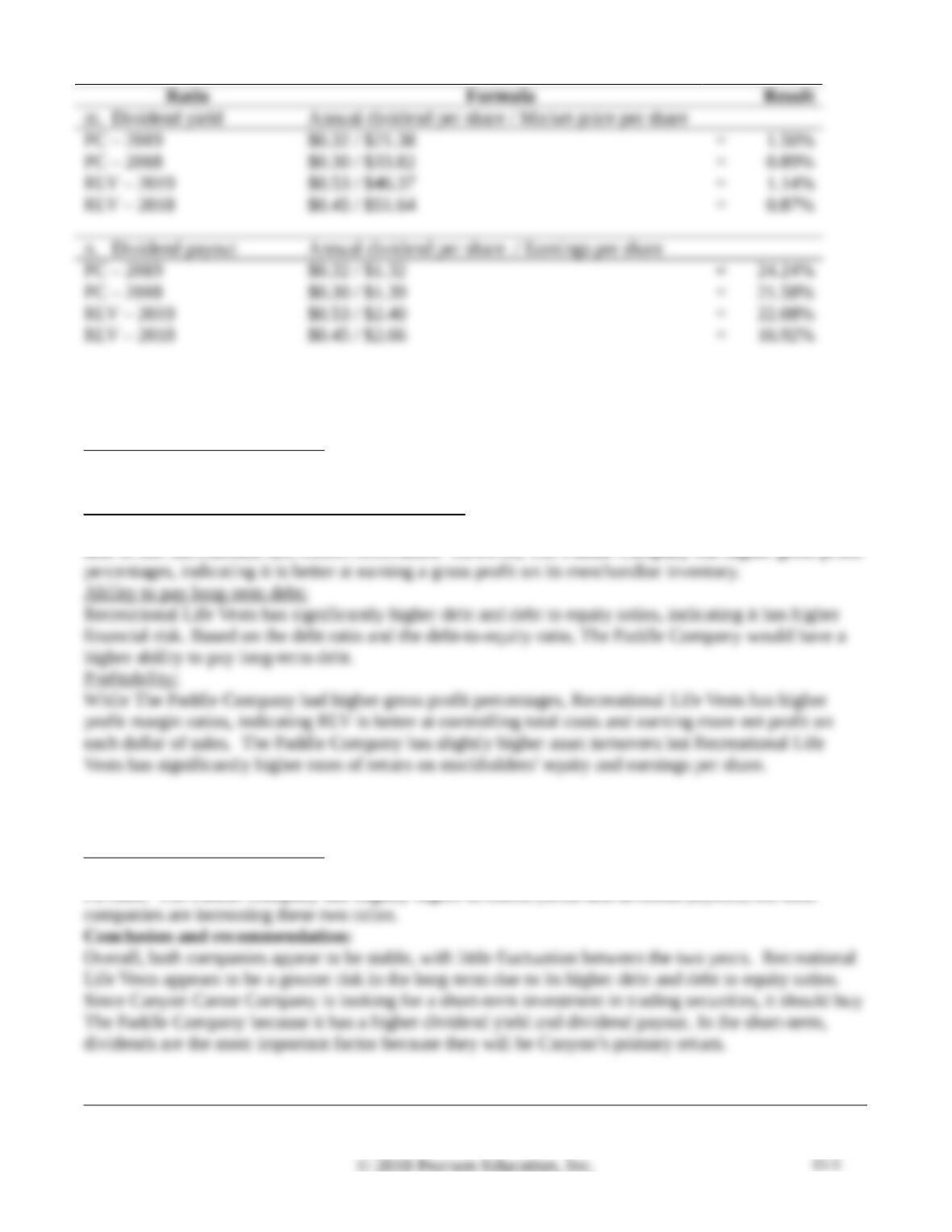
Requirement 2
Analysis:
Ability to pay current liabilities:
The Paddle Company has higher current ratios and cash ratios, indicating it is better able to pay current
liabilities.
Ability to sell merchandise and collect receivables:
Recreational Life Vests has higher inventory and accounts receivable turnovers, indicating it is better
able to sell merchandise and collect receivables. However, The Paddle Company has higher gross profit
P15-38, cont.
Requirement 2, cont.
Attractiveness as an investment:
Recreational Life Vests has a stable PE ratio, while The Paddle Company had a significant decrease in
PE ratio. The Paddle Company has slightly higher dividend yields and dividend payouts, but both
Critical Thinking
Decision Case 15-1
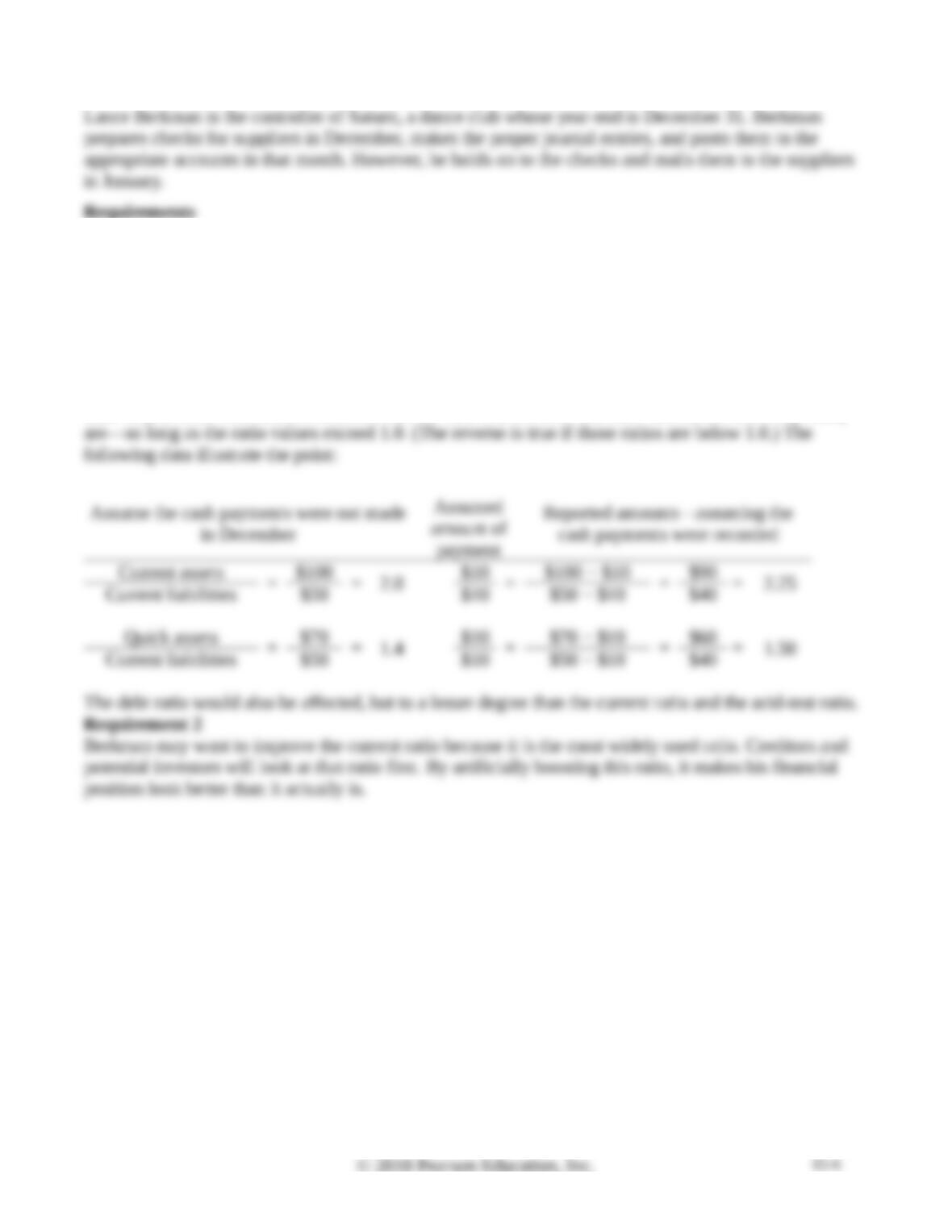
1. What financial ratio(s) is(are) most affected by the action to hold onto the checks until January?
2. What is Berkman’s purpose in undertaking this activity?
SOLUTION
Requirement 1
Recording payments in December, but mailing the checks in January, understates Accounts Payable and
Cash at year-end. This action makes the current ratio and the acid-test ratio look better than they really
Ethical Issue 15-1
Ross’s Lipstick Company’s long-term debt agreements make certain demands on the business. For
example, Ross may not purchase treasury stock in excess of the balance of retained earnings. Also,
long-term debt may not exceed stockholders’ equity, and the current ratio may not fall below 1.50. If
Ross fails to meet any of these requirements, the company’s lenders have the authority to take over
management of the company.
Changes in consumer demand have made it hard for Ross to attract customers. Current liabilities
have mounted faster than current assets, causing the current ratio to fall to 1.47. Before releasing
financial statements, Ross’s management is scrambling to improve the current ratio. The controller
points out that an investment can be classified as either long-term or short-term, depending on
management’s intention. By deciding to convert an investment to cash within one year, Ross can classify
the investment as short-term—a current asset. On the controller’s recommendation, Ross’s board of
directors votes to reclassify long-term investments as short-term.
Requirements
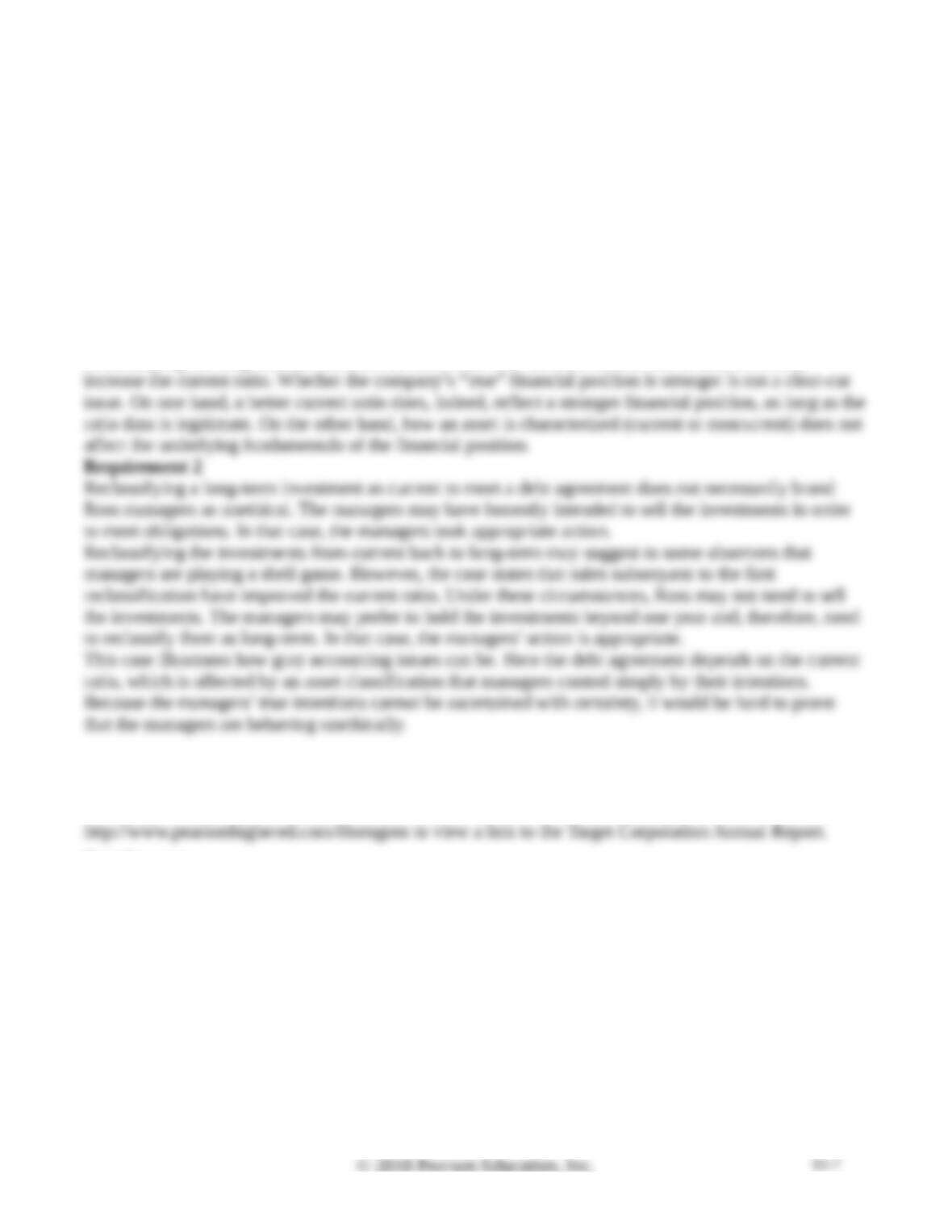
1. What effect will reclassifying the investments have on the current ratio? Is Ross’s true financial
position stronger as a result of reclassifying the investments?
2. Shortly after the financial statements are released, sales improve; so, too, does the current ratio. As a
result, Ross’s management decides not to sell the investments it had reclassified as short-term.
Accordingly, the company reclassifies the investments as long-term. Has management behaved
unethically? Give the reasoning underlying your answer.
SOLUTION
Requirement 1
Reclassifying the long-term investments as short-term will increase current assets and, therefore,
Financial Statement Case 15-1
Use Target Corporation’s Fiscal 2015 Annual Report to answer the following questions. Visit
Requirements
1. Compute trend analyses for Sales and Net earnings / (loss). Use 2013 as the base year. What is the
most notable aspect of these data?
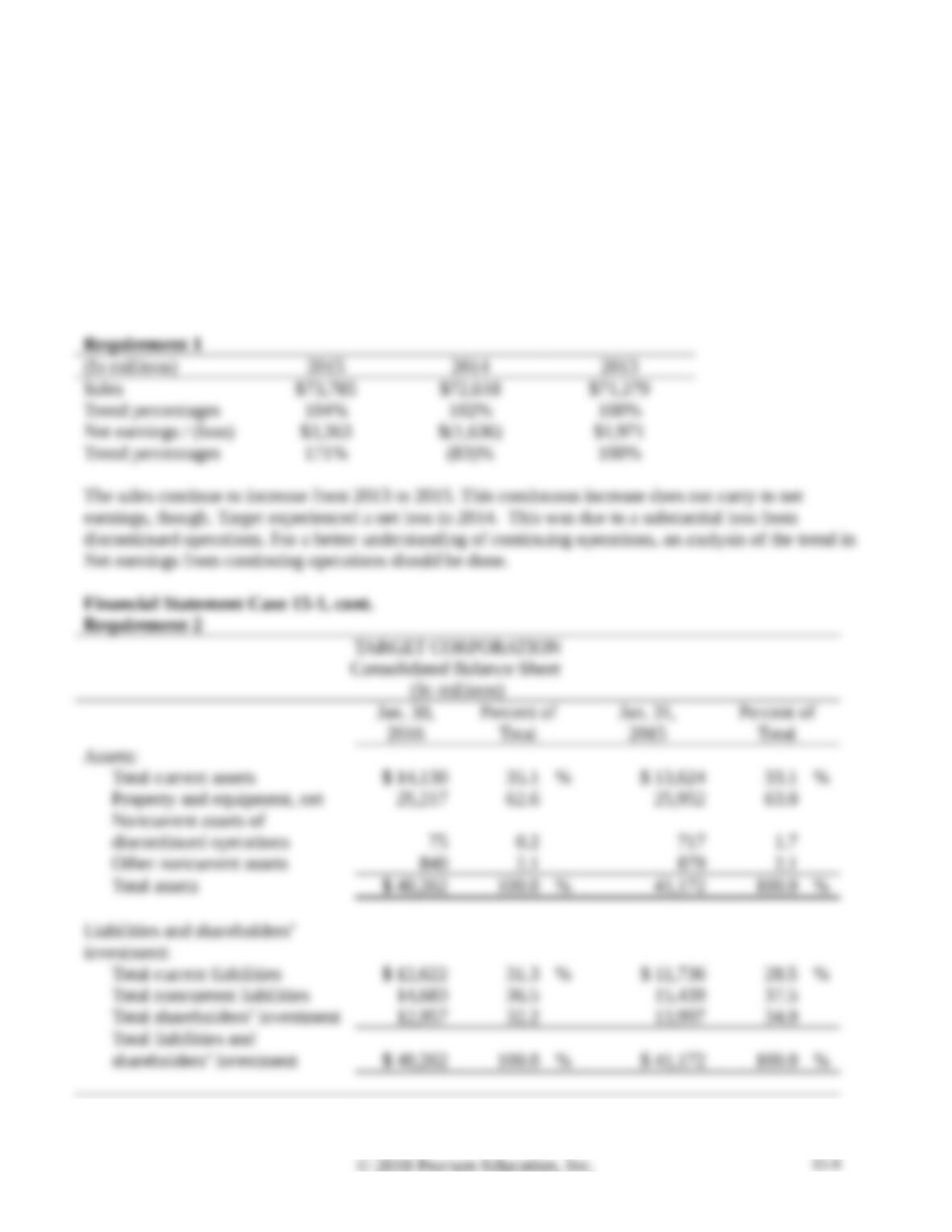
2. Perform a vertical analysis for Target Corporation’s balance sheet as of January 31, 2016 (fiscal year
2015), and January 31, 2015 (fiscal year 2014). Include only these main categories:
Assets:
Total current assets
Property and equipment, net
Noncurrent assets of discontinued operations
Other noncurrent assets
Total assets
Liabilities and shareholders’ investment:
Total current liabilities
Total noncurrent liabilities
Total shareholders’ investment
Total liabilities and shareholders’ investment
SOLUTION
Team Project 15-1 and 15-2

Team Project 15-1
Select an industry you are interested in, and pick any company in that industry to use as the benchmark.
Then select two other companies in the same industry. For each category of ratios, compute all the ratios
for the three companies. Write a two-page report that compares the two companies with the benchmark
company.
Team Project 15-2
Select a company and obtain its financial statements. Convert the income statement and the balance
sheet to common size, and compare the company you selected to the industry average. The Risk
Management Association’s Annual Statement Studies and Dun & Bradstreet’s Industry Norms & Key
Business Ratios publish common-size statements for most industries.
SOLUTION