Continuing Problem
PB–30 Using all journals
This problem continues the Canyon Canoe Company situation from Chapter 4. At the beginning
of the new year, Canyon Canoe Company decided to carry and sell T-shirts with its logo printed
on them. Canyon Canoe Company uses the perpetual inventory system to account for the
inventory. During January 2019, Canyon Canoe Company completed the following
merchandising transactions:
Jan. 1 Purchased 10 T-shirts at $4 each and paid cash.
2 Sold 6 T-shirts for $10 each, total cost of $24. Received cash.
3 Purchased 50 T-shirts on account at $5 each. Terms 2/10, n/30.
7 Paid the supplier for the T-shirts purchased on January 3, less discount.
8 Realized 4 T-shirts from the January 1 order were printed wrong and returned them for a
cash refund.
10 Sold 40 T-shirts on account for $10 each, total cost of $200. Terms 3/15, n/45.
12 Received payment for the T-shirts sold on account on January 10, less discount.
14 Purchased 100 T-shirts on account at $4 each. Terms 4/15, n/30.
18 Canyon Company called the supplier from the January 14 purchase and told them that
some of the T-shirts were the wrong color. The supplier offered a $50 purchase allowance.
20 Paid the supplier for the T-shirts purchased on January 14, less the allowance and discount.
21 Sold 60 T-shirts on account for $10 each, total cost of $220. Terms 2/20, n/30.
23 Received a payment on account for the T-shirts sold on January 21, less discount.
25 Purchased 320 T-shirts on account at $5 each. Terms 2/10, n/30, FOB shipping point.
27 Paid freight associated with the January 25 purchase, $48.
29 Paid for the January 25 purchase, less discount.
30 Sold 275 T-shirts on account for $10 each, total cost of $1,300. Terms 2/10, n/30.
31 Received payment for the T-shirts sold on January 30, less discount.
Requirements
1. Enter the transactions in a sales journal (page 2), a cash receipts journal (page 5, omit Sales
Discounts Forfeited column), a purchases journal (page 7), a cash payments journal (page 6),
and a general journal (page 4), as appropriate.
2. Total each column of the special journals. Show that total debits equal total credits in each
special journal.
PB–30, cont.
SOLUTION
Requirements 1 and 2
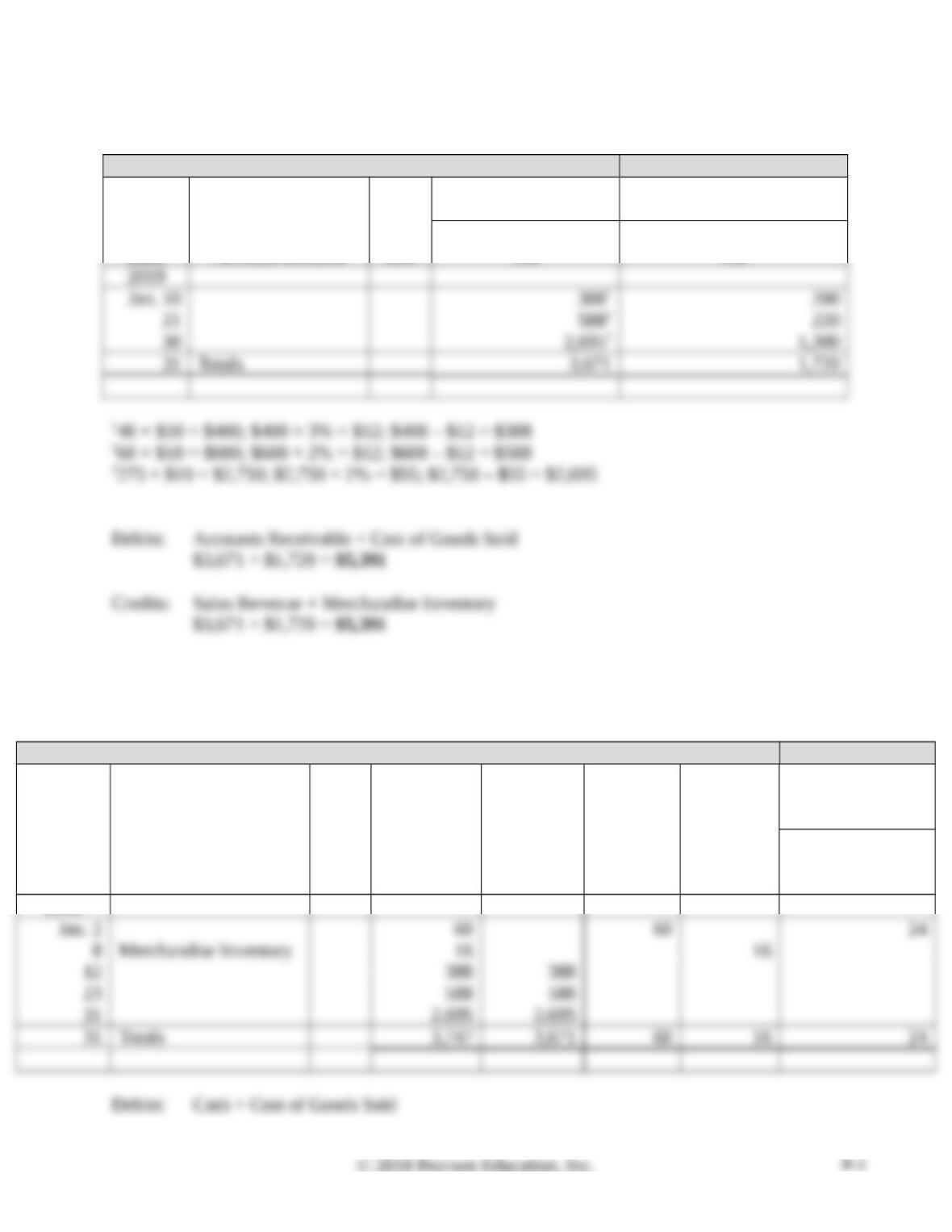
Sales Journal Page 2
Date
Customer
Account Debited
Post.
Ref.
Accounts Receivable
DR
Cost of Goods Sold
DR
Sales Revenue
CR
Merchandise Inventory
CR
PB–30, cont.
Requirements 1 and 2, cont.
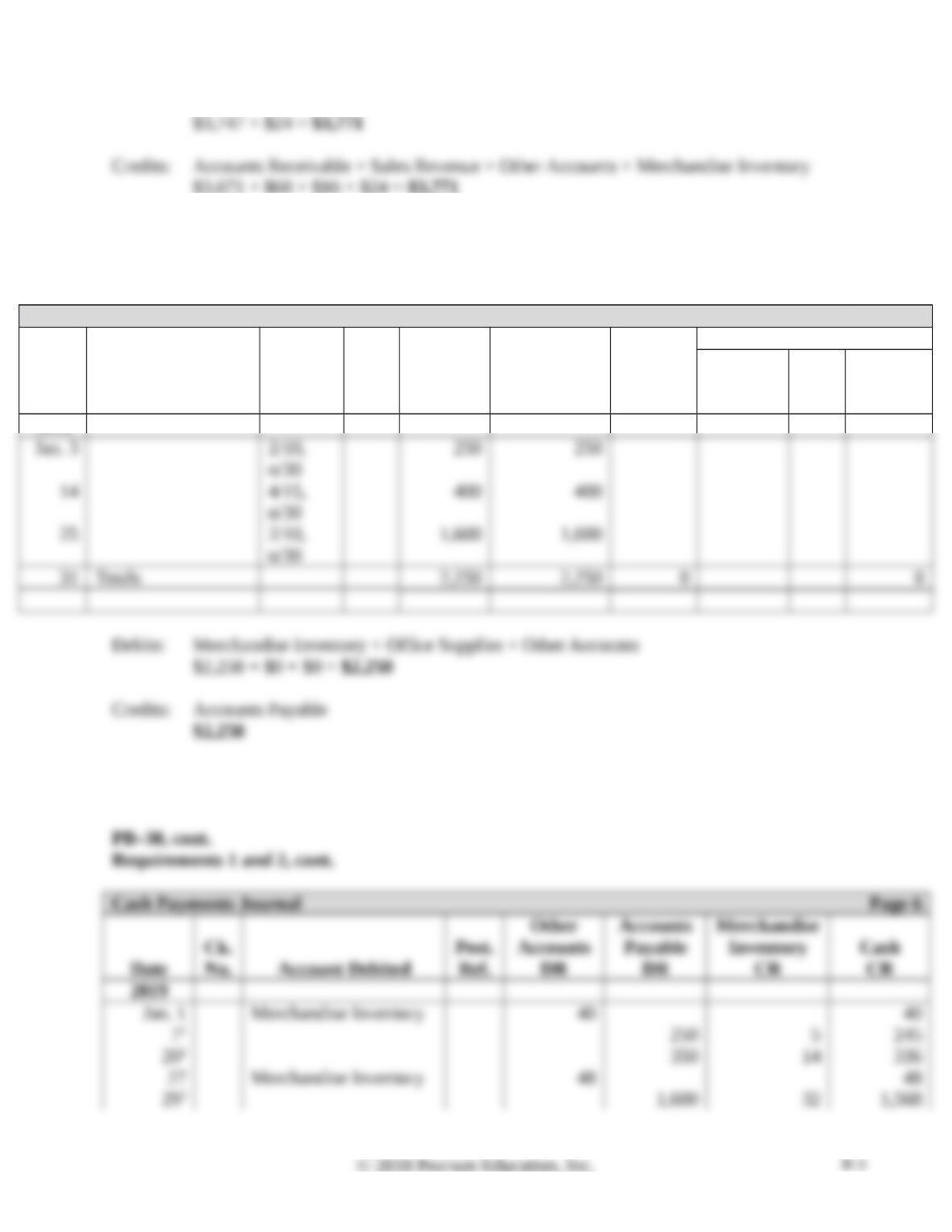
Cash Receipts Journal Page 5
Date Account Credited
Post.
Ref.
Cash
DR
Accounts
Receivabl
e
CR
Sales
Revenue
CR
Other
Accounts
CR
Cost of
Goods Sold
DR
Merchandise
Inventory
CR
2019
PB–30, cont.
Requirements 1 and 2, cont.
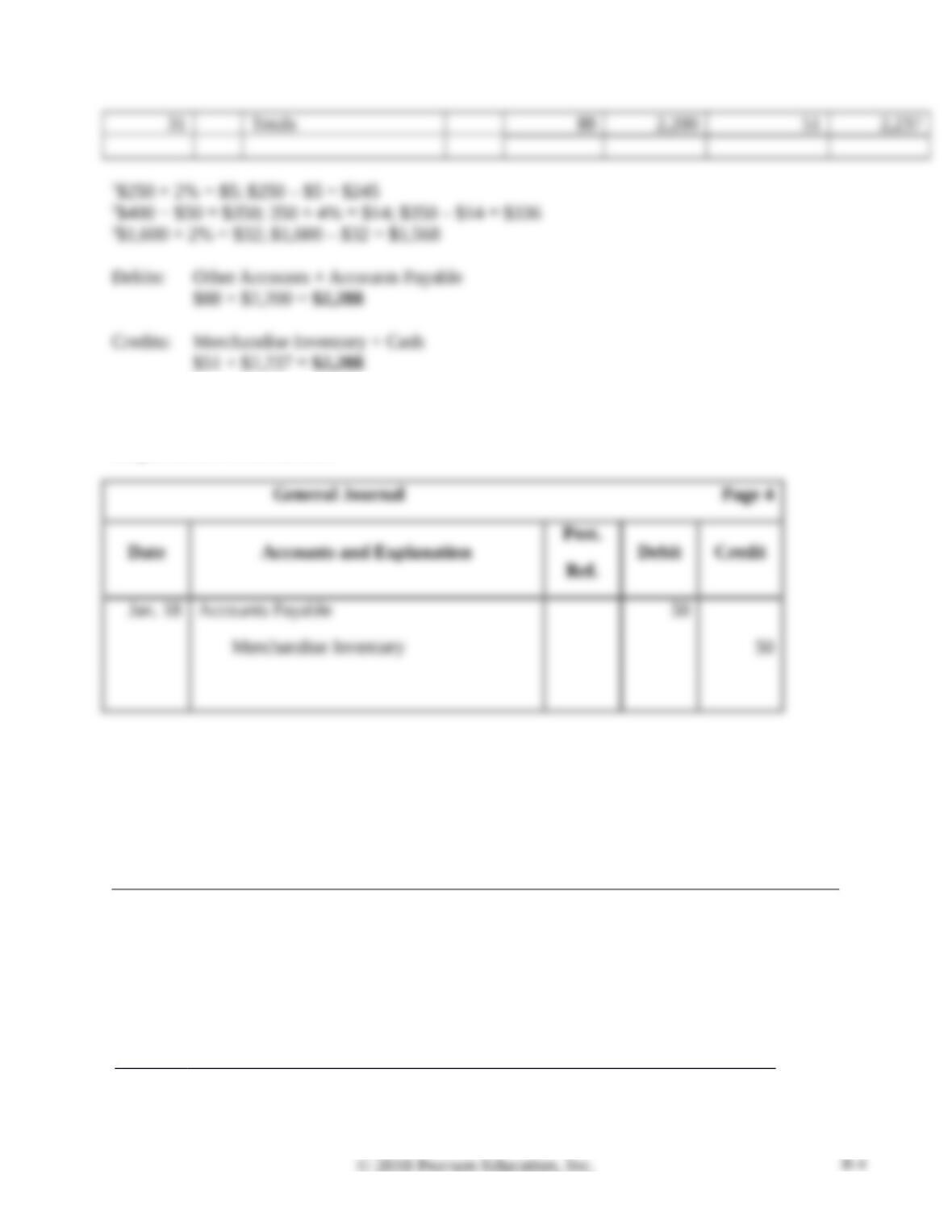
Purchases Journal Page 7
Date
Vendor
Account Credited Terms
Post
.
Ref.
Account
s
Payable
CR
Merchandise
Inventory
DR
Office
Supplies
DR
Other Accounts DR
Account
Title
Post.
Ref. Amount
2019
PB–30, cont.
Requirements 1 and 2, cont.
Practice Set
PB–31 Using all journals
This problem continues the Crystal Clear Cleaning practice set begun in Chapter 2 and continued
through Chapters 3 and 4.
Crystal Clear Cleaning has decided that, in addition to providing cleaning services, it will sell
cleaning products. Crystal Clear uses the perpetual inventory system. During December 2018,
Crystal Clear completed the following transactions:
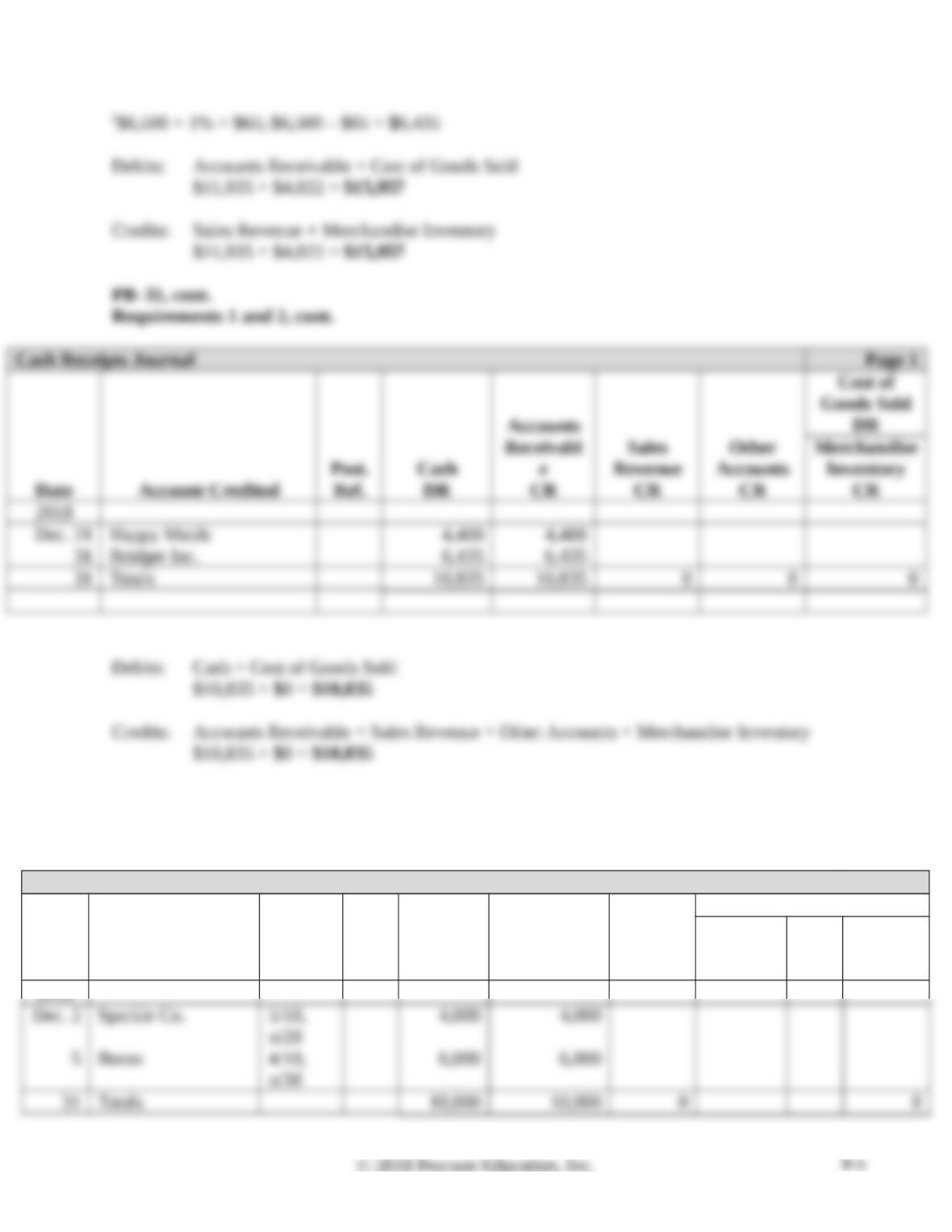
Dec. 2 Purchased 1,000 units of inventory for $4,000 on account from Sparkle Company on terms,
5/10, n/20.
5 Purchased 1,200 units of inventory from Borax on account with terms 4/10, n/30. The total
invoice was for $6,000, which included a $300 freight charge.
7 Returned 300 units of inventory to Sparkle from the December 2 purchase (cost $1,200).
9 Paid Borax.
11 Sold 500 units of goods to Happy Maids for $5,500 on account with terms n/30. Crystal
Clear’s cost of the goods was $2,000.
12 Paid Sparkle.
15 Received 100 units with a retail price of $1,100 back from customer Happy Maids. The
goods cost Crystal Clear $400.
21 Received payment from Happy Maids, settling the amount due in full.
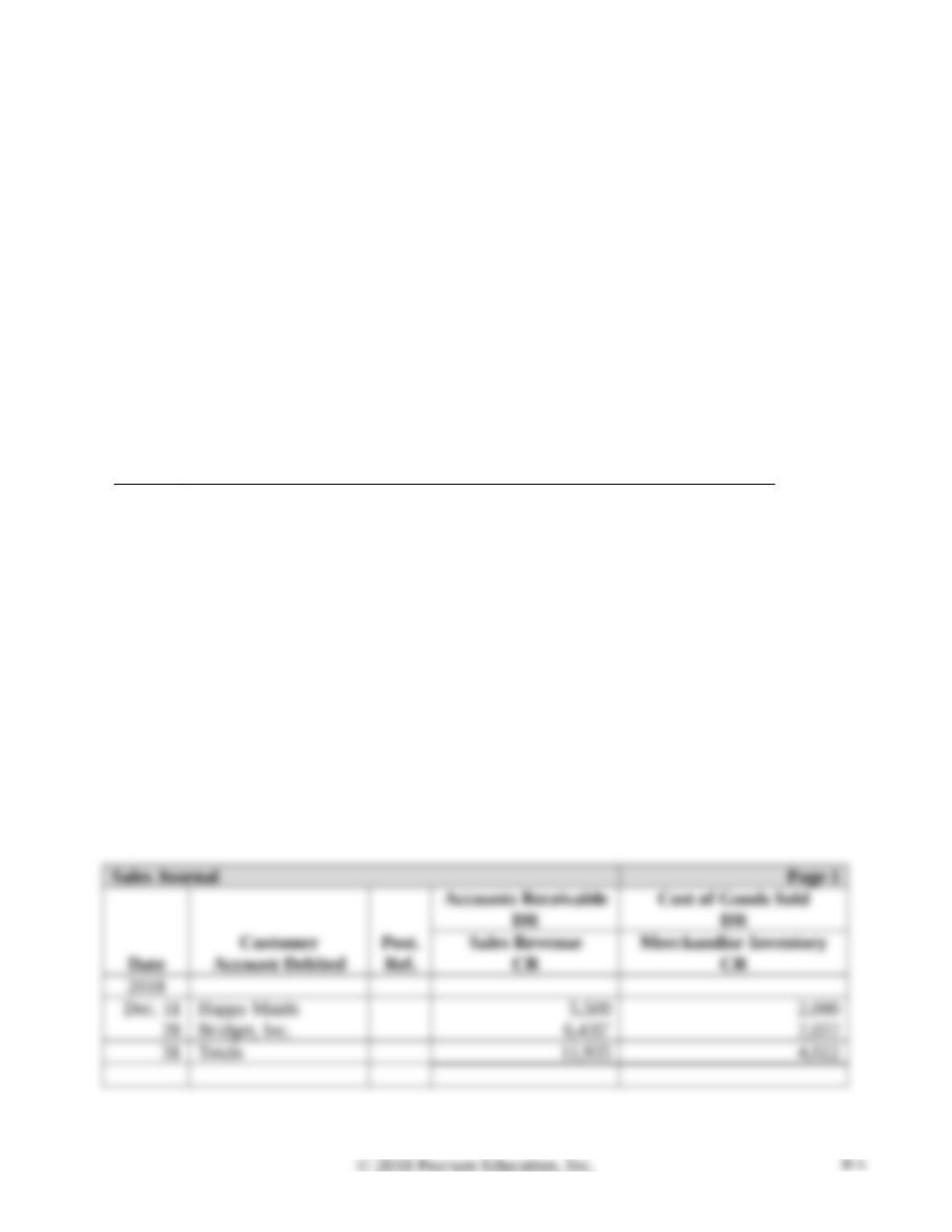
28 Sold 500 units of goods to Bridget, Inc. on account for $6,500 (cost $2,022). Terms 1/15,
n/30.
29 Paid cash for utilities of $550.
30 Paid cash for Sales Commission Expense of $214.
31 Received payment from Bridget, Inc., less discount.
Requirements
1. Use the appropriate journal to record the preceding transactions in a sales journal (omit the
Invoice No. column), a cash receipts journal (omit Sales Discounts Forfeited column), a
purchases journal, a cash payments journal (omit the Check No. column), and a general
journal.
2. Total each column of the special journals. Show that total debits equal total credits in each
special journal.
PB–31, cont.
SOLUTION
Requirements 1 and 2
PB–31 cont.
Requirements 1 and 2, cont.
Purchases Journal Page 1
Date
Vendor
Account Credited Terms
Post
.
Ref.
Account
s
Payable
CR
Merchandis
e
Inventory
DR
Office
Supplies
DR
Other Accounts DR
Account
Title
Post.
Ref. Amount