Appendix B
Accounting Information Systems
Review Questions
1. What is an accounting information system (AIS)?
An accounting information system (AIS) is a system that collects, records, stores, and
2. What does an effective accounting information system provide?
3. Explain the three basic components of an accounting information system.
The three basic components of an accounting information system are source documents and
input devices, processing and storage, and outputs.
4. What is a special journal?
A special journal is an accounting journal designed to record a specific type of transaction.
5. What is the purpose of a subsidiary ledger?
A subsidiary ledger holds individual accounts that support a general ledger account. The sum
of the balances of the accounts in the subsidiary ledger equals the balance in the control
6. What is a control account?
7. List the four special journals often used in a manual accounting information system. What
types of transactions are recorded in each of the special journals?
8. Explain the posting process of the sales journal.
Entries in the sales journal are posted to both the accounts receivable subsidiary ledger and
9. Provide some examples of transactions that would be recorded in the Other Accounts CR
column of the cash receipts journal.
10. What are the columns that are typically used in the purchases journal?
The purchases journal typically has special columns for Account Payable CR, Merchandise
Inventory DR, Office Supplies DR, and Other Accounts DR. The journal also has columns
for the date, vendor account credited, terms of purchase, and posting reference.
11. Explain the posting process of the cash payments journal.
Entries in the cash payments journal are posted to both the accounts payable subsidiary
12. When is the general journal used in a manual accounting information system? Provide some
examples of transactions that would be recorded in the general journal
13. Explain the two components of a computerized accounting information system.
The two components of a computerized accounting information system are hardware and
14. What are two common entry-level accounting software systems used by small businesses?
15. What is an enterprise resource planning (ERP) system? What are the advantages and
disadvantages of using an ERP?
An enterprise resource planning (ERP) system integrates all of a company’s functions, de–
16. How is QuickBooks organized?
17. How would a business record a sale of services on account in QuickBooks?
To record a sale of services on account in QuickBooks, the transaction is recorded on the cus-
tomers tab. Transaction data, such as customer name, date, and amount, is entered and the
system posts the transaction to the appropriate general ledger accounts.
18. How would a business record a bill received in QuickBooks?
Short Exercises
SB–1 Evaluating features of an effective accounting information system
Learning Objective 1
In Vogue, a T-shirt business, is growing fast and needs a better accounting information system. Consider
the features of an effective system. Which features are most important? Why? Which feature must you
consider if your financial resources are limited?
SOLUTION
SB–2 Defining components of an accounting information system
Learning Objective 1
Match each example with a component of a computerized accounting information system.
Components may be used more than once.
Example Component
1. Server a. Source documents and input devices
2. Bank checks b. Processing and storage
3. Reports c. Outputs
4. Keyboard
5. Software
6. Financial statements
7. Bar code scanner
SOLUTION

SB–3 Identifying special journals
Learning Objective 2
Use the following abbreviations to indicate the journal in which you would record transactions a
through n.
J = General journal
S = Sales journal
CR = Cash receipts journal
P = Purchases journal
CP = Cash payments journal
Transactions:
a. Cash purchase of merchandise inventory
b. Collection of dividend revenue earned on an investment
c. Prepayment of insurance
d. Borrowing money on a long-term note payable
e. Purchase of equipment on account
f. Cost of goods sold along with a credit sale
g. Cash sale of merchandise inventory
h. Payment of rent
i. Depreciation of computer equipment
j. Purchase of merchandise inventory on account
k. Collection of accounts receivable
l. Expiration of prepaid insurance
m. Sale on account
n. Payment on account
SOLUTION
a. CP
b. CR
c. CP
d. CR
e. P
f. S
g. CR
h. CP
i. J
j. P
k. CR
l. J
n. CP
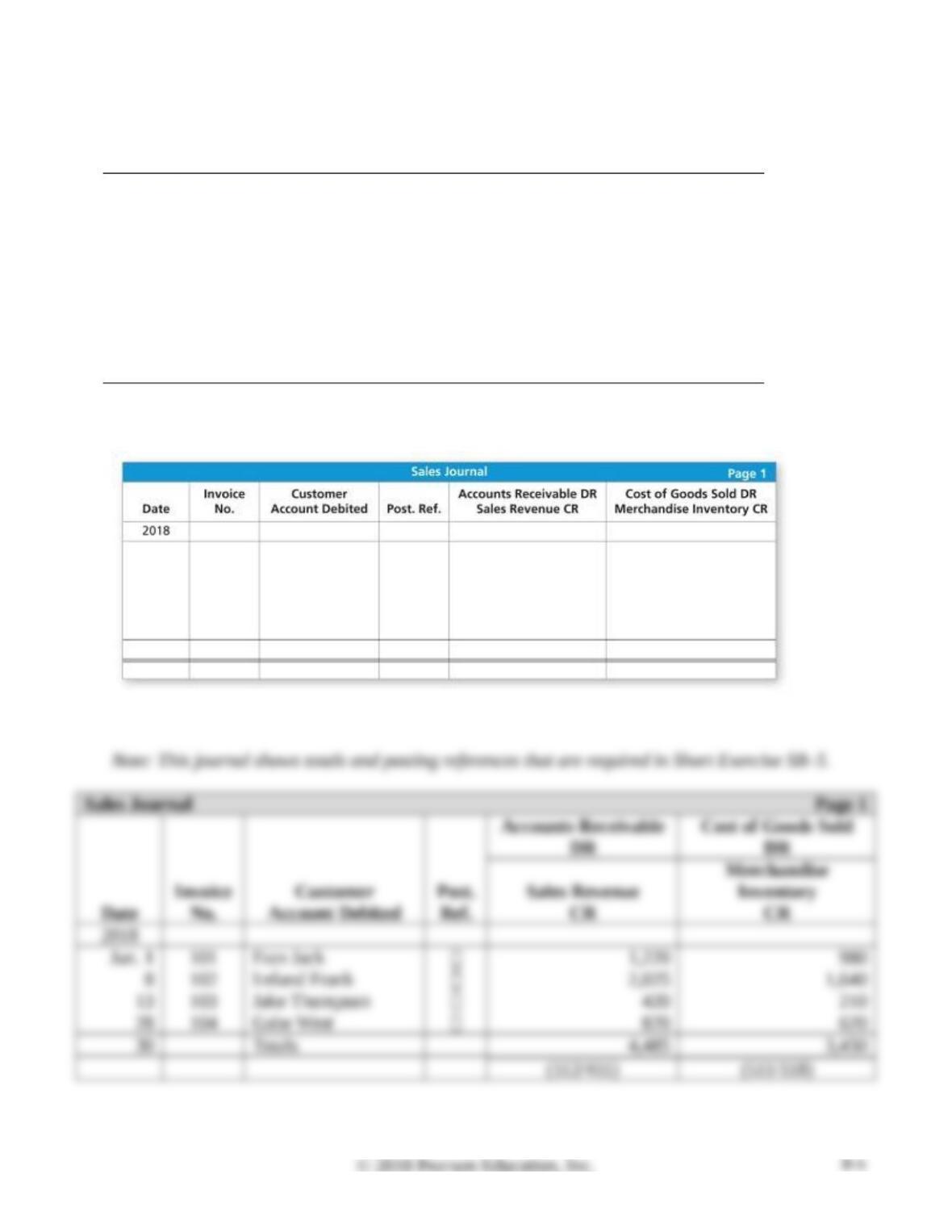
SB–4 Recording transactions in a sales journal
Learning Objective 2
Jun. 1 Sold merchandise inventory on account to Fran Jack, $1,220. Cost of goods,
$980. Invoice no. 101.
8 Sold merchandise inventory on account to Ireland Frank, $2,025. Cost of
goods, $1,640. Invoice no. 102.
13 Sold merchandise inventory on account to Jake Thompson, $420. Cost of
goods, $210. Invoice no. 103.
28 Sold merchandise inventory on account to Gabe West, $820. Cost of goods,
$620. Invoice no. 104.
Use the following sales journal to record the preceding transactions. All credit sales are terms of
n/30.
SOLUTION
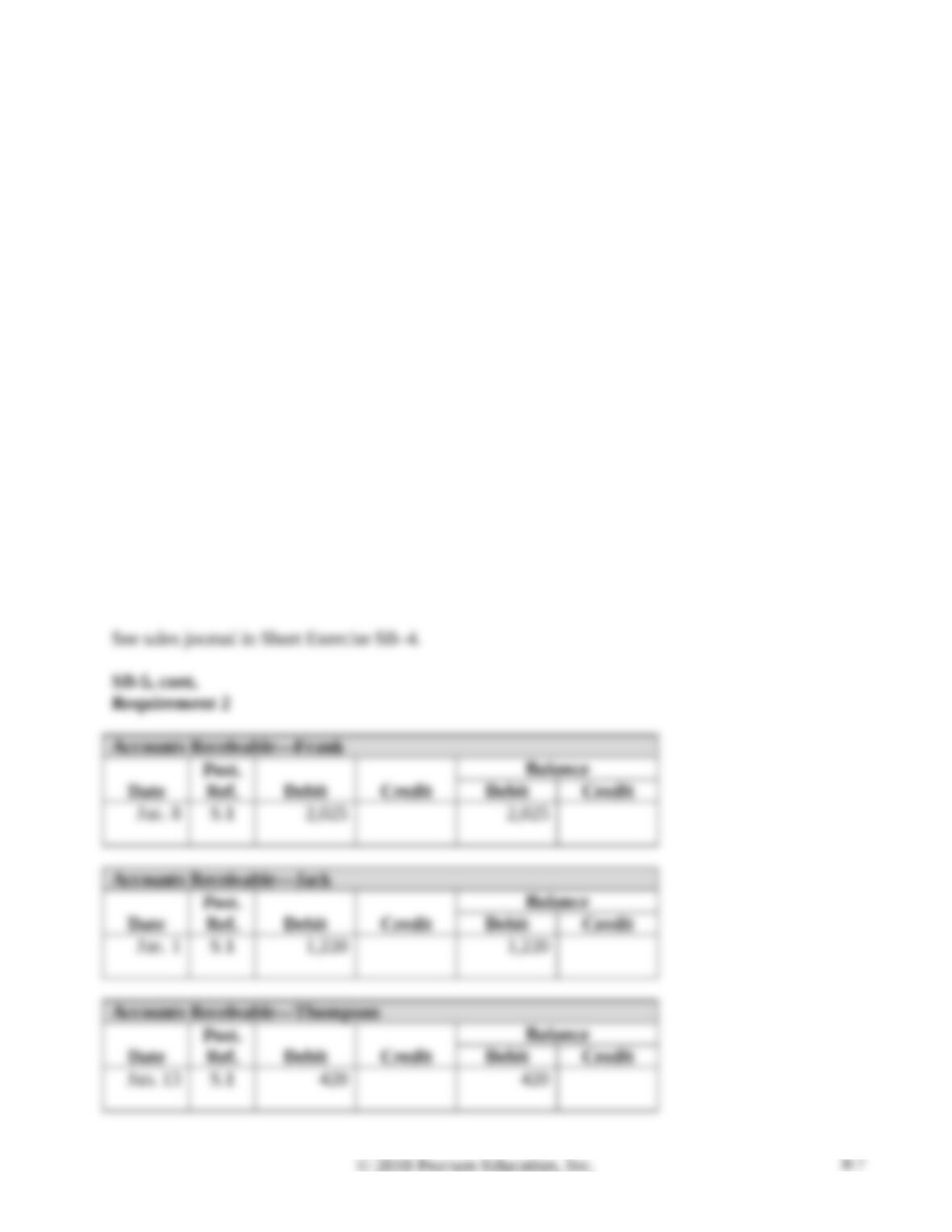
Note: Short Exercise SB-4 must be completed before attempting Short Exercise SB-5.
SB–5 Posting transactions from a sales journal to a subsidiary ledger and general ledger
Learning Objective 2
Review your results from Short Exercise SB-4.
Requirements
1. Total each column of the sales journal.
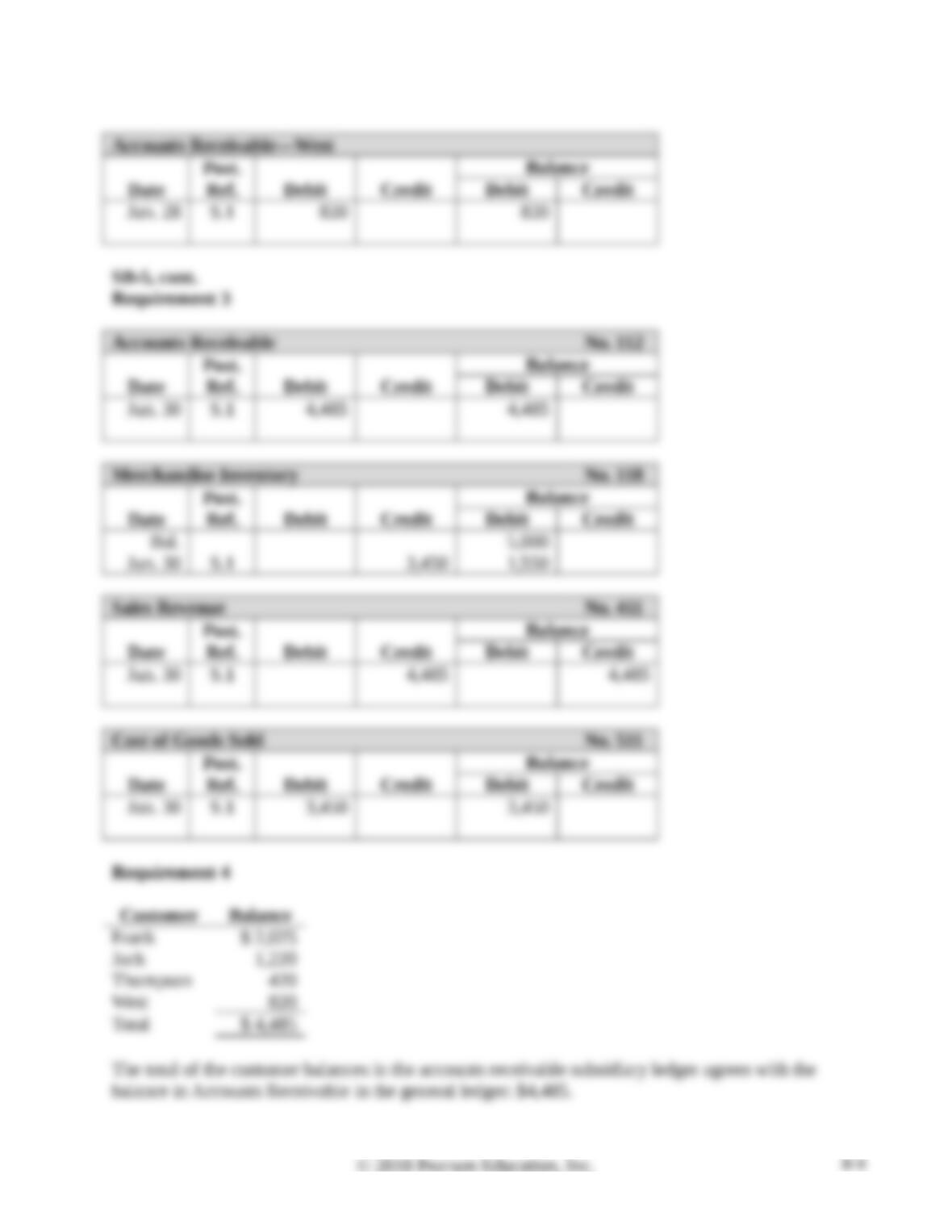
2. Open the following four-column accounts in the accounts receivable subsidiary ledger:
Accounts Receivable—Frank; Accounts Receivable—Jack; Accounts Receivable—
Thompson; Accounts Receivable—West. Post the transactions to the accounts receivable
subsidiary ledger.
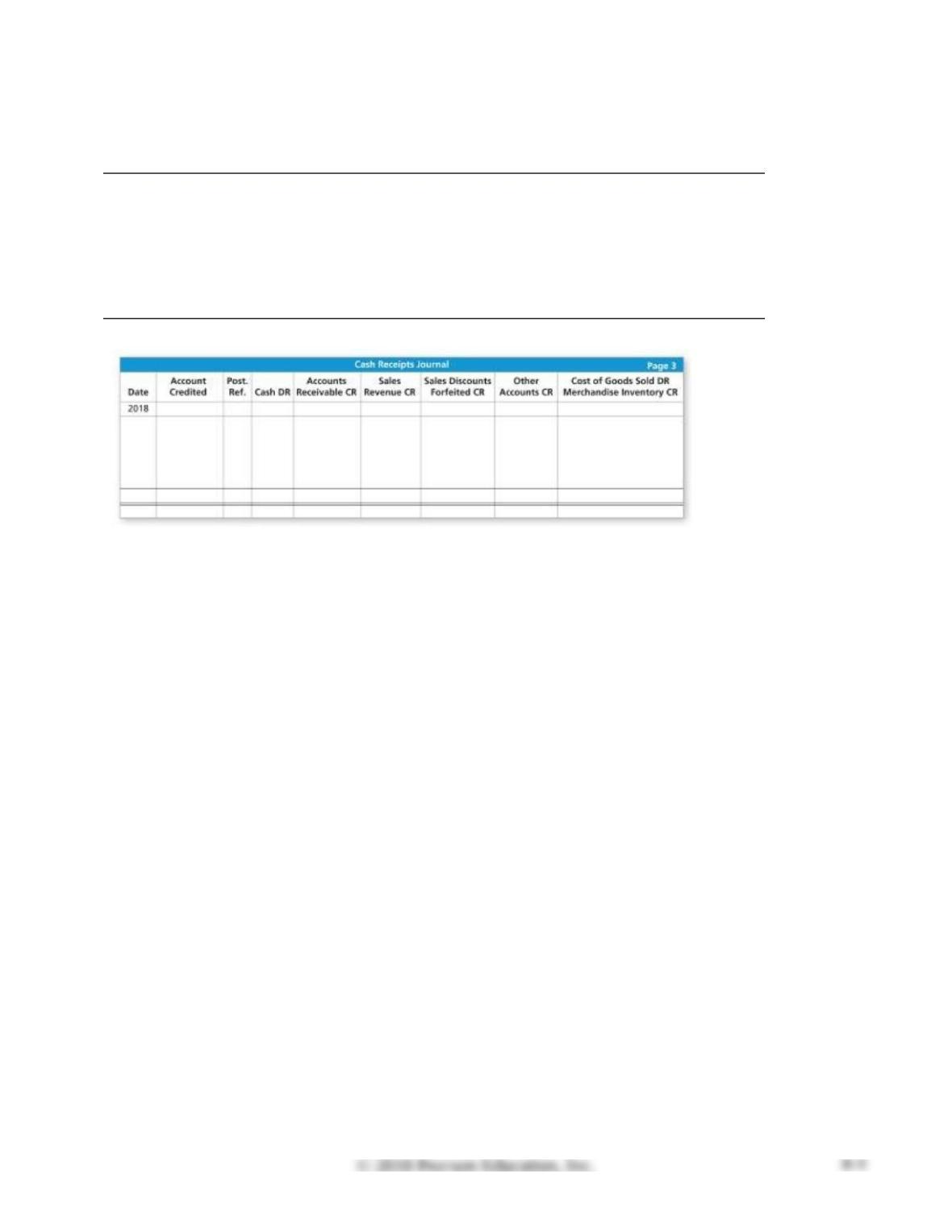
3. Open the following selected four-column accounts in the general ledger: Accounts Receivable
(112); Merchandise Inventory (118), Bal. $5,000; Sales Revenue (411); Cost of Goods Sold
(511). Post the total of each column to the general ledger.
4. Balance the total of the customer ending balances in the accounts receivable subsidiary ledger
against Accounts Receivable in the general ledger.
SOLUTION
Requirement 1
SB–6 Recording transactions in a cash receipts journal
Learning Objective 2
Jul. 5 Sold merchandise inventory for cash, $1,700. Cost of goods, $1,400.
12 Collected interest revenue of $2,050.
18 Received cash from Heidi Next, $1,200, on account. There was no discount.
29 Received $5,300 from Mitch Dylan in full settlement of his account
receivable including sales discounts forfeited of $20.
Use the following cash receipts journal to record the preceding transactions.