
A3-21
Additional Considerations in Presenting Part II
1. Inform students that they may feel some anxiety in keeping the conversation on topics
their customers want to discuss, and that there will be the unconscious tendency for them
to use probing questions to shift the conversation to topics in which they are interested.
This puts them on topics with which they feel safe and secure (Maslow); however, it will
probably cost them the attention and relationship they want from their customer. Remind
them that Mike Crandall apparently was not commenting on things in which his customer
was interested. Instruct students to pleasantly acknowledge each of the topics their
customer shares. If they do not, their customer is instructed to quit sharing.
2. Instruct students that they can share their benefit statement/proof device any time after
they begin talking about those topics in which their customer is interested. However, it
will be important (when they take their test after the role-play) that they have discussed
three of the five topics their customer wants to share. Remind them to take notes, or they
will not be able to remember all of the shared information.
3. Discuss the importance of the skills developed in this role-play as they relate to
interviewing for a job or meeting people in a business or social setting.
4. In each of the two role-plays, pair salespeople with different customers. This provides
students with the need to work with different communication styles and will help to
emphasize the importance of communication style flexibility. However, it is important
that in all three role-plays a student stays in the account category assigned. If the numbers
in your class are not even, either you can assume the role of a customer, you can ask a
fellow professor or a student from another class to be a customer, or you can organize a
team of three.
5. Ask students to think of a close friendship. Have them suggest things that occur in the
relationship that make and keep it a strong relationship. Raise the questions about
whether they talk about things in which their friend is interested. Do they acknowledge
and give support? Do they give compliments; search for additional topics of mutual

A3-22
interest to talk about, or ask questions that get their friends to talk more about their
interests? Do they send cards, thank-you letters, or follow up their meetings with
telephone calls? Do they bring new items of information to their friend’s attention? Do
they set up future times to get together? These types of topics and activities are involved
in Role-Play 1, and they are designed to build the relationship between a salesperson and
the customer.
6. Ask the students if it would ever be appropriate to make a team sales call in situations
such as Role-Play 1. Who might they take with them as a team member—T. J. McKee,
Ricardo Guido, etc.? Why would they want to make a team call? Ask students to consider
if Call 1 might result in having to speak to a group rather just one person. Under what
circumstances? If time allows, ask students how they could get more strategic
information on their prospect. What information would they try to get? Would they feel
more secure if they had this information?
7. Draw students’ attention to the relationship between Erin Adkin’s interest in building and
designing a high quality home in the Park Shores’ award-winning renovation and Leigh
Comb’s work in college as an executive chef to the Park Shores’ esteemed Chef Ricardo
Guido. Ask students if T. J. McKee may have known prospect information that wasn’t in
the Prospect Database that resulted in recommendations on which benefit to show each
prospect. Does this kind of strategic prospect information provide possible competitive
advantages in building relationships?
8. Individual video recordings can be made of this role-play. Another suggestion is to allow
students to conduct this role-play without video recording, but inform them that they will
be videotaped in either the second or third role-play or both. Another idea would be for
the instructor to video the entire group in role-play and play it back with a discussion on
nonverbal actions that enhance or detract from the effectiveness of the call.
9. An alternative assignment would be to have students write a follow-up, thank-you letter
for this sales call.
10. Use your imagination to apply this role-play to information discussed earlier in your
course.

A3-23
ROLE-PLAY—1A Association Accounts Customer’s Instructions
Establishing a Relationship
Background Information
You are to assume the customer role of Erin Adkins. You serve as chairperson of the
physical fitness committee of your local YWCA (16 Ruan Center, Anaheim CA 92802,
Telephone 949-245-3740).
In this simulation, a hotel convention salesperson, which you have not met, will be
visiting with you for a 1:00 P.M. appointment in your office. This salesperson wants to: (1)
establish a relationship with you, (2) interest you in considering the Park Shores Convention
Center for any conferences or conventions you may be scheduling, (3) find out if you are
currently planning any future conferences, and (4) set up a call-back appointment.
Section I—Topics you want to talk about:
Section II—Information you want to share:
1. My friend, Toni Bush, whom I have known for
six years
______ 1. Toni Bush is my friend.
______ 2. Toni Bush is also my golfing partner.
______ 3. Toni and I may build a new golf course.
2. The new home I have just built
______ 1. This is the second house I have
personally designed.
______ 2. My last house was featured in Better
Homes and Gardens magazine as “House
of the Year.”
______ 3. My house also won an award from the
Regional Architects Association.
3. An autographed picture of Olympic Gold
Medalist Shawn Johnson on my desk
______ 1. I was a good friend of Shawn Johnson in
high school.
______ 2. I was on the high school gymnastics
team.
______ 3. I visited Shawn Johnson at the Olympic
Tryouts
Section III—Topics you don’t want to talk about:
1. Television ad you appear in about the YWCA.
2. The Schwinn® Airdyne® Fitness Cycle in my office.
Role-Play Instructions
1. Your salesperson has researched a large amount of relationship information on you (see
Sections I and II). Much of it was received from a friend of yours, Toni Bush, the athletic
director of West College. Some of this information is not really important to you, or you
don’t enjoy talking about it (see Section III).
A3-24
Copyright © 2018 Pearson Education, Inc.
b. When your salesperson brings up one of the topics you want to talk about (see
Section I), respond by raising your voice, speaking more quickly, and emphatically
sharing a new item of information from Section II.
c. Share only one item at a time from Section II, and let the salesperson acknowledge
that item. If the salesperson doesn’t acknowledge what you have shared, do not offer
any more information on that topic. If the salesperson does acknowledge what you
have said, make a check mark next to the item and share another item. Continue until
your salesperson has discussed all three topics you want to talk about.
2. Because you are in charge of setting up meetings for large groups, your salesperson will
3. Tell you salesperson that at the present time you are not planning any conventions, but
4. If your salesperson requests another meeting with you, confirm a time, three weeks from
today.
5. Return this form to your instructor. Fill out the Assessment Form 2: Customer Strategy
on p. 471.

A3-25
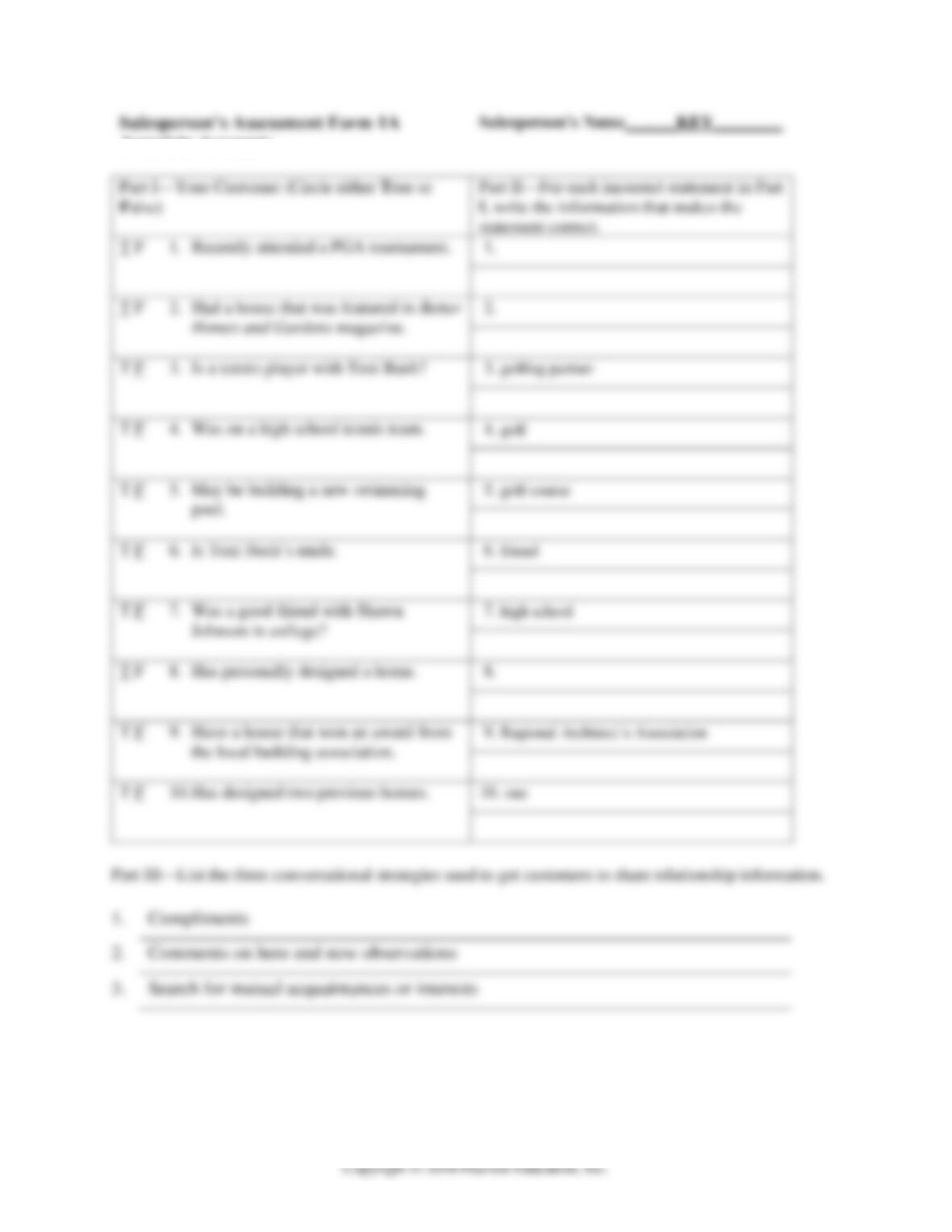
Salesperson’s Assessment Form 1A
Salesperson’s Name
___________________
Associate Accounts
Part I—Your Customer (Circle either True or
False)
Part II—For each incorrect statement in Part
I, write the information that makes the
statement correct.
T F
1. Recently attended a PGA
tournament.
1.
T F
2. Had a house that was featured in
Better Homes and Gardens
magazine.
2.
T F
3. Is a tennis player with Toni Bush?
3.
T F
4. Was on a high school tennis team.
4.
T F
5. May be building a new swimming
pool.
5.
T F
6. Is Toni Bush’s uncle?
6.
T F
7. Was a good friend with Shawn
Johnson in college?
7.
T F
8. Has personally designed a home.
8.
T F
9. Have a house that won an award
from the local building association.
9.
T F
10. Has designed two previous homes.
10.
Part III—List the three conversational strategies used to get customers to share relationship information.
1.
2.
3.
A3-26
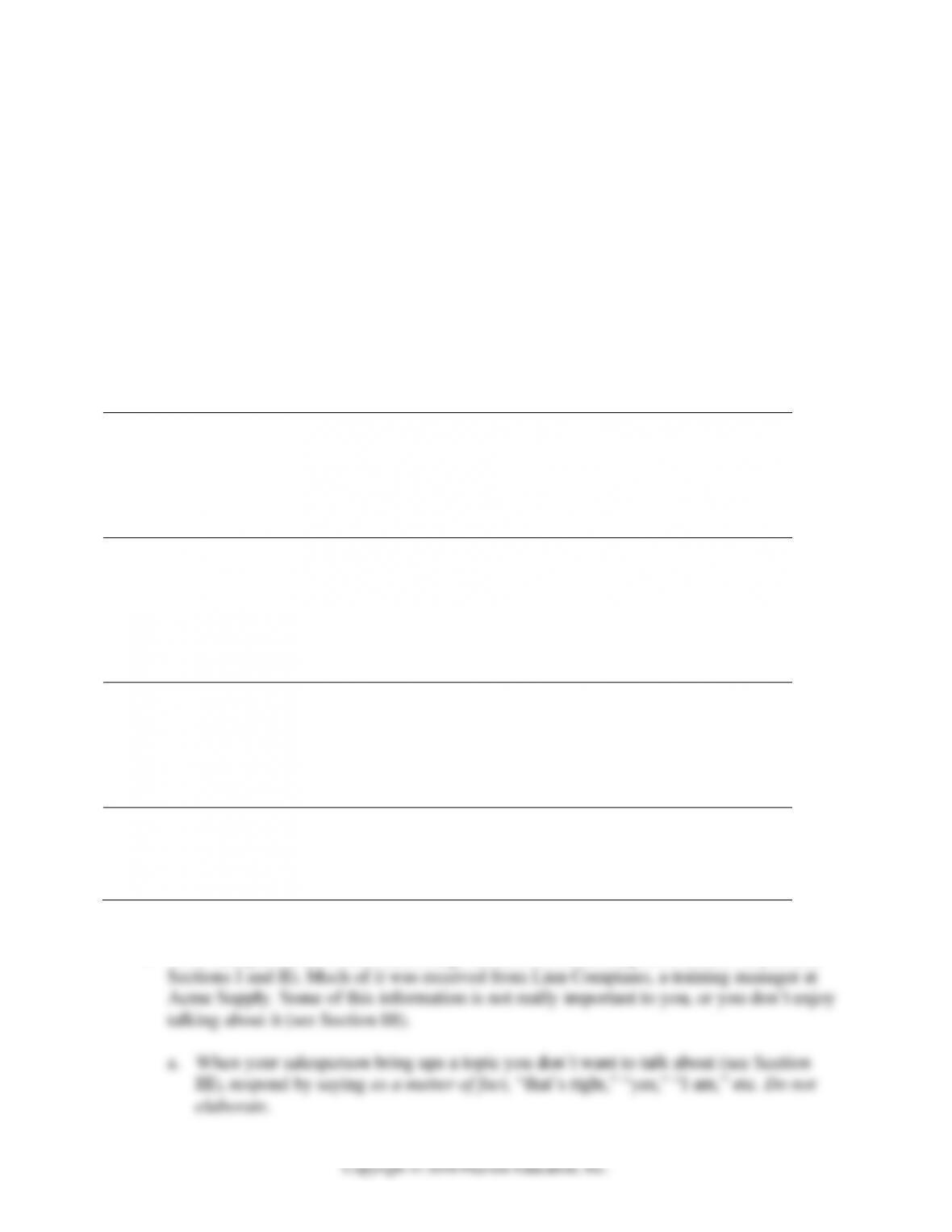
Salesperson’s Assessment Form 1A
Salesperson’s Name______KEY________
Associate Accounts
Part I—Your Customer (Circle either True or
False)
Part II—For each incorrect statement in Part
I, write the information that makes the
statement correct.
T F
1. Recently attended a PGA tournament.
1.
T F
2. Had a house that was featured in Better
Homes and Gardens magazine.
2.
T F
3. Is a tennis player with Toni Bush?
3. golfing partner
T F
4. Was on a high school tennis team.
4. golf
T F
5. May be building a new swimming
pool.
5. golf course
T F
6. Is Toni Bush’s uncle.
6. friend
T F
7. Was a good friend with Shawn
Johnson in college?
7. high school
T F
8. Has personally designed a home.
8.
T F
9. Have a house that won an award from
the local building association.
9. Regional Architect’s Association
T F
10. Has designed two previous homes.
10. one
Part III—List the three conversational strategies used to get customers to share relationship information.
1.
Compliments
2.
Comments on here and now observations
3.
Search for mutual acquaintances or interests
A3-27
ROLE-PLAY 1B—Association Accounts Customer’s Instructions
Establishing a Relationship
Background Information
You are to assume the role of Leigh Combs. You are the customer service manager for
Epic Design Systems (2401 West Towers, San Diego, CA, 92107, Telephone 949-224-0925), a
fast-growing high-tech computer company.
In this simulation, a hotel convention center salesperson, which you have not met, will be
visiting you for a 1:00 P.M. appointment in your office. This salesperson wants to: (1) establish a
relationship with you, (2) interest you in considering the Park Shores Convention Center for any
conferences you may be scheduling in the future, (3) find out if you are currently planning any
future conferences, and (4) set up a call-back appointment.
Section I—Topics you want to talk about:
Section II—Information you want to share:
1. My recent vacation.
______ 1. I spent a week in New York City.
______ 2. I had tickets to the “Tonight Show.”
______ 3. I personally met Jimmy Fallon, the new
host of the show.
2. My extra-large bookcase with many business
books in it.
______ 1. I have just finished writing a paper on
customer service called “Global
Service.”
______ 2. Inc. magazine is going to print my article
in next month’s edition.
______ 3. Inc. paid me $2000 for the right to
publish the article.
3. My degree from State University.
______ 1. I got a degree in marketing four years
ago.
______ 2. I worked as an executive chef in an
exclusive private club while in college.
______ 3. I considered a management job off from
the Marriott when I graduated.
Section III—Topics you don’t want to talk about.
1. My cousin Linn Compiano.
2. Large picture of Napoleon on the wall.
Role-Play Instructions
1. Your salesperson has researched a large amount of relationship information on you (see
A3-28
Copyright © 2018 Pearson Education, Inc.
b. When your salesperson brings up one of the topics you want to talk about (see
Section I), respond by raising your voice, speaking more quickly, and emphatically
sharing a new item of information from Section II.
c. Share only one item at a time from Section II, and let the salesperson acknowledge
that item. If the salesperson doesn’t acknowledge what you have shared, do not share
any more information on that topic. If the salesperson does acknowledge what you
have said, make a check mark next to the item and share another item. Continue until
your salesperson has discussed all three topics you want to talk about.
2. Because you are in charge of setting up meetings for large groups, your salesperson will
introduce you to the convention center and ask if you are planning any future meetings.
Keep any material your salesperson gives you.
3. Tell your salesperson that at the present time you are not planning any conventions, but
he/she may want to call you back in the next 30 days. End the call with a “Thank you,
I’ve enjoyed speaking with you.”
4. If your salesperson requests another meeting with you, confirm a time, three weeks from
today.
5. Return this form to your instructor. Fill out the Assessment Form 2: Customer Strategy
on p. 471.
A3-29
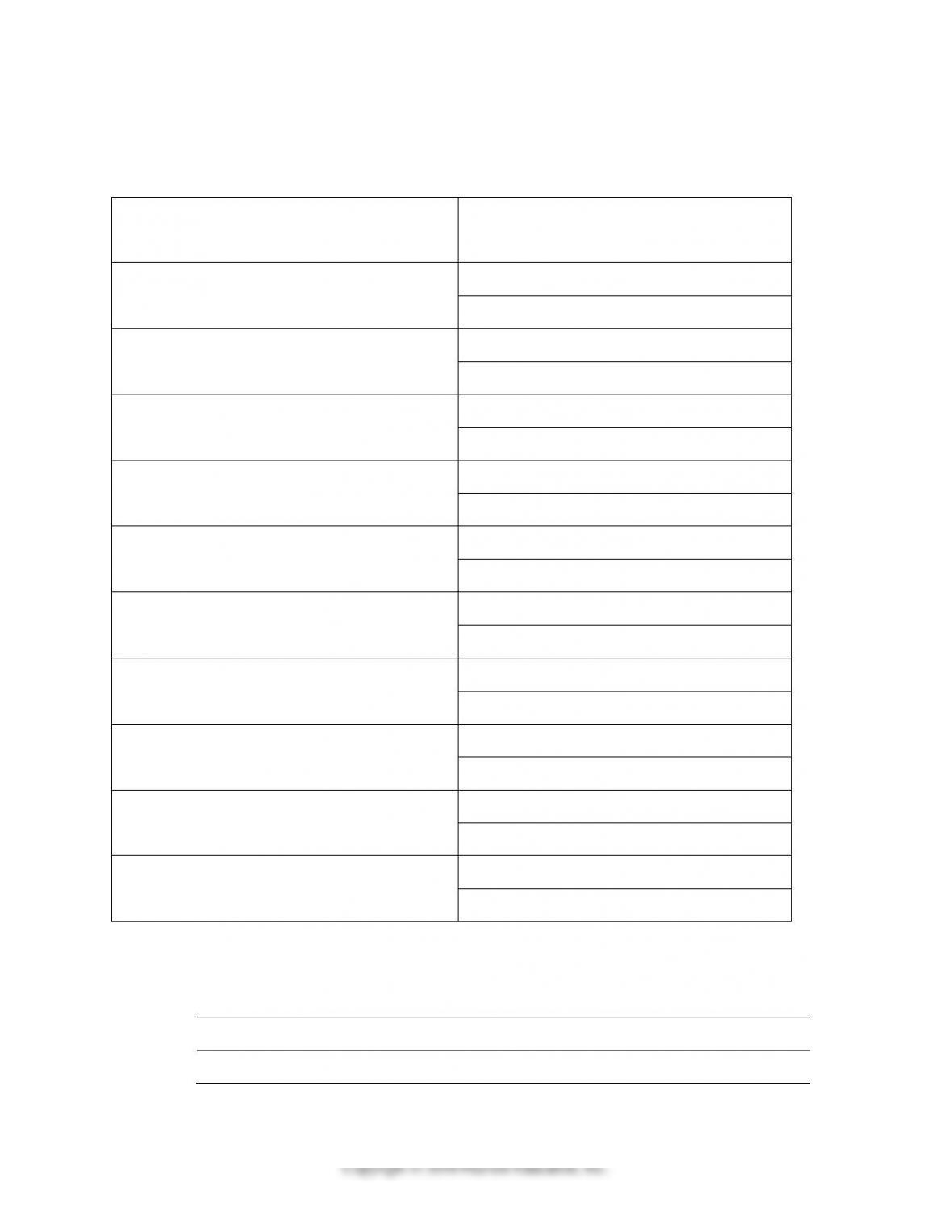
Salesperson’s Assessment Form 1B
Salesperson’s Name
___________________
Corporate Accounts
Part I—Your Customer (Circle either True
or False)
PART II—For each incorrect statement in
Part I, write the information that makes
the statement correct.
T F
1. Earned a history degree last year.
1.
T F
2. Met Jimmy Fallon, the new host
of “Saturday Night Live.”
2.
T F
3. Just wrote an article on customer
service.
3.
T F
4. Spent a week vacationing in New
York City.
4.
T F
5. Writes articles on custom cars for
magazines throughout the
country.
5.
T F
6. Is Linn Compiano’s cousin.
6.
T F
7. Has an article published in
BusinessWeek?
7.
T F
8. Worked as a chef in college.
8.
T F
9. Worked at the Marriott.
9.
T F
10. Just paid Inc. magazine $2,000 to
publish an article.
10.
Part III—List the three conversational strategies used to get customers to share relationship information.
1.
2.
3.
Salesperson’s Assessment Form 1B
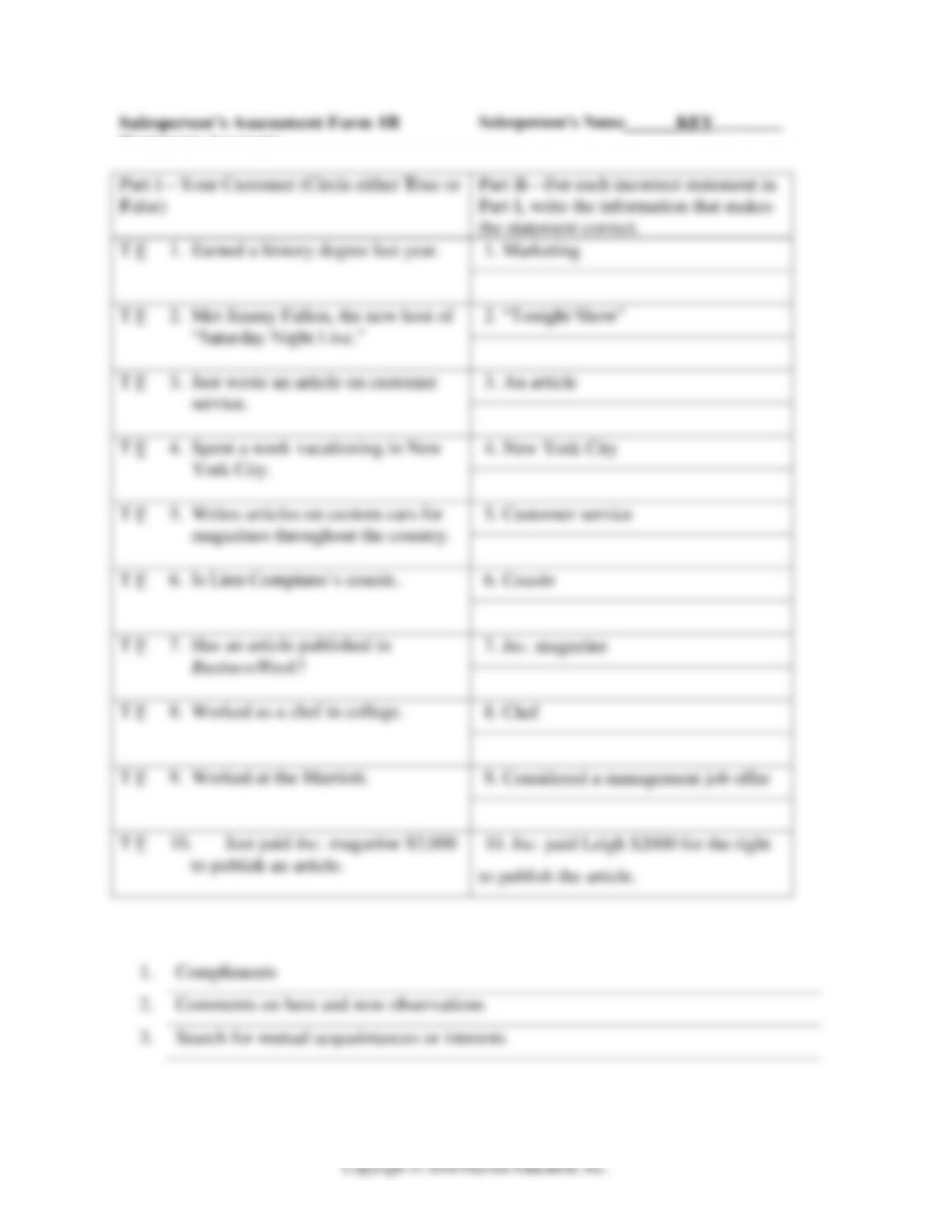
Salesperson’s Name______KEY________
Corporate Accounts
Part I—Your Customer (Circle either True or
False)
Part II—For each incorrect statement in
Part I, write the information that makes
the statement correct.
T F
1. Earned a history degree last year.
1. Marketing
T F
2. Met Jimmy Fallon, the new host of
“Saturday Night Live.”
2. “Tonight Show”
T F
3. Just wrote an article on customer
service.
3. An article
T F
4. Spent a week vacationing in New
York City.
4. New York City
T F
5. Writes articles on custom cars for
magazines throughout the country.
5. Customer service
T F
6. Is Linn Compiano’s cousin..
6. Cousin
T F
7. Has an article published in
BusinessWeek?
7. Inc. magazine
T F
8. Worked as a chef in college.
8. Chef
T F
9. Worked at the Marriott.
9. Considered a management job offer
T F
10. Just paid Inc. magazine $2,000
to publish an article.
10. Inc. paid Leigh $2000 for the right
to publish the article.
Part III—List the three conversational strategies used to get customers to share relationship information.
1.
Compliments
2.
Comments on here and now observations
3.
Search for mutual acquaintances or interests