118 Zutter/Smart • Principles of Managerial Finance Brief, Eighth Edition
b. and c.
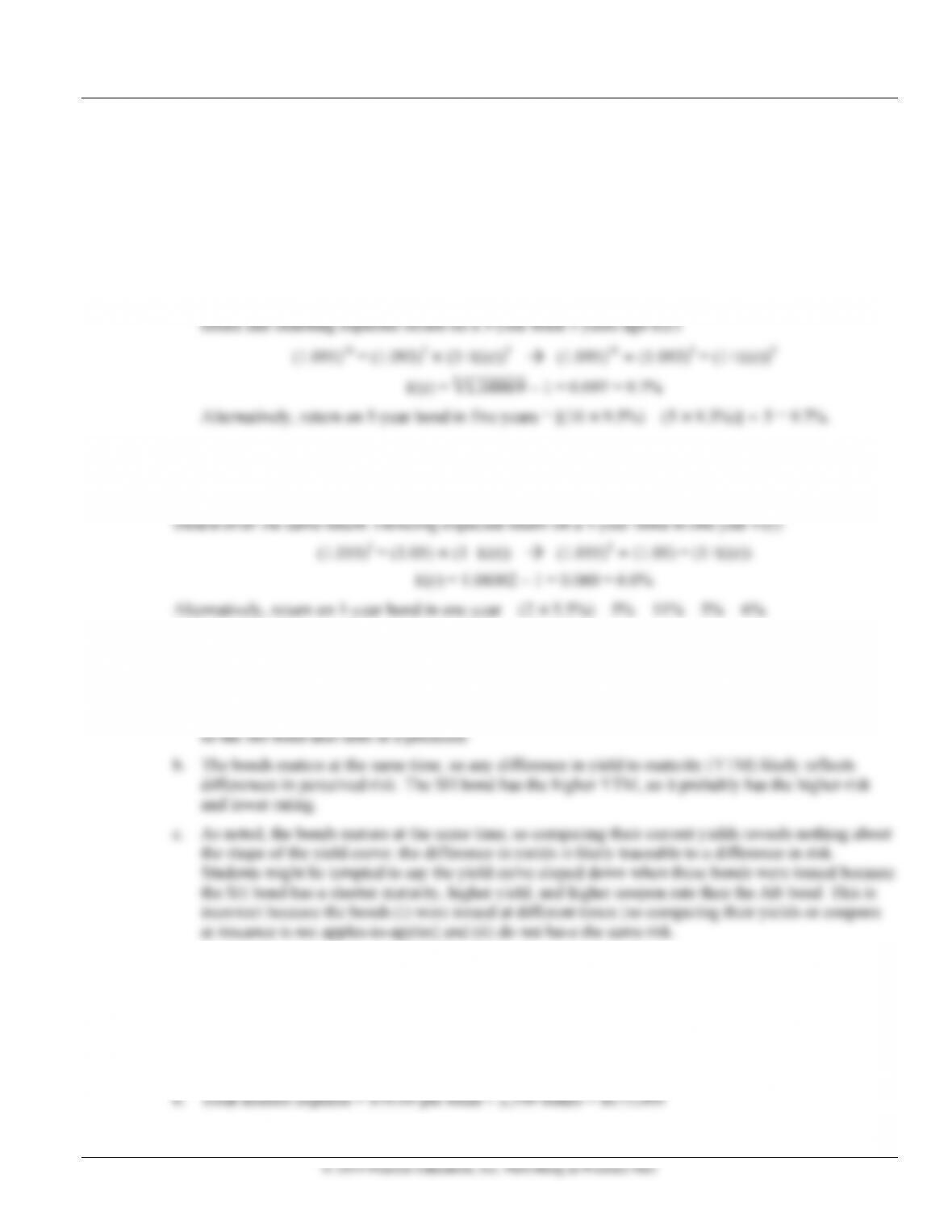
Five years ago, the yield curve was slightly upward sloping, suggesting (under the expectations
theory) investors expected future short-term interest rates to be only slightly higher than current
short-term rates. Two years ago, the yield curve had a sharp downward slope, suggesting investors
expected a dramatic decline in short-term interest rates (perhaps due to a coming recession). Today,
the yield curve is upward sloping, suggesting investors expect short-term rates to rise.
d. Consider two 10-year investment options five years ago: (i) a 10-year bond offering 9.5% or (ii) a 5-
year bond offering 9.3% and another 5-year bond in 5 years. Under the expectations theory of the
term structure, the options should offer the same return. Assuming the options offered the same
P6-8 Term structure (LG 1; Basic)
Consider two 2-year investment options: (i) a 2-year bond offering 5.5% or (ii) a 1-year bond offering
5% and another 1-year bond in 1 year. Under the expectations theory of the term structure, the options
P6-9 Risk premiums (LG 1; Intermediate)
a. The coupon rate (3.3%) on the Anheuser-Busch (AB) bond exceeds yield to maturity (2.82%, also
the current market interest rate on bonds of equivalent risk), so the AB bond sells at a premium. The
coupon rate on the Santander Holdings (SH) bond (3.571%) also exceeds yield to maturity (3.341%),
P6-10 Bond interest payments before and after taxes (LG 2; Intermediate)
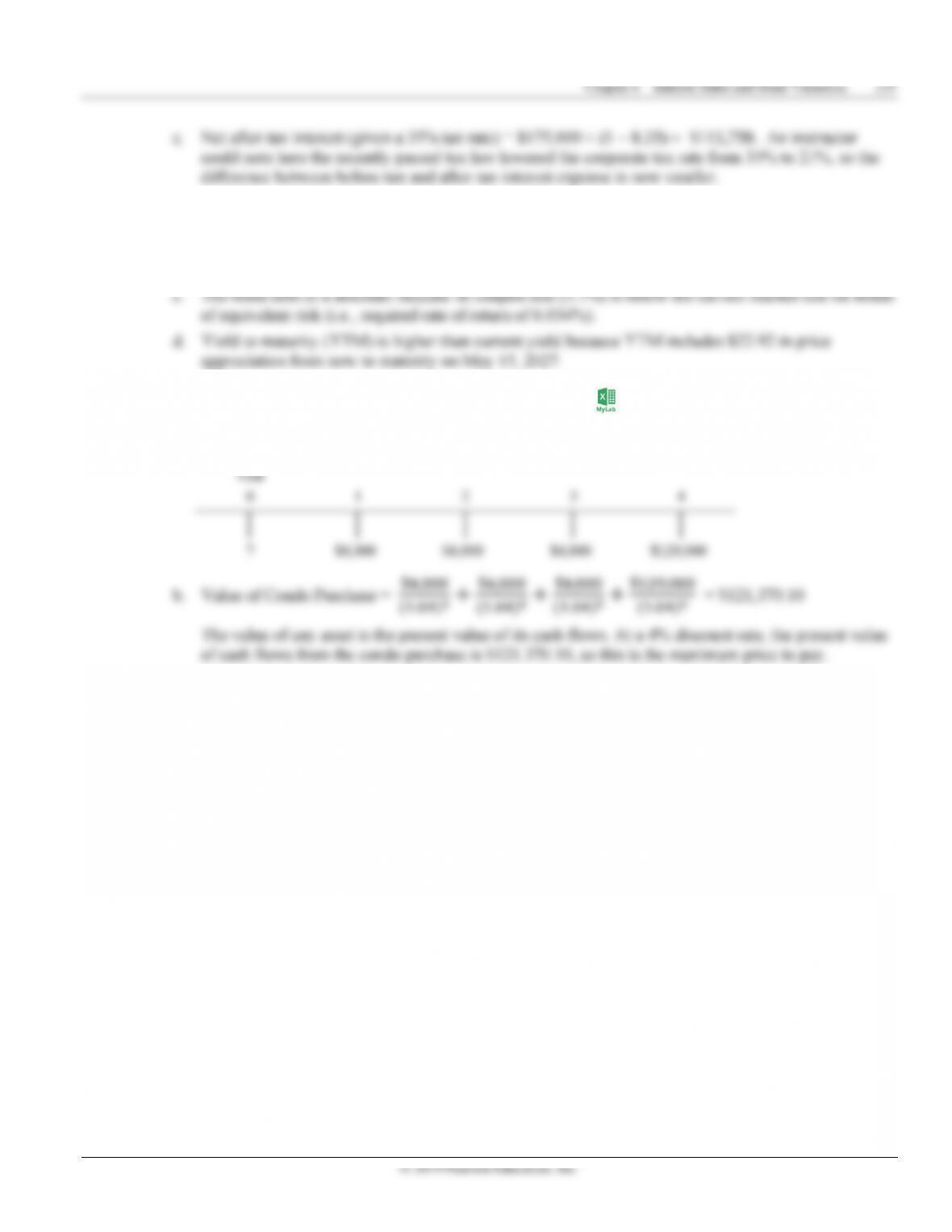
a. Yearly interest = [($2,500,000 ÷ 2,500) × 0.07] = ($1,000 × 0.07) = $70.00
© 2019 Pearson Education, Inc.
P6-11 Bond prices and yields (LG 4; Basic)
a. 0.97708 × $1,000 = $977.08
b. (0.057 × $1,000) ÷$977.08 = $57.00
÷
$977.08 = 0.0583 = 5.83%
P6-12 Personal finance: Valuation fundamentals (LG 4; Basic)
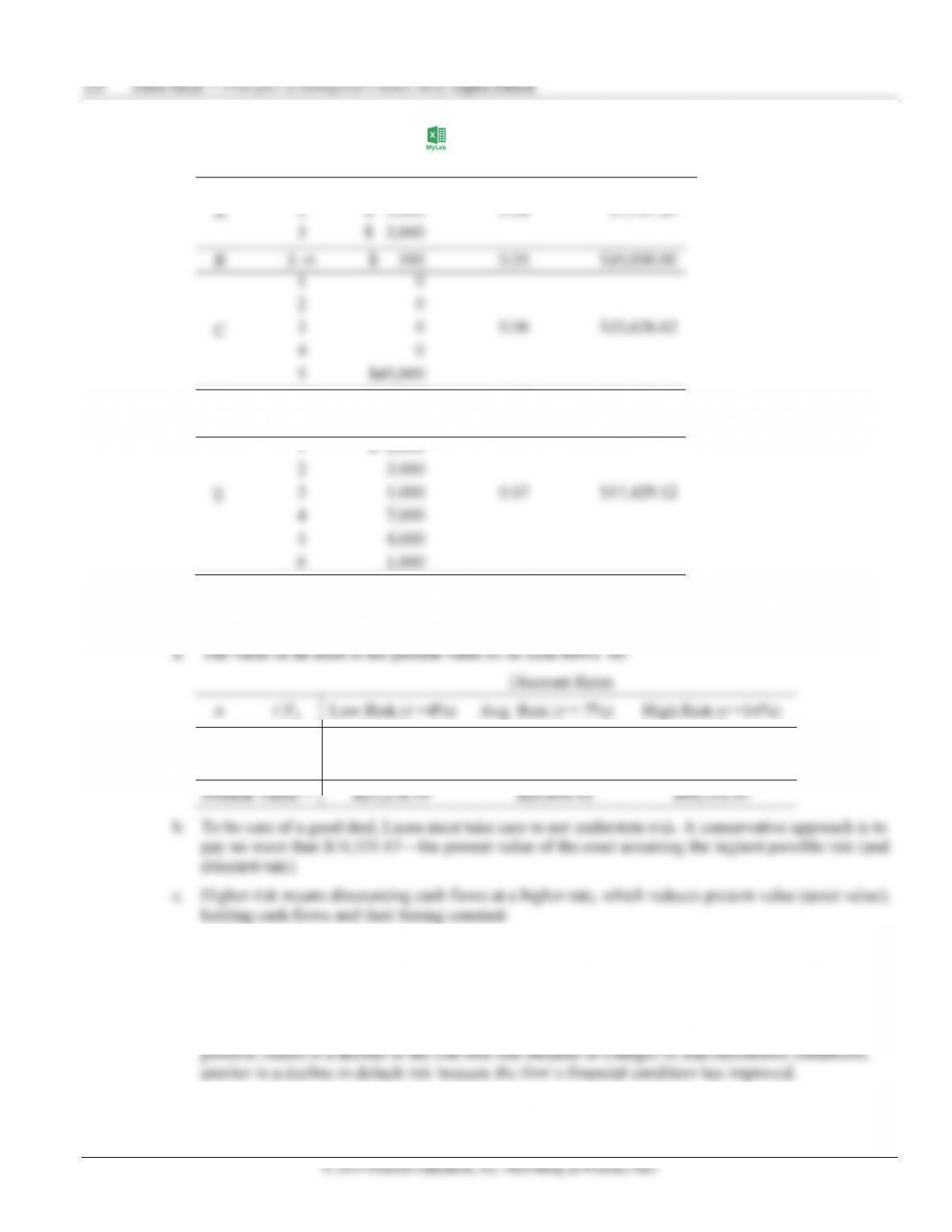
a. In years 1 – 4, $6,000 is paid on property taxes and maintenance, but $10,000 is saved on rent. Also,
in year 4, the condo will sell for $125,000. So, the timeline is:
01234
Year
Chapt
e
e
r 6 Interest R
a
a
tes and Bond
V
V
aluation 12
1
1
1
22 Zutter/
S
P6-18
B
a
b
b
c
c
c
c
n
a
b
n
v
p
r
a
o
P
a
1
1
1
1
1
1
P
a
1
1
1
1
1
1
a
0
0
0
0
0
o
0
S
mart • Princip
l
B
ond value a
a
. Using th
e
R
e
t
t
a
n
l
es of Manageri
a
n
d time: Co
n
e
PV function
=p
v
e
quired
Y
a
l Finance
B
rie
f
n
stant requir
e
in Excel wit
h
v
(required re
t
Y
ears to
f
, Eighth Editio
n
e
d returns (L
h
the syntax:
t
urn, years to
n
L
G 5; Interm
maturity, co
u
P
ediate)
u
pon, par val
u
P
arValue
u
e)
Bond
© 2019 Pearson Education, Inc.
P6-20 Yield to maturity (LG 6; Basic)
P6-21 Yield to maturity (LG 6; Intermediate)
a. Yield to maturity (YTM) may be found in Excel using the RATE function with the following syntax:
=rate(n,C,−V0,M) = rate(15,60, −$867.59,1000) = 7.50%
P6-22 Yield to maturity (LG 6; Intermediate)
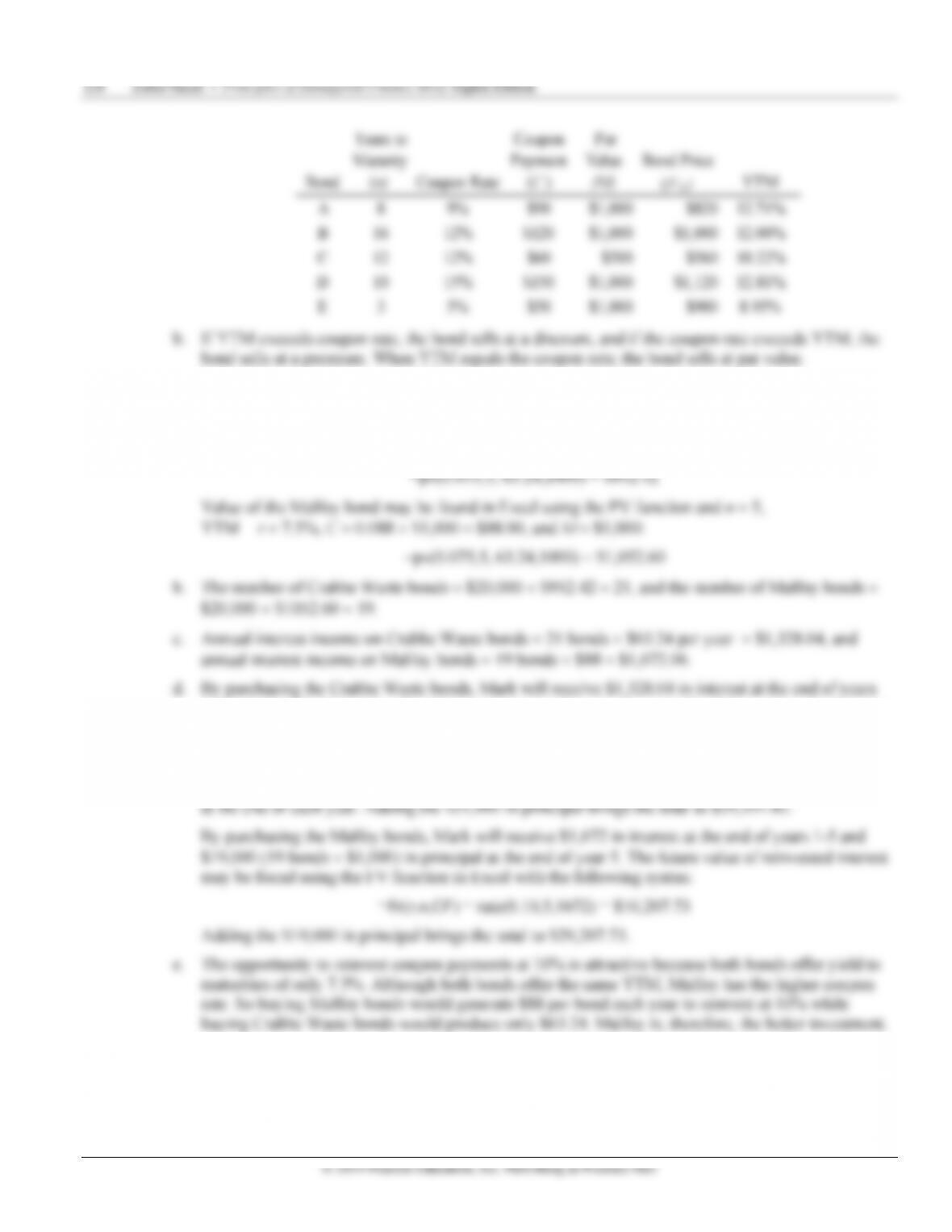
a. In Excel, the RATE function will generate a bond’s yield to maturity (YTM). For example, for bond
A in the table below, the proper syntax is:
=rate(periods, −payment,present value, −future value)
where periods (n) is number of periods to maturity, payment (C) is coupon payment, present value is
© 2019 Pearson Education, Inc. Publishing as Prentice Hall
P6-23 Personal finance: Bond valuation and yield to maturity (LG 2, LG 5, and LG 6; Challenge)
a. Value of the Crabbe Waste bond may be found in Excel using the PV function and n = 5,
YTM = r = 7.5%, C = 0.06324 × $1,000 = $63.24, and M = $1,000:
1-5 and $21,000 (21 bonds × $1,000) in principal at the end of year 5. The future value of reinvested
interest may be found using the FV function in Excel with the following syntax:
=fv(r,n,𝐶𝐹) = rate(0.10,5,1328.04) = $8,107.82
where r is the required rate of return, n is years interest will be earned, and CF is total interest earned
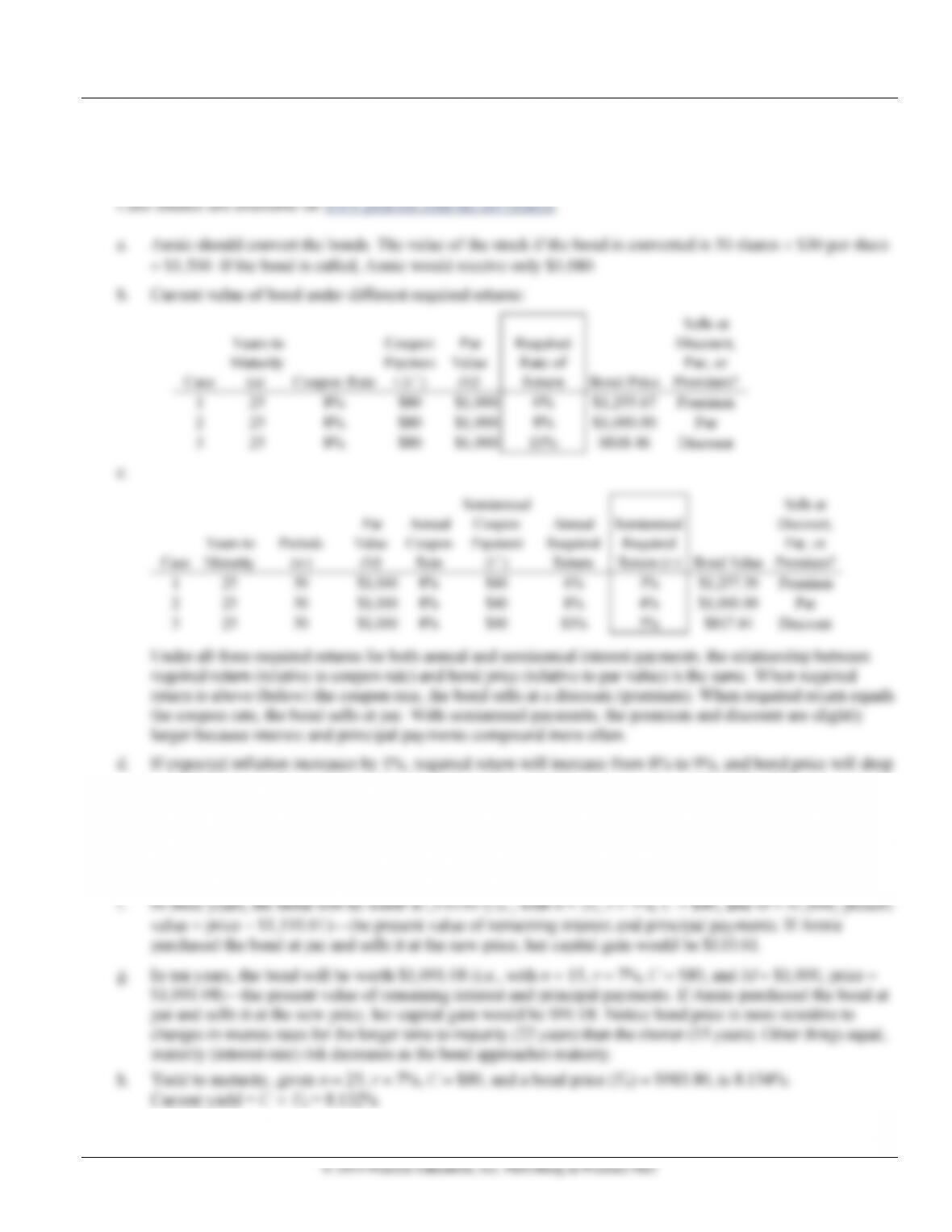
126 Zutter/Smart • Principles of Managerial Finance Brief, Eighth Edition
Case: “Evaluating Annie’s Proposed Investment in
Atilier Industries Bonds”
to $901.77 (i.e., with n = 25, r = 9%, C = $80, and M = $1,000, present value = $901.77). This amount is the
maximum Annie should pay for the bond after the increase in expected inflation.
e. If the ratings downgrade raises expected return from 8% to 8.75%, bond price will fall to $924.81 (i.e., with
n = 25, r = 9%, C = $80, and M = $1,000, present value = $924.81). This amount is the maximum Annie
should pay for the bond after the ratings downgrade.
© 2019 Pearson Education, Inc.