
Part 3
Valuation of Securities
Chapters in This Part
Chapter 6 Interest Rates and Bond Valuation
Chapter 7 Stock Valuation

Chapter 6
Interest Rates and Bond Valuation
Instructor’s Resources
Chapter Overview
This chapter introduces interest-rate and bond-market fundamentals, beginning with the distinction between
nominal and real interest rates and the role of expected inflation in linking the two. Risk premia are added to
highlight components of the nominal return on a risky security, namely the (i) real risk-free rate, (ii) expected
inflation rate, and (iii) risk premium on the security. Next, the discussion turns to the relationship between the
nominal interest rate on a bond and its term to maturity—formally referred to as the term structure of interest
rates and represented pictorially by the yield curve. The exposition notes the general upward slope of the yield
curve—that is, that long-term interest rates tend to exceed short-term rates—and offers three explanations: (a)
expectations about future short-term rates, (ii) general investor preference for short-term, liquid debt, and (iii)
segmentation of short- and long-term debt markets. The focus then moves to bond-market institutions with a
catalogue of the major types of issues along with their legal issues, risk characteristics, and indenture provisions.
The role of rating agencies is also emphasized. The chapter concludes by presenting the basic model for bond
valuation as a special case of the general model for valuing assets (i.e., value is simply the present value of
expected cash flows from the asset). Examples are provided of the impact of variation in coupon/principal
payments, timing of coupon/principal payments, and required rates of return on the market price of a bond. The
final topic is yield to maturity—explained as nothing more than the interest rate equating the present value of a
bond’s remaining coupons and principal payments with its market price.
Answers to Review Questions
6-1 The real rate of interest measures the return on an investment, not in dollars, but in terms of how much the
investment increases one’s purchasing power. The nominal rate of interest is the actual rate of interest
charged by suppliers and paid by demanders of funds; it differs (approximately) from the real rate of
interest by expected inflation. Specifically, let r* be the real rate of interest, r the nominal interest rate, and
6-2 The term structure of interest rates is the relationship between nominal rate of return and time to maturity



1
n
r
i
p
p
r
*
p
o
d
(
)
(
n
f
e
w
)
0
w
p
i
o
t
o
o
p
o
a
y
e
a
5
d
n
e
n
5
x
n
r
)
e
c
m
r
n
c
e
1
12 Zutter/
S
that is,
a
interest
c
Why do
y
run-up
t
e
S
g
b
e
e
g
f
e
c
r
o
f
d
t
c
r
o
d
r
v
a
g
d
g
n
M
e
f
n
e
a
f
a
,
t
,
a
S
o
a
o
r
o
r
o
s
o
y
l
y
u
e
a
t
a
s
o
e
s
o
s
n
o
o
S
mart • Princip
l
a
ward a ratin
g
c
osts down.
y
ou think N
R
t
o the Great
R
l
es of Manageri
a
g
indicating l
o
SROs inflate
d
R
ecession?
a
l Finance
B
rie
f
o
wer default
r
d
ratings for
n
f
, Eighth Editio
n
r
isk than just
i
n
ew complex
n
i
fied by the i
s
MBSs but n
o
s
suer’s finan
c
o
t traditional
c
c
ial informati
o
corporate bo
n
o
n.—to keep
n
ds in the
© 2019 Pearson Education, Inc.
E6-3 Calculating inflation expectation (LG 1)
E6-4 Real returns (LG 1)

© 2019 Pearson Education, Inc.
P6-1 Interest-rate fundamentals: The real rate of return (LG1; Basic)
Real rate of return (r*) ≈ nominal interest rate (r) – expected inflation (i) = 1.5% − 0.5% ≈1.0%
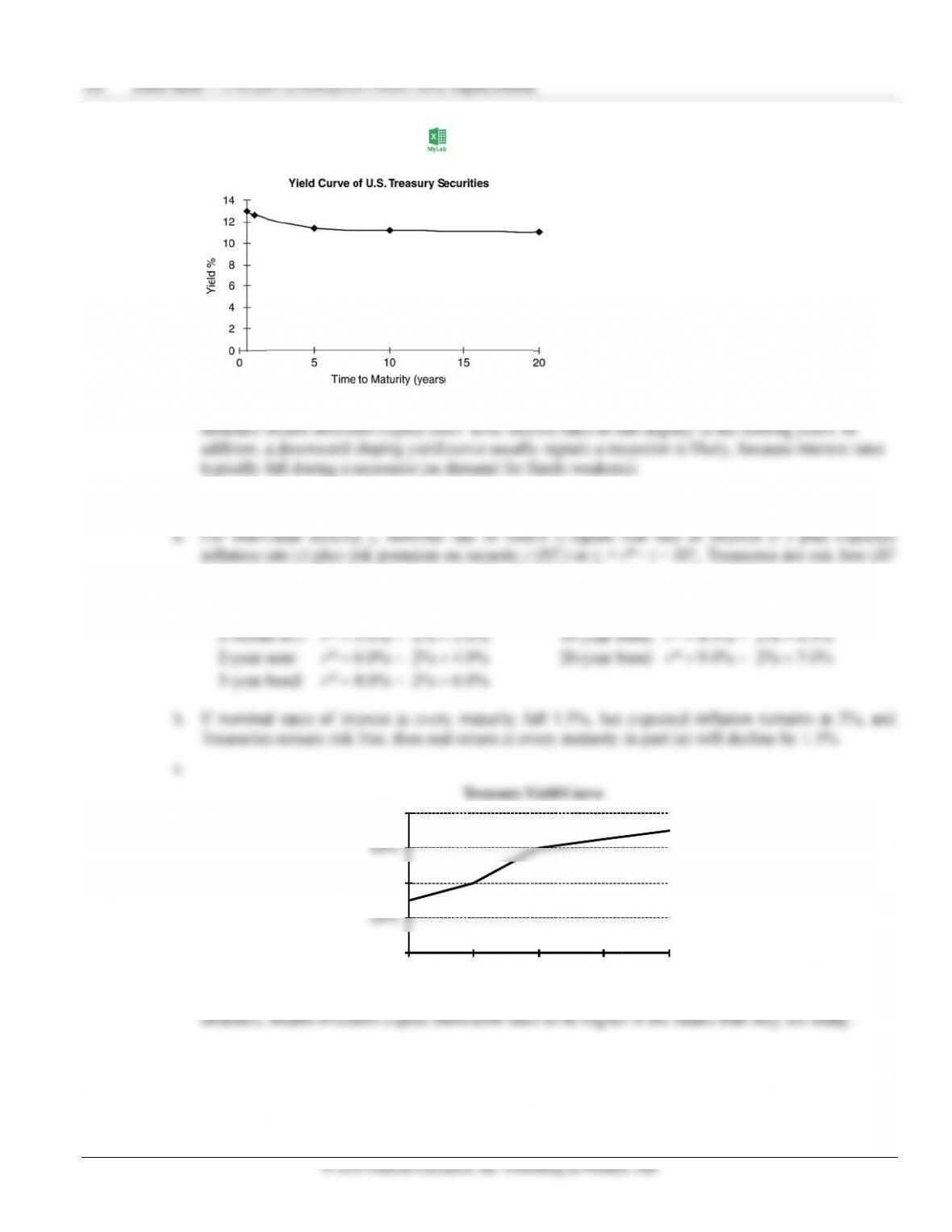
P6-2 Equilibrium rate of interest (LG 1; Intermediate)
a,b and c.
P6-3 Personal finance: Real and nominal rates of interest (LG 1; Intermediate)
a. $100 budget ÷ $2.5 per pair of socks = 40 pair of socks.
b. Nominal return on $100 invested at 9% for one year =$100 × (1.09)1 = $109.
c. Price of a pair of socks in one year with a 5% inflation rate = $2.50 × (1.05)1 = $2.625.
Point O: Initial Equilibrium
Point N: New Equilibrium
1
1
16 Zutter/
S
P6-4
Y
a
b
S
mart • Princip
l
Y
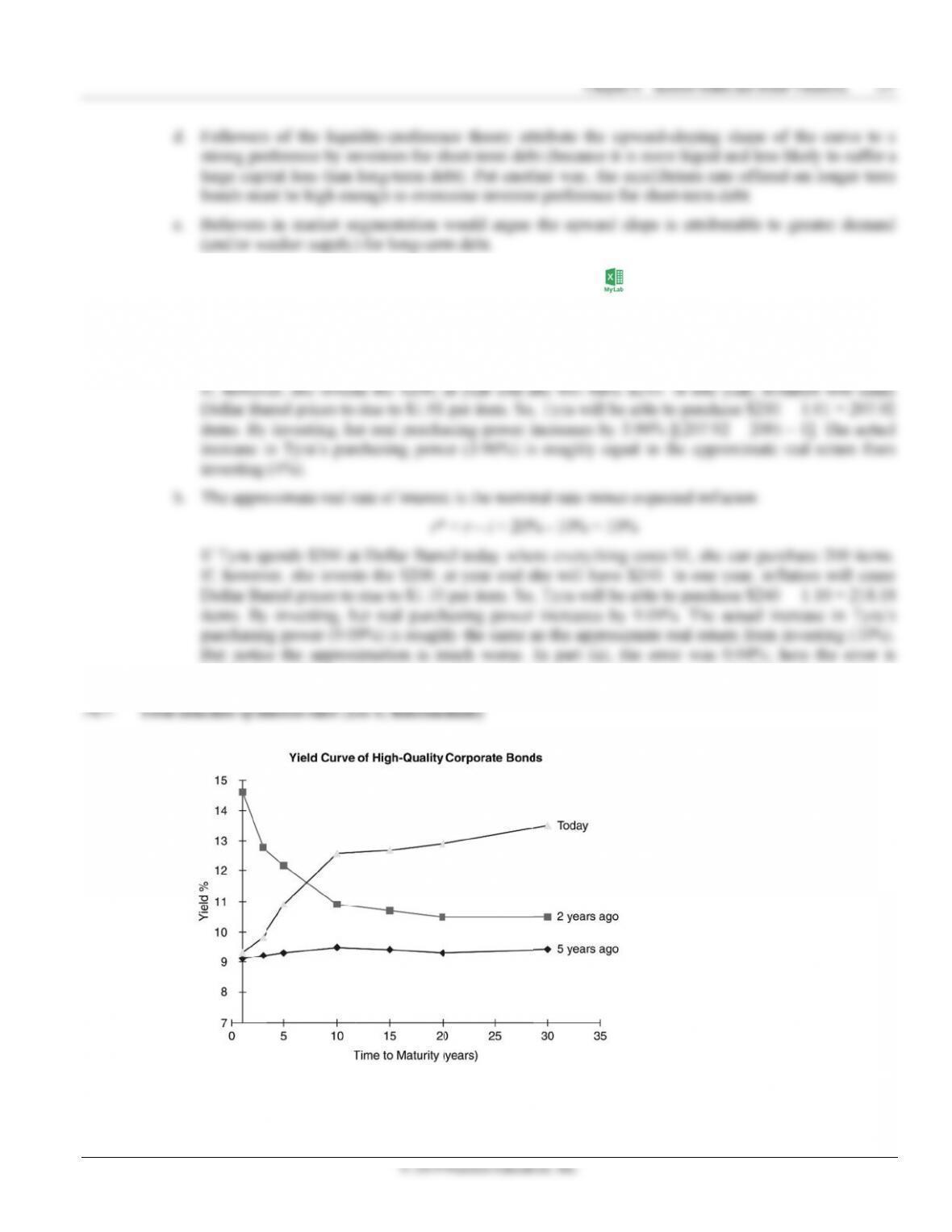
ield curve (
L
a
.
b
. The yield
l
es of Manageri
a
L
G 1; Inter
m
curve is slig
h
a
l Finance
B
rie
f
m
ediate)
h
tly downwa
r
f
, Eighth Editio
n
r
d sloping, w
h
n
h
ich under t
h
h
e expectatio
n
n
s theory of t
h
h
e term
N
a
b
c
N
a
b
c
m
a
f
v
r
t
5
n
6
b
a
t
s
e
t
r
y
i
5
6
r
a
e
p
o
f
o
m
a
p
g
r
y
c
f
n
y
–
v
g
e
f
e
n
–
e
r
n
i
T
e
y
6
7
f
n
i
t
o
y
i
p
y
6
7
o
d
Chapt
e
e
r 6 Interest R
a
a
tes and Bond
V
V
aluation 11
7