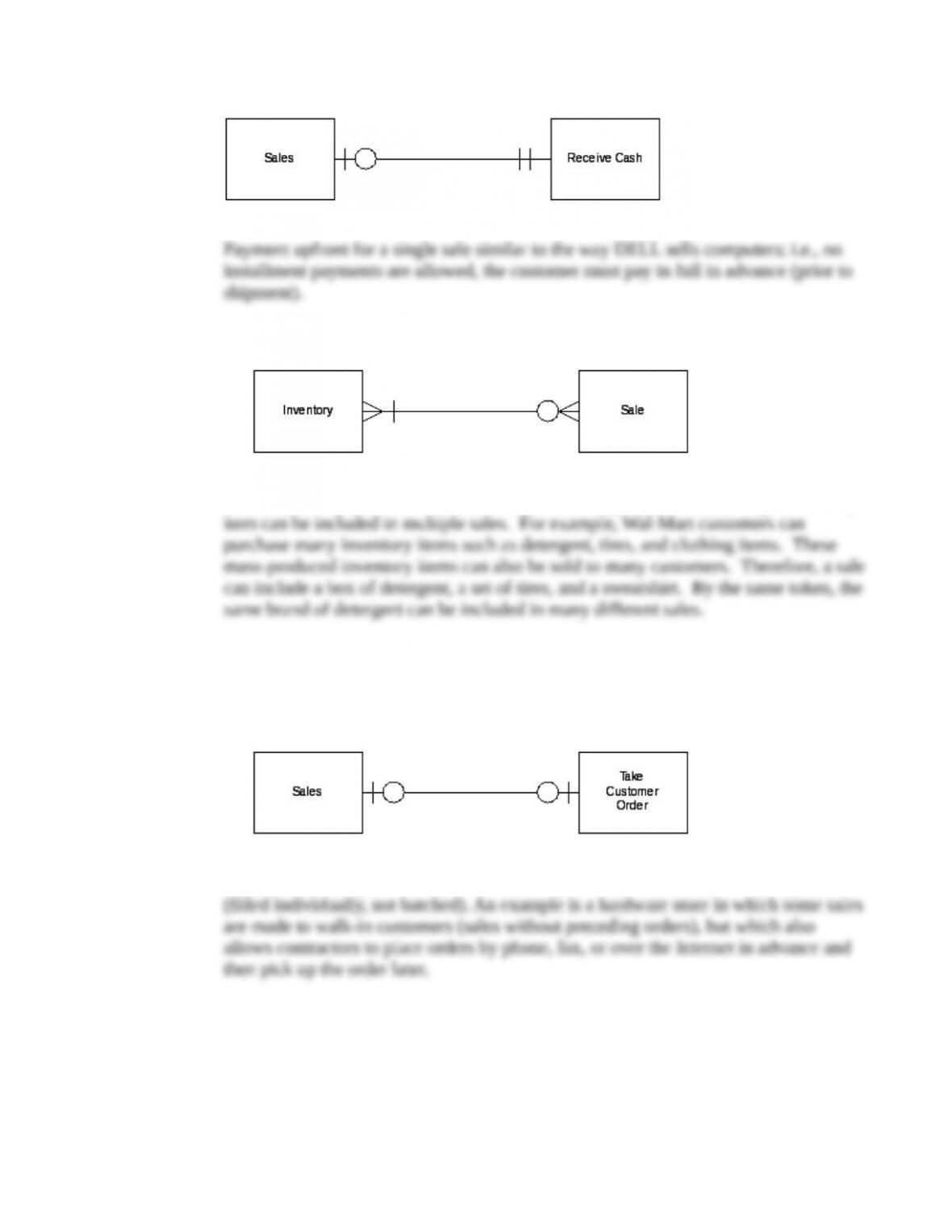
g.
h.
In this scenario, a sale can include multiple inventory items. Also, a single inventory
i.
Sales need not be preceded by orders, but any orders are associated with only one sale
17.7 Model the cardinalities of the following business policies:
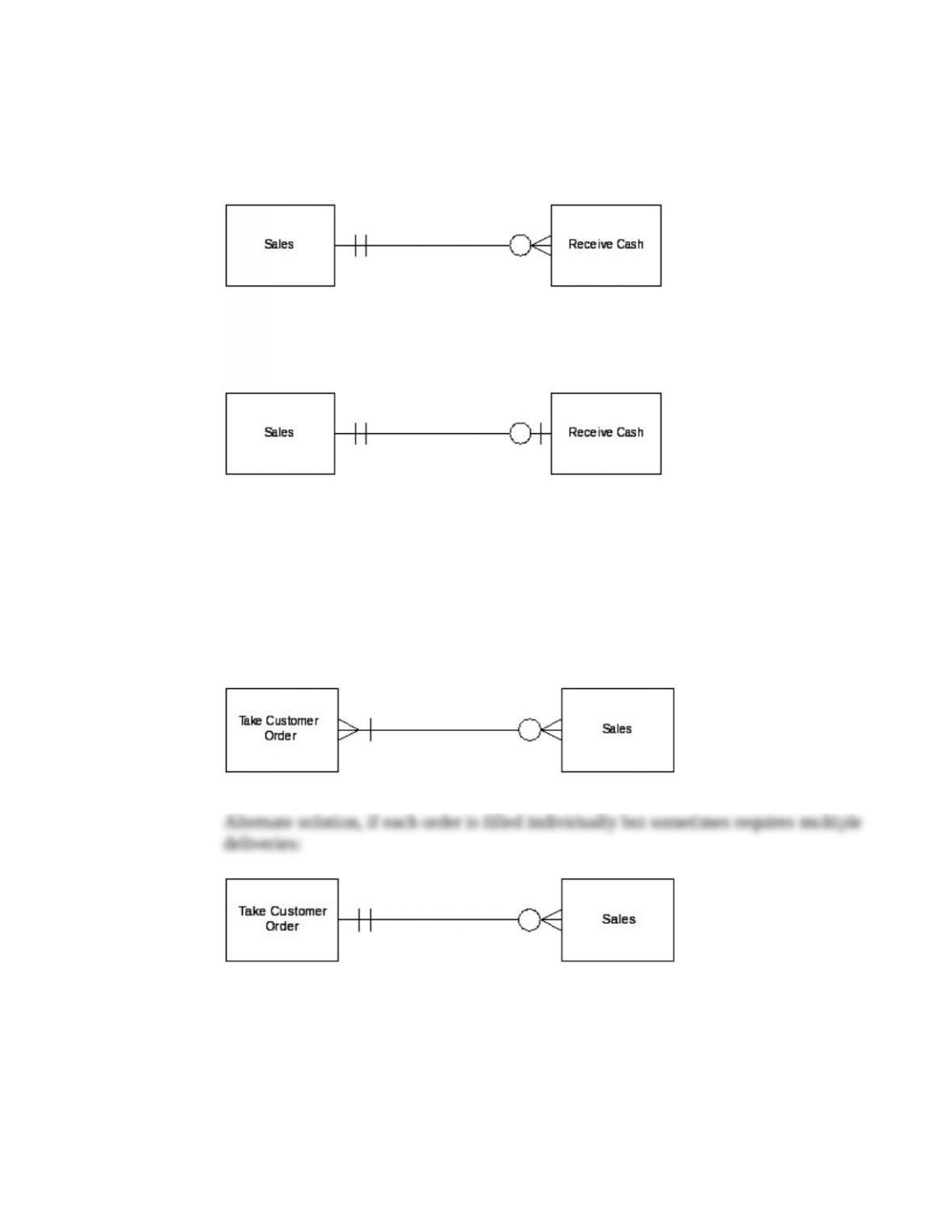
a. The relationship between the Sale and Receive Cash events
for installment sales.
b. The relationship between the Sale and Receive Cash events at a convenience
store.
c. The Take Customer Order–Sale relationship in a situation when occasionally
several shipments are required to fill an order because some items were out of
stock.
The solution presented here presumes that one sale (order fulfillment event) can be
linked to multiple orders, with occasional partial deliveries because items need to be
back ordered.
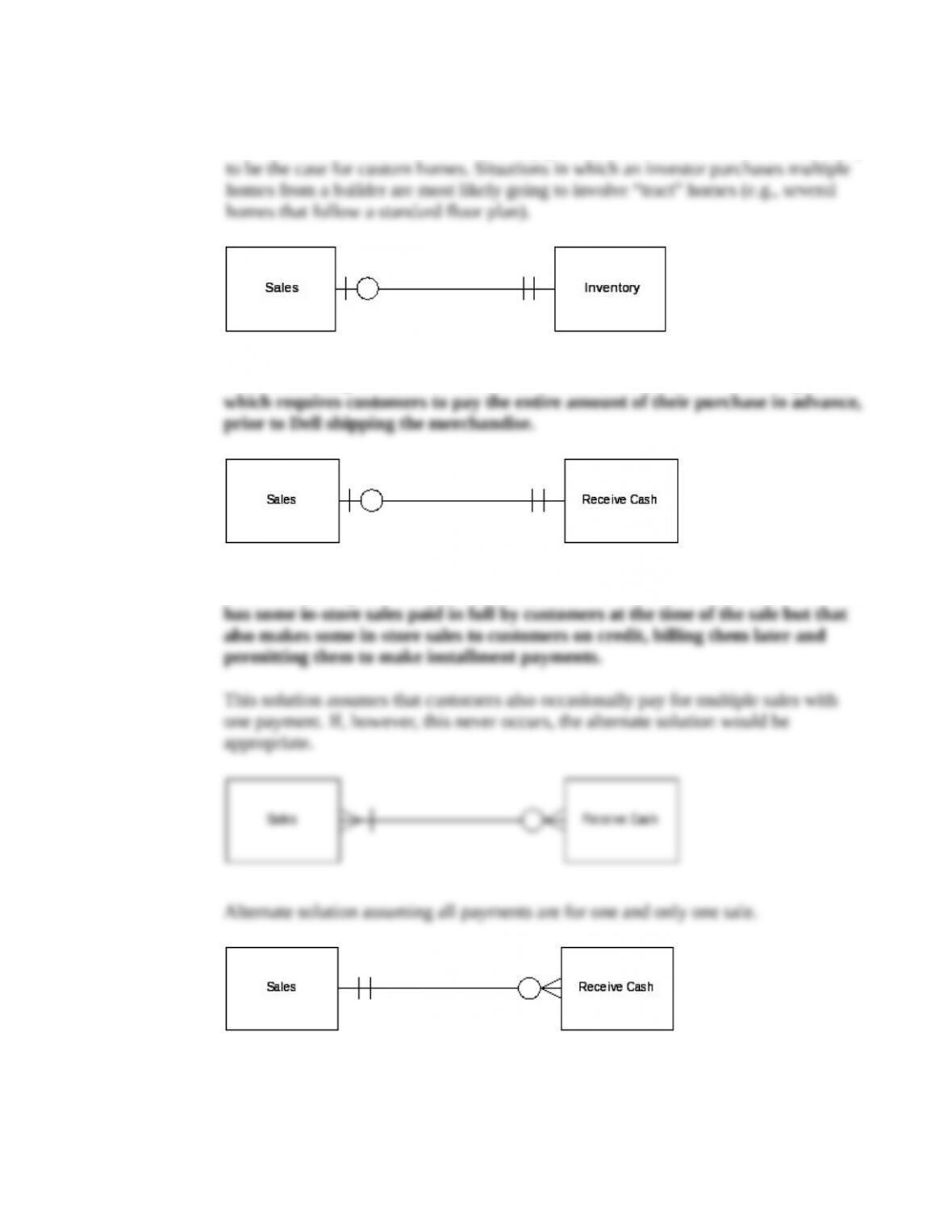
d. The Sale-Inventory relationship for a custom homebuilder.
This solution assumes that customers only purchase one home at a time. This is likely
e. The relationship between the Sale and Receive Cash events for Dell computers,
f. The relationship between the Sale and Receive Cash events for a retail store that
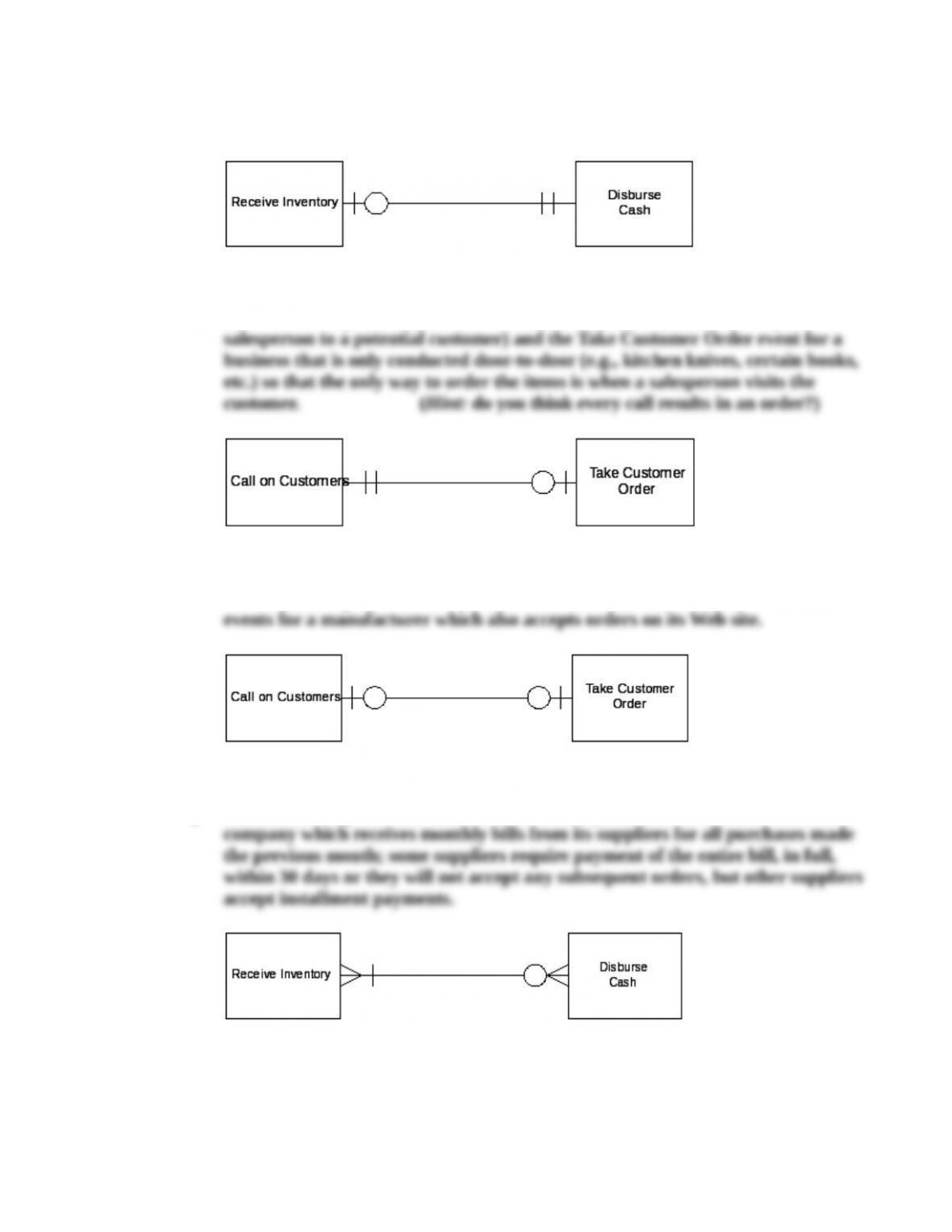
g. The relationship between the Receive Inventory and Disburse Cash events in the
case where suppliers require payment in advance, in full.
h. The relationship between the Call on Customers event (i.e., the visit by a
i. The relationship between the Call on Customers and Take Customer Orders
j. The relationship between the Receive Inventory and Disburse Cash events for a
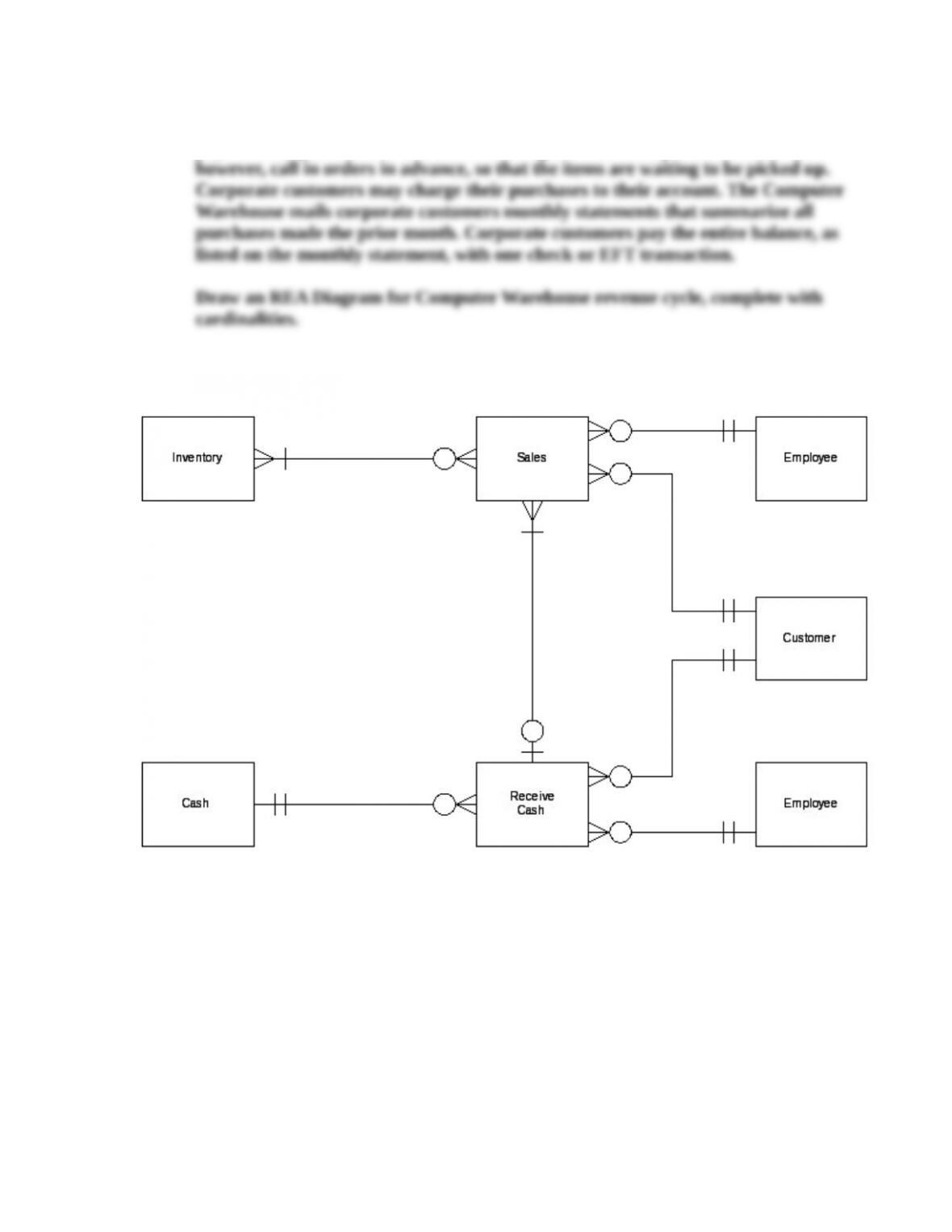
17.8 The Computer Warehouse sells computer hardware, software, and supplies (such as
paper). Individual customers just walk into the store, select merchandise, and must
pay for their purchases in full before leaving the store. Corporate customers,
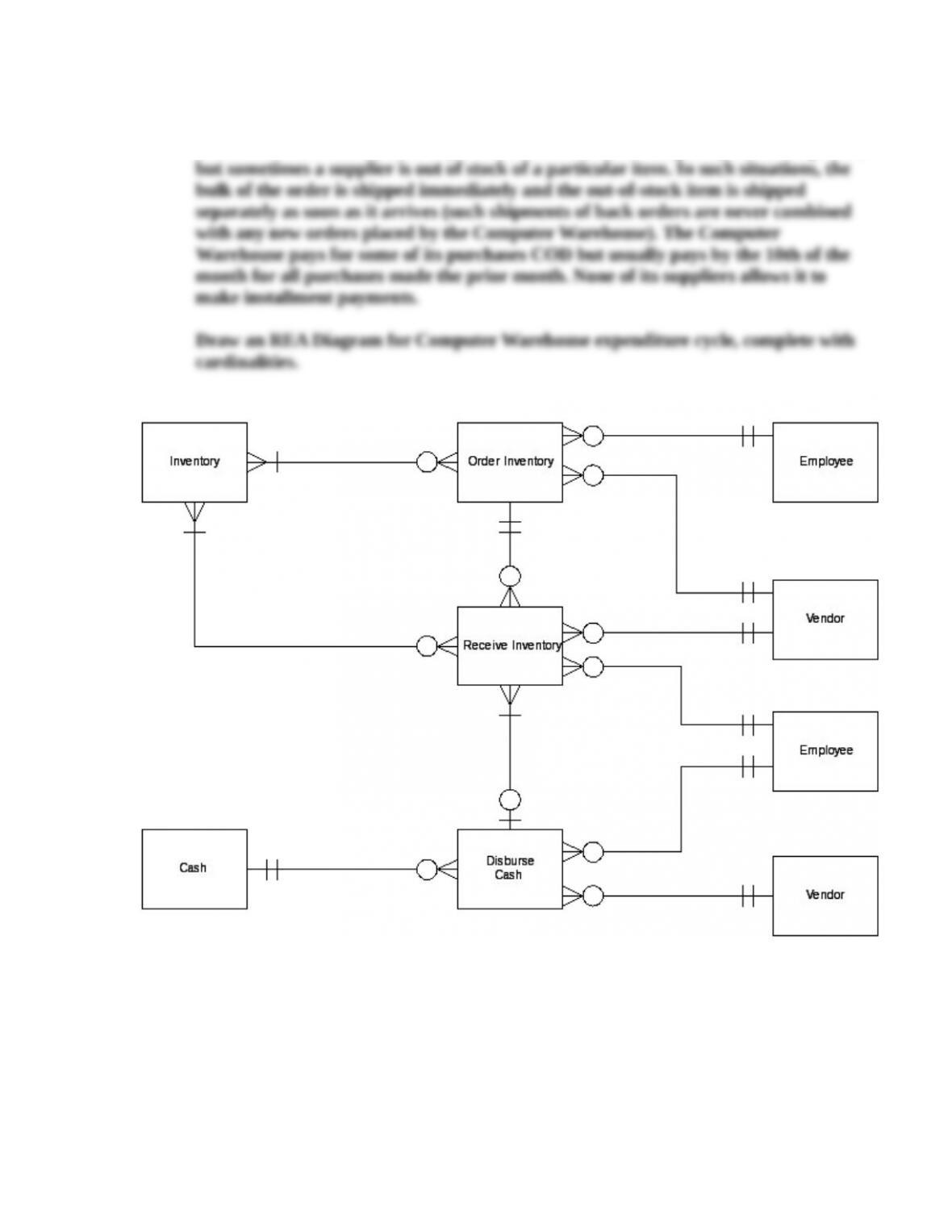
17.9 The Computer Warehouse purchases its inventory from more than a dozen different
vendors. Orders are placed via telephone, fax, or on the supplier’s Web site. Most
orders are delivered the next day. Most orders are filled completely in one shipment,
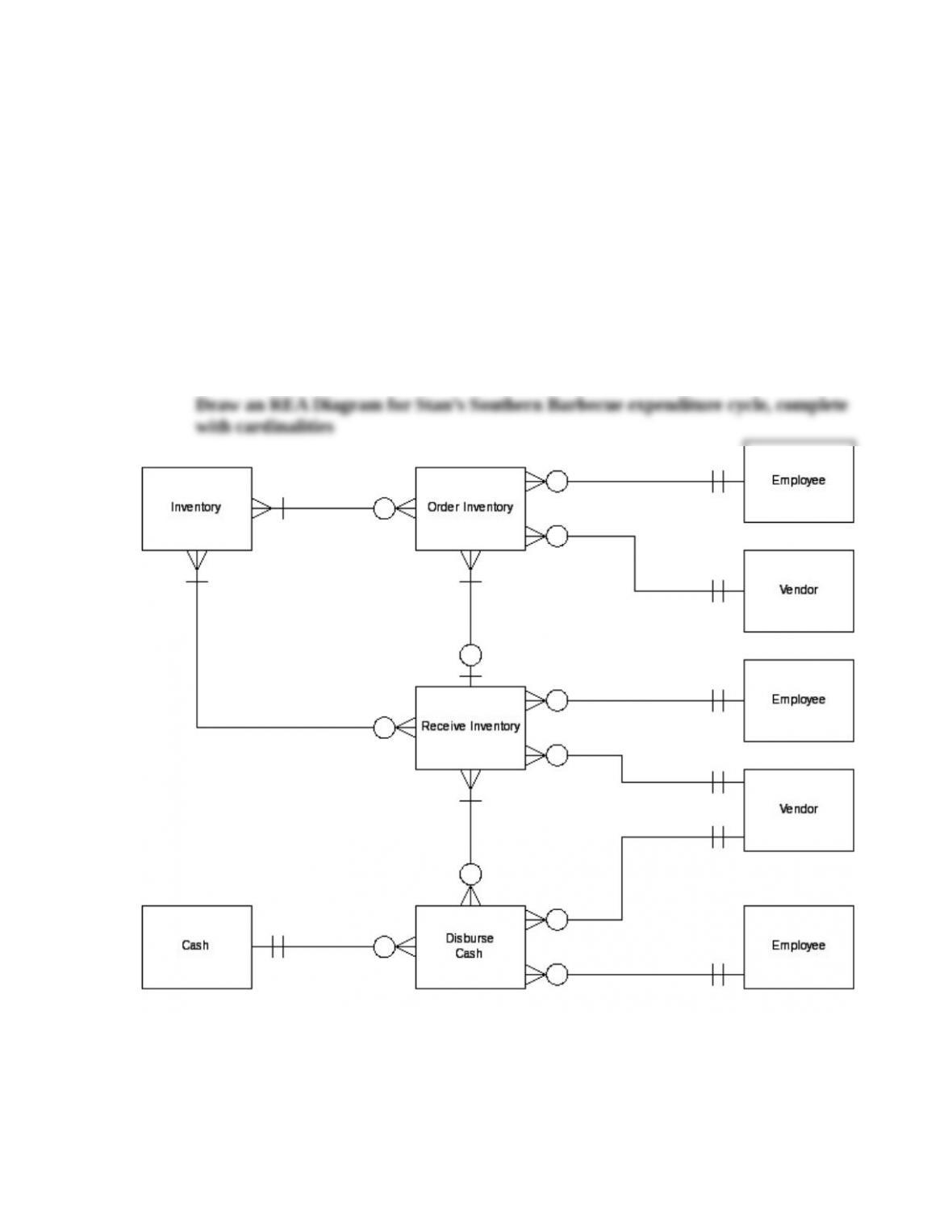
17.10 Stan’s Southern Barbeque Supply Store orders mass-produced barbecue products
from various suppliers. Stan’s maintains information about a contact person at each
supplier along with all required address information. Each purchase order has the
order number, date, tax, and total. Purchase orders also contain the following
information for each product ordered: stock number, description, and price. The
manager of Stan’s places orders by fax several times a day, whenever he notices that
an item is running low. Some suppliers fill each individual order separately. Others,
however, consolidate orders and fill all of them in one weekly delivery. Stan’s
suppliers never make partial shipments; if they are out of stock of a certain item,
they wait until they obtain that item and then ship the entire order. Some suppliers
require payment at the time of delivery, but others send Stan’s a monthly statement
detailing all purchases during the current period. Two suppliers allow Stan’s to
make installment payments for any individual purchase orders that exceed $20,000.
17.11 Answer the following multiple-choice questions
1. Which of the following steps in the revenue cycle would appear as event entities in
an REA diagram?
a. Sales Order Entry
b. Shipping
c. Billing
d. Cash Collections
2. Which of the following steps in the expenditure cycle would appear as event entities
in an REA diagram?
a. Ordering
b. Receiving
c. Approve Supplier Invoices
d. Cash Disbursements
3. Customers are sent monthly statements that list and total all sales transactions
during the preceding month. Customers must pay the entire balance owed in full
with one check. Given this set of facts, the relationship between the Sale and Receive
Cash events would be modeled as being
a. 1:1
b. 1:N
c. N:1
d. M:N
4. ABC company has a checking account, savings account, and
payroll account with the XYZ bank. ABC company deposits all
customer payments into its checking account. The relationship
between Cash and Receive Cash would be modeled as being
a. 1:1
b. 1:N
c. N:1
d. M:N
5. The REA diagram for the revenue cycle of a pet store would represent the
relationship between Sales and Inventory as being ____.
a. 1:1
b. 1:N
c. N:1
d. M:N
6. An art museum only purchases and displays original pieces of art. It sometimes
purchases several works of art from the same artist at the same time. The REA
diagram for the art museum’s expenditure cycle would model the relationship
between Purchases and Inventory as being ____.
a. 1:1
b. 1:N
c. N:1
d. M:N
7. A company’s suppliers send it separate invoices for each purchase. It also sends the
company a monthly statement that summarizes all transactions during the
preceding calendar month. Sometimes a supplier offers a discount if a specific
invoice is paid in full within 15 days; in such cases, the company takes advantage of
the discount. Otherwise, the company pays the full amount listed on the monthly
statement within seven days of receiving the statement. Given this set of facts, the
relationship between the Disburse Cash and Purchase events in the company’s
expenditure cycle REA diagram would be modeled as being ____.
a. 1:1
b. 1:N
c. N:1
d. M:N
8. A grocery store sells to individuals and also to groups, such as the local fire
department and a college fraternity. Given this set of facts, the grocery store’s
revenue cycle REA diagram would model the relationship between Sales and
Customers as being ____.
a. 1:1
b. 1:N
c. N:1
d. M:N
9. ABC company has a checking account, savings account, and payroll account with
the XYZ bank. The REA diagram for ABC’s expenditure cycle would model the
relationship between Disburse Cash and Cash as being ____.
a. 1:1
b. 1:N
c. N:1
d. M:N
SUGGESTED ANSWERS TO THE CASES
17.1 Sparky’s Amusement Park is an entertainment park run by recent college
graduates. It caters to young people and others who are young at heart. The owners
are very interested in applying what they have learned in their information systems
and marketing classes to operate a park better than any other in the area. To
accomplish these goals, guests of the park are given a personal “membership card”
as they enter. This card will be used to identify each guest. Assume that a new card
is issued each time a guest comes to the park. As a result, the system does not have to
track one person over a period of time. As at other parks, guests pay a flat fee for
the day and then are able to ride all of the attractions (such as a double-looping
roller coaster and the merry-go-round) for no extra charge. The owners, however,
want to track the rides each guest takes and the attractions the guests use. They plan
to have guests swipe their membership card through a computerized card reader,
which automatically enters information into the computer system. This should allow
the owners to gather data about the following:
Number of people who use each piece of equipment. (How many people rode the
Ferris wheel today?)
Number of times each piece of equipment is operated daily.
Times of day the attraction is busy or slow. (When was the carousel the busiest?)
Number of attractions each guest uses. (How many different pieces of equipment
did customer 1122 ride?)
Number of rides each guest enjoys. (How many different rides did customer 1122
enjoy? Did each guest go on any rides more than once?)
Draw an REA diagram for Sparky’s revenue cycle only. Be sure to include
cardinalities. State any assumptions you had to make.
(This problem is adapted from one developed for classroom use by Dr. Julie Smith David at Arizona
State University.)
The entities of interest include the equipment, cash accounts, the events of running the
rides and collecting cash, the guests, and the employees.
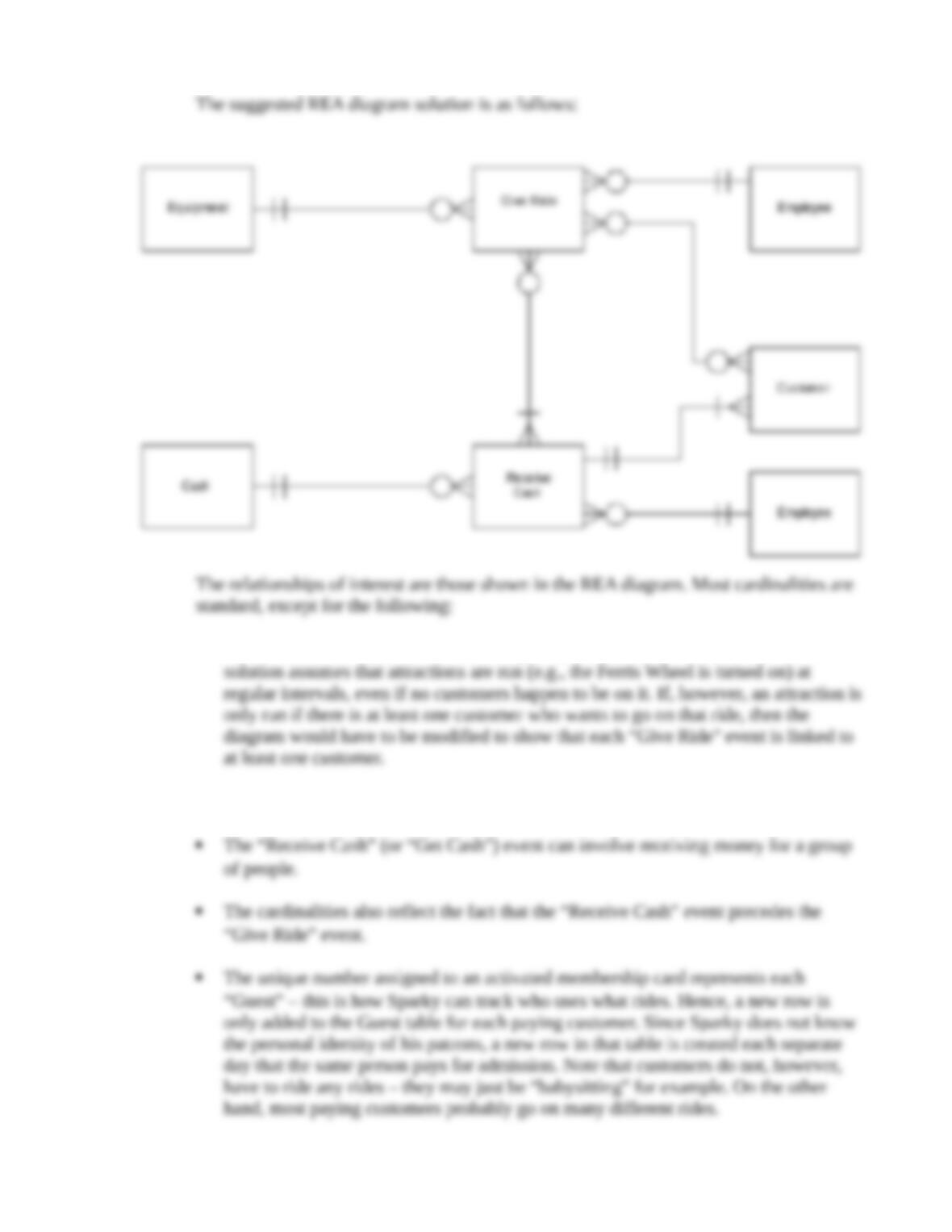
The “Give Ride” event involves running one particular piece of equipment. This
Many guests can ride the same piece of equipment at the same time.