Ch 13: The Expenditure Cycle
13.10 Last year the Diamond Manufacturing Company purchased over $10 million worth
of office equipment under its “special ordering” system, with individual orders
ranging from $5,000 to $30,000. Special orders are for low-volume items that have
been included in a department manager’s budget. The budget, which limits the
types and dollar amounts of office equipment a department head can requisition, is
approved at the beginning of the year by the board of directors. The special
ordering system functions as follows:
Purchasing A purchase requisition form is prepared and sent to the purchasing
department. Upon receiving a purchase requisition, one of the five purchasing
agents (buyers) verifies that the requester is indeed a department head. The buyer
next selects the appropriate supplier by searching the various catalogs on file. The
buyer then phones the supplier, requests a price quote, and places a verbal order. A
prenumbered purchase order is processed, with the original sent to the supplier and
copies to the department head, receiving, and accounts payable. One copy is also
filed in the open-requisition file. When the receiving department verbally informs
the buyer that the item has been received, the purchase order is transferred from
the open to the filled file. Once a month, the buyer reviews the unfilled file to follow
up on open orders.
Receiving The receiving department gets a copy of each purchase order. When
equipment is received, that copy of the purchase order is stamped with the date and,
if applicable, any differences between the quantity ordered and the quantity
received are noted in red ink. The receiving clerk then forwards the stamped
purchase order and equipment to the requisitioning department head and verbally
notifies the purchasing department that the goods were received.
Accounts Payable Upon receipt of a purchase order, the accounts payable clerk
files it in the open purchase order file. When a vendor invoice is received, it is
matched with the applicable purchase order, and a payable is created by debiting
the requisitioning department’s equipment account. Unpaid invoices are filed by
due date. On the due date, a check is prepared and forwarded to the treasurer for
signature. The invoice and purchase order are then filed by purchase order number
in the paid invoice file.
Treasurer Checks received daily from the accounts payable department are
sorted into two groups: those over and those under $10,000. Checks for less than
$10,000 are machine signed. The cashier maintains the check signature machine’s
key and signature plate and monitors its use. Both the cashier and the treasurer sign
all checks over $10,000.
a. Describe the weaknesses relating to purchases and payments of “special orders”
by the Diamond Manufacturing Company.
b. Recommend control procedures that must be added to overcome weaknesses
identified in part a.
c. Describe how the control procedures you recommended in part b should be
modified if Diamond reengineered its expenditure cycle activities to make
maximum use of current IT (e.g., EDI, EFT, bar-code scanning, and electronic
forms in place of paper documents).
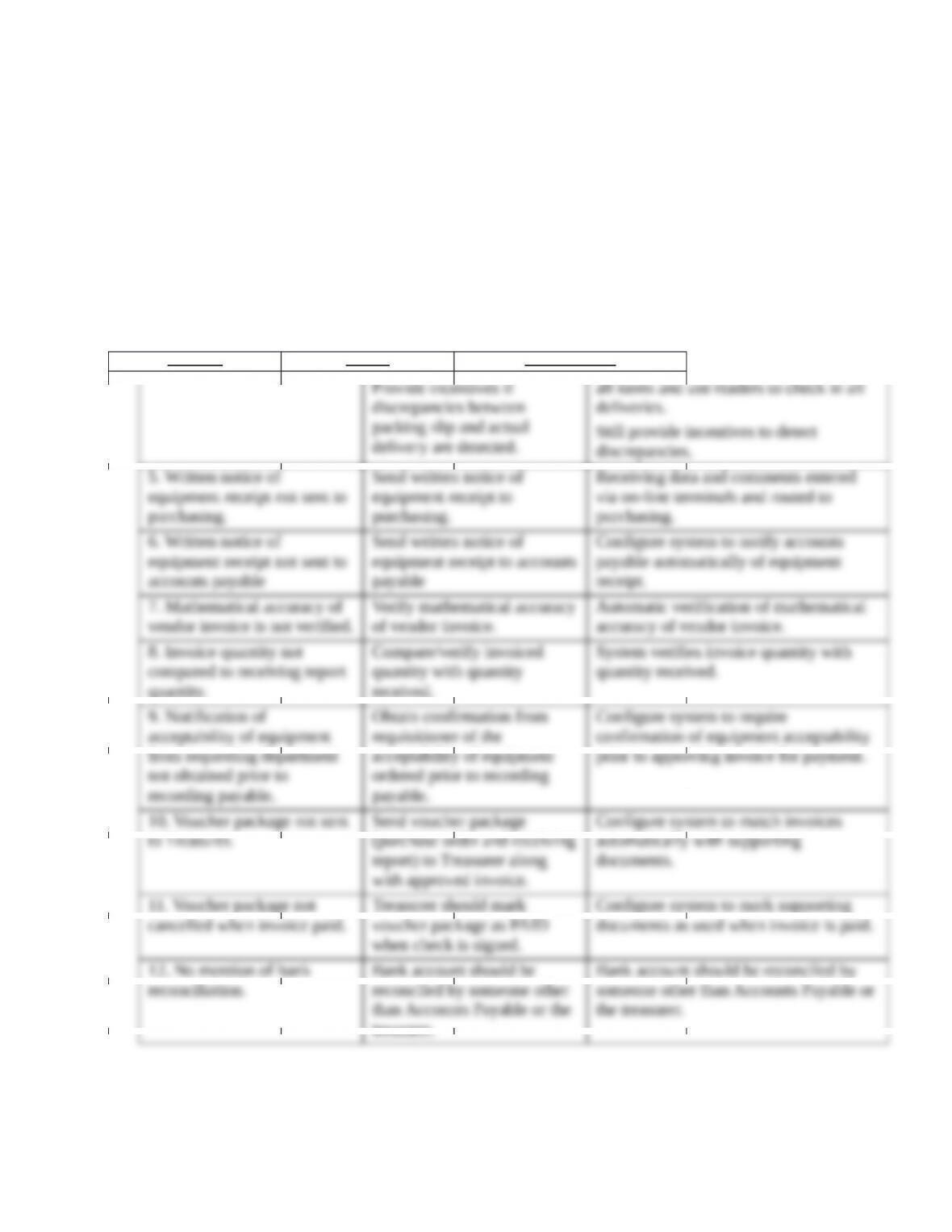
Weakness Control Effect of new IT
1. Buyer does not verify that
Compare requested amounts
System can automatically compare the
5. Written notice of
Send written notice of
Receiving data and comments entered
6. Written notice of
Send written notice of
Configure system to notify accounts
7. Mathematical accuracy of
Verify mathematical accuracy
Automatic verification of mathematical
8. Invoice quantity not
Compare/verify invoiced
System verifies invoice quantity with
9. Notification of
Obtain confirmation from
Configure system to require
10. Voucher package not sent
Send voucher package
Configure system to match invoices
11. Voucher package not
Treasurer should mark
Configure system to mark supporting
12. No mention of bank
Bank account should be
Bank account should be reconciled by
Ch 13: The Expenditure Cycle
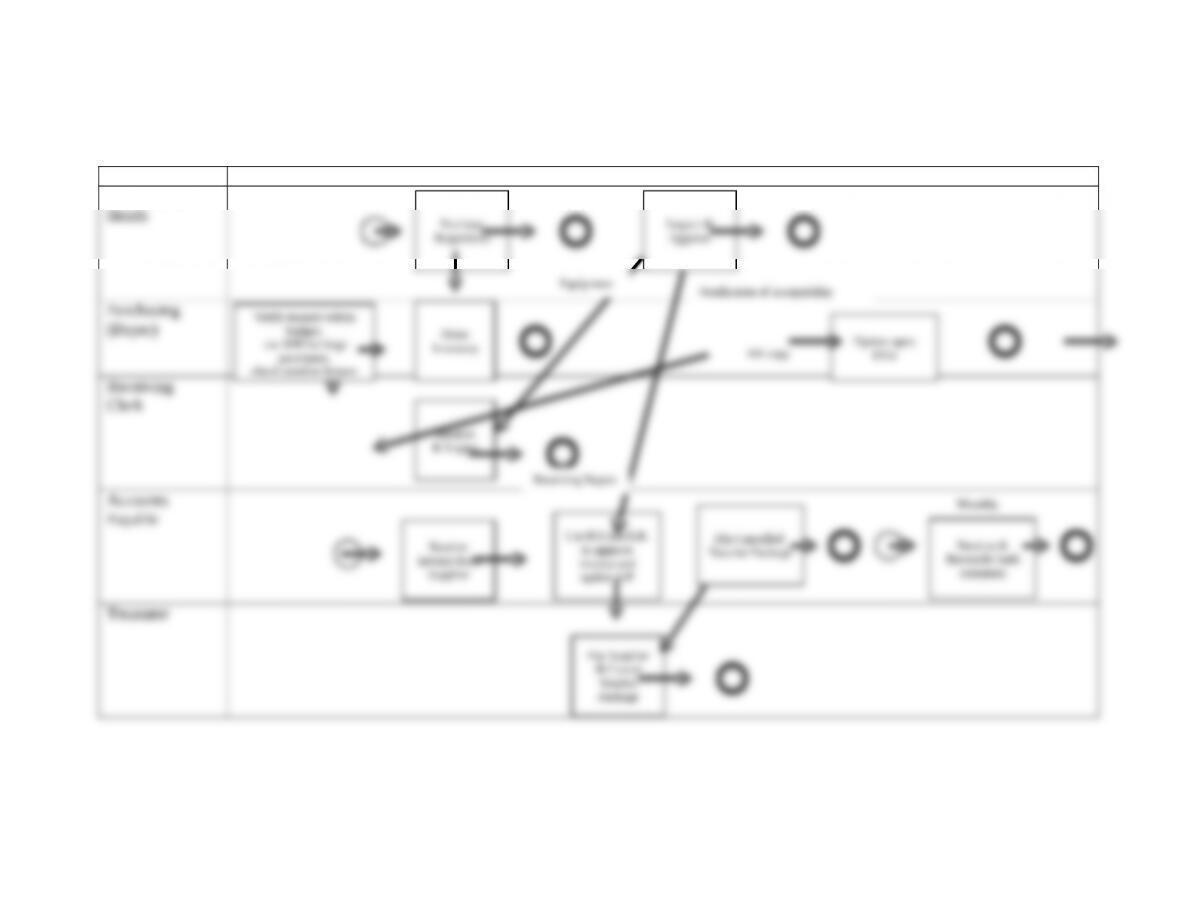
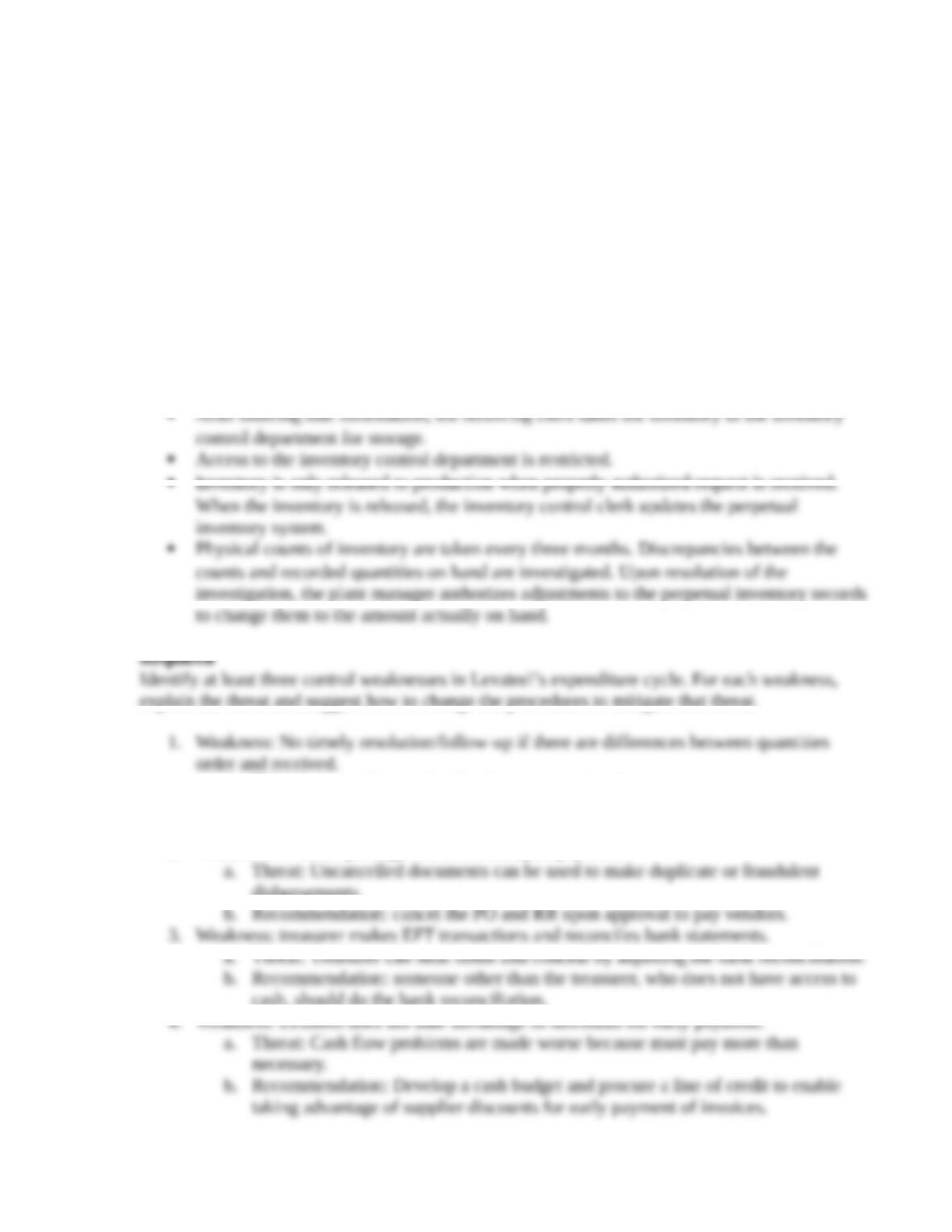
d. Draw a BPMN diagram that depicts Diamond’s reengineered expenditure cycle. (CPA Examination, adapted)
Solution will vary depending upon which weaknesses were corrected. This BPMN addresses all the weaknesses listed above.
Employee Activity Performed (sequential, left-to-right across all rows)
Department
Heads
Payable
Treasurer
Use P.O and R.R.
to approve
invoice and
update A/P
Receive
Invoice from
Supplier
Pay Supplier
& Cancel
Voucher
Package
Receive &
Reconcile bank
statement
File Cancelled
Voucher Package
Accounting Information Systems
13.11 The ABC Company performs its expenditure cycle activities using its integrated
ERP system as follows:
Employees in any department can enter purchase requests for items they note as being
The company maintains a perpetual inventory system.
Each day, employees in the purchasing department process all purchase requests from
Receiving department employees have read-only access to outstanding purchase
Receiving department employees compare the quantity delivered to the quantity
Inventory is stored in a locked room. During normal business hours an inventory
Occasionally, special items are ordered that are not regularly kept as part of inventory,
All supplier invoices (both regular and one-time) are routed to accounts payable for
Required:
a. Identify weaknesses in ABC’s existing expenditure cycle procedures, explain the
resulting problems, and suggest as solution.
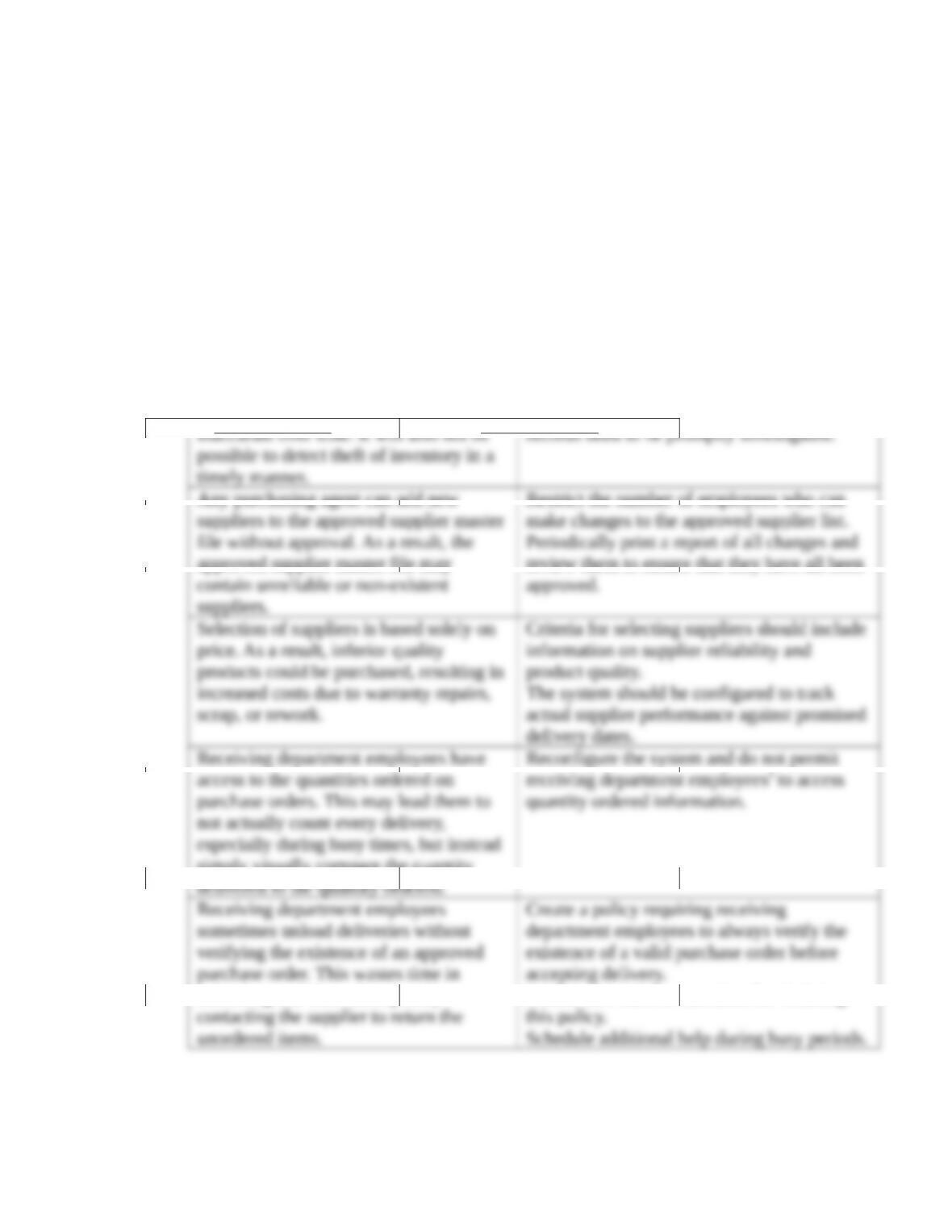
Weakness/Problem Applicable Control
A formal inventory control system (EOQ,
A formal inventory control system should be
There is no mention of periodic physical
Regular physical counts of inventory need to
Any purchasing agent can add new
suppliers to the approved supplier master
suppliers.
Restrict the number of employees who can
make changes to the approved supplier list.
Selection of suppliers is based solely on
Criteria for selecting suppliers should include
Receiving department employees have
access to the quantities ordered on
Reconfigure the system and do not permit
receiving department employees’ to access
Receiving department employees
sometimes unload deliveries without
Create a policy requiring receiving
department employees to always verify the
Receiving department employees inform
purchasing of discrepancies between
Configure the system to compare quantities
received to quantities ordered. The system
The identity of employees removing
The identity of employees removing
Accounts payable clerks can create
one-time supplier records without review
The system should be configured to print a
list of all one-time suppliers. Management
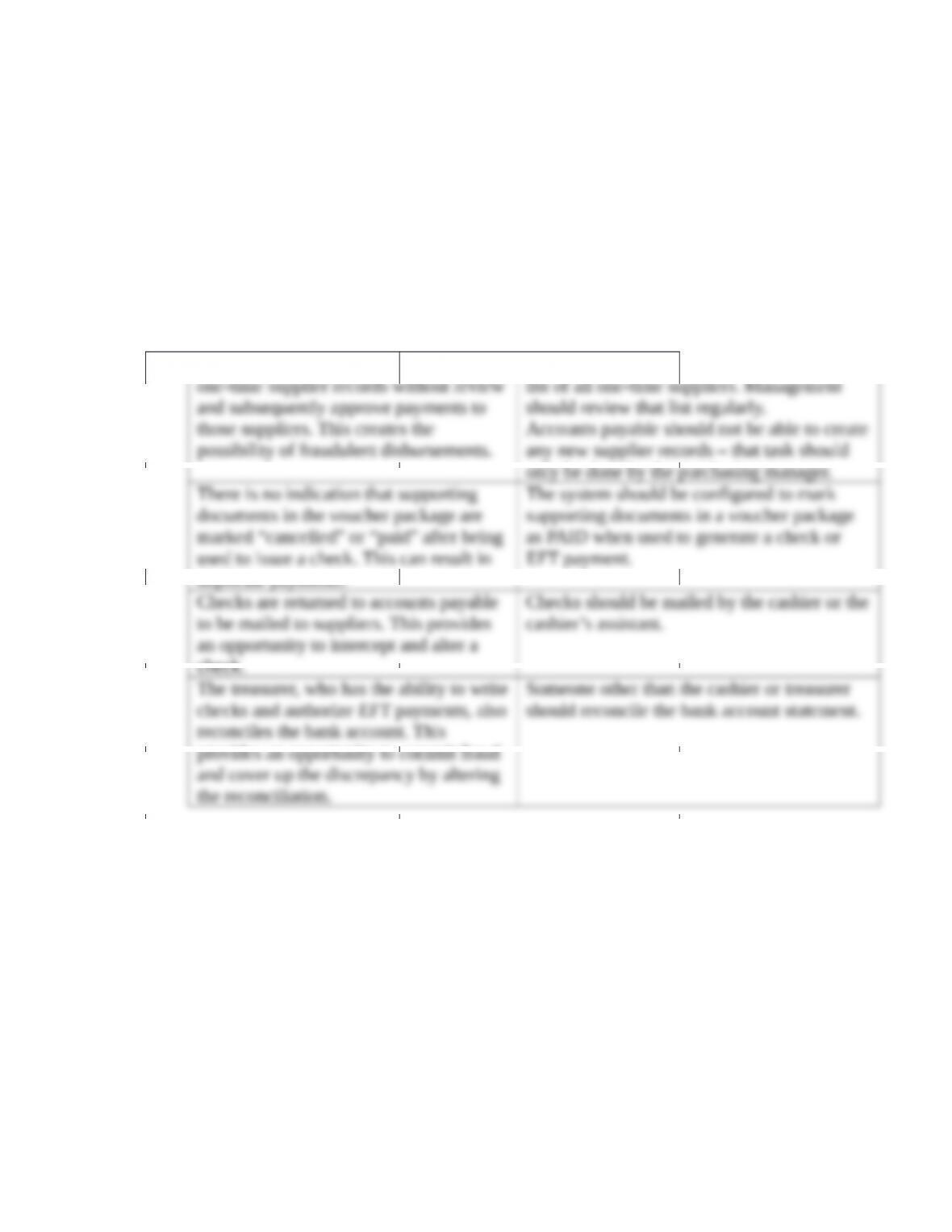
There is no indication that supporting
The system should be configured to mark
Checks are returned to accounts payable
Checks should be mailed by the cashier or the
The treasurer, who has the ability to write
Someone other than the cashier or treasurer
Ch. 13: The Expenditure Cycle: Purchasing and Cash Disbursements
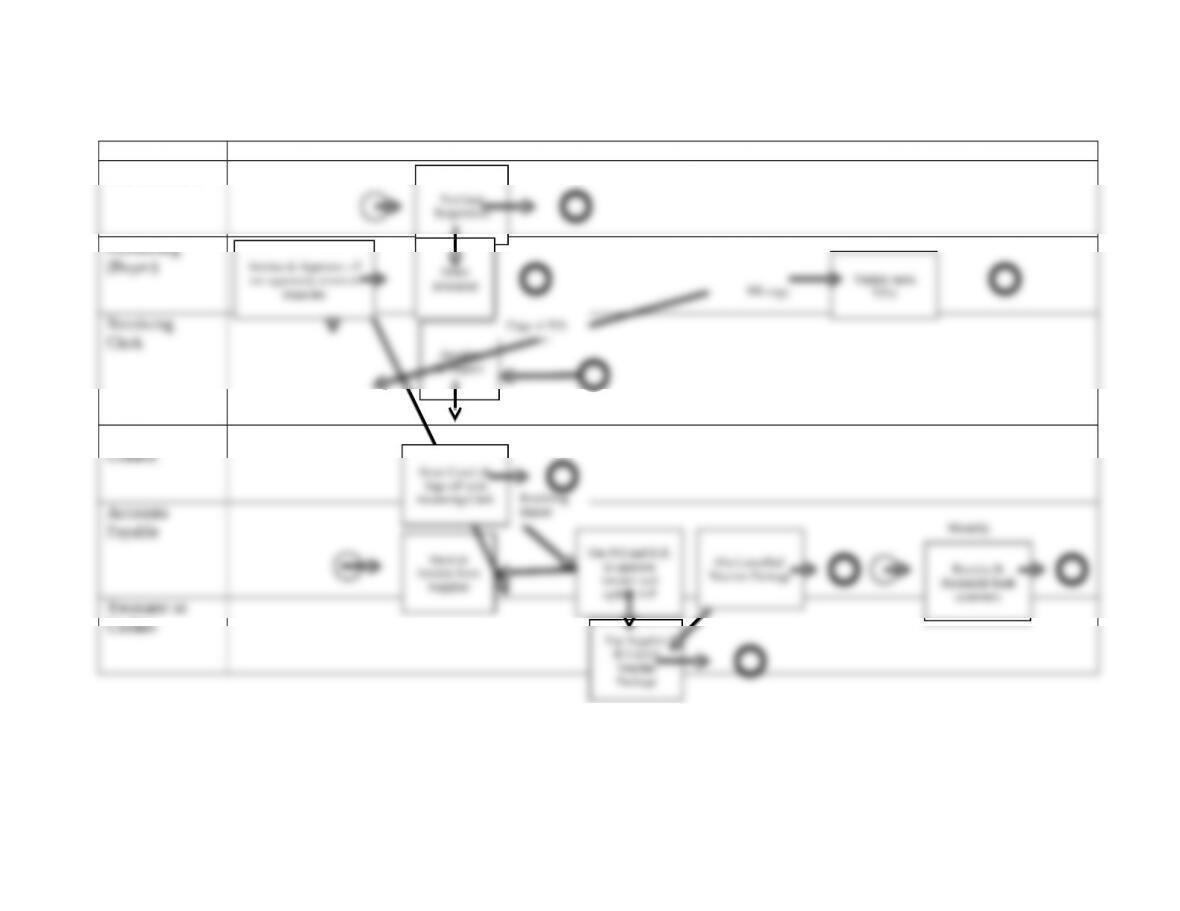
b. Draw a BPMN that reflects the ABC Company’s reengineered expenditure cycle processes.
Actual solution will depend upon which weaknesses were identified; this diagram addresses all the weaknesses.
Employee Activity Performed (sequential, left-to-right across all rows)
Any Employee
Receiving
Clerk
Inventory
Control
Treasurer or
Cashier
Receive
& Inspect
Use P.O and R.R.
to approve
invoice and
update A/P
Receive
Invoice from
Supplier
Pay Supplier
& Cancel
Voucher
Package
Receive &
Reconcile bank
statement
Copy of P.O.
File Cancelled
Voucher Package
Accounting Information Systems
13.12 Figure 13-11 depicts the basic activities performed in Lexsteel’s expenditure cycle.
The following additional information supplements that figure:
Because of cash flow problems, Lexsteel always pays suppliers on the last possible day
The purchasing manager reviews and approves all purchases prior to e-mailing them to
After counting and inspecting incoming deliveries, the receiving clerk enters the
After entering that information, the receiving clerk takes the inventory to the inventory
Access to the inventory control department is restricted.
Inventory is only released to production when properly authorized request is received.
Physical counts of inventory are taken every three months. Discrepancies between the
Required
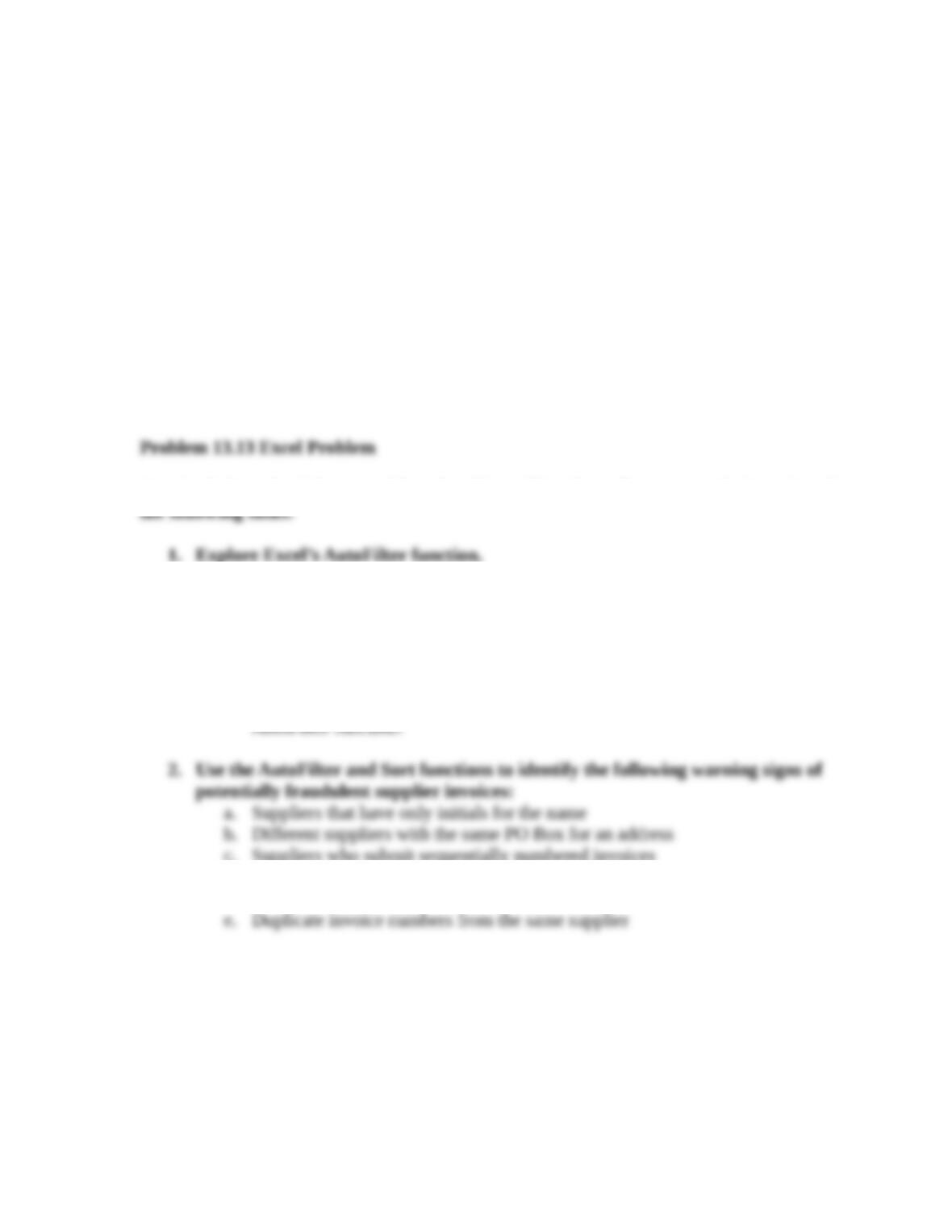
Identify at least three control weaknesses in Lexsteel’s expenditure cycle. For each weakness,
explain the threat and suggest how to change the procedures to mitigate that threat.
1. Weakness: No timely resolution/follow-up if there are differences between quantities
a. Threat: may end up paying for items not received.
b. Recommendation: timely reconciliation of receiving report against purchase order
2. Weakness: Voucher package not cancelled upon payment.
a. Threat: Uncancelled documents can be used to make duplicate or fraudulent
3. Weakness: treasurer makes EFT transactions and reconciles bank statements.
a. Threat: Treasurer can steal funds and conceal by adjusting the bank reconciliation.
4. Weakness: Lexsteel does not take advantage of discounts for early payment.
5. Weakness: Receiving clerk has custody of inventory and updates records
6. Weakness: Copy of RR sent to A/P is not signed by inventory control.
a. Threat: theft of inventory with no way to determine accountability.
7. Weakness: no indication that receiving verifies that all incoming deliveries are
authorized.
a. Threat: time and cost of receiving and then returning unordered merchandise.
Problem 13.13 Excel Problem
Required: Download the spreadsheet for this problem from the course website and perform
the following tasks:
1. Explore Excel’s AutoFilter function.
a. At the bottom of the table, in cell C79 enter the words “Total (sum)” and in cell
b. At the bottom of the table, in cell C80 enter the words “Total (subtotal)” and in
c. Use AutoFilter to display all purchases from suppliers in Zipcode 85110. What is
2. Use the AutoFilter and Sort functions to identify the following warning signs of
potentially fraudulent supplier invoices:
a. Suppliers that have only initials for the name
Solution steps for Problem 13.13
1. Requirement 1 – autofilter and subtotal versus sum.
a. Sum totals all rows, whether or not visible. Subtotal only sums visible rows, so
2. Requirement 2 – fraud investigation
a. Sort by supplier names in alpha order will show many variants on DFR
13.14 Answer the following multiple-choice questions:
1. The control procedure of comparing a voucher package to vendor invoices is designed to
reduce the risk of
a. Failure to take advantage of discounts for prompt payment
b. Mistakes in posting to accounts payable
c. Paying for items not received
d. Theft of inventory
e. Making duplicate payments
2. Which of the following statements are true?
a. Issuing employees procurement cards is an example of the control procedure referred to
as “general authorization”
b. Organizations can reduce the risk of fraudulent disbursements by sending their bank a list
of all checks issued, a process referred to as “Positive Pay”
c. Both of the statements above are true
d. None of the statements above are true
3. The control procedure of prohibiting employees from accepting gifts is designed to
reduce the risk of
a. Theft of inventory
b. Kickbacks
c. Fraudulent cash disbursements
d. Stockouts
e. None of the above
4. The control procedure of cancelling the documents in a voucher package is designed to
reduce the risk of
a. Making duplicate payments
b. Paying for items not received
c. Fraudulent cash disbursements
d. Failure to take advantage of discounts for prompt payment
e. Theft of inventory
5. Which of the following control procedures is designed to reduce the risk of check
alteration fraud?
a. ACH blocks on accounts not used for payments
b. Use of dedicated computer and browser for online banking
c. Establishing “Positive Pay” arrangements with banks
d. Access controls for EFT terminals
e. Prenumbering all checks
6. Which of the following control procedures is designed to reduce the risk of theft of
inventory?
a. Restriction of physical access to inventory
b. Periodic physical counts of inventory and reconciliation to recorded quantities on
hand
c. Documentation of all transfers of inventory between employees
d. All of the above
e. None of the above
7. Which of the following control procedures is designed to reduce the risk of ordering
unneeded inventory?
a. Tracking and monitoring product quality by supplier
b. Purchasing only from approved suppliers
c. Holding purchasing managers responsible for rework and scrap costs
d. All of the above
e. None of the above
8. Which of the following documents is no longer needed if a company uses the evaluated
receipts system (ERS) with its suppliers?
a. Purchase Order
b. Receiving Report
c. Supplier Invoice
d. Debit Memo
e. None of the above

9. Kickbacks are a problem because they increase the risk of
a. Purchasing inventory that is not needed
b. Purchasing inferior quality items
c. Purchasing at inflated prices
d. All of the above
e. None of the above
10. Which threat is most likely to result in the largest losses in a short period of time?
a. Alteration of checks or EFT payments
b. Theft of inventory
c. Duplicate payments to suppliers
d. All of the above
e. None of the above
SUGGESTED ANSWERS TO THE CASES
CASE 13-1 RESEARCH PROJECT: IMPACT OF IT ON EXPENDITURE
CYCLE ACTIVITIES, THREATS, AND CONTROLS
Search popular business and technology magazines (Business Week, Forbes,
Fortune, CIO, etc.) to find an article about an innovative use of IT that can be used
to improve one or more activities in the expenditure cycle. Write a report that:
a. Explains how IT can be used to change expenditure cycle activities
Solutions will vary depending upon articles read.
b. Discusses the control implications. Refer to Table 13-2 and explain how the new
procedure changes the threats and appropriate control procedures for mitigating
those threats.
Be sure that the report adequately addresses the relevant issues from Table 13-2.