Current spot rate ($/€) $1.4158
Credit Suisse 90-day forward rate ($/€) $1.4172
Barclays 90-day forward rate ($/€) $1.4195
Mattel Toys WACC ($) 9.600%
90-day eurodollar interest rate 4.000%
90-day euro interest rate 3.885%
90-day eurodollar borrowing rate 5.000%
90-day euro borrowing rate 5.000%
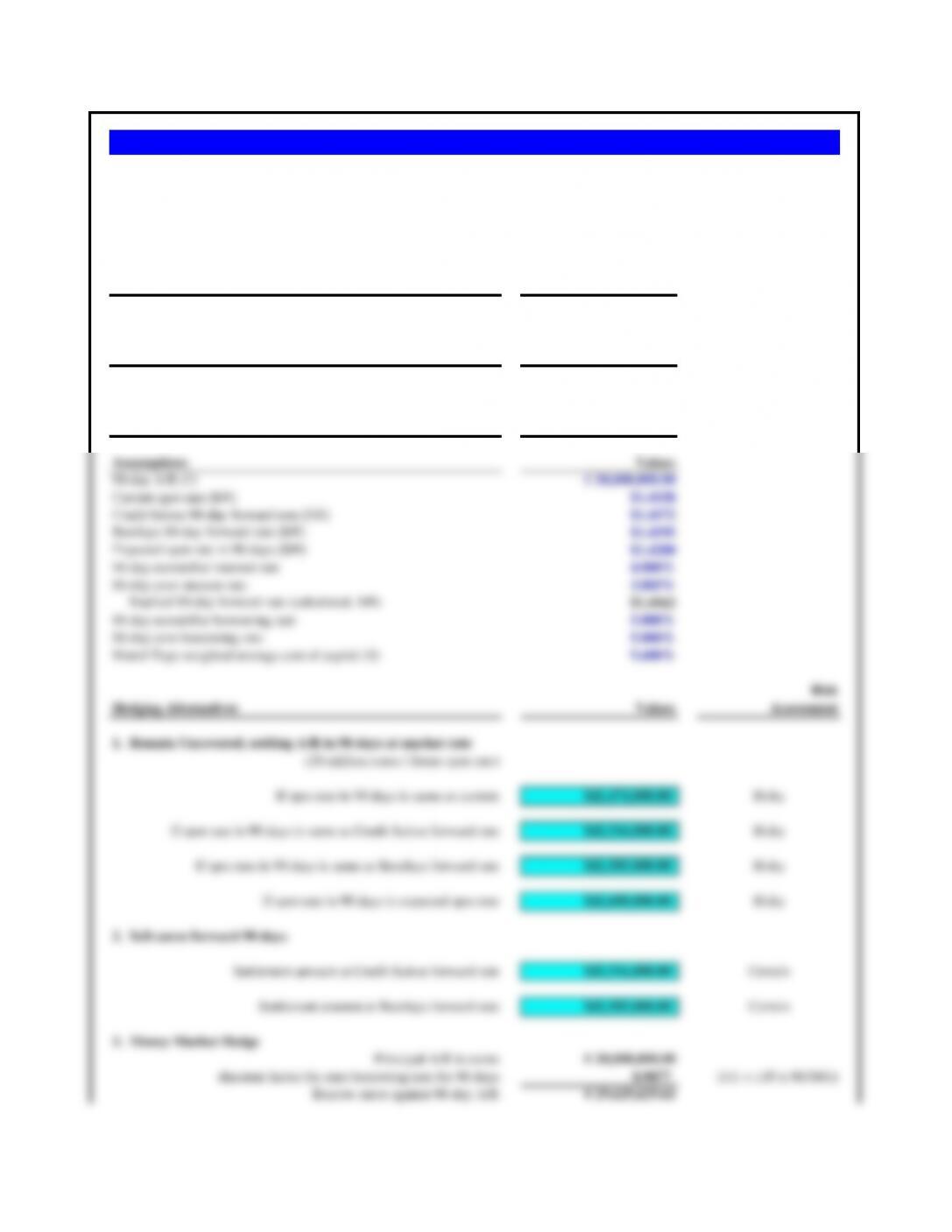
Assumptions Values
90-day A/R (€) € 30,000,000.00
Current spot rate ($/€) $1.4158
Credit Suisse 90-day forward rate ($/€) $1.4172
Barclays 90-day forward rate ($/€) $1.4195
Expected spot rate in 90 days ($/€)$1.4200
90-day eurodollar interest rate 4.000%
90-day euro interest rate 3.885%
Implied 90-day forward rate (calculated, $/€)$1.4162
90-day eurodollar borrowing rate 5.000%
90-day euro borrowing rate 5.000%
Mattel Toys weighted average cost of capital ($) 9.600%
Risk
Hedging Alternatives Values Assessment
1. Remain Uncovered, settling A/R in 90 days at market rate
(20 million euros / future spot rate)
If spot rate in 90 days is same as current $42,474,000.00 Risky
If spot rate in 90 days is same as Credit Suisse forward rate $42,516,000.00 Risky
If spot rate in 90 days is same as Barclays forward rate $42,585,000.00 Risky
If spot rate in 90 days is expected spot rate $42,600,000.00 Risky
2. Sell euros forward 90 days
Settlement amount at Credit Suisse forward rate $42,516,000.00 Certain
Settlement amount at Barclays forward rate $42,585,000.00 Certain
3. Money Market Hedge
Principal A/R in euros € 30,000,000.00
discount factor for euro borrowing rate for 90 days 0.9877 1/(1 + (.05 x 90/360))
Borrow euros against 90-day A/R € 29,629,629.63
Problem 10.10 Mattel Toys
Mattel is a U.S.-based company whose sales are roughly two-thirds in dollars (Asia and the Americas) and one-third in euros
(Europe). In September Mattel delivers a large shipment of toys (primarily Barbies and Hot Wheels) to a major distributor in
Antwerp. The receivable, €30 million, is due in 90 days, whish is standard terms for the toy industry in Europe. Mattel’s treasury
team has collected the following currency and market quotes. The company’s foreign exchange advisors believe the euro will be at
about $1.4200/€ in 90 days. Mattel’s management does not use currency options in currency risk management activities. Advise
Mattel on which hedging alternative is probably preferable.
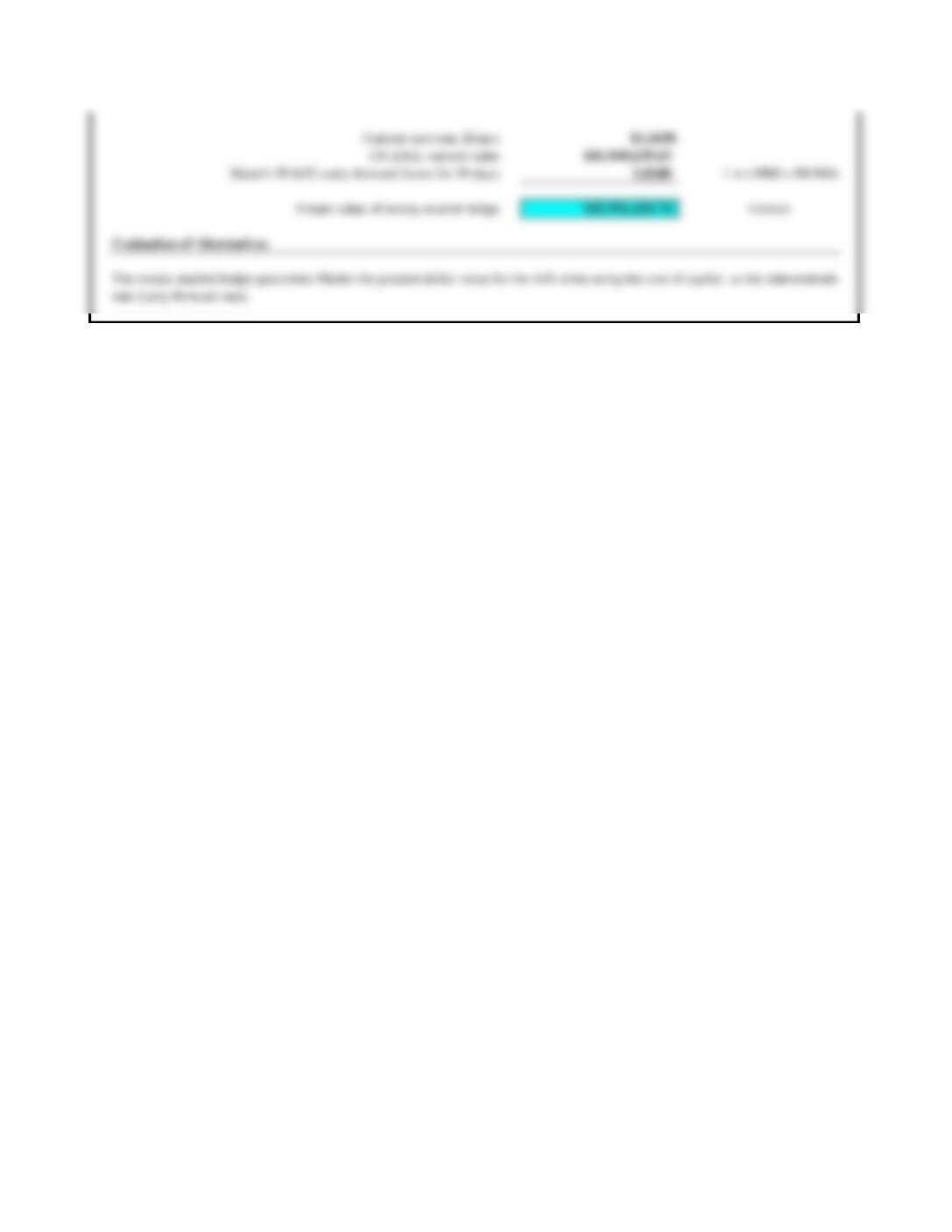
Current spot rate, $/euro $1.4158
US dollar current value $41,949,629.63
Mattel’s WACC carry-forward factor for 90 days 1.0240 1 + (.0960 x 90/360)
Future value of money market hedge $42,956,420.74 Certain
Evaluation of Alternatives
The money market hedge guarantees Mattel the greatest dollar value for the A/R when using the cost of capital as the reinvestment
rate (carry-forward rate).
b. What does it mean to hedge 120% of a transaction exposure?
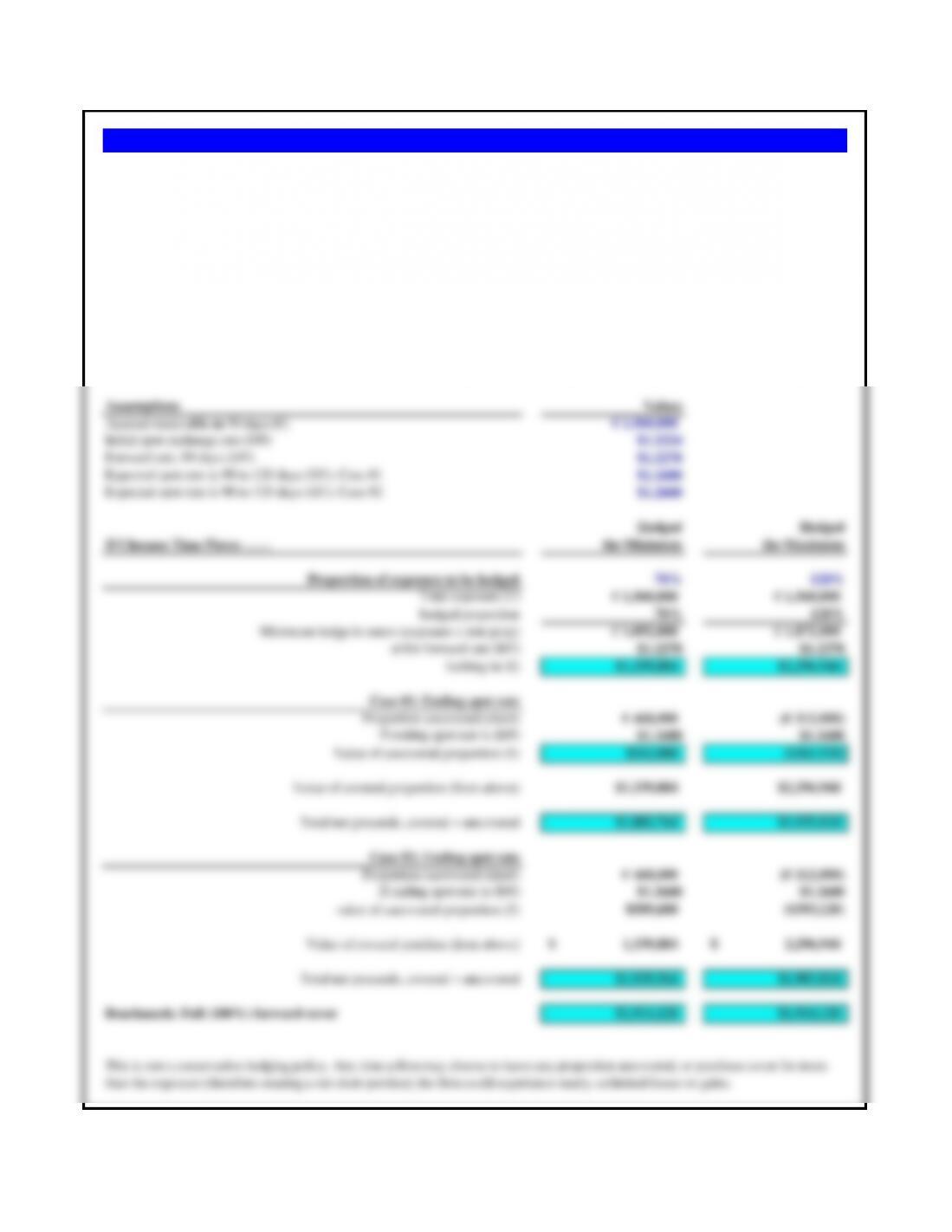
Assumptions Values
Account recievable in 90 days (€) € 1,560,000
Initial spot exchange rate ($/€)$1.2224
Forward rate, 90 days ($/€)$1.2270
Expected spot rate in 90 to 120 days ($/€): Case #1 $1.1600
Expected spot rate in 90 to 120 days ($/€): Case #2 $1.2600
Hedged Hedged
If Chronos Time Pieces …… the Minimum the Maximum
Proportion of exposure to be hedged 70% 120%
Total exposure (€)€ 1,560,000 € 1,560,000
hedged proportion 70% 120%
Minimum hedge in euros (exposure x min prop) € 1,092,000 € 1,872,000
at the forward rate ($/€)$1.2270 $1.2270
locking in ($) $1,339,884 $2,296,944
Case #1: Ending spot rate
Proportion uncovered (short) € 468,000 (€ 312,000)
If ending spot rate is ($/€)$1.1600 $1.1600
Value of uncovered proportion ($) $542,880 ($361,920)
Value of covered proportion (from above) $1,339,884 $2,296,944
Total net proceeds, covered + uncovered $1,882,764 $1,935,024
Case #2: Ending spot rate
Proportion uncovered (short) € 468,000 (€ 312,000)
If ending spot rate is ($/€)$1.2600 $1.2600
value of uncovered proportion ($) $589,680 ($393,120)
Value of covered position (from above) 1,339,884$ 2,296,944$
Total net proceeds, covered + uncovered $1,929,564 $1,903,824
Benchmark: Full (100%) forward cover $1,914,120 $1,914,120
Problem 10.11 Chronos Time Pieces
This is not a conservative hedging policy. Any time a firm may choose to leave any proportion uncovered, or purchase cover for more
than the exposure (therefore creating a net short position) the firm could experience nearly unlimited losses or gains.
Chronos Time Pieces of Boston exports watches to many countries, selling in local currencies to stores and distributors. Chronos prides
itself on being financially conservative. At least 70% of each individual transaction exposure is hedged, mostly in the forward market,
but occasionally with options. Chronos’s foreign exchange policy is such that the 70% hedge may be increased up to a 120% hedge if
devaluation or depreciation appears imminent. Chronos has just shipped to its major North American distributor. It has issued a 90-day
invoice to its buyer for €1,560,000. The current spot rate is $1.2224/€, the 90-day forward rate is $1.2270/€. Chronos’s treasurer,
Manny Hernandez, has a very good track record in predicting exchange rate movements. He currently believes the euro will weaken
against the dollar in the coming 90 to 120 days, possibly to around $1.16/€.
a. Evaluate the hedging alternatives for Chronos if Manny is right (Case 1: $1.16/€) and if Manny is wrong (Case 2: $1.26/€). What do
you recommend?
c. What would be considered the most conservative transaction exposure management policy by a firm? How does Chronos compare?
Construction payment due in six-months (A/P, quetzals) 8,400,000
Present spot rate (quetzals/$) 7.0000
Six-month forward rate (quetzals/$) 7.1000
Guatemalan six-month interest rate (per annum) 14.000%
U.S. dollar six-month interest rate (per annum) 6.000%
Farah’s weighted average cost of capital (WACC) 20.000%
Expected spot rate in six-months (quetzals/$):
Highest expected rate (reflecting a significant devaluation) 8.0000
Expected rate 7.3000
Lowest expected rate (reflecting a strengthening of the quetzal) 6.4000
What realistic alternatives are available to Farah for making payments? Which method would you select and why?
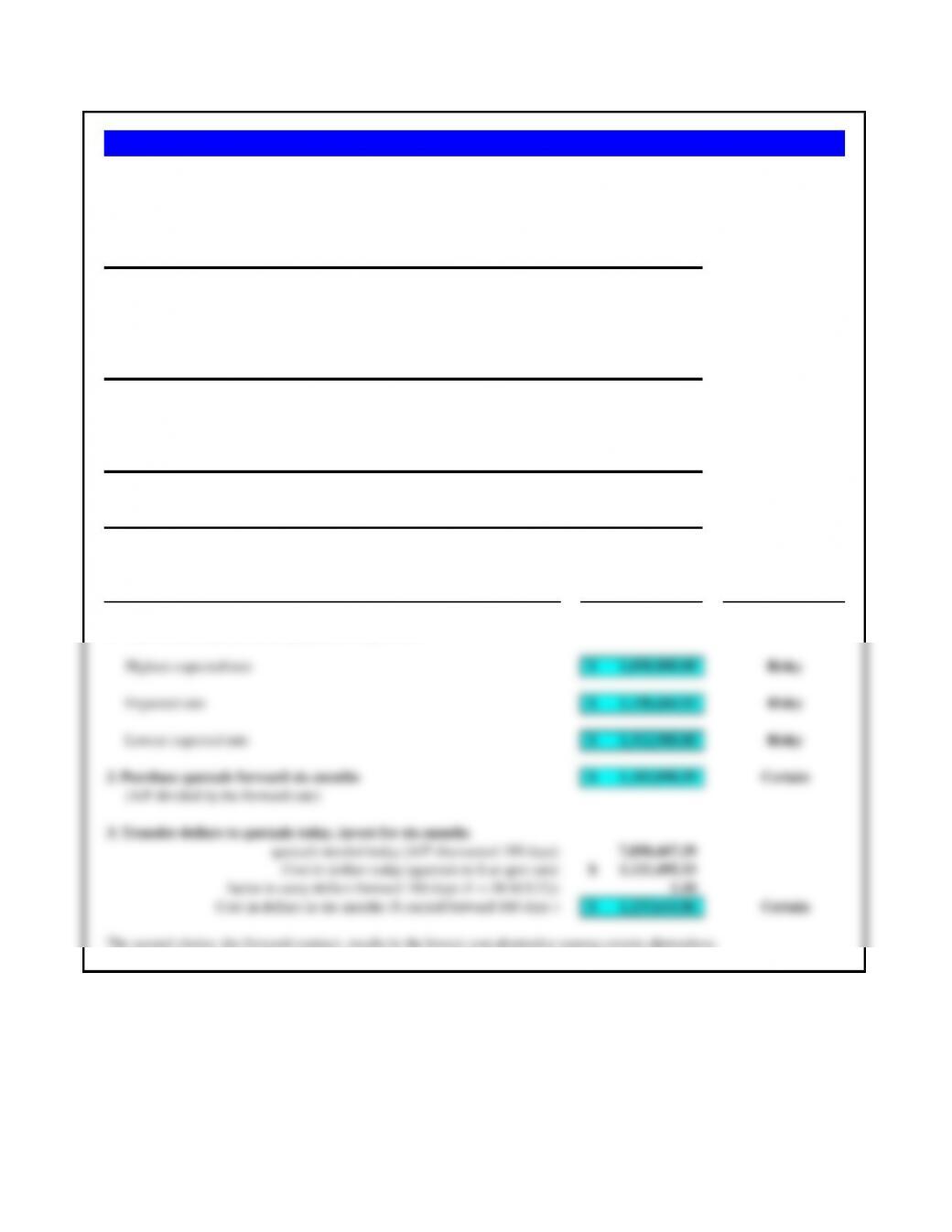
What realistic alternatives are available to Farah Jeans? Cost Certainty
1. Wait six months and make payment at spot rate
Highest expected rate 1,050,000.00$ Risky
Expected rate 1,150,684.93$ Risky
Lowest expected rate 1,312,500.00$ Risky
2. Purchase quetzals forward six-months 1,183,098.59$ Certain
(A/P divided by the forward rate)
3. Transfer dollars to quetzals today, invest for six-months
quetzals needed today (A/P discounted 180 days) 7,850,467.29
Cost in dollars today (quetzals to $ at spot rate) 1,121,495.33$
factor to carry dollars forward 180 days (1 + (WACC/2)) 1.10
Cost in dollars in six-months ($ carried forward 180 days ) 1,233,644.86$ Certain
The second choice, the forward contract, results in the lowest cost alternative among certain alternatives.
Problem 10.12 Farah Jeans
Farah’s treasury manager, concerned about the Guatemalan economy, wonders if Farah should be hedging its foreign
exchange risk. The manager’s own forecast is as follows:
Farah Jeans of San Antonio, Texas, is completing a new assembly plant near Guatemala City. A final construction payment of
Q8,400,000 is due in six months. (“Q” is the symbol for Guatemalan quetzals.) Farah Jeans uses 20% per annum as its
weighted average cost of capital. Today’s foreign exchange and interest rate quotations are:
a. What will be the amount of foreign exchange gain (loss) upon settlement?
b. If Jason hedges the exposure with a forward contract, what will be the net foreign exchange gain (loss) on settlement?
Spot Rate Forward Rate Days Forward
Date Event ($/£) ($/£) of Forward Rate
February 1 Price quotation for Pegg
1.7850 1.7771 210
March 1 Contract signed for sale
1.7465 1.7381 180
Contract amount, pounds £1,000,000
June 1 Product shipped to Pegg
1.7689 1.7602 90
August 1 Product received by Pegg
1.7840 1.7811 30
September 1 Pegg makes payment
1.7290 ——— ———
Analysis
a. The sale is booked at the exchange rate existing on June 1, when the product is shipped to Pegg Metropolitan, and the shipment
is categorized as an account receivable. This sale is then compared to that value in effect on the date of cash settlement,
the difference being the foreign exchange gain (loss).
Value as settled 1 million pounds @ $1.7290/pound
$1,729,000
Value as booked 1 million pounds @ $1.7689/pound
$1,768,900
FX gain (loss)
($39,900)
b. The value of the foreign exchange gain (loss) will depend upon when Jason actually purchases the forward contract. Because
many firms do not define an “exposure” as arising until the date that the product is shipped (loss of physical control over
the goods) and the sale is booked on the income statement, that is a common date for the purchase of the forward contract.
Forward contract purchased on June 1
Value of forward settlement 1 million pounds @ $1.7602/pound
$1,760,200
Value as booked 1 million pounds @ $1.7689/pound
$1,768,900
FX gain (loss)
($8,700)
A more aggressive alternative is for Jason to purchase the forward contract on the date that the contract was signed, March 1, locking–
in Burton’s U.S. dollar settlement amount a full 90 days earlier in the transaction exposure’s life span.
Forward contract purchased on March 1
Value of forward settlement 1 million pounds @ $1.7381/pound
$1,738,100
Value as booked 1 million pounds @ $1.7689/pound
$1,768,900
FX gain (loss)
($30,800)
Note that in this case if Jason had covered forward on March 1st rather than June 1st, the amount of the foreign exchange loss would
have been even greater, although “fully hedged.” The difference is of course the result of the forward rate changing with spot rates
and interest differentials.
Problem 10.13 Burton Manufacturing
Jason Stedman is the director of finance for Burton Manufacturing, a U.S.-based manufacturer of hand-held computer systems for inventory
management. Burton’s system combines a low-cost active tag that is attached to inventory items (the tag emits a low-grade radio frequency)
with custom-designed hardware and software that tracks the low-grade emissions for inventory control. Burton has completed the sale of a
inventory management system to a British firm, Pegg Metropolitan (UK), for a total payment of £1,000,000. The exchange rates shown were
available to Burton on the following dates corresponding to the events of this specific export sale. Assume each month is 30 days.
Assumptions Values
Shipment of phosphates from Morocco, Moroccan dirhams 6,000,000
Micca’s cost of capital (WACC) 14.000%
Spot exchange rate, dirhams/$ 10.00
Six-month forward rate, dirhams/$ 10.40
Options on Moroccan dirhams: Call Option Put Option
Strike price, dirhams/$ 10.00 10.00
Option premium (percent) 2.000% 3.000%
United States Morocco
Six-month interest rate for borrowing (per annum) 6.000% 8.000%
Six-month interest rate for investing (per annum) 5.000% 7.000%
Risk Management Alternatives Values Certainty
1. Remain uncovered, making the dirham payment in six months
at the spot rate in effect at that date
Account payable (dirhams) 6,000,000
Possible spot rate in six months — the current spot rate (dirhams/$) 10.00
Cost of settlement in six months (US$) 600,000.00$ Uncertain.
Account payable (dirhams) 6,000,000
Possible spot rate in six months — forward rate (dirhams/$) 10.40
Cost of settlement in six months (US$) 576,923.08$ Uncertain.
2. Forward market hedge. Buy dirhams forward six months.
Account payable (dirhams) 6,000,000
Six month forward rate, dirhams/$ 10.40
Cost of settlement in six months (US$) 576,923.08$ Certain.
3. Money market hedge. Exchange dollars for dirhams now, invest for six months.
Account payable (dirhams) 6,000,000.00
Discount factor at the dirham investing rate for 6 months 1.035
Dirhams needed now for investing (payable/discount factor) 5,797,101.45
Current spot rate (dirhams/$) 10.00
US dollars needed now 579,710.14$
Carry forward rate for six months (WACC) 1.070
US dollar cost, in six months, of settlement 620,289.86$ Certain.
4. Call option hedge. (Need to buy dirhams = call on dirhams)
Problem 10.14 Micca Metals, Inc.
Six-month call options on 6,000,000 dirhams at an exercise price of 10.00 dirhams per dollar are available from Bank Al-
Maghrub at a premium of 2%. Six-month put options on 6,000,000 dirhams at an exercise price of 10.00 dirhams per dollar are
available at a premium of 3%. Compare and contrast alternative ways that Micca might hedge its foreign exchange transaction
exposure. What is your recommendation?
Micca Metals, Inc. is a specialty materials and metals company located in Detroit, Michigan. The company specializes in
specific precious metals and materials which are used in a variety of pigment applications in many industries including
cosmetics, appliances, and a variety of high tinsel metal fabricating equipment. Micca just purchased a shipment of phosphates
from Morocco for 6,000,000, dirhams, payable in six months.
Option principal 6,000,000.00
Current spot rate, dirhams/$ 10.00
Premium cost of option 2.000%
Option premium (principal/spot rate x % pm) 12,000.00$
If option exercised, dollar cost at strike price of 10.00 dirhams/$ 600,000.00$
Plus premium carried forward six months (pm x 1.07, WACC) 12,840.000
Total net cost of call option hedge if exercised 612,840.00$ Maximum.
The lowest cost certain alternative is the forward. If Micca were to expect the dirham to depreciate significantly over the next six
months, it may choose the call option.
Assumptions Value
90-day A/R in pounds £3,000,000.00
Spot rate, US$ per pound ($/£)$1.7620
90-day forward rate, US$ per pound ($/£)$1.7550
3-month U.S. dollar investment rate 6.000%
3-month U.S. dollar borrowing rate 8.000%
3-month UK investment interest rate 8.000%
3-month UK borrowing interest rate 14.000%
Put options on the British pound: Strike rates, US$/pound ($/£)
Strike rate ($/£) $1.75
Put option premium 1.500%
Strike rate ($/£) $1.71
Put option premium 1.000%
Ganado’s WACC 12.000%
Maria Gonzalez’s expected spot rate in 90-days, US$ per pound ($/£)$1.7850
Alternative #1: Remain Uncovered Rate ($/pound) Proceeds
Value of A/R will be (3 million pounds x ending spot rate ($/pound))
If spot rate is the same as current spot rate $1.7620 $5,286,000.00
If ending spot rate is the same as current forward rate $1.7550 $5,265,000.00
If ending spot rate is the expected spot rate $1.7850 $5,355,000.00
Alternative #2: Forward Contract Hedge Rate ($/pound) Proceeds
Sell the pounds forward 3-months locking in the forward rate
Pound A/R at the forward rate (pounds x forward) $1.7550 $5,265,000.00
Alternative #3: Money Market Hedge Rate ($/pound) Proceeds
Borrows against the A/R, receiving £ up-front, exchanging into US$.
Amount of A/R in 90-days, in pounds £3,000,000.00
Discount factor, pound borrowing rate, for 3-months 0.9662
Proceeds of borrowing, up-front, in pounds £2,898,550.72
Exchanged to US$ at current spot rate of $1.7620
US$ received against A/R, up-front $5,107,246.38
US$ need to be carried forward for comparison:
Carry-forward rate, WACC for 90-days 1.0300
Money Market Hedge, US$, at end of 90-days $5,260,463.77
Strike Rate ($/pnd) Strike Rate ($/pnd)
Alternative #4: Put Option Hedges 1.75 1.71
Option premium 1.500% 1.000%
Notional principal of option (pounds) £3,000,000.00 £3,000,000.00
Spot rate ($/pound) $1.7620 $1.7620
Option premium, US$ $79,290.00 $52,860.00
Carry-forward factor, WACC, for 90-days 1.0300 1.0300
Total premium cost, in 90-days $81,668.70 $54,445.80
Proceeds from put option if exercised $5,250,000.00 $5,130,000.00
Less cost of premium, including time-value (81,668.70) (54,445.80)
Ganado — the same U.S.-based company as discussed in this chapter, has concluded another large sale of telecommunications
equipment to Regency (U.K.). Total payment of £3,000,000 is due in 90 days. Maria Gonzalez has also learned that Ganado will only
be able to borrow in the United Kingdom at 14% per annum (due to credit concerns of the British banks). Given the following
exchange rates and interest rates, what transaction exposure hedge is now in Ganado’s best interest?
Problem 10.15 Maria Gonzalez and Ganado
Net proceeds from put options, in 90-days: Minimum $5,168,331.30 $5,075,554.20
Ending spot rate needed to be superior to forward: $1.7825 $1.7732
Proceeds from exchanging pounds for US$ spot $5,347,500.00 $5,319,600.00
Less cost of option (allowed to expire OTM) (81,668.70) (54,445.80)
Net proceeds from put option, unexercised $5,265,831.30 $5,265,154.20
Analysis: Maria Gonzalez would receive the most certain US$ from the forward contract, $5,265,000; the money market hedge is
less attractive as result of the higher borrowing costs in the UK now. The two put options yield unattractive amounts if they had to be
exercised. As shown, the $1.75 strike price put option would be superior to the forward if the ending spot rate was $1.7825 or higher;
the $1.71 strike price would be superior to the forward if the ending spot rate were $1.7732 or higher.
2. Hedge in the money market. Larkin could borrow euros from the Frankfurt branch of its U.S. bank at 8.00% per annum.
Assumptions Values Today is May 1
90-day Forward rate, $/€$1.1060 Exchange Rate
180-day Forward rate, $/€$1.1130 Date ($/€)
US Treasury bill rate 3.600% April 1 $1.0800
Larkin’s borrowing rate, euros, per annum 8.000% May 1 $1.1000
Larkin’s cost of equity 12.000%
Options on euros Strike ($/euro) Call Option Put Option
August maturity options $1.1000 3.0% 2.0%
November maturity options $1.1000 2.6% 1.2%
Valuation of Alternative Hedges August Receivable November Receivable
Amount of receivable, in euros € 2,000,000 € 2,000,000
a. Hedge in the forward market
Amount of receivable, in euros € 2,000,000 € 2,000,000
Respective forward rates ($/€)$1.1060 $1.1130
US dollar proceeds as hedged ($) $2,212,000 $2,226,000
Carry forward to Nov 1st at WACC 1.03 —–
Total US$ proceeds on Nov 1st $2,278,360 $2,226,000
Total of both payments
b. Hedge in the money market
Amount of receivable, in euros € 2,000,000 € 2,000,000
Discount factor for euro funds, period 1.02 1.04
Current proceeds from discounting, euros € 1,960,784 € 1,923,077
Current spot rate ($/€)$1.1000 $1.1000
Current US dollar proceeds $2,156,863 $2,115,385
Carry forward rate for the period 1.06 1.06
US dollar proceeds on future date $2,286,275 $2,242,308
Total of both payments
c. Hedge with options
Amount of receivable, in euros € 2,000,000 € 2,000,000
Buy put options for maturities (% x spot value) ($44,000) ($26,400)
Carry forward for the period 1.06 1.06
Premium cost carried forward to Nov 1 ($46,640) ($27,984)
Gross put option value if exercised $2,200,000 $2,200,000
Carried forward 3 months to Nov 1 1.03 —-
Gross proceeds, Nov 1 $2,266,000 $2,200,000
3. Hedge with foreign currency options. August put options were available at strike price of $1.1000/€ for a premium of 2.0% per contract, and
November put options were available at $1.1000/€ for a premium of 1.2%. August call options at $1.1000/€ could be purchased for a premium
of 3.0%, and November call options at $1.1000/€ were available at a 2.6% premium.
4. Do nothing. Larkin could wait until the sales proceeds were received in August and November, hope the recent strengthening of the euro
would continue, and sell the euros received for dollars in the spot market.
Problem 10.16 Larkin Hydraulics
$4,504,360
$4,528,582
1. Hedge in the forward market. The 3-month forward exchange quote was $1.1060/€ and the 6-month forward quote was $1.1130/€.
By the time the order was received and booked on May 1st, the euro had strengthened to $1.1000/€, so the sale was in fact worth €4,000,000
x $1.1000/€ = $4,400,000. Larkin had already gained an extra $80,000 from favorable exchange rate movements. Nevertheless Larkin’s
director of finance now wondered if the firm should hedge against a reversal of the recent trend of the euro. Four approaches were possible:
On May 1st, Larkin Hydraulics, a wholly owned subsidiary of Caterpillar (U.S.), sold a 12 megawatt compression turbine to Rebecke-
Terwilleger Company of the Netherlands for €4,000,000, payable €2,000,000 on August 1st and €2,000,000 on November 1st. Larkin derived
its price quote of €4,000,000 on April 1st by dividing its normal U.S. dollar sales price of $4,320,000 by the then current spot rate of
$1.0800/€.
Larkin estimates the cost of equity capital to be 12% per annum. As a small firm, Larkin Hydraulics is unable to raise funds with long–term
debt. U.S. T-bills yield 3.6% per annum. What should Larkin do?
Total net proceeds, after premium deduction, Nov 1
d. Do nothing (remain uncovered)
Amount of receivable, in euros € 2,000,000 € 2,000,000
Ending spot exchange rate ($/€)??? ???
The money market hedge provides the highest certain outcome. If Larkin Hydraulics believes the euro will strengthen versus the dollar over the
coming months, and it is willing to take the currency risk, the put option hedges could be considered.
$4,391,376
US Parent Company Sells Product to a Barcelona Subsidiary
Parameters Value
Sales price 500,000$
Spot rate, day 0 ($/€) 1.0640$
Spot rate, day 90 ($/€) 1.0980$
Forward rate, 90 days ($/€) 1.0615$
Barcelona P&L: No hedge Rate ($/€) Entry
Payable as booked (initial spot) 1.0640 € 469,924.81
Payable as settled (ending spot) 1.0980 € 455,373.41
FX gain (loss) € 14,551.41
Barcelona P&L: Forward hedge Rate ($/€) Entry
Payable as booked (initial spot) 1.0640 € 469,924.81
Payable as settled (forward rate) 1.0615 € 471,031.56
FX gain (loss) -€ 1,106.75
US P&L: No Hedge Rate ($/€) Entry
Receivable in USD 500,000.00$
A/R as invoiced in euros 1.0640 € 469,924.81
A/R as settled at ending spot rate 1.0980 515,977.44$
Problem 10.17 Navarro’s Intra-Company Hedging
Navarro was a U.S.-based multinational company which manufactured and distributed specialty materials for sound-
proofing construction. It had recently established a new European subsidiary in Barcelona, Spain, and was now in the
process of establishing operating rules for transactions between the U.S. parent company and the Barcelona subsidiary.
Ignacio Lopez was International Treasurer for Navarro, and was leading the effort at establishing commercial policies
for the new subsidiary.
Navarro’s first shipment of product to Spain was up-coming. The first shipment would carry an intra-company
invoice amount of $500,000. The company was now trying to decide whether to invoice the Spanish subsidiary in U.S.
dollars or European euros, and in turn, whether the resulting transaction exposure should be hedged. Ignacio’s idea was
to take a recent historical period of exchange rate quotes and movements and simulate the invoicing and hedging
alternatives available to Navarro to try and characterize the choices.
a) If the product was invoiced in US dollars, the US parent has no direct exposure, but the Spanish subsidiary in
Barcelona does.
b) If the product was invioiced in euros, the Barcelona subsidiary has no exposure, but the US parent company does.
Ignacio looked at the 90-day period which had ended the previous Friday (standard intra-company payment terms for
transcontinental transactions was 90 days). The quarter had opened with a spot rate of $1.0640/€, with the 90-day
forward rate quoted at $1.0615/€ the same day. The quarter had closed with a spot rate of $1.0980/€.
a. Which unit would have suffered the gain (loss) on currency exchange if intra-company sales were invoiced in U.S.
dollars ($), assuming both completely unhedged and fully hedged?
b. Which unit would have suffered the gain (loss) on currency exchange if intra-company sales were invoiced in euros
(€), assuming both completely unhedged and fully hedged?
FX gain (loss) 15,977.44$
Barcelona P&L: Forward hedge Rate ($/€) Entry
Receivable in USD 500,000.00$
A/R as invoiced in euros 1.0640 € 469,924.81
A/R as settled at forward rate 1.0615 498,825.19$
FX gain (loss) (1,174.81)$
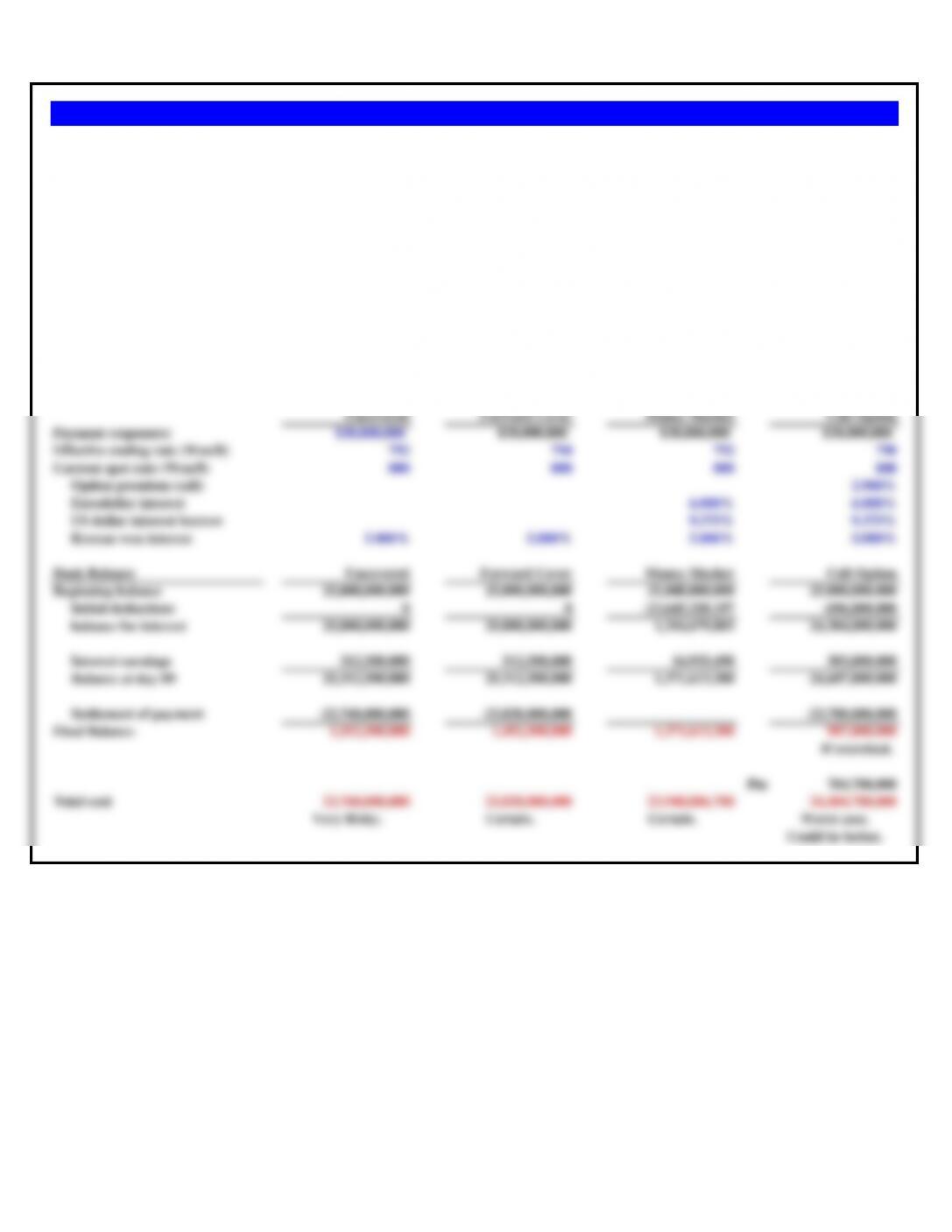
Uncovered Forward Cover Money Market Call Option
Payment (exposure) $30,000,000 $30,000,000 $30,000,000 $30,000,000
Effective ending rate (Won/$) 792 794 792 790
Current spot rate (Won/$) 800 800 800 800
Option premium (call) 2.900%
Eurodollar interest 6.000% 6.000%
US dollar interest borrow 9.375% 9.375%
Korean won interest 5.000% 5.000% 5.000% 5.000%
Bank Balance Uncovered Forward Cover Money Market Call Option
Beginning balance 25,000,000,000 25,000,000,000 25,000,000,000 25,000,000,000
Initial deductions 0 0 -23,645,320,197 -696,000,000
balance for interest 25,000,000,000 25,000,000,000 1,354,679,803 24,304,000,000
Interest earnings 312,500,000 312,500,000 16,933,498 303,800,000
Balance at day 89 25,312,500,000 25,312,500,000 1,371,613,300 24,607,800,000
Settlement of payment -23,760,000,000 -23,820,000,000 -23,700,000,000
Final Balance 1,552,500,000 1,492,500,000 1,371,613,300 907,800,000
If exercised.
Pm 704,700,000
Total cost 23,760,000,000 23,820,000,000 23,940,886,700 24,404,700,000
Very Risky. Certain. Certain. Worst case.
Could be better.
How should KAL plan to make the payment to Boeing if KAL’s goal is to maximize the amount of won cash left in the bank at the end of the three
month period? Make a recommendation and defend it.
Problem 10.18 Korean Airlines
Korean Airlines (KAL) has just signed a contract with Boeing to purchase two new 747-400’s for a total of $60,000,000, with payment in two equal
tranches. The first tranche of $30,000,000 has just been paid. The next $30,000,000 is due three months from today. KAL currently has excess cash of
25,000,000,000 won in a Seoul bank, and it is from these funds that KAL plans to make its next payment.
The current spot rate is won 800/$, and permission has been obtained for a forward rate (90 days), won 794/$. The 90 day Eurodollar interest rate is
6.000%, while the 90 day Korean won deposit rate (there is no Euro-won rate) is 5.000%. KAL can borrow in Korea at 6.250%, and can probably
borrow in the U.S. dollar market at 9.375%.
A three month call option on dollars in the over-the-counter market, for a strike price of won 790/$ sells at a premium of 2.9%, payable at the time the
option is purchased. A 90 day put option on dollars, also at a strike price of won 790/$, sells at a premium of 1.9% (assuming a 12% volatility). KAL’s
foreign exchange advisory service forecasts the spot rate in three months to be won792/$.
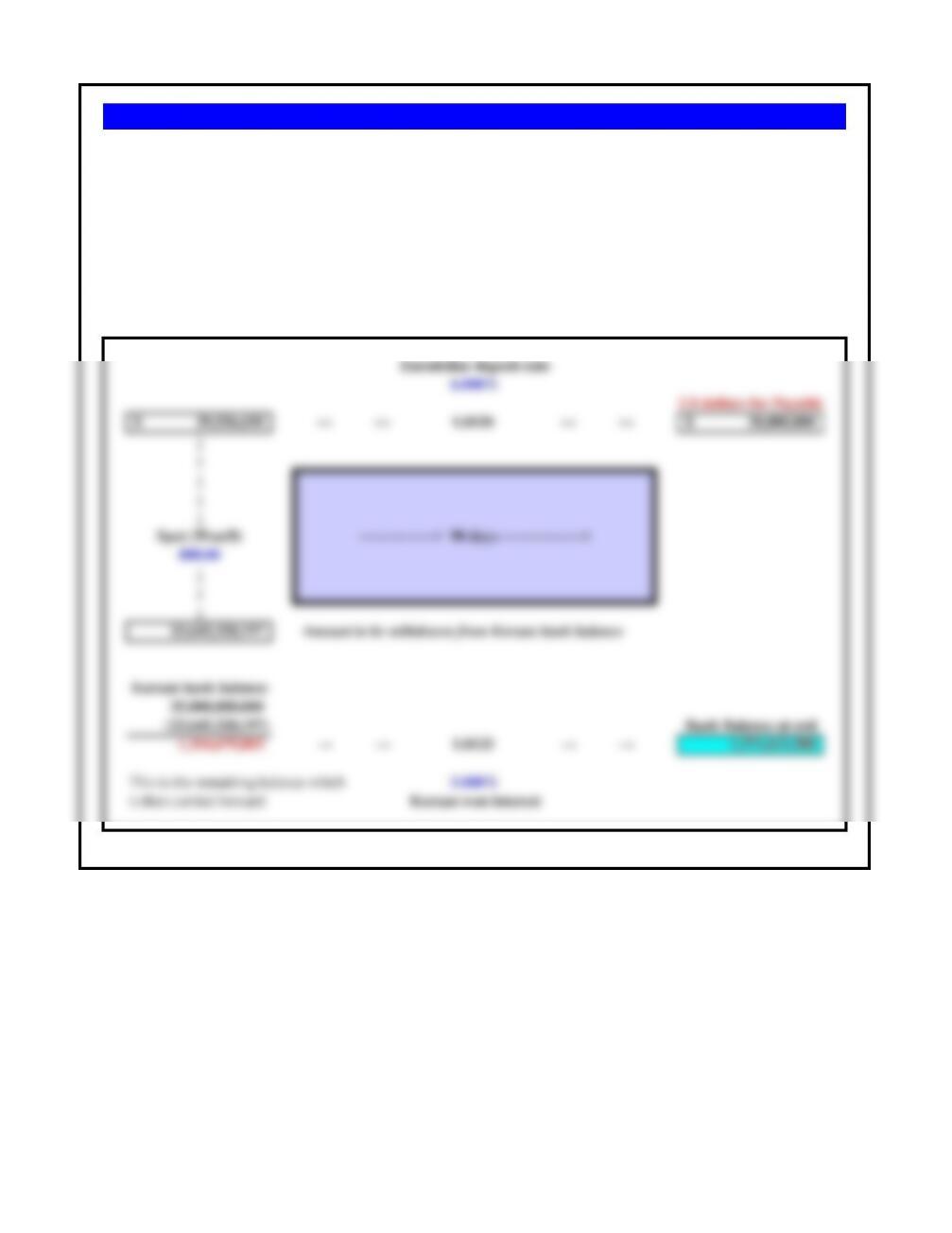
Eurodollar deposit rate
6.000%
US dollars for Payable
29,556,650$ ↔ ↔ 1.0150 ↔ ↔ 30,000,000$
↓
↓
↓
↓
↓
Spot (Won/$) —————> 90 days —————->
800.00
↓
↓
↓
23,645,320,197 Amount to be withdrawn from Korean bank balance
Korean bank balance
25,000,000,000
(23,645,320,197) Bank Balance at end
1,354,679,803 → → 1.0125 → → 1,371,613,300
5.000%
Korean won interest
Korean Airlines Money Market Hedge
The challenge with the Korean Money Market Hedge is that it is a payable — a payable form a Korean won cash balance. A
MM Hedge for a payable is to simply transfer money into the target currency at the start of the period (the front end of the
box), and then to have that money earn interest on deposit for the time period until payment is due.
In this problem, that means transfering enough Korean won at the start to fund a dollar deposit which will yield a total
of $30 million at the end of 90 days. The dollar deposit earns a deposit rate (not a borrowing rate). The won transferred
out of the account at the beginning of the period then reduces the account balance, which then earns the Korean interest
rate for the 90 days to get to an ending cash balance.
This is the remaining balance which
is then carried forward