A
B U S I N E S S A N A L Y T I C S MOD U L E
Decision-Making Tools
DISCUSSION QUESTIONS
1. The 6 steps of the decision-making process are:
6. Implement the solution.
2. The purpose of this question is to make students use a personal
experience to distinguish between good and bad decisions. A “good”
AACSB: Reflective Thinking
4. The basic difference between decision making under certain-
making under certainty assumes that we know with complete
that we are able to objectively measure or estimate the probability
of occurrence of each of the outcomes in the set. Decision making
under uncertainty implies that we do not know the specific out-
making environments
AACSB: Reflective thinking
5. A decision tree is a graphic display of the decision process
LO A.6: Evaluate the nodes in a decision tree
AACSB: Application of knowledge
AACSB: Application of knowledge
7. EVPI is the difference between payoff under certainty and
9. Decision tree steps:
1. Define the problem
of nature node.
10. Maximax considers only the best outcomes, while maximin
considers only worst-case scenarios.
11. Expected values is useful for repeated decisions because it is
an averaging process. However, it averages out the extreme out-
12. Decision trees are most useful for sequences of decisions
under risk.
LO A.7: Create a decision tree with sequential decisions
BUSINESS ANALYTICS MODULE A DE C I S I O N – M A K I N G TO O L S 279
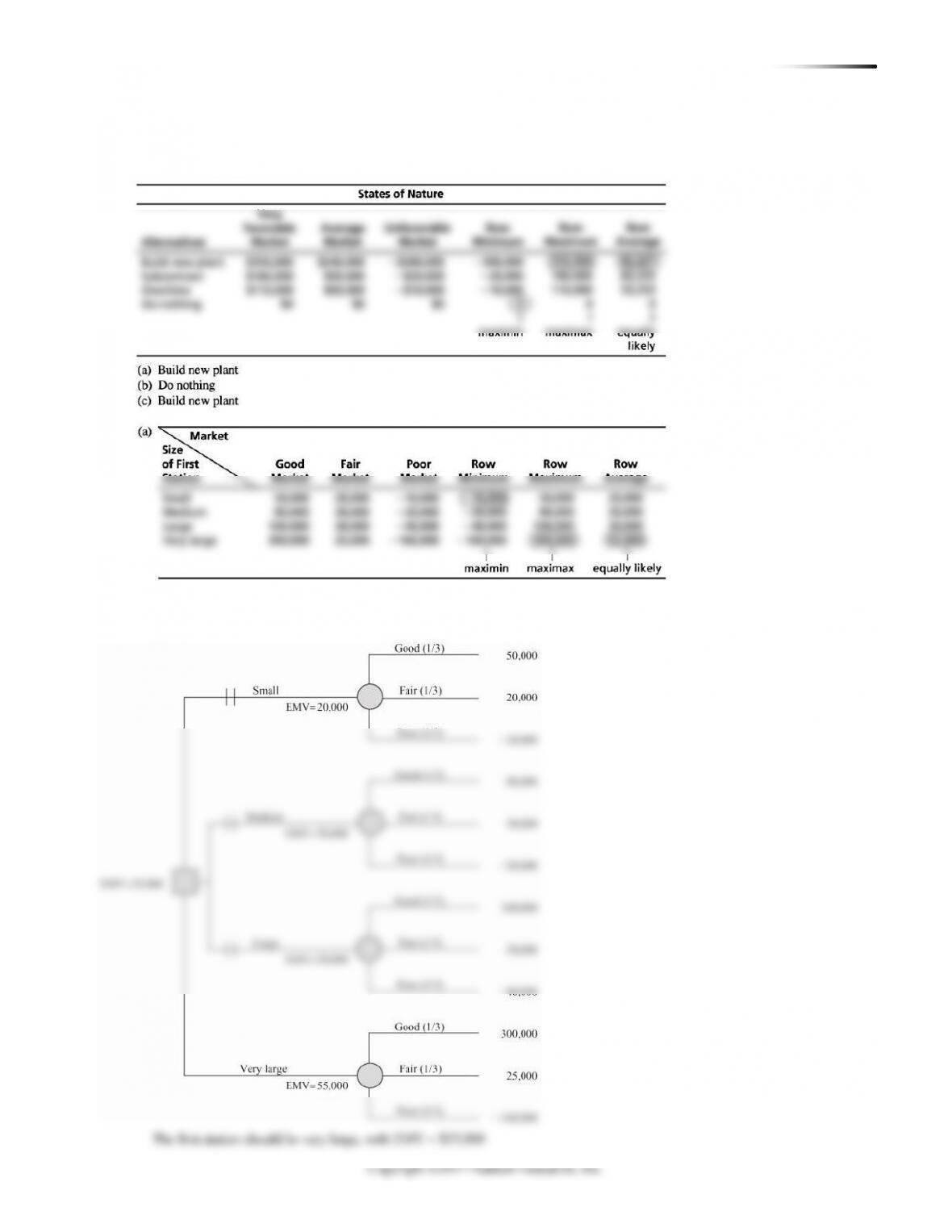
The first station should be very large, with EMV = $55,000
(b) Maximax decision: very large station
(c) Maximin decision: small station
(d) Equally likely decision: very large station
(e)
END–OF-MODULE PROBLEMS (PROBLEMS WITH
ASTERISKS APPEAR IN MYOMLAB ONLY)
A.1
A.2
280 BUSINESS ANALYTICS MODULE A DE C I S I O N – M A K I N G TO O L S
Copyright ©2017 Pearson Education, Inc.
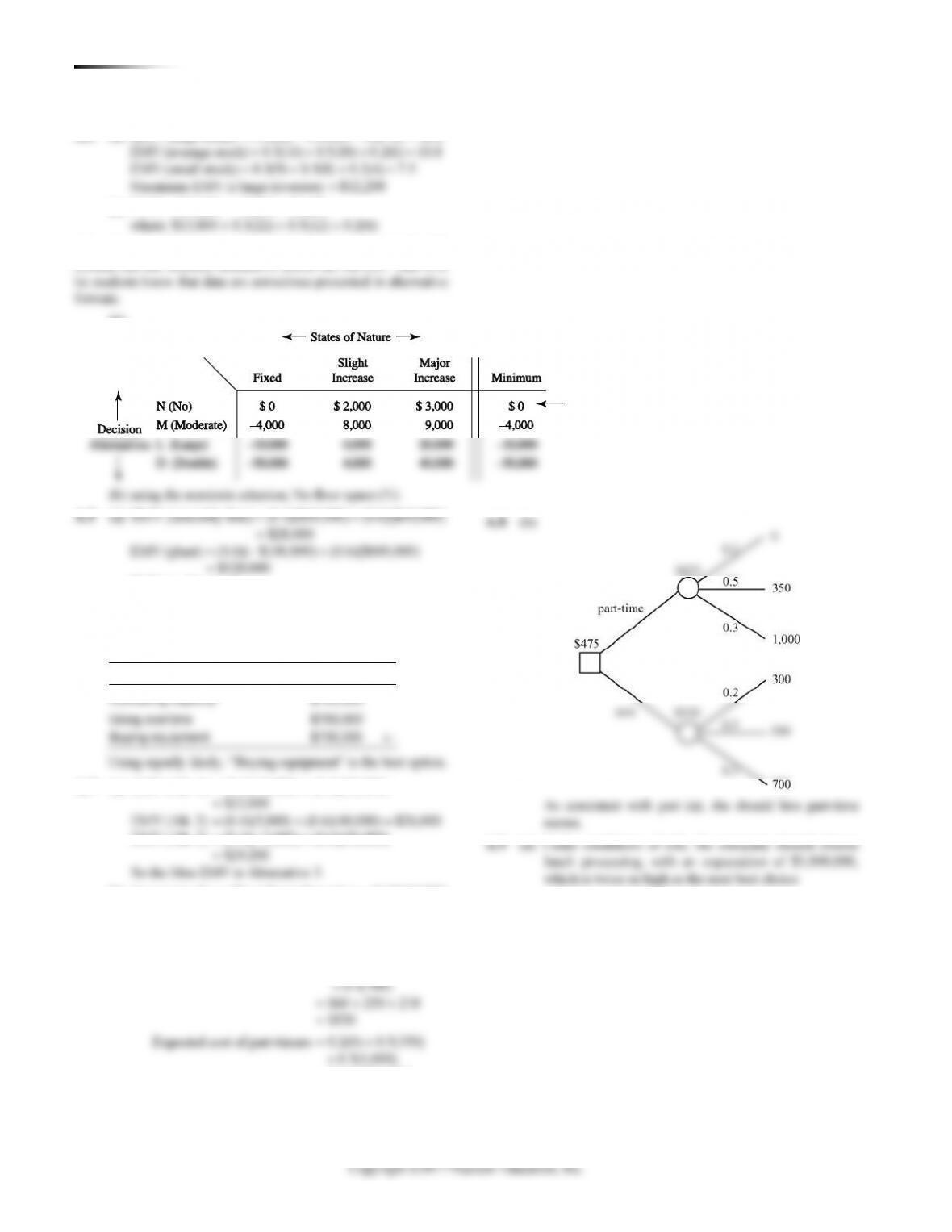
(b) EVPI = $13,800 – 12,200 = $1,600
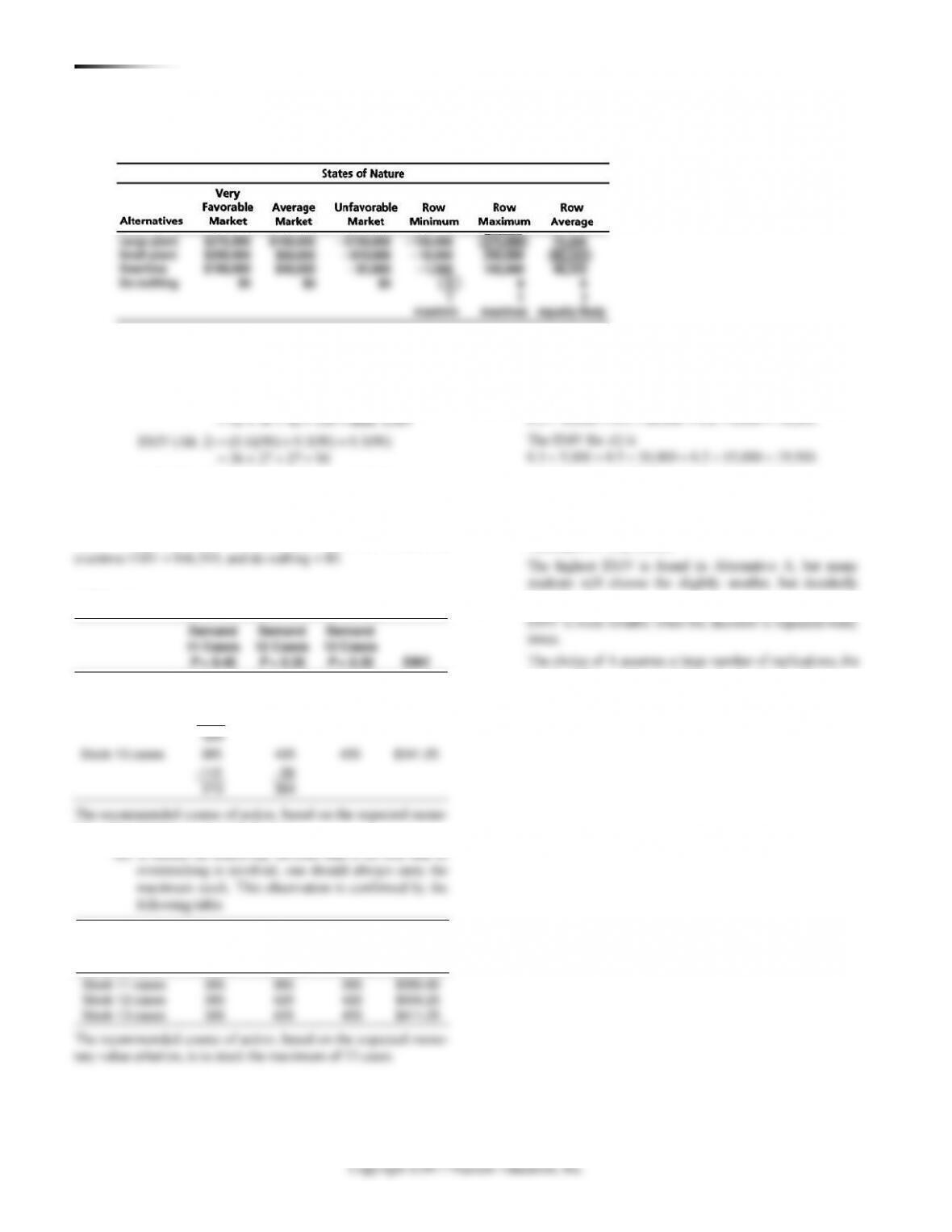
A.4 Note: In the text, the states of nature appeared in the left
BUSINESS ANALYTICS MODULE A DE C I S I O N – M A K I N G TO O L S 281
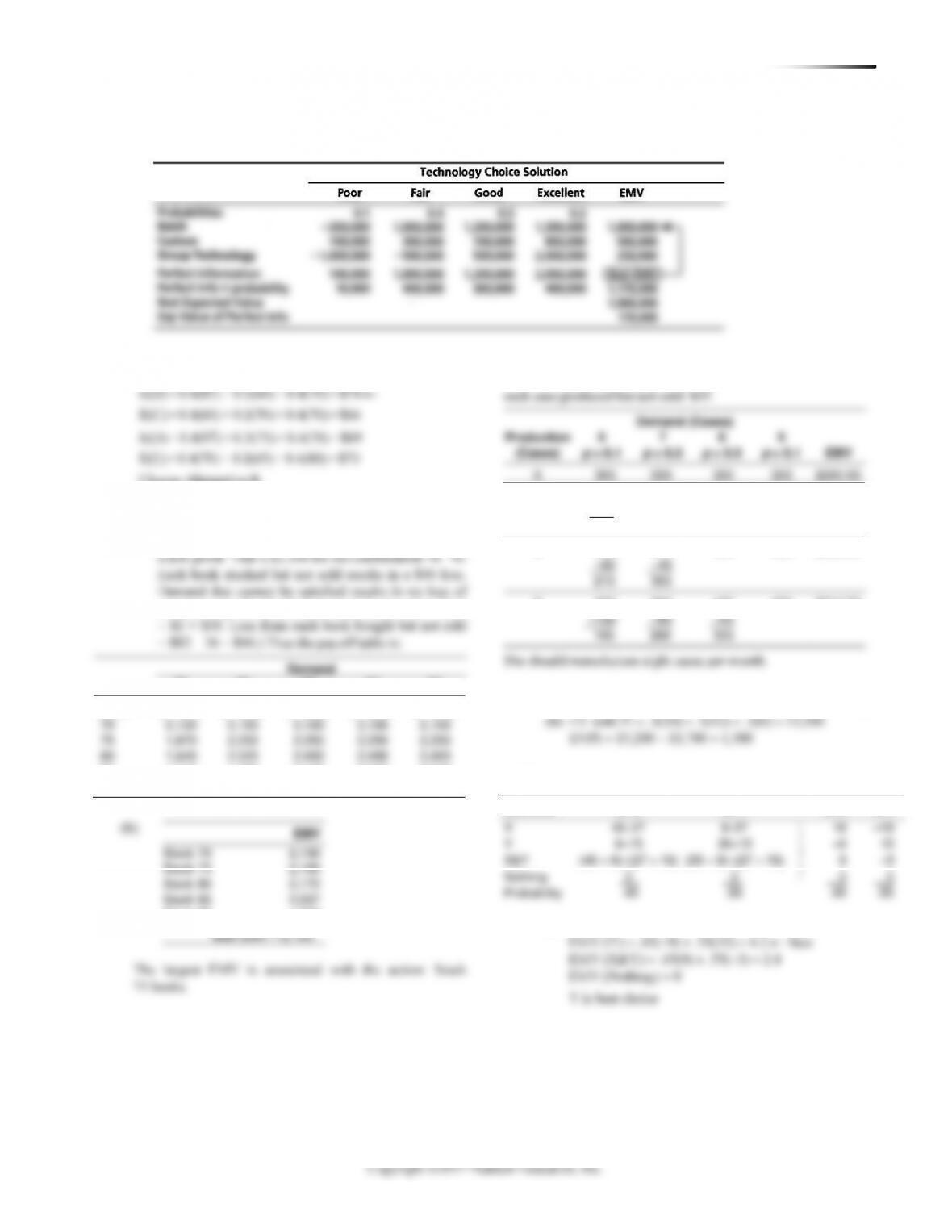
(b) EVPI is $170,000.
A.10
A.12 Profit from each case sold: $95 – $45 = $50. Loss from
E(A) = 0.4(40) + 0.2(100) + 0.4(60) = $60
282 BUSINESS ANALYTICS MODULE A DE C I S I O N – M A K I N G TO O L S
A.16* (a) EMV (Alt. 1) = (0.4)(80) + 0.3(120) + 0.3(140)
EMV (Alt. 3) = (0.4)(50) + 0.3(70) + 0.3(150)
= 20 + 21 + 45 = 86
(b) EVPI = 117 − 110 = 7
A.18* (a)
Stock 11 cases
385
385
385
$385.00
Stock 12 cases
385
420
420
$379.05
−56
329
Stock 13 cases
273
The recommended course of action, based on the expected mone-
tary value criterion, is to stock 11 cases.
Demand
11 Cases
P = 0.45
Demand
12 Cases
P = 0.35
Demand
13 Cases
P = 0.20
EMV
Stock 11 cases
385
385
385
$385.00
Stock 12 cases
385
420
420
$404.25
A.19* The EMV for A1 is
A2 has the higher EMV and is the more profitable.
A.20* The EMV of Alternative A is $1,400,000
Alternative B is $1,350,000.
less risky B.
choice of B assumes a problem solved perhaps only once.
A.15*
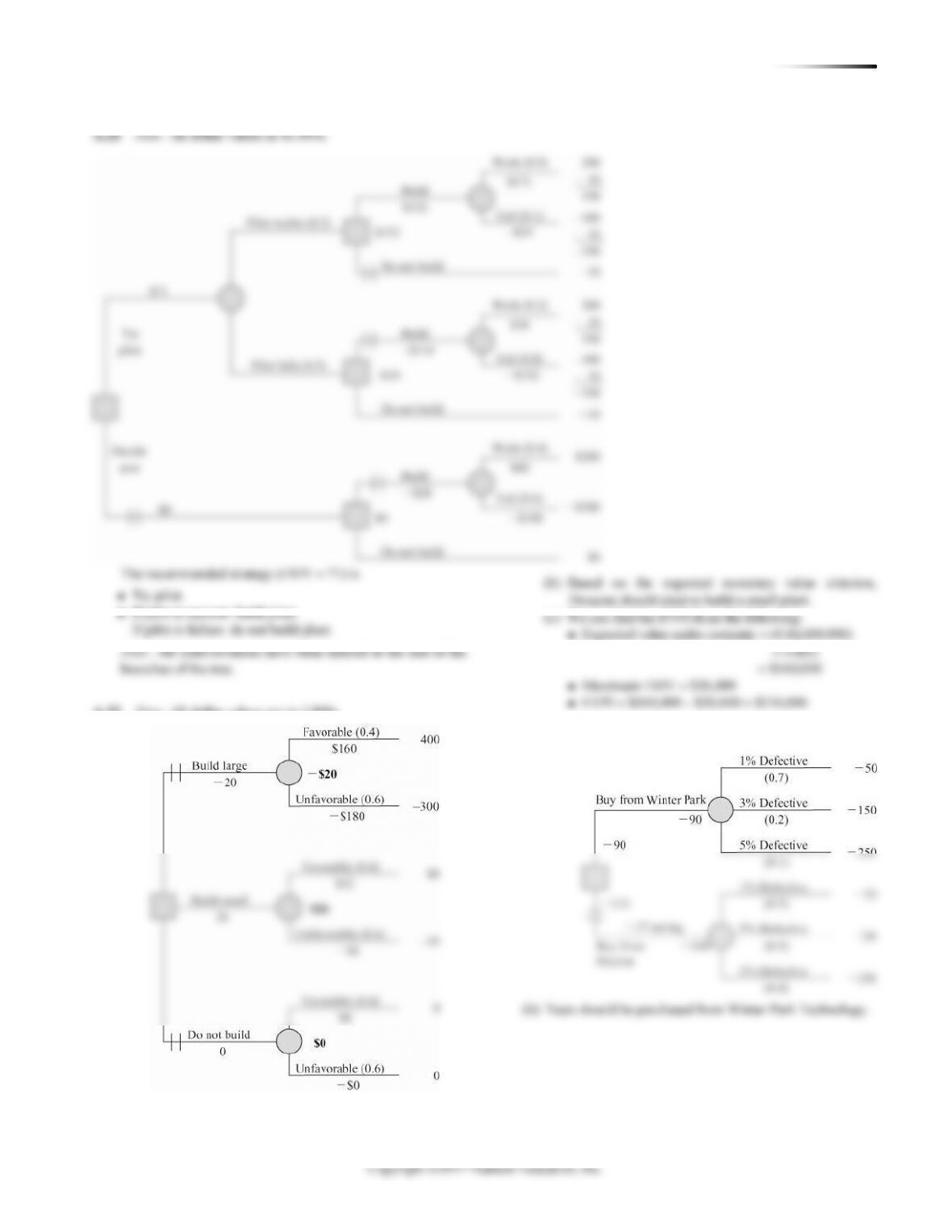
(a) Large plant
(b) Do nothing
(c) Small plant
BUSINESS ANALYTICS MODULE A DE C I S I O N – M A K I N G TO O L S 283
Copyright ©2017 Pearson Education, Inc.
A.22 Note: All dollar values are in 1,000s.
(a)
A.23 (a)
284 BUSINESS ANALYTICS MODULE A DE C I S I O N – M A K I N G TO O L S
Copyright ©2017 Pearson Education, Inc.
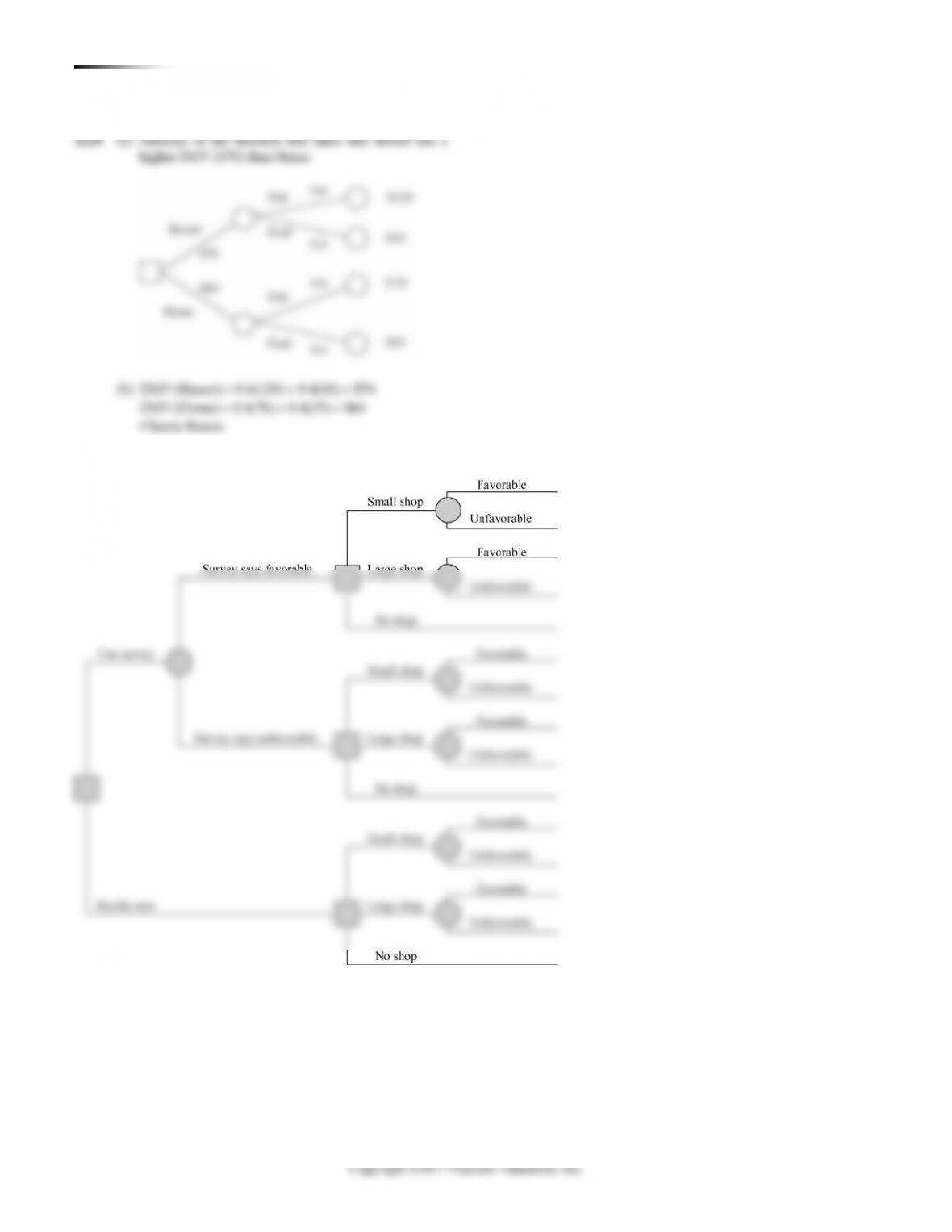
A.24 (a) Analysis of the decision tree finds that Resort has a
higher EMV ($76) than Home:
(b) EMV (Resort) = 0.6(120) + 0.4(10) = $76
EMV (Home) = 0.6(70) + 0.4(55) = $64
Choose Resort.
A.25