CHAPTER 14 MA T E R I A L RE Q U I R E M E N T S PL A N N I N G ( M RP) AND E RP 243
Scheduled receipt
On hand (beginning)
40
40
10
0
70
80
0
On hand (end of period)
10
10
0
70
0
Net requirements
30
30
20
50
Planned order receipt
30
20
50
30
50
On hand (end of period)
0
0
0
0
0
0
0
0
0
Net requirements
15
20
10
25
Planned order receipt
15
20
10
25
1
4
7
Gross requirements
15
20
10
25
Scheduled receipts
On hand (beginning of period)
0
0
3
0
0
9
9
9
On hand (end of period)
0
3
3
1
9
9
9
2
1
2
3
5
6
7
9
Gross requirements
15
20
10
25
On hand (beginning of period)
0
0
0
0
0
0
0
0
0
On hand (end of period)
0
0
0
0
0
0
0
0
0
Planned order release
15
20
14.26 (a)
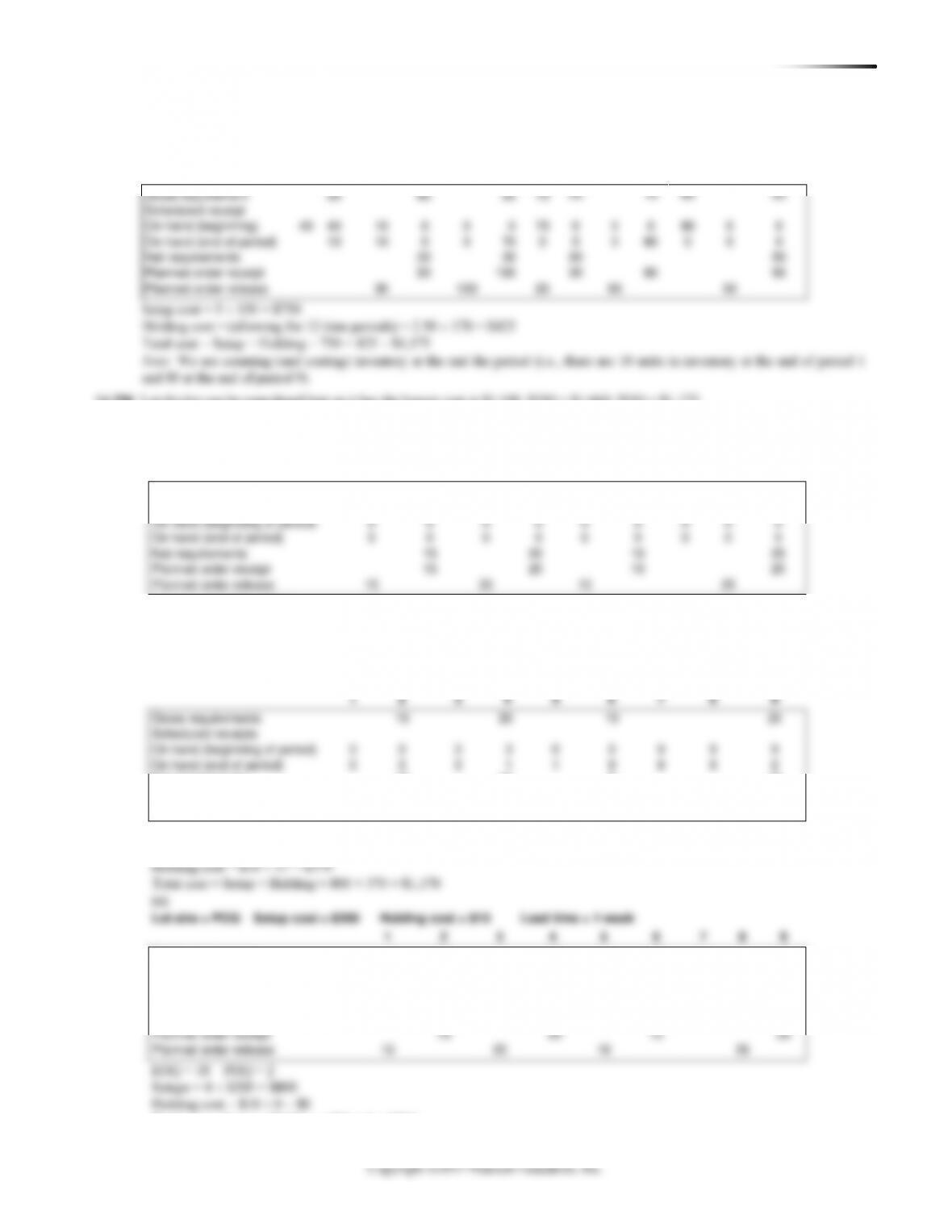
Lot size = Lot-for-lot Setup cost = $200 Holding cost = $10 Lead time = 1 week
1
2
3
4
5
6
7
8
9
Gross requirements
15
20
10
25
Scheduled receipts
On hand (beginning of period)
0
0
0
0
0
0
0
0
0
Planned order release
15
20
10
25
Setups = 4 200 = $800
Holding cost = $10 0 = $0
Total cost = Setup + Holding = 800 + 0 = $800
(b)
Lot size = EOQ Setup cost = $200 Holding cost = $10 Lead time = 1 week
Net requirements
15
20
9
16
Planned order receipt
18
18
18
18
Planned order release
18
18
18
18
EOQ = 18
Setups = 4 $200 = $800
Holding cost = $10 37 = $370
Net requirements
15
20
10
25
Planned order receipt
15
20
10
25
Total cost = Setup + Holding = 800 + 0 = $800
(d) Both lot-for-lot and POQ have the same ordering policy and thus the same cost for the 9-week period, $800.
14.25# Lot-for-lot can be considered best as it has the lowest cost at $1,100. EOQ = $1,660; POQ = $1,175.
14.24#
Lot size = POQ
Setup cost = $150
Holding cost = $2.50
Lead time = 1 week
1
2
3
4
5
6
7
8
9
10
11
12
Gross requirement
30
40
30
70
20
10
80
50
244 CHAPTER 14 MA T E R I A L RE Q U I R E M E N T S PL A N N I N G ( MRP) AND E RP
Scheduled receipts
On hand (beginning of period)
0
0
0
0
0
0
0
0
0
0
0
On hand (end of period)
0
0
0
0
0
0
0
0
0
0
0
Net requirements
35
40
10
25
10
45
Planned order receipt
35
40
10
25
10
45
14.27#
(a)
Lot size = Lot-for-lot Setup cost = $200 Holding cost = $10 Lead time = 1 week
1
2
3
4
5
6
7
8
9
10
11
12
Gross requirements
35
40
10
25
10
45
Planned order release
35
40
10
25
10
45
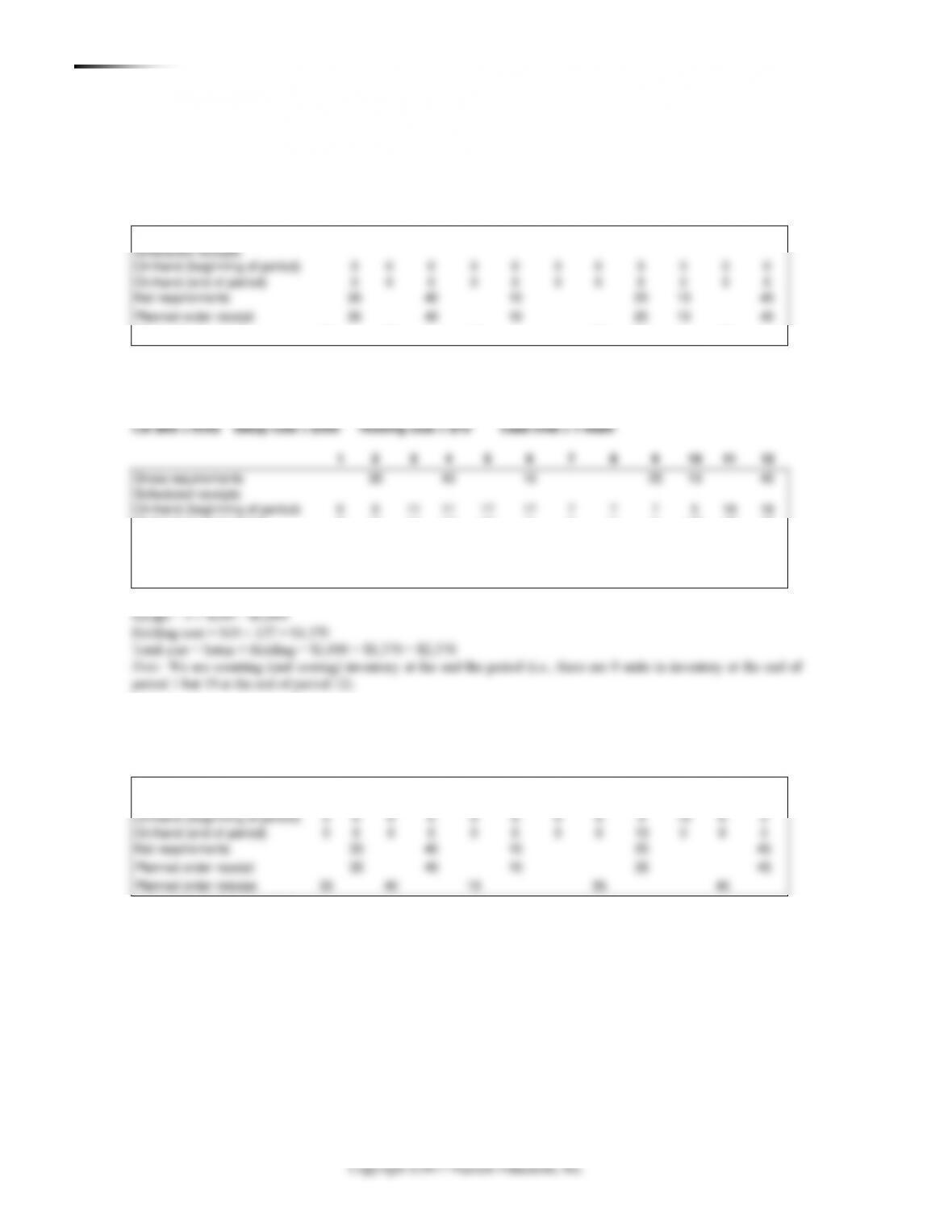
Setups = 6 200 = $1,200
Holding cost = $10 0 = $0
Total cost = Setup + Holding = 1,200 + 0 = $1,200
(b)
Lot size = EOQ Setup cost = $200 Holding cost = $10 Lead time = 1 week
1
2
3
4
5
6
7
8
9
10
11
12
Gross requirements
35
40
10
25
10
45
Scheduled receipts
On hand (beginning of period)
0
0
11
11
17
17
7
7
7
5
18
18
On hand (end of period)
0
11
11
17
17
7
7
7
5
18
18
19
Net requirements
35
29
0
18
5
27
Planned order receipt
46
46
0
23
23
46
Planned order release
46
46
23
23
46
EOQ = 23
Setups = 5 $200 = $1,000
Holding cost = $10 137 = $1,370
Total cost = Setup + Holding = $1,000 + $1,370 = $2,370
Note: We are counting (and costing) inventory at the end the period (i.e., there are 0 units in inventory at the end of
period 1 but 19 at the end of period 12).
(c)
Lot size = POQ Setup cost = $200 Holding cost = $10 Lead time = 1 week
1
2
3
4
5
6
7
8
9
10
11
12
Gross requirements
35
40
10
25
10
45
Scheduled receipts
On hand (beginning of period)
0
0
0
0
0
0
0
0
0
10
0
0
On hand (end of period)
0
0
0
0
0
0
0
0
10
0
0
0
Net requirements
40
10
25
Planned order receipt
40
10
35
Planned order release
35
10
35
45
Setups = 5 $200 = $1,000
Holding cost = $10 10 = $100
Total cost = Setup + Holding = $1,000 + $100 = $1,100
(d) Periodic order quantity yields the lowest cost, $1,100, for this unique 12-week period.
246 CHAPTER 14 MA T E R I A L RE Q U I R E M E N T S PL A N N I N G ( MRP) AND E RP
Week
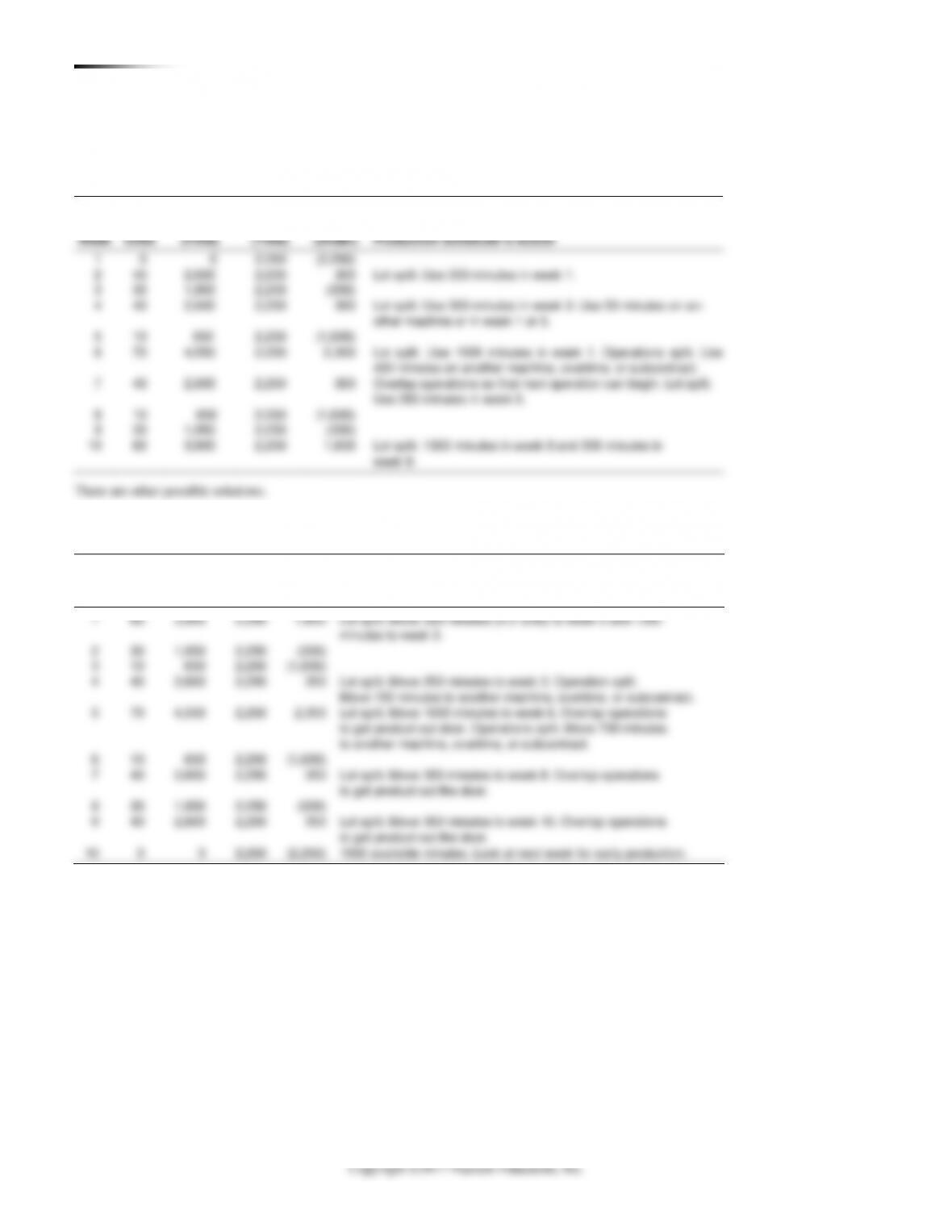
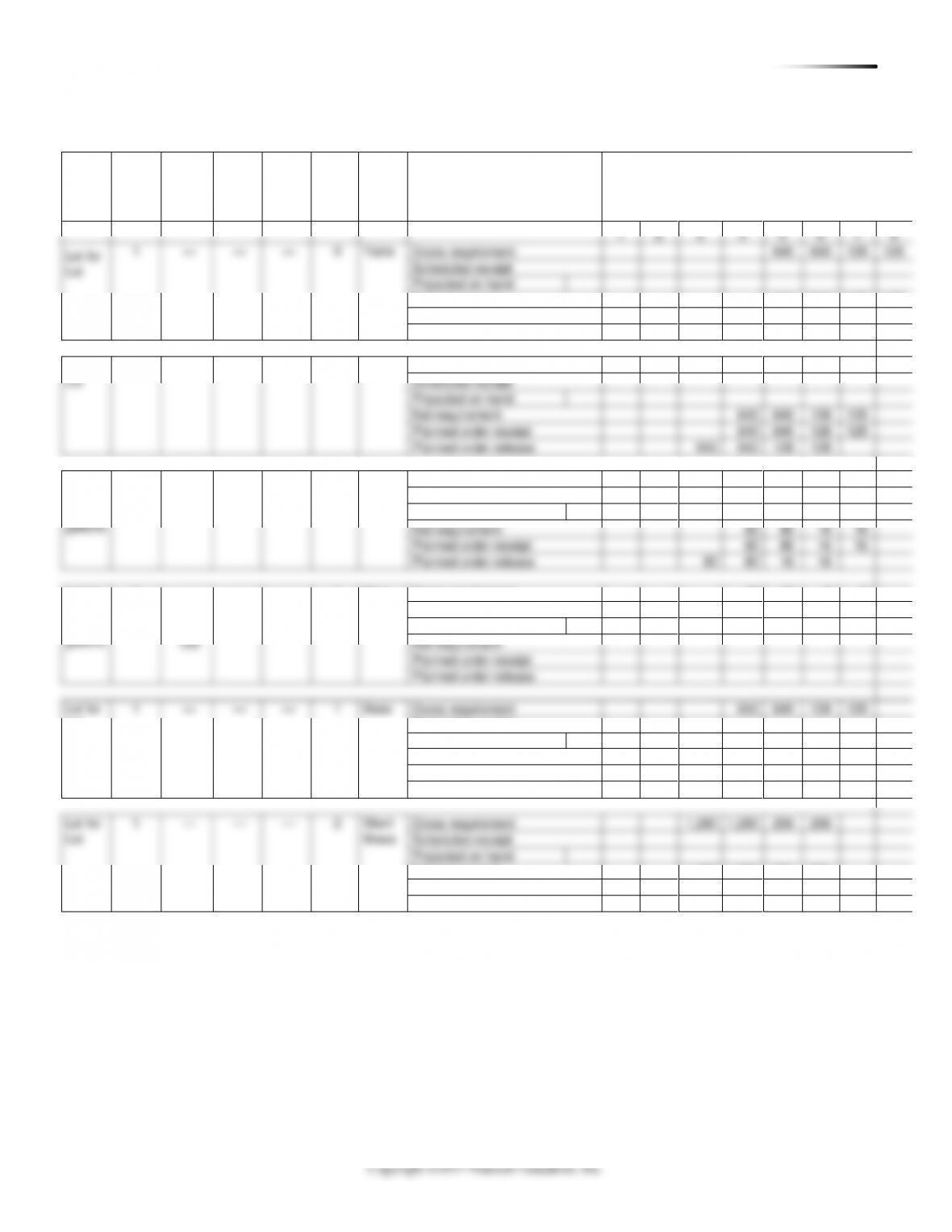
14.29# The firm has 22,500 minutes available to produce 330 units, which require 21,450 minutes of work. One
possible solution is:
Capacity
Capacity
Required
Available
Over/
14.30#
Capacity
Capacity
Required
Available
Over/
Week
Units
(Time)
(Time)
(Under)
Production Scheduler’s Action
There are other possible solutions.
CHAPTER 14 MA T E R I A L RE Q U I R E M E N T S PL A N N I N G ( M RP) AND E RP 247
14.31#
Lot
Size
Lead
Time
(# of
periods)
On
Hand
Safety
Stock
Allo-
cated
Low–
Level
Code
Item ID
Period (day)
1
2
3
4
5
6
7
8
Lot for
Lot
1
—
—
—
0
Table
Gross requirement
640
640
128
128
Scheduled receipt
Projected on hand
Net requirement
640
640
128
128
Planned order receipt
640
640
128
128
Planned order release
640
640
128
128
Lot for
Lot
1
—
—
—
1
Top
Gross requirement
640
640
128
128
Scheduled receipt
Projected on hand
Net requirement
640
640
128
128
Planned order receipt
640
640
128
128
Planned order release
640
640
128
128
Lot for
Lot
gallons
1
—
—
—
1
Stain
(gal.)
Gross requirement
80
80
16
16
Scheduled receipt
Projected on hand
Net requirement
80
80
16
16
Planned order receipt
80
80
16
16
Planned order release
80
80
16
16
Lot for
Lot
gallons
1
—
—
—
1
Glue
(gal.)
Gross requirement
40
40
8
8
Scheduled receipt
Projected on hand
100
100
100
100
100
60
20
12
4
100
Net requirement
Planned order receipt
Planned order release
Lot for
Lot
1
—
—
—
1
Base
Gross requirement
640
640
128
128
Scheduled receipt
Projected on hand
Net requirement
640
640
128
128
Planned order receipt
640
640
128
128
Planned order release
640
640
128
128
Lot for
Lot
1
—
—
—
2
Short
Brace
Gross requirement
1,280
1,280
256
256
Scheduled receipt
Projected on hand
Net requirement
1,280
1,280
256
256
Planned order receipt
1,280
1,280
256
256
Planned order release
1,280
1,280
256
256
Continued
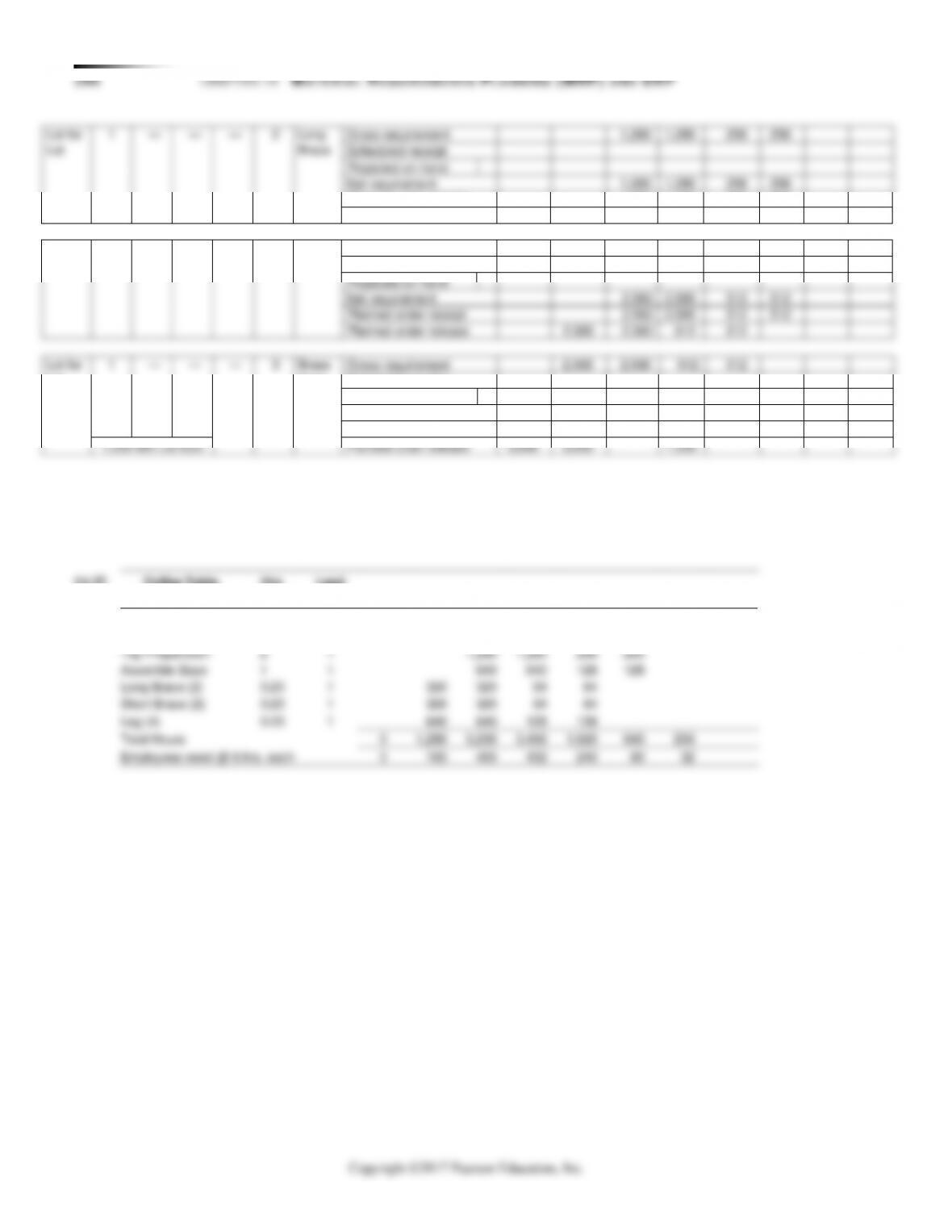
Net requirement
2,560
2,560
512
512
Planned order receipt
2,560
2,560
512
512
Planned order release
2,560
512
512
Planned order release
3,000
3,000
1,000
Assemble Base
1
1
640
640
128
128
Long Brace (2)
1
320
320
Short Brace (2)
1
320
320
Leg (4)
1
640
640
128
Total Hours
1,280
3,200
3,456
1,920
640
256
Employees need @ 8 hrs. each
160
400
432
240
Planned order receipt
1,280
1,280
256
256
Planned order release
1,280
1,280
256
256
Lot for
Lot
1
—
—
—
2
Leg
Gross requirement
2,560
2,560
512
512
Scheduled receipt
Projected on hand
Lot for
Lot
1
—
—
—
3
Brass
Caps
Gross requirement
2,560
2,560
512
512
Scheduled receipt
Projected on hand
440
880
368
856
856
856
Net requirement
2,560
2,120
144
Planned order receipt
3,000
3,000
1,000
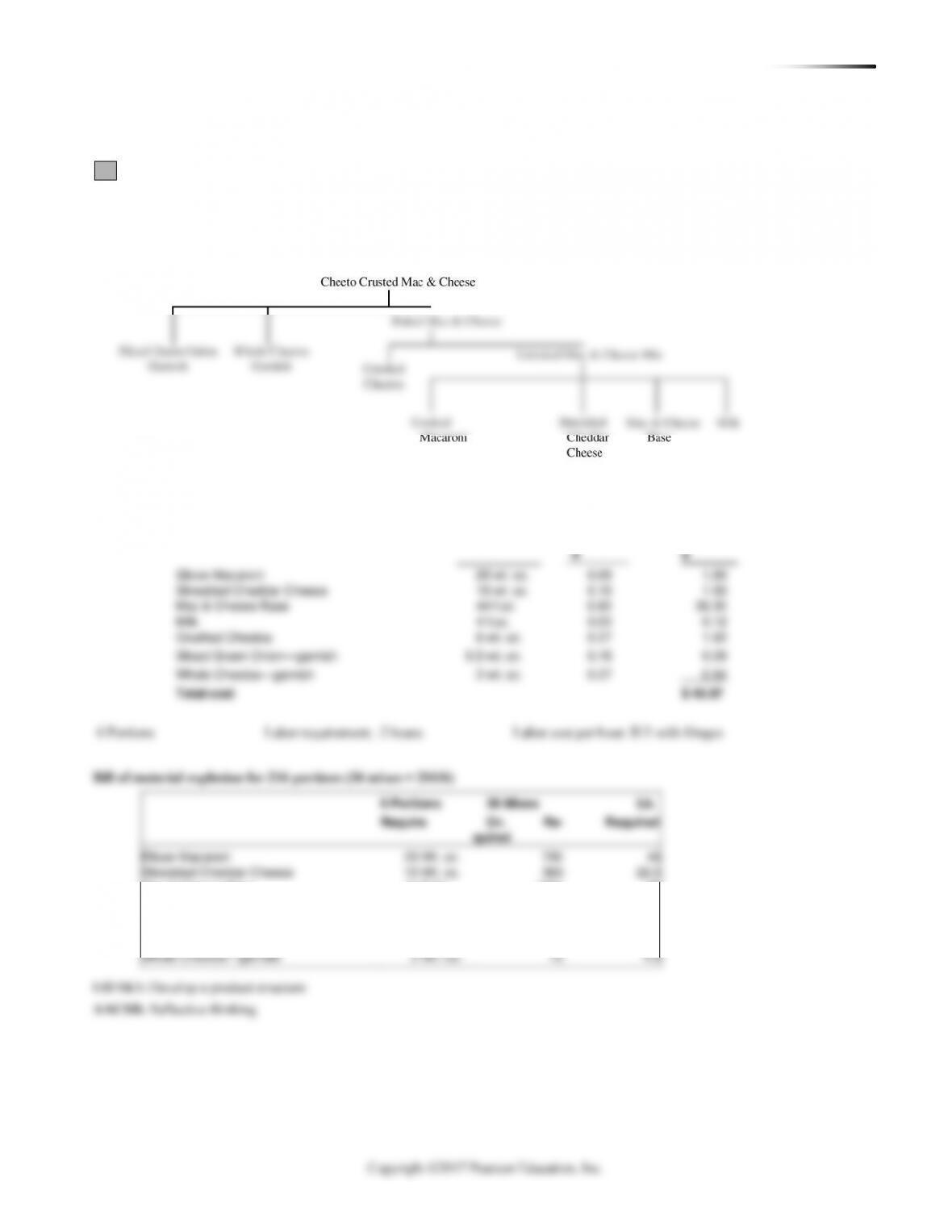
14.32
Coffee Table
Master Schedule
Hrs
Required
Lead
Time
Day 1
Day 2
Day 3
Day 4
Day 5
Day 6
Day 7
Day 8
640
640
128
128
Table Assembly
2
1
1,280
1,280
256
256
Top Preparation
2
1
1,280
1,280
256
256
1
—
—
—
2
Gross requirement
1,280
1,280
256
256
Scheduled receipt
Projected on hand
Net requirement
1,280
1,280
256
256
CHAPTER 14 MA T E R I A L RE Q U I R E M E N T S PL A N N I N G ( M RP) AND E RP 249
1
VIDEO CASE STUDIES
WHEN 18,500 ORLANDO MAGIC FANS
COME TO DINNER
A 10-minute video, filmed specifically for this text and case, is
available in MyOMLab.
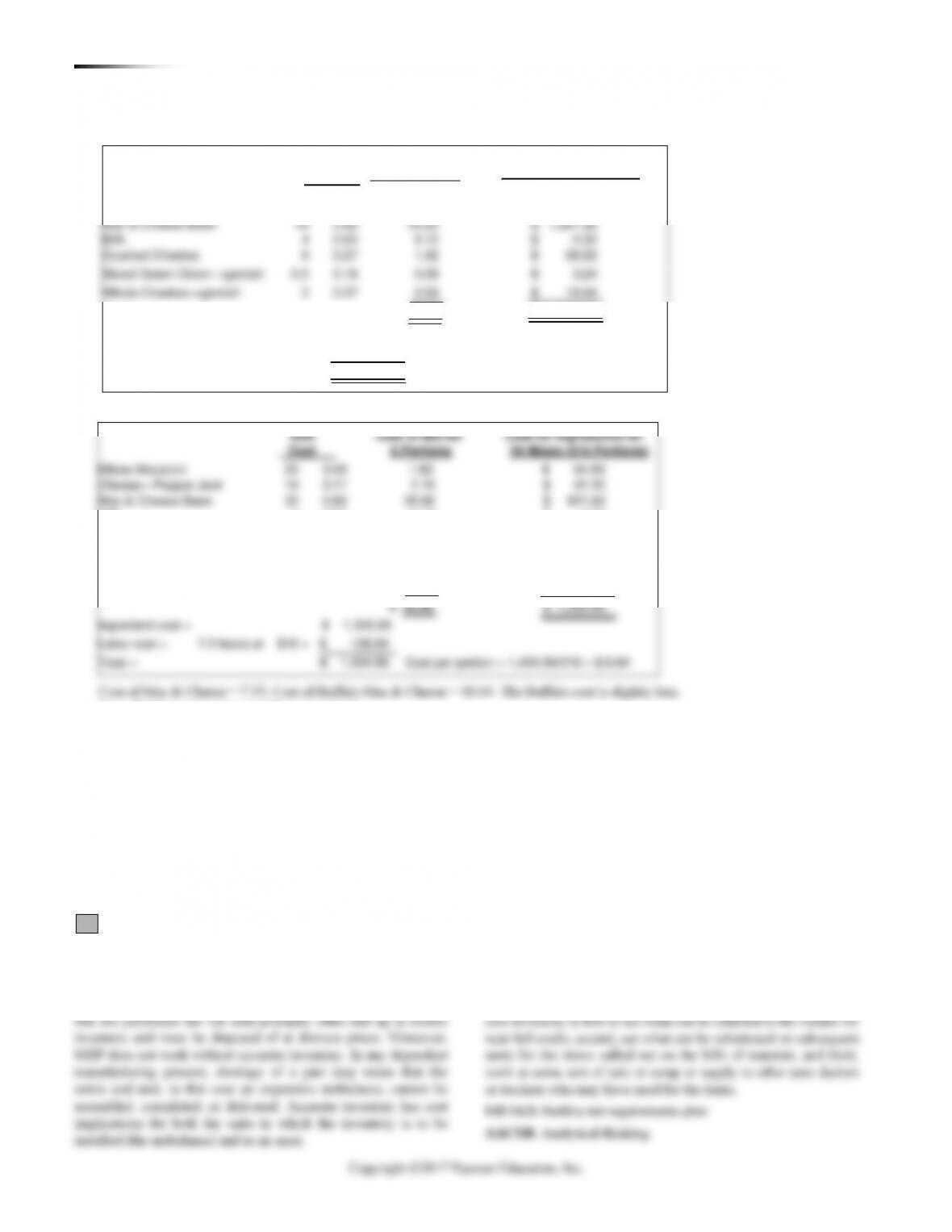
1. Product structure:
$
Elbow Macaroni
20 wt. oz.
0.09
1.80
Shredded Cheddar Cheese
10 wt. oz.
0.16
1.60
Mac & Cheese Base
44 f.oz.
0.80
Milk
4 f.oz.
0.03
0.12
Crushed Cheetos
6 wt. oz.
0.27
1.62
Sliced Green Onion—garnish
0.18
0.09
Whole Cheetos—garnish
2 wt. oz.
0.27
0.54
Total cost
Elbow Macaroni
20 Wt. oz.
720
45
Shredded Cheddar Cheese
10 Wt. oz.
360
Whole Cheetos—garnish
2 Wt. Oz.
72
Unit
Cost for
Description
Qty
Costs
This Mix
Mac & Cheese Base
44 F.Oz.
1584
99
Milk
4 F.Oz.
144
9
Crushed Cheetos
6 Wt. Oz.
216
13.5
Sliced Green Onion—garnish
0.5 Wt. Oz.
18
1.125
Recipe/bill of material for Cheeto Crusted Mac & Cheese for six portions:
250 CHAPTER 14 MA T E R I A L RE Q U I R E M E N T S PL A N N I N G ( MRP) AND E RP
2. Cost per portion for Cheeto Crusted Mac & Cheese
Mac & Cheese Base
44 0.80
35.20
$ 1,267.20
Milk
4 0.03
0.12
$ 4.32
Crushed Cheetos
6 0.27
1.62
Sliced Green Onion—garnish
0.09
Whole Cheetos—garnish
2 0.27
0.54
Cost per portion for Buffalo Chicken Mac & Cheese
Elbow Macaroni
20 0.09
10 0.17
1.70
$ 61.20
Ingredient cost =
Labor cost =
7.2 hours at $15 = $ 108.00
MRP AT WHEELED COACH
A 7-minute video, filmed specifically for this text and case, is
available in MyOMLab.
1. Accurate inventory is an important issue at Wheeled Coach
because of the dynamic changes that occur in ambulances. Items
Mac & Cheese Base
32 0.80
$ 921.60
LO 14.3: Build a net requirements plan
AACSB: Analytical thinking
2. Excess inventory exists because of minimum order require-
ments, BOM errors, customer-change orders, purchasing and
receiving errors, etc. A plan for Wheeled Coach to deal with ex-
2
Unit
Cost
Cost of Mix for
6 Portions
Cost for Ingredients for
36 Mixes (216 Portions)
Elbow Macaroni
20 0.09
1.80
$ 64.80
Shredded Cheddar Cheese
10 0.16
1.60
$ 57.60
Total
40.97
$ 1,474.92
Ingredient cost =
$ 1,474.92
Labor cost =
7.2 hours at $15 = $ 108.00
Total = $ 1,582.92 Cost per portion = 1,582.92/216 = $7.33
Unit
Cost of Mix for
Cost for Ingredients for
Milk
4 0.03
0.12
$ 4.32
Smoked Pulled Chicken
2 2.90
5.80
$ 208.80
Buffalo Sauce
8 0.09
0.72
$ 25.92
Blue Cheese Crumbles
4 0.19
0.76
$ 27.36
Scallions
2 0.18
0.36
$ 12.96
$ 36.86
$ 1,326.96
Note: Portions are not necessarily a “serving.”
LO 14.3: Build a net requirements plan
AACSB: Analytical thinking
3. Preparation of each mix (6 portions) = .2 hours for each mix times 36 mixes = 7.2 hours
7.2 hrs. to prepare the 36 mixes plus .6 hours to cook = 7.8 hours
Therefore, preparation must begin 7.8 hours prior to serving.
So if we expect to begin serving at 7 P.M., we need to start prep 7.8 hours earlier, at 11:12 A.M.
LO 14.3: Build a net requirements plan
AACSB: Analytical thinking
LO 14.5: Describe MRP II
AACSB: Application of knowledge
CHAPTER 14 MA T E R I A L RE Q U I R E M E N T S PL A N N I N G ( M RP) AND E RP 251
2
3. Wheeled Coach will find it difficult to dispose of excess inven-
tory. It is hard to substitute excess components in units (and their
related bills of material) as units are being assembled. It takes inno-
are not critical, management instituted an effectivity date. That is a
date that the change would be effective to the date in the production
schedule that allowed all of the components in stock to be used.
ble last resort. However, even this is expensive. It requires catalog-
ing, publicity, letter writing, phone calls, and follow–up. It is a real
LO 14.3: Build a net requirements plan
AACSB: Analytical thinking
ADDITIONAL CASE STUDIES
(AVAILABLE IN MYOMLAB)
IKON’S ATTEMPT AT ERP
1. IKON needs comprehensive marketing information on poten-
tial customers, existing customers, and their copier installations,
an integrated system that ties HR, accounting, manufacturing, and
advantage. A wide variety of special programs have been written
3. The bet was that the pilot installation would work at reasona-
ble cost and, not incidentally, do the job. This did not turn out to be
4. The project was canceled because of the expense, combined
with functionality gaps and the amount of internal business proce-
dures IKON would have to change.
HILL’S AUTOMOTIVE, INC.
In this case, each department argues that it is doing its job well—
ity planning; and (c) few, if any, accurate lead times, all resulting in
poor scheduling and chaos in the assembly area. There seems also
(a) introduction of corporate wide goals and performance
measures for each function; (b) development of labor standards
for the assembly, and packaging operations; (c) development of
quality standards for all production and purchased items, to which
suppliers would adhere; (d) improvements in inventory manage-
ment practices; (e) development of a capacity planning procedure
(i.e., determination as to how many units can be produced during
what time periods); (f) implementation of a master production
schedule (which might encompass a relatively short horizon due
to the typical short production cycle); and, ultimately, proper use
of an MRP system. When this is completed, everyone will be
material will be evident, as will production schedules beyond the
employees and increased integration among departments.
1