14
C H A P T E R
Material Requirements Planning (MRP) and ERP
DISCUSSION QUESTIONS
1. The difference between a gross requirements plan and a net
requirement plan is that a net plan adjusts for on-hand inventory
and scheduled receipts at each level.
LO 14.2: Build a gross requirements plan
2. Once the MRP system is in place, it provides information to
assist decision makers in other functional areas such as the amounts
(MRP) and distribution resource planning (DRP) are that the
4. The difference between material requirements planning
(MRP) and material resource planning II (MRP II) is that MRP II
includes or integrates functions within the firm in addition to the
AACSB: Application of knowledge
5. There is no one “ideal” lot-sizing technique that should be
used by all manufacturing organizations. Lot-for-lot is the goal
6. In a DRP system, inventory residing within the system is
moved within the system rather than entering or leaving the
scheduling factor in inventory planning. MRP II, of course,
addresses the timing/scheduling of other resources in addition to
inventory.
LO 14.3: Build a net requirements plan
AACSB: Reflective thinking
of options, including:
ment to increase capacity, add a shift, or develop an
9. The master schedule is expressed in terms of:
(1) End items in a continuous (make-to-stock) company;
10. Virtually all functions of the firm impact an MRP system.
For instance, purchasing performance affects delivery, changes
in capacity (i.e., labor, maintenance, breakdowns) impact
11. The rationale for: (a) A phantom bill of material is a subas-
sembly that exists only on the production line—say a mixture/
glue that exists only a few minutes and then must be used or
Copyright ©2017 Pearson Education, Inc.
◼ A good schedule of what is to be made
13. The benefits of ERP include:
◼ Provides integration of the production, supply chain,
14. Distinctions between MRP, DRP, and ERP, are: MRP is a
set of software programs designed to schedule material require-
plan for all levels of the distribution network. Its focus is on
retail and wholesale distribution network. On the other hand,
15. In MRP, demand need not be constant. Also, in an MRP
as spare parts and maintenance orders.)
16. The disadvantages of ERP include:
◼ Expertise in ERP is limited, with staffing an ongoing
problem.
LO 14.7: Describe ERP
AACSB: Application of knowledge
17. (a) The Web sites of most of the major ERP vendors
include “successful solutions” using their software.
Oracle: www.oracle.com
IQMS: www.iqms.com
(see Oracle Peoplesoft CRM website):
Supplier Relationship Management—Manage supplier
◼ CRM industry solutions
◼ Marketing solution
(b) SAP’s Supply Chain Management product includes:
(c) SAP’s Product Lifecycle Management product
includes:
LO 14.7: Describe ERP
19. Moving toward JIT and kanban suggest that the traditional
“positions” in the production process—a “flow” criterion rather
ETHICAL DILEMMA
ERP is going to cost more than expected.
What do you do? Certainly, any sense of fairness and decency
suggest that the customer must be told the truth. However,
a sales representative can be expected to try to solve the problem
Copyright ©2017 Pearson Education, Inc.
enhancement?”
The bottom line is that not telling the customer the truth and/or
200 units. Which items are affected by this change?
Items E, F, G, and D
END–OF-CHAPTER PROBLEMS (PROBLEMS WITH
ASTERISKS ARE IN MYOMLAB ONLY; PROBLEMS
WITH # SYMBOLS ARE NOT IN MYOMLAB)
14.1 An exploded bill yields the following:
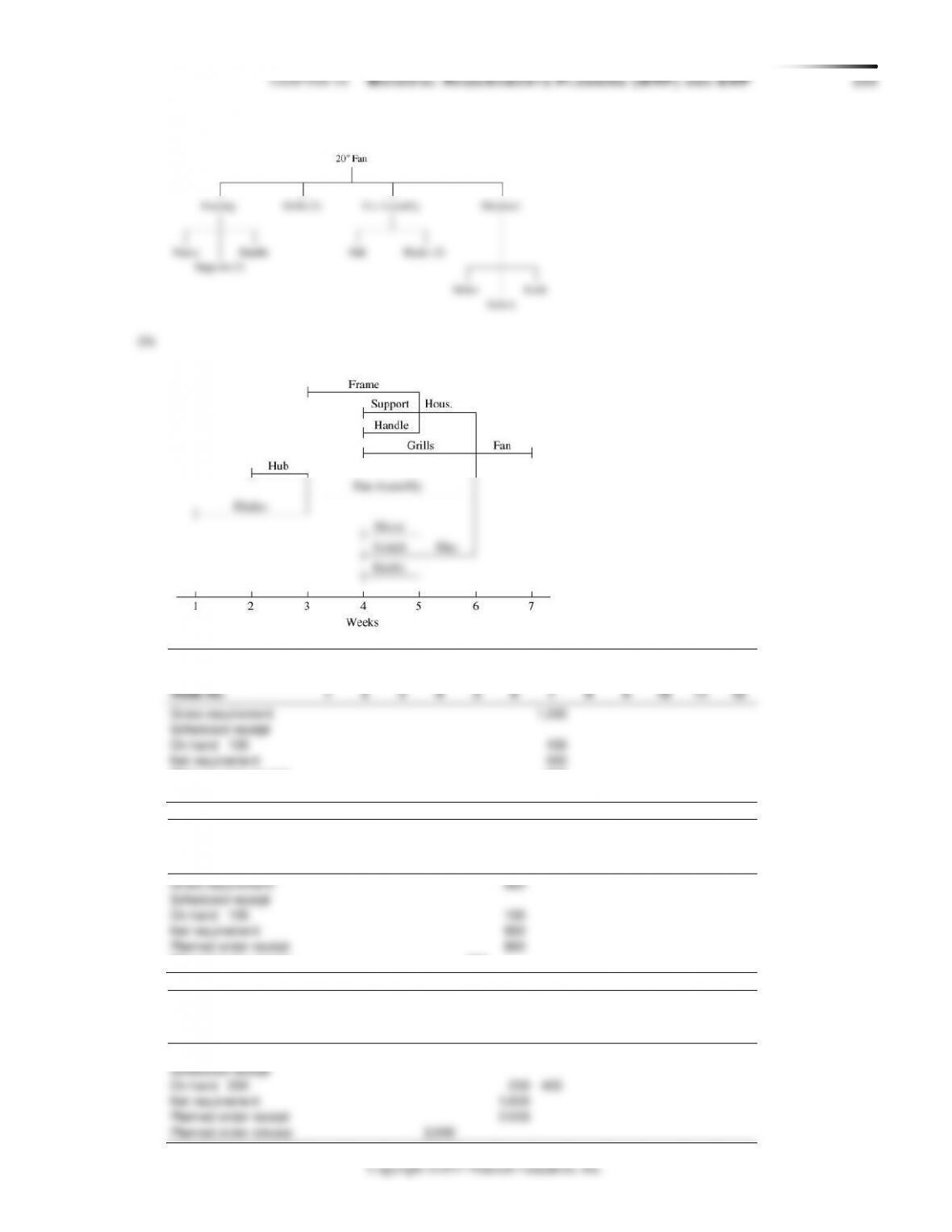
14.2 The time-phased assembly plan for the gift bags is:
14.3 (a)
(b) For 50 brackets, the gross requirements are for 50
castings, 100 housings, 200 bearings, and 100 shafts.
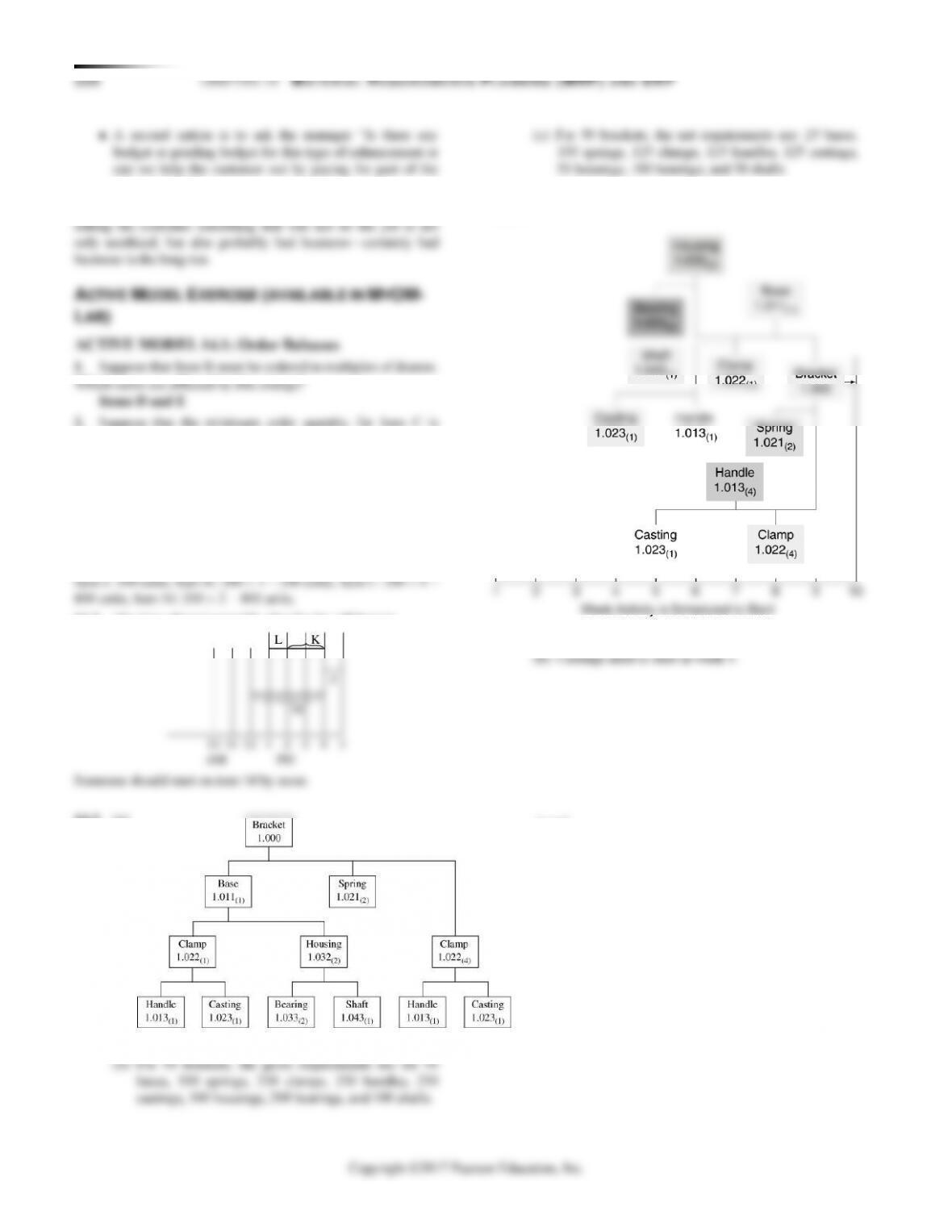
14.4 (a) Time-phased product structure for bracket with start
times:
Level
0
1
2
3
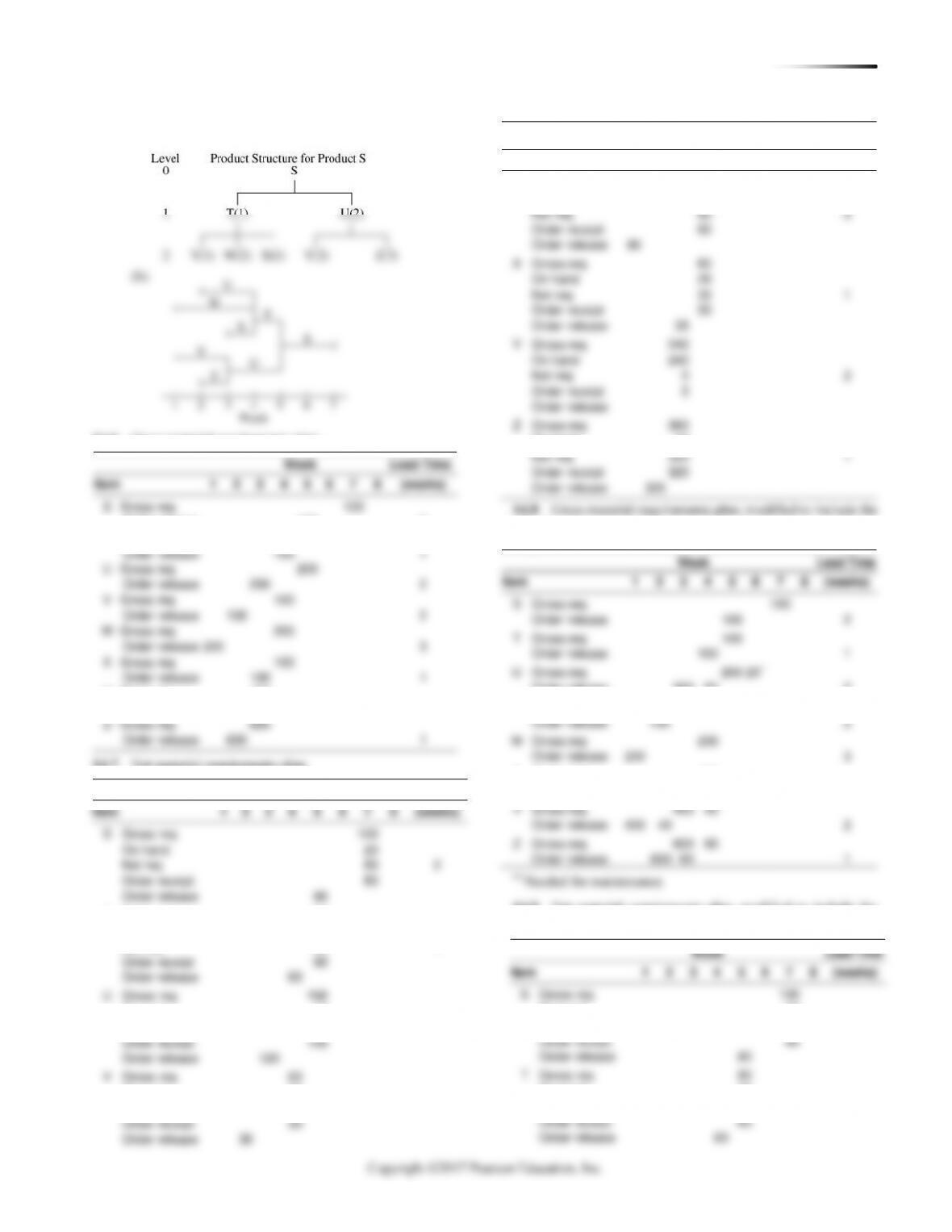
CHAPTER 14 MA T E R I A L REQ U I R EM E N T S PL A N N I N G ( MRP) AND E R P 227
14.5 (a) Product structure:
X
Gross req
60
On hand
25
Net req
35
1
Order receipt
35
Order release
35
Y
Gross req
240
On hand
240
Net req
0
2
Order receipt
0
Order release
14.6 Gross material requirements plan:
Week
Lead Time
Item
1
2
3
4
5
6
7
8
(weeks)
S
Gross req
100
Order release
100
2
T
Gross req
100
Order release
100
1
U
Gross req
200
Order release
200
2
V
Gross req
100
Order release
100
2
W
Gross req
200
Order release
200
3
X
Gross req
100
Order release
100
1
Y
Gross req
400
Order release
400
2
Z
Gross req
600
Order release
600
1
14.7 Net material requirements plan:
Y
Gross req
400
Order release
400
2
Z
Gross req
600
Order release
60
1
Item
2
4
6
S
Gross req
100
On hand
20
Net req
80
2
Order receipt
80
Order release
80
Order receipt
60
Order release
60
Item
1
2
3
5
6
7
8
(weeks)
Net req
60
1
U
Gross req
160
Lead Time
S
Gross req
100
Order release
120
Order release
80
20 units of U required for maintenance purposes:
14.9 Net material requirements plan, modified to include the
20 units of U required for maintenance:
Week
Lead Time
Item
1
2
3
4
5
6
7
8
(weeks)
W
Gross req
120
On hand
30
Net req
90
3
Order receipt
90
Order release
90
Z
Gross req
360
On hand
40
Net req
320
1
Order receipt
320
Order release
320
Week
Lead Time
Item
1
2
3
4
5
6
7
8
(weeks)
S
Gross req
100
Order release
100
2
T
Gross req
100
Order release
100
1
U
Gross req
200
20**
Order release
200
20
2
V
Gross req
100
Order release
100
2
W
Gross req
200
Order release
200
3
X
Gross req
100
Order release
100
1
Week
Lead Time
T
Gross req
80
On hand
20
On hand
40
Net req
120
2
Order receipt
120
V
Gross req
60
On hand
30
Net req
30
2
Order receipt
30
Order release
30
On hand
20
Net req
80
2
Order receipt
80
T
Gross req
80
On hand
20
Net req
60
1
Order receipt
60
Order release
60
228 CHAPTER 14 MA TE RI AL RE Q U I R EM E N T S PL A N N I N G ( MRP) AND ER P
14.10# (a) Gross material requirements plan:
Note: Elements have been listed in the gross material require-
ments plan in the order of level, and within a level, from left to
Week
Lead Time
Item
1
2
3
4
5
6
7
8
(weeks)
20*
CHAPTER 14 MA T E R I A L REQ U I R EM E N T S PL A N N I N G ( MRP) AND E R P 229
Net requirement
Planned order receipt
Planned order release
95
Level: 2
Parent: B2
Quantity: 2X
Planned order receipt
40
400
Planned order release
40
400
Level: 2
Parent: B2
Quantity: 1X
Item: D
Lead Time: 1
Lot Size: L4L
Planned order release
20
200
Level: 2 & 3
Item: E
Lead Time: 2
Lot Size: L4L
Week No.
1
2
3
4
5
6
7
8
9
10
11
12
Gross requirement
40
400
100
Week No.
1
2
3
4
5
6
7
8
9
10
11
12
Gross requirement
20
200
Scheduled receipt
On hand
0
0
Net requirement
20
200
Planned order receipt
20
200
Scheduled receipt
On hand
10
0
0
Net requirement 10
30
400
100
Planned order receipt
30
400
100
Planned order release
30
400
100
Level: 2
Parent: B1
Quantity: 1X
Item: A1
Lead Time: 1
Lot Size: L4L
Week No.
1
2
3
4
5
6
7
8
9
10
11
12
Gross requirement
100
Scheduled receipt
On hand 5
5
Item: C
Lead Time: 1
Lot Size: L4L
Week No.
1
2
3
4
5
6
7
8
9
10
11
12
Gross requirement
40
400
Scheduled receipt
On hand
0
0
Net requirement
40
400
230 CHAPTER 14 MA TE RI AL RE Q U I R EM E N T S PL A N N I N G ( MRP) AND ER P
14.11 (a)
Order rel
100
50
C
Gross req
100
100
50
50
150
100
100
50
50
150
On hand
0
0
Net requirement
100
50
150
Planned order receipt
100
50
150
Planned order release
100
50
150
Planned order receipt
100
50
Planned order release
100
50
Level: 1
Parent: A, H
Quantity: 1X
Item: C
Lead Time: 2
Lot Size: L4L
Planned order receipt
50
100
50
50
150
Week
Item
1
2
3
4
5
6
7
8
9
10
11
12
A
Gross req
100
50
150
Order rel
100
50
150
H
Gross req
100
50
Level: 0
Parent: —
Quantity:
Item: A
Lead Time: 1
Lot Size: L4L
Week No.
1
2
3
4
5
6
7
8
9
10
11
12
Gross requirement
100
50
150
Scheduled receipt
Level: 0
Parent: —
Quantity:
Item: H
Lead Time: 1
Lot Size: L4L
Week No.
1
2
3
4
5
6
7
8
9
10
11
12
Gross requirement
100
50
Scheduled receipt
On hand
0
0
Week No.
1
2
3
4
5
6
7
8
9
10
11
12
Gross requirement
100
100
50
50
150
Scheduled receipt
On hand
50
0
0
0
0
Net requirement 50
50
100
50
50
150
Planned order release
50
100
50
50
150
Copyright ©2017 Pearson Education, Inc.
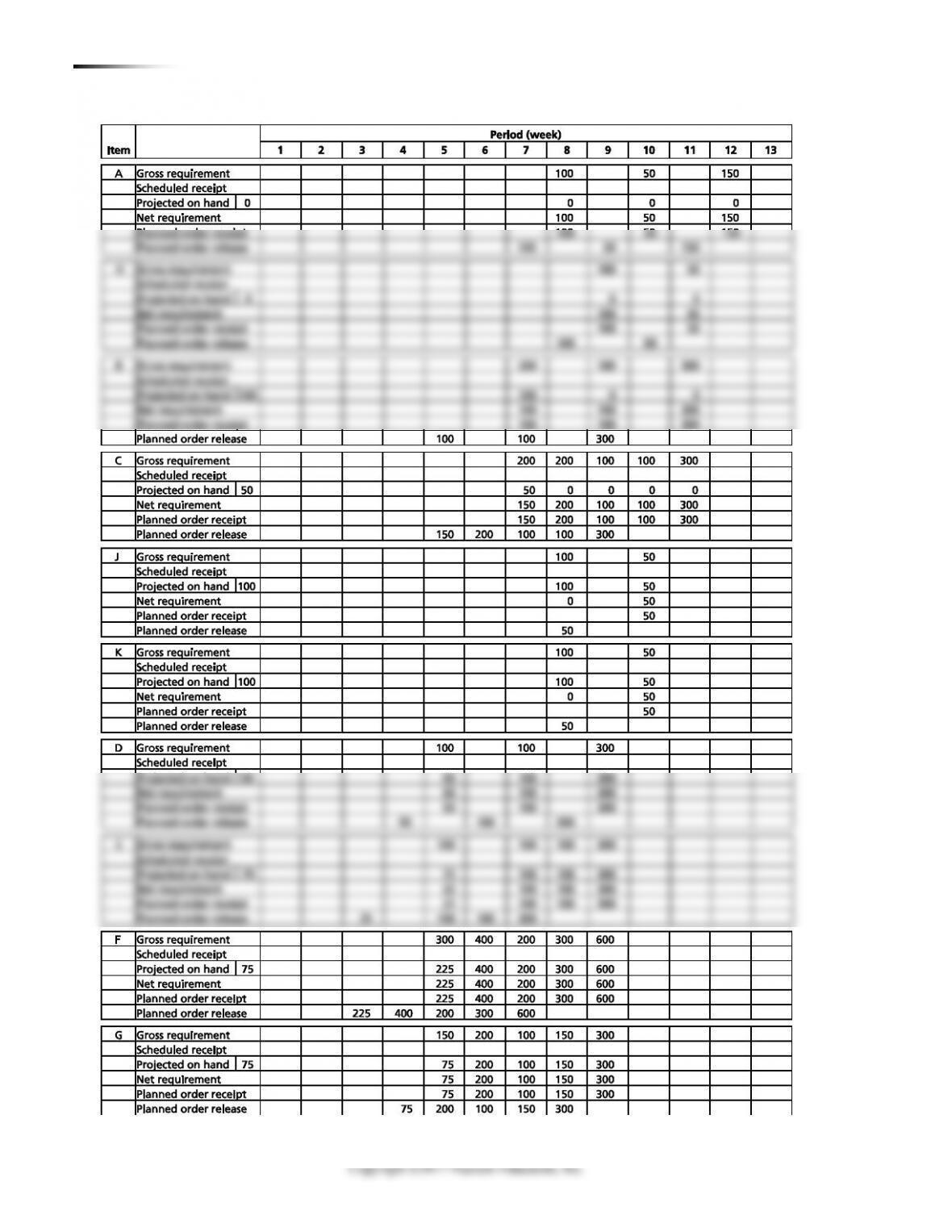
14.12# (a) Net material requirements plan:
Week
Item
1
2
3
4
5
6
7
8
9
10
11
12
A
Gross requirement
100
50
150
On hand: —
0
0
0
0
Net requirement
100
50
150
Order receipt
100
50
150
Order release
100
50
150
H
Gross requirement
100
50
On hand: —
0
0
0
Net requirement
100
50
Order receipt
100
50
Order release
100
50
B
Gross requirement
100
50
150
On hand:
100
100
0
0
Net requirement
50
150
Order receipt
50
150
Order release
50
150
C
Gross requirement
100
100
50
50
150
On hand:
50
50
0
0
0
0
Net requirement
50
100
50
50
150
Order receipt
50
100
50
50
150
Order release
50
100
50
50
150
J
Gross requirement
100
50
On hand:
100
100
0
Net requirement
0
50
Order receipt
0
50
Order release
50
K
Gross requirement
100
50
On hand:
100
100
0
Net requirement
0
50
Order receipt
0
50
Order release
50
D
Gross requirement
50
150
On hand:
50
50
0
Net requirement
150
Order receipt
150
Order release
150
E
Gross requirement
50
100
150
On hand:
75
75
25
0
Net requirement
75
150
Order receipt
75
150
Order release
75
150
F
Gross requirement
50
100
50
100
150
On hand:
75
75
25
0
0
0
Net requirement
75
50
100
150
Order receipt
75
50
100
150
Order release
75
50
100
150
G
Gross requirement
50
100
50
100
150
On hand:
75
75
25
0
0
0
Net requirement
75
50
100
150
Order receipt
75
50
100
150
Order release
75
50
100
150
232 CHAPTER 14 MA TE RI AL RE Q U I R EM E N T S PL A N N I N G ( MRP) AND ER P
(b)