CHAPTER 9
SELECTING THE SAMPLE
LEARNING OBJECTIVES
In this chapter you will learn:
9-1 Basic concepts involved with samples and sampling
9-2 The reasons for taking a sample
9-3 Differences between probablity and nonprobability sampling
9-4 How to perform each of four different types of probability sampling
9-5 How to perform each of four different types of nonprobability sampling
9-6 About online sampling techniques
9-7 The steps involved with developing a sampling plan
CHAPTER OUTLINE
Basic Concepts in Samples and Sampling
• Population
• Census
• Sample and Sample Unit
• Sample Frame and Sample Frame Error
• Sampling Error
Reasons for Taking a Sample
Probability Versus Nonprobability Sampling Methods
• Probability Sampling Methods
o Simple random sampling
▪ The random device method
▪ The random numbers method
▪ Advantages and disadvantages of simple random sampling
▪ Simple random sampling used in practice
o Systematic sampling
▪ Why systematic sampling is “fair”
▪ Disadvantage of systematic sampling
o Cluster sampling
▪ Area sampling as a form of cluster sampling
▪ Disadvantage of cluster (area) sampling
o Stratified sampling
▪ Working with skewed populations
▪ Accuracy of stratified sampling
▪ How to apply stratified sampling
• Nonprobability Sampling Methods
o Convenience samples
o Purposive samples
o Chain referral samples
o Quota samples
Online Sampling Techniques
• Online Panel Samples
• River Samples
• Email List Samples
Developing A Sample Plan
KEY TERMS
Population Census
Sample Sample unit
Sampling error Sample frame
Sample frame error Probability samples
Nonprobability samples Simple random sampling
Random device method Blind draw method
Random numbers Random digit dialing
Plus-one dialing procedure
Systematic sampling Skip interval
Cluster sampling Area sampling
One-step area sample Two-step area sample
Stratified sampling Skewed population
Strata Weighted mean
Surrogate measure Proportionate stratified sample
Statistical Efficiency Disproportionate stratified sampling
Convenience samples Purposive samples
Chain referral samples Quota sample
Online panel sample River sample
Email list samples Sample plan
TEACHING SUGGESTIONS
1. The equiprobable aspects of a blind draw random sample can be demonstrated a
number of different ways. Here are two examples.
• Have students research weekly lottery numbers and determine the percent of
times each number appears.
• Use 3×5 cards with students’ names in a hat or a box and have a series of actual
blind draw samples. Replace the drawn names to the population pool after each
sample. Maintain a record of how often each student’s name is selected.
2. The greater efficiency of systematic sampling over simple random sampling can be
demonstrated with a class exercise. Identify two groups of students and give each a
3. When learning about the skip interval used in systematic sampling, students
sometimes ask how to determine the population size when a directory or phone book
4. A disadvantage of systematic sampling noted in the chapter is hidden patterns or
“periodicities.” These are extremely rare in most lists used in marketing research.

5. Some students may have difficulty understanding the weighted mean calculations in
systematic sampling. It may be necessary to illustrate how the mean changes with
different stratum configurations. Here are some comparisons than can be used to
demonstrate the effects.
Stratum Mean Estimated Population Mean
A B 50/50 40/60 10/90
5 8 6.5 6.8 7.7
6. Students should come to realize that the success of quota sampling is greatly
dependent on a priori knowledge of the population’s characteristics. One way to
facilitate this understanding is to ask students what quota characteristics should be
used in the following two cases.
• Case one. Kellogg’s wants to know the reactions of parents to a new children’s
cereal called “Cheery–O’s”
• Case two. Proctor and Gamble wants the reactions of potential buyers to its new
hair rinse called “Gentle Care.”
With case one, the quota characteristics would be: (1) parents (percent female versus
male), (2) marital status (percent married versus separated), and (3) age of youngest
child (percent 4, 5, 6, etc.). With case two, however, the target market is not
identified well other than it is implicitly made up of women.
7. Students tend to recall little about tables of random numbers, and a worthwhile class
exercise is to bring in a table or have one made into a PowerPoint slide. Use the table
to show how a simple random sample would be selected as well as how the starting
page in a directory (such as the telephone directory) would be selected by use of the
table of random numbers. (Note: We have opted to include no statistical tables, so
you will need to turn to a statistics textbook for a table of random numbers.)
8. A different random number example is to use Excel or a spreadsheet program and
program random numbers into it, say in a block of 10 rows by 10 columns.
Multiplying the decimal random number by 100 and rounding it will create random
numbers between 0 and 99. In theory, the average of any 10 random numbers (any
row or any column) should be approximately equal to the average of any other ten
random numbers. The standard deviations should be approximately equal as well.
9. When students work with a familiar population, they are better able to apply sample
methods. Ask how the full-time students in your university would be sampled using
each sample method described in the chapter. For example, where would they station
interviewers for a convenience sample? How would they set up clusters or strata
using student characteristics?
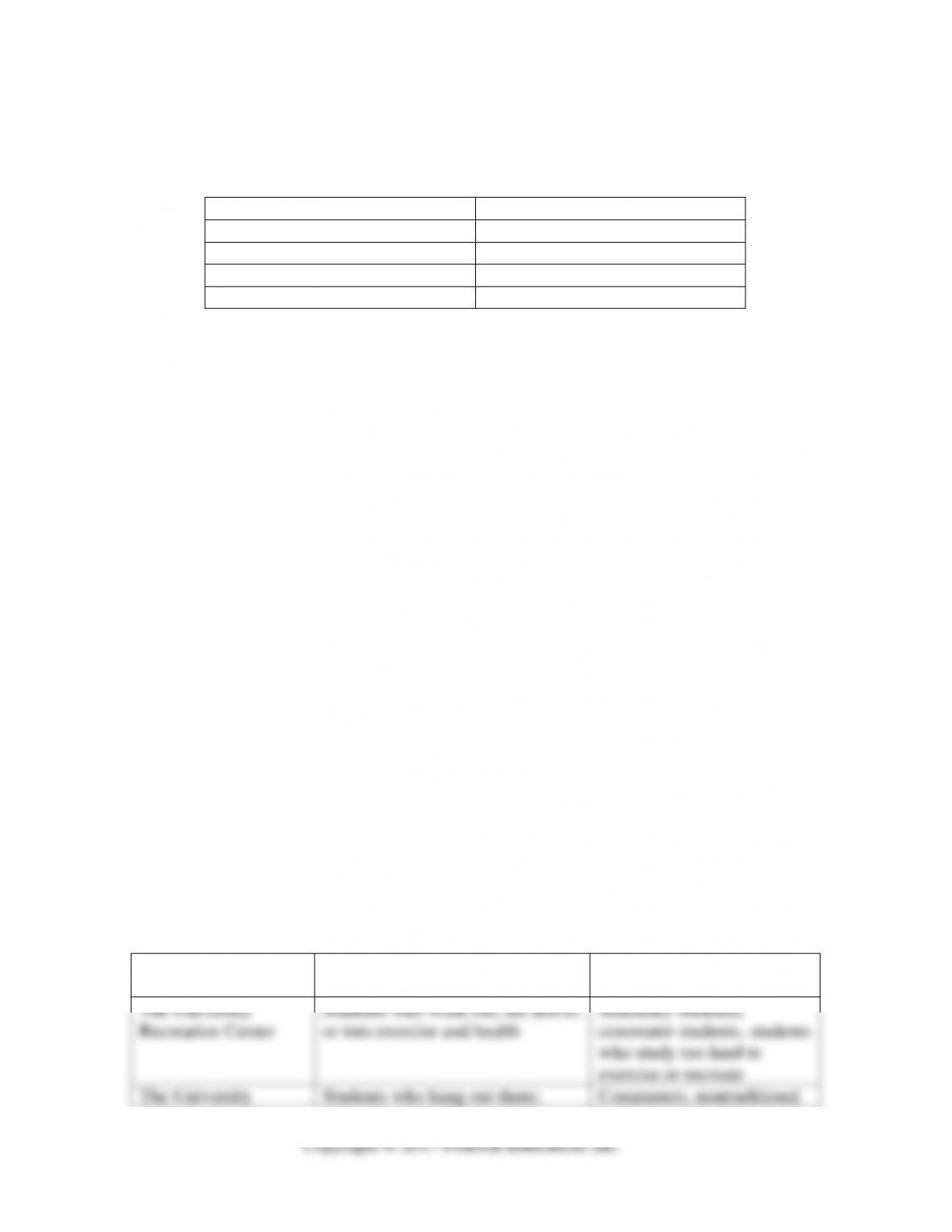
10. Here is a table the summarizes the differences between probability sampling methods
and nonprobability sampling methods:
Probability Sampling
Nonprobability Sampling
Known chance of selection
Unknown chance of selection
Takes more time
Takes less time
Higher cost
Lower cost
Can compute sample error
Cannot compute sample error
ACTIVE LEARNING EXERCISES
Are Random Numbers Really Random?
This exercise demonstrates the generation of random numbers with a computer
(Microsoft Excel). If students follow the instructions correctly, they will find that each
number from 1 to 100 has one chance out of 100 of being selected, do the random
numbers are random.
Take a Systematic Sample Using Your Telephone Book
This exercise takes students step-by-step thorough how to select a systematic sample
from a telephone book.
Assume that you expect a 50% response rate. What adjustment to in the skip interval
calculation can you make to accommodate the fact every other prospective respondent
will refuse to take part in the survey when asked?
To adjust for a 50 percent response rate, the sample size must be doubled.
Assess the Representativeness of Various Convenience Samples
Suppose the Athletic Department at your university is disappointed at student attendance
of its “minor” collegiate sports events such as wrestling, cross country, and softball. It
wants to learn why students do not attend them. Listed below are possible locations for a
convenience sample. With each one, indicate what types of students would be
overrepresented in the sample and what types would be underrepresented in the sample
versus the population of students at your university for each case.
Convenience sample
location
What students would be
overrepresented?
What students would be
underrepresented?
The University
Recreation Center
Students who work out, are active,
or into exercise and health
Sedentary students,
commuter students, students
who study too hard to
exercise or recreate
The University
Students who hang out there;
Commuters, nontraditional
Commons
those who buy food and snacks;
those who participate in the
activities at the Commons
students (such as
nighttimers), students who
do not buy food there or
participate in the activities
The Library
Students who use the Library
(typically underclasspersons and
graduate students)
Students who do not use the
Library (may be a huge
number if the Library has
many electronic services)
Physics 401
(Advanced class for
physics majors)
Students majoring in physics
All other students
ANSWERS TO END-OF-CHAPTER QUESTIONS
1. Distinguish a nonprobability from a probability sampling method. Which one is the
preferable method and why? Indicate the pros and cons associated with probability
and nonprobability sampling methods.
A probability sample is one in which members of the population have a known
2. List and describe briefly each of the probability sampling methods described in the
chapter.
3. What is meant by the term random? Explain how each of the following embodies
randomness:
With random sampling, the probability of being selected into the sample is “known”
4. In what ways is a systematic sample more efficient than a simple random sample? In
what way is systematic sampling less representative of the population than simple
random sampling?
The systematic sample’s popularity over simple random sampling is based primarily
on the “economic efficiency” that it represents, for systematic sampling can be
5. Distinguish cluster sampling from simple random sampling. How are systematic
sampling and cluster sampling related?
The basic difference between cluster sampling and simple random is the sample unit.
With cluster sampling, theoretically identical clusters are selected, while in simple
6. Differentiate one-step from two-step area sampling, and indicate when each one is
preferred.
With one-step area sampling, a few areas are selected at random, and a census is
7. What is meant by a “skewed” population? Describe a skewed population distribution
variable and provide an example.
8. What are some alternative online sampling methods? Describe each one.
The types are described below.
9. Briefly describe each of the four nonprobability sampling methods.
Review question. Students will need to find a description of each nonprobability
sampling method.
Convenience Sampling
10. Why is quota sampling often used with a convenience sampling method such as mall
intercepts?
The quota sample establishes a specific quota for various types of individuals to be
11. Provide the marketing researcher’s definitions for each of the following populations:
Each is an exercise in population definition. The definitions are listed under each
case.
a. Nest Thermostat, a company that sells a home thermostat that runs on the Internet
12. Here are four populations and a potential sample frame for each one. With each
pair, identify (1) members of the population who are not in the sample frame and (2)
sample frame items that are not part of the population. Also, for each one, would you
judge the amount of sample frame error to be acceptable or unacceptable?
Students must make judgments about sample frame error. The evaluation is provided
beneath each case.
13. A market researcher is proposing a survey for the Big Tree Country Club, a private
country club that is contemplating several changes in its layout to make the golf
course of championship caliber. The researcher is considering three different sample
designs as a way to draw a representative sample of the club’s golfers. The three
alternative designs include the following:
Assess representativeness and other issues associated with this sample problem. Be
sure to identify the sample method being contemplated in each case. Which sample
method do you recommend using and why?
14. A researcher has the task of estimating how many units of a revolutionary new high-
speed office copier machine (it does not require ink cartridges and is guaranteed not
to jam) will be purchased by business firms in Cleveland, Ohio for the upcoming
annual sales forecast. Her plan is to ask the likelihood that they will purchase the
new device, and for those who are “very likely” to purchase, she wants respondents
to estimate how many machines their company will buy. She has data to divide the
companies into small, medium, and large firms based on number of employees at the
Cleveland office.
a. What sampling plan should be used?
15. Honda USA is interested in learning what its 550 U.S. dealers think about a new
service program the carmaker provided to dealers at the beginning of last year.
Honda USA wants to know if the dealers are using the program and, if so, their likes
and dislikes about it. The carmaker does not want to survey all 550 dealers but hopes
to ensure that the results are representative of all dealers.
a. What sampling plan should be used?
16. Applebee’s Restaurants has spent several tens of thousands of dollars advertising the
restaurant during the last two years. Marketing executives want to measure what
effect the advertising has had, and they decide to measure top-of-mind awareness
(TOMA). A TOMA score for such a restaurant is the ranking a firm has as a result of
asking a representative sample of consumers in the service area to “name a non-fast-
food restaurant.” The restaurant that is named by the most persons has the top
TOMA score. It is important that Applebee’s management conduct the TOMA survey
on a representative sample in the metropolitan area.
a. What sampling plan should be used?
17. Belk has a chain of department stores across the South. Top management requires
that each store manager collect, maintain, and respond to customer complaints
(emails, letters, calls, etc.). Each store manager is supposed to keep a list of
complaints that have been received. Top management is considering establishing a
more formalized method of monitoring and evaluating the response managers give to
the complaints. They want some information that will tell them whether they need to
develop such a formalized program or whether they can leave well enough alone and
allow managers to use their discretion in handling the complaints. They want to
review a sample of these complaints and the responses to them.
a. What sampling plan should be used?
CASE SOLUTIONS
Case 9.1 Peaceful Valley Subdivision: Trouble in Suburbia
Case Objective
This case requires students to ponder various sample methods as to representativeness
and bias.
Answers to Case Questions
1. There is only one street into and out of the subdivision. The president is thinking of
paying his teenage daughter to stand at the stop light at the entrance to Peaceful
Valley next week between the hours of 7:00 and 8:30 a.m. to hand out questionnaires
to exiting drivers while they wait for the red light to change. The handouts would
include addressed, postage-paid envelopes for returns. Identify what sample method
the president would be using, list its pros and cons, and indicate how representative a
sample would result.
This is a convenience sample, using the high traffic location where cars stop for the
2.The chairperson of the Suburb Steering Committee thinks the 1,000 homeowners
whose houses are on the waterfront properties of Peaceful Lake are the best ones to
survey because they paid more for their lots, their houses are bigger, and they tend to
have lived in Peaceful Valley longer than other residents. If these 1,000 homeowners
are used for the sample, what sample method would be involved, what are its pros
and cons, and how representative a sample would result?
3.Assume that the Steering Committee chairperson’s point that the 1000 waterfront
owners are not the same as the 5000 other Peaceful Valley Subdivision homeowners
is true. How should this fact be utilized to draw a representative sample of the entire
subdivision? Identify the probability sampling method that is most appropriate, and
indicate, step-by-step, how it should be applied here.
The 1000 and 5000 households are strata – meaning that they are different groups
4.How would you select a simple random sample of those Peaceful Valley
homeowners who paid their subdivision association dues last year? What, if any,
sample bias, might result from this approach?
5. How could a two-step cluster sample be used here? Identify this sample method
and describe how it could be used here to select a representative sample of Peaceful
Valley households?
Case 9.2 Jet’s Pets
Case Objective
Jet wants to survey the approximately 10,000 families in two ZIP code areas. Of
course, he cannot survey all of them, so he must use a sample. For each of the
following possible ways of selecting a sample of the families living in several
subdivisions in two ZIP code areas: (1) identify the type of sample method; (2)
identify the sample frame; (3) indicate what, if any, sample frame error there is; and
(4) indicate the degree to which the resulting sample will be representative of all
families living in the two ZIP code areas.
Answers to Case Questions
1. Place questionnaires in veterinarian clinics located in the two ZIP code areas for pet
owners to fill out while they are waiting for the doctor to examine their pet.
2. Select every 100th name in the city telephone book; call and interview only those who
live in the two ZIP code areas.
3. Use a random number system to select a single subdivision located somewhere in the
two ZIP code areas, and then place questionnaires in the mailboxes of every home in that
selected subdivision.
4. Announce in the local newspaper a “Cutest Dog Contest” with contestants sending in
a photo and address information. Use the contestants who live in the two ZIP code areas
as the sample.
5. Go to the local animal shelter and get the addresses of the past pet adopters who live
in the two ZIP code areas. Send a mail survey to the nearest neighbor’s address for each
of the addresses obtained from the animal shelter. For example, if the adopter lives at 1
Green Street, send the mail questionnaire to the occupants at 2 Green Street.