
CHAPTER 6
QUALITATIVE RESEARCH TECHNIQUES
LEARNING OBJECTIVES
In this chapter you will learn:
6-1 To understand basic differences between quantitative and qualitative research
techniques
6-2 To learn the pros and cons of using observation as a means of gathering data
6-4 To become acquainted with ethnographic research and be aware of its strengths
6-6 To become familiar with other qualitative methods used by marketing researchers,
including in-depth interviews, protocol analysis, projective techniques, and
neuromarketing
CHAPTER OUTLINE
Quantitative, Qualitative, and Mixed Methods Research
• Quantitative research
o Research involving the administration of a set of structured questions with
predetermined response options
• Qualitative research
o Collecting, analyzing, and interpreting unstructured data by observing
what people do and say
• Mixed methods research
o Combination of qualitative and quantitative research methods with the
goal of gaining the advantages of both
Observation Techniques
• Observation methods
• Types of observation
o Direct versus indirect
o Covert versus overt

o Structured versus unstructured
o In Situ versus invented
• Appropriate Conditions for the Use of Observation
• Advantages of Observational Data
• Limitations of Observational Data
Focus Groups
• How Focus Groups Work
• Online Focus Groups
• Advantages of Focus Groups
• Disadvantages of Focus Groups
• When Should Focus Groups Be Used?
• When Should Focus Groups Not Be Used?
• Some Objectives of Focus Groups
• Operational Aspects of Traditional Focus Groups
o How many people should be in a focus group
o Who should be in the focus group
o How many focus groups should be conducted
o How should focus group participants be recruited and selected
o Where should a focus group meet
o When should the moderator become involved in the research project
o How are focus group results reported and used
o What other benefits do focus groups offer
Ethnographic Research
• Descriptive study of a group and its behavior, characteristics, and culture
• Mobile ethnography
• Netnography
Marketing Research Online Communities
• Marketing research online communities (MROCs)
Other Qualitative Research
• Techniques
o In-Depth Interviews
o Laddering
o Protocol Analysis
o Projective Techniques
▪ Word-Association test
▪ Sentence-completion test
▪ Picture test
▪ Cartoon or balloon test
▪ Role-playing activity
• Neuromarketing
o Neuroimaging

o Eye Tracking
o Facial Coding
o The Controversy
• Still More Qualitative Techniques
KEY TERMS
Quantitative research Qualitative research
Mixed methods research Observation methods
Direct observation Indirect observation
Archives Physical traces
Covert observation Overt observation
Structured observation Unstructured observation
In situ observation Invented observation
Focus groups Moderators
Focus group report Online focus group
Ethnographic research Shopalong
Mobile ethnography Netnography
Market research online communities Neuroimaging
In-depth interview Laddering
Protocol analysis Projective techniques
Word-association test Sentence-completion test
Picture test Balloon test
Role playing Eye Tracking
Neuromarketing Facial coding

Copyright © 2017 Pearson Education, Inc.
TEACHING SUGGESTIONS
1. The following comparison can be used to emphasize the differences between
qualitative and quantitative research.
Factor Qualitative Research Quantitative Research
Purpose To explore To understand
Questions Not standardized Standardized
Instrument Camera or recorder Questionnaire
Sample Size Very Small Large
Analysis Subjective Objective
Result Tentative Conclusive
2. To test students on their understanding of physical traces observation, ask them how
it can be applied in each of the following cases. Suggested applications are provided.
Case
Possible Physical Trace Research
Honda wants to know how
safe its vehicles are.
Go to automobile junk yards and determine the
severity of damage to Hondas versus other makes.
Your university health
service wants to know if
students are eating junk
food.
Search dumpsters or trash containers at dorms and in
high traffic areas on campus for junk food packages
and wrappings.
3. Students can participate in disguised observation by posing as “secret shoppers.”
Select a local retailer, restaurant, or service company, and have specific students (3 or
4. Obtain permission from a local grocery store for students to act as observers of
grocery shoppers. Students may masquerade as clerks or pretend to be shoppers
5. There are several ways to teach focus groups. Here are some suggestions.

• Ask a local research company to lend you tape recordings of a focus group that
you can play during class for students to observe.
• Arrange for a class field trip to a local focus group company that is willing to
provide a guided tour.
• Arrange for small groups of students to go to a focus group facility and observe a
live focus group in progress.
• Act as moderator and conduct a focus group in class with students. With a large
class, have the nonparticipants play the role of clients who are observing the focus
group.
• Divide the class into teams of 2-4 students and assign each team the task of
recruiting, conducting, and interpreting a focus group using other university
students as participants. Audio tape recording will be sufficient. This will require
identifying the topic and focus issues ahead of time, perhaps as a class exercise.
• A fellow marketing faculty member may have experience in focus groups,
perhaps as a moderator or a freelance consultant. He or she may be willing to
bring examples into your class.
• Some online course management systems have chat room capabilities, or you may
have experience with an online chat product. Use it with a small number of
students stationed at various locations on PCs to illustrate how an online focus
group works.
6. As evidenced in the section on “online focus groups,” this is an area of rapid growth
and innovative new approaches. Have selected students research the new forms of
7. Thomas Greenbaum has many articles and books on focus groups. Instructors can
8. The sentence completion test and the balloon test are amenable to class activity.
Select a semi-sensitive topic that students can relate to such as dating, spending
money, or cutting classes. Use class discussion to have students volunteer sentence
stems, or if artistic students are present, have them attempt to make line drawings for
balloon tests. Select the best examples, and administer them in a large class such as a
principles of marketing class. Bring the raw data to class for students to interpret.
Here are some sentence completion stems for college students’ use of credit
cards.

For college students, credit cards
are______________________________________________________________.
College students use credit cards
to_______________________________________________________________.
When a college freshman gets a new credit card application,
he/she____________________________________________________________.
When a college student reaches the limit of his/her credit card,
he/she____________________________________________________________.
When a college senior gets a new credit card application,
he/she____________________________________________________________.
If parents of college students learned about their children’s credit card situations,
they would________________________________________________________.
9. Physiological measure equipment is sometimes used in psychology experiments. If
you have a colleague in this area, he or she may be willing to bring examples to your
class and describe to students how the instruments are used. Subsequent class
discussion can take place on the appropriateness of physiological measures in
marketing research.
10. There are occasional qualitative research articles in the Journal of Consumer
Research, and a few have appeared in the Journal of Marketing Research.
Qualitative research papers can also be found in recent volumes of Advances in
Consumer Research, which is the proceedings of the annual meetings of the
Association for Consumer Research. Select one that is content-based and present it to
the class. Lead class discussion to help students comprehend why qualitative
research was necessary to research this topic. Alternatively, select an expository
method-based article to illustrate that the method is not haphazard. For instance,
explain what documentation is necessary, how validity is assessed, the role of
member checks, and so on.
ANSWERS TO END-OF-CHAPTER QUESTIONS
1. Define quantitative research. Define qualitative research. List the differences
between these two research methods. What is mixed methods research?

Copyright © 2017 Pearson Education, Inc.
representative sample of the population, and a formalized procedure for gathering
data. The purpose of quantitative research is very specific, and the manager and
researcher have agreed that precise information is needed. Data format and sources
are clear and well defined, and the presentation of the data that has been gathered
follows an orderly procedure, which is largely numerical in nature. Qualitative
research, in contrast, involves collecting, analyzing, and interpreting data by
observing what people do and say. Observations and statements are in a qualitative
or nonstandardized form. Because of this fact, qualitative data can be quantified but
only after a translation process has taken place.
Mixed methods research is the combination of qualitative and quantitative research
methods in order to gain the advantages of both.
2. What is meant by an “observation technique”? What is observed, and why is it
recorded?
3. Indicate why covert observation would be appropriate for a study on how parents
discipline their children when dining out.
With covert observation, the subject is unaware that he/she is being observed. Covert
4. Describe a traditional focus group.
5. Describe two formats of online focus groups.
The online focus group, a form of nontraditional focus group, is one in which the
Copyright © 2017 Pearson Education, Inc.
group company.
A variation of the online focus group is one that is conducted in a traditional setting,
but the client watches online.
6. Describe at least three different uses of focus groups.
The chapter lists four uses. They are: (1) to generate ideas, such as in product
7. How are focus group participants recruited, and what is a common problem
associated with this recruitment?
8. Should the members of a focus group be similar or dissimilar? Why?
It is generally believed that the best focus groups are ones in which the participants
9. Describe what a focus group setting looks like and how a focus group would take
place in such a setting.
A focus group facility is a set of rooms especially designed to conduct focus groups
Copyright © 2017 Pearson Education, Inc.
Focus group participants sit around the large table with a focus group moderator at
the head of the table. The client may sit on the other side of the one-way mirror and
view the focus group session.
10. Should the marketing manager client be a focus group moderator? Why or why not?
A focus group moderator is a person who conducts the entire session and guides the
11. Indicate how a focus group moderator should handle each of the following cases: (a)
A participant is loud and dominates the conversation; (b) a participant is obviously
suffering from a cold and goes into coughing fits every few minutes; (c) two
participants who, it turns out, are acquaintances persist in a private conversation
about their children; and (d) the only minority representative participant in the focus
group looks very uncomfortable with the group and fails to make any comments.
Here are the suggested ways to handle these cases.
Problem case
Suggested way for the moderator to handle it
(a) A participant is loud and
dominates the conversation
Avoid eye contact with the person
Ask others by name to respond before the
offensive person can
Tell the person to let others have a say
(b) a participant is obviously
suffering from a cold and goes
into coughing fits every few
minutes;
Offer a cough drop, life saver, or chewing gum
to the person
Make sure the person has a glass of water
handy
Excuse the person to go outside until the
coughing spell subsides
(c) two participants who, it turns
out, are acquaintances, persist in
a private conversation about their
children
Separate the two by placing them at opposite
ends of the table
Give them a “dirty” look
Ask them to postpone their chatting until the
break
Remind them that the session is being tape-
recorded and side conversation will garble it
(d) the only minority
representative participant in the
focus group looks very
uncomfortable with the group and
fails to make any comments
Attempt to bring the person into the
conversation by:
Making eye contact
Smiling and nodding at the person
Asking him or her direct questions
12. What should be included in a report that summarizes the findings of a focus group?
13. Indicate the advantages and disadvantages of client interaction in the design and
execution of a focus group study.
Client involvement in the design of a focus group will help the researcher and/or
moderator better understand the problem better. It will also ensure that the
14. What is ethnographic research? Discuss how a marketing researcher could get into
an ethically sensitive situation using the technique.
Ethnographic research is used in marketing to gain a deeper and more comprehensive
understanding of the consumer and consumer behavior by studying the behavior
Copyright © 2017 Pearson Education, Inc.
Because ethnographic research may include shopalongs, or being in someone’s home,
the researcher may be exposed to various degrees of sensitive information, creating
the possibility of being placed in an ethically challenging situation.
15. What is mobile ethnography? List three types of consumption activities that might be
studied using mobile ethnography.
16. What is protocol analysis?
Protocol analysis involves placing people in a decision-making situation and to
17. What is meant by the term projective, as in projective techniques?
18. Describe: (a) sentence completion, (b) word association, and (c) balloon test. Create
one of each of these that might be used to test the reactions of parents whose children
are bed wetters to an absorbent underpants that their children would wear under
their nightclothes.
With a sentence completion test, respondents are asked to complete, in their own
words, a set of incomplete sentences. The notion here is that the respondent will
Here are some possible brand names to which informants would be asked to respond.
Brand name Association that comes to mind
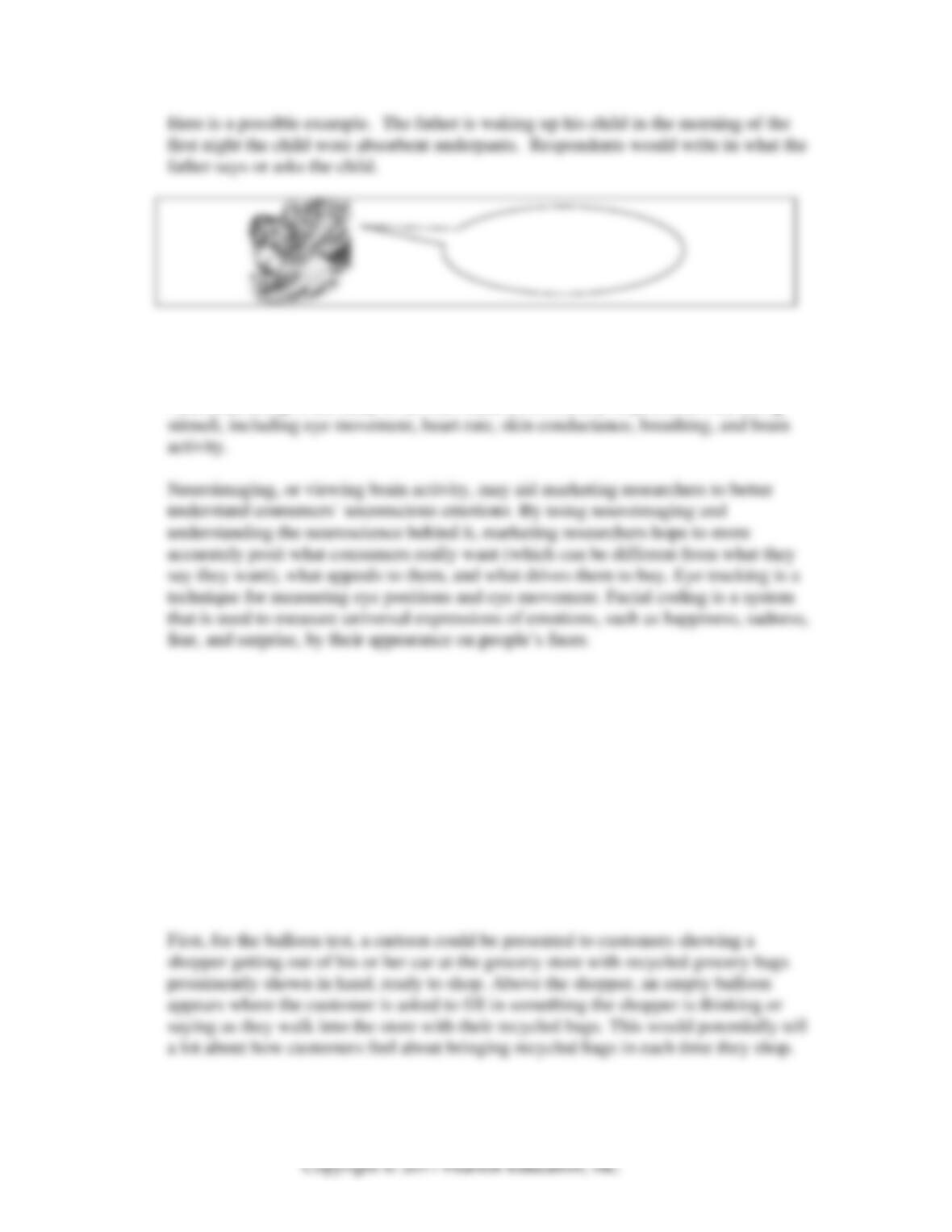
Here is a possible example. The father is waking up his child in the morning of the
first night the child wore absorbent underpants. Respondents would write in what the
father says or asks the child.
19. What is neuromarketing? Give examples of three techniques.
Neuromarketing is the study of an individual’s involuntary responses to marketing
20. Associated Grocery Stores (AGS) has always used paper bags for sacking groceries
in its chain of retail supermarkets. Management has noticed that some competitors
are offering reusable bags to their customers. AGS management isn’t certain just how
strongly consumers in its markets feel about having to bring the reusable bags every
time they visit the supermarket. Select two projective techniques. First, defend your
use of a projective technique. Second, describe in detail how your two chosen
techniques would be applied to this research problem.
Two potential choices are the balloon test and role playing. Both of these projective
techniques could work quite well in this situation.

Copyright © 2017 Pearson Education, Inc.
Second, for the role playing activity, customers could be asked to respond as a friend
of a shopper who is returning to the grocery store with recycled bags in toe. The
customers could be asked to freely comment to their friend on what they think about
any inconvenience associated with them having to bring back bags versus the benefits
to Earth that recycling offer. This, too, would produce important information on how
customers feel about the recycled bag program.
21. Your university is considering letting an apartment management company build an
apartment complex on campus. To save money, the company proposes to build a
common cooking area for every four apartments. This area would be equipped with
an oven, stove-top burners, microwave oven, sink, food preparation area, garbage
disposal, and individual mini-refrigerators with locks on them for each apartment.
Two students would live in each apartment, so eight students would use the common
cooking area. You volunteer to conduct focus groups with students to determine their
reactions to this concept and to brainstorm suggestions for improvements. Prepare
the topics list you would have as a guide in your role as moderator.
Note: Some universities have partnered with private firms or otherwise to build
apartment complexes. If yours has done so, this question might be altered to
conducting focus groups with students who live in them to gain insight on problems
and improvements.

Reactions to the apartmatory concept. (It is important to ask students their reactions to
the concept because it is novel and will require them to adapt to it.)
CASE SOLUTIONS
Case 6.1 The College Experience
Case Objective
This case interrogates students’ knowledge and understanding of the uses of focus
groups.
Answers to Case Questions
The following answers were provided by case writer, Daniel Purdy.
1. Do you think focus groups were the appropriate research method in this case, given
the research objectives? What other type(s) of research might provide useful data?
Yes, focus group research is appropriate in this situation. The research objective is
to identify negative and positive attitudes about the College and develop ways of
2. Evaluate the questions posed by the moderator in light of the research
objectives/questions: (a) Are any of them leading or biasing in any way? (b) Can you
think of any additional questions that could or should be included?

Copyright © 2017 Pearson Education, Inc.
Second, specific follow-up questions that addressed concerns other than advising and
course relevance could also be useful: (1) What do you think about the career
placement services offered in the business school? (2) How do you feel about the
current course registration procedure – do you have any problems getting into the
courses you want?
3. Examine the findings. How is the college perceived? What are its apparent strengths
and weaknesses?
4. Can we generalized these findings to all of the college’s students? Why or why not?
No. Focus group research is exploratory, qualitative research that consists of a
Case 6.2 Supplemental Integrated Case: Auto Concepts
Case Objective
This exercise requires students to consider and recommend a qualitative research
technique to the Auto Concepts integrated case. The objective is to gain some
information that will assist in the advertising strategies to be used for the new models.
Answers to Case Questions
1. What technique identified in this chapter would help Ashley Roberts with this
advertising task? Why?