
CHAPTER 3
THE MARKETING RESEARCH PROCESS AND DEFINING THE
PROBLEM AND RESEARCH OBJECTIVES
LEARNING OBJECTIVES
In this chapter you will learn:
3-1 To know the steps of the marketing research process
3-2 To know the importance and process of defining the problem
3-3 To learn how to formulate research objectives
3-4 To know what an action standard is and why it can be helpful
3-5 To learn the components of the marketing research proposal
CHAPTER OUTLINE
The Marketing Research Process
The 11-Step Process
• Using the steps as a road map for planning a research project. Creates an
overview of the process and provides a procedure for completion
o Step 1: Establish the Need for Marketing Research
o Step 2: Define the Problem—Stating the Decision Alternatives
o Step 3: Establish Research Objectives
o Step 4: Determine Research Design
o Step 5: Identify Information Types and Sources
o Step 6: Determine Methods of Accessing Data
o Step 7: Design Data Collection Forms
o Step 8: Determine Sample Plan and Size

o Step 9: Collect Data
o Step 10: Analyze Data
o Step 11: Prepare and Present the Final Research Report
• Caveats to a Step-by-Step Process
o Not all studies use all 11 steps
o Steps are not always followed in order
• Step 1: Establish the Need for Marketing Research
o The information is already available
o The timing is wrong to conduct marketing research
o Costs outweigh the value of marketing research
• Step 2: Define The Problem
o Develop a problem statement
• Step 3: Establish Research Objective
o Tells exactly what information needs to be gathered and analyzed
• Step 4: Determine Research Design
o Exploratory
o Descriptive
o Causal
• Step 5: Identify Information Types and Sources
o Primary
o Secondary
• Step 6: Determine Methods of Accessing Data
• Step 7: Design Data Collection Forms

o Questionnaires
o Focus groups
• Step 8: Determine the Sample Plan and Size
o Population
o Sample
o Sample plans
o Sample frame
o Sample size
• Step 9: Collect Data
o Validation
o Field services firms
• Step 10: Analyze Data
o Data analysis tools
• Step 11: Prepare and Present the Final Research Report
o Clearly communicates finding
Defining The Problem
• Recognize the Problem
• Understand the Background of the Problem
o Symptoms
• Conduct a Situation Analysis
• Clarify the Symptoms

• Determine the Probable Cause of the Symptom
• Determine Alternative Decisions
Determine What Decisions Need to Be Made
• Specify Decision Alternative
• Weigh the Alternative
o Consequences
o Assumptions
Identify What Additional Information Is Needed
• Information states
• Information gaps
Inventory the Current Information State
Identify the Information Gaps
Formulate the Problem Statement
Research Objectives
• Using Hypotheses
• Defining Constructs
• What is the Unit of Measurement
• What is the Proper Frame of Reference
Action Standards
Impediments to Problem Definition
The Marketing Research Proposal
• Marketing research proposal
• Invitation to bid

Copyright © 2017 Pearson Education, Inc.
• Request for proposal
• Elements of the Proposal
o Statement of the problem
o Research objective
o Research method
o Statement of deliverables
o Cost
o Timetable
Ethical Issues and the Research Proposal
KEY TERMS
11 Steps in the marketing Situation analysis
research process Invitations to bid (ITBs)
Requests for proposals (RFPs) Decision alternatives
Consequences Assumptions
Information state Information gaps
TEACHING SUGGESTIONS

1. Students will have some difficulty relating to the differences between managers and
researchers. Instructors may wish to use the table in our earlier editions (e.g., the 4th
edition) as a teaching aid. (We eliminated the table in the 5th edition to conserve
space.)
2. If you have had a recent consulting experience with an interesting problem definition
dialogue, use it as an example in class. Consider “acting out” the roles of the
manager and the researcher in a question and answer format. Alternatively, you can
have the class play the role of the researcher, and you play the manager. Exaggerate
your manager role by giving cryptic answers and going into detail on irrelevant topics
to emphasize that the researcher must be a persistent detective during the problem
definition stage.
3. A slightly more risky variation of the dialogue is to actually have a manager come to
the class with a marketing problem. You and/or the class play the role of the
4. We find that students often fail to make the transition from solving marketing
problems (which is the orientation of all of their marketing courses to date) to
thinking about providing information to help a marketing manager solve a problem
(which is the purpose of marketing research). An in-class exercise that can help
alleviate this problem is to pose a topic question such as “Should (insert company
name) cut its prices by 20 percent?”
Some students will immediately rush to the recommendation to cut prices, but others
will want to have more information. Class brainstorming can identify the needed
information. When 10 to12 information topics are noted and agreed upon by the
majority of the class as information needs, the instructor can then point out that
marketing research activities are necessary to gather this information. That is, the
researcher’s task is to gather accurate and timely information, not make the decision.
5. The apartment complex example that is continued throughout the chapter is
specifically chosen as one that students can relate to. Most college students live off
campus, so they have had experience with apartment searches, and while they may
not live in student-oriented apartment complexes, they should be able to relate to this
concept. Even those who live on campus should have little difficulty relating to the
competition that goes on among apartment complexes that are targeting the students
of the nearby university or college. Instructors are encouraged to use the University
Estates example in class as an example. For instance, go over this example and make
certain that students understand how the list of potential causes was narrowed down
to probable causes.

6. Class discussion can be generated by presenting students with a problem situation and
having them work through the step where they specify actions that may solve the
problem plus identifying the consequences of each action. Here are some scenarios.
• Perrier notices that it is losing market share to fruit-flavored sparkling water
competitors
• The school newspaper finds it increasingly difficult to sell advertising space
• The American Automobile Association thinks that carjacking is the number one
fear of its members
7. The concepts of assumptions, information states, and information gaps are somewhat
abstract. It is useful to provide students with concrete examples. One strategy is to
identify a student who has a management capacity or who has knowledge of a
company, such as a family business. Ask the student what he/she thinks the company
can do to perform better. Then query the student to determine assumptions, certainty
of these assumptions, and where there is uncertainty.
8. The concept of an operational definition is not easy for students to understand this
early in the course. Instructors may wish to use example operational definitions for
commonly used constructs. The point of the discussion is that researchers are
thinking way ahead of the problem definition and about the actual research methods
including how the questions will appear on the questionnaire and how the results will
be reported. It illustrates how much difference exists between the orientation of the
researcher and the manager.
A ‘what–if” exercise that is useful to emphasize these differences is to take two or
three of the constructs and say, for example:
• “What if the researcher found that 80 percent of the respondents are unfamiliar
with the manager’s brand?”
• “What if the researcher found that most respondents did remember a recent ad for
the product?”
The point is that the researcher would stop at reporting these findings, but the
manager would go to work on them.
9. The chapter describes generically what is in a research proposal. If you have a
research proposal with which you are familiar, such as a consulting project, consider
using it as an example because students will relate to a specific example.

colleague in economics or real estate who has done a lot of grant proposal writing.
This is analogous to responding to an ITB and ties in with the ITB/RFP aspects of the
chapter. Ask your colleague to talk to the class about grant proposals, particularly the
(low) success percentage. If you are lucky, he or she may also note some of the
political aspects of grant awards.
ACTIVE LEARNING EXERCISES
Want to see some actual RFP’s and ITB’s?
You can find RFPs and ITBs on the Internet, a very effective medium for broadcasting
RFPs/ITBs. Supplier firms search the Web for postings of these requests and often use the
Web to reply. Go to advanced search at www.google.com, and at “with at least one of the
words,” enter ITB RFP. At “with the exact phrases,” enter “marketing research.” You
will get many hits, and that is OK. Exploring, you will find actual ITBs and RFPs. You
will also find some sites designed to help you write an effective ITB or RFP.
Now let’s take a look at www.marketresearchfirms.com. This takes you to a website that
serves as a portal allowing buyer firms to place their RFPs on the website and research
firms to review those RFPs and submit a proposal. Take a quick look at the free RFP
service (top right) of the web page. Note that the form allows a buyer firm to specify the
type of research firms it wishes to respond to the RFP.
REVIEW QUESTIONS/APPLICATIONS
1. What are the steps in the marketing research process?
Copyright © 2017 Pearson Education, Inc.
7) Design data-collection forms
8) Determine the sample plan and size
9) Collect data
10) Analyze data
11) Prepare and present the final research report
2. Are all 11 steps in the marketing research process used at all times? Why or why not?
3. Use an example to illustrate that the steps in the marketing research process are not
always taken in sequence.
4. Explain why firms may not have a need for marketing research.
5. Why is defining the problem the most important step in the marketing research
process?
6. Discuss why defining the problem is really stating the decision alternatives.
7. Explain why research objectives differ from the definition of the problem.
Defining the problem creates a need to make a decision, which requires decision
8. What is meant by the problem?
9. What is the research objective?
10. What are the two sources of marketing problems?
11. Explain how managers should recognize they have a problem.
Unless managers have a control system they will not likely identify problems arising
12. What is the role of symptoms in problem recognition?
13. What is the role of the researcher when management has already defined the
problem?
14. What is a situation analysis, and when would it likely be used when defining the
problem?
15. What is the role of the researcher when management has not already defined the
problem?
16. What is meant by the researcher validating the symptoms?
17. What is the difference between “all possible causes” and “ probable causes”?
18. What is meant by consequences of the decision alternatives?
Consequences are the results of marketing actions.
19. Explain how assumptions play a role in the problem definition process.
20. Explain the information state when there are information gaps.
21. What is needed to close information gaps?
22. What is the role of a hypothesis in defining the problem?
23. What are some relevant factors in determining research objectives?
The factors are:
24. What role do constructs play in the problem definition/research objectives process?
25. What is an operational definition and where would it likely be used?
26. What is an action standard?
27. Discuss impediments to problem definition.
28. What are the elements of the marketing research proposal?
The components are:
Here is a detailed description.
Function
Description
Defines the marketing management
problem
The problem statement identifies: (1) the
client company and principals, (2)
symptoms, (3) possible causes of these
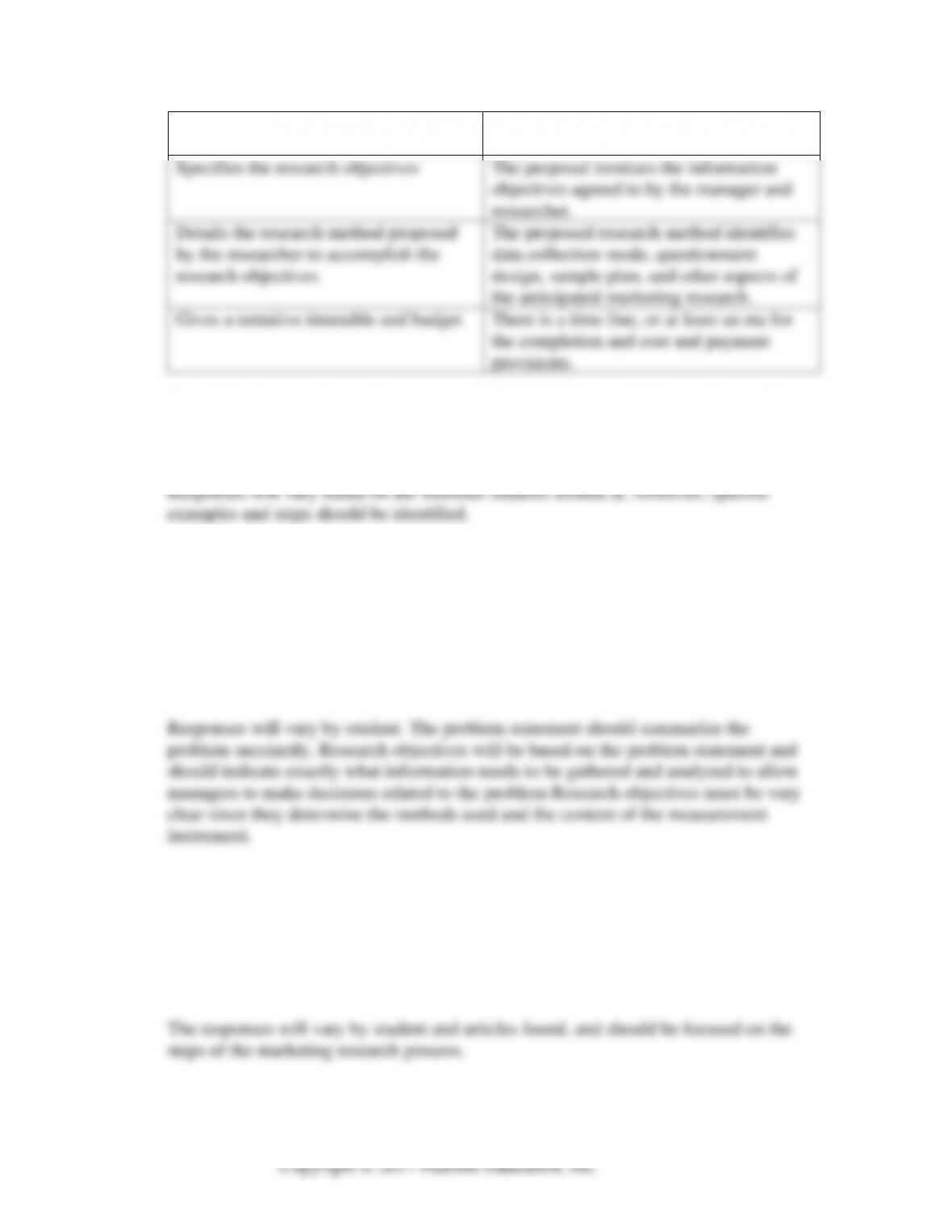
symptoms, and (4) anticipated uses of the
research.
Specifies the research objectives
The proposal itemizes the information
objectives agreed to by the manager and
researcher.
Details the research method proposed
by the researcher to accomplish the
research objectives
The proposed research method identifies
data collection mode, questionnaire
design, sample plan, and other aspects of
the anticipated marketing research.
Gives a tentative timetable and budget
There is a time line, or at least an eta for
the completion and cost and payment
provisions.
29. Search the Internet for marketing research firms. Look through their websites. Can
you identify examples in their presentations that relate to steps in the research
process?
30. Formulate a problem statement and research objectives for the following situations:
a. Zulily wants to investigate whether it should allow returns on purchases.
b. Starbucks wants to examine whether or not it should charge more for its
Frappuccinos.
c. Ikea wants to investigate how people use their home offices.
d. Michael Kors wants to explore how it can sustain a reputation as a premium
brand.
31. Go to your library’s online databases and look for examples of firms conducting a
marketing research study. There are many examples reported in periodicals such as
Advertising Age, Marketing News, Business Week, and Forbes. Typically, these
articles will mention a few details of the research project itself. Identify as many of
the steps in the marketing research process as possible that are referred to in the
articles you find.
32. Observe a business in your community. Examine what it does, what products or
services it provides, how it prices and promotes its products and services, and other
aspects of the business. If you managed the business, would you have conducted
research to determine the firm’s products, design, features, prices, promotion, and so
on? If you decide you would not have conducted marketing research in a given area,
explain why.
CASE SOLUTIONS
Case 3.1 Golf Technologies, Inc.
Case Objective
This case presents students with a problem definition situation and requires them to solve
it.
Answers to Case Questions
1. Assuming Pennick agrees with his staff on the choice of McIlroy or Watson, what now
is Pennick’s decision in terms of decision alternatives?
Pennick must determine that hiring either McIlroy or Watson will make enough of a
2. Assuming Pennick is not confident in his assumptions about the consequences of the
outcomes associated with your decision alternative, what should Pennick consider
doing?
Copyright © 2017 Pearson Education, Inc.
gaps. Assessing the information state, in this case, might include determining whether
or not he has enough information and the correct information on driver technologies,
successes/failures of other companies in similar situations, and public opinions of
McIlroy and/or Watson. Identifying information gaps might include some of the same
questions.
3. Should Pennick decide to conduct marketing research, write the research objective.
Case 3.2 Integrated Case: Auto Concepts
Case Objective
This case will help students to understand how to define the problem and develop a list of
research objectives.
Answers to Case Questions
1. State the problems.
The three problems can be posed as the following questions.
How many of the various hybrid vehicles under consideration for development will be
purchased?
2. Write the research objective for one of your problems defined in your answer to the
first question.
c. Hybrid compact-size autos with moderately high mpg ratings?
2. What are consumer preferences and intentions for various types and combinations
of fuel-efficient automobiles?
The research objectives for “Can we identify different types of buyers who will buy the
various hybrid vehicles under consideration for development?”
What are the unique media habits of those who prefer each of the various the new hybrid
vehicle types?